Seminar | The Uses of Antiquity in European Art, 1300–1800
The following announcement may be of interest for full-time faculty who regularly teach art history at institutions affiliated with the Council of Independent College (there are over 600 member schools). While addressing the eighteenth century, the seminar will focus on previous periods; I imagine it’s ideally suited for dix-huitièmistes who find themselves teaching late medieval and Renaissance courses. Up to 20 individuals will be selected. Details are available from the brochure. -CH
◊ ◊ ◊ ◊ ◊
The Uses of Antiquity: A Seminar on Teaching Pre-Modern European Art in Context
Smart Museum of Art, University of Chicago, 13–18 July 2014
Nominations due by 2 December 2013
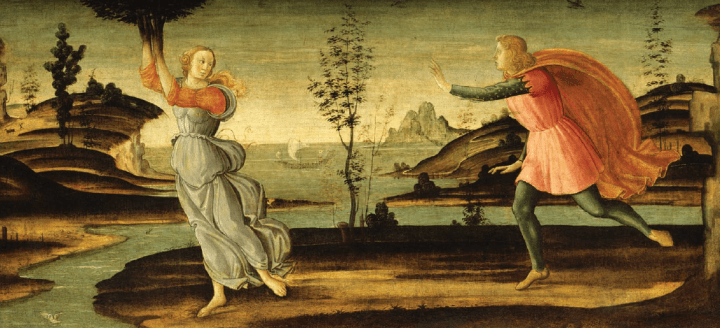
Daphne Fleeing from Apollo, ca. 1500
(Chicago: Smart Museum of Art)
◊ ◊ ◊ ◊ ◊
This seminar will be led by Rebecca Zorach, professor of art history and the college at the University of Chicago, and will be held at the University of Chicago’s Smart Museum of Art. It will take as its starting point European objects spanning the years 1300–1800 at the Smart Museum and participants will have the chance to examine prints and rare printed books in the Regenstein Library’s Special Collections Research Center, principally the very large collection of the Speculum Romanae Magnificentiae and related prints after Roman monuments and antiquities, considering the role of prints, books, and other small objects in disseminating and popularizing classical styles and imagery. Moving beyond the European early modern period, the seminar also will visit other local sites—the Oriental Institute, campus and neighborhood murals, and buildings such as the nearby Museum of Science and Industry—to think about how participants can use their own local resources creatively to discuss with students ways in which artists, architects, patrons, and others have understood and reinterpreted the past. The seminar will examine recent and older scholarship on the uses of the past and draw on the expertise and teaching experience of participants. For many of our students, differences between an ancient Greek temple and a Renaissance church (or a 19th-century Beaux-Arts museum, for that matter) barely register. But the benefits of teasing out the nuances of
references and associations go beyond awareness of the chronology of style. Pedagogical discussions will address close looking, the relationship of texts to objects, and ways faculty members can help students think critically about the texture of history and the practices and decisions of artists.
 Zorach teaches late medieval and Renaissance art, primarily French and Italian; gender studies and critical theory; print culture and technology; and contemporary activist art. Her books include The Passionate Triangle (2011) and Blood, Milk, Ink, Gold: Abundance and Excess in the French Renaissance (which received the Society for the Study of Early Modern Women 2005 Book Award), both published by the University of Chicago Press. In addition, she has created catalogues for several exhibitions, including The Virtual Tourist in Renaissance Rome: Printing and Collecting the Speculum Romanae Magnificentiae produced in conjunction with The Speculum Romanae Magnificentiae Digital Collection, and Paper Museums: The Reproductive Print in Europe 1500–1800, co-edited with Elizabeth Rodini.










 Enfilade
leave a comment