Study Day | Art, Animals, and Politics at Knowsley Hall
From the conference programme:
Art, Animals, and Politics: Knowsley and The Earls of Derby
Knowsley Hall, Merseyside, 9 October 2013
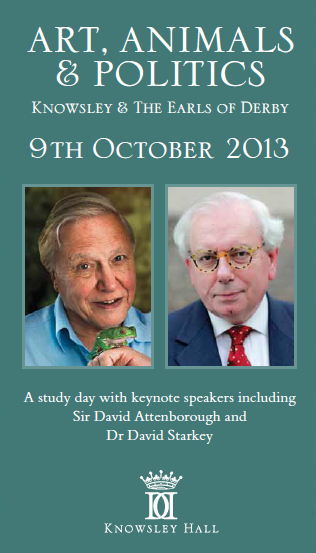 Historians, art historians and natural historians will be presenting exciting new research on three of the outstanding legacies of the Earls of Derby and the Stanley family: the art collection, the natural history library and the political archive. Emphasis will be also be placed on the family’s considerable historical and social influence in the north-west of England, as well as their political impact on the national and international stages, notably throughout the 18th and 19th centuries and the first half of the 20th century. For more information or to register, please email events@knowsley.com.
◊ ◊ ◊ ◊ ◊
Keynote Address
David Starkey, The political and cultural significance of Lady Margaret Beaufort, Countess of Richmond and Derby
Session 1: Art
· Elspeth Graham (Liverpool John Moores University), The Shakespearean stage: Prescot, Lathom and Knowsley
· Richard Stephens (University of York), The 10th Earl as a collector of old master paintings and patron of the arts at Knowsley during the 1720s
· Jonny Yarker (Trinity College, University of Cambridge), Hamlet Winstanley as an artist, copyist and art-agent for the 10th Earl
· Xanthe Brooke (Walker Art Gallery, National Museums Liverpool), Aspects of the old master picture collection at Knowsley during the 18th century
· Gill Perry (Open University), The image of Eliza Farren, Georgian comic actress and Countess of Derby
Session 2: Animals and Edward Lear
· David Attenborough, Edward Lear’s natural history watercolours and prints for the 13th Earl
· Colin Harrison (Ashmolean Museum, University of Oxford), Edward Lear’s landscape watercolours in the Derby Collection
Session 3: Politics
· Angus Hawkins (University of Oxford), The forgotten Prime Minister: The 14th Earl Douglas Hurd, Lord Hurd of Westwell: The 15th Earl’s career as Foreign Secretary
· Bendor Grosvenor (Philip Mould Ltd), The Eastern Question and the 15th Earl’s foreign policy
· Jennifer Davey (University of East Anglia), The Invisible Politician: The political career of the 15th Countess of Derby
Six New Acquisitions at the Meadows Museum
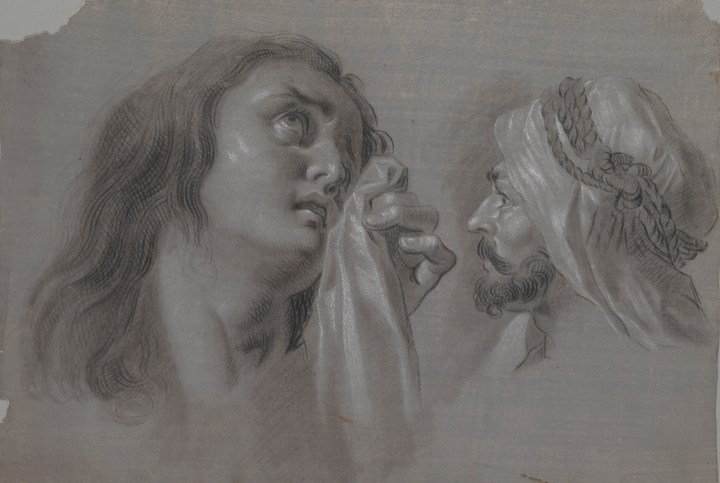
Zacarías González Velázquez, Mary Magdalene and Head of a Moor,
1793. Black chalk, wash and white chalk highlights on grey
tinted paper (Dallas: Meadows Museum, SMU)
◊ ◊ ◊ ◊ ◊
Press release (13 September 2013) from SMU’s Meadows Museum:
Southern Methodist University’s Meadows Museum announces the acquisition of six new paintings and drawings, including important works by influential Spanish artists Alonso Cano, Miguel Jacinto Meléndez, and Juan de Valdés Leal.
“We are thrilled to add six extraordinary works by artists who are so central to the history of Spanish art,” said Mark A. Roglán, the Linda P. and William A. Custard Director of the Meadows Museum and Centennial Chair, Meadows School of the Arts, SMU. “We are particularly excited to acquire such exquisite paintings by Cano and Meléndez as the first examples of works by these two prominent artists to enter the Meadows’ collection.”
The six new works are Alonso Cano’s painting Christ Child (c. 1636–38); pendant paintings by Miguel Jacinto Meléndez, Portraits of Philip V, King of Spain, and his first wife, María Luisa Gabriela of Savoy (c. 1701–03); a sanguine and black chalk drawing by Juan de Valdés Leal, Apparition of Christ to Saint Ignatius on his Way to Rome (c. 1662); a chalk drawing by Zacarías González Velázquez, Mary Magdalene and Head of a Moor (1793); and a pencil drawing by Antonio Carnicero, María Luisa of Parma, Queen of Spain (1789).
“As one of the most comprehensive museums of Spanish art in the world, the Meadows is constantly growing. These works will greatly enhance and help complete the Museum’s distinguished permanent collection,” said Linda Custard, chair of the Meadows Museum Advisory Board.
Earlier this year, the Meadows announced nine significant acquisitions, including five early 20th-century Spanish paintings from the Coleman Collection; a small oil painting by Joaquín Sorolla y Bastida (1904 or 1905); a miniature portrait attributed to Alonso Sánchez Coello (c. 1580), a terracotta sculpture by Juan Alonso Villabrille y Ron (c. 1715); and The Stewart Album, an anthology of cartes de visite, drawings and correspondence compiled by renowned American collector and expatriate William Hood Stewart during the latter half of the 19th century.
Together, these recent additions mark a milestone expansion of the Museum’s premier permanent collection of Spanish art that will be featured under the banner “Launching the Next 50 Years: Continuing the Legacy of Collecting at the Meadows Museum.” The Museum officially celebrates its 50th anniversary in April 2015.
“This has become a landmark year of acquisitions for the Meadows,” said Roglán. “Not only is it remarkable to be adding such extraordinary works by so many artists during a single year, but the breadth and variety of the acquisitions is tremendous — the new paintings, sculpture and drawings range from the 16th century to the 20th century.”
◊ ◊ ◊ ◊ ◊
Alonso Cano, Christ Child (c. 1636–38)

Alonso Cano, Christ Child (Ego dormio, et cor meum vigilat), c. 1628–29. Oil on panel (Dallas: Meadows Museum, SMU)
The exquisite oil painting Christ Child (Ego dormio, et cor meum vigilat) is the first work by the noted Sevillian artist Alonso Cano (1601–1667) to be acquired by the Meadows Museum, and the first time the painting has come to light in some 200 years. Dated to 1636–38, the work is thought to be the tabernacle door for the altarpiece of Saint Theresa of Ávila originally in the church of the former Carmelite monastery of San Alberto de Sicilia in Seville, Spain. The altarpiece was dismantled in the early 1800s, and the painting’s discovery provides new clues into the history of the altarpiece ensemble, of which only two other works are known to exist.
“This is a unique and special work by a very influential Spanish artist,” said Iraida Rodríguez-Negrón, the Meadows/Kress/Prado Curatorial Fellow who conducted extensive research on the history behind Cano’s Christ Child. “Most tabernacle doors are either lost or still located in churches, and the quality of this Cano painting is magnificent.”
Funding for the acquisition of Cano’s Christ Child was generously provided by Friends and Supporters of the Meadows Museum and the Meadows Museum Acquisition Fund.
Miguel Jacinto Meléndez, Portraits of Philip V, King of Spain, and his first wife, María Luisa Gabriela of
Savoy (c. 1701–03)

Miguel Jacinto Meléndez, Portrait of Philip V, King of Spain, c. 1701–03. Oil on copper (Dallas: Meadows Museum, SMU)
Miguel Jacinto Meléndez’s previously unknown oil paintings on copper, Portraits of Philip V, King of Spain, and his first wife, María Luisa Gabriela of Savoy, date to between 1701 and 1703, before he officially began his long career as Philip V’s court painter. The works are now recognized as the earliest known likenesses of the monarchs to be painted by the artist, and they are also the first examples of work by Meléndez (1679–1734) to enter the Meadows Collection.
Although Meléndez painted the two portraits when he was only in his early 20s, the works show the technical mastery and exquisite delicacy that made him one of the greatest Spanish portraitists of the early 18th century. The paintings were previously owned by Lord Mowbray and Stourton and his wife, Jane de Yarburgh-Bateson, and displayed at Heslington Hall in Yorkshire, England and Marcus House in Angus, Scotland.
Funding for this acquisition was generously provided by Richard and Gwen Irwin and the McDermott Foundation.
Juan de Valdés Leal, Apparition of Christ to Saint
Ignatius on his Way to Rome (c. 1662)

Miguel Jacinto Meléndez, Portrait of María Luisa Gabriela of Savoy, c. 1701–03. Oil on copper
(Dallas: Meadows Museum, SMU)
This extremely rare, unpublished drawing by Sevillian artist Juan de Valdés Leal (1622–1690) is a preparatory work for his Jesuit painting series depicting scenes from the life of St. Ignatius of Loyola. The Apparition of Christ to Saint Ignatius on his Way to Rome corresponds to the fourth in the series of at least fifteen canvases commissioned by the Jesuits of Seville for the Cloister of La Casa Profesa de la Compañía de Jesús, where the paintings were installed until the order’s expulsion in 1767.
The work is the first drawing by Juan de Valdés Leal to enter the collection of the Meadows Museum. It joins one Valdés Leal painting in the Museum, Joachim and the Angel (1655–60), as well as a print by the artist depicting the cathedral of Seville created for the canonization of Ferdinand III in 1671. There are only about 13 known drawings by Valdés Leal in the world, and until the Meadows acquired this work, only one drawing was in the United States.
Funding for this acquisition has been generously provided by Friends and Supporters of the Meadows Museum.
Zacarías González Velázquez, Mary Magdalene and
Head of a Moor (1793)

Juan Valdés Leal, Apparition of Christ to Saint Ignatius on the Road to Rome, 1660–64. Black and red chalk on paper (Dallas: Meadows Museum, SMU)
The chalk drawing Mary Magdalene and Head of a Moor by the Madrid painter Zacarías González Velázquez (1763–1834) contains two intricately executed sketches for two distinct González Velázquez paintings commissioned for the Cathedral of Jaén: Calvary and Martyrdom of St. Peter Pascual. In the drawings, González Velázquez depicts only each figure’s face, with concentration given to capturing the emotions of each character. Only minor changes can be found between the drawn figures and their painted counterpart, suggesting that this was one of the artist’s final sketches before beginning work on the canvas.
Mary Magdalene and Head of a Moor joins only one other González Velázquez work in the Museum’s collection, the painting Portrait of a Lady with a Fan (c. 1805–10). The addition of this new drawing into the Meadows collection is part of a planned expansion in holdings of original works on paper.
Funds for this acquisition were generously provided by a Challenge Grant by the Gill Family in honor of their daughter,
Anju Gill.
Antonio Carnicero, María Luisa of Parma, Queen of
Spain (1789)
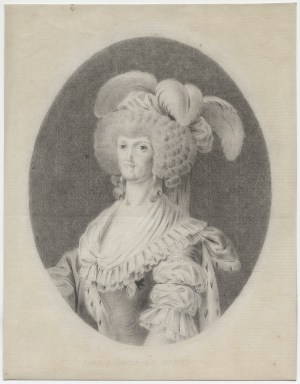
Antonio Carnicero, María Luisa de Parma, Queen of Spain, 1789. Chalk on paper (Dallas: Meadows Museum, SMU)
María Luisa of Parma, Queen of Spain is the first work to enter the Meadows Museum by Madrid painter Antonio Carnicero (1748–1814), who would become court painter to King Charles IV in 1796. This drawing stems from the period well before Carnicero’s royal appointment, which indicates the sovereigns’ awareness of Carnicero’s exceptional talent.
As a propagandistic campaign to disperse the new sovereigns’ images throughout the Spanish kingdom, portraits of Charles IV and María Luisa were commissioned from Carnicero and other painters. In Carnicero’s drawing, a bust-length portrait of María Luisa is set within an oval, and an elaborate headdress of feathers and ribbons sits on the queen’s wig of ringlets. The work is a preparatory drawing for the painted portraits of the queen, but its exquisite, polished lines resemble an engraving more than a sketch made in anticipation of a work on canvas.
Funds for this acquisition were provided by a Challenge Grant by the Gill family in honor of their daughter, Anju Gill.
High resolution images are available here»
Exhibition | A Queer History of Fashion
From The Museum at FIT:
A Queer History of Fashion: From the Closet to the Catwalk
The Museum at FIT, New York, 13 September 2013 — 4 January 2014
Curated by Fred Dennis and Valerie Steele

Man’s three piece silk velvet suit, 1790–1800, France
Museum purchase, 2010.98.1. Photo by Eileen Costa
A Queer History of Fashion: From the Closet to the Catwalk features approximately 100 ensembles, from 18th-century menswear styles associated with an emerging gay subculture to 21st-century high fashion. This is the first museum exhibition to explore in depth the significant contributions to fashion made by LGBTQ (lesbian-gay-bisexual-transgender-queer) individuals over the past 300 years.
Exhibition curators Fred Dennis, senior curator of costume, and Valerie Steele, director and chief curator of The Museum at FIT, spent two years researching and curating the exhibition. They worked with an advisory committee of eminent scholars, including professors George Chauncey (author of Gay New York), Shaun Cole (author of Don We Now Our Gay Apparel), Jonathan Katz (author/curator of Hide and Seek), Peter McNeil (co-editor of The Men’s Fashion Reader), and Vicki Karaminas (co-editor of the forthcoming Queer Style), as well as FIT faculty and fashion professionals.
“This is about honoring the gay and lesbian designers of the past and present,” said Dennis. “By acknowledging their contributions to fashion, we want to encourage people to embrace diversity.”
“We also hope that this exhibition will transform our understanding of fashion history,” added Steele. “For many years, gays and lesbians were hidden from history. By acknowledging the historic influence of gay designers, and by emphasizing the important role that fashion and style have played within the LGBTQ community, we see how central gay culture has been to the creation of modern fashion.”
From Cristobal Balenciaga and Christian Dior to Yves Saint Laurent and Alexander McQueen, many of the greatest fashion designers of the past century have been gay. Organized in roughly chronological order, the exhibition explores the history of modern fashion through the lens of gay and lesbian life and culture, addressing subjects including androgyny, dandyism, idealizing and transgressive aesthetic styles, and the influence of subcultural and street styles, including drag, leather, and uniforms.
The exhibition will trace how the gay vernacular styles changed after Stonewall, becoming increasingly “butch.” Lesbian style also evolved, moving from the ‘butch-femme’ paradigm toward an androgynous, anti-fashion look, which was, in turn, followed by various diversified styles that often referenced subcultures like punk. The AIDS crisis marks a pivotal mid-point in the exhibition. Clothing by a number of designers who died of AIDS, including Perry Ellis, Halston, and Bill Robinson, will be featured, as will a wide range of activist T-shirts for ACT UP, Queer Nation, the Lesbian and Gay Rights March in Washington and the iconic Read My Lips. Emphasizing that gay rights are human rights, the exhibition concludes with a section on gay wedding fashions as the sartorial expression of the issue of marriage equality.
Exhibition design is by Joel Sanders, well-known architect and author of Stud: The Architecture of Masculinity.
◊ ◊ ◊ ◊ ◊
From Yale UP:
Valerie Steele, ed., A Queer History of Fashion: From the Closet to the Catwalk (New Haven: Yale University Press, 2013), 248 pages, ISBN: 978-0300196702, $50.
 From Christian Dior to Yves Saint Laurent and Alexander McQueen, many of the greatest fashion designers of the past century have been gay. Fashion and style have played an important role within the LGBTQ community, as well, even as early as the 18th century. This provocative book looks at the history of fashion through a queer lens, examining high fashion as a site of gay cultural production and exploring the aesthetic sensibilities and unconventional dress of LGBTQ people, especially since the 1950s, to demonstrate the centrality of gay culture to the creation of modern fashion.
Contributions by some of the world’s most acclaimed scholars of gay history and fashion – including Christopher Breward, Shaun Cole, Vicki Karaminas, Jonathan D. Katz, Peter McNeil, and Elizabeth Wilson – investigate topics such as the context in which key designers’ lives and works form part of a broader ‘gay’ history; the ‘archeology’ of queer attire back to the homosexual underworld of 18th-century Europe; and the influence of LGBTQ subcultural styles from the trouser suits worn by Marlene Dietrich (which inspired Yves Saint Laurent’s ‘Le Smoking’) to the iconography of leather. Sumptuous illustrations include both fashion photography and archival imagery.
Valerie Steele is director and chief curator of The Museum at the Fashion Institute of Technology, New York.
New Book | From Marie-Antoinette’s Garden
As noted at Style Court and distributed by Rizzoli:
Élisabeth De Feydeau, edited by Alain Baraton with a foreword by Catherine Pegard, From Marie-Antoinette’s Garden: An Eighteenth-Century Horticultural Album (Paris: Flammarion, 2013), 240 pages, ISBN: 978-2080201423, $50.
 A horticultural tour of Marie-Antoinette’s domain, the lavishly constructed gardens at Versailles, accompanied by eighteenth-century archival illustrations. Plants, flowers, and trees were Marie-Antoinette’s passion; she transformed the Petit Trianon’s gardens into an enchanted escape from the oppressive shackles of Versailles. Based on archival documents, this book meanders through Marie-Antoinette’s estate as the queen herself would have walked it: traversing hyacinths, buttercups, and anemones in the French Gardens, via winding paths in the Anglo-Chinese Gardens, through the conifers of the Belvedere Gardens—where fabulous nocturnal parties were hosted—past the entrancing aromas of the shrubs surrounding the Temple of Love, to the wildflowers of the Garden of Solitude. This fascinating reconstruction includes descriptions of the cosmetic and medicinal uses of the garden’s plants, anecdotes from the royal court, and watercolors of the herbarium.
Historian and perfume specialist Élisabeth de Feydeau has published books on perfume. She teaches at the École des Parfumeurs in Versailles. Catherine Pégard is the president of the Établissement Public du Château, du Musée, et du Domaine National de Versailles.
Exhibition | Royal Paintbox: Royal Artists Past and Present
Press release from Windsor Castle:
Royal Paintbox: Royal Artists Past and Present
Windsor Castle, 22 June 2013 — 26 January 2014

◊ ◊ ◊ ◊ ◊
For generations, Britain’s kings, queens and their families have been inspired to paint, sketch and sculpt. Accompanying the ITV programme Royal Paintbox, an exhibition of the same name at Windsor Castle this summer charts the history of royal artists from the 17th century to the present day. It includes works by George III and his children, Queen Victoria and Prince Albert and their children, King Edward VII and Queen Alexandra and by Her Majesty The Queen. Also on display are a group of watercolours by His Royal Highness The Prince of Wales, who plays a leading role in the film. The Prince, who is Chairman of The Royal Collection Trust, has described how his love of painting was inspired by his early years at Windsor Castle surrounded by great art – so it is fitting that the Castle’s Drawings Gallery provides the backdrop for an exhibition dedicated to his family’s work.
The story told in the exhibition, which brings together works from the Royal Collection and from the collection of The Prince of Wales, begins during the aftermath of the English Civil War. Charles I’s nephew, the military leader Prince Rupert of the Rhine, depicted the execution of St John the Baptist in a magnificent mezzotint entitled The Great Executioner (1658). Mezzotint was a new engraving technique which Prince Rupert introduced to Great Britain at the time of the Restoration in 1660. His subject matter may refer obliquely to the execution in 1649 of his uncle Charles I, who is buried in St George’s Chapel, Windsor Castle. During the reign of Charles I’s son and successor Charles II, Prince Rupert was appointed Governor and Constable of Windsor Castle.

George III, Design for a Corinthian Temple for Kew, ca.1759
Pencil, pen and ink and wash (Royal Collection: RCIN 981419)
By contrast, a century later, the work of George III shows the ordered perfection characteristic of the Georgian style. The King’s drawings, which mostly date from the late 1750s, just before his accession in 1760, include a Design for a Corinthian Temple at Kew and a View of Syon House from Kew Gardens.
A familiar scene for visitors to Windsor is captured by George III’s fifth son, Prince Ernest Augustus, Duke of Cumberland. Aged nine, he painted an accomplished view in gouache of Windsor Town and Castle (1780), presumably under the careful supervision of his art teacher.
George III’s daughters were also tutored in art, and painted and drew throughout their lives. Like The Prince of Wales, the young Princesses were often inspired by the works of art they saw around them. In 1785, George III’s second daughter, Princess Augusta made an etching after a drawing by Leonardo da Vinci from the magnificent group of the artist’s work that entered the Royal Collection during the reign of Charles II. Leonardo’s drawing and the Princess’s etching will be shown side by side in the exhibition. George III’s third daughter, Princess Elizabeth, was particularly creative. One of the rooms at Frogmore House, a favourite royal retreat in Windsor Home Park, is decorated with her floral murals and decorative panels, including intricate cut-paper. Silhouettes and a large floral still life by Princess Elizabeth are included in the exhibition. (more…)
New Book | Travel, Collecting, and Museums of Asian Art
While addressing the nineteenth century, Ting Chang’s new book will be of interest to many dix-huitièmistes, particularly in connection with Edmond de Goncourt; in chapter four, Chang explores how Goncourt’s collection of Asian art and his writings on the subject supported his larger vision of an eighteenth-century revival. It’s part of Ashgate’s series on the Histories of Material Culture and Collecting, 1700–1950:
Ting Chang, Travel, Collecting, and Museums of Asian Art in Nineteenth-Century Paris (Aldershot: Ashgate, 2013), 210 pages, ISBN: 978-1409437765, $100 / £55.
 Travel, Collecting, and Museums of Asian Art in Nineteenth-Century Paris book examines a history of contact between modern Europe and East Asia through three collectors: Henri Cernuschi, Emile Guimet, and Edmond de Goncourt. Drawing on a wealth of material including European travelogues of the East and Asian reports of the West, Ting Chang explores the politics of mobility and cross-cultural encounter in the nineteenth century. This book takes a new approach to museum studies and institutional critique by highlighting what is missing from the existing scholarship — the foreign labours, social relations, and somatic experiences of travel that are constitutive of museums yet left out of their histories. The author explores how global trade and monetary theory shaped Cernuschi’s collection of archaic Chinese bronze. Exchange systems, both material and immaterial, determined Guimet’s museum of religious objects and Goncourt’s private collection of Asian art. Bronze, porcelain, and prints articulated the shifting relations and frameworks of understanding between France, Japan, and China in a time of profound transformation. Travel, Collecting, and Museums of Asian Art in Nineteenth-Century Paris thus looks at what Asian art was imagined to do for Europe. This book will be of interest to scholars and students interested in art history, travel imagery, museum studies, cross-cultural encounters, and modern transnational histories.
Ting Chang teaches art history at the University of Nottingham. She has published in The Art Bulletin, Oxford Art Journal, and Les Cahiers Edmond et Jules de Goncourt.
C O N T E N T S
Introduction
1: The historical terms of Euro-Asian object acquisition
2: Gold, silver, and bronze: Cernuschi’s collection and re-appraisals of Europe and Asia
3: The labour of travel: Guimet and Régamey in Asia
4: Equivalence and inversion: France, Japan and China in Goncourt’s cabinet
Conclusion
Bibliography
Index
Exhibition | The Nude Male in Art
Press release masculin (1 July 2013) from the Musée d’Orsay:
Masculin / Masculin: L’homme nu dans l’art de 1800 à nos jours
Musée d’Orsay, Paris, 24 September 2013 — 2 January 2014
Curated by Ophélie Ferlier, Xavier Rey, Ulrich Pohlmann, and Tobias G. Natter

Pierre et Gilles, Mercury, 2001 © Pierre et Gilles (Courtesy Galerie Jérôme de Noirmont, Paris)
Jean-Baptiste Frédéric Desmarais, The Shepherd Paris, 1787 (Ottawa, National Gallery of Canada)
While it has been quite natural for the female nude to be regularly exhibited, the male nude has not been accorded the same treatment. It is highly significant that until the show at the Leopold Museum in Vienna in the autumn of 2012, no exhibition had opted to take a fresh approach, over a long historical perspective, to the representation of the male nude. However, male nudity was for a long time, from the 17th to 19th centuries, the basis of traditional Academic art training and a key element in Western creative art. Therefore when presenting the exhibition Masculine / Masculine, the Musée d’Orsay, drawing on the wealth of its own collections (with several hitherto unknown sculptures) and on other French public collections, aims to take an interpretive, playful, sociological and philosophical approach to exploring all aspects and meanings of the male nude in art. Given that the 19th century took its inspiration from 18th-century classical art and that this influence still resonates today, the Musée d’Orsay is extending its traditional historical range in order to draw a continuous arc of creation through two centuries down to the present day. The exhibition will include the whole range of techniques: painting, sculpture, graphic arts and, of course, photography, which will have an equal place in the exhibition.
To convey the specifically masculine nature of the body, the exhibition, in preference to a dull chronological presentation, takes the visitor on a journey through a succession of thematic focuses, including the aesthetic canons inherited from Antiquity, their reinterpretation in the Neo-Classical, Symbolist and contemporary eras where the hero is increasingly glorified, the Realist fascination for truthful representation of the body, nudity as the body’s natural state, the suffering of the body and the expression of pain, and finally its eroticisation. The aim is to establish a genuine dialogue between different eras in order to reveal how certain artists have been prompted to reinterpret earlier works. In the mid-18th century, Winckelmann examined the legacy of the divine proporzioni of the body inherited from Antiquity, which, in spite of radical challenges, still apply today having mysteriously come down through the history of art as the accepted definition of beauty. From Jacques-Louis David to George Platt-Lynes, LaChapelle and Pierre et Gilles, and including Gustave Moreau, a whole series of connections is revealed, based around issues of power, censorship, modesty, the boundaries of public expectation and changes in social mores.
Winckelmann’s glorification of Greek beauty reveals an implicit carnal desire, relating to men as well as women, which certainly comes down through two centuries from the “Barbus” group and from David’s studio, to David Hockney and the film director James Bidgood. This sensibility also permeates the turn of the 19th and 20th centuries as it questions its own identity, as we see in the extraordinary painting École de Platon [School of Plato], inexplicably purchased by the French state in 1912 from the Belgian artist Delville. Similarly, the exhibition will reveal other visual and intellectual relationships through the works of artists as renowned as Georges de La Tour, Pierre Puget, Abilgaard, Paul Flandrin, Bouguereau, Hodler, Schiele, Munch, Picasso, Bacon, Mapplethorpe, Freud and Mueck, while lining up some surprises like the Mexican Angel Zarraga’s Saint Sébastien [Saint Sebastian], De Chirico’s Les Bains mystérieux [Mysterious Baths] and the erotica of Americans Charles Demuth and Paul Cadmus.
This autumn therefore, the Musée d’Orsay will invite the visitor to an exhibition that challenges the continuity of a theme that has always interested artists, through unexpected yet productive confrontations between the various revivals of the nude man in art. The exhibition has been organised by the Musée d’Orsay in collaboration with the Leopold Museum in Vienna.
◊ ◊ ◊ ◊ ◊
The catalogue is published jointly by by the Musée d’Orsay and Flammarion:
Guy Cogeval, Claude Arnaud, Philippe Comar, Damien Delille, Ophélie Ferlier, Ulrich Pohlmann, Xavier Rey, Masculin / Masculin: L’homme nu dans l’art de 1800 à nos jours (Paris: Musée d’Orsay / Flammarion, 2013), 304 pages, ISBN: 978-2081310094, 40€.
 Masculin/Masculin montre combien les professions de foi esthétiques, dogmes et prises de position plastiques du XIXe siècle en matière de nudité masculine puisent leurs origines au classicisme du XVIIIe siècle et demeurent encore présents aujourd’hui. Les oeuvres y sont envisagées sous l’angle de l’histoire sociale et culturelle, ou des enjeux de politique actuelle concernant la redéfinition de la perception du corps, la permissivité dans sa représentation et son usage, son pouvoir et son intimité, ou encore du rapport entre les sexes et de l’évolution de la masculinité.
Véritable dialogue entre peintures, sculptures, arts graphiques et photographies, le catalogue tisse des liens entre les époques grâce à d’inattendues et fécondes confrontations, les oeuvres contemporaines apportant un éclairage nouveau sur les siècles précédents. L’éclectisme revendiqué dans le choix des oeuvres, sans pour autant occulter les représentations les plus douloureuses de l’homme nu, aboutit à une célébration de la beauté qui ne dissimule pas sa joie et à un plaisir trop longtemps passé sous silence alors même qu’il est indissociable du genre. L’originalité n’est donc pas recherchée pour elle-même, mais davantage érigée en sésame ouvrant à un renouvellement du regard porté sur des oeuvres parfois extrêmement célèbres, visant à bousculer des lectures et à créer des correspondances.
◊ ◊ ◊ ◊ ◊
Note (added 12 October 2013) — Doreen Carvajal, “With Money Tight, Museums Embrace Nudes,” The New York Times (11 October 2013).
. . . the crowds are coming [to the Musée d’Orsay], averaging more than 4,500 people a day, triple the amount for a show at the same time last year, according to museum figures. The exhibition — which includes works by Picasso and Edvard Munch as well as more contemporary nudes by David Hockney, Andy Warhol and Robert Mapplethorpe — has provoked a wide range of responses inside and outside France. “A confused show” the French daily newspaper Le Monde weighed in, “devoid of any historical reflection.” But the show still was the buzz of Paris Fashion Week. And Marie Claire, a women’s beauty magazine, anointed it the “hottest event” of autumn. And sizzle is what a number of major European institutions seek this fall, hoping that a focus on sex will entice visitors and broaden their appeal to younger generations and a demographic who are more likely to read Marie Claire than Le Monde. . .
The full article is available here»
New Book | Life in an Eighteenth-Century Country House
From Amberley:
Peter and Carolyn Hammond, Life in an Eighteenth-Century Country House (Stroud,
Gloucestershire: Amberley, 2012) 160 pages, ISBN 978-1445608655, £13.
 Grove House and its extensive estate in Chiswick were owned in the eighteenth century by Humphrey Morice, a not very successful politician and an animal lover. The story of the house has been reconstructed by Carolyn and Peter Hammond who have studied the country home for almost a decade.
A wealth of period detail comes from the rare survival of letters written by the head groom to the lord of the house while he was in Italy for his health. They are a window into the daily life on the estate, describing the rather turbulent relationships between the servants in the house and the sometimes exciting events from the outside world. There was an attempted armed robbery, the theft of the walnut crop and the arrival of the Poor Law officers from a neighbouring parish to attempt to force one of the stable lads to pay for an illegitimate child he had apparently fathered…
Here is real life in the country house during the period of English history, immortalized by the fiction of Jane Austen.
Discussion | Perspectives on the English Country House
The National Trust & Apollo present
Perspectives on the English Country House: Preserving our Cultural Heritage
The National Portrait Gallery, London, 23 September 2013
 This event celebrates the publication of this year’s National Trust Historic Houses and Collections Annual. The journal features essays that bring to light the great range of research currently being undertaken at the Trust’s properties, giving us a better and deeper perspective on its work.
Speakers include:
Simon Jenkins, Chairman of the National Trust
Oscar Humphries, Publisher of Apollo Magazine
Nicky Haslam, English interior designer
Robert Sackville-West, on his ancestral home, Knole House
Professor Maurice Howard, speaking about The Vyne
Chaired by Oscar Humphries, Publisher of Apollo Magazine, and Simon Jenkins, Chairman of the National Trust, this panel discussion will examine the personal stories behind a number of great houses, exploring the different ways in which people are connected to, or have been influenced by them – whether that means shaping their aesthetics, their cultural politics, or their academic research.
Discussion begins 7pm. Drinks reception afterwards. Tickets £20. Click here to book tickets.
Exhibition | Tiepolo, Guardi, and Their World
Press release (3 September 2013) from The Morgan:
Tiepolo, Guardi, and Their World: Eighteenth-Century Venetian Drawings
The Morgan Library & Museum, New York, 27 September 2013 — 5 January 2014
Organized by William M. Griswold and Jennifer Tonkovich

Giambattista Tiepolo, Psyche Transported to Olympus, pen and brown ink, brown wash, over black chalk (New York: The Morgan Library & Museum, photo by Graham S. Haber)
The eighteenth century witnessed Venice’s second Golden Age. Although the city was no longer a major political power, it reemerged as an artistic capital, with such gifted artists as Giambattista Tiepolo, his son Domenico, Canaletto, and members of the Guardi family executing important commissions from the church, nobility, and bourgeoisie, while catering to foreign travelers and bringing their talents to other Italian cities and even north of the Alps. Drawn entirely from the Morgan’s collection of eighteenth-century Venetian drawings—one of the world’s finest—Tiepolo, Guardi, and Their World chronicles the vitality and originality of an incredibly vibrant period. The exhibition will be on view from September 27, 2013 to January 5, 2014.
“In the eighteenth century, as the illustrious history of the thousand-year-old Venetian Republic was coming to a close, the city was favored with an array of talent that left a lasting mark on western art,” said William M. Griswold, director of the Morgan Library & Museum and principal curator of the exhibition. “The names Tiepolo, Canaletto, and Guardi are almost synonymous with the time and place, and their paintings and frescoes are the works most commonly associated with the Settecento in Venice. But their greatness as painters is only part of a much larger story. The drawings in this exhibition, chosen entirely from the Morgan’s collection, bring to light the full spirit of eighteenth-century Venetian art and the many extraordinary individuals who participated in the resurgence of cultural activity that characterized the final years of the Republic.”
The Morgan has more than two hundred sheets by Giambattista Tiepolo, spanning his long and immensely successful career. Over thirty are on view in the exhibition, including a monumental early drawing of Hercules, dozens of luminous studies in pen and washthe frescoed ceilings for which Tiepolo was most famouand a late study for an overdoor decoration that he created in Madrid, where he lived and worked from 1762 until his death in 1770.
Many of Tiepolo’s most beautiful drawings relate to the vast fresco depicting Apollo accompanied by other deities and the Four Continents, which the artist painted in 1740 on a ceiling in the Palazzo Clerici, Milan. Several works in the show, such as a drawing of Father Time and Cupid, relate directly to the finished fresco. A number of others were ultimately rejected by Tiepolo, or instead relate to the spectacular oil sketch for the Palazzo Clerici ceiling that now belongs to the Kimbell Art Museum, in Fort Worth.
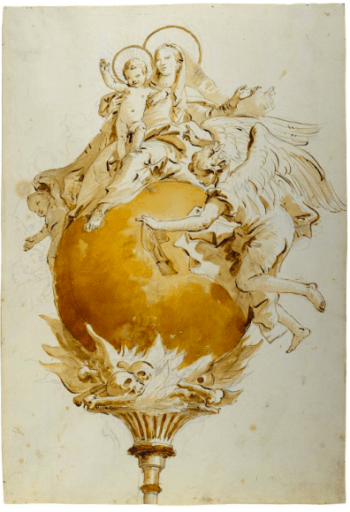
Giambattista Tiepolo, The Virgin and Child Seated on a Globe, pen and brown ink, brown and ochre wash, over black chalk
(New York: The Morgan Library & Museum)
A highlight of the exhibition is Tiepolo’s remarkable drawing The Virgin and Child Seated on a Globe, which like a number of other sheets on view formerly belonged to an album of exceptionally large, finished studies once in the collection of Prince Alexis Orloff. The sheet may be a rare example of the artist’s designs for metalwork, in this case perhaps a processional mace for the Scuola Grande dei Carmini, Venice.
Giovanni Battista Piazzetta was a half a generation older than Giambattista Tiepolo, and he exercised a profound influence on the work of the younger artist. The exhibition includes nine of the Morgan’s more than two hundred drawings by Piazzetta, including figure studies, drawings of ideal heads made for sale to collectors, and a selection of sheets that relate to the artist’s work as a designer of book illustrations.
Sebastiano Ricci played a crucial role in reorienting Venetian painting toward a new, painterly grand manner inspired by such earlier masters as Paolo Veronese. Ricci’s paintings, distinguished by their bright colors and flickering brush work, were a source of inspiration for later eighteenth-century Venetian artists. In addition to two drawings by him, the exhibition also features five sheets by Sebastiano’s nephew and pupil Marco Ricci. Best known for his imaginary landscapes, the younger Ricci’s drawings reflect diverse influences, including Renaissance and later Italian painters and printmakers, and even seventeenth-century Dutch art.
View painting—or vedutismo—flourished in eighteenth-century Venice, and both local collectors and foreign grand tourists eagerly sought images that replicated or merely evoked the unique topography of the city. Such topographical views and architectural capricci inspired by Venice’s architecture, canals, and lagoon were the specialty of Canaletto, who is represented in the exhibition with five drawings. These range from sketches made on the spot to finished works intended for sale. Francesco Guardi similarly excelled in depictions of Venice and nearby locations. Two of his drawings on view depict the richly decorated bucintoro, the state barge on which the doge journeyed each year on Ascension Day to reenact Venice’s symbolic marriage to the sea. Guardi’s drawing of Count Giovanni Zambeccari’s balloon ascent—launched from a platform in the Bacino di San Marco in 1783—is a faithful record of an event, whereas other works by the artist mingle the real with the imaginary.
The Morgan is one of the world’s principal repositories of drawings by Giovanni Battista Piranesi, an artist whose spirited work reflects a variety of influences, from late Baroque stage design to the monuments of ancient Rome. Although few of his surviving drawings were made in his native Venice, the Morgan has a small group, of which a selection is on display. These include a magnificent, large sketch of a gondola, several designs for the interior decoration of Venetian palaces, and one of a very small number of freely drawn figural compositions that apparently date to the first years of the artist’s career.
The last truly great Venetian artist of the period was Domenico Tiepolo, who lived until the first decade of the nineteenth century and saw the collapse of the Venetian Republic in 1797. In 1740 Domenico entered his father Giambattista’s busy workshop, where he rapidly became a key member. The influence of his father was profound, and many drawings by the younger Tiepolo relate to those of Giambattista, but Domenico’s tremulous pen work and layering of wash set his work apart from that of the older artist.
Between 1786 and 1790, Domenico Tiepolo executed a series of more than three hundred New Testament scenes. Six of the Morgan’s twenty-three sheets from the series are on display, including a moving Christ on the Mount of Olives, Saints Peter and John at the Beautiful Gate, and The Holy Family Arrives at the Robbers’ Farm, an unusual subject derived from the Apocrypha.
In another series of about eighty large drawings the artist depicted scenes of Venetian life during the final years of the Republic. The six drawings from the series in the exhibition wittily describe the foibles and excesses of the artist’s contemporaries from all walks of life, including a quack dentist, a storyteller, a bride-to-be with her prospective mother-in-law, and bewigged magistrates.
Toward the very end of his life Domenico Tiepolo undertook one last, important series of drawings: theatrical vignettes chronicling birth, childhood, youthful advenmiddle age, illness, death, and resurrection of the Commedia dell’Arte character Punchinello. Begun in 1797, the year the last doge stepped aside and the thousand-yold Republic of Venice ceased to exist, these drawings are among the greatest achievements of eighteenth-century Venetian art.
In addition, Tiepolo, Guardi, and Their World presents drawings by some of the many lesser-known artists who worked alongside Sebastiano Ricci, Piazzetta, and Giambattista Tiepolo. These include Gaspare Diziani, Franceso Fontebasso, Mattia Bortoloni, Pietro Longhi, Pietro Antonio Novelli, Francesco Tironi, and Giacomo Guardi, whose postcard-like Venetian views in gouache on paper mark the end of a long, glorious tradition.
G A L L E R Y T A L K S
Tiepolo, Guardi, and Their World: Eighteenth-Century Venetian Drawings
Friday, October 18, 6:30 pm
An informal exhibition tour with Edward Payne, Moore Curatorial Fellow in the Morgan’s Department of Drawings and Prints. Free with museum admission
Tiepolo, Guardi, and Their World: Eighteenth-Century Venetian Drawings
Friday, November 8, 6:30 pm
William M. Griswold, Director of the Morgan, will lead an informal tour of the exhibition. Free with museum admission










 Enfilade
leave a comment