Symposium Bringing Art into Being in the Early Modern Period
From The Courtauld:
Bringing Art into Being in the Early Modern Period
The Courtauld Institute of Art, London, 26 October 2013
Organised by Anya Matthews and Giulia Martina Weston
Complex narratives spanning months, years or even decades exist behind the single bracketed date attached to artworks to indicate their moment of execution or completion. This one-day symposium will explore the ‘ante-natal’ development of early modern art from its conception to its ‘quickening’ and eventual birth. The process fascinated contemporary theorists and continues to raise questions for modern art historians. For example, when was an artistic project considered finished or unfinished? What terms were used to indicate the various stages of bringing an artwork into being, and what implications did these terms have for authorship and authenticity? The creation of art is not the work of a moment or achieved at a single stroke; it involves a series of transpositions from idea to study or plan, from sketch to painting, from plan to building and so on. How did early modern art reflect on the process of its own making?
Ticket/entry details: £16 (£11 students, Courtauld staff/students and concessions). Book online. Or send a cheque made payable to ‘The Courtauld Institute of Art’ to: Research Forum Events Co-ordinator, Research Forum, The Courtauld Institute of Art, Somerset House, Strand, London WC2R 0RN, stating ‘Fifth Early Modern Symposium’. For further information, email ResearchForumEvents@courtauld.ac.uk.
◊ ◊ ◊ ◊ ◊
P R O G R A M M E
9.00 Registration
9.30 Introduction – Anya Matthews and Giulia Martina Weston (The Courtauld Institute of Art)
9.40 Session 1: Inspiration and the Artistic Idea
• Nikola Piperkov (Université Paris I Panthéon, Sorbonne), V(isita) I(nteriora) T(errae) R(ectificando) I(nvenies) O(ccultum) L(apidem): Pieter Brueghel the Elder’s and Adriaen de Vries’ Mercury and Psyche, an Allegory of Artistic and Alchemical Creation
• Anne Bloemacher (University of Münster), Raphael on Invention: Work in Progress Before the Materialisation of the Object
• James Hall (Independent art historian and critic), Sex and Genius: Raphael and Titian as Competing Models of the Creative Artist
• Vasco Nuno Figueiredo de Medeiros (University of Lisbon), Between Heuresis and Mimesis: Artistic Science and the Iconopoiesis as Mediators of the Creative Process
11.30 Coffee and Tea Break
12.00 Session 2: Breaking Boundaries
• Joris Van Gastel (University of Warwick), The Sculptor’s Drawing: An Embodied Approach
• Sefy Hendler (Tel Aviv University): A Paragone in Progress: Parmigianino Recto-Verso Study for Moses
• Claire Gapper (Independent architectural historian), Designing and Executing Decorative Plasterwork in the 16th and 17th Centuries
13.20 Break for lunch
14.20 Session 3: Out of Time
• Carolin Behrmann (Kunsthistorisches Institut in Florence -Max-Planck-Institut), In/action: The Non-Finito as Sculptural ‘Actio’
• David Gilks (Queen Mary, University of London), An Impossible Monument: Bringing the French Pantheon Into Being, 1791-94
• Foteini Vlachou (University of Lisbon), The ‘Trial’ and Tribulations of Sequeira’s Allegory of Junot Protecting
the City of Lisbon
• Letha Chien (University of California, Berkeley), The Frustrated Ongoing Saga of the Decorations at the Scuola Grande di San Marco
16.10 Coffee and tea break
16.40 Session 4: Artistic Experimentalism: Practices and Methods
• Kamini Vellodi (Independent art historian and practicing artist), Tintoretto’s Stage-Method: A Modern Constructivism
• Carrie Anderson (Massachusetts College of Art and Design, Boston), Translation and Translocation: Rethinking the Materiality of the ‘Old Indies’ Series
• Stefan Albl (University of Vienna), From Drawing to Painting: The Genesis of Pietro Testa’s Adorations of
the Shepherds and Some Considerations on His Working Methods
18.00 Reception
Forthcoming Book | The Pantheon: From Antiquity to the Present
Due next year from Cambridge UP:
Tod A. Marder and Mark Wilson Jones, eds., The Pantheon: From Antiquity to the Present (New York: Cambridge University Press, 2014), 350 pages, ISBN: 978-0521006361, $120.
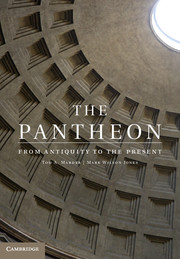 The Pantheon is one of the most important architectural monuments of all time. Thought to have been built by Emperor Hadrian in approximately 125 AD on the site of an earlier, Agrippan-era monument, it brilliantly displays the spatial pyrotechnics emblematic of Roman architecture and engineering. The Pantheon gives an up-to-date account of recent research on the best preserved building in the corpus of ancient Roman architecture from the time of its construction to the twenty-first century. Each chapter addresses a specific fundamental issue or period pertaining to the building; together, the essays in this volume shed light on all aspects of the Pantheon’s creation, and establish the importance of the history of the building to an understanding of its ancient fabric and heritage, its present state, and its special role in the survival and evolution of ancient architecture in modern Rome.
C O N T E N T S
1. Introduction, Tod A. Marder and Mark Wilson Jones
2. Agrippa’s Pantheon and its origin, Eugenio La Rocca
3. Dating the Pantheon, Lise M. Hetland
4. The conception and construction of drum and dome, Giangiacomo Martines
5. Sources and parallels for the design and construction of the Pantheon, Gene Waddell
6. The Pantheon builders: estimating manpower for construction, Janet DeLaine and Christina Triantafillou
7. Building on adversity: the Pantheon and problems with its construction, Mark Wilson Jones
8. The Pantheon in the Middle Ages, Erik Thunø
9. Impressions of the Pantheon in the Renaissance, Arnold Nesselrath
10. The Pantheon in the seventeenth century, Tod A. Marder
11. Neo-classical remodelling and reconception, 1700–1820, Susanna Pasquali
12. A nineteenth-century monument for the state, Robin B. Williams
13. The Pantheon in the modern age, Richard Etlin
Call for Nominations | 2014 Charles C. Eldredge Prize
2014 Charles C. Eldredge Prize
Nominations due by 1 December 2013
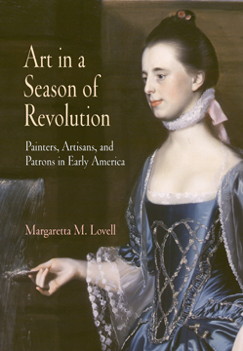
Winner of the 2006 Charles C. Eldredge Prize: Margaretta Lovell, Art in a Season of Revolution: Painters, Artisans, and Patrons in Early America (University of Pennsylvania Press, 2005).
The Smithsonian American Art Museum invites nominations for the 2014 Charles C. Eldredge Prize, an annual award for outstanding scholarship in American art history. Single-author books devoted to any aspect of the visual arts of the United States and published in the three previous calendar years are eligible. To nominate a book, send a letter explaining the work’s significance to the field of American art history and discussing the quality of the author’s scholarship and methodology. Self-nominations and nominations by publishers are not permitted. The deadline for nominations is December 1, 2013.
Funding for the Charles C. Eldredge Prize is provided by the American Art Forum, a patrons’ support organization of the Smithsonian American Art Museum. The prize was instituted to honor Charles C. Eldredge, who founded the American Art Forum in 1986 during his tenure as director of the museum.
Symposium | Courtly Rococo in Thuringia
As noted at the Portal Kunstgeschichte:
Höfisches Rokoko in Thüringen: Kunst um Krohne und Pedrozzi
Schloss Heidecksburg, Rudolstadt, Thüringen, 25–26 October 2013
Registration due by 8 October 2013
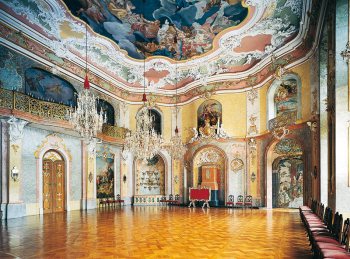 Der Blickpunkt des Symposiums richtet sich vornehmlich auf das architektonische Werk Gottfried Heinrich Krohnes (1703–1756) und Giovanni Battista Pedrozzis (1711–1778), das den Höhepunkt des Rokoko in Thüringen markiert. Die zu untersuchenden Architekturen und Ausstattungen werden dabei insbesondere nach den zugrunde liegenden Strategien und Intentionen herrschaftlicher Repräsentation befragt.
◊ ◊ ◊ ◊ ◊
F R E I T A G , 2 5 O K T O B E R 2 0 1 3
10.00 Begrüßung durch die Veranstalter Helmut-Eberhard Paulus und Peter-Michael Hahn
10.15 Helmut-Eberhard Paulus (Stiftung Thüringer Schlösser und Gärten), Einführung I: Rokoko – Stil oder Epoche?
10.30 Peter-Michael Hahn (Universität Potsdam), Einführung II: Kulturtransfer und Modernität. Ein altes Herzogtum rüstet auf
10.45 Ernst Badstübner (Berlin), Krohne und seine Auftraggeber in Thüringen
11.15 Heiko Laß (Hannover), Krohnes Lustschlosstypus – Dornburg und die Folgen
11.45 Vinzenz Czech (Universität Potsdam), Die Heidecksburg und das Zeremoniell am Rudolstädter Fürstenhof im 18. Jahrhundert
12.15 Diskussion
12.30 Mittagspause
13.30 Lutz Unbehaun (Thüringer Landesmuseum Heidecksburg), Führung durch Schloss Heidecksburg zum Thema „Schloss Heidecksburg als Zeichen und Symbol territorial-herrschaftlicher Macht in Thüringen“
14.45 Wolfgang Jahn (Ebermannstadt), Pedrozzi in seiner Bayreuther Zeit
15.15 Verena Friedrich (Julius-Maximilians-Universität Würzburg), Rocaillen für Rudolstadt. Der Rokokostuck Giovanni Battista Pedrozzis auf Schloss Heidecksburg in Rudolstadt
15.45 Diskussion
16.15 Kaffeepause
16.45 Eva Krems (Universität Münster), Raumstrukturen im höfischen Rokoko
17.15 Katja Heitmann (Philipps-Universität Marburg), A la mode – Raumkunst des Rokoko am Rudolstädter Hof
17.45 Abschlussdiskussion
18.30 Festvortrag Ulrich Schütte (Philipps-Universität Marburg) „Künstler und Architekten bey Hofe“
S A M S T A G , 2 6 O K T O B E R 2 0 1 3
8.30 Abfahrt nach Dornburg
10.00 Führung durch das Rokokoschloss Dornburg
11.45 Abfahrt nach Jena
12.30 Mittagessen im Schwarzen Bären, Jena
14.00 Weiterfahrt nach Molsdorf
15.30 Führung durch Schloss Molsdorf
16.30 Rückfahrt nach Rudolstadt Ankunft gegen 17.30 Uhr
September 2013 Issue of ‘The Art Bulletin’
The eighteenth century from the September issue:
Matthew M. Reeve, “Gothic Architecture, Sexuality, and License at Horace Walpole’s Strawberry Hill,” The Art Bulletin 95 (September 2013): 411–39.
From 1747 Horace Walpole and a close circle of male friends and associates designed, decorated, and furnished Strawberry Hill, the remarkable neo-Gothic villa in Twickenham, a fashionable suburb of London. An examination of the role of Walpole’s sexuality in the design and reception of the house and its furnishings, following the lead of recent studies in literature, historiography, and the history of sexuality, reveals the interrelations between the revival of the Gothic as one of the “modern styles” of eighteenth-century architecture and fundamental changes in human sexuality characterized by the rise of a “third sex.”
In addition, the “Notes from the Field” feature addresses the theme of time, with the following responses drawing on the eighteenth century:
Malcolm Bull, “Time,” The Art Bulletin 95 (September 2013): 360–62.
Ludmilla Jordanova, “Time,” The The Art Bulletin 95 (September 2013): 364–67.
Gerrit Walczak, “Time,” The Art Bulletin 95 (September 2013): 377–79.
David E. Wellbery, “Time, The Art Bulletin 95 (September 2013): 379–80.
New Book | Learning to Paint: The Private Studios of Paris
From Presse Universitaire François Rabelais, as noted at Le Blog de L’ApAhAu:
France Nerlich et d’Alain Bonnet, eds., Apprendre à peindre : les ateliers privés à Paris, 1780-1863 (Tours: Presse Universitaire François Rabelais, 2013), 432 pages, ISBN : 978-2869062979, 35€.
 Où apprenait-on à peindre à Paris au XIXe siècle ? Cette question pourtant cruciale n’a jusqu’à maintenant guère été approfondie par les historiens de l’art dont l’attention était surtout tournée vers le fonctionnement de l’École des beaux-arts. Or les classes de peinture n’y furent introduites qu’en 1863. De la fin du XVIIIe siècle à 1863, c’est dans l’espace hybride des ateliers privés d’enseignement, entre ancienne cellule artisanale et structure académique, que s’inventent et se développent de nouvelles approches du métier de peintre. Au-delà des aspects techniques et esthétiques, c’est le statut même des artistes qui se redéfinit à l’aune d’une autonomie inédite. Le caractère professionnel des formations se précise, tandis que la relation entre le maître et l’élève gagne en complexité.
Si la nostalgie du lien intime entre patron et apprenti de l’Ancien Régime apparaît comme un leitmotiv de la réflexion artistique, la situation nouvelle des ateliers privés favorise l’émancipation des jeunes peintres par rapport à l’autorité du maître. La liberté nouvelle face aux modèles, à la fois source d’angoisse et d’enthousiasme, transforme ainsi les ateliers privés en laboratoires expérimentaux de la modernité.
◊ ◊ ◊ ◊ ◊
Sébastien Allard : Préface
Avant-propos et remerciements
France Nerlich : Ateliers privés – enjeux et problématiques
Art et métier – structures et réseaux de la formation artistique
• Alain Bonnet : La formation pratique dans les ateliers d’artistes au XIXe siècle
• Séverine Sofio : « Mon élève que je regarde comme l’un de mes meilleurs ouvrages ». Former les jeunes filles à la peinture dans la première moitié du XIXe siècle
• Noémie Étienne : De l’atelier privé à l’atelier de restauration. La formation professionnelle des restaurateurs autour de 1800
• Cyril Lécosse : Devenir peintre en miniature : la professionnalisation des formations à la fin du XVIIIe siècle et au début du XIXe siècle
Partage et diffusion – réinventer les pratiques de l’enseignement artistique
• Nina Struckmeyer : « C’est seul que je vaux une académie ». Dans l’atelier des élèves de Jacques-Louis David
• Sidonie Lemeux-Fraitot : Les ateliers de Girodet
• Frauke Josenhans : La nature conçue depuis l’atelier : la formation dans les ateliers de peintres de paysage à Paris au début du XIXe siècle
• Armelle Jacquinot : Copier le moderne. Les marchands d’art et la location de tableaux dans la pratique de l’étude, 1820-1850
• Christian Omodeo : L’apprentissage par la copie : l’atelier de Vincenzo Camuccini à Rome
École et réseaux : les ateliers de Paul Delaroche et Léon Cogniet
• Clémentine Garcia : David, Gros, Delaroche et Gleyre. Une généalogie d’ateliers ?
• Lisa Hackmann : Les élèves allemands dans l’atelier de Paul Delaroche
• Cédric Lesec : Delaroche et ses élèves. L’atelier et ses « affinités électives »
• Michaël Vottero : Les ateliers de Léon Cogniet
• Beata Studziżba Kubalska : Le rôle de l’atelier de Léon Cogniet pour l’histoire de la peinture polonaise
• Kamila Kłudkiewicz : Un parcours transnational et privilégié. Henryk Rodakowski dans l’atelier de Léon Cogniet
Mission et subversion : les ateliers privés comme foyers d’une pensée alternative
• Hélène Jagot : Une académie dissidente. La formation des néo-grecs dans l’atelier de Delaroche et de Gleyre
• Margot Renard : Une « école de peinture nationale ». L’atelier privé de Thomas Couture
• Camille Mathieu : Du dessin dans l’enseignement de Thomas Couture
• Martin Schieder : « Ne fais pas ce que je fais ». Dans l’atelier de Gustave Courbet
• France Lechleiter : Paris – Rome – Tanger : formation, itinéraire et parcours des grands prix de Rome de peinture 1863-1872
Private Goes Public, Private Art Dealers Association Exhibition
Press release (22 July 2013) from PADA (a CAA affiliate society, incidentally). . .
Private Goes Public (Private Art Dealers Association)
13 East 69th Street, New York, 1–16 November 2013
 The Private Art Dealers Association (PADA), the first trade association to represent private art dealers, is celebrating its 25th anniversary with its first-ever public exhibition, Private Goes Public, 1–16 November 2013. Over thirty members of the 50-member strong PADA organization will exhibit a full range of fine art from the 17th to the 21st centuries at 13 East 69th Street, where galleries of three PADA members are located. European and American paintings, drawings, prints, photographs, and sculpture will be offered, all available for sale. An illustrated catalog will provide details on each of the dealers exhibiting at this show. (more…)
Exhibition | American Adversaries: West and Copley
Press release (19 June 2013) from the MFAH:
American Adversaries: West and Copley in a Transatlantic World
Museum of Fine Art, Houston, 6 October 2013 — 5 January 2014
 This October, the Museum of Fine Arts, Houston, presents American Adversaries: West and Copley in a Transatlantic World, an extensive exhibition charting the rise and spectacular success of contemporary history painting in the 18th century through the lives and experiences of two colonial American innovators: Benjamin West (1738–1820) and John Singleton Copley (1738–1815). West and Copley—initially friends and eventually bitter rivals—gained phenomenal fame from their theatrical paintings that romanticized current events and captured the imaginations of the art-viewing public. American Adversaries is on view from October 6, 2013, to January 20, 2014.
American Adversaries: West and Copley in a Transatlantic World traces the ambitious, competitive and highly successful lives of West and Copley through oil paintings, works on paper, sculptures and artifacts. At the core of the exhibition are two paintings that catapulted West and Copley into international fame: West’s The Death of General Wolfe (1770; 1779 version) and Copley’s Watson and the Shark (1778). The paintings have not been presented together in more than 60 years and never before in this context.
“This is a remarkable opportunity for Museum visitors to see in the same exhibition these two iconic paintings in the history of art, The Death of General Wolfe and Watson and the Shark,” said MFAH director Gary Tinterow. “Painted nearly 250 years ago and considered strikingly modern in their day, the issues addressed with such dramatic flair have the power to still resonate with viewers today.”
“Long before Jackson Pollock drew international acclaim for his innovative Abstract Expressionist paintings in the mid-twentieth century, West and Copley held center stage in the international art world of the 18th century centered in London,” said Emily Ballew Neff, MFAH curator of American painting and sculpture. “The exhibition addresses how it is that these two colonial artists on the margins of empire come to have such phenomenal success.”
Both born in the same year (1738) in the American Colonies of Pennsylvania and Massachusetts, Benjamin West and John Singleton Copley crossed the Atlantic in pursuit of international fame and fortune. London, the cultural and political capital of the empire, attracted and swayed both artists to stay to develop their careers as history painters and neither returned home to America.
West and Copley established a new genre of painting known as contemporary history painting with The Death of General Wolfe and Watson and the Shark. These dramatic large-scale canvases featured compositional elements derived from antique and Old Master sources, yet instead of portraying biblical, mythological or literary heroes, they depicted real people from contemporary life. This exhibition examines these paintings and the period in which they were painted to animate a past that is unfamiliar to many today. It restores the dynamism and modernity of this particular artistic moment as it happened, rather than through the lens of what we later have come to know. These works point to a world informed by the powerful agency of the Iroquois (Haudenosaunee) Confederacy in the Great Lakes region; the scientific and imperial exploration of the seas; the rising role of the media and its relationship to history painting; and the stagecraft involved in managing the perception of a successful artistic career in 18th-century London. In the exhibition, the two key paintings are joined by works of art from all over the Atlantic World, which give them greater context and meaning.
A fully illustrated catalogue, published by the Museum of Fine Arts, Houston, distributed by Yale University Press and designed by Studio Blue, accompanies the exhibition and features essays by international scholars. The catalogue for this exhibition receives generous funding from Furthermore: a program of the J. M. Kaplan Fund.
American Adversaries: West and Copley in a Transatlantic World is organized by the Museum of Fine Arts, Houston. An indemnity has been granted by the Federal Council on the Arts and the Humanities. The exhibition is made possible through support from the Terra Foundation for American Art.
◊ ◊ ◊ ◊ ◊
38th Annual Ruth K. Shartle Symposium
American Adversaries: West and Copley in a Transatlantic World
Museum of Fine Art, Houston, 5 October 2013
This one-day symposium includes talks by prominent scholars addressing themes developed in the exhibition. Following the symposium, guests are invited to a reception and a viewing of the exhibition. More information is forthcoming. Visit www.mfah.org/calendar for updates.
◊ ◊ ◊ ◊ ◊
From Yale UP:
Emily Ballew Neff with Kaylin H. Weber, American Adversaries: West and Copley in a Transatlantic World (New Haven: Yale University Press, 2013), 272 pages, ISBN: 978-0300196467, $75.
American artists and innovators Benjamin West (1738–1820) and John Singleton Copley (1738–1815) changed the way history was recorded in the 18th century and became America’s first transatlantic art superstars. Initially friends but eventually bitter rivals, the artists painted contemporary events as they happened, illustrating the transformation of imperial power through diplomacy between British Americans and the Iroquois, and through transatlantic trade, exploration, and the natural history of the West Indies.
Focusing on two iconic works, West’s The Death of General Wolfe (1770) and Copley’s Watson and the Shark (1778), American Adversaries charts the rise of contemporary history painting, and offers a compelling examination of American history and New World exploration. Featuring more than two hundred color reproductions of paintings, works on paper, and objects that informed the artists, this handsome volume also includes essays that shed new light on, among other subjects, West and Copley within the context of the Royal Academy and the use of Western and Native American objects in cultural diplomacy.
Emily Ballew Neff is curator of American painting and sculpture, and Kaylin H. Weber is assistant curator of American painting and sculpture, both at the Museum of Fine Arts, Houston.
Call for Papers | Political Portraiture in the United States and France
Political Portraiture in the United States and France
during the Revolutionary and Federal Eras, ca. 1776–1814
National Portrait Gallery, Washington, D.C., 25–26 September 2014
Proposals due by 15 November 2013
Organized by Todd Larkin and Brandon Brame Fortune
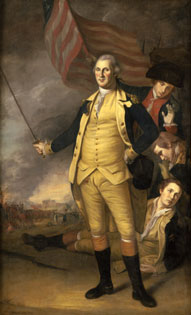
Charles Wilson Peale, Washington at the Battle of Princeton (Princeton)
In August 1814 British troops under General Robert Ross sacked Washington, D.C., and burned the Capitol, together with some splendid state portraits of Louis XVI and Marie-Antoinette, the French monarchy’s gift to the American Congress some thirty years earlier. The approaching bicentennial of this event will provide scholars of the United States and France a rare occasion to meet and share expertise on aspects of late eighteenth- to early nineteenth-century portraiture.
The premise of this conference is that in the period between the War of Independence and the War of 1812 the United States maintained a complicated political alliance with France, which had an impact on patterns of cultural representation and consumption on both sides of the Atlantic. The transition from monarchical to republican forms of government was accompanied by a shift from aristocrats to citizens as the primary patrons, subjects, and viewers of portraits. Yet portraits of American and French heads of state, delegates, and families often reveal an uneasy integration of traditional aristocratic forms and new republican values.
The first half of the conference, titled “Dialect[ic]s of Diplomacy,” will treat with single-person portraits (and portrait pairs) that suggest an individual invested with high status, extraordinary power, martial strength, or diplomatic duty on behalf of the nation; the second half of the conference, “Representative Bodies,” will examine group portraits that suggest a shared commitment to collective governance, family harmony, or equitable representation within the nation. How effective were state portraits in promoting the authority of a hereditary monarch, group portraits in promoting the authority of an elected assembly? To what extent did American artists reference or adapt the paintings and prints of French artists, and vice versa? What formal arrangements and symbolic repertories were invented to invest politicians, merchants, and workers with ideals of “patriotism” and “republicanism”?
This line of inquiry is meant to challenge or complicate persistent claims that the United States remained culturally dependent on Great Britain throughout the period, that its portraits reflect a kind of “Anglo-American synthesis.” Although the British flooded North America with royal paintings and celebrity prints in the general expectation that these would encourage fidelity to the Crown and taste for English goods, the French deployed images of sovereigns, ministers, and generals more precisely to seal diplomatic agreements, to celebrate military victories, and to rally public support. Indeed, so appealing were French productions that American artists freely borrowed from them to commemorate the first Presidents of the United States.
There will be six sessions, each lasting approximately two hours and consisting of three to four participants. (more…)
New Book | Portrayal and the Search for Identity
Published last December by Reaktion and distributed by the University of Chicago Press:
Marica Pointon, Portrayal and the Search for Identity (London: Reaktion Books, 2012), 272 pages, ISBN: 978-1780230412, £25 / $40.
 We are surrounded by portraits: from the cipher-like portrait of a queen on a banknote to security pass photos; from images of politicians in the media to Facebook; from galleries exhibiting Titian or Leonardo to contemporary art featuring the self-image, as with Jeff Koons or Cindy Sherman. In Antiquity portraiture was of major importance in the exercise of power. Today it remains not only a component of everyday life but also a crucial way for artists to define themselves in relation to their environment and their contemporaries.
In Portrayal and the Search for Identity, Marcia Pointon investigates how we view and understand portraiture as a genre, and how portraits function as artworks within social and political networks. Likeness is never a straightforward matter as we rarely have the subject of a portrait as a point of comparison. Featuring familiar canonical portraits as well as little-known works, Portrayal seeks to unsettle notions of portraiture as an art of convention, a reassuring reflection of social realities. Readers are instead invited to consider how identity is produced pictorially, and where likeness is registered apart from in a face. In exploring these issues, the author addresses wide-ranging challenges, such as the construction of masculinity in dress, representations of slaves, and self-portraiture in relation to mortality.
Marcia Pointon is an independent scholar and research consultant; she is Professor Emeritus of History of Art at the University of Manchester and Honorary Research Fellow at the Courtauld Institute of Art, London. She is author of Brilliant Effects: A Cultural History of Gem Stones and Jewellery and Hanging the Head: Portraiture and Social Formation in Eighteenth-century England.
C O N T E N T S
Introduction
1. Portrait, Fact and Fiction
2. Slavery and the Possibilities of Portraiture
3. Adolescence, Sexuality and Colour in Portraiture: Sir Thomas Lawrence
4. Accessories in Portraits: Stockings, Buttons and the Construction of Masculinity in the Eighteenth Century
5. The Skull in the Studio
References
Select Bibliography
Acknowledgements
Photo Acknowledgements
Index










 Enfilade
leave a comment