Display | Ben Okri on Ayuba Suleiman Diallo
From the NPG:
Ben Okri on Ayuba Suleiman Diallo: A Dialogue Across Time
National Portrait Gallery, London, 20 September 2013 — 16 March 2014

William Hoare, Portrait of Ayuba Suleiman Diallo (Job ben Solomon), 1733 (NPG L245, Lent by Qatar Museums Authority/Orientalist Museum, Doha, 2010)
Ayuba Suleiman Diallo was an educated man from a family of Muslim clerics in West Africa. In 1731 he was taken into slavery and sent to work on a plantation in America. By his own enterprise, and assisted by a series of spectacular strokes of fortune, Diallo arrived in London in 1733. Recognised as a deeply pious and educated man, in England Diallo mixed with high and intellectual society, was introduced at Court and was bought out of slavery by public subscription. Through the publication of his Memoirs in 1734, Diallo had an important and lasting impact on Britain’s understanding of West African culture, black identity and Islam. In the early years of the nineteenth-century, advocates of the abolition of slavery would cite Diallo as a key figure in asserting the moral rights and humanity of black people.
Booker-prize winning Ben Okri is one of Britain’s finest writers. Fascinated with the enigmatic story of Diallo, and his relevance today, Okri embarked on a series of conversations to explore the painting and its impact with audiences at the National Portrait Gallery and its regional partners in Liverpool, South Shields and Leicester. Okri’s new poem, which is part of the display, is inspired by this journey of discovery into the moving and sometimes uncomfortable story of Ayuba Suleiman Diallo and a portrait which raises many questions.
The tour and display has been made possible by the generosity of Thomson Reuters, the Qatar Museums Authority and individual Gallery supporters. The display and its interpretation is complemented by a series of talks and events funded by the American Friends of the National Portrait Gallery, including a conversation between Ben Okri and Gus Casely-Hayford.
Call for Papers | ASECS 2014 in Williamsburg
Reminder: the due date is 15 September!
2014 American Society for Eighteenth-Century Studies Conference
Williamsburg, 20–22 March 2014
Proposals due by 15 September 2013
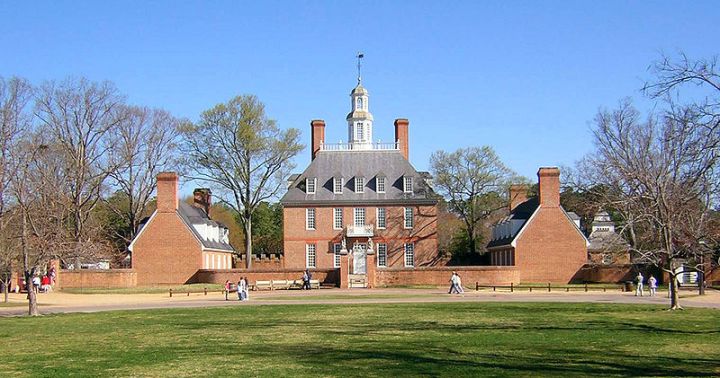
Governor’s Palace in Williamsburg, Virginia. The original structure was built between
1710 and 1722, with further additions made in the 1750s. Fire destroyed the
main house in 1781. The present building was constructed in the early 1930s.
Photo by Larry Pieniazek, 2006, from Wikimedia Commons.
◊ ◊ ◊ ◊ ◊
The 2014 ASECS conference takes place in Williamsburg, 20–22 March. Along with our annual luncheon and business meeting, HECAA will be represented by two panels chaired by Denise Baxter and Amy Freund and Jessica Fripp. In addition to these, a wide selection of sessions that might be relevant for HECAA members are also included below. A full list of panels (68 pages’ worth!) is available as a PDF file here.
◊ ◊ ◊ ◊ ◊
Anne Schroder New Scholar’s Session (Historians of Eighteenth-Century Art and Architecture)
Denise Amy Baxter, 1304 Edgewood Court, Carrollton, TX 75007; denise.baxter@unt.edu
Named in honor of the late Anne Schroder, this seminar will feature outstanding new research by emerging scholars.
◊ ◊ ◊ ◊ ◊
Selfhood and Visual Representation in the Eighteenth Century (Historians of Eighteenth-Century Art and Architecture)
Amy Freund, Texas Christian U. and Jessica Fripp, Parsons The New School for Design; a.freund@tcu.edu and frippj@newschool.edu
This panel will consider the relationship between the visual arts and new ideas of selfhood in the eighteenth century. Enlightenment-era debates about the nature of the self had profound effects on how people imagined the individual’s place in society, how gender, age, and racial difference were framed, how science and medicine conceived of the mind and body, and how emotions such as love and friendship were understood and expressed. Some scholars have approached the question of the eighteenth-century self in terms of the rise of possessive individualism, of secularization, and of consumer culture; others have pointed to the persistence and transformation of traditional hierarchies, of collective identities, and of mysticism and the irrational. We are seeking papers that examine the visual representation of the eighteenth-century self, both in portraiture and in other genres and modes, including (but not limited to) genre and history painting, architecture and the decorative arts, dress, and material culture. We encourage proposals that deal with the eighteenth-century self in Asia, Africa, and the Americas, and with the transformation (or inapplicability) of Enlightenment ideas outside of Europe.
A larger list of potentially relevant sessions is available here»
New Book | The Portuguese Synagogue in Amsterdam
For all those observing Rosh Hashana, may the new year bring blessings. -CH . . . From ACC Distribution:
Pieter Vlaardingerbroek, ed., The Portuguese Synagogue in Amsterdam (Zwolle: W Books, 2013), 208 pages, ISBN: 978-9040007989, $32.50.
 The Portuguese Synagogue, or Snoge, was the largest Sephardi synagogue in the world when it was built, between 1671 and 1675. The fact that Amsterdam’s Sephardim were permitted to erect this grand structure attests to the relative freedom of Jews in this part of Western Europe, at a time when Jews elsewhere were confined to ghettos and subject to restrictions. Through the centuries, foreign tourists have been amazed by the beauty and scale of the complex. This volume examines the many aspects of this glorious synagogue, which has been preserved almost perfectly in its seventeenth-century state.
Pieter Vlaardingerbroek is an architectural historian at the Office of Monuments and Archaeology, Amsterdam.
◊ ◊ ◊ ◊ ◊
C O N T E N T S
The Portuguese Jewish Community in Amsterdam
Elias Bouman (1635–1686), The Architect of the Snoge
The Snoge: A Jewish Building in a Dutch Architectural Style
Construction and Maintenance (1671–2000)
Restoring the Past, Creating Room for the Future
The Festive Inauguration of the Esnoga in 1675
The Esnoga and the Snogeiros: The Interior Function of the Synagogue and its Annexes
The Ceremonial Art Treasures of the Esnoga
New Book | Turner and the Sea
The exhibition opens at the National Maritime Museum in November; proposals for the related conference are due by September 6.
Christine Riding and Richard Johns, Turner and the Sea (London: Thames & Hudson, 2013), 288 pages, ISBN: 978-0500239056, $60.
 This is the first publication to focus on J. M. W. Turner’s lifelong fascination with the sea, from his Royal Academy debut in 1796, Fishermen at Sea, to his iconic maritime subjects of the 1830s and 1840s such as Staffa, Fingal’s Cave. It places Turner and his work firmly in the broader field of maritime painting that flourished in nineteenth-century Britain, France, Germany, Holland, and America.
The majority of the works illustrated here—paintings, watercolors, sketches, sketchbooks, and engravings—are by Turner, but there are also comparative works by some forty other artists including Winslow Homer, James McNeill Whistler, John Constable, Benjamin West, and Gustave Courbet. The book is organized thematically and chronologically, and the subjects range from “Contested Waters,” which examines what was at stake for marine painting during the Napoleonic Wars, to “New Wave,” an exploration of Turner’s international and often surprising legacy for the art of the sea.
Christine Riding is senior curator of paintings and head of the arts department at the National Maritime Museum. Richard Johns is curator of prints and drawings at the National Maritime Museum.
Exhibition | Splendore a Venezia: Art and Music
Press release (6 June 2013) from the MMFA:
Splendore a Venezia: Art and Music from the Renaisance to Baroque in the Serenissima
Montreal Museum of Fine Arts, 12 October 2013 — 19 January 2014
Portland Art Museum, 15 February — 11 May 2014
Curated by Hilliard T. Goldfarb
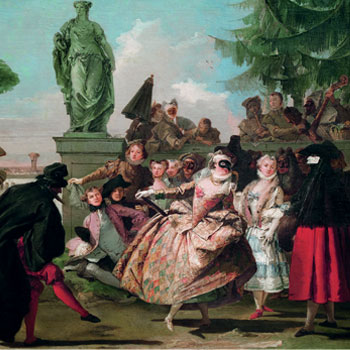
Giovanni Domenico Tiepolo, Minuet (detail), 1756 (Barcelona: Museu Nacional d’Art de Catalunya)
This fall the Montreal Museum of Fine Arts will present an innovative interdisciplinary exhibition, exploring for the first time the important interrelationships between the visual arts and music in the Venetian Republic, from the early sixteenth century to the fall of the Serenissima at the close of the eighteenth century, a period during which these art forms served the political ambitions of the state and civic institutions and became increasingly central to the economy of the Republic.
Thanks to outstanding loans from prestigious museums and collectors, visitors to the exhibition Splendore a Venezia: Art and Music from the Renaissance to Baroque in the Serenissima will discover the splendours of Venice through the musical scene: salons, the elaborate carnevale, the theatre, street performances and the festive, costumed commedia dell’arte.
Featuring approximately 120 paintings, prints and drawings, as well as historical instruments, musical manuscripts and texts, Splendore a Venezia paints a portrait of extraordinary artistic and musical creativity. This exhibition organized by the Museum brings together masterworks by many of the most renowned names associated with the city on the lagoon: visual artists directly associated with the musical life of the city include Titian, Tintoretto, Bassano, Giovanni Battista and Domenico Tiepolo, and Francesco Guardi, many of whom were also amateur musicians, as well as Bernardo Strozzi, Pietro Longhi and Canaletto, whose paintings record the role of music in Venetian life. The exhibition also includes manuscripts and publications by Venetian composers like the Gabrieli, Monteverdi, Albinoni, Lotti and Vivaldi.
Nathalie Bondil, Director and Chief Curator of the MMFA, said, “In keeping with the original exhibition programming we began with Warhol Live, Imagine, Miles Davis and Lyonel Feininger, music takes its place front and centre with this new MMFA production. As D’Annunzio said: “In Venice, in the same way that one cannot feel except in music, one cannot think if not in images.” That’s how it is at the MMFA, too: it is impossible to see without listening or to listen without seeing.” In a presentation that resembles the Museum’s previous multidisciplinary exhibitions, Splendore a Venezia will give visitors an opportunity to enjoy musical accompaniment related to each theme in the galleries, thus enhancing the exploration of each of these works.
Exhibition curator Hilliard T. Goldfarb, Associate Chief Curator and Curator of Old Masters at the MMFA and a specialist of the Italian Renaissance, developed the concept of this original exhibition produced by the MMFA, by gaining inspiration from an idea put forward by the Musée de la musique in Paris. This exhibition will be circulated by the MMFA to the Portland Art Museum in Oregon from March 7 to June 8, 2014. The exhibition’s musical accompaniment is being overseen by musicologist François Filiatrault.
The works, on loan from prominent international collections like the Metropolitan Museum of Art, the Morgan Library & Museum, the New York Public Library, the Wadsworth Atheneum, the Cleveland Museum of Art, the National Gallery of Art (Washington), the Palatine Gallery, Uffizi, Capitoline, Cini Foundation, Accademia, Museo Correr, Kunsthistorisches Museum, Thyssen-Bornemisza, the Dulwich Picture Gallery, the National Gallery (London) and the National Gallery of Canada (Ottawa), and the Cité de la musique in Paris, among others. Extensive associated programming includes a series of concerts with period instruments in the MMFA’s Bourgie Hall, as well as related activities throughout the city.
The visual arts and musical scenes during the extraordinarily creative period from Titian to Guardi and Willaert to Vivaldi were profoundly interconnected. The world’s first public opera house (1639) opened in Venice, which boasted no fewer than nine commercial opera houses in the seventeenth and eighteenth centuries. Modern music typography was invented in Venice, and it was there that the most important musical presses in Europe were located. Public musical concerts were crucial to the economic strength of Venice’s scuole (rich, powerful brotherhoods) and ospedali (establishments for the poor and orphans). Each year, a variety of processions were held in celebration of special occasions. These were recorded in the visual arts and celebrated in music, in turn serving its government, which sponsored the arts. Music and the visual arts also became central to state propaganda and the Republic’s state receptions and international profile.
The exhibition is organized along three broad conceptual themes reflecting specific, parallel and interrelated characteristics of art and music during this critical period of Venetian history: 1) Art and Music in the Public Sphere 2) Art and Music in the Private Realm 3) Art, Music and Mythology [more information about each theme is available in the press release]
To accompany the exhibition, the MMFA’s Publishing Department is co-publishing a full-colour exhibition catalogue, in English and French editions, with Hazan, Paris [Art and Music in Venice: From the Renaissance to Baroque]. The catalogue features essays by leading international experts in Venetian art, culture and music, under the general editorship of Dr. Hilliard T. Goldfarb. He is joined by a distinguished team of international cultural and musicological experts, including Tiziana Bottecchia, Dawson Carr, Francesca del Torre, Joël Dugot, Iain Fenlon, Caroline Giron, Jonathan Glixon, Sergio Guarino, Eugene Johnson, Piero Lucchi and Ellen Rosand. This publication will serve as a reference work that will make an ongoing contribution to the body of knowledge on music and the visual arts in the private and public realms of the Venetian Republic. It will be distributed internationally by Hazan (French edition) and Yale University Press (English edition). (more…)
Exhibition | Interwoven Globe: The Worldwide Textile Trade, 1500–1800
As noted at Style Court, Interwoven Globe opens this month at The Met; from the press release:
Interwoven Globe: The Worldwide Textile Trade, 1500–1800
The Metropolitan Museum of Art, New York, 16 September 2013 — 5 January 2014
Curated by Amelia Peck
 Interwoven Globe: The Worldwide Textile Trade is the first major exhibition to explore the international transmittal of design from the 16th to the early 19th century through the medium of textiles. It highlights an important design story that has never before been told from a truly global perspective. Beginning in the 16th century, the golden age of European maritime navigation in search of spice routes to the east brought about the flowering of an abundant textile trade, causing a breathtaking variety of textiles in a multiplicity of designs and techniques to travel across the globe. Textiles, which often acted as currency for spices and other goods, made their way from India and Asia to Europe, between India and Asia and Southeast Asia, from Europe to the east, and eventually to the west to North and South America. Trade textiles blended the designs, skills, and tastes of the cultures that produced them, resulting in objects both intrinsically beautiful and historically fascinating.
The exhibition is made possible by The Andrew W. Mellon Foundation, the Diane W. and James E. Burke Fund, The Coby Foundation, Ltd., The Favrot Fund, the Gail and Parker Gilbert Fund, and the Quinque Foundation.
While previous studies have focused on this story from the viewpoint of trade, Interwoven Globe is the first exhibition to explore it as a history of design—and to approach it from a perspective that emphasizes the beauty and sophistication of these often overlooked objects. It will explore the interrelationship of textiles, commerce, and taste from the Age of Discovery to the 19th century. From India and its renowned, ancient mastery of painted and dyed cotton to the sumptuous silks of China and Japan, Turkey and Iran, the paths of influence are traced westward to Europe and the Americas. Shaped by an emerging worldwide visual culture, the resulting fashion for the “exotic” in textiles, as well as in other goods and art forms, gave rise to what can be recognized as the first truly global style.
Interwoven Globe will feature 134 works, about two-thirds of which are drawn from the Metropolitan Museum’s own rich, encyclopedic collection. These objects will be augmented by important domestic and international loans in order to make worldwide visual connections. Works from the Metropolitan will come from the following departments: American Decorative Arts, Asian Art, Islamic Art, European Sculpture and Decorative Arts, The Costume Institute, European Paintings, Drawings and Prints, and Arts of Africa, Oceania, and the Americas. They will include numerous flat textiles (lengths of fabric, curtains, wall hangings, bedcovers,) tapestries, costumes, church vestments, pieces of seating furniture, and paintings and drawings. (more…)
Symposium | Interwoven Globe: The Worldwide Textile Trade
From The Met:
Symposium: Interwoven Globe: The Worldwide Textile Trade, 1500–1800
The Metropolitan Museum of Art, New York, 4 October 2013
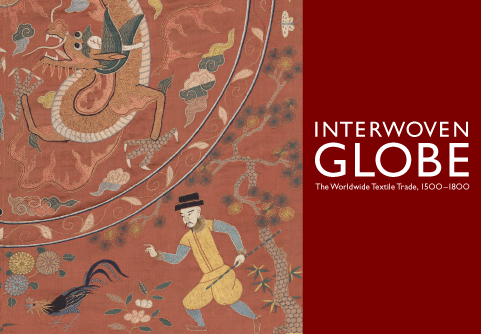 International scholars explore the impact of the burgeoning textile trade in the early modern period, focusing on specific aspects of how trade textiles influenced global economics, social history, and design aesthetics. The program is presented in conjunction with the exhibition Interwoven Globe: The Worldwide Textile Trade, 1500–1800 and made possible in part by the Clara Lloyd-Smith Weber Fund. Free with museum admission.
P R O G R A M
10:30 Amelia Peck — Welcome and Introduction
10:45 Louise Mackie — Ottoman Turkish Silks in Italian and Russian Trade and Diplomacy
11:15 Rudi Matthee — The Dutch East India Company and Asian Raw Silk: From Iran to Bengal via China and Japan
11:45 Jessica Hallett — Textiles, Trade, and Taste: Portugal and Asia in the Sixteenth and Seventeenth Centuries
12:15 Masako Yoshida — The International Expansion of Textiles with Flower, Bird, and Animal Designs
12:45 Break for lunch
2:30 Ebeltje Hartkamp-Jonxis — Aspects of the Luxury Trade in Indian Chintzes for the Dutch Market
3:00 John Styles — East Meets West: Everyday Fashion in Eighteenth-Century London
3:30 Colleen E. Kriger — Lost and Found in Translation: West African Textiles and Atlantic Trade
4:00 Donna Pierce — Popular and Prevalent: The Impact of Asian Textiles on Colonial Mexico
New Book | Of Elephants & Roses: French Natural History, 1790–1830

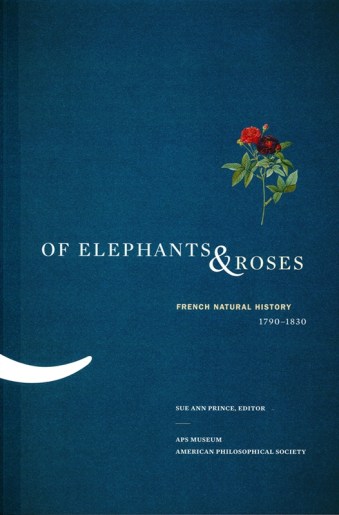
Design by Marc Blaustein
◊ ◊ ◊ ◊ ◊
Published by APS and available from Diane Publishing:
Sue Ann Prince, ed., Of Elephants & Roses: French Natural History, 1790–1830 (Philadelphia: American Philosophical Society, 2013), 294 pages, ISBN: 9780871692672, $50.
Of Elephants & Roses explores the fascinating history of the natural sciences in the turbulent years of post-revolutionary and Restoration France, from Empress Josephine’s black swans and rare Franklin tree to a giraffe that walked 480 miles across France to greet the king. This illustrated book is the catalogue for an international loan exhibition held in 2011 at the APS Museum in Philadelphia and the record of an associated interdisciplinary symposium. It presents new perspectives on French natural history, its influence on French culture, and its ties to the natural sciences in North America.

From J. P. Hoüel, Histoire naturelle des deux éléphans (Paris, 1803)
Edited by APS Museum director and curator Sue Ann Prince, the catalogue contains all sixteen talks, the keynote and concluding addresses, the session commentaries, edited transcripts of the audience discussions, and a checklist of the exhibition. Contributors include art historians, historians of science, and scholars of French literature, history, and culture. The book is illustrated throughout in full color. Both the symposium and the publication have been made possible by generous funding from the Richard Lounsbery Foundation.
About the APS
An eminent scholarly organization of international reputation, the American Philosophical Society promotes useful knowledge in the sciences and humanities through excellence in scholarly research, professional meetings, support of young scholars, publications, library resources, and a museum. This country’s first learned society, the APS has played an important role in American cultural and intellectual life for more than 250 years.










 Enfilade
leave a comment