Exhibition | The Exotic at Home: China in Portuguese Ceramics
From Lisbon’s National Azulejo Museum:
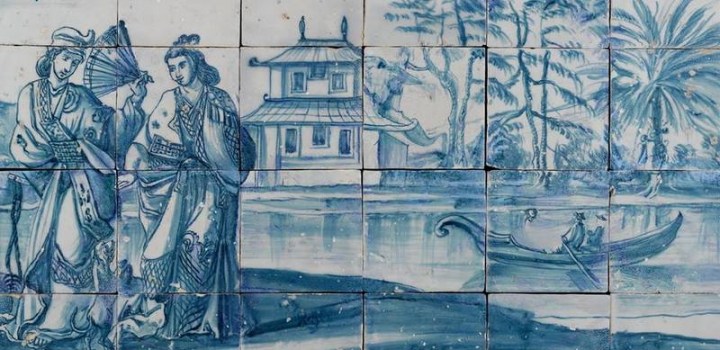
The Exotic is Never at Home? China in Portuguese Faience and Azulejo, 17th–18th Centuries
O Exótico nunca está em casa? A China na faiança e no azulejo portugueses (séculos XVII–XVIII)
Museu Nacional do Azulejo, Lisbon, 17 December 2013 — 29 June 2014
Curated by Alexandra Curvelo
◊ ◊ ◊ ◊ ◊
Since 1513, the Portuguese established a direct and regular contact between China and Europe. Taking on the role of suppliers and commercial brokers, Lusitanian adventurers and merchants progressively penetrated that immense kingdom, which was, perchance, the most exotic of the horizons dreamed and created in Europe since the Middle Ages. Exotic is a term of Latin origin, delivered from ancient Greek, meaning ‘outside’, an essential condition to arise one’s condition to marvel as it only exists after it is discovered. To this purpose the exotic object must always be transferred to a new context, in which it is reinterpreted, assuming another importance and meaning. But is the exotic always away from home, or are there moments in which it is ‘at the door’, if not even ‘in house’? These are the questions this exhibition aims to answer, by presenting the influence of China in Portuguese faience and azulejo in the 17th and 18th centuries.
◊ ◊ ◊ ◊ ◊
Dana Thomas writes about Lisbon in the March 2014 issue of Architectural Digest. . .
Be sure to pay a visit to the Museu Nacional do Azulejo (National Tile Museum), set in the opulent Madre de Deus Convent. Artist Joana Vasconcelos, who represented Portugal at last year’s Venice Biennale, calls it “one of Lisbon’s best-kept secrets.” The gem of the museum’s collection is a 75-foot-long mural from 1738 that’s made up of 1,300 tiles illustrating Lisbon before the earthquake of 1755, a cataclysm that destroyed much of the city and killed as many as 60,000 residents. Another impressive display of azulejos can be found at the São Vicente de Fora Monastery, which is decorated with tile panels depicting French poet Jean de La Fontaine’s fables. The hilltop monastery, in the historic residential neighborhood of Alfama, offers some of the finest views of the city. . .
The full article is available here»










 Enfilade
leave a comment