New Books | Beastly London / Gorgeous Beasts
Along with these two books (the second of which I should have posted months ago), readers interested in animals may find useful the review essay by Simona Cohen, “Animal Imagery in Renaissance Art,” in Renaissance Quarterly 67 (March 2014): 164–80. -CH
From Reaktion:
Hannah Velten, Beastly London: A History of Animals in the City (London: Reaktion Books, 2013), 288 pags, ISBN: 978-1780231679, £29 / $50.
 Horse-drawn cabs rattling through the streets, terrified cattle being herded along congested thoroughfares to Smithfield market, pigs squealing and grunting in back yards—London was once filled with a cacophony of animal noises (and smells). But over the last thirty years, the city seems to have finally banished animals from its streets, apart from a few well-loved beasts such as the ravens at the Tower of London and the shire horses that pull the Lord Mayor’s golden coach.
Londoners once shared their homes with all kinds of animals—pets, livestock and vermin—and the streets were full of horses, cattle and the animal entertainers that performed to passers-by. Animals from all corners of the globe were imported through London’s docks and exotic beasts became popular attractions at venues such as the Zoological Gardens or lived in the private menageries of kings and naturalists. The city’s residents were entertained by performing fleas, mathematically gifted horses and dancing bears, as well as more bloodthirsty pursuits such as shooting and dog- and cockfights. In the Victorian age the city, not before time, became the birthplace of animal welfare societies and animal rights campaigns. Yet just as conditions gradually improved for the beasts of London, markets, slaughterhouses and dairies began to be moved to the suburbs, and the automobile eventually replaced the horse. The number of resident animals fell, and they are no longer a large part of everyday life in the capital—apart from a stalwart few, such as pets, pigeons and pests. Beastly London explores the complex and changing relationship between Londoners of all backgrounds and their animal neighbours, and reveals how animals helped to shape the city’s economic, social and cultural history.
Hannah Velten is a freelance writer based in Fletching, Sussex, and the author of Cow (Reaktion, 2007) and Milk (Reaktion, 2010).
C O N T E N T S
Introduction: Revealing the Beasts
1. Livestock: Londoners’ Nuisance Neighbours
2. Working Animals: Straining Every Muscle
3. Sporting Animals: Natural Instincts Exploited
4. Animals as Entertainers: Performance, Peculiarity and Pressure
5. Exotic Animals: The Allure of the Foreign and the Wild
6. Pampered Pets and Sad Strays
7. London Wildlife: The Persecuted and the Celebrated
Final Thoughts: An Apology and a Pardon
References
Acknowledgements
Photo Acknowledgements
Index
◊ ◊ ◊ ◊ ◊
From Penn State UP:
Joan B. Landes, Paula Young Lee, and Paul Youngquist, eds., Gorgeous Beasts: Animal Bodies in Historical Perspective (University Park: Pennsylvania State University Press, 2012), 258 pages, ISBN: 978-0271054018, $50.
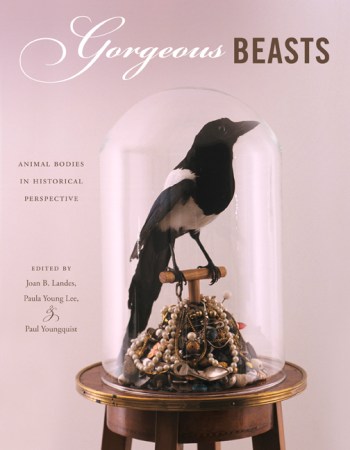 Gorgeous Beasts takes a fresh look at the place of animals in history and art. Refusing the traditional subordination of animals to humans, the essays gathered here examine a rich variety of ways animals contribute to culture: as living things, as scientific specimens, as food, weapons, tropes, and occasions for thought and creativity. History and culture set the terms for this inquiry. As history changes, so do the ways animals participate in culture. Gorgeous Beasts offers a series of discontinuous but probing studies of the forms their participation takes.
This collection presents the work of a wide range of scholars, critics, and thinkers from diverse disciplines: philosophy, literature, history, geography, economics, art history, cultural studies, and the visual arts. By approaching animals from such different perspectives, these essays broaden the scope of animal studies to include specialists and nonspecialists alike, inviting readers from all backgrounds to consider the place of animals in history and art. Combining provocative critical insights with arresting visual imagery, Gorgeous Beasts advances a challenging new appreciation of animals as co-inhabitants and co-creators of culture.
Joan B. Landes is Walter L. and Helen Ferree Professor of Early Modern History and Women’s Studies at The Pennsylvania State University. Paula Young Lee is an independent scholar and the editor of Meat, Modernity, and the Rise of the Slaughterhouse (2008). Paul Youngquist is Professor of English at the University of Colorado.
C O N T E N T S
List of Illustrations
Acknowledgments
Introduction, Joan B. Landes, Paula Young Lee, and Paul Youngquist
1. Animal Subjects: Between Nature and Invention in Buffon’s Natural History Illustrations, Joan B. Landes
2. Renaissance Animal Things, Erica Fudge
3. The Cujo Effect, Paul Youngquist
4. On Vulnerability: Studies from Life That Ought Not to Be Copied, Ron Broglio
5. The Rights of Man and the Rights of Animality at the End of the Eighteenth Century, Pierre Serna, Translated by Vito Caiati and Joan B. Landes
6. Calling the Wild, Harriet Ritvo
7. Trophies and Taxidermy, Nigel Rothfels
8. Fishing for Biomass, Sajay Samuel and Dean Bavington
9. Daniel Spoerri’s Carnival of Animals, Cecilia Novero
A Conversation with the Artist Mark Dion, Joan B. Landes, Paula Young Lee, and Paul Youngquist
Bibliography
About the Contributors
Index










 Enfilade
leave a comment