Conference | Prices Beyond Borders: The Art Market at European Courts
Next month at Herzog August Bibliothek:
Preis(e) ohne Grenzen. Kunstmarkt an europäischen Höfen der Vormoderne
Herzog August Bibliothek, Wolfenbüttel, 2–4 April 2014
M I T T W O C H , 2 A P R I L 2 0 1 4
19.00 Edgar Lein (Graz), Öffentlicher Abendvortrag: Vom Preis und Wert der Kunst: Benvenuto Cellinis Skulpturen für Franz I. von Frankreich und Cosimo I. de Medici
D O N N E R S T A G , 3 A P R I L 2 0 1 4
9.00 Michael Wenzel (Wolfenbüttel), Einführung
Künstler und Produzenten
9.15 Nils Büttner (Stuttgart) „His demands ar like ye lawes of Medes an Persians wch may not be altered”: Rubens’ Preise
10.15 Gabriele Marcussen-Gwiazda (Rüsselsheim), Rudolfs Böhmische Krone: Zu internationalen Edelstein-Konsortien und Schmuckkartellen am Beginn des 17. Jahrhunderts
11.15 Kaffeepause
Agenten und Vermittler
11.30 Sarvenaz Ayooghi (Aachen), Die rudolfinischen Kunstagenten: Akteure auf dem europäischen Kunstmarkt um 1600
12.30 Christina M. Anderson (Oxford), Brokering at Court: The Gonzaga Sale of 1627/28
13.30 Mittagspause
15.00 Natalia Gozzano (Rom), The Maestro di casa and the role played in the art market by the professionals of the Roman Court
16.00 Heiner Krellig (Venedig/Berlin), Francesco Algarotti als Kunstagent im Dienste der Höfe in Berlin, Dresden und Kassel (1741–1764)
17.00 Kaffeepause
Fürstliche Akteure
17.15 Carmen Decu Teodorescu (Paris/Genf), Borso d’Este’s Roman de la Rose cortine: The Most Expensive Item of a 15th-Century Italian Collection
F R E I T A G , 4 A P R I L 2 0 1 4
9.00 Susanne König-Lein (Graz) „des Anschaffens und Ausgebens in Graz kein Ende“: Die Erwerbungen der Maria von Bayern, Erzherzogin von Innerösterreich, für die Grazer Kunstkammer (1571–1608)
10.00 Axel Christoph Gampp (Basel), Der Kunstmarkt und Fürst Karl Eusebius von Liechtenstein
11.00 Kaffeepause
Mechanismen der Preisbildung bei Hofe
11.15 Michael North (Greifswald), Preisgestaltung und Wertkriterien auf dem internationalen Kunstmarkt im 18. Jahrhundert (wird gegebenenfalls verlesen)
12.15 Tina Kosak (Ljubljana), Pricing Paintings in Late 17th- and Early 18th-Century Inner Austria
13.15 Mittagspause
14.45 Martina Frank (Venedig), Zur Entwicklung des Kunstmarkts in Venedig im 17. Jahrhundert
15.45 Schlussdiskussion
Anmeldung, Information: forschung@hab.de
New Book | A Companion to British Art: 1600 to the Present
From Wiley:
Dana Arnold and David Peters Corbett, eds., A Companion to British Art: 1600 to the Present (Hoboken, NJ: Wiley-Blackwell, 2013), 588 pages, ISBN: 978-1405136297, $195.
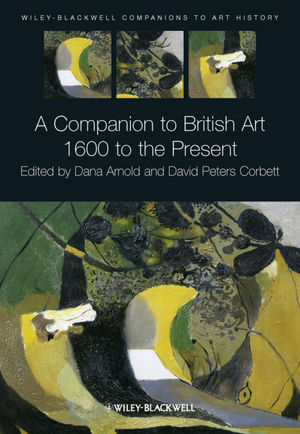 This companion is a collection of newly-commissioned essays written by leading scholars in the field, providing a comprehensive introduction to British art history.
• A generously-illustrated collection of newly-commissioned essays which provides a comprehensive introduction to the history of British arts
• Combines original research with a survey of existing scholarship and the state of the field
• Touches on the whole of the history of British art, from 800-2000, with increasing attention paid to the periods after 1500
• Provides the first comprehensive introduction to British art of the eighteenth, nineteenth, and twentieth centuries, one of the most lively and innovative areas of art-historical study
• Presents in depth the major preoccupations that have emerged from recent scholarship, including aesthetics, gender, British art’s relationship to Modernity, nationhood and nationality, and the institutions of the British art world
Dana Arnold is Professor of Architectural History and Theory at Middlesex University, UK. She has published several books on British architecture and visual culture and is author of the best selling Art History: A Very Short Introduction (2004). She is series editor of New Interventions in Art History, Wiley-Blackwell Companions to Art History, and Blackwell Anthologies in Art History.
David Peters Corbett is Professor of History of Art at the University of East Anglia. He has published a number of books, and has received prizes from the Historians of British Art, College Art Association USA, and a Guardian book of the year award. He is the editor of the journal Art History.
C O N T E N T S
Table of Contents
List of Illustrations viii
Acknowledgements xiii
Notes on Contributors xiv
Editors’ Introduction 1
Part 2 | General
1 The ‘Englishness’ of English Art Theory 13
Mark A. Cheetham
2 Modernity and the British 38
Andrew Ballantyne
3 English Art and Principled Aesthetics 60
Janet Wolff
Part 3 | Institutions
4 “Those Wilder Sorts of Painting”: the Painted Interior in the Age of Antonio Verrio 79
Richard Johns
5 Nineteenth-Century Art Institutions and Academies 105
Colin Trodd
6 Crossing the Boundary: British Art across Victorianism and Modernism 131
David Peters Corbett
7 British Pop Art and the High/Low Divide 156
Simon Faulkner
8 When Attitudes Became Formless: Art and Antagonism in the 1960s 180
Jo Applin
Part 4 | Nationhood
9 Art and Nation in Eighteenth-Century Britain 201
Cynthia Roman
10 International Exhibitions: Linking Culture, Commerce, and Nation 220
Julie F. Codell
11 Itinerant Surrealism: British Surrealism either side of the Second World War 241
Ben Highmore
12 55° North 3° West: a Panorama from Scotland 265
Tom Normand
13 Retrieving, Remapping, and Rewriting Histories of British Art: Lubaina Humid’s “Revenge” 289
Dorothy Rowe
Part 5 | Landscape
14 Defining, Shaping, and Picturing Landscape in the Nineteenth Century 317
Anne Helmreich
15 Theories of the Picturesque 351
Michael Charlesworth
16 Landscape into Art: Painting and Place-Making in England, c.1760–1830 373
Tom Williamson
17 Landscape Painting, c.1770–1840 397
Sam Smiles
18 Landscape and National Identity: the Phoenix Park Dublin 422
Dana Arnold
Part 6 | Men and Women
19 The Elizabethan Miniature 451
Dympna Callaghan
20 “The Crown and Glory of a Woman”: Female Chastity in Eighteenth-Century British Art 473
Kate Retford
21 Serial Portraiture and the Death of Man in Late-Eighteenth-Century Britain 502
Whitney Davis
22 Virtue, Vice, Gossip, and Sex: Narratives of Gender in Victorian and Edwardian Painting 532
Pamela M. Fletcher
Conference | The Global Lowlands
From Brown:
The Global Lowlands in the Early Modern Period, 1300–1800
Dutch and Flemish History and Culture in a Worldwide Perspective
Brown University, 4–5 April 2014
During the early modern period the Lowlands became an entrepôt for global exchanges. They connected outwards to every part of the globe through trade, colonization, expanded knowledge, material culture, and consumption. Antwerp during the sixteenth century, and Amsterdam during the seventeenth century were the first modern cities to dominate world trade and commerce. The Lowlands attracted merchants, immigrants, and visitors while importing and redistributing a vast new array of goods and information, not only effecting the culture, art, and sciences of the Lowlands but touching the lives of many other people, from New Amsterdam and Brazil to Africa, the Indian Ocean, Southeast Asia, Japan, and elsewhere. This conference focuses on the Lowlands as an example of how globalization is affecting Renaissance and Early Modern Studies.
Sponsored by Brown University, the Pembroke Center, the History Department, the program in Renaissance and Early Modern Studies, department of the History of Art & Architecture and the John Carter Brown Library. Pre-registration required: click here.
F R I D A Y , 4 A P R I L 2 0 1 4
5:00 Session 1 | Introduction and Chair: Evelyn Lincoln, Brown University
• Karel Davids, Vrije Universiteit, Amsterdam, “Instrument Makers, Cartographers, and Navigators: The Dutch and Transnational Networks in the Eighteenth-Century Atlantic”
• Mariët Westermann, The Andrew W. Mellon Foundation, “Retrading the Golden Age: Dutch Art and Its Histories”
6:30 Reception
S A T U R D A Y , 5 A P R I L 2 0 1 4
9:00 Session 2 | Chair: Wim Klooster, Clark University
• Claudia Swan, Northwestern University, “Lost in Translation: Exoticism in Early Modern Holland”
• Dániel Margócsy, Hunter College, “Commercial Visions: Global Trade and Scientific Debate, c. 1700”
10:30 Coffee
11:00 Session 3 | Chair: Jeffrey Muller, Brown University
• Mark Meuwese, University of Winnipeg , “Intention to Exterminate: Massacres in the Making of the Dutch Empire, 1600–1750”
• Julie Hochstrasser, University of Iowa, “Whose Baroque? Drawing and Human Experience among the Khoikhoi”
12:30 Lunch
2:00 Session 4 | Chair: Anne McCants, MIT
• Benjamin Schmidt, University of Washington, “Oriental Despots on Ornamental Desks: On Dutch Geography, the ‘Decorative’ Arts, and the Production of the Exotic World”
• Anne Goldgar, King’s College, London, “The Dutch and Natural History in the Seventeenth-Century Arctic”
• Lissa Roberts, University of Twente, “Deshima as a Center of Accumulation and Management”
4:00 General Discussion | Chair: Harold J. Cook, Brown University
Lecture | Rica Jones on Allan Ramsay’s Technique
From the UK’s Institute of Conservation (ICON). . .
Rica Jones on Ramsay’s Technique in Context and Perspective
Grand Robing Room, Freemason’s Hall, London, 16 April 2014
Allan Ramsay took London’s art world by storm when he set up his painting practice in Covent Garden in the late 1730s, and his work remained fashionable for the next two decades. One aspect of his portraiture was much commented on—he painted the faces in shades of red before applying the more naturalistic flesh tones. This paper was first written for the catalogue of the exhibition Allan Ramsay: Portraits of the Enlightenment at The Hunterian Museum and Art Gallery, Glasgow (October 2013 to January 2014). The author will illustrate this feature of Ramsay’s work, examine its significance to Ramsay, and place it in the context of the times.
Rica Jones trained as an art historian before studying the conservation of paintings. Until 2012 she worked as a conservator at the Tate Gallery and published extensively on techniques of painting in Britain from the 16th through the 18th centuries. She continues to work in both fields in the private sector.
Wednesday, 16 April 2014 in the Grand Robing Room at Freemason’s Hall, 60 Great Queen Street London WC2B 5AZ. Close to both Covent Garden and Holborn Tube Stations. Doors open at 6pm. Talk 6.30–8pm. Tickets: ICON members: £10, non-members: £15. Students £5 (student card required to be shown on the door). Free wine and cheese including in price of ticket.
Please register by sending your name and stating if you are an ICON member. Your name must be on the security list no later than Monday, 14 April 2014. RSVP Clare Finn +44 20 7937 1895 or finnclare@aol.com.
New Book | Winckelmann on Art, Architecture, and Archaeology
From Boydell & Brewer:
Johann Joachim Winckelmann on Art, Architecture, and Archaeology, translated by David Carter (Rochester, NY: Boydell & Brewer, 2013), 280 pages, ISBN: 978-1571135209, $90.
 Johann Joachim Winckelmann (1717–68) has long been recognized as one of the founders of modern art history and a major force in the development of archaeology and the study of ancient Greek architecture. He also exerted an influence on the Weimar Classicism of Goethe and Schiller, for whom his description of Greek sculpture as evoking “edle Einfalt und stille Grösse” (noble simplicity and a calm greatness) became a watchword. He contributed to modern scientific archaeology through his application of empirically derived categories of style to the analysis of classical works of art and architecture, and was one of the first to undertake detailed empirical examinations of artifacts and describe them precisely in a way that enabled reasoned conclusions to be drawn about ancient societies and their cultures. Yet several of his important essays are not available in modern English translation. The present volume remedies this situation by collecting four of Winckelmann’s most seminal essays on art along with several shorter pieces on the topic, two major if brief essays on architecture, and one longer essay on archaeology. Paired with this is an introduction covering Winckelmann’s life and work.
David Carter is retired as Professor of Communicative English at Yonsei University, Seoul, Korea, and is former Lecturer in German Studies at the University of Southampton, UK. Among his recently published translations from German are Klaus Mann’s novel Alexander (2008) and On Cocaine (2011), a collection of Sigmund Freud’s writings on the topic.
C O N T E N T S
1 Translator’s Acknowledgments
2 Introduction
3 Thoughts on the Imitation of Greek Works in Painting and the Art of Sculpture
4 Open Letter on Thoughts on the Imitation of Greek Works in Painting and the Art of Sculpture
5 Explanation of Thoughts on the Imitation of Greek Works in Painting and the Art of Sculpture and Response to the Open Letter on These Thoughts
6 More Mature Thoughts on the Imitation of the Ancients with Respect to Drawing and the Art of Sculpture
7 Description of the Most Excellent Paintings in the Dresden Gallery
8 Reflections on Art
9 Recalling the Observation of Works of Art
10 On Grace in Works of Art
11 Description of the Torso in the Belvedere in Rome
12 Treatise on the Capacity for Sensitivity to the Beautiful in Art and the Method of Teaching It
13 Remarks on the Architecture of the Old Temples at Agrigento in Sicily
14 Preliminary Report on Remarks on the Architecture of the Ancients
15 Open Letter on the Herculanean Excavations
16 Notes
17 Select Bibliography
Exhibition | Ruin Lust
For anyone with Richard Wilson on the mind, he turns up in Tate Britain’s ruin exhibition, too.
Ruin Lust
Tate Britain, London, 4 March — 18 May 2014
Curated by Brian Dillon, Emma Chambers, and Amy Concannon
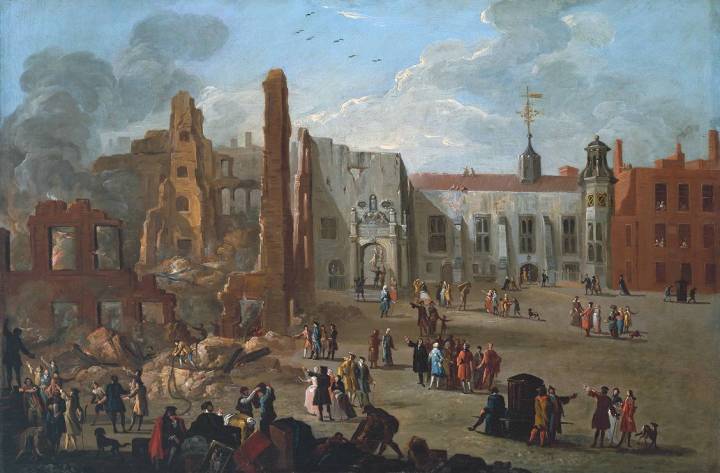
Richard Wilson, The Inner Temple after the Fire of 4 January 1737, oil on canvas, 1737 (Tate Britain). The picture records the devastation caused by a fire that destroyed Crown-Office Row in the Inner Temple. The group in the centre includes Frederick, Prince of Wales (in blue, wearing the Garter star), who had sent fifty soldiers to help the firemen and later came to inspect the scene himself. More information is available here»
◊ ◊ ◊ ◊ ◊
Ruin Lust, an exhibition at Tate Britain from 4 March 2014, offers a guide to the mournful, thrilling, comic and perverse uses of ruins in art from the eighteenth century to the present day. The exhibition is the widest-ranging on the subject to date and includes over 100 works by artists such as J.M.W. Turner, John Constable, John Martin, Eduardo Paolozzi, Rachel Whiteread, and Tacita Dean.
The exhibition begins in the midst of the craze for ruins that overtook artists, writers and architects in the eighteenth century. J.M.W. Turner and John Constable were among those who toured Britain in search of ruins and picturesque landscapes, producing works such as Turner’s Tintern Abbey: The Crossing and Chancel, Looking towards the East Window 1794 and Constable’s Sketch for ‘Hadleigh Castle’ c.1828–29.
 This ruinous heritage has been revisited—and sometimes mocked—by later artists such as Keith Arnatt, who photographed the juxtaposition of historic and modern elements at picturesque sites for his deadpan series A.O.N.B. (Areas of Outstanding Natural Beauty) 1982–84 and John Latham whose sculpture Five Sisters Bing 1976, which was part of a project to turn post-industrial shale heaps in Scotland into monuments. Classical ruins have a continued presence in the work of Eduardo Paolozzi, Ian Hamilton Finlay, and John Stezaker. In works such as Keith Coventry’s Heygate Estate 1995 and Rachel Whiteread’s Demolished—B: Clapton Park Estate 1996, which shows the demolition of Hackney tower blocks, we see Modernist architectural dreams destroyed.
The exhibition explores ruination through both the slow picturesque decay and abrupt apocalypse. John Martin’s The Destruction of Pompeii and Herculaneum 1822 recreates historical disaster while Gustave Doré’s engraving The New Zealander 1872 shows a ruined London. The cracked dome of St Paul’s Cathedral in the distance was a scene partly realised during the Blitz.
Ruin Lust will include work provoked by the wars of the twentieth century, including Graham Sutherland’s Devastation series 1940–41, which depicts the aftermath of the Blitz and Jane and Louise Wilson’s 2006 photographs of the Nazis’ defensive Atlantic Wall. Paul Nash’s photographs of surreal fragments in the 1930s and 40s, or Jon Savage’s images of a desolate London in the late 1970s show how artists also view ruins as zones of pure potential, where the world must be rebuilt or reimagined.
The exhibition will include rooms devoted to Tacita Dean and Gerard Byrne. Dean’s nostalgic film installation Kodak 2006 explores the ruin of the image, as the technology of 16 mm film becomes obsolescent. In 1984 and Beyond 2005–07, Byrne reimagines a future that might have been. The installation presents a re-enactment of a discussion, published in Playboy in 1963, in which science fiction writers—including Isaac Asimov, Ray Bradbury, and Arthur C. Clarke—speculate about what the world might be like in 1984.
This transhistorical exhibition is curated by writer and critic Brian Dillon; Emma Chambers, Curator of Modern British Art; and Amy Concannon, Assistant Curator of British Art, 1790–1850. It will be accompanied by a book and a programme of talks and events in the gallery.
◊ ◊ ◊ ◊ ◊
From Tate Britain’s bookshop:
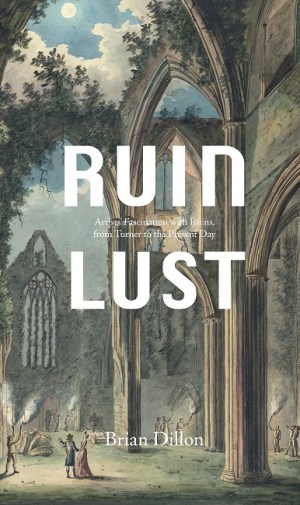
Brian Dillon, Ruin Lust: Artists’ Fascination with Ruins from Turner to the Present Day (London: Tate Publishing, 2014), 64 pages, ISBN: 978-1849763011, £10 / $22.
Why are we fascinated by ruins? They recall the glory of dead civilisations and the certain end of our own. They stand as monuments to historic disasters, but also provoke dreams about futures born from destruction and decay. Ruins are bleak but alluring reminders of our vulnerable place in time and space. For centuries, ruins have attracted artists: among them J.M.W. Turner, Gustave Doré, Paul Nash, Graham Sutherland, Patrick Caulf eld, Tacita Dean, and Jane and Louise Wilson. Ruin Lust explores the history of this obsession, from the art of the picturesque in the eighteenth century, through the wreckage of two world wars, to contemporary artists complex attitudes to the ruins of the recent past.
Brian Dillon is a novelist, critic, and curator who has explored many ancient and modern ruins and written widely on the history of ruination in art and culture. His books include: Objects in this Mirror: Essays; Sanctuary; In the Dark Room; and Ruins, an anthology of artists and critics reflections on ruination. He is UK editor of Cabinet magazine and reader in critical writing at the Royal College of Art.
Exhibition and Lectures | Diverse Maniere: Piranesi, Fantasy and Excess
From the Soane Museum:
Diverse Maniere: Piranesi, Fantasy and Excess
Sir John Soane’s Museum, London, 7 March — 31 May 2014
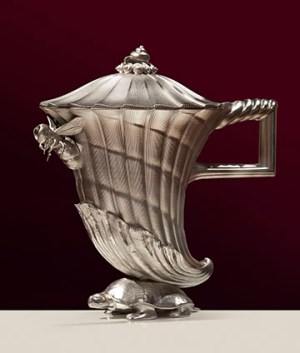
Coffee pot from Piranesi’s Diverse maniere d’adornare i cammini… (1769), cast in silver from digitally modeled elements © Factum Arte.
Sir John Soane’s Museum has one of the richest holdings of graphic work by Piranesi and this exhibition continues the exploration of Soane’s interest in Piranesi. Diverse Maniere will focus upon Piranesi’s engagement with the decorative arts. The displays will consist of meticulous three dimensional reproductions of the objects, such as coffee pots, chairs, chimneypieces and antique candelabra, tripods and altars imagined by Piranesi in such publication as Diverse Maniere or Vasi, Candelabri, Cippi etc…, but never actually realised physically. Now using the latest scanning and 3-dimensional printing technologies Factum Arte has realised Piranesi’s vision as a designer. Bronze Tripods, porphyry altars and marble candelabra will embellish the rooms of No 13 Lincoln’s Inn Fields, whilst in the Soane Gallery a display of Piranesi’s related etchings and explication of Factum Arte’s work will accompany the show. Surely, Sir John Soane, with his love of new technologies, his collections of plaster ‘reproductions’ after the antique, and his fascination with Piranesi’s boundless imagination would find this a particularly appropriate exhibition.
As part of our programme of events, three panel discussions, involving architects, designers, artists and academics, will look at how different disciplines approach these issues and what they might tell us about architectural and design practice in the past and how it has evolved today. All talks will begin at 6pm and take place at the Royal College of Surgeons, WC2A 3PE. Early bird ticket offer: purchase tickets for all three talks for £40. Individual lecture tickets, £15. Click here to find out more or to purchase tickets.
Visualising Design Ideas, 10 March 2014
Speakers: Michele de Lucchi, Ross Lovegrove and Adam Lowe
Using Objects as Evidence of Themselves, 18 March 2014
Speakers: Jerry Brotton, Lisa Jardine and Grayson Perry
Casts, Copies & the Dissemination of Design Ideas, 19 May 2014
Speakers: Adriano Aymonino and Sam Jacob
Display | Art, Revolution and War: France, 1789–1914
From The Fitzwilliam:
Art, Revolution and War: France, 1789–1914
The Fitzwilliam Museum, Cambridge, 4 March — 28 September 2014
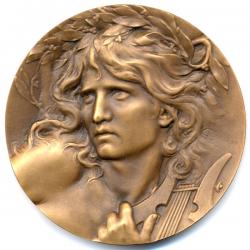 Medals, coins, and banknotes illustrate key moments in the political and artistic history of France. This display focuses on the 1789 revolution, Napoleon, the 1848 revolution, and the artistic triumphs of Art Nouveau. One of the most famous examples of the Art Nouveau style in French medals is Orphée by Marie-Alexandre Lucien Coudray (pictured right). This was exhibited to great acclaim at the 1900 Universal Exhibition in Paris, with thousands of copies sold to art lovers.
Display | From Root to Tip: Botanical Art in Britain
From The Fitzwilliam:
From Root to Tip: Botanical Art in Britain
The Fitzwilliam Museum, Cambridge, 28 January — 11 May 2014
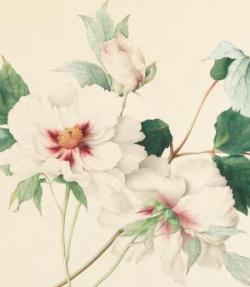 This exhibition brings together a selection of watercolours from the Fitzwilliam’s outstanding collection of botanical art. It draws on over 300 years of work by both professional and amateur artists, tracing a history of flower drawing in Britain. Works on show date from the seventeenth century to present day. See finely executed watercolours by many well-known and influential artists, including Georg Dionusius Ehret, who settled in Britain in 1736, and William Henry Hunt. These are displayed alongside recently acquired pieces by contemporary artists such as Margaret Stones and Rebecca John. The exhibition shows how artists have depicted plants and flowers in glorious detail as both botanical specimens and as part of decorative arrangements.
New Book | The Golden Age of Botanical Art
Published by The University of Chicago Press in September 2013 (having first appeared in Europe in 2012). . .
Martyn Rix, The Golden Age of Botanical Art (Chicago: The University of Chicago Press, 2013), 256 pages, ISBN: 978-0226093598, $35.
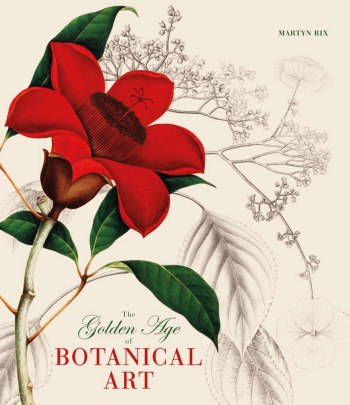 The seventeenth century heralded a golden age of exploration, as intrepid travelers sailed around the world to gain firsthand knowledge of previously unknown continents. These explorers also collected the world’s most beautiful flora, and often their findings were recorded for posterity by talented professional artists. The Golden Age of Botanical Art tells the story of these exciting plant-hunting journeys and marries it with full-color reproductions of the stunning artwork they produced. Covering work through the nineteenth century, this lavishly illustrated book offers readers a look at 250 rare or unpublished images by some of the world’s most important botanical artists.
Truly global in its scope, The Golden Age of Botanical Art features work by artists from Europe, China, and India, recording plants from places as disparate as Africa and South America. Martyn Rix has compiled the stories and art not only of well-known figures—such as Leonardo da Vinci and the artists of Empress Josephine Bonaparte—but also of those adventurous botanists and painters whose names and work have been forgotten. A celebration of both extraordinarily beautiful plant life and the globe-trotting men and women who found and recorded it, The Golden Age of Botanical Art will enchant gardeners and art lovers alike.
Martyn Rix is a botanist and the Editor of Curtis’s Botanical Magazine, and as such has an unrivalled knowledge of botanical art. With a PhD in Botany from the University of Cambridge, he has worked at the University Botanic Garden in Zurich and at the RHS Garden, Wisley and has made many expeditions to different parts of the world, to collect new plants for gardens. He is the author or co-author of a number of books, including the highly acclaimed The Botanical Garden.
C O N T E N T S
Introduction
1 The Origins of Botanical Art / Leonardo da Vinci
2 Early Works of the Sixteenth Century / Jacopo Ligozzi
3 Seventeenth-Century Florilegia / Dutch Flower Paintings
4 North American Plants / Linnaeus and Plant Classification
5 Travellers to the Levant / Maria Sybilla Merian
6 The Exploration of Russia and Japan / Les Vélins du Muséum
7 Botany Bay and Beyond / Sir Joseph Banks
8 The Golden Age in England / Mrs. Delany and Her Paper Mosaicks
9 South American Adventures / Thornton’s The Temple of Flora, or Garden of Nature
10 The Golden Age in France / Empress Joséphine
11 Botanical and Horticultural Illustrated Journals / Henry C. Andrews
12 Early Chinese Plant Drawings / Père David and the French Missionaries
13 The Company School in India / The Story of Flora Danica 1761–1883
14 A New Era at Kew / George Maw
15 Victorian Travellers / Elwes and the Genus Lilium
16 Bringing China to Europe / Modern Florilegia
17 The Flowers of War and Beyond / Exhibiting Botanical Watercolours
18 Carrying on the Tradition
Index
Bibliography
Publishers’ Credits










 Enfilade
leave a comment