Exhibition | Etruscan Enchantment
From Holkham Hall:
Etruscan Enchantment: From the Secrets of Holkham Hall to the Wonders of the British Museum
Seduzione Etrusca: Dai Segreti di Holkham Hall alle Meraviglie del British Museum
Museo dell’Accademia Etrusca e della Città di Cortona, Palazzo Casali, Cortona, 22 March — 31 July 2014
◊ ◊ ◊ ◊ ◊
2014 will see Holkham Hall’s largest international collaboration since the eighteenth century. From March to July, the MAEC (Museo dell’Accademia Etrusca e della Città di Cortona) in Cortona, Tuscany, will host an exhibition of sculpture, paintings, prints, drawings and manuscripts drawn from the Uffizi museums in Florence, the Vatican Museums, the British Museum in London, and Holkham Hall.
 The exhibition, which will run from 22nd March to 31st July, centres on a moment of crucial importance in the history of archaeology and of Tuscany itself, that is the publication of Thomas Dempster’s De Etruria regali (On Royal Tuscany) in Florence in 1723 and 1726. The publication was entirely funded by the young Thomas Coke, the builder of Holkham Hall, and led to the foundation in 1727 of one of most important learned societies in Italy, the Accademia Etrusca. Since its beginnings, the Accademia has been housed in the medieval Palazzo Casali in Cortona, now the home of the MAEC itself.
Thomas Dempster (1579–1635) was an impoverished Scottish nobleman who taught at universities throughout Europe, and ended his career as Professor of Humanities in Bologna. Between 1616 and 1619, he compiled the De Etruria Regali, a monumental history of the Etruscan (broadly, Tuscan) people, the very first attempt to demonstrate the existence of a highly developed civilisation in Italy before the Romans. The work remained unpublished in Dempster’s lifetime, and survived in only one copy, in his own handwriting. This unique manuscript copy was purchased for Thomas Coke by his Grand Tour tutor-governor, Thomas Hobart, in July 1719, from the Florentine scholar Anton Maria Salvini, at a price of eleven guineas. It is still in the library at Holkham Hall, as MS 501.
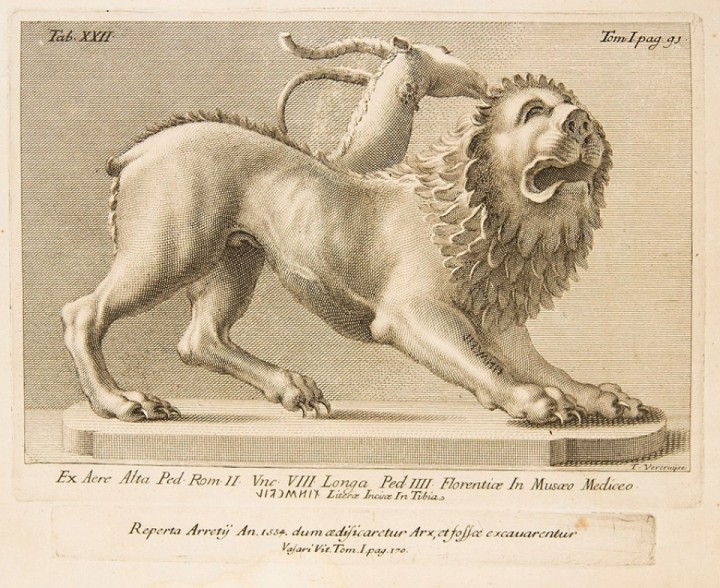
Thomas Coke returned the manuscript to Florence and paid for the publication of work at a cost of over 2,000 Florentine scudi. Under the supervision of the antiquarian Senator Filippo Buonarotti, whom Coke and Hobart had visited several times while they were in Italy, a substantial programme of illustration was added to the printed edition. For the first time, a work of ancient history was based on the evidence of surviving artefacts and objects rather than on written sources, laying the foundations for modern archaeology. The printed volumes were dedicated to the Grand Dukes of Tuscany, whose dynasty was traced in the text back to the Etruscans themselves! The frontispiece to volume 2 is a portrait of Grand Duke Gian Gastone de’ Medici. He was the last of the line, and on his death in 1737, the family who had dominated Tuscany for centuries died out.
The importance of Coke’s role was only fully understood in 2007 with the discovery at Holkham by Dr Suzanne Reynolds of the accounts for the production process, documenting payments to the artists, engravers, and editors who worked on the project. These documents will be on display in the exhibition, along with the autograph manuscript of the text. Also on display will be the original drawings and copper plates for the illustrations which were discovered in the attics at Holkham by the 5th Earl of Leicester in 1964. The drawings were in the original leather wallet in which they had been sent back to England from Italy after publication.
Some three hundred years after Thomas Coke first arrived in Italy in November 1713, Holkham is also lending paintings, drawings and manuscripts that attest to his passion for Italian history and art. Highlights include Procaccini’s Tarquinius and Lucretia, paintings and drawings by Claude and Vanvitelli, and some of the most beautifully illuminated medieval manuscripts of ancient history from the Holkham Library.
-Dr Suzanne Reynolds (Curator of Manuscripts and Printed Books, Holkham Hall) September 2013










 Enfilade
leave a comment