Exhibition | Things We Do in Bed
From the exhibition description at Art Daily:
Things We Do in Bed
Danson House, Bexleyheath, Kent, 1 April — 31 October 2014
Curated by Tracy Chevalier
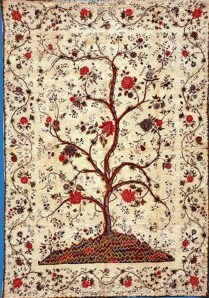
Tree of Life Quilt cropped, detail, c.1810 (Jen Jones Welsh Quilt Centre)
Things We Do in Bed celebrates quilts and their continuing links to what goes on behind the bedroom door. Featuring quilts and quilt works dating from the 18th and 19th centuries, alongside contemporary work, the exhibition is displayed through the five bedrooms in Danson House, with each room focusing on a different bed activity: Birth, Sleep, Sex, Illness, Death.
The exhibition features a lively mix of antique and contemporary quilts including:
• intricate 18th- and 19th-century cot quilts with quilted feathers and flowers and colourful patchwork designs
• a new ‘sleep quilt’ from Fine Cell Work, a charity that teaches prisoners to sew; prisoners all over the UK were asked to make squares exploring their feelings about sleep, and join them together in this quilt
• Karina Thompson’s quilt which captures an echocardiogram examining the maker’s heartbeats
• Grayson Perry’s Right to Life quilt, made as a provocative response to the abortion debate in the USA
 • Sue Watters’ hand stitched quilt, Unchained Melody which she made sitting by her husband’s side while he was in the final stages of Alzheimer’s, with sewing and music as her solace
Tracy Chevalier is an internationally bestselling author of seven novels. In her most recent book, The Last Runaway, her heroine is a quilter. As well as learning a lot about quilts, Tracy learned to quilt by hand. As she says: “Since researching quilts for my last novel, I have fallen hard for the varied and miraculous artistry of quilting. With this show I explore how quilting relates to bedroom activities, in both practical and abstract ways. For traditionalists, there are jaw-dropping examples of antique quilt-making. For contemporary art lovers, there are works that push boundaries and emotions.”
◊ ◊ ◊ ◊ ◊
Hannah Duguid writes about the exhibition for The Independent (8 April 2014).
Call for Papers | Facing the Unknown: Anonymity in the History of Art
From the symposium website:
Student Symposium | Facing the Unknown: Anonymity in the History of Art
The Cleveland Museum of Art, 24 October 2014
Proposals due by 15 June 2014
The Case Western Reserve University/Cleveland Museum of Art Joint Graduate Program in Art History & Museum Studies invites submissions from all areas of art history for the 40th Annual Cleveland Symposium. Facing the Unknown: Anonymity in the History of Art seeks papers which address the theme of anonymity or the unknown in the visual arts. The obscurity of an artist, subject, function, or context may be a byproduct of the passage of time, of traditional cultural practices, or a conscious decision on the part of the maker. This symposium aims to explore the ways in which an anonymous aspect of a work may influence its interpretation, function, classification, or perceived value throughout the object’s history.
Potential topics include, but are not limited to:
• Anonymous artists or makers
• Images of unknown subjects or for unknown patrons
• Objects with undetermined function or context
• Works of questionable authenticity, attribution, dating, or provenance
• Objects with elements that have been deliberately effaced, obscured, or omitted
• Lost works of art
• Previously unknown, unstudied, or unpublished artists or artworks
• Intentional use of anonymity, including works that mask or conceal identity
Doctoral and master’s degree students in art history and related disciplines are invited to submit a 250-word abstract and C.V. to clevelandsymposium@gmail.com by June 15, 2014. Applicants will receive notification of their status via email by August 1, 2014.
The 40th Annual Cleveland Symposium will be held in conjunction with the Symposium in Honor of Ellen G. Landau, Andrew W. Mellon Professor Emerita in the Humanities, to take place on Saturday, October 25, 2014 at the MOCA Cleveland. The keynote speaker for both events is Dr. Joan Marter, Board of Governors Professor of Contemporary Painting and Sculpture, Rutgers University, who will speak after the conclusion of the program on Friday October 24.
Newly Conserved and Renovated Salon Doré Unveiled

◊ ◊ ◊ ◊ ◊
The newly restored Salon Doré has just opened at the Legion of Honor Museum in San Francisco:
The Salon Doré from the Hôtel de La Trémoille is one of the finest examples of French Neoclassical interior architecture in the United States. Richly carved and ornately gilded, it was designed during the reign of Louis XVI as the main salon de compagnie—a receiving room for guests—of the Hôtel de La Trémoille on the rue Saint-Dominique in Paris.
After being moved not less than seven times between 1877 and today, its appearance and presentation was greatly changed from its original aspect. For a period of 18 months from 2012 to 2014, the Fine Arts Museums of San Francisco closed the Salon Doré and the adjacent British art gallery at the Legion of Honor to allow for the comprehensive conservation and renovation of this important 18th-century period room.
Over the course of the conservation and renovation project, curators, conservators, and architects reinstated the room’s original floor plan, restored the gilding and paint, repaired and replaced key carved elements, and installed an 18th-century parquet floor, a coved ceiling, windows, and new lighting.
In its new installation, a new program of period furnishings bring renewed focus to the room’s character and original purpose by demonstrating the social function of the room as a salon de compagnie, a formal room for receiving guests and conversation. The renovated Salon Doré at the Legion of Honor is a truly groundbreaking museum display that sets a new standard for American period rooms.
◊ ◊ ◊ ◊ ◊
The museum’s website includes several instructive videos explaining the project.
The Style Saloniste, the blog of Diane Dorrans Saeks, includes a report (31 March 2014) by Philip Bewley, who spoke with both the museum curator Martin Chapman and project architect Andrew Skurman.
New Book | Globes: 400 Years of Exploration, Navigation, and Power
From The University of Chicago Press:
Sylvia Sumira, Globes: 400 Years of Exploration, Navigation, and Power (Chicago: The University of Chicago Press, 2014), 224 pages, ISBN: 978-0226139005, $45.
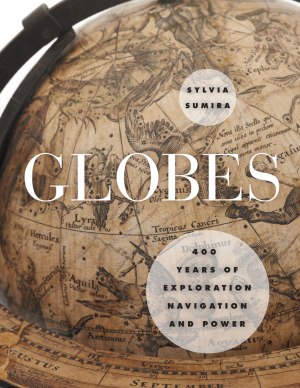 The concept of the earth as a sphere has been around for centuries, emerging around the time of Pythagoras in the sixth century BC, and eventually becoming dominant as other thinkers of the ancient world, including Plato and Aristotle, accepted the idea. The first record of an actual globe being made is found in verse, written by the poet Aratus of Soli, who describes a celestial sphere of the stars by Greek astronomer Eudoxus of Cnidus (ca. 408–355 BC). The oldest surviving globe—a celestial globe held up by Atlas’s shoulders—dates back to 150 AD, but in the West, globes were not made again for about a thousand years. It was not until the fifteenth century that terrestrial globes gained importance, culminating when German geographer Martin Behaim created what is thought to be the oldest surviving terrestrial globe. In Globes: 400 Years of Exploration, Navigation, and Power, Sylvia Sumira, beginning with Behaim’s globe, offers a authoritative and striking illustrated history of the subsequent four hundred years of globe making.
Showcasing the impressive collection of globes held by the British Library, Sumira traces the inception and progression of globes during the period in which they were most widely used—from the late fifteenth century to the late nineteenth century—shedding light on their purpose, function, influence, and manufacture, as well as the cartographers, printers, and instrument makers who created them. She takes readers on a chronological journey around the world to examine a wide variety of globes, from those of the Renaissance that demonstrated a renewed interest in classical thinkers; to those of James Wilson, the first successful commercial globe maker in America; to those mass-produced in Boston and New York beginning in the 1800s. Along the way, Sumira not only details the historical significance of each globe, but also pays special attention to their materials and methods of manufacture and how these evolved over the centuries.
Sylvia Sumira is a leading authority on historic globes and one of few conservators in the world to specialize in printed globes. She worked at the National Maritime Museum, Greenwich before setting up her own studio, where she carries out conservation work for museums, libraries, and other institutions, as well as for private owners. She lives in London.
Exhibition | The Three Graces of Antonio Canova

From the Canova Museum:
Le Grazie di Antonio Canova
Museo e Gipsoteca Antonio Canova, Possagno, 6 December 2013 — 4 May 2014
Canova le ha interpretate in due esemplari, molto simili. Il primo, ora all’Ermitage di San Pietroburgo, glielo commissionò Josephine de Beauharnais, all’epoca moglie di Napoleone; il secondo al Duca di Bedford che, visto il gesso che lo scultore teneva nel suo atelier romano, lo supplicò di creargli un ulteriore esemplare in marmo. Canova riprese il modello, apportando piccoli cambiamenti e, quasi per allontanare il momento di distacco dall’opera, l’accompagnò personalmente sino alla nuova dimora inglese. Oggi quel magnifico marmo è equamente suddiviso, sette anni ciascuno, dalla National Gallery of Scotland di Edimburgo e dal Victoria & Albert Museum di Londra.
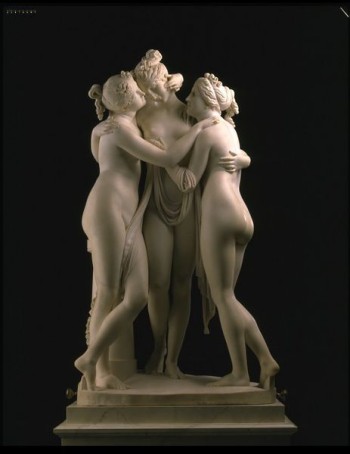
Antonio Canova, The Three Graces (London: V&A)
Dall’inizio di quelle vicende sono passati esattamente due secoli: il modello originale in gesso delle Grazie è infatti datato 1813. In questi due secoli la fama delle tre bellezze canoviane è diventata universale. La sinuosità delle forme femminili, la delicatezza e la morbidezza nonché la ricercata levigatezza del marmo determinano un gioco di luci ed ombre che affascinano chiunque le ammiri.
Nella sua Casa-Museo, nella natia Possagno, Canova lasciò il gesso originale della prima versione delle Grazie, quel gesso su cui aveva lavorato per creare il suo capolavoro. La levigatezza del marmo finale era qui ricreata da una patina in cera d’api. A Possagno giunse anche il gesso tratto dalle Grazie inglesi, quale documento da conservare a perenne memoria dell’arte del grande scultore.
Grazia e violenza non vanno d’accordo. Lo conferma, se ce ne fosse bisogno, il destino dei due capolavori del Canova. I gessi, con altre opere conservate nella Gipsoteca vennero investiti dalla nuvola di calcinacci causata dai cannoneggiamenti austroungarici durante la Prima Grande Guerra, quando Possagno, ai piedi del Grappa, era zona di battaglia. Particolarmente gravi i danni subiti dal gruppo “inglese” che vide le Grazie ritrovarsi con volti e busti drammaticamente lesionati. All’indomani del conflitto, Stefano e Siro Serafin, custodi e abilissimi restauratori, sanarono molti dei danni. Non agirono invece sulle Grazie di Bedfod che, deturpate trovarono sede nella sala del consiglio comunale di Possagno, a stridente ricordo di un guerra terribile per il paese. Il secondo gruppo di Grazie, restaurato è esposto nell’Ala Scarpiana della Gipsoteca.
A cent’anni dallo scoppio della Grande Guerra, mentre l’Europa si appresta a ricordare quel centenario, anche le Grazie “inglesi” risorgono, ritrovando tutte le loro parti. Quello che i Serafin non si sentirono di fare lo consente ora la tecnologia.
Grazie alla collaborazione delle National Galleries of Scotland, di Edinburgo, proprietari del prezioso marmo, è stato possibile fotografare e scansionare l’opera e grazie all’elettronica si è riusciti a ricomporre le parti mancanti al gesso di Possagno.
“Se Canova avesse lasciato sul marmo una sola impronta digitale, la ritroveremmo sul gesso restaurato”. Ad affermarlo è Mario Guderzo Direttore del Museo e Gipsoteca Antonio Canova di Possagno che, con Ugo Soragni, Direttore Regione per i Beni Culturali, Giuseppe Pavanello, dell’Università di Trieste e Direttore del Centro Studi Canoviani di Possagno, Marica Mercalli, Soprintendente per i Beni Storici e Artistici ed Etnoantropologici per le Province di Venezia, Padova, Belluno e Treviso e Aidan Weston Lewis, dello Scottish National Gallery di Edinburgo, Guancarlo Cunial della Gipsoteca di Possagno, componenti dell Comitato Scientifico della mostra. A dire dell’incredibile grado di perfezione raggiunto da questa tecnica, che aveva già dato prova di sé per un altro gesso di Canova, la Danzatrice, anch’essa deturpata dalla guerra, che ha ritrovato braccia e cembali.
In mostra, dal 7 dicembre al 4 maggio, si potranno ammirare entrambi gruppi delle Grazie, quello “russo”, e quello “inglese” così recuperato. Con i gessi, i due bozzetti, l’uno proveniente dal Museo di Lione, il secondo oggi di proprietà del Museo di Bassano. Poi tempere, disegni, incisioni, sempre intono al tema delle Grazie.
Mostra nella mostra è l’esposizione delle crude immagini della Gipstoteca e dei Gessi di Canova all’indomani dei bombardamenti: immagini concesse da due archivi pubblici, drammatiche nella volontà di costituire una precisa documentazione di un orrore.
“Questa mostra, afferma il Presidente della Fondazione Canova, Giancarlo Galan, sarà un’ulteriore conferma della centralità del patrimonio canoviano conservato gelosamente a Possagno e ne sottolineerà l’impegno espresso in termini di tutela e valorizzazione delle opere. Rimane fondamentale per la Storia dell’arte quanto Canova ha voluto lasciare alla sua terra facendola, così, diventare il centro mondiale dell’arte del grande Scultore.
New Book | Mimesis Across Empires
From Duke UP:
Natasha Eaton, Mimesis across Empires: Artworks and Networks in India, 1765–1860 (Durham: Duke University Press, 2013), 352 pages, ISBN: 978-0822354802, $30.
 In Mimesis Across Empires, Natasha Eaton examines the interactions, attachments, and crossings between the visual cultures of the Mughal and British Empires during the formative period of British imperial rule in India. Eaton explores how the aesthetics of Mughal ‘vernacular’ art and British ‘realist’ art mutually informed one another to create a hybrid visual economy. By tracing the exchange of objects and ideas—between Mughal artists and British collectors, British artists and Indian subjects, and Indian elites and British artists—she shows how Mughal artists influenced British conceptions of their art, their empire, and themselves, even as European art gave Indian painters a new visual vocabulary with which to critique colonial politics and aesthetics. By placing her analysis of visual culture in relation to other cultural encounters—ethnographic, legislative, diplomatic—Eaton uncovers deeper intimacies and hostilities between
the colonizer and the colonized, linking artistic mimesis to the larger colonial
project in India.
Natasha Eaton is a Lecturer in the History of Art at University College London.
◊ ◊ ◊ ◊ ◊
C O N T E N T S
List of Illustrations
Acknowledgments
Introduction
1. Colonizing the Exotic: Indian and Colonial Art in London
2. The Mirroring of Mirrors: Nostalgia, Sovereignty, and Unhomely Images in Calcutta
3. Mimicking Kingship: Sovereign Genealogies, Vernacular Landscape, and the Work of William Hodges
4. Art and Gift in India: Mimesis and Inalienability
5. Sacrifice and the Double: Physiognomy, Divination, and Ethnographic Art in India
Conclusion
Notes
Works Cited
Index
New Book | Colour, Art, and Empire
From Macmillan:
Natasha Eaton, Colour, Art, and Empire: Visual Culture and the Nomadism of Representation (London: I. B. Tauris, 2013), 416 pages, ISBN: 978-1780765198, $105.
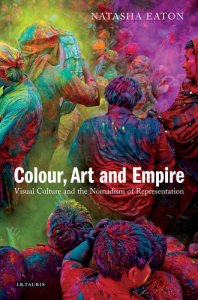 Colour, Art and Empire explores the entanglements of visual culture, enchanted technologies, waste, revolution, resistance and otherness. The materiality of color offers a critical and timely force-field for approaching afresh debates on colonialism. Located at the thresholds of nomenclature, imitation, mimesis and affect, this book analyses the formation of color and politics as qualitative overspill. Here color can be viewed both as central and supplemental to early photography, the totem, alchemy, tantra and mysticism. From the 18th-century Austrian empress Maria Theresa, to Rabindranath Tagore and Gandhi, to 1970s Bollywood, color makes us adjust our take on the politics of the human sensorium as defamiliarizing and disorienting.
Color wreaks havoc with western expectations of biological determinism, objectivity and eugenics. Beyond the cracks of such discursive practice, color becomes a sentient and nomadic retort to be pitted against a perceived colonial hegemony. Its alter materiality’s and ideological reinvention as a resource for independence struggles, makes color fundamental to multivalent genealogies of artistic and political action and their relevance to the present.
Natasha Eaton is a Lecturer in the History of Art at University College London.
◊ ◊ ◊ ◊ ◊
C O N T E N T S
1. Introduction: Chromo Zones and the Nomadism of Colour
2. Alchemy, Painting and Revolution in India, 1750–1860
3. Supplement, Subaltern Art, Design and Dyeing in Britain and South Asia, 1851–1905
4. Part 1: Still Dreaming of the Blue Flower? Race, Anthropology and the Colour Sense
5. Part 2: Creole Laboratory: Anthropology and Affect in the Torres Strait
6. Swadeshi Colour Throughout the Philtre/Filter of Indian Nationalism, 1905–1947
Exhibition | Baroque Paintings from the Francesco Molinari Collection
From the Uffizi:
Rooms of the Muses: Baroque Paintings from the Francesco Molinari Collection
Uffizi, Florence, 11 February — 11 May 2014

Carlo Magini, Still-life with Vegetables, Bread, Calf’s Head, and Kitchen Utensils, ca. 1760–1800
The Molinari Pradelli private collection is internationally renown and the most important formed in Bologna in the twentieth century. The famed orchestra conductor Francesco Molinari Pradelli (1911–1996) traveled all over the world during his professional career and loved collecting high quality works of art.
With over 100 paintings from the collection, the Uffizi Gallery pays homage to a prestigious conductor who worked in Florence at the helm of the Maggio Musicale Fiorentino and at the Teatro Comunale. The conductor had success all over the world, in Europe and America, from Vienna to San Francisco to New York’s Metropolitan Opera. His growing passion for collecting paintings started in the 1950s, first with nineteenth-century works and then discovering Baroque painting. He developed an attraction for still-lifes, a genre just beginning to garner interested from scholars. Great art historians from Europe and America came to admire the maestro’s large private collection of seventeenth- and eighteenth-century painting from various Italian schools and the particular attention for models.
Call for Papers | CAA in New York, 2015
The following selection of panels may be of interest for scholars of the eighteenth century, though readers are encouraged to consult the full Call for Participation. HECAA members are asked to pay special attention to two sessions: 1) a commemorative panel for Donald Posner chaired by Andria Derstine and Rena Hoisington and 2) a new scholars workshop led by Jennifer Milam (details for the latter will follow soon). –CH
◊ ◊ ◊ ◊ ◊
103rd Annual Conference of the College Art Association
New York, 11–14 February 2015
Proposals due by 9 May 2014
The 2015 Call for Participation for the 103rd Annual Conference, taking place February 11–14 in New York, describes many of next year’s sessions. CAA and the session chairs invite your participation: please follow the instructions in the booklet to submit a proposal for a paper or presentation. This publication also includes a call for Poster Session proposals.
◊ ◊ ◊ ◊ ◊
Donald Posner and the Study of Seventeenth- and Eighteenth-Century French and Italian Art
Andria Derstine, Allen Memorial Art Museum, Oberlin College; Rena M. Hoisington, Baltimore Museum of Art, Andria.Derstine@oberlin.edu and RHoisington@artbma.org
Donald Posner (1931–2005), the Ailsa Mellon Bruce Professor of Fine Arts at the Institute of Fine Arts, New York University, was one of a select group of art historians who, beginning in the 1950s and 1960s, significantly advanced scholarly inquiry into the Italian and French Baroque. From his first published article, on Le Brun’s Triumphs of Alexander series (1959), to his work on Annibale Carracci, Caravaggio, Domenichino, Lanfranco, Callot, and Poussin, his work helped to initiate and direct future research in the field. In the late 1960s and early 1970s, he began to turn his attention toward the eighteenth century—then a notably understudied area. His publications on Watteau, Fragonard, Boucher, Tiepolo, Rigaud, and Nattier set standards for art historical scholarship and greatly contributed to the burgeoning interest in this ‘new’ century. As wide-ranging as the topics he took up was his critical method, encompassing connoisseurship, patronage and collecting, iconography, stylistic issues, taste, and aesthetics, among others. Posner promoted and encouraged research and publication over the course of his long career, and served CAA as Editor-in-Chief of The Art Bulletin from 1968 to 1971 and as Chairman of The Art Bulletin Editorial Board from 1991 to 1994. Ten years after his death, this panel celebrates Posner’s rich legacy by inviting papers that take up particular areas of his field of inquiry and present new information, or that are stimulated by his scholarship and relate to his broad interests.
◊ ◊ ◊ ◊ ◊
Artistic Exchange between the Spanish and British Empires, 1550–1900
Michael A. Brown, The San Diego Museum of Art; and
Niria E. Leyva-Gutiérrez, Long Island University C.W. Post Campus, michael.alexander.brown92@gmail.com and Niria.Leyva-Gutierrez@liu.edu
This session will focus on the vibrant cultural, political, and economic connections between early modern Spain and Britain and how these histories played out in their American colonies between the years 1550 and 1900. While recent exhibitions and publications have examined the compelling rivalry between the two empires, the nature of artistic exchange between England and Spain and how it unfolded in the Americas is a topic that has received scant scholarly attention. Papers should address any aspect of artistic exchange between Spain and England in North and South America and the Caribbean. We encourage proposals with an interdisciplinary, global purview. Emerging and early career scholars are especially welcome to submit proposals.
◊ ◊ ◊ ◊ ◊
Remaking the American Gallery
Sharon Corwin, Colby College Museum of Art, scorwin@colby.edu
In recent years major museums across the United States have been opening and reopening galleries devoted to American art, from the National Gallery of Art (2009) and the Museum of Fine Arts Boston (2010) to the Crystal Bridges Museum of American Art (2012) and the Colby College Museum of Art (2013). This session invites speakers to reflect on these efforts to remake the “American gallery” and specifically examine the kinds of histories of American art that museums are putting on display. How are those histories being (re)constructed in the twenty-first century? What work are they doing for particular institutions, collectors, curators, scholars, students, and museum visitors? In what ways are new museum installations reinforcing and challenging the parameters (or the very notion) of the American canon? Speakers may explore such questions through contemporary case studies; interpretive surveys of historiography, criticism, and institutional practices; or creative proposals to remake an American gallery.
◊ ◊ ◊ ◊ ◊
Rethinking American Art and the Italian Experience, 1760–1918
Melissa Dabakis, Kenyon College; and Paul Kaplan, Purchase College, State University of New York, dabakis@ kenyon.edu and paul.kaplan@purchase.edu
This session will focus on Italy as a key destination for Americans between the years 1760 and 1918. Examining the ways in which artists engaged the social, political, and aesthetic life of the Italian peninsula, papers should expand the ground upon which visual imagery has been understood by situating it within the dynamic process of transatlantic exchange. This panel seeks papers that offer new avenues of study by locating and analyzing the hybrid aesthetic practices that developed from encounters with Italian cultural traditions. How did American artists adopt, transform, and even translate modern Italian beliefs and aesthetic practices in their own artwork? How did the categories of gender, race, and religion inform artistic production across national boundaries? How were these artists and artworks received by Italian and American critics? We especially invite Italian scholars with research interests in transatlantic exchange and expatriate studies to submit paper proposals.
◊ ◊ ◊ ◊ ◊
Making and Being Made: Visual Representation and/of Citizenship
Corey Dzenko, University of North Carolina, Greensboro; and Theresa Avila, independent scholar, cjdzenko@gmail.com and sahibah@hotmail.com
Traditionally defined by an individual’s membership and level of participation within a community, “citizenship” results in access to benefits or rights, as described by scholars such as Eric Hobsbawm. Yet citizenship moves beyond political framings. According to Aiwha Ong, cultural citizenship is a “dual process of self-making and being-made” but done so “within webs of power linked to the nation-state and civil society.” Taking citizenship as a political position, cultural process, and intertwining of both, this panel examines the role of art and visual culture in reflecting, confirming, or challenging ideals of citizenship across historical periods and media. We seek proposals that engage with the questions: How does citizenship inform artistic and visual practices? And how do images inform citizenship? Topics may include but are not limited to nation building, civic practices, transnationalism, civil rights, politics of identity, labor, border zones, affects of belonging, and activism.
◊ ◊ ◊ ◊ ◊
The Art of Travel: People and Things in Motion in the Early Modern Mediterranean
Elisabeth Fraser, University of South Florida, fraser@usf.edu
For centuries artists, diplomats (ambassadors, consuls, and interpreters), and merchants served as cultural intermediaries in the Mediterranean. Stationed in port cities and other entrepôts of the Mediterranean, these go-betweens forged intercultural connections even as they negotiated and sometimes promoted cultural misunderstandings. They also moved objects of all kinds across time and space. Focusing on the early modern period from roughly 1600 to 1850, this session will consider how the mobility of art is intertwined with diplomatic and trade networks in the international arena of the Mediterranean. With the theorist Arjun Appadurai, we consider “ways in which people find value in things and things give value to social relations,” investigating analogies and relationships between the work performed by artists, diplomats, and merchants. How does the work of art participate in, foster, or resemble diplomatic negotiation or commercial exchange? Papers investigating any aspect of visual and material culture are welcome.
◊ ◊ ◊ ◊ ◊
Shifting Sands: ‘Ancient’ Art and the Art Historical Canon
Amy Gansell, St. John’s University; and Ann Shafer, Rutgers University, gansella@stjohns.edu and ann.shafer@rutgers.edu
This session critiques the art-historical canon by investigating the terminology “ancient” across cultural boundaries. We define a “canon” as an established list of sites, monuments, and objects considered most representative of a tradition. Although the current canon has evolved to include global cultures, outmoded periodizations linger. When, how, and why did ancient art become canonized as such? We aim to take stock of the viability of our present criteria for classifying art as ancient, to investigate how regional subcanons of ancient material have developed, and to explore the impact of discovery, exhibition, and publication. Considering future frameworks of conceptualization, how might ancient art be situated within the global perspective? When issues of authenticity, provenance, and loss arise, should the canon preserve the memory? We welcome contributions from scholars of any period or culture, artists, publishers, and museum professionals whose work transforms the very concept of ancient art in the art-historical canon today.
◊ ◊ ◊ ◊ ◊
White People: The Image of the European in Non-Western Art during the ‘Age of Exploration’, 1400–1750
James Harper and Philip Scher, University of Oregon, harperj@uoregon.edu and pscher@uoregon.edu
How did the rest of the world see Europeans during the so- called Age of Exploration? This session focuses on images of “Westerners” dating from the onset of European expansion to the beginning of the industrial period. While much has been written about Western images of Europe’s others, this session reverses the direction of the gaze, consider ing the African, Asian, Pacific Islander, and Native North or South American as the makers and the European as the object. Whether their exposure to Europeans was fleeting or sustained, first- or secondhand, artists and artisans around the world distilled their impressions of the encounter into images of foreign soldiers, sailors, merchants, missionaries, explorers, and colonists. Culturally specific, these often tell as much about the makers as they do about those they depicted. Papers are invited from a variety of cultural traditions, and interdisciplinary approaches are encouraged.
◊ ◊ ◊ ◊ ◊
Skeuomorphic: The Skeuomorph from the Acropolis to iOS
Nicholas Herman, The Courtauld Institute of Art; and Sarah M. Guérin, Université de Montréal, nicholas.herman@courtauld.ac.uk and s.guerin@umontreal.ca
A skeuomorph, from Greek σκεῦος (vessel) and μορῦή (form), is an object that adopts essential structural features of its predecessor as ornament. While not strictly necessary, these features connect the new to the old, rendering an object recognizable or more palatable to its audience. Examples include stone modillions on Greek temples derived from the structural elements of wooden architecture; print- ed fonts resembling their handwritten antecedents; faux- wood paneling; and, most topically, touchscreen software that mimics the appearance of three-dimensional items such as notebooks, agendas, and clocks. At the intersection of ergonomics, historicism, and illusionism, the skeuomorph can be revealed as a frequent feature across many historical periods. This session seeks papers that consider instances of skeuomorphism from antiquity to the present, and solicits especially analyses that reach beyond descriptive categories to investigate the motivations, intentions, and ideologies behind seemingly redundant visual continuities that survive at times of technological change.
◊ ◊ ◊ ◊ ◊
Historic Preservation and Changing Architectural Function
Maile Hutterer, Rutgers, The State University of New Jersey, maile.hutterer@rutgers.edu
This session explores shifts in the visual and physical experience of premodern buildings and monuments as a consequence of their preservation, which intrinsically alters the way historians and visitors interact with those spaces. Sometimes this intervention comes in the form of fences or newly created parvis, and other times by means of changed accessibility, signage, or purpose. The session welcomes papers on subjects from all geographical locations. It seeks to understand more fully how structures operate as records that reflect changing social practice and how that social practice might be reconstructed. If the function of a monument changed, for what purpose was it adapted and was there any resulting amendment to the fabric? Does its preservation obscure or highlight the full range of activities for which it was used, and why or how might it do so? How do the theories and practices of architectural preservation and landmark status account for the intrinsically transformative nature of restoration and conservation?
◊ ◊ ◊ ◊ ◊
Architecture in Islamic Painting
Abdallah Kahil, Lebanese American University, Abdallah.kahil@lau.edu.lb
This session addresses the representation of architecture in Islamic painting. Architectural structures and decoration are often included in Islamic paintings from most periods; they form either an independent visual entity or sets for scenes. The forms and roles of architectural representations in Islamic painting stimulate various methodological and formal approaches. These include exploring spatial concepts and representations, relationships between the architectural representation and visual culture of a specific period or style, the relationship between physical architecture and painted architecture, the imaginative renderings of painters, the formulaic representation, and so on. The architectural decorations in these paintings are so varied and rich in details. Some of them may correspond to the decoration of existing buildings, and some may not. This session is open to exploring all aspects of architectural representation and architectural decoration within the painting, and between the painting and the physical world throughout the periods between thirteenth and eighteenth centuries.
◊ ◊ ◊ ◊ ◊
Unfolding the Enlightenment
Alyce Mahon, University of Cambridge; and
Nebahat Avcioglu, Hunter College, City University of New York, am414@cam.ac.uk and navciogl@hunter.cuny.edu
What was the value of the Enlightenment for the artist, and how have artists responded to it since? While the Enlightenment is a well-known critical and historical paradigm, associated with an established set of ideas and objects in art, literature, philosophy, and science, this panel asks how we might go beyond existing formulations by seeking to understand the Enlightenment in terms of the expression of flexibility and hybridity in noncanonical art forms such as costume albums, carnets de voyages, livres d’artiste, and performance art. From the late eighteenth century to the present day, artists have explored the Enlightenment and its legacy in various media and historical and geographical contexts. They have challenged and undermined its obsession with knowledge, truth, and classification and exploited its preoccupation with the relationship of ethics to aesthetics, the private to the public, art to the state, and the collector to the museum. We welcome proposals that ask what forms have been taken by these representations of the Enlightenment and its legacy, and what insights they have offered.
◊ ◊ ◊ ◊ ◊
Original Copies: Art and the Practice of Copying
Stephanie Porras, Tulane University, sporras@tulane.edu
Technologies of copying—printing, casting, digital duplication—have always engendered debates about artistic authorship and invention. Copying can be viewed as a debasement and as creative praxis. Albrecht Dürer complained about copyists but also advised young artists learning to draw to “copy the work of good masters until you attain a free hand.” Copying can also produce originality. Andy Warhol’s copies of Brillo Boxes expose this paradox, asking (in Arthur Danto’s words), “What is the difference between two things, exactly alike, one of which is art and one is not?” This session seeks papers addressing techniques and functions of artworks that copy other objects (drawings, prints, casts, rubbings, photographs) produced from the early modern period to today, as well as the legal, ethical, philosophical, and ontological issues embedded in copying. Covering a wide temporal and material range, the session aims to encourage a broader dialogue about the problematic status of the copy in the history of art.
◊ ◊ ◊ ◊ ◊
Art Historical Scholarship and Publishing in the Digital World
Emily Pugh, Center for Advanced Study in the Visual Arts, National Gallery of Art; and Petra Chu, Seton Hall University, emily@emilypugh.com and petra.chu@shu.edu
In recent years computing technologies have opened up new avenues of inquiry and new publishing formats for art-historical research. Yet these new opportunities are not without challenges and raise a number of questions. Do computer-based tools represent merely a more expedient way to answer existing art-historical research questions, or can they inspire art historians to ask (and answer) entirely new questions? What are the options available for publishing new kinds of scholarly data (datasets, three-dimensional images)? What about copyright? And funding? Are there models for best practices for collaborative projects or for working with technical specialists? What are the implications of such approaches for peer review and tenure? Scholars who have used computing technology in their research and publishing are invited to join this panel to discuss their approaches and practices, to analyze what has worked or has not, and in the process to answer some of the questions raised above.
◊ ◊ ◊ ◊ ◊
What Have You Done for Art History Lately? Initiatives for the Future of a Discipline
Karen J. Leader, Florida Atlantic University; and Amy K. Hamlin, St. Catherine University, karen.leader@nyu.edu and akh218@nyu.edu
This session emerges out of the so-called crisis in the humanities, and our objective is to change the conversation toward constructive engagement, using art history as a platform. This Open Forms session will showcase eight to ten initiatives. Examples might include projects that promote positive outcomes in the political and employment arena, classroom innovations that rejuvenate the discipline for a twenty-first-century audience, museum practices that capture the centrality of the physical en- counter with the object in the digital age, or ideas that embrace crowdsourcing or collective activity. This session will represent the outcome of our multiyear, multiplatform project to partner with current and former CAA officers, CAA-affiliated committees and caucuses, and other art professionals. We invite proposals for short presentations on results-oriented initiatives that are concrete vs. anecdotal and that are grounded in best practices. A project website more thoroughly describes our vision: https:// sites.google.com/site/arthistorythat/.
◊ ◊ ◊ ◊ ◊
Performative Architecture before the Modern Era
Wei-Cheng Lin, University of North Carolina at Chapel Hill, wclin@email.unc.edu
When speaking of how art engages viewers, one is already considering its performative potential as an active agent in shaping and mediating the world. This panel seeks more specifically to explore architecture’s performativity, not as the structural frame of a theater, so to speak, but as the construction of a theatrical space as well as an essential component of the performance, before it was built with modern technologies. Recent research in architecture has already turned our attention less to what it looks like than what it does, thus shifting our focus to experience rather than interpretation of architecture, asking how it acts upon the beholder and transforms the perceived reality. We are chiefly interested in how architecture creates or provokes synesthetic and kinesthetic experience, and how architecture orchestrates the built environment in such a way that it, for example, performs the sacred, enacts memories, elicits desire, commands authority, and produces social drama.
◊ ◊ ◊ ◊ ◊
Guerilla Approaches to the Decorative Arts and Design
Haneen Rabie, Princeton University; and Catherine Whalen, Bard Graduate Center, hrabie@princeton.edu and whalen@bgc.bard.edu
The methodological conventions of art-historical practice remain inadequate for a thorough appreciation of objects classed as decorative art and design. In a broad “material turn,” researchers in a diverse array of academic fields have begun to consider such objects and proffer alternative frameworks for their study. This panel seeks to move the decorative arts and design further toward the center of our own field with rich, rigorously analytical, multidisciplinary studies that treat them as both document and text, material and abstracted, evidentiary and productive of meaning. The organizers encourage “guerilla” approaches that strategically deploy extradisciplinary analytical tools as needed. We welcome submissions from scholars at all levels whose papers focus on decorative art and design while demonstrating thoughtfully derived theoretical, methodological, and interpretive models.
◊ ◊ ◊ ◊ ◊
Techniques of Reversal
Jennifer L. Roberts and David Pullins, Harvard University, roberts6@fas.harvard.edu and pullins@fas.harvard.edu
This panel explores reversal as a generative operation across a wide range of media, geography, and historical contexts including printmaking, casting, counterproofing, and photography. While art historians have often assumed that a technical understanding of these processes is sufficient, this panel aims to elucidate how basic physical operations that demand an understanding of an image and its inverse might inform more abstract modes of thinking. How is reversal inherent to processes of reproduction and of conceptualizing images in three dimensions? How might formal solutions result from material and technological change? How might “negative intelligence” embody broader cultural beliefs and ideas or engage with problems of symmetry, bodily orientation, and oppositionality? We hope to explore the perspectives of both makers and viewers. And while we seek to highlight historical and geographic breadth and diversity of media (including such traditionally under- interrogated forms as marquetry, metalwork, or weaving), contextual specificity will also be crucial, notably in relation to materials and technology.
◊ ◊ ◊ ◊ ◊
Global Baroques: Shared Artistic Sensibilities in the Seventeenth and Eighteenth Centuries
Ünver Rüstem, Columbia University, ur2124@columbia.edu
Arguably the first truly global artistic style, the Baroque achieved extraordinary reach during the seventeenth and eighteenth centuries, spreading far beyond its original European context. Little regard, however, has been paid to non-Western aspects of the Baroque outside the colonial framework, despite the style’s manifest impact on regions such as the Ottoman Empire, Iran, India, and China. This session explores the Baroque’s global dimensions in a manner commensurate with the phenomenon itself, encompassing topics and geographies that fall outside the field’s traditional purview. Contributions are invited from scholars concerned with all global expressions of Baroque art and architecture, including Europeanists engaged in cross-cultural perspectives. Relevant topics include the Baroque as an international aesthetic of power; the roles of trade, export, and travel in spreading the style; the meaningfulness or otherwise of Baroque ornament in its global iterations; Orientalism, Occidentalism, and cultural appropriation in the Baroque; and the intellectual and conceptual factors behind the style’s worldwide success.
◊ ◊ ◊ ◊ ◊
Composite Art in the Colonies of Europe: Stealing, Smiting, Enshrining, Erasing, Recarving, and Recontextualizing
Kaylee Spencer, University of Wisconsin-River Falls; and Linnea Wren, Gustavus Adolphus College, kaylee. spencer@uwrf.edu and lwren@gustavus.edu
The term spolia, which derives from the Latin word for “spoils” of war, refers to architectural and sculptural materi- als reused in new monuments, thus creating composite works of art. This panel focuses on spoliated works of art that came into being through the encounter of Europe with the broader world during the Colonial era. What meanings were transferred from Europe to territories on other continents? To what extent was spoliation motivated by pragmatic necessities? How was the materiality of spolia understood by both colonizer and colonized? What potentials for propaganda, imperialism, compliance, or resistance existed in spoliated forms? How did spolia function in the rapidly shifting visual cultures of colonized territories? How do discussions of spoliation in colonial contexts inform dialogues surrounding art criticism today? To engender dialogues about these types of questions, we seek papers of geographic breadth between 1400 CE and the present.
◊ ◊ ◊ ◊ ◊
The Global History of Design and Material Culture
Paul Stirton, Bard Graduate Center, Stirton@bgc.bard.edu
In recent years, the “global history of art” has become a familiar theme in teaching and research, but the global history of design and the decorative arts remains a formidable prospect. As histories of design, craft, and material culture find a wider application in colleges, this session will address the problems of teaching at undergraduate and graduate level, seeking to confront both practical and theoretical questions: how to expand the canon and yet retain some degree of coherence to the field; the lack of introductory tools for teaching particular regions or subject areas; the problems of Eurocentrism; the separation of “indigenous” and “colonial” studies in the Americas; disciplinary boundaries between design, craft, decorative arts, and material culture; also the boundaries between art and design historians, anthropologists, and archaeologists; questioning the role of the survey as a pedagogical method. Papers may consider topics from any period or region, but should aim to highlight underlying conceptual, methodological, or pedagogical problems that relate to the larger histories of design and material culture.
◊ ◊ ◊ ◊ ◊
Early Modern Cross-Cultural Conversions
Claudia Swan, Northwestern University; and
Bronwen Wilson, University of East Anglia, c-swan@northwestern.edu and bronwen.wilson@me.com
The mobility of people, things, and forms of knowledge between Islamic and European lands in the early modern world, and the intriguing ways in which artifacts activated conversations and creativity across geographical boundaries, have been the focus of much recent scholarly attention. This session seeks contributions concerning early modern cross-cultural and transregional conversions, transformations, and metamorphoses. Cross-cultural interaction has a long history, and one premise of this session is that societies and cultures are always already entangled. By using the terms “conversions,” “transformations,” and “metamorphoses,” then, instead of “encounters” or “exchanges,” this session shifts the focus away from categories of identity, otherness, and hybridity to explore the potential for creativity and imagination—for reorientations of material and pictorial forms—that are opened up by cross-cultural interplay. We seek papers that explore, for example, how forms and ideas were transformed or underwent conversion, and how disorientation, temporality, and concerns with religion manifested in visual and material forms. How might such forms allow us to rethink art-historical categories such as periodization and style?
◊ ◊ ◊ ◊ ◊
The Period of the Period Room: Past or Present?
Elizabeth A. Williams, Rhode Island School of Design Museum, eawilliams@risd.edu
In 1904 Charles L. Pendleton bequeathed his collection of decorative arts to the Rhode Island School of Design (RISD), and in 1906 RISD opened Pendleton House, the country’s first muse- um wing dedicated to the display of American decorative arts. Built to replicate Pendleton’s 1799 house in Providence with eight contextualized period rooms, Pendleton House is ripe for reassessment after nearly 110 years of existence. Yet, among the myriad options of reconsidered interpretation and display, which is the most engaging, the most educational, and the most accurate? What criteria must a period room achieve to be deemed authentic and worthy? This session will rigorously explore and debate the viability of the contextualized period room within the environment of a museum, historical property, or other public institutions and venues. Papers addressing the complex issues of contextualized period installations with innovative approaches, theory, research, and experience from all perspectives are welcome.
◊ ◊ ◊ ◊ ◊
Note (added 14 April 2014) — The original version of the posting referenced the HECAA-sponsored Posner session but did not include the full description.
Exhibition | Etruscan Enchantment
From Holkham Hall:
Etruscan Enchantment: From the Secrets of Holkham Hall to the Wonders of the British Museum
Seduzione Etrusca: Dai Segreti di Holkham Hall alle Meraviglie del British Museum
Museo dell’Accademia Etrusca e della Città di Cortona, Palazzo Casali, Cortona, 22 March — 31 July 2014
◊ ◊ ◊ ◊ ◊
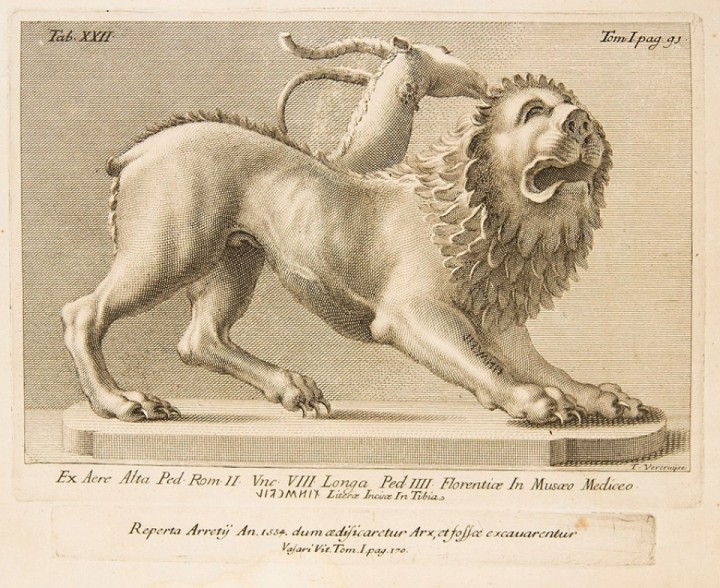
2014 will see Holkham Hall’s largest international collaboration since the eighteenth century. From March to July, the MAEC (Museo dell’Accademia Etrusca e della Città di Cortona) in Cortona, Tuscany, will host an exhibition of sculpture, paintings, prints, drawings and manuscripts drawn from the Uffizi museums in Florence, the Vatican Museums, the British Museum in London, and Holkham Hall.
 The exhibition, which will run from 22nd March to 31st July, centres on a moment of crucial importance in the history of archaeology and of Tuscany itself, that is the publication of Thomas Dempster’s De Etruria regali (On Royal Tuscany) in Florence in 1723 and 1726. The publication was entirely funded by the young Thomas Coke, the builder of Holkham Hall, and led to the foundation in 1727 of one of most important learned societies in Italy, the Accademia Etrusca. Since its beginnings, the Accademia has been housed in the medieval Palazzo Casali in Cortona, now the home of the MAEC itself.
Thomas Dempster (1579–1635) was an impoverished Scottish nobleman who taught at universities throughout Europe, and ended his career as Professor of Humanities in Bologna. Between 1616 and 1619, he compiled the De Etruria Regali, a monumental history of the Etruscan (broadly, Tuscan) people, the very first attempt to demonstrate the existence of a highly developed civilisation in Italy before the Romans. The work remained unpublished in Dempster’s lifetime, and survived in only one copy, in his own handwriting. This unique manuscript copy was purchased for Thomas Coke by his Grand Tour tutor-governor, Thomas Hobart, in July 1719, from the Florentine scholar Anton Maria Salvini, at a price of eleven guineas. It is still in the library at Holkham Hall, as MS 501.
Thomas Coke returned the manuscript to Florence and paid for the publication of work at a cost of over 2,000 Florentine scudi. Under the supervision of the antiquarian Senator Filippo Buonarotti, whom Coke and Hobart had visited several times while they were in Italy, a substantial programme of illustration was added to the printed edition. For the first time, a work of ancient history was based on the evidence of surviving artefacts and objects rather than on written sources, laying the foundations for modern archaeology. The printed volumes were dedicated to the Grand Dukes of Tuscany, whose dynasty was traced in the text back to the Etruscans themselves! The frontispiece to volume 2 is a portrait of Grand Duke Gian Gastone de’ Medici. He was the last of the line, and on his death in 1737, the family who had dominated Tuscany for centuries died out.
The importance of Coke’s role was only fully understood in 2007 with the discovery at Holkham by Dr Suzanne Reynolds of the accounts for the production process, documenting payments to the artists, engravers, and editors who worked on the project. These documents will be on display in the exhibition, along with the autograph manuscript of the text. Also on display will be the original drawings and copper plates for the illustrations which were discovered in the attics at Holkham by the 5th Earl of Leicester in 1964. The drawings were in the original leather wallet in which they had been sent back to England from Italy after publication.
Some three hundred years after Thomas Coke first arrived in Italy in November 1713, Holkham is also lending paintings, drawings and manuscripts that attest to his passion for Italian history and art. Highlights include Procaccini’s Tarquinius and Lucretia, paintings and drawings by Claude and Vanvitelli, and some of the most beautifully illuminated medieval manuscripts of ancient history from the Holkham Library.
-Dr Suzanne Reynolds (Curator of Manuscripts and Printed Books, Holkham Hall) September 2013










 Enfilade
leave a comment