At Auction | Indian and Islamic Art at Bonhams
From the Bonhams press release:
Bonhams Sale 21720 | Indian and Islamic Art
London, 8 April 2014
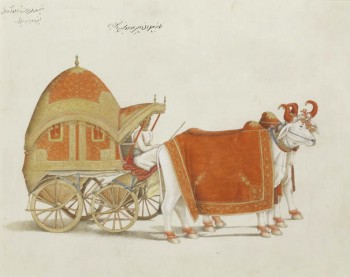
Lot 299: Painting from the Fraser Album of The Bullock-drawn Carriage of Prince Mirza Babur, Delhi, 1815–19
Bonhams will sell three stunning images from The Fraser Album, discovered amongst the papers of this Scottish family in 1979, at its next auction of Indian and Islamic art on April 8th in London. The Album consists of more than ninety watercolors of breathtaking quality, which provide an extraordinary portrait of life in and around Delhi in the early 19th century. This was an area which was relatively unknown to the British at that date, with Mughal control ceded to them only in 1803 and the Emperor nominally in power.
James Baillie Fraser (1783–1856) and his brother William (1784–1835) came from Inverness. William went to India aged 16 as a trainee political officer in the East India Company while James arrived a year later, taking a commercial position in Calcutta. James, a talented artist himself, published collections of views of the Himalayas and of Calcutta.
When James joined William in Delhi in 1815 the two brothers commissioned local artists to depict servants, tradesmen and figures from the irregular military units, some of which were employed by the British, including Gurkha soldiers and the colourfully-attired troopers of bodies such as Skinner’s Horse. More than one artist was employed on the paintings which go to make up the album. The best examples are usually attributed to Ghulam Ali Khan, but it is likely that the rest were produced by other members of his family. The works date between 1815 and 1820. The two lots in the present sale capture the richness of ceremonial life in Delhi, and are also representative of the British fascination with types of transport and servants which appears in other more typical examples of Company School painting.
The first image is of an elephant and driver, probably from the Mughal Emperor’s stable, with a hunting howdah equipped with a rifle, bows and a pistol, from Delhi or Northern India, 1815–19 (estimate £20,000–30,000).
The second Fraser Album image is of the bullock-drawn carriage of Prince Mirza Babur, Delhi or Northern India, 1815–19 (estimate £20,000–30,000). The inscriptions read: ‘The special chariot of the son of the spiritual preceptor of the horizons (Murshidzada-i afaq), Mirza Babur Bahadur’. The honorific title refers to Mirza Babur’s father, the Mughal Emperor Bahadur Shah II, in his role as a Sufi spiritual leader.
The third image is that of a cotton-carder at work, attributed to the artist Ghulam ‘Ali Khan (fl. 1817–55) Delhi, circa 1820 (estimate £20,000–30,000). This detailed and technically accurate painting shows a captured moment from daily life. The action depicted is in fact strictly referred to as ‘bowing’, running the taut string of the bow across the pile of fibers to fluff up the cotton.
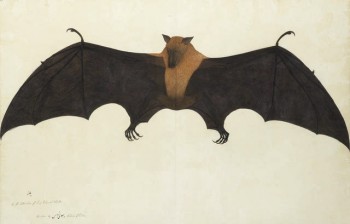
Lot 292: A painting by Bhawani Das from the Impey Album,
A Great Indian Fruit Bat, or Flying Fox (Pteropus giganteus),
Calcutta, ca 1778–82
Another important painting in this Bonhams sale of Indian and Islamic art is from the Impey Album, by the artist Bhawani Das: a Great Indian Fruit Bat, or Flying Fox (Pteropus giganteus) Calcutta, circa 1778–82. The Great Indian Fruit Bat, or Flying Fox, has a wingspan of 1.5 meters, well captured in this painting. This is a pen and ink, watercolor with gum arabic, heightened with bodycolour, on watermarked paper, inscribed at lower left In the Collection of Lady Impey at Calcutta/Painted by [in Persian in nasta’liq script, Bhawani Das] Native of Patna, (estimate £80,000–120,000).
Sir Elijah Impey was the East India Company’s Chief Justice of Bengal from 1774 to 1782. He was a well-known patron of Indian artists, but his wife, Mary, Lady Impey, who joined him in Calcutta in 1777, was particularly interested in the flora and fauna of the surrounding area, creating her own menagerie. She then commissioned studies of animals and plants from various artists from the nearby city of Patna, the most senior of whom were the Muslim Shaykh Zayn-al-Din, and the Hindus Ram Das and Bhawani Das, the painter of the present lot. The precision of these artists’ technique, which stemmed from the Mughal tradition, appealed to British patrons, and the technique and the subject-matter have become known as ‘Company School’. The series commissioned by Lady Impey (as well as others in a similar style by unknown artists) are particularly striking because of their large size, using sheets of English watermarked paper. There were 326 works in the original series, which were brought back to England with the Impeys in 1783, and were sold at Phillips (now Bonhams) in London in 1810.
◊ ◊ ◊ ◊ ◊
Note (added 10 April 2014) — The painting of the great Indian fruit bat sold for £458,500, four times its presale estimate. More information is available here»
ed to sell for £80,000-£120,000, but
Exhibition | Andreas Schlüter and Baroque Berlin
To mark the 300th anniversary of Andreas Schlüter’s death, the Bode-Museum mounts this exhibition:
Schloss Bau Meister: Andreas Schlüter and Baroque Berlin
Bode-Museum, Berlin, 4 April — 13 July 2014
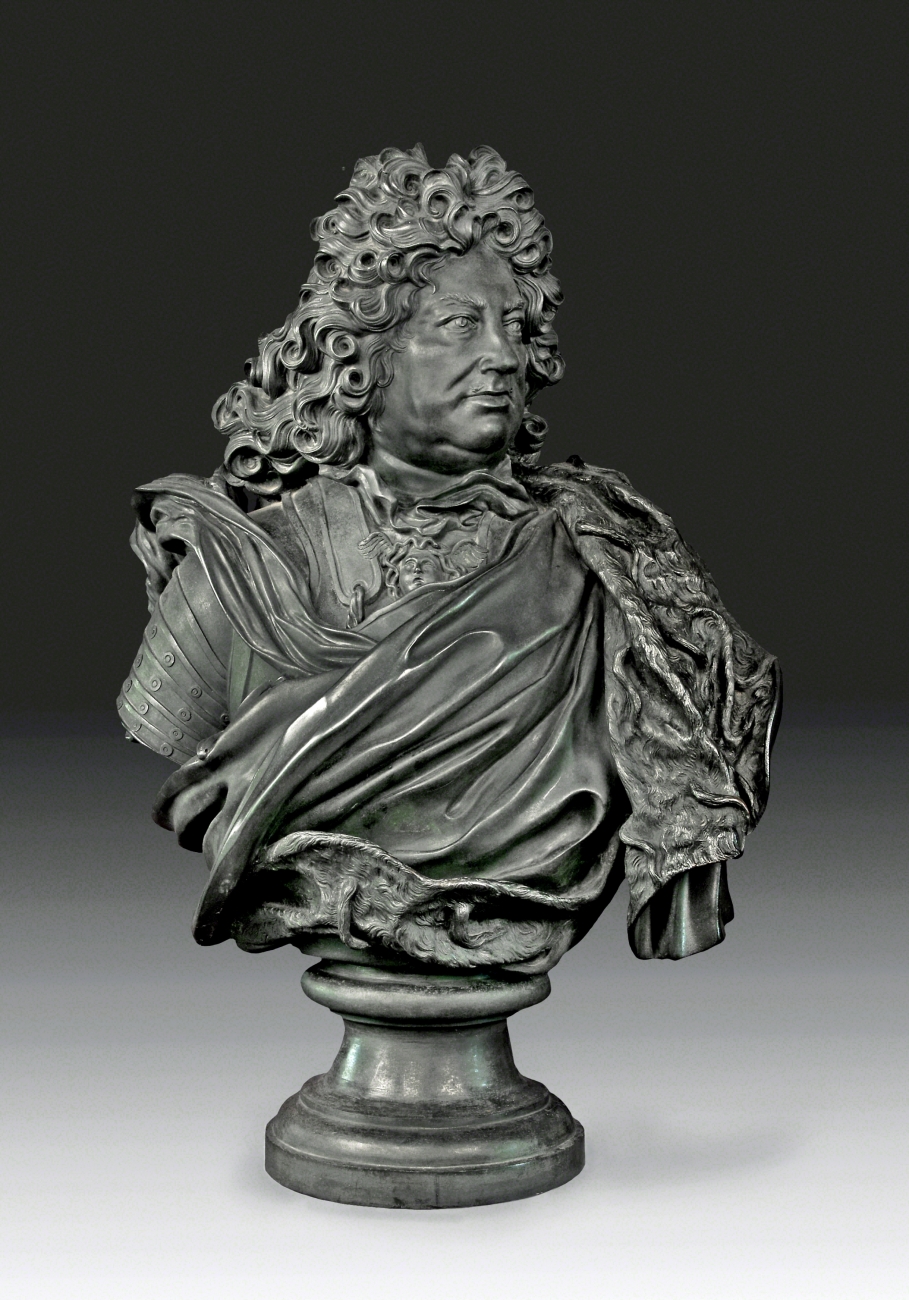
Bust of Landgrave Frederick II of Hesse Homburg, Berlin, 1701, bronze © Bad Homburg v. d. Höhe, Palace, Photo: Renate Deckers-Matzko
Andreas Schlüter (1659/60–1714) was a Baroque artist par excellence. Celebrated by his contemporaries as the ‘Michelangelo of the North’, Schlüter was not only a sculptor, but also an architect, town planner, and designer of magnificent interiors which were created to give lustre, for the first time, to the ambitious and emerging royal capital of Berlin. To commemorate the 300th anniversary of his death, the Bode-Museum is now holding the first ever major exhibition to be devoted to this important Berlin artist.
During the reign of Elector Friedrich III (from 1701 Friedrich I, ‘King in Prussia’), Schlüter was appointed official court sculptor and was entrusted with a variety of artistic roles in the Prussian capital, during a time when Prussia was emerging as a nascent new power.
This retrospective takes in all aspects of his multifaceted work and, enriched by numerous outstanding loans, recreates the opulent world that this creator of Baroque Berlin fashioned and inhabited. The exhibition in the Bode-Museum runs from 4 April until 13 July 2014 and is spread over a total of 16 galleries and side rooms. On display are not only Schlüter’s own works, but also those of the greatest role models of his time, including sculptures by such distinguished artists as Gian Lorenzo Bernini, Francesco Mochi, Francois Girardon, and Antoine Coysevox.
More information is available at the exhibition website.
◊ ◊ ◊ ◊ ◊
Published by Hirmer, the catalogue is available from Artbooks.com:
Hans-Ulrich Kessler, ed., Andreas Schlüter: Schöpfer des Barocken Berlin (Munich: Hirmer Verlag, 2014), 540 pages, ISBN: 978-3777421995, 50€ / $95.
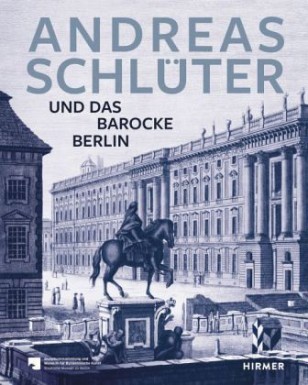 Andreas Schlüter (1659/60–1714), der bedeutendste Architekt und Bildhauer der Barockzeit nördlich der Alpen, verwandelte um 1700 Berlin in eine moderne, barocke Residenzstadt. Anlässlich seines 300. Todestages erzählt das opulente Katalogbuch die spannende Geschichte von Schlüters künstlerischem Werdegang und bietet einen fundierten Überblick über sein Œuvre.
Zunächst am Hof des polnischen Königs tätig, wurde Schlüter 1694 von Kurfürst Friedrich III. von Brandenburg, ab 1701 König Friedrich I. von Preußen, nach Berlin berufen. Fortan war er als Hofkünstler maßgeblich an der Umsetzung der Repräsentationsstrategien seines königlichen Auftraggebers beteiligt, wobei er sich an so glanzvollen Kunstzentren wie Rom und Paris orientierte. In 25 Beiträgen stellen namhafte Kenner Schlüters Werk umfassend vor, beginnend mit den Jahren in Danzig und Polen über seine Berliner Blütezeit mit Hauptwerken wie dem Reiterstandbild des Großen Kurfürsten,
dem Zeughaus und dem Berliner Schloss bis hin zu seinem
Spätwerk, der Berliner Villa Kameke.
Call for Papers | Art History— Adaptation—Knowledge—Society
Art History—Adaptation—Knowledge—Society
Budapest, 20 June 2014
Proposals due by 30 April 2014
Organized by Zoltán Dragon and Miklós Székely
The end of art history was first envisioned by Hans Belting Munich’s inaugural lecture in 1983. Belting later reconsidered his theory, but the creed of art history and its consciousness have not been affected. In recent decades, the demands of society, social inclusion, forms, communications, infrastructure, and the environment have changed several times, but the discipline of art history still uses the same methodology, it interprets the actualities by applying the same structures. Meanwhile, the social utility of traditional art historical research is questioned and its usability is thrown into doubt. Other fields of the humanities adopted new structures, approaches, new interdisciplinary areas. It seems as if in the discipline of art history, change is not enforced by the profession in the strict sense, but by the commissioners and those interested. The importance of art historians is also diminished by new employment practices, when professionals of information technology, communication, and museum education are more likely to be employed in museums or in the traditional places related to heritage conservation. As a sign of the crisis, university students often neglect art historical studies and focus their interest instead on art management and curatorial studies. Belting has envisioned the future of art history in a kind of science of the image / Bildwissenschaft, but traditional art historical practices can well be represented by new emerging professionals of the reformed higher educational system. One crucial question concerns the historical focus of art history. Can art history identify itself as a historical (backward looking) field of the humanities, reflecting mainly on history, in spite of the palpable interest in contemporary interpretation of events? Creativity and the use of innovative approaches have been equally characteristic of art history, the preservation of cultural heritages, and museology. As an initiative aiming at renewal, a one-day workshop will be organized. Its purpose is to provide a forum for innovative, progressive, proactive and even provocative ideas and approaches, presenting solutions that are appropriate responses to today’s challenges through their relevant contemporary approach.
Topic Frames
1. Image and image preservation. A work of art is not always merely a matter of what is seen or how it is viewed. Works of art can be a demonstration, a performance, and documentation—if the space and time of the work have been limited, or if the work of art has been destroyed altogether. How do museums adapt in their acquisition practices to technological advancements and social changes? During the canonization-process of the works, what new contemporary meanings are added, provoked by new circumstances and surpassing the traditional framework of art history? And what happens with objects outside the museums: graffitis, tags, documents of festivals, performances, demonstrations, digital tools and mediums?
2. Monument, community, space use. Is there such a thing as a community monument, instead of or in addition to national monuments? What are the new challenges with respect to the protection of monuments caused by private “contemporary use” of public spaces? What are innovative solutions and what is the appropriate attitude to adopt towards contemporary renovations? What are the roles and limits of virtual reconstructions, their educational use, and how do they challenge traditional methods in monument conservation?
3. Museum and innovation. The post-museum is still one of the most commonly cited concepts of the museum in the theoretical discourse on museums. But what is beyond the post-museum? What are the characteristics of an innovation-based acquisition policy? What potentials are there in the stronger cooperation between the external research into the museum world and the integration of partialities into the scientific research? What are potential future solutions for real-time online publication of archival materials, and what is the next step in the participatory museum concept?
4. Changes in the history of art history methodologies are also a question of shifts of focus lies. The modern-day equivalent of taking notes on index-cards is database construction, while image albums, popularizing articles will be replaced by the photo galleries and Wikipedia. Constructing databases exempts one from interpretation and transforms the research topic into dry data, while simultaneously democratizing the data itself. The democratization of scholarship takes place on the pages of Wikipedia. But what is the future of new publications of data, essays and monographs? How will they be published, and on the basis of what, and for whom?
5. Knowledge-based society. What should be taught in public schools about the history of art and what should be taught outside the schools? Can the instruction of art history be transformed at the university level? What new educational models would be appropriate at the secondary school level or in postsecondary education? How can the transfer of knowledge be adapted to the changed social, scholarly and technological contexts?
Presentations are in ‘TED -style’. If you wish to share your vision, your ongoing research or recent scholarly findings, we encourage you to join us for the workshop! Prepare a presentation of no more than 15 minutes in length. Send us an outline by 30 April to conference@centrart.hu We will compile the program by mid-May and then reply to participants. Info on broadcasting will be provided later.
Regarding the application, there are no formal criteria: you can send short abstracts, portfolios, presentations, etc. The point is to see what questions or problems you are interested in and whether you are aware of the theoretical background, and also to give you a chance to outline your conception clearly. Be sure to write a few lines about yourself and to provide us with your contact details. The conference will be broadcast online and recorded, and the recording will be made publicly available via video-sharing. Speakers from abroad are welcome to join the event virtually and also to hold presentations via online communication mediums (Skype, Google hangout, etc). We invite you to join us as a speaker or participant for our event on the spot in Budapest or via internet on 20 June, 2014.
New Book | The Material Culture of the Jacobites
From Cambridge UP:
Neil Guthrie, The Material Culture of the Jacobites (New York: Cambridge University Press, 2014), 284 pages, ISBN: 978-1107041332, $95.
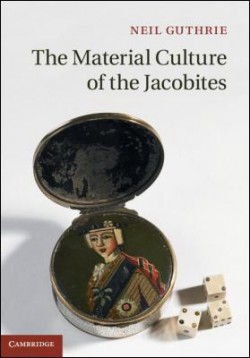 The Jacobites, adherents of the exiled King James II of England and VII of Scotland and his descendants, continue to command attention long after the end of realistic Jacobite hopes down to the present. Extraordinarily, the promotion of the Jacobite cause and adherence to it were recorded in a rich and highly miscellaneous store of objects, including medals, portraits, pin-cushions, glassware and dice-boxes. Interdisciplinary and highly illustrated, this book combines legal and art history to survey the extensive material culture associated with Jacobites and Jacobitism. Neil Guthrie considers the attractions and the risks of making, distributing and possessing ‘things of danger’; their imagery and inscriptions; and their place in a variety of contexts in the seventeenth and eighteenth centuries. Finally, he explores the many complex reasons underlying the long-lasting fascination with the Jacobites.
Neil Guthrie is a lawyer by profession and has published articles on Jacobite material culture, law, and literary history, including “Johnson’s Touch-piece and the ‘Charge of Fame’: Personal and Public Aspects of the Medal in Eighteenth-Century Britain,” in The Politics of Samuel Johnson (edited by H. Erskine-Hill and J. C. D. Clark, 2012).
C O N T E N T S
Introduction
1. ‘By things themselves’: the danger of Jacobite material culture
2. ‘Many emblems of sedition and treason’: patterns of Jacobite visual symbolism
3. ‘Their disloyal and wicked inscriptions’: the uses of texts on Jacobite objects
4. ‘Tempora mutantur et nos mutamur in illis’: phases and varieties of Jacobite material culture
5. ‘Those who are fortunate enough to possess pictures and relics’: later uses of Jacobite material culture
Bibliography
Exhibition | Architectural Drawings of the Eighteenth Century
From the Museo di Roma:
Architectural Drawings of the Eighteenth Century / Disegni di architettura del Settecento
Museo di Roma, 20 December 2013 — 30 June 2014
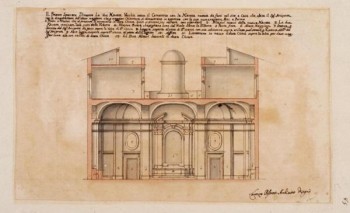
Lorenzo Possenti, Progetti per la nuova chiesa di Sant’Andrea a Gallicano, ca. 1731–33
The drawings exhibited in the “Hall of graphics” were selected from the collection of the Museum of Rome and come mainly from the collection of Antonio Muñoz. They testify the various architectural structures in Rome during the eighteenth century, which have greatly contributed to the creation of the image of the city.
In addition to the projects for monumental works commissioned by the popes, such as the Trevi Fountain, the facade of St. John Lateran, St. Paul Outside the Walls, there are those for minor works, such as small shrines, oratories, fountains and especially houses. A new type of building was conceived in this period: the apartment building, which helps to dramatically change the appearance of the city by marking its “gentrification.”
The designs, both by major architects (Ferdinando Fuga, Nicola Salvi) and other less well-known ones (Andrea Francesco Nicoletti, Girolamo Toma), are always very imaginative and extremely elegant from the point of view of graphics, especially those presenting the project to the potential buyer, the only means available to an artist to promote their work. Sketches, study sheets, design or academic drawings, and publications also allow to follow and better understand some important debates of the period relating to the “modern style” of the Roman Barocchetto opposed to the more austere “old style” or the difference between reproduction and imitation.
New Book | Four Emperors and an Architect
From Oxbow Books:
Alicia Salter, Four Emperors and an Architect: How Robert Adam Rediscovered the Tetrarchy (Lexicon Publishing, 2013), 196 pages, ISBN: 978-0957571907, £20.
 The eighteenth century saw an explosion of interest in the architecture of ancient Rome, spawning the phenomenon of the Grand Tour. The palace of Diocletian at Split, however, remained unappreciated and under the radar until its 1757 rediscovery by the young British architect, Robert Adam. This superbly illustrated volume narrates Adam’s pioneering work and the influence it had on his own architectural practice, interweaving his story with that of Diocletian himself and his colleagues in power, the Tetrarchs. Above all Alicia Salter explores their architecture, showing how it was used to symbolise their rule, and describing in detail not only the palace at Split, but work by the other Tetrarchs in their capitals at Milan, Trier, Nicomedia and Thessalonica, as well as at Rome itself.
Alicia Salter read history at St. Hilda’s College, Oxford. After marriage and three children, she graduated to Art History (The Study Centre at The Victoria and Albert Museum), specialising in the history of architecture—her great love. For seventeen years, together with two friends, she ran her own small business—Art Circle—concentrating on the great wealth of art to be found in a city such as London. Some years later research into the work of Sir Robert Taylor led to an interest in Robert Adam and his archaeological survey of Diocletian’s palace in Split.
More information is available at book’s website.
Conference | The Sculpture of the Écorché
From the Henry Moore Institute:
The Sculpture of the Écorché
Henry Moore Institute, Leeds, 7 June 2014

Thomas Mewburn Crook ‘Stage 9a: Anatomical Studies of the Human Figure from the Flat’ 1893 Pencil, ink and watercolour on paper Leeds Museums & Galleries (Henry Moore Institute Archive)
This one-day conference takes the écorché as its subject, reconsidering the many ways that models of the flayed figure have been understood from the sixteenth century to the present day. Across seven papers, the conference addresses the écorché variously as a teaching object for the education of sculptors, as a scientific model crucial to the understanding of anatomy, as a sculptural process and as a sculptural object in its own right.
The écorché has frequently operated across disciplinary boundaries and registers of respectability. Makers of wax écorchés in the eighteenth century, such as the Florentine Clemente Susini (1754–1814), were highly acclaimed during their lifetimes, with their work sought by prestigious collectors. By the nineteenth century, however, wax had come to be seen as a merely preparatory, or even a disreputable, medium for sculpture with its capacity for forensic detail and mimetic reproduction of bone, muscle and skin operating against the prevailing neoclassical tendency towards ideal form. As a result of this change in taste, the écorché in plaster of Paris became the primary teaching object for anatomical studies in European academies and schools of art into the twentieth century.
The conference will be chaired by Professor Fay Brauer (University of East London/University of New South Wales College of Fine Arts), Dr Nina Kane (University of Huddersfield) and Dr Rebecca Wade (Henry Moore Institute). Advanced booking is required for this event. Book here.
◊ ◊ ◊ ◊ ◊
S A T U R D A Y , 7 J U N E 2 0 1 4
10.30 Registration
11.00 Introduction
11.10 Panel 1: Cigoli and Ceroplastics: Wax Écorché in Seventeenth-Century Italy
• Roberta Ballestriero (Open University), Under the Wax Skin: Representation of the Écorché in the Art of
Ceroplastics
• Lisa Bourla (University of Pennsylvania), Cigoli’s Écorché, Giambologna’s Studio and the ‘Poe Paradox’
12.20 Lunch
1.30 Panel 2: Dissection as Sculptural Practice: Criminality, Pathology, and the Academy
• Meredith Gamer (Yale University), ‘A necessary inhumanity’: William Hunter’s Criminal Écorchés
• Naomi Slipp (Boston University), Thomas Eakins and the Écorché: Understanding the Human Body in Three
Dimensions
• Natasha Ruiz-Gómez (University of Essex), In Sickness and in Health: Doctor Paul Richer’s Écorché at the École
des Beaux-Arts
3.30 Tea
4.00 Panel 3: Écorché, Modernism, and the Sculptural Canon
• Elena Dumitrescu (National University of Arts, Bucharest), The Écorché by Brancusi and Gerota: An Artwork Created at the School of Fine Arts of Bucharest
• Stefan Grohé (University of Cologne), An Anatomy of Sculpture: The ‘Ecorche, dit de Michel-Ange’ and its Transformations in Modern Art
5.20 Closing remarks
Exhibition | In the Library: Deforming and Adorning
Of the 29 volumes on display (dating from 1471 to 1973), 8 are from the eighteenth century, including Reynolds’s copy of Walpole’s Anecdotes of Painting and Christoph Gottlieb von Murr’s copy of Philipp von Stosch’s gem collection, Description des Pierres gravés du feu Baron de Stosch.
From the National Gallery of Art in Washington:
In the Library: Deforming and Adorning with Annotations and Marginalia
National Gallery of Art, Washington, D.C., 3 March — 27 June 2014
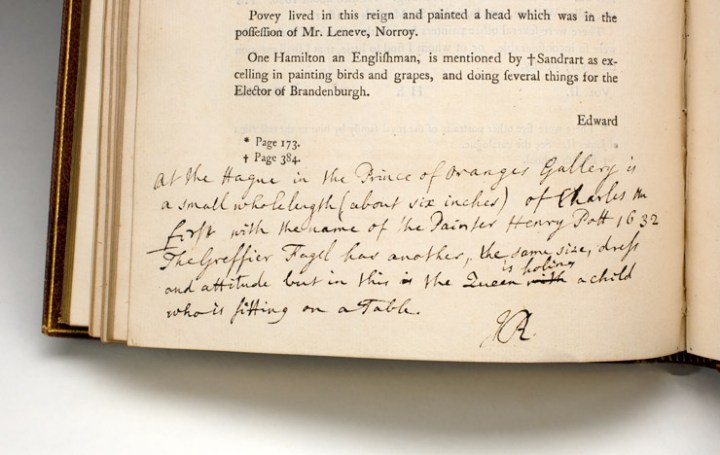
Horace Walpole, Anecdotes of Painting in England (Strawberry Hill, 1762–1771). National Gallery of Art Library, Gift of Joseph E. Widener. The remarks throughout this four-volume set reveal that this copy of an important 18th-century work on British paintings once belonged to Sir Joshua Reynolds (1723–1792). His commentary illuminates his relationship with the author and his role as the head of the Royal Academy of Arts.
◊ ◊ ◊ ◊ ◊
This exhibition highlights a selection of rare books that are unique not because of their content or imprint, but because of the one-of-a-kind markings and additions that readers of the past made to the printed text. From their hand-written marginal commentary and sketches to custom bindings with extra pages and illustrations to editorial notes, each of these books has been transformed from a standard mass-printed volume into a uniquely personal object. They illuminate us with insights into the texts themselves, as well as the readers who read, enjoyed, and annotated them—and the relationships between the two.
The printing press was introduced in the West by Johannes Gutenberg in the 15th century. Prior to this, manuscripts were often copied by hand—a laborious process that was both expensive and prone to errors. In contrast, the printed page permitted the creation and distribution of exact copies of a book to a wide audience. This revolutionary technology changed the spread of knowledge forever.
Yet even a mass-printed volume has the potential to survive as a unique artifact: perhaps all other copies of a particular edition are destroyed; perhaps an individual copy gains notoriety through its provenance, having belonged to a figure of historical importance; or perhaps the book is bound in a peculiar way. In the hand-press period, variance in collation is common for a variety of reasons. Alterations to the text might be made during the print run; moreover, bookbinding was performed separately from the actual publishing process, which allowed for the possibility of pages being lost, added, trimmed, or bound in a different order.
In spite of all these variations, the specific focus of this exhibition is alterations made to the text by readers. The books on view all began as copies identical to hundreds or thousands of others, but each has been transformed by the addition of new information. Many include annotations ranging from navigational aids to detailed critiques of the text.
In the manuscript era, extra-large margins were sometimes provided for scholars to provide commentary, known as glosses. Many early printed books incorporated these earlier glosses along with the main text, and modern readers continued the tradition of adding their own thoughts in the margins. Benjamin Franklin was known to have penned entire debates with authors in the blank spaces of his books; other readers adorned the text with sketches and illustrations. Some readers had their books rebound and included extra material such as prints, notes, and correspondence. In several cases, the author has made editorial notes and revisions for the next edition of his book.
Call for Essays | Art and Social Change, La Salle University Art Museum
Art and Social Change: The Collection of La Salle University Art Museum
Abstracts for an edited volume due by 30 June 2014; completed essays due by 30 January 2015
We are seeking scholarly essays (3,000–6,000 words) for an edited book on the subject of art and social change. The book will focus on Western art from the Renaissance to about 1950 (after which artists-activists and art for social change become important themes—and the focus of numerous other recent books). Scholarly essays should address some aspect of the subject and should ideally engage with one or more artworks in the collection of La Salle University Art Museum. (See the museum’s website for images of artworks on display; detailed lists of artworks in storage are also available on request.)
We welcome proposals from established scholars, recent Ph.D. recipients, upper level graduate students and museum professionals. The deadline for submission of abstracts (300–600 words) is June 30, 2014, with notification by August 30, 2014. The deadline for completed essays is January 30, 2015, with peer reviews taking place in early spring 2015. More information is available here.
Please direct proposals and inquiries to the editors:
Susan Dixon, Ph.D., Chair/Associate Professor Art History, La Salle University Deptartment of Fine Arts, dixons@lasalle.edu
Klare Scarborough, Ph.D., Director/Chief Curator, La Salle University Art Museum, scarborough@lasalle.edu
Call for Papers | The Monkey in the 17th and 18th Centuries
The call for papers includes a bibliography. From Le Blog de L’ApAhAu:
Le singe aux XVIIe et XVIIIe siècles: Figure de l’art, personnage littéraire & curiosité scientifique
CLARE Université Bordeaux Montaigne, 28–29 May 2015
Proposals due by 15 June 2014
 Colloque international, organisé par Florence BOULERIE, CEREC [Centre de Recherches sur l’Europe Classique (XVIIe et XVIIIe siècles)], EA 4593 CLARE, Université Bordeaux Montaigne, Bordeaux (France), et Katalin BARTHA-KOVÁCS, Université de Szeged (Hongrie)
Le singe figure dans les représentations littéraires et artistiques depuis l’Antiquité, en particulier autour du culte des singes dans l’Égypte ancienne ; on le rencontre fréquemment au Moyen âge, notamment dans la statuaire, illustrant la symbolique chrétienne de l’homme déchu, et il reste familier dans l’imaginaire burlesque de la Renaissance (voir à ce sujet la journée d’étude « Singes et singeries à la Renaissance », Chantilly, 15 mars 2014, organisée par l’Atelier XVIe siècle de l’université Paris-Sorbonne).
Au XVIIe siècle, l’intérêt pour cet animal connaît cependant un essor nouveau : les singes prolifèrent dans les fables et les représentations allégoriques, devenant figures du double trompeur et images satiriques de la vanité humaine. La mode des chinoiseries à la fin du XVIIesiècle vient renforcer la vogue des représentations picturales de singes, avant que le XVIIIe siècle ne s’enthousiasme pour les singeries… et les singes, animaux de compagnie fort prisés au milieu du siècle.
Allégorie de l’artiste (peintre, écrivain, acteur), le singe interroge aussi sur l’humain d’un point de vue religieux, moral et philosophique. Les naturalistes l’observent, le dessinent ; l’on découvre de nouvelles espèces au gré des explorations géographiques, de sorte que la limite entre l’homme et le singe est parfois bien près de chanceler.
Notre colloque entend éclairer les multiples aspects du singe dans la culture européenne des XVIIeet XVIIIe siècles : la mode picturale des « singeries », à son apogée vers 1740, doit être replacée dans un contexte artistique (l’héritage des peintres flamands), littéraire (la tradition de la fable concurrencée par les nouveaux visages du singe littéraire) et anthropologique (les interrogations sur l’homme et les espèces). (more…)










 Enfilade
leave a comment