Conference | Enlightenment Senses?
From the conference website:
Enlightenment Senses? Eighteenth-Century Sensorium(s), Theory and Experience
Centre for Enlightenment Studies at King’s, King’s College London, 13 June 2014
Registration due by 7 June 2014
Organized by William Tullett, Alice Marples, and Marlee Newman
The conference brings together those concerned with the social and cultural history of the senses in the period from 1650 to 1790 as well as those working on literary or intellectual histories of the senses in an attempt to encourage a more active dialogue between these areas. It aims to link ‘sensory histories’, concerned with embodied sensory experience and representation, with ‘histories of the senses’ in which the intellectual and medical understandings of the senses are foregrounded.
◊ ◊ ◊ ◊ ◊
P R O G R A M M E
8:30 Registration
9:15 Panel 1: Describing Sensory Experience
Chair: William Tullett (KCL)
• Helen Slaney (St Hilda’s, Oxford), ‘A Sense of History: Haptic Perceptions of Ancient Sites in Eighteenth-century Italy’
• Felicity Roberts (King’s College London & British Museum), ‘The Science of Describing in Early Eighteenth-century England’
• Alice Marples (King’s College London & British Library), ’An Enlightened Approach to Sensory Information: Collecting and Circulating Knowledge’
10:30 Panel 2: Race and the Senses
Chair: Alice Marples (KCL)
• William Tullett (King’s College London), ‘Race and Smell in the Eighteenth-century British Atlantic’
• George Newberry (University of Sheffield), ‘Skin Colour, Insensitivity and the Roots of Enlightenment Racial Anatomy’
11:30 Coffee
12:00 Panel 3: Music and the Senses
Chair: Felicity Roberts (KCL)
• James Kenneway (Newcastle University), ‘Medical Conceptions of Hearing and Enlightenment Music’
• Miranda Stanyon (Christ’s, Cambridge), ‘Enlightening Rauschen: Sublime Hearing from Locke to Klopstock’
• Danielle Grover (University of Surrey), “Music Untouched by Unseen Hands Breathed Around’: Music as a Sensory Experience in Fiction’
13:15 Lunch
14:00 Panel 4: Inner Senses and Emotions
Chair: Marlee Newman (KCL)
• Yuriy Khalturin (Moscow), “Inner senses’ in the Russian Mysticism of the Eighteenth Century’
• Tobias Gabel (Justus-Liebig-Universität Giessen), ‘Ears Intent: Hearing, Listening and Insight in Milton’
• Richard Firth Godbehere (Queen Mary UL), ‘Aesthetics, Taste, and the Birth of Disgust’
15:15 Panel 5: Pain, Illness and the Senses
Chair: Sophie Mann (KCL)
• Rachel Brownstein (City University of New York), ‘Pointed Details: Feeling Gillray’s Pain’
• Marlee Newman (King’s College London), ‘’Fortresses of Solitude: The Material Experience of the Plague at Home’
• Lisa Toland (Indiana Wesleyan University), ‘Sensibility and the Diseased Body: The Senses in Moments of Crisis in Eighteenth-century Family Life’
16:30 Coffee
16:45 Roundtable: Enlightenment and the Senses
Chair: William Tullett (KCL)
• Mark Jenner (University of York)
• Clare Brant (King’s College London)
• Thomas Irvine (University of Southampton)
• Elizabeth Eger (King’s College London)
18:15 Wine reception
Exhibition | Catching Sight: The World of the British Sporting Print
From the VMFA:
Catching Sight: The World of the British Sporting Print
Virginia Museum of Fine Arts, Richmond, 31 August 2013 — 13 July 2014
 This exhibition sheds new light on a common, but often overlooked aspect of British art: the British sporting print. Highly sought after during the 18th and 19th centuries, these prints endure as symbols of English culture. Featuring more than 100 prints, Catching Sight demonstrates the aesthetic sophistication and accomplishments of the genre. The exhibition takes an innovative approach, examining these works of art from an art historical perspective rather than simply as documents of the history of sport and rural culture. Catching Sight demonstrates the qualities of directness, vividness, and even wit for which the genre was prized by both the larger public and artists such as Degas and Géricault, who borrowed extensively from its artistic vocabulary.
Mitchell Merling, with Malcolm Cormack and Corey Piper, Catching Sight: The World of the British Sporting Print (Richmond: Virginia Museum of Fine
Arts, 2013), 112 pages, ISBN: 978-1934351031, $36.
The exhibition is accompanied by an illustrated catalogue by Mitchell Merling, Paul Mellon Curator, with contributions from Malcolm Cormack, Paul Mellon Curator Emeritus, and Corey Piper, former Curatorial Associate for the Mellon Collection.
Catalogue cover: Isaac Cruikshank, London Sportsmen Shooting Flying [from a set of four], ca. 1800, hand-colored etching (VMFA: Paul Mellon Collection, 85.1282.2)
Call for Papers | Images of the Other: Istanbul—Vienna—Venice
Images IV: Images of the Other: Istanbul—Vienna—Venice
Austrian Cultural Forum, Istanbul, 2–4 September 2014
Proposals due by 20 June 2014
After the conferences Images I: Films as Spaces of Cultural Encounters (2011), Images II: Images of the Poor (2012), and Images III: Images of the City (2013), the Images Project is planning to focus on ‘Images of the Other’ as documented in images and representations of Istanbul, Vienna, and Venice in its 2014 conference.
Since the Middle Ages all three cities have been (culturally) mythologized as points of cultural intersection in works of literature, arts and film—be it as the spaces where East meets West, where lines blur between the conscious and the subconscious, between life and death, between the visible/ the seen and the invisible/ the unseen, or as spaces identified with the evil, as the Moloch luring—all these mythologizations being part both of the self-perception documented in the native cultural production and of the perception from the (cultural) ‘outside’. Regarding this fact the Images project has decided to discuss the (historically) changing representation and perception of the three cities in its 2014 conference Images IV: Images of the Other: Istanbul—Vienna—Venice, with the representations being seen as documentations of cultural approaches and also of cultural concepts. Hence, the historically grown mythologizations of the three cities create a sheer unlimited number of potential cases of both cultural encounters and conflicts, including most of the socially relevant fields in the academic discourse on the topic, like politics, communication, culture, and migration.
In order to discuss issues like the above mentioned Images IV: Images of the Other: Istanbul—Vienna—Venice invites scholars, architects, photographers, writers, artists, and filmmakers to propose papers in the following fields of research and interest:
• The Making of a Myth (theoretical approaches with special reference to Istanbul, Vienna, and Venice)
• The psychology of feeling Istanbulite, Viennese and Venetian
• The psychology of attraction (theoretical approaches with special reference to Istanbul, Vienna, and Venice)
• Istanbul’s, Vienna’s, Venice’s cityscape as a (mythologized) statement
• The impact of the media (news, internet, daily soaps) on the perception of Istanbul, Vienna, and Venice
• Images of Istanbul, Vienna, and Venice in feature films (present and past)
• Images of Istanbul, Vienna, and Venice in the Arts (present and past)
• Images of Istanbul, Vienna, and Venice as seen by photographers (present and past)
• Images of Istanbul, Vienna, and Venice in literature (present and past)
The conference Images IV: Images of the Other: Istanbul—Vienna—Venice is planned as an interdisciplinary international conference. It will bring together senior scholars with PhD students, postdoctoral academics, and members of the artistic community without following the classical keynote speaker pattern but rather inviting all speakers either to present their research findings in 20-minute (paper) presentations plus 10 minutes for discussion or in 120–150 minute panels (4–5 panelists). There will be no parallel sessions. All sessions will be plenary sessions. The conference language is English. Selected articles of each session/ field of research will be published as a volume of conference proceedings. Münster, Berlin, Vienna and New York based LIT Verlag has already declared strong interest in publishing the conference proceedings. The publication will provide limited space for black-and-white illustrations. Please, send paper proposals to images-1@gmx.at and cc them to veronika.bernard@uibk.ac.at and otuzun@hotmail.com and gonul.ucele@bahcesehir.edu.tr
Deadline for paper submission for publication in conference proceedings: 1 month after conference
Planned date of publication of conference proceedings: July 2015
Images Project Director
Veronika Bernard (University of Innsbruck)
Conference Organizing Committee
Veronika Bernard (University of Innsbruck, Innsbruck)
Hatice Övgü Tüzün (Bahçeşehir University, Istanbul)
Gönül Ücele (Bahçeşehir University, Istanbul)
New Book | The Concept of the ‘Master’ in Art Education
From Ashgate:
Matthew Potter, ed., The Concept of the ‘Master’ in Art Education in Britain and Ireland, 1770 to the Present (Aldershot: Ashgate, 2013), 312 pages, ISBN: 978-1409435556, £70.
 A novel investigation into art pedagogy and constructions of national identities in Britain and Ireland, this collection explores the student-master relationship in case studies ranging chronologically from 1770 to 2013, and geographically over the national art schools of England, Ireland, Scotland and Wales. Essays explore the manner in which the Old Masters were deployed in education; fuelled the individual creativity of art teachers and students; were used as a rhetorical tool for promoting cultural projects in the core and periphery of the British Isles; and united as well as divided opinions in response to changing expectations in discourse on art and education.
Case studies examined in this book include the sophisticated tradition of ‘academic’ inquiry of establishment figures, like Joshua Reynolds and Frederic Leighton, as well as examples of radical reform undertaken by key individuals in the history of art education, such as Edward Poynter and William Coldstream. The role of ‘Modern Masters’ (like William Orpen, Augustus John, Gwen John and Jeff Wall) is also discussed along with the need for students and teachers to master the realm of art theory in their studio-based learning environments, and the ultimate
pedagogical repercussions of postmodern assaults on the
academic bastions of the Old Masters.
Matthew C. Potter is a Senior Lecturer in Art and Design History at Northumbria University, UK. His research interests include national identity in British art and the history of art education.
◊ ◊ ◊ ◊ ◊
C O N T E N T S
Learning from the masters: An introduction, Matthew C. Potter
1. Naturalising tradition: Why learning from the masters?, Iris Wien
2. A free market in mastery: Re-imagining Rembrandt and Raphael from Hogarth to Millais, Paul Barlow
3. The John Frederick Lewis Collection at the Royal Scottish Academy: Watercolour copies of old masters as teaching aids, Joanna Soden
4. British art students and German masters: W.B. Spence and the reform of German art academies, Saskia Pütz
5. Standing in Reynolds’ shadow: The academic discourses of Frederic Leighton and the legacy of the first President of the Royal Academy, Matthew C. Potter
6. Opening doors: The entry of women artists into British art schools, 1871–1930, Alice Strickland
7. Struggling with the Welsh masters, 1880–1914, Matthew C. Potter
8. Emulation and legacy: The master-pupil relationship between William Orpen and Seán Keating, Éimear O’Connor
9. Prototype and perception: Art history and observation at the Slade in the 1950s, Emma Chambers
10. The pedagogy of capital: Art history and art school knowledge, Malcolm Quinn
11. Study the masters? On the ambivalent status of art history within the contemporary art school, Katerina Reed-Tsocha
12. ‘Without a master’: Learning art through an open curriculum, Joanne Lee
Bibliography
Index
Conference Report | ‘The Educated Eye?’ Connoisseurship Now
Writing for Apollo Magazine’s blog, Katy Barrett provides a recap of the one-day conference on connoisseurship held at The Paul Mellon Centre earlier this month (still available as a recorded webinar). From The Muse Room:
Katy Barrett, ” ‘The Educated Eye? Connoisseurship Now’ at the Paul Mellon Centrer,” The Muse Room: The Apollo Blog (6 May 2014).
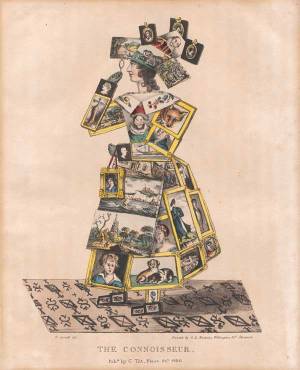
The Connoisseur, 1830, unknown artist (Yale Center for British Art, gift of Max and Barbara Wilk)
What do we mean by ‘connoisseurship’ these days? The term has had negative connotations since at least the 17th century—as long, essentially, as academics, collectors and dealers have prided themselves on possessing this quality. Yet, it also denotes a fêted attribute that any self-respecting art lover would wish to have.
A lively and thought-provoking conference and webinar at The Paul Mellon Centre on Friday 2 May, The Educated Eye: Connoisseurship Now considered this thorny question. Speakers with varied and eclectic backgrounds brought perspectives from the realms of art museums, print collections, art funding, academia, dealerships, auction houses, and conservation. . . .
I was particularly struck by a comment by Stephen Deuchar about academic connoisseurship hiding under the mantle of material culture these days. . . .
Both from our speakers and their subject, personality emerged for me as key to the day. The mantle of authority both as a ‘connoisseur’ and as a commentator on such a person’s validity rests in the marriage of knowledge and persuasive communication, in the mixing of the subjective and the objective, not so different really from an appealing gallery educator or exhibition text. Repeatedly, discussion came back to the need for collaboration to keep these elements in balance. . . .
The full report is available here»
Call for Papers | HECAA Session at UAAC, 2014
Thanks again to Christina Smylitopoulos, HECAA is scheduled to be represented at this year’s UAAC Conference! Details and a full list of panels are available here»
◊ ◊ ◊ ◊ ◊
Universities Art Association of Canada / l’association d’art des universités du Canada
OCAD University, Toronto, 20–26 October 2014
Proposals due by 18 June 2014
HECAA Open Session (Historians of Eighteenth-Century Art and Architecture)
The objective of this society is to stimulate, foster, and disseminate knowledge of all aspects of visual culture in the long eighteenth century. This HECAA open session welcomes papers that examine any aspect of art and visual culture from the 1680s to the 1830s. Special consideration will be given to proposals that demonstrate innovation in theoretical and/or methodological approaches. Please email proposals for 20-minute papers to Dr. Christina Smylitopoulos (University of Guelph), csmylito@uoguelph.ca.
Conference | Collecting Prints & Drawings
From the conference flyer:
Collecting Prints & Drawings
Kloster Irsee, 13–16 June 2014
Registration due by 6 June 2014
Organized by Andrea M. Gáldy, Sylvia Heudecker, and Angela M. Opel
 Excursions to Staatliche Graphische Sammlung München on 13 June and to Burg Trausnitz, Landshut on 16 June
Cabinets of prints and drawings belong to the earliest art collections of Early Modern Europe. Some of them achieved astounding longevity such as the Florentine Gabinetto Disegni e Stampe at the Uffizi. The fame which they acquired then demanded an ordered and scientific display. Keepers were employed to ensure that fellow enthusiasts as well as visiting courtiers, diplomats and also artists might have access to the print room. Documenting an encyclopaedic approach to knowledge, prints and drawings often depicted parts of the collection in the form of a paper museum. They spread its fame, and with it the renown of its owner, across Europe and into new worlds of collecting.
Themes of this conference include the importance of such collections for the self-representation of a prince or connoisseur; the reliability of the presentation of a gallery’s picture hang in prints and drawings; differences in the approach to collecting, presentation and preservation of prints and drawings in diverse parts of the world; as well as the afterlife of such collections to the present day.
◊ ◊ ◊ ◊ ◊
F R I D A Y , 1 3 J U N E 2 0 1 4
2.00 Speakers and delegates meet at the Staatliche Graphische Sammlung München (SGSM), Katharina-von-Bora-Str. 10, Munich (nearest tube station Königsplatz U2)
Welcome address by Michael Semff (Director SGSM)
Angela M. Opel (Hochschule Augsburg, Hochschule München), Dürer, Raphael, Rembrandt: The Reconstruction of the Display Collection of Drawings of the Electoral Cabinet of Drawings and Prints Mannheim (1758–1793)
Visit to the collections with presentation of some drawings from the Mannheim display collection in the Print Room
5.00 Travel to Kloster Irsee
6.30 Dinner
8.00 Michael Stoll (Hochschule Augsburg), Postcards from Treasure Island: Collecting Explanatory Information Graphics
S A T U R D A Y , 1 4 J U N E 2 0 1 4
9.00 Registration and Welcome
9.30 Order, Preservation, and Reconstruction
• Dimitri Ozerkov (The State Hermitage Museum, St. Petersburg), The Print Collection of Cathrine II (1762–1796) in the Hermitage
• Joyce Zelen (Rijksprentenkabinet, Rijksmuseum, Amsterdam), The Zobel Album: The Reconstructed Print Album of Johann Georg Zobel von Giebelstadt, ca. 1568
• Borbála Gulyás (The Hungarian Academy of Sciences, Budapest), ‘Achtet casten, darinnen allerlei bücher’: Prints and Manuscripts in the Kunstkammer of Ferdinand II of Tyrol
11.00 Coffee and Tea
11.30 Art Historical Approaches to Canon Building
• Valérie Kobi (Université de Neuchâtel), From Collection to Art History: The Recueil of Prints as a Model for the Theorisation of Art History
• Laura Aldovini (Università Cattolica del Sacro Cuore, Milano), Luigi Malaspina Di Sannazaro and the ‘Accessories’ to a Print Collection
• Corina Meyer (Technische Universität Berlin), ‘Unschätzbare Dinge. Eins immer besser gedacht und ausgeführt als das andre’: J. F. Städel’s Print Collection, ca. 1500 in Frankfurt a.M./ Germany
1.00 Lunch
2:30 Documentation and Academic Education
• Ralf Bormann (Niedersächsisches Landesmuseum Hannover), Wallmoden’s Drawings Collection at Hannover-Herrenhausen: Towards the Reconstruction of a Baroque Aemulatio of the Uffizi
• Anne Harbers (University of Sydney), The Macleay Family of Colonial New South Wales, 1767–1891: Public Figures Private Collectors—Drawings from the Collection
• Camilla Murgia (Independent Scholar), ‘But the Question is: Who is the Connoisseur?’ Pierre-Marie Gault de Saint Germain’s Collection of Drawing, 1752–1842
16.00 Coffee and Tea
16.30 Keynote/Public Lecture by Kate Heard (Royal Library, The Royal Collections, Windsor Castle), ‘That is Treason, Jonny’: The British Royal Family as Collectors of Satirical Prints, 1762–1901
19.00 Conference dinner
S U N D A Y , 1 5 J U N E 2 0 1 4
9.00 Artists as Collectors
• Alisa Carlson (University of Texas at Austin), Collecting Himself: Hans Holbein the Elder’s Portrait Drawings
• Donato Esposito (Metropolitan Museum of Art), Sir Joshua Reynolds (1723–1792) as a Collector of Prints and Drawings
• Wendy Wassyng Roworth (University of Rhode Island), A Painter’s Print Collection: Angelica Kauffman in Eighteenth-Century Rome
10.30 Coffee and Tea
11.30 Princely Collections
• Miriam Hall Kirch (University of North Alabama), In My Most Gracious Lord’s Study and Beyond: Ottheinrich’s Print Collection
• Eva Michel, (Albertina, Vienna), Collecting in the Age of Enlightenment: The Collection of Duke Albert of Saxe-Teschen
• Cathrine Phillips (Independent Scholar), Catherine the Great and the Cabinet of Drawings of the Hermitage Museum
12.30 Lunch
2.00 Image and (Re-)presentation
• Maria López-Fanjul y Diez del Corral (Staatliche Museen zu Berlin), Drawings Collections and Self-fashioning in Seventeenth-century Spain
• Sebastian Fitzner (Ludwig-Maximilians-Universität München), Collecting Architectural Drawings and Prints: Self-Representation of Princes in the Northern Renaissance
• Sabine Peinelt-Schmidt (Universität Dresden), The Collection of a Dealer: Carl Christian Heinrich Rost (1742–1798) and His Collection of Prints and Drawings
3.30 Coffee and Tea
4.00 Display and Displays
• Ivo Raband (Universität Bern), A Forgotten Original or an Original Copy? On MS. Douce 387 in the Bodleian Library: Collecting Early Modern Festival Books
• Beatrice Hidalgo (Madrid), The Cabinet Room, Artworks on Display: Interior Decoration Influence on Madrid’s Drawing and Print Collectors Choices during the Second Half of the Eighteenth Century
• Ronit Sorek (The Israel Museum Jerusalem), Everything in Order: The Prints and Drawings Collection at the Israel Museum, Jerusalem
6.30 Dinner
M O N D A Y , 1 6 J U N E 2 0 1 4
9.00 am Transport to Burg Trausnitz, Landshut
Visit of the castle Burg Trausnitz and the Kunstkammer:
Guided tours (ca. 45 minutes) of the castle 1.00 and 1.30
Guided tour of the Kunstkammer (ca. 60 minutes)
Travel to Munich airport/train station (more…)
New Book | Matthew Boulton: Enterprising Industrialist
From Ashgate:
Kenneth Quickenden, Sally Baggott, and Malcolm Dick, eds., Matthew Boulton: Enterprising Industrialist of the Enlightenment (Aldershote: Ashgate, 2014), 312 pages, ISBN: 978-1409422181, £75 / $124.
 Matthew Boulton was a leading industrialist, entrepreneur, and Enlightenment figure. Often overshadowed through his association with James Watt, his Soho manufactories put Birmingham at the centre of what has recently been termed ‘The Industrial Enlightenment’.
Exploring his many activities and manufactures—and the regional, national and international context in which he operated—this publication provides a valuable index to the current state of Boulton studies.
Combining original contributions from social, economic, and cultural historians, with those of historians of science, technology, and art, archaeologists and heritage professionals, the book sheds new light on the general culture of the eighteenth century, including patterns of work, production, and consumption of the products of art and industry. The book also extends and enhances knowledge of the Enlightenment, industrialization, and the processes of globalization in the eighteenth century.
Kenneth Quickenden is Research Professor at Birmingham Institute of Art and Design, Birmingham City University. Sally Baggott was Librarian and Curator at The Birmingham Assay Office and is now Research Facilitator, College of Arts and Law, University of Birmingham. Malcolm Dick is Director of the Centre for West Midlands History, University of Birmingham.
◊ ◊ ◊ ◊ ◊
C O N T E N T S
1. Introduction: Matthew Boulton — Enterprising industrialist of the Enlightenment, Kenneth Quickenden, Malcolm Dick, and Sally Baggott
2. Matthew Boulton, Birmingham, and the Enlightenment, Peter M. Jones
3. Matthew Boulton: Innovator, Jennifer Tann
4. Was Matthew Boulton a scientist? Operating between the abstract and the entrepreneurial, David Philip Miller
5. The origins of the Soho Manufactory and its layout, George Demidowicz
6. Boulton, Watt and Wilkinson: The birth of the improved steam engine, Jim Andrew
7. Matthew Boulton’s copper, Peter Northover and Nick Wilcox
8. The mechanical paintings of Matthew Boulton and Francis Eginton, Barbara Fogarty
9. Samuel Garbett and early Boulton and Fothergill assay silver, Kenneth Quickenden
10. Hegemony and hallmarking: Matthew Boulton and the battle for the Birmingham Assay Office, Sally Baggott
11. Dark Satanic millwrights? Forging foremanship in the industrial revolution: Matthew Boulton and the leading hands of Boulton and Watt, Joseph Melling
12. Workers at the Soho Mint, (1788–1809), Sue Tungate
13. Matthew Boulton’s Jewish partners between France and England: Innovative networks and merchant enlightenment, Liliane Hilaire-Pérez and Bernard Vaisbrot
14. Enlightened entrepreneurs versus ‘philosophical pirate’, (1788–1809): Two faces of the Enlightenment, Irina Gouzévitch
15. Creating an image: portrait prints of Matthew Boulton, Val Loggie
16. The death of Matthew Boulton 1809: Ceremony, controversy and commemoration, Malcolm Dick
Appendix
Select bibliography
Index
Call for Papers | Collecting and Display: New Directions in Museology
Collecting and Display: New Directions in Museology
MEWO Kunsthalle, Memmingen, 10–12 October 2014
Proposals due by 16 June 2014
Research in the history of collecting has often focused on the development and the uses of historical collections of art and artefacts, their composition and the choreography of display. Over the past decade, the international forum Collecting & Display has been investigating diverse aspects of Collecting History: female collectors, dynastic ambition, the role of nature, or the location of display rooms within the context of princely residences.
To celebrate the first decade of our existence as well as the launch of a dedicated series of publications—Collecting Histories under the editorship of founding member Andrea Gáldy, PhD, FHistS—we propose a conference dedicated to new directions in the areas of collecting, display, visitor experience and the use of modern media in today’s museums that might or might not dispel with the need to engage with actual objects, and whether and how the engagement with the history of collections has influenced and modified contemporary museology.
With this event we intend to look forward towards a future, which oftentimes looks bleak due to funding cuts but also offers exciting prospects as far as the diverse possibilities of display are concerned; not to forget the rising visitor numbers at many of the great museums worldwide. What is the mission of collections and museums? And, how does one balance the history of collections and the collections themselves against the need for outreach activities, the call for edutainment and popular access in conjunction with a sustainable use of collectibles? Is there a way in which the past of a collection may point the way towards the best practice in use and presentation of the exhibits? The organisers of this conference invite proposals from scholars of the history of collecting as well as museum professionals (curators, art historians, librarians, administrators, IT specialists) who intend to explore the intersection between scholarly approach to and hands-on occupation with collections.
Keywords
Target audience and visitor experience
Museum outreach and education
Technical innovation
Knowledge and collections
State of the art museum display in a period/listed building
Coping with diminishing funding
Who cares about cultural heritage and whose is it anyway?
Please send proposals of c. 250 words to Dr Andrea Gáldy collecting_display@hotmail.com and Dr Axel Lapp axel.lapp@memmingen.de by 16 June 2014.
At Auction | Eighteenth-Century Cognac at Bonhams
Press release (5 May 2014) from Bonhams:

Lot 947: Cognac 1762. Gautier. Wax seal, driven cork. Hand-blown bottle. Bottled circa 1840s. Handwritten label, coated in cellar grime. Writing clearly visible. Level: (u.5.1cm below bottom of cork) No bottle size indicated, approximately half bottle size. Sold for $59,500 including premium.
Very old and ultra-rare cognacs led the successful sale of the Whisky, Cognac & Rare Spirits Auction on April 30 at Bonhams, New York (21633), the third largest international fine art auction house. The auction’s top lot and front cover catalog highlight, a 1762 vintage Gautier that is one of the oldest authenticated cognac vintages known, experienced spirited bidding amongst an international clientele, eventually selling to an online bidder from Poland for a final price of $59,500. A further rare 18th-century vintage cognac, a 1790 Grande Champagne, sold for $49,980, also purchased by the same bidder. Additional cognac highlights include an 1840 AE Dor, which found its new owner for $5,355.
Overall, the auction sold 94 percent of its lot offerings and about 74 percent of all lots sold either above or within their estimated values, proving the items on offer accurately reflect the current market demand for luxury spirits. A majority of the bidders were based in the U.S., followed by the U.K. and particularly Hong Kong, which is indicative of increasing popularity of this collecting category in Asia.
The 987-lot auction notes other top selling highlights of whisky, bourbon, rye, cognac, and rare spirits, which includes a 40-year-old Royal Salute 1953–1993 that sold for $10,115. It was a limited edition offering in a ruby red Baccarat crystal decanter for the 40th anniversary of the introduction of Royal Salute to honor the Queen’s Coronation. A highlight among the fine examples of top-tier Scotch whiskies is a 40-year-old 1961 Macallan Fine & Rare that fetched $8,925. Also of note, a 1965 Macallan Fine & Rare sold for $4,760. Of the bourbon and rye selection, Hannisville Rye distilled in the 1860s and bottled in 1913 reached a final sale of $7,735, and from the Pappy Van Winkle line, a rare presentation of a 23-year-old bourbon in a crystal decanter with two accompanying crystal glasses in a leather lined cherry wood case fetched $5,712.
Other noteworthy highlights that sold include a seven bottle set of Erte Edition from Courvoisier ($5,950) and a 38-year-old Bowmore 1964 vintage ($5,355). Moreover, the two demi-johns of pre-prohibition bourbon from Chapin & Gore, a favorite of Chicago’s late 19th- and early 20th-century gangsters, fetched final prices of $2,975 each.










 Enfilade
leave a comment