The Burlington Magazine, June 2014
The eighteenth century in The Burlington:
The Burlington Magazine 156 (June 2014)
 A R T I C L E S
• Meredith M. Hale, “Amsterdam Broadsheets as Sources for a Painted Screen in Mexico City, c. 1700,” pp. 356–64.
European print sources for a twelve-panel screen made in Mexico City (c. 1697–1701).
• Alvar González-Palacios, “Giardini and Passarini: Facts and Hypotheses,” pp. 365–75.
New documents on the gold- and silversmith Giovanni Giardini (1646–1721).
• Koenraad Brosens and Guy Delmarcel, “Raphael’s Acts of the Apostles: Italians in the Service of the Habsburg Monarchy and the Leyniers Tapestry Workshop, 1725–55,” pp. 376–81.
A seven-part series of tapestries made by Daniel Leyniers (1752–54) in the Villa Hugel, Essen, based on Raphael’s Acts of the Apostles (woven 1516–21).
R E V I E W S
• Simon Jervis, Review of the exhibition William Kent: Designing Georgian Britain, pp. 391–94.
• Christopher Baker, Review of Christopher Rowell, ed., Ham House: 400 Years of Collecting and Patronage (The Paul Mellon Centre for Studies in British Art and the National Trust, 2013), pp. 398–99.
• Kate Retford, Review of the exhibition catalogue Moira Goff et al, Georgians Revealed: Life, Style, and the Making of Modern Britain (British Library, 2013), p. 401.
• David Pullins, Review of the exhibition From Watteau to Fragonard: Les Fêtes Galantes, pp. 408–10.
• Philippe Bordes, Review of the exhibition Le Goût de Diderot, pp. 413–15.
Evening Lecture | Beyond the Ropes: National Trust Collections
From Spectator Events:
Beyond the Ropes: A Closer Look at National Trust Collections
Chelsea Old Town Hall, London, 7 July 2014
The National Trust looks after some 200 individual collections, with more than a million objects in its care. Together, they include nearly 14,000 paintings—the single largest collection in the UK. What can these outstanding collections tell us about the families who built them, and what historical and artistic narratives might they yet reveal? How have they been passed to the Trust, and how do they continue to grow? And are they beginning to benefit from the expansion of government incentives for philanthropy?
Join our panel of experts for an evening of discussion and debate about the National Trust collections, their formation and future. A drinks reception will follow the talk.
Thomas Marks (Editor, Apollo Magazine) and David Adshead (Head Curator, the National Trust), with more speakers to be announced.
Doors open at 6:30 and the discussion begins at 7:00. Tickets are £20 and can be booked here.
New Book | Looking Smart: Chardin’s Genre Subjects
From the University of Delaware Press:
Paula Radisich, Pastiche, Fashion, and Galanterie in Chardin’s Genre Subjects: Looking Smart (Newark: University of Delaware Press, 2013), 206 pages, ISBN: 978-1611494242, $75.
 Pastiche, Fashion, and Galanterie in Chardin’s Genre Subjects seeks to understand how Chardin’s genre subjects were composed and constructed to communicate certain things to the elites of Paris in the 1730s and 1740s. The book argues against the conventional view of Chardin as the transparent imitator of bourgeois life and values so ingrained in art history since the nineteenth century. Instead, it makes the case that these pictures were crafted to demonstrate the artist’s wit (esprit) and taste, traits linked to conventions of seventeenth-century galanterie.
Early eighteenth-century Moderns like Jean-Siméon Chardin (1699–1779) embraced an aesthetic grounded upon a notion of beauty that could not be put into words—the je ne sais quoi. Despite its vagueness, this model of beauty was drawn from the present, departed from standards of formal beauty, and could only be known through the critical exercise of taste. Though selecting subjects from the present appears to be a simple matter, it was complicated by the fact that the modernizers expressed themselves through the vehicles of older, established forms. In Chardin’s case, he usually adapted the forms of seventeenth-century Dutch and Flemish genre painting in his genre subjects. This gambit required an audience familiar enough with the conventions of Lowlands art to grasp the play involved in a knowing imitation, or pastiche. Chardin’s first group of enthusiasts accordingly were collectors who bought works of living French artists as well as Dutch and Flemish masters from the previous century, notably aristocratic connoisseurs like the chevalier Antoine de la Roque and Count Carl-Gustaf Tessin.
Paula Radisich is professor of art history at Whittier College.
Might & Magnificence: Silver in the Georgian Age
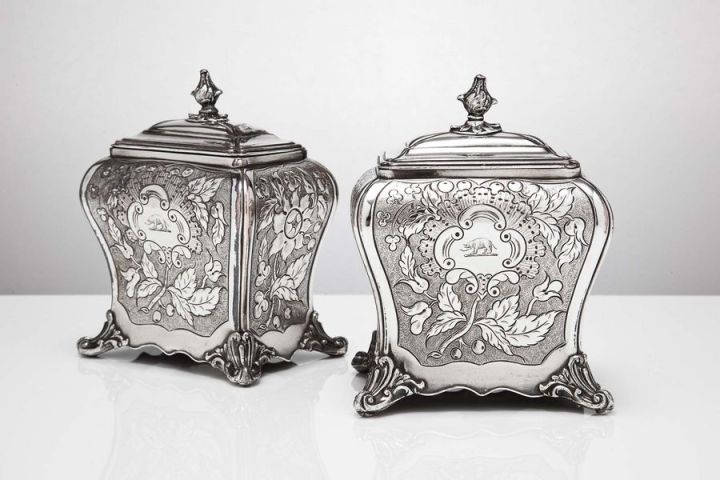
Pair of Sheffield Plate tea caddies, ca. 1800/1810,
of earlier rococo style.
◊ ◊ ◊ ◊ ◊
Press release from London’s Silver Vaults:
Might & Magnificence: Silver in the Georgian Age
The London Silver Vaults, Chancery Lane, London 2 June — 4 October 2014
Curated by Philippa Glanville
The summer selling exhibition at the London Silver Vaults, Might & Magnificence: Silver in the Georgian Age, will display a wide variety of Georgian silver design, drawn from all 30 Vaults shops, encompassing the major design trends of the period, from the effusively embellished rococo to the restrained neo-classical. With added curating expertise from Philippa Glanville, silver historian, author and former Keeper of Metalwork at the Victoria & Albert Museum, key pieces will be selected that demonstrate the finest Georgian design and craftsmanship. All items are for sale, offering an opportunity to acquire a beautifully crafted piece of design history from this elegant era.
In the Georgian period silverware gradually ceased to be the exclusive preserve of aristocrats, diplomats and bishops. A new middle and merchant class was emerging in Britain, wanting to buy impressive objects for their new homes. Throughout the Georgian period silver remained one of the most popular expressions of taste, style and innovative manufacturing techniques. Ingenious designers ensured a flow of novel objects for these new consumers, in Britain and overseas. England was already a rich country by the early 1700s, and in the 120 years spanning George I’s accession in 1714 to the end of William IV’s reign in 1837, the country went through an explosion of commercial growth, technical development and social improvement. Silver design and manufacture reflected these changes.
Until the 1760s most silver was entirely made by hand, the alloy hammered into shape and raised or chased to form decoration so the pattern was shown in relief on the exterior. Cast elements, like handles and feet, were soldered on. These purely hand-decorated pieces were quite heavy, making silver a super-luxury product that only the very wealthy could afford. Retailers sold silver mostly by weight, with an extra charge per ounce for workmanship and more for any engraved heraldry. In the 1750s a London goldsmith would charge £50 for a new set of eight cast candlesticks, essential lighting for the dinner table. This is a large sum, as much as a portrait or the year’s wages for a smart French chef. (An English cook was paid half as much.) In 1765 the young Duke of Portland bought a complete Wedgwood creamware dinner service for £13, but in silver that would have bought a single sauceboat. Pre-owned silver sold well too, by weight, as the ‘fashion’ or workmanship charge was reduced. (more…)
New Book | Les Ruines: Entre Destruction et Construction
Published by Campisano and available from ArtBooks.com:
Karolina Kaderka, ed., Les Ruines: Entre destruction et construction de l’Antiquité à nos jours (Rome: Campisano Editore, 2013), 284 pages, ISBN: 978-8898229123, €40.
 Aucune époque n’échappe aux ruines et toutes les ruines ont une histoire. Elles sont vouées à perdurer ou disparaître, fasciner ou déranger. L’intérêt pour les ruines s’explique de façon naturelle par leur omniprésence et ne date pas d’aujourd’hui: différentes époques et cultures témoignent de leur façon propre de les appréhender. Si le goût des ruines antiques émerge en Europe avec la Renaissance et suscite un véritable culte au siècle des Lumières, toutes les époques de l’histoire sont amenées à affronter des ruines de genres divers, parfois conceptualisées mentalement. Au cours du siècle dernier, dans un contexte où surgissent de nouvelles formes de destructions, massives et violentes, se font jour une nouvelle sensibilité aux ruines et un désir d’étudier, de manière plus complexe, leur impact et leur signification pour les sociétés : celles auxquelles elles appartenaient à l’origine, comme celles auxquelles elles seront confrontées par la suite. S’inscrivant dans la continuité des recherches actuelles sur le sujet, ce volume interdisciplinaire souhaite présenter et discuter l’existence et la perception de ruines en Europe, dans des contextes culturels et historiques variés, qu’elles soient considérées in situ, représentées ou ressenties, qu’elles soient décrites ou abordées par d’autres moyens que les mots. Des archéologues, historiens, historiens de l’art et de l’architecture, esthéticiens, spécialistes des langues, de la littérature et des nouvelles technologies de conservation des traces du passé, croisent leurs regards dans des études qui portent sur les constructions détruites, tout comme sur les destructions construites, en montrant diverses façons de les concevoir depuis l’Antiquité jusqu’à aujourd’hui.
Karolina Kaderka est archéologue et historienne de l’art antique. Chercheuse associée dans l’équipe d’accueil Histara (EA 4115) de l’École pratique des hautes études (EPHE Paris) et lauréate du prix «Jeune chercheur» de la Fondation des Treilles pour 2013, elle est actuellement post-doctorante Fernand Braudel-IFER à l’Université
de Constance. Après des études universitaires à l’Université Charles de Prague et à l’Université Louis-et-Maximilien de Munich, elle a obtenu en 2012 un doctorat (co-tutelle EPHE Paris/Université de Dresde), avec une thèse consacrée au décor tympanal des temples de Rome. Ses travaux portent notamment sur la sculpture romaine, sur l’art romain dans son contexte (spatial, socioculturel et historique, avec un intérêt particulier pour les programmes décoratifs), sur les transferts culturels entre la Grèce, le monde étrusco-italique et Rome et sur la photographie archéologique. Dernièrement elle a collaboré au catalogue d’exposition Éclats d’antiques. Sculptures et photographies : Gustave Mendel à Constantinople (Paris, 2013).
C O N T E N T S
• Préface – Une lecture des ruines, François Queyrel
• Introduction. Les Ruines. Entre destruction et construction, Karolina Kaderka
• La conservazione delle rovine di guerra nella Grecia antica e il giuramento di Platea (vero o falso?), Massimiliano Papini
• Les ruines de Cicéron. Temples et mœurs à la fin de la République romaine, Karolina Kaderka
• Paysage de ruines dans la peinture romaine (Ier siècle av. J.-C. – Ier siècle ap. J.-C.), Isabella Colpo
• Abandonner ou restaurer: la peur des ruines dans l’Antiquité tardive, Éric Morvillez
• L’esthétique paysanne des spolia dans les églises médiévales du Hat¸eg (Roumanie, xiiie-xve siècle), Vladimir Agrigoroaei
• Le «Antichità greche» di Giuliano da Sangallo. Erudizione e rovinismo nel Libro dei Disegni, Codice Barberiniano Latino 4424, Dario Donetti
• Tradition religieuse contre invention à l’antique: ruines dans la peinture de la deuxième moitié du Quattrocento, Sabine Frommel
• Spazio, Tempo e rovine nel giardino del Rinascimento, Claudia Conforti
• Symbolique et réemploi des ruines: réflexions à partir du cas de la Lorraine après la guerre de Trente Ans, Raphaël Tassin
• La tourelle de l’abbatiale de Royaumont: un débris devenu monument, Jean-François Belhoste
• Ruines et Lumières : Français et Anglais aux prises autour de la Rome antique aux xviiie et début xixe siècles, Odile Boubakeur
• Ruines et pensée de l’Histoire. Le paradigme catastrophique de Walter Benjamin, Sabine Forero Mendoza
• Ruines de la modernité ou modernité de la ruine ?, Audrey Norcia
• Poétiques des ruines ou comment écrire dans les décombres de la Seconde Guerre mondiale, Pierre Hyppolite
• L’expression interlinguistique des ruines et sa poétique, Anne Szulmajster-Celnikier
• Réplique virtuelle et réplique réelle de la tablette d’Idalion – bronze chypriote conservé à la BnF, Patrick Callet
• Ruines, permanence de l’impermanence: un essai de conclusion, Alain Schnapp
The Frick Collection Announces Expansion Plans
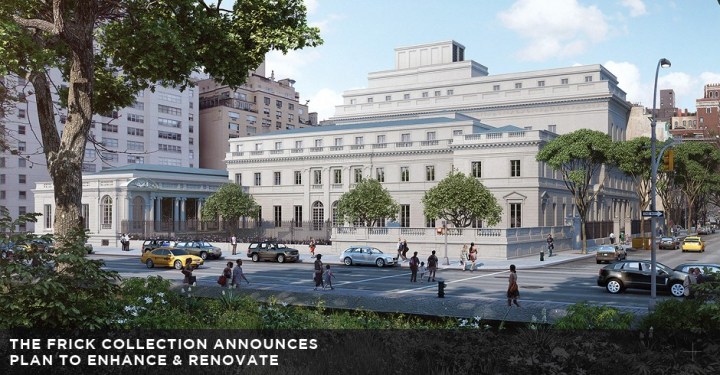
Rendering of The Frick Collection plan from Fifth Avenue
Neoscape Inc., 2014
◊ ◊ ◊ ◊ ◊
Press release (10 June 2014) from The Frick:
The Frick Collection today unveiled a plan to enhance and renovate its museum and library to further fulfill founder Henry Clay Frick’s long-standing vision to offer public access to its works of art and educational programs. The proposal derives from the Frick’s history of architecturally cohesive expansions and alterations. It includes the construction of a new addition in keeping with the scale and design of the original house and the library wing, and the renovation and expansion of interior spaces added in the 1930s and 1970s. A centerpiece of the new plan will be the opening of the museum’s second floor to the public for the first time. The result will preserve the intimate visitor experience in an extraordinary mansion that has delighted art lovers for nearly eight decades. Davis Brody Bond Architects and Planners, the New York–based firm that was responsible for the 2011 award-winning transformation of an exterior loggia into the museum’s Portico Gallery, will design the project.
In addition to converting several of the museum’s historic second-floor rooms into galleries, the Frick’s proposal calls for the construction of an architecturally respectful addition to the East 70th Street side of the museum, consistent with the style, history, and design of the original 1913–14 mansion and previous expansions. The new addition, which will provide the institution with a net gain of 42,000 square feet, will house more gallery space, an expanded entrance hall, additional space for the Frick’s world-renowned art reference library, new classrooms, a 220-seat auditorium, expanded administrative space, and updated conservation laboratories, as well as a rooftop garden terrace for museum visitors. The addition will match the heights of the Frick’s historic wings, including the three-story original house and the six-story library building constructed in 1935. The project will undergo all necessary public reviews, including that of the New York City Landmarks Preservation Commission.
“Since The Frick Collection opened as a museum nearly eighty years ago, we have been guided by Henry Clay Frick’s mandate that his home and exquisite collection offer inspiration and enjoyment to the public,” said Frick Director Ian Wardropper. “Today, Mr. Frick’s wishes continue to guide our Trustees and Administration as we seek to further realize his vision and, at the same time, secure the institution’s future through a sensitive plan that is respectful of the museum’s tradition and the community.”
“To improve service to our audiences, we wish to make an already great institution even better,” said Margot Bogert, Chair of the Frick Board of Trustees. “We occupy a structure and property that has evolved numerous times since the passing of Henry Clay Frick in 1919, with each occurrence conceived to better meet the needs of the institution and its public. We are driven by our mission once more with this plan.”
“We approach this project with reverence for the 1913–14 Frick mansion and the 1935 additions, including the Frick Art Reference Library,” said Carl Krebs, a partner at Davis Brody Bond. “The evolution of the Frick has been marked by a combination of a consistent design vocabulary, high architectural quality, and respectful additions and alterations. Our design speaks to all of these themes.”
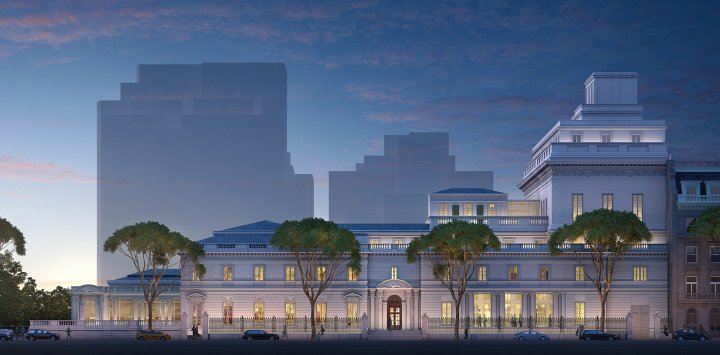
Elevation of The Frick Collection plan from 70th Street
Neoscape Inc., 2014
◊ ◊ ◊ ◊ ◊
The project primarily focuses on three areas:
Expanding Gallery Space
• The Frick will open several second-floor rooms to museum visitors for the first time ever, including what were formerly bedrooms, a study, and a breakfast room. This will enable more objects from the permanent collection to be exhibited and will offer visitors a greater sense of how the Frick family lived in the Gilded-Age house.
• The plan calls for the construction of an addition that will match the heights of the existing house and library to create more than 42,000 square feet of new space, including an additional exhibition gallery on the museum’s first floor. The new gallery will allow the museum to better accommodate popular special exhibitions without having to take works from the permanent collection off public view, as it often does currently.
Enhancing Educational Offerings
• The Frick’s educational programming will expand with a new education center including two dedicated classrooms and an auditorium capable of accommodating 220 visitors, a 30% capacity increase. The Frick’s education programming already serves more than 25,000 adults and children through lectures and symposia, school group visits, and an acclaimed concert series. The new education center will expand the Frick’s ability to cultivate these lifelong students of art.
• A dedicated study room for visiting scholars and public seminars will be added.
• Additional space for the Frick Art Reference Library will be created, as well as barrier-free access between it and the museum’s galleries on the ground floor.
• Also included will be an enlarged, updated lab where the Frick’s world-class conservators will work to preserve the Collection’s masterpieces.
Improving the Visitor Experience
• The entrance hall will be enlarged to approximately three times its current size, thereby reducing the time visitors wait in line outside the Frick and providing them with a smoother, more comfortable arrival.
• Two new elevators and a ramp will be constructed to provide improved barrier-free access.
• Four new restrooms and larger coat-check facilities will be added.
• The plan will create a larger shop to allow visitors more space to browse and purchase an expanded array of books, images, and merchandise related to the collection and exhibitions.
• The new building will feature a meditative rooftop garden terrace accessible to museum visitors.
Construction is expected to start in the spring of 2017, with completion as early as 2020. The museum and library are anticipated to remain open throughout the construction process.

Rendering of The Frick Collection plan from 70th Street looking West, Neoscape Inc., 2014
As with all of the Frick’s previous renovations and expansions, Davis Brody Bond’s approach to the Frick project will remain true to the neoclassical building constructed in 1913–14 by Carrère and Hastings. Since Mr. Frick’s death in 1919, the museum has continued to acquire works of art, expanding the permanent collection holdings of paintings by more than one-third. To accommodate this growth and the needs of the public, the building’s public spaces have been enlarged several times (in 1924, 1931–35, 1977, and 2011). Visitors to The Frick Collection are often surprised to learn that many of the museum’s architectural features were not part of the original Frick family home. In 1924, a single-story library was constructed on 71st Street, adjoining the mansion. In the 1930s architect John Russell Pope undertook the conversion of the family home into a public museum, nearly doubling its original size, and demolishing the 1924 building to construct a larger, six-story library. As the institution continues to grow, the need for additional gallery space and expanded facilities for education, conservation, and other activities is paramount.
The addition to the museum―which will feature a rooftop garden terrace for visitors―will be constructed on Frick property that includes the 1977 addition and a gated side garden on East 70th Street, also from 1977, which has always been inaccessible to the public. Originally the site of three unrelated townhouses, the property was acquired by the Frick over a period of decades beginning in the 1940s with an eye towards expanding the building to better serve the public. But, due to a lack of funds, in 1977, the Frick was only able to build a structure with a small reception hall, coat check, and shop on the ground-floor level, and two small rooms in the basement, with the gated private garden occupying the remaining space.
Several critically acclaimed exhibitions, including last year’s Vermeer, Rembrandt, and Hals: Masterpieces of Dutch Painting from the Mauritshuis (which attracted more than 235,000 visitors), have underscored the strong public demand and the need for additional space in order to continue to fulfill the Frick’s mission of providing the public easy access to the institution’s offerings.
Davis Brody Bond is one of the nation’s leading design firms with capabilities in urban design, architecture, master planning, historic preservation, and interior design. It is the recipient of more than 200 awards of excellence and has a unique design style that responds to the physical, cultural, and historical contexts of each project and site. Many of Davis Brody Bond’s iconic structures are enduringly relevant and have earned the firm a reputation for innovation and design excellence. Current cultural projects include the National September 11 Memorial Museum at the World Trade Center; the Smithsonian Institution’s National Museum of African American History and Culture, under construction on the National Mall in Washington, D.C.; the Embassy of South Africa in Washington, D.C.; and the Portico Gallery at The Frick Collection in New York City, which was completed in 2011.
◊ ◊ ◊ ◊ ◊
Note (added 13 June 2014) — In her article “Frick Seeks to Expand Beyond Jewel-Box Spaces” for The New York Times (9 June 2014), Robin Pogrebin notes that
Critics of other expansions—like MoMA’s—have called them unnecessary, too expensive or even hubristic. As the Frick rolls out its plans, it could face opposition for altering one of New York’s beloved historic buildings, a late Gilded Age mansion designed by Thomas Hastings for the industrialist Henry Clay Frick, where visitors can view a world-class assemblage of old master paintings, European sculpture and decorative arts. . .
Right on cue, David Masello, the executive editor of the design magazine Milieu, weighs in with an Op-Ed for The New York Times (12 June 2014), “Save the Frick Collection” . . .
America has few mansions built by a family with an art collection they meant to share with the public. So when word came this week that the Frick Collection, on the Upper East Side of Manhattan, was planning to expand and build a tower where there is now a discreet garden and a splashing fountain with lily pads—one of those few places in the cityscape where we are allowed to stop and breathe—I felt blunt disappointment, as well as betrayal. . .
The full editorial is available here»
◊ ◊ ◊ ◊ ◊
Note (added 30 July 2014) — Michael Kimmelman weighs in against the project: “The Case Against a Mammoth Frick Collection Addition,” The New York Times (30 July 2014), available here»
◊ ◊ ◊ ◊ ◊
Note (added 4 June 2015) — Michael Kimmelman notes the demise of the project, “Frick Collection Returns to Square One, a Prized Garden Intact,” The New York Times (4 June 2015) . . .
The administration of Mayor Bill de Blasio let the Frick know that the proposal couldn’t survive the gantlet of the Landmarks Preservation Commission. The museum had no choice. It issued a gracious statement on Thursday morning, thanking everyone, including opponents “who share a great deal of affection and respect for the institution.” The museum promised to come up with a new plan, one that would spare the Russell Page-designed garden. . . .
The full piece is available here»
The Louvre Reopens Eighteenth-Century Decorative Arts Galleries
Paneling from the hôtel Le Bas de Montargis, place Vendôme, Paris, ca. 1705 (Musée du Louvre / Olivier Ouadah).
◊ ◊ ◊ ◊ ◊
Press release posted at ArtDaily (with additional coverage and images at ArtNet News and by Didier Rykner at La Tribune de l’Art) . . .
The Louvre has announced the June 6, 2014 reopening of its newly restored and reinstalled 18th-Century Decorative Arts Galleries. One of the most comprehensive collections of 18th-century French decorative arts in world, the collection is on view to the public for the first time since 2005. The 35 galleries—which span 23,000 square feet—display over 2,000 pieces in object-focused galleries and period-room settings. The new installation traces the evolution of French taste and the decorative arts, emphasize the major artisans and artists of the period, and highlight the renowned collectors and patrons of the era.
The exhibition design was conceived collaboratively by interior designer and French decorative-arts connoisseur Jacques Garcia and the curators in the Department of Decorative Arts under the direction of Marc Bascou. The architectural project management for the new galleries was entrusted to Michel Goutal, the Louvre’s senior historical monument architect, with technical assistance provided by the Louvre’s Department of Project Planning and Management. American Friends of the Louvre (AFL) has played a vital role in the renovation by raising $4 million in support of the project and one of its key period rooms—the restoration of l’Hôtel Dangé-Villemaré drawing room which has not been exhibited in its entirety since its 19th-century acquisition by the Louvre. In addition, AFL also raised funds for the restoration and first ever public presentation of a magnificent cupola painted by Antoine François Callet which will be installed in the galleries and for the English-language edition of the book of the Louvre’s decorative arts collection whose publication will celebrate the opening (see below).
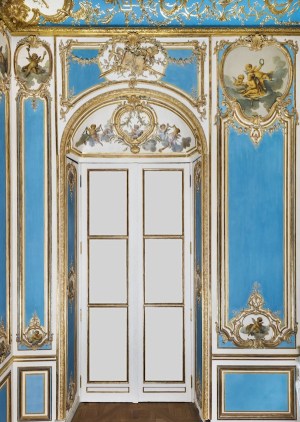
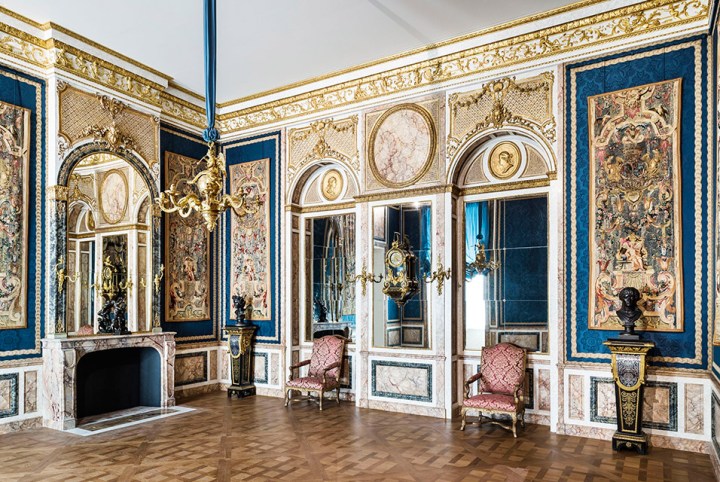
Interior architecture from the assembly room of l’hôtel Dangé. Paris, ca. 1750, with modern additions. Height to the cornice, 15’ Paris, Musée du Louvre / Olivier Ouadah).
L’Hôtel Dangé-Villemaré’s drawing room, built in 1709 and redecorated in 1750, is one of the most important surviving examples of an interior by a Louis XV-era Parisian workshop. The room’s decorative paneling, for which it is noteworthy, has undergone extensive conservation to reveal its original color and various tones of gilding. The alternating wide and narrow panels are also notable for their elegant motifs, which include symbols of the arts, sciences, and commerce. Medallions at the tops and the bases of the panels feature delightfully painted images of children at play. The drawing room will also feature Versailles parquet floors, sumptuous furniture pieces, and bronze furnishings.
“The 18th-Century Decorative Arts Galleries have always been a particular favorite of American visitors, who appreciate the opulence and craftsmanship of this work,” said Executive Director of AFL Sue Devine. “AFL’s support of the renovation of l’Hôtel Dangé-Villemaré’s drawing room seemed like a natural progression in the United States’ long tradition of support for and appreciation of French art and culture. We are proud to be a part of this major moment in the Louvre’s history.”
When the Louvre closed the decorative arts galleries on the first floor of the Cour Carrée’s north wing to bring them in compliance with current safety regulations, the museum seized the opportunity to revisit the installation of the galleries, which had not been appreciably updated since 1966. Under the direction of Marc Bascou and Jannic Durand, former and current Directors of the Department of Decorative Arts respectively, and in collaboration with the curators in the Department of Decorative Arts, the Louvre has reinterpreted its collections and reinstalled them as a series of period rooms and themed galleries, which allows closer examination of the museum’s collection. The galleries are grouped into three main chronological and stylistic moments:
• 1660–1725, The reign of Louis XIV and the Regency
• 1725–1755, The height of the Rococo style
• 1755–1790, Return to classicism and the reign of Louis XVI
“We wanted to achieve a happy medium between period rooms and exhibition galleries,” said Jannic Durand, Director of the Department of Decorative Arts. “Each object benefits from being in relationship with other objects. In some cases, this means creating a period room so our visitors can understand how people lived with these objects or so they can appreciate holistically the elegance and refinement of the 18th century. In other instances, it means curating display cases devoted entirely to porcelain, silverware, and even some pieces of furniture to underscore the history of techniques and styles.”
When possible, the Louvre has reconstructed documented decorative groupings, accompanied by period furniture, such as the drawing room and library of l’Hôtel Dangé-Villemaré, the Grand Salon of the Château d’Abondant, and the ceremonial bedchamber at the Hôtel de Chevreuse. Other rooms bring together “recollections of interiors,” in Jacques Garcia’s words, which are stylistically coherent groupings of furniture and objects within a recreated decorative setting. “The Louvre’s new decorative arts galleries will embody the constant evolution of taste, flowing in a coherent movement from the ascension of a new style during Louis XIV’s reign to the time of Marie- Antoinette at the end of the Ancien Régime,” said Jacques Garcia. “The galleries will display a multitude of atmospheres, but will always remain true to the sense of the innovation and beauty that characterizes the Grand Siècle of decorative arts which, in France, was the 18th century.”

Faience dishes and pottery depicting scenes from history, in the tradition of Castelli Maiolica earthenware, Pavie and Nevers (France) 1650–1700
(Paris, Musée du Louvre / Olivier Ouadah).
Using objects and furnishings, the reinstallation also introduces visitors to members of the royal family, including: Louis XIV, Louis XV and Louis XVI, the Prince de Condé, the Comte d’Artois, Mesdames de France (the king’s daughters), and Marie-Antoinette, as well as Louis XV’s mistresses Madame de Pompadour and Madame du Barry, nobles of the royal court such as the duc de Chevreuse and the marquis de Sourches, and wealthy financiers such as the keeper of the royal treasure Claude Le Bas de Montargis, and the tax collector François-Balthazar Dangé. Particular emphasis has been given to artisans with royal patronage—the most celebrated of whom were granted free lodgings in the Galerie du Louvre alongside their workshops. Such examples include André- Charles Boulle and Thomas Germain, whose workshops served not only French kings and courtiers, but also Europe’s elite, contributing to the dissemination of French culture and setting fashions throughout the continent. The installation also highlights the period’s master craftsmen, including: cabinet-makers André-Charles Boulle, Charles Cressent, Bernard II van Risemburgh, Jean-François Oeben, Martin Carlin, and Jean-Henri Riesener; the silver- and goldsmiths Thomas and François-Thomas Germain, Nicolas Besnier, Jacques Roëttiers and son, and Robert-Joseph Auguste; and the painters and decorators Charles Le Brun, Jean-Baptiste Oudry, and Charles-Antoine Coypel. The visitor experience in the galleries is further enriched through multimedia aids and new interpretative materials that contextualize the works on view and give insight into the evolution of taste, methods of production, the patronage system, and how the objects were used
◊ ◊ ◊ ◊ ◊
Somogy published the catalogue, available in both French and English:
Jannic Durand, Michèle Bimbenet-Privat, and Frédéric Dassas, Décors, Mobilier et Objets d’Art du Musée du Louvre: De Louis XIV à Marie-Antoinette (Paris: Somogy, 2014), 554 pages, ISBN: 978-2757206027, €45.
Jannic Durand, Michèle Bimbenet-Privat, and Frédéric Dassas, Decorative Furnishings and Objets d’Art in the Louvre from Louis XIV to Marie-Antoinette (Paris: Somogy, 2014), 568 pages, ISBN: 978-2757206034, €45.
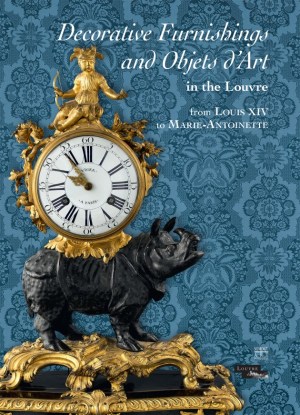 Over two hundred and fifty masterpieces from one of the most magnificent eras in the decorative arts are featured in this book, ranging from the splendors of courtly art under Louis XIV to the dazzling creations inspired first by Madame de Pompadour under Louis XV and then by Queen Marie-Antoinette under Louis XVI. A broad perspective on interior decoration, luxury goods, and the art market is offered through lavish furniture by the likes of André-Charles Boulle and Charles Cressent during the Régence, through extravagant dinner services, and through the magnificent porcelain and tapestries produced by the royal manufactories, constituting a “moment of perfection in French art” that lasted until the Revolution.
The Louvre’s new rooms devoted to seventeenth- and eighteenth-century decorative arts opened in May 2014. Some two thousand items are displayed in nearly twenty thousand square feet of exhibition space, representing one of the world’s finest collections of furnishings and objets d’art from the reign of Louis XIV through that of Louis XVI. The new galleries are organized chronologically and are punctuated by spectacular period rooms that recreate the magnificent wood-paneled interiors of lavish residences and princely palaces in eighteenth-century Paris. These reconstitutions of a bygone period provide the setting for truly remarkable objets d’art from the Louvre’s Department of Decorative Arts—now placed in their original intellectual and material context, these items recreate a vanished atmosphere and finally reveal their full meaning as well as their full beauty.
Fair | Art Antiques London, 2014
From the fair’s website:
 Art Antiques London
London, 11–18 June 2014
The Albert Memorial and Kensington Gardens once again provide the stunning backdrop to one of London’s most exciting and glamorous art and antique fairs. Held in a beautiful bespoke pavilion opposite the Royal Albert Hall and close to the site of the Great Exhibition of 1851, Art Antiques London brings together leading international dealers and discerning visitors from all over the world, who can buy with confidence at this strictly vetted sumptuous summer showcase for the arts.
◊ ◊ ◊ ◊ ◊
From the fair’s lecture series (with information about each speaker available here) . . .
Jewellery in the Age of Queen Victoria: A Mirror to the World
Thursday, 12 June, 11:30
Judy Rudoe (Curator of Jewellery and Decorative Arts, The British Museum)
This lecture emerges from the speaker’s recent book co-authored with Charlotte Gere (see biography). The ‘age of Victoria’ is taken in its widest sense to encompass jewellery from across Europe and America, at a time when expanding foreign trade, the new illustrated press and a growing tourist industry brought jewellery from many parts of the world to a wide audience. Queen Victoria played a huge role: what she wore and did had tremendous impact, so what might seem a narrow subject acts as a key to our understanding of the entire Victorian age. Using examples from the British Museum and collections worldwide, Judy Rudoe considers Victorian jewellery against its global background and uncovers what jewellery meant to those who wore it, both literally and metaphorically. She will show how it was used in private and in public to reveal that politics, nationalism and even humour of the period are all embodied in jewellery.
◊ ◊ ◊ ◊ ◊
J.M.W. Turner: The Artist and His House at Twickenham
Thursday, 12 June, 2:30
Catherine Parry-Wingfield (Chairman of Turner’s House Trust)
Turner is rightly one of the most famous names in the history of British art, and remains an inspiration to painters today. Tucked away in Twickenham is a small unknown work by this great artist, not a painting, but a work in three dimensions. Sandycombe Lodge was designed by Turner himself as a country retreat from the pressures of the London art world; his ‘old Dad’ kept house here, Turner sketched, fished the river and occasionally entertained. This talk will explore a little-known side of Turner’s life and work, against the backdrop of the ‘Matchless Vale of Thames’, the beautiful Thames scenery which inspired much of his work. Sandycombe Lodge is now owned by Turner’s House Trust, which is developing plans for major conservation and future use of this beautiful and important building.
◊ ◊ ◊ ◊ ◊
A Matter of Fashion: The Collecting of English Ceramics
Friday, 13 June, 11:30
Anton Gabszewicz (Independent ceramics researcher)
Since the death of Lady Charlotte Schreiber in 1895, English ceramics have been collected with increasing enthusiasm. The founding of the English Porcelain Circle in 1927, under the Presidency of Mrs Radford, brought leading enthusiasts together and since then, through the yearly publication of the ECC Transactions their knowledge has been disseminated to a wider public. Yet the collections the speaker will discuss are markedly varied in their content and in the way they have been assembled. The names form a roll call of the influential collectors of the last 70 years. This lecture identifies those influences and how they informed the taste of succeeding generations.
◊ ◊ ◊ ◊ ◊
Of Soup and Love: The Campbell Collection of Soup Tureens at Winterthur Museum
Friday, 13 June, 2:30
Pat Halfpenny (Independent researcher)
The Campbell Collection of soup tureens is the finest collection of its type in the world. Although this lecture will focus on the magnificent ceramic pieces, they will be set in a context that includes highly prized silver and gilt examples that will help us understand the evolution of high style in the eighteenth and early nineteenth centuries. As grand gilded baroque examples, fanciful rococo porcelain, and elegant neoclassical forms will be discussed, the speaker will share some of the changes in social life and dining practices that created the environment in which tureens were first introduced, rose to great prominence, declined, and found new purpose in the twentieth and twenty-first centuries.
◊ ◊ ◊ ◊ ◊

Early Chelsea Model of a Finch, ca. 1745–49, exhibited by the Brian Haughton Gallery.
Nature, Porcelain and Enlightenment: Early English Porcelain and its Place in the Eighteenth-Century Home
Friday, 13 June, 4:30
Paul Crane (Lecturer, researcher, and dealer)
England in the mid-eighteenth century was a country riveted by an insatiable appetite for knowledge, exploration, and discovery. This forged a new scientific approach which was to spearhead the Age of Enlightenment. Through new eminent publications Science and Nature became the pinnacle of taste and fashion within the Aristocracy, who decorated their homes with this organic natural force. The birth of English porcelain in London in the 1740s provided an opportunity for enlightenment to fuse with the arts. Examples of the production at the porcelain manufactories of Bow, Chelsea, Worcester, and Vauxhall together with the Liverpool factories of Samuel Gilbody, William Reid, and Richard Chaffers will illustrate these natural recreations that were to fill the eighteenth-century home with a totally re-invented Cabinet of Natural Curiosity.
◊ ◊ ◊ ◊ ◊
The Silver Society Study Day: New Silver Projects
Saturday, 14 June, 11:00–6:00
Dirk-Jan Biemond, Michèle Bimbenet Privat, Hazel Forsyth, Christopher Hartop, James Rothwell, Peter Taylor, and Charles Truman
Tickets: £50 society members / £65 non-members. Please note that The Silver Society Study Day is booked separately from the Art Antiques London lecture programme. To book, visit The Silver Society’s website or email events@thesilversociety.org.
◊ ◊ ◊ ◊ ◊
Around the World in 80 Figures: Highlights of the Pauls-Eisenbeiss-Stiftung, Basel
Sunday, 15 June, 11:30
Samuel Wittwer (Director, Prussian Palaces and Gardens Foundation, Berlin-Brandenburg)
Established in 1975 in Basel, the Pauls-Eisenbeiss Foundation is one of the world’s leading collections of eighteenth-century German porcelain figures. The collection concentrates on four leading manufactories (Meissen, Frankenthal, Ludwigsburg, and Höchst) bringing together 750 objects, mainly figures. This treasure trove of German porcelain has been open to the public since 1977. It is not just a collection of important examples of each manufactory; it is a collection cleverly put together in the 1950s and 1960s and is the perfect study base enabling collectors to compare variations of decoration and modelling, discovering unique pieces and also enabling students to gain insight to a wide range of topics such as fashion and social aspects of the eighteenth century. This lecture introduces us to this important collection in a multifaceted way by giving us a general overview as well as concentrating on new aspects of research and details.
◊ ◊ ◊ ◊ ◊
Freedom of Expression: The Fantastic Range of du Paquier Porcelain
Sunday, 15 June, 3:30
Claudia Lehner-Jobst (Art historian and curator, Vienna)
This lecture will pay homage to two personalities: Claudius Innocentius du Paquier, the founder of the first porcelain manufactory in Vienna and his artistic resourcefulness and to one of the first collectors of his work, Marchese Emanuele d’Azeglio whose objects now form the heart of the ceramics collection at the Palazzo Madama in Turin. The speaker will discuss the history of that collection and some outstanding objects in depth.
◊ ◊ ◊ ◊ ◊
A Behind the Scenes Look at Ming: 50 Years that Changed China
Monday, 16 June, 11:30
Jessica Harrison-Hall (Curator of Chinese Ceramics, British Museum and Sir Percival David Collections and Vietnamese Art)
This year the British Museum will open a major exhibition on Ming courts and their international engagement. Ming: 50 Years that Changed China shows how fifty years of the Ming dynasty transformed China in ways which still affect the country we know today. Ming China was thoroughly connected with the rest of the world in these years and absorbed many influences. The staggering wealth of the courts included some of the most beautiful porcelain, gold, jewellery, furniture, paintings, sculptures, and textiles ever made. Many of these objects were undiscovered until recently and have never been shown within the context of China’s multiple courts and of Ming China’s interaction with foreign countries ranging from Mogadishu to Kyoto. This lecture takes a behind the scenes look at the four years of collaborative research and international co-operation which culminate in the exhibition.
◊ ◊ ◊ ◊ ◊
Face to Face: Dame Rosalind Savill in Conversation with the Duke of Devonshirec
Monday, 16 June, 4:00
Where do you find the essential combination of sensibility and pizzazz needed to cherish the traditional and celebrate the innovative in a great country house? The answer is simple: at Chatsworth with the Duke and Duchess of Devonshire. Throughout its history the individual contribution of each generation has enabled it to evolve and flourish, often against huge odds, but the pressures and challenges today are more formidable than ever. Stoker and Amanda Devonshire have spent the last ten years reinventing Chatsworth in a myriad of inspirational ways, giving it a new twenty-first century lease of life, and using their magic touch to turn a possible millstone into a marvel. This discussion will attempt to discover the secrets of their success in bringing a thrilling new edge to Chatsworth. It will touch on the history of the house and its great collections, and will explore their daunting responsibilities and prospects when he inherited in 2004, how their grand plans took shape, the highs and lows of achievement, and the continuing excitement of future projects and dreams. Conversation sponsored by 1stdibs.
◊ ◊ ◊ ◊ ◊
The French Porcelain Society Study Day: Sèvres and China
Tuesday, 17 June, 11:00–5:30
Dame Rosalind Savill, John Whitehead, Juliet Carey, Kee Il Choi, Vincent Bastien, and David Peters
Tickets: £45 Society members / £65 non-members. Please note that The French Porcelain Study Day is booked separately from the Art Antiques London lecture programme. To book, visit The French Porcelain Society’s website or email rmcpherson@orientalceramics.com.
◊ ◊ ◊ ◊ ◊
Porcelain Figures in the Royal Court Pantries in Dresden, Warsaw and Hubertusburg: A Crash-Course in the Hof-Conditorei Inventories
Wednesday, 18 June, 2:30
Maureen Cassidy Geiger (Independent ceramic researcher)
Meissen figures have typically been studied via the work reports in the manufactory archives, which were suspended from 1748 to 1764, or the Japanese Palace inventories. By comparison, the highly detailed inventories of the court pantries of the Saxon-Polish realm have been overlooked as an essential resource for understanding the types and numbers of figures produced for table decoration, especially during the gap in the work reports. This Hof-Conditorei crash course will focus on three inventories taken between 1750 and 1755 at three royal palaces: Dresden, Warsaw, and Hubertusburg.
◊ ◊ ◊ ◊ ◊
Dining Culture in Enlightenment Europe
Wednesday, 18 June, 4:30
Ivan Day (British food historian)
From the town houses of Edinburgh to the palaces of St Petersburg, from the chocolate houses of Madrid to the grand salons of Stockholm, the cuisine and dining protocol of the French ancien regime spread rapidly during the course of the eighteenth century to all of the great European centres, frequently obliterating the native high status food traditions of those who adopted it. In this illustrated lecture, British food historian Ivan Day will examine the dramatic cultural impact that the spread of French court dining protocol had on the non-French speaking aristocratic world. He will not discuss not only the remarkable food itself, with a particular emphasis on the dessert course, but also its mode of service and the glittering material culture it spawned.
New Book | The Life and Times of Quatremère de Quincy
From Palgrave Macmillan:
Louis A. Ruprecht, Classics at the Dawn of the Museum Era: The Life and Times of Antoine Chrysostome Quatremère de Quincy (1755–1849) (New York: Palgrave Macmillan, 2014), 300 pages, ISBN: 978-1137384072, $95.
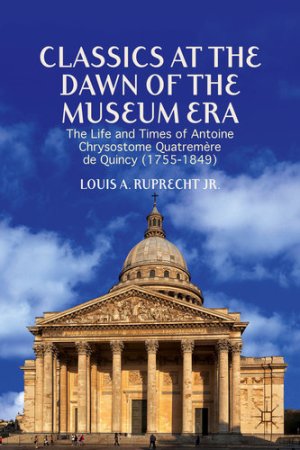 Antoine Chrysostome Quatremere de Quincy (1759–1849), arguably the foremost French classicist and art historian of the nineteenth century, is relatively little-known in English language scholarship. Three of his books were translated in the early nineteenth century, none in the twentieth century, and an important collection of two sets of open letters concerning museums, looting and repatriation was just published in 2012.
Quatremère has been unfairly called ‘the French Winckelmann,’ a charge that sticks primarily because so little of his work has ever been translated. In fact, he shows us, not what apish imitation of Wincklemann’s Neoclassicism looked like in the nineteenth century, but rather what these two overlapping disciplines had become in the generation after Winckelmann. Quatremère was formed by three crucial developments that Winckelmann did not and could not know: the French Revolution and its aftermath; Hegelian aesthetics; and the establishment of the museum era in Europe. Quatremère also remained committed to his Roman Catholicism and to the secular values of the early Revolution; in this he is very different than Winckelmann, who converted to Catholicism just before moving to Rome, and who was, according to many who claimed to understand him best, really a ‘closeted pagan’ if he were anything at all. Quatremère wrote eloquently and with deep insight concerning his understanding of the compatibilities between the Classical and Christian vision, an issue that does not figure in Winckelmann’s more intentionally ‘profane’ musings. Ruprecht hopes to show that Quatremère’s true importance emerges only if we situate him in his own times, one generation after Winckelmann, in a very different, and a far more revolutionary and secularizing cultural moment.
Louis A. Ruprecht is William M. Suttles Chair of Religious Studies at Georgia State University.
New Book | The Pathos of the Cross
According the the foreword, the book focuses on the period from 1600 to 1750. From Oxford UP:
Richard Viladesau, The Pathos of the Cross: The Passion of Christ in Theology and the Arts-The Baroque Era (New York: Oxford University Press, 2014), 368 pages, ISBN: 978-0199352685, £36 / $55.
 The Baroque period was in some senses the beginning of modern Western scientific and intellectual culture, the early budding of the Enlightenment. In the light of a new scientific and historical consciousness, it saw the rise of deism and the critique of traditional forms of Christianity. Secular values and institutions were openly or surreptitiously replacing the structures of traditional Christian society. At the same time, it was a time of religious renewal and of the reaffirmation of tradition. In sacred art, it was the age of of Bernini, Rubens, Van Dyck, Velazquez, and Rembrandt; in church music, the period of Monteverdi, Scarlatti, Handel, Telemann, and Bach. The pathos of Christ’s crucifixion—its power to evoke strong emotions of pity and compassion—was a central element in Baroque theology and spirituality. The sacred arts of the period reflect the centrality of this theme. Many of the works of the period retain their ability to move us emotionally and spiritually centuries later—even though the theology they represent has been challenged and frequently rejected. This volume traces the ways in which Roman Catholic and Protestant theologies of the period continued to proclaim the centrality of cross of Christ to human salvation. In a parallel movement, it illustrates how musical and artistic works of the period were both inspired and informed by these theologies, and how they moved beyond them in an aesthetic mediation of faith.
• Continues the historical theological/aesthetic survey of the first two volumes of this series
• Systematically examines the presence of theological themes in individual works of art and music of the Baroque period
• Is unique in its overview of the interrelationships of art and theology during a significant period of religious development
• Proposes the notion of ‘pathos’ as a means of summarizing the Baroque sensibility with regard to Christ’s passion
Richard Viladesau was ordained in 1969 in Rome for the Diocese of Rockville Centre. He is Professor of Theology at Fordham University, since 1988, and Administrator of Our Lady Star of the Sea Church, Saltaire, New York.
◊ ◊ ◊ ◊ ◊
C O N T E N T S
Foreword
Abbreviations
List of Illustrations
Introduction—The Social Context of the Baroque Period: The Beginnings of Modernity
Part I: The Survival of the Classical Paradigm of the Cross in Roman Catholicism
1 The Theoretical Mediation: The Cross in Baroque Tridentine Orthodoxy
2 The Aesthetic Mediation: The Cross in Baroque Catholic Art
3 The Aesthetic Mediation: The Passion in Catholic Music
Part II: The Cross in Protestant Orthodoxy
4 The Theological Mediation: Baroque Lutheran and Reformed Theology of the Cross
5 The Aesthetic Mediation: The Cross in Protestant Art
6 The Aesthetic Mediation: Protestant Passion Music
Part III: The Challenge to the Orthodox Doctrine of Redemption: The Enlightenment Paradigm
7 Challenges to the Classical Paradigm of the Cross and the Emergence of a New Paradigm of Salvation
Envoi
Appendix 1: Virtual Museum
Appendix 2: Discography—Music of the Passion of the Baroque Era
Bibliography
Index
Notes










 Enfilade
leave a comment