Conference | Animating the 18th-Century Country House
From The National Gallery:
Animating the 18th-Century Country House
The National Gallery, London, 5 March 2015
When we visit a Georgian country house and wander through its interiors, the impression we get is of a moment frozen in time. In fact the country house was anything but a static, unchanging entity. This one-day scholarly conference encourages fresh thinking about 18th-century country houses as environments that were always evolving, animated by interactions between objects and people.
The conference will look at the ways in which objects, when placed on display within a particular space, entered into different kinds of dialogue with the contents, decoration and associations of that space. It will also explore the ways in which the evolving environment of the country house, and the forms of display found within it, were experienced; by those who lived in the house, by those who visited as tourists or invited guests, and by those who engaged vicariously through the process of ‘armchair travel’.
Organised by the National Gallery, Birkbeck (University of London), and the Paul Mellon Centre, the conference is designed for art historians and scholars of 18th-century fine and decorative arts, architecture, and garden history; curators and custodians of historic houses; and the general public interested in historic houses of the period.
• Buying, collecting and display: the purchase, commissioning, inheritance, gifting of works of art, furniture, books and other materials; picture hangs; room arrangements.
• The country house as a complete environment: the total effect of the 18th-century country house, and the ways in which its various elements—works of art, furniture, decorative schemes—worked together to create a complete experience.
• The country house and visitor experience: country house tourism; visitor experience of houses and gardens; the multifarious literature related to country houses, including guidebooks, regional guidebooks, and periodical articles.
Book tickets here»
◊ ◊ ◊ ◊ ◊
P R O G R A M M E
10.00 Registration
10.30 Welcome and Introduction by Nicholas Penny
10.45 Panel 1: Buying, Collecting and Display
Chair: Jonathan Yarker
• Silvia Davoli, Paul Mellon Centre Research Curator at Strawberry Hill and Susan Walker, Head of Public Services at the Lewis Walpole Library, Yale University, ‘Horace Walpole’s Strategies as a Collector and the Movement of Objects at Strawberry Hill over Fifty Years’
• Karin Wolfe, Research Fellow at the British School at Rome, ‘New Rome Animates Old Britain: The Contemporary Art Acquisitions Made in Rome by John Cecil, 5th Earl of Exeter (1648–1700), for Burghley House’
• Jon Stobart, Professor of Social History at the University of Northampton, ‘Remaking an English Country House: Craftsmen, Furnishings and Taste at Stoneleigh Abbey in the 1760s’
12.15 Lunch break
13.15 Panel 2: The Country House as a Complete Environment
Chair: Sebastian Edwards
• Richard Johns, Lecturer in History of Art at the University of York, ‘Mind the Step: Animating the Country House Staircase’
• Laurel O. Peterson, doctoral candidate in the History of Art at Yale University, ‘Decorating for the Decorated: Louis Laguerre’s Murals in the Saloon at Blenheim’
• Alison Yarrington, Professor of Art History, Dean of the School of Arts at Loughborough University, ‘Light, Camera, Action: The 6th Duke of Devonshire and the Evolution of Chatsworth’
14.45 Refreshment break
15.15 Panel 3: The Country House and Visitor Experience
Chair: Stephen Lloyd
• Anthony Geraghty, Senior Lecturer in History of Art at the University of York, ‘Experiencing Castle Howard’
• Stephen Bending, Senior Lecturer in English at the University of Southampton, ‘Experiencing the Country House Pleasure Garden’
• Jocelyn Anderson, Visiting Lecturer at the Courtauld Institute of Art, ‘Visitors’ Experiences and Travellers’ Writings: The 18th-Century Country House as Tourist Attraction’
16.45 Closing comments and thanks from Susanna Avery-Quash, Research Curator in the History of Collecting, National Gallery and Kate Retford, Senior Lecturer in Eighteenth- and Early Nineteenth-Century Art, Birkbeck, University of London
Call for Papers | Disseminating Dress: Britain and the Fashion World
From the conference website:
Disseminating Dress: Britain and the Fashion World
University of York, 28–30 May 2015
Proposals due by 15 January 2015
Disseminating Dress is a three-day international and interdisciplinary conference that explores how ideas and knowledge about dress have been shared, sought and communicated throughout history.
In bringing together academics, curators and industry professionals, this conference is an invitation for interdisciplinary discussion concerning methods of communicating concepts of what someone should, could, or would wear. Dress has been demonstrated to be central to the creation, expression, and subversion of cultural and national identity. However, what remains relatively unexplored is how these ideas were conveyed and perceived. If fashion is the result of a mixture of innovation and emulation, then we need to ask how these new ideas came to be circulated around and between societies.
From the London of the Blitz to Renaissance Italy, men and women have both sought out and been instructed in what to wear, forming personal, social and cultural aesthetics, while driving trade and mercantile success. This conference welcomes a broad interpretation of how dress has been disseminated throughout history, and will be an open forum for work undertaken from a variety of disciplinary and professional viewpoints.
Disseminating Dress invites proposals for 20-minute papers that explore the manifold media, methods, perceptions and motivations driving fashion dissemination across history. Paper topics might include, but are certainly not limited to, the following methods and media for transferring fashion ideas and information:
• Correspondence and social networks
• Global networks for trade and cultural exchange
• The written word—including novels, journals, and fashion magazines
• Costume books, home sewing patterns, and other instructional sources
• Visual and material culture, including both fine art and popular culture
• Advertising, the role of fashion designers, and branding
• Famous persons, from court culture to modern celebrities
• Film, television, the Internet, and modern social media including MMS-ography
• The history of taste, and the influence of outside cultural forces such as developments within architecture and the decorative arts on fashion
Abstracts of 250 words in length, with an accompanying 100-word biography should be sent to disseminatingdress@gmail.com no later than 15th January 2015.
Confirmed Keynote Speakers
Christopher Breward, University of Edinburgh & Edinburgh College of Art
Peter McNeil, University of Technology, Sydney, & University of Sweden
Marcia Pointon, University of Manchester
Jennie Batchelor, University of Kent
Ulinka Rublack, University of Cambridge
Anna Reynolds, The Royal Collection
Organised by: Anna Bonewitz (University of York), Serena Dyer (University of Warwick), Sophie Littlewood (University of York), Jade Halbert (University of Glasgow), and Elizabeth Bobbitt (University of York).
Supported by: The Paul Mellon Centre; and The British Art Research School, The Humanities Research Centre, The Centre for Modern Studies, The Centre for Eighteenth Century Studies, and The Centre for Renaissance and Early Modern Studies, University of York.
New Book | The Spiritual Rococo: Decor and Divinity
From Ashgate:
Gauvin Alexander Bailey, The Spiritual Rococo: Decor and Divinity from the Salons of Paris to the Missions of Patagonia (Aldershot: Ashgate, 2014), 454 pages, ISBN: 978-1409400639, $130.
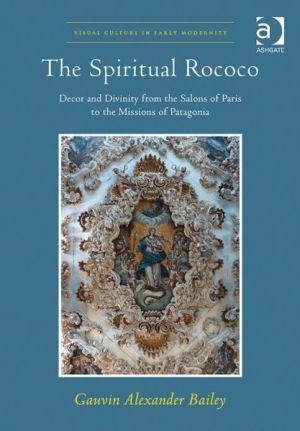 A groundbreaking approach to Rococo religious décor and spirituality in Europe and South America, The Spiritual Rococo addresses three basic conundrums that impede our understanding of eighteenth-century aesthetics and culture. Why did the Rococo, ostensibly the least spiritual style in the pre-Modern canon, transform into one of the world’s most important modes for adorning sacred spaces? And why is Rococo still treated as a decadent nemesis of the Enlightenment when the two had fundamental characteristics in common? This book seeks to answer these questions by treating Rococo as a global phenomenon for the first time and by exploring its moral and spiritual dimensions through the lens of populist French religious literature of the day-a body of work the author calls the ‘Spiritual Rococo’ and which has never been applied directly to the arts. The book traces Rococo’s development from France through Central Europe, Portugal, Brazil, and South America by following a chain of interlocking case studies, whether artistic, literary, or ideological, and it also considers the parallel diffusion of the literature of the Spiritual Rococo in these same regions, placing particular emphasis on unpublished primary sources such as inventories. One of the ultimate goals of this study is to move beyond the cliché of Rococo’s frivolity and acknowledge its essential modernity.
Thoroughly interdisciplinary, The Spiritual Rococo not only integrates different art historical fields in novel ways but also interacts with church and social history, literary and post-colonial studies, and anthropology, opening up new horizons in these fields.
Gauvin Alexander Bailey is Professor and Alfred and Isabel Bader Chair in Southern Baroque Art at Queen’s University, Kingston, Canada.
◊ ◊ ◊ ◊ ◊
C O N T E N T S
Introduction
1. ‘The Dream of Happiness’: The Literature of the Spiritual Rococo and the Christianity of Reason
2. ‘As Bizarre a Style as Ever Occurred’: Rococo in France
3. ‘Bright Shining as the Stars’: Spiritual Rococo in Central Europe
4. ‘Irregular Ornament in the Finest French Taste’: Spiritual Rococo in Portugal and Brazil
5. ‘O Happy Vision!’: Spiritual Rococo in Spain and Spanish South America
Epilogue: ‘Superfluous Stucco and Laughable Decoration’: Rococo, Religion, and the Global Enlightenment
Appendix A: French Spiritual Literature in Central European Collections
Appendix B: French Spiritual Literature in Luso-Brazilian Collections
Appendix C: French Spiritual Literature in the Spanish Southern Cone
Bibliography
Index
New Book | Rococo Echo
The latest volume of SVEC:
Melissa Lee Hyde and Katie Scott, eds., Rococo Echo: Art, History and Historiography from Cochin to Coppola (Oxford: Voltaire Foundation, 2014), 398 pages, ISBN: 978-0729411585, £65 / €82 / $102.
 Intermittently in and out of fashion, the persistence of the Rococo from the eighteenth century to the twenty-first is clear. From painting, print and photography, to furniture, fashion and film, the Rococo’s diverse manifestations appear to defy temporal and geographic definition. In Rococo Echo, a team of international contributors adopts a wide lens to explore the relationship of the Rococo with time.
Through chapters organised around broad temporal moments—the French Revolution, the First World War and the turn of the twenty-first century—contributors show that the Rococo has been viewed variously as modern, late, ruined, revived, preserved and anticipated. Taking into account the temporality of the Rococo as form, some contributors consider its function as both a visual language and a cultural marker engaged in different ways with the politics of nationalism, gender and race. The Rococo is examined, too, as a mode of expression that encompassed and assimilated styles, and which functioned as a surprisingly effective means of resisting both authority—whether political, religious or artistic—and cultural norms of gender and class. Contributors also show how the Rococo, from its birth in France, reverberated through England, Germany, Italy, Portugal and the South American colonies to become a pan-European, even global movement. The Rococo emerges from these contributions as a discourse defined but not confined by its original historical moment, and whose adaptability to the styles and preoccupations of later periods gives it a value and significance that take it beyond the vagaries of fashion.
Melissa Lee Hyde is Professor of eighteenth- and nineteenth-century European art at the University of Florida, and her work focuses on gender and visual culture in France. She is writing a monograph on Marie-Suzanne Roslin and is co-authoring a book with Mary D. Sheriff on women in French art.
Katie Scott is a professor at the Courtauld Institute of Art. She has written widely about the Rococo in relation to issues of class, race and gender and is currently writing a book on the origins of intellectual property in France before the 1793 Act of the Rights of Genius.
◊ ◊ ◊ ◊ ◊
C O N T E N T S
Foreword. Rococo Echo: Style and Temporality, Katie Scott
I. Rococo Revivals: The Nineteenth Century
1. The Uncomfortable Frenchness of the German Rococo, Michael Yonan
2. Rococo Republicanism, Elizabeth Mansfield
3. Scavenging Rococo: Trouvailles, Bibelots and Counter-Revolution, Tom Stammers
4. Vive l’amateur! The Goncourt House Revisited, Andrew McClellan
5. Pierrot’s Periodicity: Watteau, Nadar and the Circulation of the Rococo, Marika T. Knowles
6. Remembrance of Things Past: Robert de Montesquiou, Emile Gallé and Rococo Revival during the Fin de Siècle, Meredith Martin
7. Irregular Rococo Impressionism, Anne Higonnet
II. Rococo: The Eighteenth Century
8. Was There Such a Thing as Rococo Painting in Eighteenth-Century France?, Colin B. Bailey
9. ‘A Wild Kind of Imagination’: Eclecticism and Excess in the English Rococo Designs of Thomas Johnson, Brigid von Preussen
10. Out of Time: Fragonard, with David, Satish Padiyar
11. Rococo and Spirituality from Paris to Rio de Janeiro, Gauvin Alexander Bailey
III. New Rococo: The Twentieth Century and Beyond
12. Sedlmayr’s Rococo, Kevin Chua
13. Warhol’s Rococo: Style and Subversion in the 1950s, Allison Unruh
14. The New Rococo: Sofia Coppola and Fashions in Contemporary Femininity, Rebecca Arnold
15. Post-Colonial Rococo: Yinka Shonibare MBE Plays Fragonard, Sarah Wilson
16. The Rococo Revival and the Old Art History, Carol Duncan
Afterword. The Rococo Dream of Happiness as ‘a Delicate Kind of Revolt’, Melissa Lee Hyde
List of illustrations
Summaries
Select bibliography
Index
Details for ordering a copy are available (as a PDF file) here»
(more…)
Exhibition | The Jason Tapestries
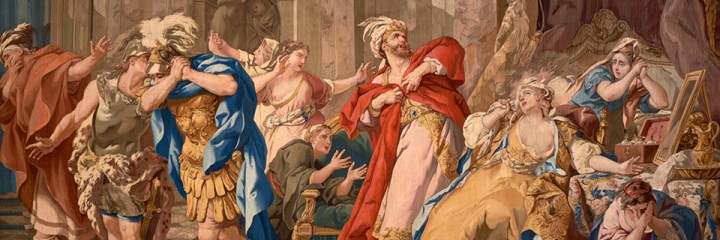
Creusa Consumed by the Poisoned Robe [detail], French, 1789. After a cartoon by Jean François de Troy, woven by Royal Gobelins Manufacture, signed “Audran 1789.” Wool, silk, and linen (Wadsworth Atheneum Museum).
◊ ◊ ◊ ◊ ◊
Press release (25 November 2014) from the Wadsworth:
The Jason Tapestries
Wadsworth Atheneum Museum of Art, Hartford, Connecticut 28 November 2014 — April 2015
The Wadsworth Atheneum Museum of Art will display rarely-exhibited tapestries from the eighteenth century in its soaring Morgan Great Hall during the final phase of the museum’s five-year, $33 million renovation. The large, intricate tapestries—which depict the saga of Greek hero Jason—will be on view through April 2015, at which point the Great Hall will be transformed in preparation for the September 19, 2015 grand reopening of the Morgan Memorial Building. The Jason Tapestries are enormous in size—ranging in height up to 14 feet, and in width up to 24 feet—presenting a challenge for curators in exhibiting them on a regular basis.
“The sheer magnitude of these stunning woven treasures, when paired with their fragility, prevents the museum from showing them as frequently as we would wish,” said Susan L. Talbott, Director and C.E.O. “The changing of the guard in our magnificent Morgan Great Hall presented us an ideal window in which to share these masterpieces with our visitors, and it is our hope that everyone will take advantage of this marvelous opportunity.”
The Jason Tapestries series was donated to the Wadsworth Atheneum in 1946. It consists of four tapestries from an original set of seven, which narrates the saga of Jason, well known to French contemporaries through the book Metamorphosis by Ovid. The tapestries depict Jason’s voyage with the Argonauts, the capture of the Golden Fleece (a symbol of kingship), and their subsequent return to Greece. Jason appears as a tragic hero—youthful, brave and clever—whose entanglement with the sorceress Medea will assure him the Fleece, but will also lead to the annihilation of his family.
From the fourteenth to the eighteenth centuries—the great period of tapestry weaving— popes, kings, and aristocrats alike competed for these luxurious pieces. Much more labor intensive and expensive to produce than paintings and sculpture, tapestries served as portable sources of wealth, and were given as precious diplomatic gifts. Manufactories used the finest materials, such as silk threads that were often combined with silver and gold. The mythological (or historical and biblical) narratives depicted were often used to glorify heroic acts of the past and present.
The story of Jason was one of the most popular tales to illustrate in tapestries of the late eighteenth century, the time of the Ancien Régime in France. In 1743, King Louis XV commissioned a seven-part Jason and Medea series for the Throne Room at Versailles, arguably the most prestigious room in France. Jean François de Troy (1679–1752) provided sketches that were later translated into life-size preparatory drawings and subsequently woven into tapestries at the Gobelins workshop. Other versions of this series were given as precious gifts by the French crown, and today belong to the Hermitage in St. Petersburg, the Royal Collections in Sweden, the Palazzo Reale in Milan and Windsor Castle in England, among others.
About Morgan Great Hall
Hartford native J. Pierpont Morgan, one of America’s richest men and greatest art collectors during the Gilded Age, donated the land and money to build the Beaux-arts Morgan Memorial. He also had a special interest in tapestries, and when the Great Hall opened in 1915, he loaned ten of them to adorn its walls. The space soon became known as ‘Tapestry Hall’. Morgan and his contemporaries saw themselves as the offspring of the old European aristocracy, who hung tapestries in the Great Halls of their country houses to demonstrate their power and influence, as well as to keep out the cold. The Wadsworth Atheneum will celebrate the centennial of the Morgan Memorial and its Great Hall in 2015; following the exhibition of The Jason Tapestries, Morgan Great Hall will be installed with masterworks from the museum’s permanent collection of European art, to open September 19, 2015, as part of the unveiling of the restored building.
Call for Essays | Equestrian Cultures, 1700–Present
From H-ArtHist:
Edited Collection of Essays: Equestrian Cultures, 1700–Present
Proposals due by 28 February 2015
Pictured in wonderfully textured shades of sepia, the horses of Roberto Dutesco’s photographic Sable Island series are beautiful, larger than life, and undeniably Other. They come alive on the walls of urban art galleries, and in doing so they both reaffirm and unsettle our conceptions of what it means to be ‘horse’. Liminally situated between rural and urban, domestic and wild, aesthetic object and independent subject, Dutesco’s Sable Island horses are both eminently real beings with their own experiences of worlding, and representations that speak to Western, hegemonic discourses of the nonhuman. What is ‘horse’? How have they been represented within literature and the arts? What is their relationship to humans, and how has their presence altered human society over time? These questions, along with the complex instability of the equine nonhuman, are the subject of this essay collection. We invite papers that explore the role and representation of horses in human culture from 1700 to the present in a wide array of geographies and contexts, and from multiple disciplinary perspectives within the humanities. Papers that explore horses in non-Anglocentric equestrian cultures are especially welcome. (more…)
Fellowships | Lichtenberg-Kolleg Early Career Fellowships
Lichtenberg-Kolleg Early Career Fellowships, 2015–17
Applications due by 2 March 2015
The Lichtenberg-Kolleg, the Göttingen Institute for Advanced Study in the Humanities and Social Sciences, invites applications for up to 12 Early Career Fellowships.
 Opening its doors in 1737 Göttingen quickly established itself as one of Europe’s leading Enlightenment universities. Named after one of the most important and versatile representatives of the Gottingen Enlightenment, the Lichtenberg-Kolleg is an interdisciplinary research institute with a strong focus not only on the Enlightenment(s), but also on ‘bridges’ between the human and natural sciences and on the study of religion. For the period October 2015 to July 2017 we are inviting early career scholars to join one of the research teams for the study of either:
• Globalising the Enlightenment: Knowledge, Culture, Travel, Exchange and Collections, or:
• Human Rights, Constitutional Politics and Religious Diversity, or:
• Primate Cognition: Philosophical, Linguistic, and Historical Perspectives.
The University of Göttingen is an equal opportunities employer and places particular emphasis on fostering career opportunities for women. Qualified women are therefore strongly encouraged to apply as they are underrepresented in this field. Disabled persons with equivalent aptitude will be favoured. All Fellowships are open to candidates who have received a doctorate within the last 6 years. The deadline for applications is 2nd March 2015.
Details are available here»
Exhibition | Tiepolo: I Colori del Disegno

Giandominico Tiepolo, The Three Angels Appearing to Abraham
(Venice: Accademia)
◊ ◊ ◊ ◊ ◊
Now on at the Capitoline Museum (with caveats concerning an English translation in this particular case) . . .
Tiepolo: The Colours of Drawings / I Colori del Disegno
The Capitoline Museum, Rome, 3 October 2014 — 18 January 2015
Curated by Giorgio Marini with Massimo Favilla and Ruggero Rugolo
For the first time in Rome, the work of one of the greatest painters and printmakers of the eighteenth-century Venice, Giambattista Tiepolo. In the history of European figurative art, the impressive quantity and variety of designs produced by Tiepolo stands out as a great monument of eighteenth-century graphic representation.
 The history of European figurative culture is remarkably marked by a huge amount and variety of drawings of the Tiepolos, which stand out as a magnificent monument of Eighteenth-century graphics. Indeed, drawing is the basic element of Giambattista Tiepolo’s genial art and is where he was the most prolific. Similarly, drawing characterized the exceptional and unique production of his family-owned original atelier, where he guided the graphical activity of his sons, Giandomenico and Lorenzo, in the last example of a very old Venitian tradition. Such an inexhaustible narrative vein, mainly intended as an independent exercise, is made of an extensive variety of registers that the artist used to adjust to the different functionalities of his production. Thus, the various typologies, techniques and themes give rise to a ‘colour of drawing’. This occasion is dedicated to this peculiar perspective on the many-sided world of Tiepolo and finds its reason in the lucky chance of gathering a selection of works coming from Italian collections, unfamiliar to the great public, with sheets that have been hardly ever exhibited before.
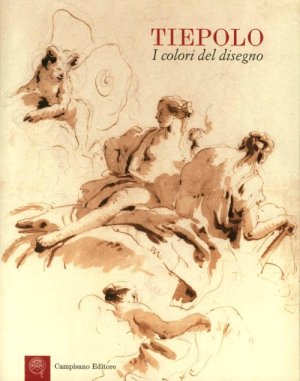 The four sections of the exhibition feature drawings and a selection of etchings according to prominent thematic clusters, but still arranged according to the range of their techniques: from the project to the early sketches, from ‘memories’ to ‘amusements’ and to the replicas of Giandomenico and Lorenzo, as an emulation of their father’s works. A measured selection of paintings is also exhibited in order to introduce and somehow represent the painting outcomes of every graphical typology. Some are well known, others have re-emerged or have been recognized only by the most recent research activities—even in the preparation of this exhibition—but they all contribute to grasp the dynamics of Tiepolo’s language, whose exceptional imaginative fertility does not exclude a constant innovation in the iteration of models.
The catalogue is available from ArtBooks.com:
Giorgio Marini et al., Tiepolo: I Colori del Disegno
(Rome: Campisano Editore, 2014), 192 pages, ISBN:
978-8898229338, $78.
New Book | The Churches of Rome, 1527–1870
From Pindar:
Michael Erwee, The Churches of Rome, 1527–1870: Volume I. The Churches (Oxford: Pindar Press, 2014), 780 pages, ISBN: 978-1904597285, £150 / $300.
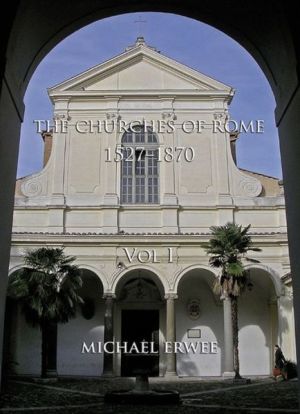 The churches of Rome constitute arguably the most important manifestations of art and architecture in the Western world. This book is a detailed description of 251 churches in Rome and the Vatican City, built or decorated between 1527 and 1870, and is based on extensive research in state, church and private archives, as well as an exhaustive survey of modern and historical bibliographical sources.
Its aim is to provide a more complete picture of the construction and decoration of these churches than previously known. This entails not only providing the names of the architects who designed the churches, but also the names of the masons (muratori) and stone cutters (scalpellini), who built the churches and whose skills were essential for realising the architect’s plans. This depth of information is carried through to the interior decorations. The interior of each church is then described in depth, on a chapel-by-chapel basis, and includes stucco work, marble revetment, monuments, metal work, fresco and painted decorations and altarpieces. For each church, a brief historical introduction is given and a general bibliography supplied. Archival research has brought to light a great number of works of art whose authorship and/or dates have hitherto been unknown, including works by well-known artists but also many that are unknown to scholars. A great number of works of art whose authorship has hitherto been unknown are published in this volume for the first time.
An alphabetic index of artists (consisting of over two thousand names) is supplied, and includes the churches where their works are to be found and accurate biographical information for each artist. In addition there is an index of patrons, and a street and rione index. Also provided are the names and contact details of the archives consulted in researching this book. The book is intended to be used as a reference and resource book, as well as to be used by visitors to these churches. It is lavishly illustrated with photographs.
Michael Erwee was born in Zambia. He received his doctorate from the University of Sydney and was awarded an Alexander von Humboldt post doctorate scholarship from the German Government. At present he is an independent researcher.
Exhibition | Country House, City House
In a posting on the preservation strategy for Menokin a few days ago, I failed to note the related exhibition now on view in DC. Thanks to Pierre-Henri Biger for pointing it out! –CH
From the website Menokin: Rubble with a Cause:
Country House, City House
The Octagon House, Washington, D.C., 6 November 2014 — April 2015
 Menokin and The Octagon House are linked across the centuries through historic events, a family, and a love of architecture. Step inside their history and be immersed in the revolutionary plans for their future in the Country House, City House exhibition. The AIA Foundation (which operates The Octagon House) and The Menokin Foundation share a common mission: to encourage and educate the public and the architecture profession about the preservation of great design of the past, and the creation of great design for the future. That mission is made tangible through this
collaborative exhibition. It is comprised of three parts:
Menokin: Re-imagining A Ruin
A visual overview of the history, rehabilitation and future of Menokin.
Through Their Eyes: A Photographic Journey
Take an artistic journey through the camera lenses of two photographers—Frances Benjamin Johnston and Hullihen Williams Moore. This collection spans over eight decades of Menokin’s history, as well as the changes in technique and the advancements in photo-technology from 1930 to 2014.
Menokin Revealed
This exhibition is a curated collection of the imaginations and visions of the students of architect, Jorge Silvetti, from his 2013 studio course at the Harvard Graduate School of Design.
Additional information is available here»










 Enfilade
leave a comment