Exhibition | Rich and Tasty: Vermont Furniture to 1850
On view this summer at the Shelburne Museum:
Rich and Tasty: Vermont Furniture to 1850
Shelburne Museum, Shelburne, 25 July — 1 November 2015

Stand, attributed to Lemuel Bishop, Charlotte, Vermont, ca. 1815. Cherry, birch, mahogany, basswood and brass, 28 x 18 x 15 inches. Private Collection
This exhibition and accompanying catalogue will introduce and identify Vermont high style furniture, previously known only to decorative arts scholars, historians, and collectors. The project arrives twenty years after Shelburne Museum published a seminal checklist of early Vermont Furniture and is the result of two decades of scholarship. The exhibition will feature pieces that will illuminate the craft practices and regional economics that help define Vermont furniture’s stylistic features and unexpected aesthetic innovations, referred to as “rich and tasty” by one Vermont cabinetmaker.
◊ ◊ ◊ ◊ ◊
Jean M. Burks and Philip Zea, eds., Rich and Tasty: Vermont Furniture to 1850 (Shelburne, Vermont: Shelburne Museum, 2015), 180 pages, ISBN: 978-0939384112, $30.
Two landmark 1995 publications, The Best the Country Affords: Vermont Furniture 1765–1850 and Vermont Cabinetmakers & Chairmakers Before 1855: A Checklist, reintroduced Vermont high style furniture to decorative arts scholars, historians, and collectors. Equipped with this seminal knowledge, a small cadre of Vermont connoisseurs started scouring country auctions, adding signed and well-documented pieces to their private collections. Twenty years later, it is time to bring these pieces together and share them with the public. This catalog and the accompanying exhibition advances the understanding of Vermont high style furniture—from its features, craftsmanship, and economics, to its unexpected aesthetic innovations. The authors identify key eighteenth-century Vermont pieces before covering a variety of topics, including clockmaking, chairmaking, the half sideboard, furniture from Woodstock, and furniture from Vermont factories. Seventy-five full-color photographs by acclaimed Boston photographer David Bohl and extended catalog entries display furniture from all over the Green Mountain State.
New Book | Global Trade and Visual Arts in Federal New England
From the University Press of New England:
Patricia Johnston and Caroline Frank, eds., Global Trade and Visual Arts in Federal New England (University of New Hampshire Press, 2014), 296 pages, ISBN: 978-1611685848 (hardback), $85 / ISBN: 978-1611685855 (paperback), $45 / ISBN: 978-1611685862, $45 Ebook.
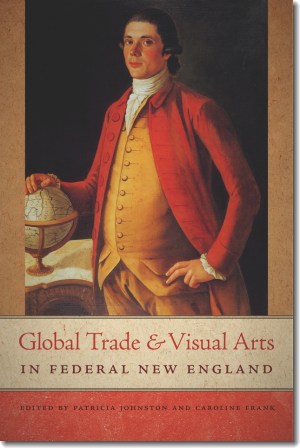 A highly original and much-needed collection that explores the impact of Asian and Indian Ocean trade on the art and aesthetic sensibilities of New England port towns in the late eighteenth and early nineteenth centuries. This diverse, interdisciplinary volume adds to our understanding of visual representations of economic and cultural changes in New England as the region emerged as a global trading center, entering the highly prized East Indies trades. Examining a wide variety of commodities and forms including ceramics, textiles, engravings, paintings, architecture, and gardens, the contributors highlight New Englanders’ imperial ambitions in a wider world.
Patricia Johnston is professor of art history and Rev. J. Gerard Mears, S.J., Chair in Fine Arts at the College of the Holy Cross. Caroline Frank teaches American studies at Brown University.
◊ ◊ ◊ ◊ ◊
C O N T E N T S
Acknowledgments
Introduction: Emerging Imperial Aesthetics in Federal New England—Patricia Johnston and Caroline Frank
Part I: Political Geographies
• The Art of Tea, Revolution, and an American East Indies Trade—Caroline Frank
• West from New England: Geographic Information and the Pacific in the Early Republic—David Jaffee
• The Forgotten Connection: The Connecticut River Valley and the China Trade—Amanda E. Lange
Part II: Commodities
• Salem’s China Trade: ‘Pretty Presents’ and Private Adventures—Jessica Lanier
• ‘Shipped in Good Order’: Rhode Island’s China Trade Silks—Madelyn Shaw
• The Story of A’fong Moy: Selling Chinese Goods in Nineteenth-Century America—Nancy Davis
Part III: Domesticating Asia
• Cultivating Meaning: The Chinese Manner in Early American Gardens—Judy Bullington
• ‘Lavish Expenditure, Defeated Purpose’: Providence’s China Trade Mansions—Thomas Michie
• Fabrics and Fashion of the India Trade at a Salem Sea Captain’s Wedding—Paula Bradstreet Richter
Part IV: Global Imaginaries
• Drawing the Global Landscape: Captain Benjamin Crowninshield’s Voyage Logs—Patricia Johnston
• Capturing the Pacific World: Sailor Collections and New England Museums—Mary Malloy
• Beyond Hemp: The Manila-Salem Trade, 1796–1858—Florina H. Capistrano-Baker
Part V: Global Productions
• Osceola’s Calicoes—Elizabeth Hutchinson
• From Salem to Zanzibar: Cotton and the Cultures of Commerce, 1820–1861—Anna Arabindan-Kesson
• Luxury and the Downfall of Civilization in Thomas Cole’s Course of Empire—Alan Wallach
Contributors
Index
HBA Travel Award for Graduate Students
Historians of British Art Travel Award
Proposals due by 15 October 2015
HBA is accepting applications for this year’s Travel Award. The award is designated for a graduate student member of Historians of British Art who will be presenting a paper on British art or visual culture at an academic conference in 2016. The award of $750 is intended to offset travel costs. Applicants must be current members of HBA. To apply, send a letter of request, a copy of the letter of acceptance from the organizer of the conference session, an abstract of the paper to be presented, a budget of estimated expenses (noting what items may be covered by other resources), and a CV to Kimberly Rhodes, Prize Committee Chair, HBA, krhodes@drew.edu. The deadline is October 15, 2015.
Exhibition | Treasure Ships: Art in the Age of Spices

Scenes of Traders in Nagasaki, mid-eighteenth century, detail from a pair of hand scrolls, opaque watercolour, ink and gold on paper, box, wood, paper and ink, each 313 x 35 cm (Art Gallery of South Australia, Adelaide)
◊ ◊ ◊ ◊ ◊
Press release (April 2015) from the Art Gallery of South Australia:
Treasure Ships: Art in the Age of Spices
Art Gallery of South Australia, Adelaide, 13 June — 30 August 2015
Art Gallery of Western Australia, Perth, 10 October 2015 — 31 January 2016
Curated by James Bennett and Russell Kelty
Treasure Ships: Art in the Age of Spices is the first exhibition on view in Australia to present the complex artistic and cultural interaction between Europe and Asia from the sixteenth to the nineteenth centuries—a period known as the Age of Spices. The exhibition includes 300 outstanding and rarely seen works of ceramics, decorative arts, furniture, metalware, paintings, prints, engravings and textiles from both public and private collections in Australia, India, Portugal, Singapore and the United States.
Nick Mitzevich, Director, Art Gallery of South Australia sees this landmark exhibition and its publication as highlighting the Gallery’s international reputation for presenting spectacular exhibitions of historical Asian and European art. Treasure Ships showcases a diverse collection of luxury objects, many of which have never previously been seen on public display in Australia. This has been made possible through the extensive cooperation and support the Gallery has received from institutions, collectors and scholars in Portugal, India, Singapore, Indonesia and the United States, as well as the partnership with the Art Gallery of Western Australia. The Gallery’s two curators James Bennett and Russell Kelty have worked researching the exhibition for over three years, and their professional commitment has ensured the success of this much-anticipated exhibition.

China and Europe–Japan, Surcoat (jinbaori), with mon, late 18th century with 19th-century repairs, brocade created in China, velvet and factory print created in Europe, possibly France, garment constructed in Japan, cotton, wool, silk, velvet, metallic thread, natural dyes, supplementary weft and plain weave, wood, 101 x 85 cm (Helen Bowden Gift Fund 2015, Art Gallery of South Australia, Adelaide)
The works of art selected reveal how the international trade in spices and other exotic commodities inspired dialogue between Asian and European artists, a centuries old conversation whose heritage is the aesthetic globalism we know today. Europe’s infatuation with pepper, nutmeg and cloves has often been explained in terms of the necessity to preserve cooked foods in the days before the invention of refrigeration. “This is a half-truth, which takes little account of the complex reasons the condiments of luxury and status were so avidly sought, often at great expense to human lives,” said Bennett.
The exhibition commences with the small country of Portugal. Located on the periphery of Europe, Portugal re-mapped the West’s view of the world and created a mercantile spice empire stretching halfway around the globe during the fifteenth-sixteenth century. In 1498 Vasco Da Gama’s small fleet became the first to reach India, landing with the famous words, ‘we come in search of Christians and spices’. Within a decade, the Portuguese soldier—aristocrat Francisco de Almeida (1450–1510) had ruthlessly seized control of the Indian Ocean spice trade and established Portugal’s permanent presence in Asia that lasted four hundred years.
Treasure Ships also presents the story of the slave trade, piracy and shipwrecks, as well as illustrating the astonishing beauty of Chinese porcelain, known as ‘white gold’, and celebrating the vibrant Indian textiles created for export around the world. There are several highlights in this exhibition including two works from the personal collection of Queen Adelaide (1792–1849), after whom the city of Adelaide was named in 1836: artefacts retrieved from the Batavia, which sank off the Western Australian coast in the seventeenth century, and a magnificent early 19th-century Chinese punchbowl depicting Sydney Cove that locates Australia within this global history.
It is most appropriate that this exhibition should originate in Adelaide as this is the only Australian city founded on the vision of a Eurasian—the surveyor Colonel William Light (1786–1839) whose Mother was of Malaysian descent and whose remarkable self-portrait features in the exhibition said James Bennett.
Treasure Ships also examines the impact of the Age of Spices on the ‘discovery’ of the Australian continent and the commencement of English occupation in 1788. The colonial art of the period displays the aesthetic reverberations that continued in the Australasian region long after European ships had ceased carrying cargoes of nutmeg and cloves.
James Bennett and Russell Kelty, Treasure Ships: Art in the Age of Spices (Adelaide: Art Gallery of South Australia, 2015), ISBN: 978-1921668227, $70.
At Christie’s | Old Master & British Paintings
Press release (11 June 2015) from Christie’s:
Old Master & British Paintings Evening Sale #10389
Christie’s, South Kensington, London, 9 July 2015
 Christie’s Old Master & British Paintings Evening Sale in London on Thursday 9 July will offer an exceptional selection of pictures from private collections, with emphasis on rarity, importance and provenance. Many of the highlights in the sale have not been seen on the market for generations. The sale is led by a masterpiece by Bernardo Bellotto (1721–1780), Dresden from the Right Bank of the Elbe above the Augustus Bridge, one of the last great views of the city by this artist still remaining in private hands (estimate: £8–12 million). The sale also includes six carefully selected paintings from The Alfred Beit Foundation with two superb panels by Rubens: Head of a Bearded Man (estimate: £2–3 million), and Venus and Jupiter (estimate: £1.2–1.8 million); and one of the greatest Kermesse scenes by David Teniers the Younger (estimate: £1.2–1.8 million). Other sale highlights are a portrait of Sir Richard Brooke, 5th Bt. by Thomas Gainsborough, which has never been on the market before (estimate: £2–3 million); the most important oil by Richard Parkes Bonington to come to the market in a generation, A Coastal Landscape with Fisherfolk (estimate: £2–3 million); four major works by Pieter Brueghel the Younger, featuring one of his rarest and most original compositions, The Kermesse of Saint George (estimate: £2.5–3.5 million); and seven Dutch paintings from the Cunningham collection, led by an exquisite Still-Life by Jan Davidsz. de Heem (estimate: £1.5–2.5 million). Other notable works which are at auction for the first time include: Christ on the Cross by El Greco and studio (estimate: £1–1.5 million), Hermes Entertained by Calypso by Jacob Jordaens (estimate: £600,000–800,000), Ruins of the Old Church at Muiderberg by Jacob van Ruisdael (estimate: £500,000–800,000), and a sublime, signed view of Venice by Francesco Guardi The Grand Canal, Venice, with San Simeone Piccolo (estimate: £1–1.5 million). A re-discovered panel by Jean-Antoine Watteau, La Lorgneuse, previously believed to be lost, will also be offered (estimate: £300,000–500,000).
This auction, together with the Day Sale on 10 July and the Old Master & British Drawings & Watercolours sale on 7 July, are all part of London Art Week 2015 (3 to 10 July), which highlights the exceptional riches and unparalleled expertise available within Mayfair and St. James’s. Celebrating the contemporary art of the past, the wealth of classical works at Christie’s from 7 to 10 July represent excellence and technical brilliance. They will be offered across the sales of Old Master & British Paintings, Drawings & Watercolours, The Exceptional Sale, the Taste of the Royal Court: Important French Furniture and Works of Art from a Private Collection sale, and The Collection of a Distinguished Swiss Gentleman. Together, the week of sales at Christie’s presents works by many of the most revered artists and craftsmen in history, who have stood the test of time and were ground-breaking and innovative in their day.
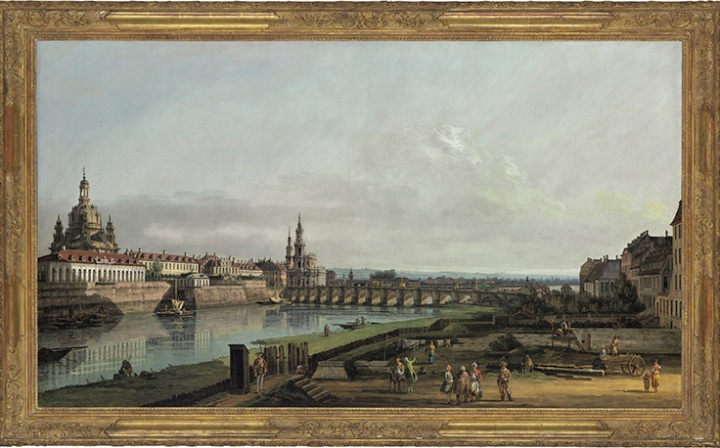
Bernardo Bellotto
Dresden from the Right Bank of the Elbe above the Augustus Bridge is a masterpiece of Bernardo Bellotto’s full maturity (estimate: £8–12 million). An artist of precocious talent, Bellotto emerged from the shadow of his uncle, Canaletto, to become one of the most skilful view painters of his time. His renditions of Dresden, Vienna, Munich and Warsaw were the defining records of four of the major capitals of northern Europe in the mid-eighteenth century and have a distinguished place in the development of European topographical painting. Bellotto’s early renown led to him being called to Dresden in 1747 to work for Friedrich-August II, Elector of Saxony, where he undertook a series of views of the city during the height of its powers, in the mid-eighteenth century.
This picture, one of the most remarkable views by the artist to appear on the market in recent times, is a variant of the very first view of Dresden that Bellotto executed for the Elector. It acted as a great showcase for his talent, exemplifying a method based on the highest levels of exactitude and topographical accuracy. Offered from the Property of a Private European Collector, the painting depicts some of the greatest civic and religious buildings that made up the so-called Brühlsche Terrasse that ran along the Elbe at the time, with the domed Frauenkirche rising up to the left, next to the Brühl Library and the Fürstenburg Palace. The promenade was devastated during the Second World War, but has largely been rebuilt. Painted in circa 1751–53, this view of Dresden is distinguished from Bellotto’s two earlier pictures of the same subject in its atmospheric tone, cooler palette and the wonderful reflections in the river. It is a picture of outstanding refinement and precision, without any loss of spontaneity, presenting one of Europe’s great cities in all its splendour.
The Alfred Beit Foundation
A group of six Old Master paintings from The Alfred Beit Foundation is led by two magnificent works on panel by Sir Peter Paul Rubens, Head of a Bearded Man (estimate: £2–3 million) and Venus and Jupiter (estimate: £1.2–1.8 million) and also includes a masterpiece by David Teniers II, one of the finest works by the artist still in private hands. The works are being sold by the foundation in order to set up an endowment fund to safeguard the long term future of Russborough, one of the greatest Georgian houses in Ireland, built almost 300 years ago, which was gifted by the Beit family to The Alfred Beit Foundation in 1976. In 1986, Sir Alfred and Lady Clementine Beit gifted many of the most celebrated pictures from the Beit Collection to the National Gallery of Ireland, which included masterpieces by Vermeer, Gabriel Metsu, Jacob van Ruisdael, Goya and Gainsborough amongst others. This donation transformed the Gallery’s collection of Old Master Paintings and a wing of the Gallery was fittingly named ‘The Beit Wing’ in recognition of this remarkable gift. Please click here for the separate press release.
Thomas Gainsborough
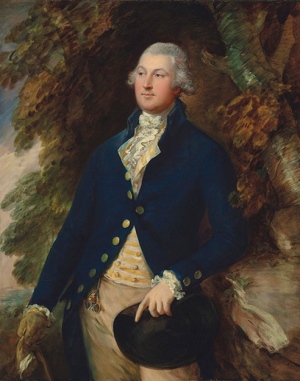
Thomas Gainsborough, Portrait of Sir Richard Brooke, 5th Bt., ca. 1780s
Only seen in public on one previous occasion, when it was exhibited in 1876, the Portrait of Sir Richard Brooke, 5th Bt. (1753–1795) by Thomas Gainsborough, R.A. (1727–1788) has descended through the family of the sitter to the present owner (estimate: £2–3 million). The picture will be included in Hugh Belsey’s forthcoming catalogue raisonné of Gainsborough’s portraits, having never previously been published in any of the monographs written on the artist. Sir Richard is understood to have commissioned the work shortly after he inherited the title and family estates in Cheshire from his father in July 1781. Refined and elegant, the portrait is a superb example of Gainsborough’s bravura draughtsmanship, and presents Sir Richard as the epitome of the sophisticated country gentleman.
Richard Parkes Bonington
Constituting the grandest statement in oil by Richard Parkes Bonington to appear at auction in a generation, and one of the last on this scale to remain in private hands, A Coastal Landscape with Fisherfolk, a Beached Boat Beyond was painted at the height of the artist’s career (estimate: £2–3 million). It displays Bonington’s virtuoso handling of the brush and the subtle observation of light and atmosphere that he had first mastered as a watercolourist. The picture belongs to a group of coastal scenes that were celebrated during Bonington’s lifetime and have captivated artists and collectors ever since. These are considered to be among the most beautiful of the romantic period and led Edith Wharton, the American novelist, to write in 1910 that “surely he was the Keats of painting.” The picture reveals the undeniable influence of Turner, whose landscapes Bonington would have seen on his trip from Paris to London in 1825. The following year, 1826, in which the present picture is thought to have been executed, was a key date in Bonington’s tragically short career, marking his debut, to great acclaim, at the British Institution in London; his works were soon much in demand from many of the great Whig patrons of the day, including John Russell, 6th Duke of Bedford, Henry Petty-Fitzmaurice, 3rd Marquess of Lansdowne, and Robert, 2nd Earl Grosvenor. This picture was acquired by Henry Wellesley (1773–1847), later Lord Cowley, the younger brother of Arthur Wellesley, 1st Duke of Wellington, who served as ambassador at Paris.
Cunningham Collection
The superb collection of Dutch and Flemish Old Master Paintings formed by Philip Tracy Cunningham and his wife Lizanne is a remarkable testimony to their passion for the arts and for the Dutch Golden Age in particular. The pictures being offered exemplify the Cunningham’s keen appreciation for condition and quality. Following three lots from the collection which were sold at Christie’s New York in June, the London sale will offer seven stellar Dutch paintings that have been on view at the National Gallery in Washington, D.C. for the past fifteen years. The group is led by an exquisite still-life by Jan Davidsz. de Heem (1606–1684), Grapes, Peaches, Blackberries, Oysters, Hazelnuts, and Wine in Façon-de-Venise Glasses on a Partially Draped Stone Ledge with a Snail, Butterfly, and a Bee (estimate: £1.5–2.5 million). The other works include a beautifully preserved example of Willem van de Velde II’s treatments of atmospheric Calms (estimate: £600–800,000), The Wedding Dance by Pieter Brueghel II, and cabinet pictures by Dirck van Delen, Jan van Goyen and Nicolaes Berchem.
Francesco Guardi
The Grand Canal, Venice, with San Simeone Piccolo by Francesco Guardi (estimate: £1–1.5 million). Previously unrecorded, this exquisite canvas is an important discovery, exemplifying the captivating, atmospheric qualities for which Francesco Guardi is most renowned. It has been in the possession of the present European family for more than a century and is signed prominently on the left. Datable to the 1770s, the picture is a work of Guardi’s full maturity, when his mastery of vedute painting in Venice was unrivalled. The view is taken from a bustling stretch of the Grand Canal, near to the church of the Scalzi, then the main route into the city from the mainland. Though the present-day scene is somewhat changed, the vibrancy of Guardi’s view is immediately recognisable. He renders the tranquil, shimmering beauty of the city with an incomparable touch, a superb addition to the oeuvre of one of the greatest of view painters.
Pieter Brueghel the Younger
The sale presents an exceptional selection of four major works by Pieter Brueghel the Younger. The Kermesse of Saint George (estimate: £2.5–3.5 million) is one of his rarest and most original inventions, entirely independent from any of his father’s works and more accomplished than any of his other original compositions. Including this picture, only four securely autograph versions are known. Georges Marlier, the pioneering Breughel scholar, dated the picture to before 1626–28. He praised it for brilliantly affirming the younger Brueghel’s personality, calling it “one hundred percent ‘Breughelian’, not only for the dramatic rhythms that pervade it, but also in the stylisation of the figures and in the colour harmonies. While maintaining the continuity of Pieter the Elder’s art through these themes, his son Pieter gives rein to his own particular vigour, his own taste for anecdote and his own mastery of his profession that is equal to those of the greatest artists.”
From a European Private Collection, The Birdtrap (estimate: £2–3 million) is a superbly preserved example, painted on a single panel, of what is arguably the Brueghel dynasty’s most iconic invention, and one of the most enduringly popular images in Western art. The Birdtrap is a composition of distinctive poetic beauty: in a hilly landscape, blanketed with snow, a merry band of country folk are skating, curling, playing skittles and hockey on a frozen river, in apparently carefree fashion. Yet there are hidden perils, serving as pertinent reminders of the precariousness and transience of life itself: the fishing hole in the centre of the frozen river is a sign of the dangers that lurk beneath the light-hearted pleasures of the Flemish winter; and to the right of the composition birds surround the eponymous trap, seemingly oblivious to its imminent threat. In this remarkable work, executed with poise and great delicacy, Brueghel delivers a message of lasting poignancy about the fickleness and uncertainty of life.
The other works include The Wedding Feast, which is offered from the property of a European Family (estimate: £1.5–2.5 million). The Wedding Feast is not only one of the most iconic images in the Brueghel canon, it is one of the most famous banquet scenes in the history of Western art by virtue of the prototype, the masterpiece by Pieter Bruegel the Elder now in the Kunsthistorisches Museum, Vienna. The picture offered for sale is one of only four recorded autograph versions by Brueghel the Younger and this will be the first to come to the market since the late 1970s. And the final picture by Brueghel the Younger comes from The Cunningham Collection, The Outdoor Wedding Dance, dated 1621 (estimate: £1.2–1.8 million).
New Book | The Gentleman’s House in the British Atlantic World
From Palgrave Macmillan:
Stephen Hague, The Gentleman’s House in the British Atlantic World, 1680–1780 (London: Palgrave Macmillan, 2015), 264 pages, ISBN: 978-1137378378, $90.
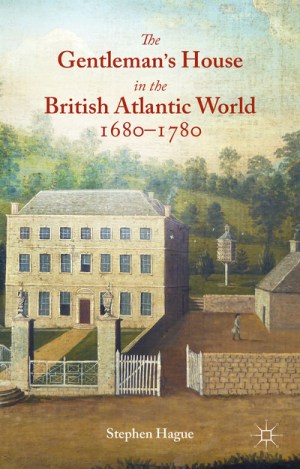 The eighteenth-century Georgian mansion holds a fascination in both Britain and America. Between the late seventeenth century and 1780, compact classical houses developed as a distinct architectural type. From small country estates to provincial towns and their outskirts, ‘gentlemen’s houses’ proliferated in Britain and its American colonies.
The Gentleman’s House analyses the evolution of these houses and their owners to tell a story about incremental social change in the British Atlantic world. It challenges accounts of the newly wealthy buying large estates and overspending on houses and materials goods. Instead, gentlemen’s houses offer a new interpretation of social mobility characterized by measured growth and demonstrate that colonial Americans and provincial Britons made similar house building and furnishing choices to confirm their status in British society. This book is essential reading for social, cultural, and architectural historians, curators, and historic house-enthusiasts.
Stephen Hague teaches modern European, British and British imperial history at Rowan University in New Jersey. Previously, he held the SAHGB Ernest Cook Trust Research Studentship at Oxford University, UK, and is a Supernumerary Fellow of Linacre College, Oxford. He has published essays on the intersection of social, cultural, and architectural history.
◊ ◊ ◊ ◊ ◊
C O N T E N T S
1 Introduction
2 The Gentleman’s House in Context
3 Building Status
4 Situating Status
5 Arranging Status
6 Furnishing Status
7 Enacting Status
8 Social Strategies and Gentlemanly Networks
9 Conclusion
Fellowships | The Baroque in Turin
From H-ArtHist:
Study Program on the Age and the Culture of Baroque
Borse di alti studi sul Barocco
La Fondazione 1563 per l’Arte e la Cultura, Torino
Applications due by 15 July 2015
Call for applications for three fellowships on the theme Baroque civilization and the notions of historia
The Study Program on the Age and the Culture of Baroque is a strategic priority for the Foundation for a number of reasons. Turin was a cradle of Baroque creativity, as witnessed by its appearance. Devoting a program of advanced studies and research to this field also contributes to a deeper understanding of this major historical and cultural feature of the city. Over the past few years Turin has become a more attractive destination for cultural tourists from Italy and the world who perceive it as a ‘Baroque’ town. As such it is important that Turin gains international recognition as a research center of excellence in this field. The study of Baroque as an international cultural system, which found in Piedmont an original expression, is an ambitious goal that rests on a solid tradition of historical and critical studies but requires continuity and new inputs. There is also a more eminently ‘generational’ objective: the program aims to open up career opportunities for young researchers in humanities in a national context that provides very limited options.
The Study Program will be closely integrated with the other main activity of the Foundation, namely the management of the Historical Archives of Compagnia di San Paolo. Following in the footsteps of the international workshop Rethinking Baroque that was organised in Turin in March 2012, the Program will focus on ‘European history from a local perspective’ to delve into the multifaceted aspects of the age of Baroque that, in spite of significant advancements, remain largely unknown and even uncertain as regards its definition and collocation in time.
In this sense the project aims to explore the literary, musical, theater, artistic, architectural, historical and political heritage of Baroque in the 17th and 18th centuries from a comparative and multidisciplinary national and international perspective. This activity will be carried out through the awarding of fellowship grants, the organization of seminars and conferences, the filing and cataloguing of research outcomes for the purpose of creating databases, archival sources, photographic and library documentation to be made available to scholars both on- and off-line.
Special emphasis will be placed on younger generations both as researchers and as beneficiaries of the expected results, for the purpose of opening up new career opportunities (e.g., Universities, Artistic and Cultural Institutions, Conservatories, and other cultural organizations) and contributing to providing advanced cultural education and training in partnership with the cultural institutions in charge.
This Program aims to put in place constructive relations with universities and cultural institutions and to create opportunities for collaboration, in line with the mission of each organization, so as to allow the Foundation to promote greater quality in research. The 2015 Notice of Competition and the online application forms are available on the Foundation’s website.
Exhibition | Vices of Life: The Prints of William Hogarth

William Hogarth, After (detail), 1736, etching and engraving, 41 x 33 cm
(Städel Museum, Frankfurt am Main)
◊ ◊ ◊ ◊ ◊
Press release for the exhibition now on view at the Städel Museum:
Vices of Life: The Prints of William Hogarth
Laster des Lebens: Druckgrafik von William Hogarth
Frankfurt’s Städel Museum, Frankfurt, 10 June — 6 September 2015
Schloss Neuhardenberg, Brandenburg, TBA
Curated by Annett Gerlach
From 10 June to 6 September 2015—in its bicentennial year ‘200 Years Städel’—Frankfurt’s Städel Museum will be presenting prints by the English painter, engraver and etcher William Hogarth (1697‒1764). Altogether seventy works including the famous printmaking series A Harlot’s Progress (1732), A Rake’s Progress (1735) and Marriage à la Mode (1745) will be on view in the exhibition hall of the Department of Prints and Drawings. These visual novels from the Städel holdings take the fashions, vices and downsides of modern life in the London metropolis as their themes. Hogarth conceived of his artworks as printed theatre of his times and with them he laid the cornerstone for socio-critical caricature in England. The prints owe their special quality to the keen powers of perception and caustic humour of an artist who contributed so greatly to shaping the image of his era that it is still referred to as ‘Hogarth’s England’ today. Executed during Johann Friedrich Städel’s lifetime, the engravings are among the Städel’s oldest holdings and mirror the critical spirit inherent to this institution since its founding.
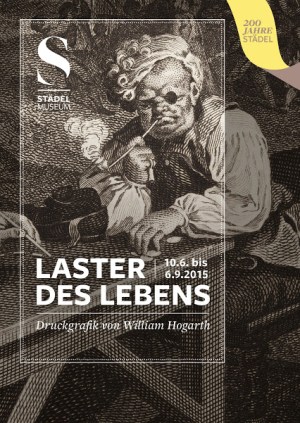 William Hogarth was born in London in 1697. In keeping with an early eighteenth-century fashion, his father Richard opened a coffee house at which only Latin was spoken. The business failed, and Richard Hogarth had to serve five years in London’s notorious Fleet Prison for failure to pay his debts. As was usual at the time, his wife and children had to accompany him. In 1713, after his father’s release, William Hogarth began an apprenticeship as a silver engraver where he also learned the rudiments of the complex techniques of intaglio printing—engraving and etching. Following his seven-year training, he went into business for himself as an engraver and attended the privately run St Martin’s Lane Academy, an art school in London, to acquire the art of painting. In 1724 he also became a member of the academy of royal court painter James Thornhill (1675‒1734), whose daughter Jane he married in 1729. It was not with his paintings, however, that Hogarth achieved a breakthrough with the public, but with the prints made after his works on canvas. With the series A Harlot’s Progress, produced in the early 1730s, he founded a new genre he later dubbed modern moral subjects. Hogarth conceived of these subjects as contemporary, moral-didactic history scenes. He thus took a stand against the hierarchization of the visual arts, a firmly entrenched principle of academy doctrine which granted classical history painting pride of place. With his printmaking works, he succeeded in creating a new, up-to-date genre based on the keen observation of reality. In 1755 Hogarth was elected to the Royal Society of Arts, which he quit again just two years later on account of artistic and personal differences. His appointment as royal court painter followed in 1757, but never led to any commissions. The final years of the artist’s life were overshadowed by bitter disputes between himself and his critics. A stroke in 1763 left Hogarth severely handicapped and he died the following year in his home in Leicester Fields, a district of London.
The presentation in the exhibition gallery of the Department of Prints and Drawings focuses primarily on those of William Hogarth’s printmaking series that earned him international fame: A Harlot’s Progress, A Rake’s Progress und Marriage à la Mode. There is a very simple reason for the fact that his works on paper secured him a place in art history: prints can be circulated far better than paintings. It was by these means that the artist reached the enlightened and educated public of his day in large numbers. Already the first edition of A Harlot’s Progress (1732) comprised 1,240 sold copies. In six episodes, this series describes the rise and fall of a young woman who has come from the country to the city to find work. To earn a living she ends up as a prostitute and lands in prison as a result. The final scene shows the wretched funeral of the protagonist, whose life has already come to an end at the age of twenty-three. Hogarth had numerous real and literary models to look to for his creation of this figure. Inspired by his great interest in the social characterization of his time, he directed his critical, ironical gaze to all strata of society, from the highest nobility to the most abject circumstances. The sick and needy of all generations formed the downside of the economic boom enjoyed by the colonial and commercial metropolis and its many profiteers.
In his second series, A Rake’s Progress (1735), consisting of eight prints, Hogarth tells the story of the social decline of Tom Rakewell, who brainlessly squanders his inheritance and is thrown first into debtors’ prison and then the madhouse. Rakewell’s incarceration on grounds of indebtedness is reminiscent of the artist’s own biography. Entirely unlike his father, however, William Hogarth was an excellent businessman and very clever at taking advantage of the London press—which was flourishing in his day—and its public impact for his own purposes. In newspapers such as the London Daily Post, the General Advertiser or the London Journal he published announcements of his prints and advertised them for subscription.
Hogarth borrowed the title of his third major series, published in 1745, from a comedy by John Dryden (1631‒1700). Marriage à la Mode is about an espousal arranged by the two spouses’ fathers. Neither the bride nor the groom is the least bit interested in the other, both amuse themselves on the side, and the situation comes to a dramatic conclusion. Hogarth’s protagonists feign innocence and practise deception, abandon themselves to their passions and founder on their false ideals. Looking to true stories for orientation and integrating well-known persons and recognizable sites, he warned his public of the dangers of modern life—dangers still very real today. In 1751, with his popular prints Beer Street and Gin Lane, he supported a public campaign against the excessive consumption of gin. The former scene presents the enjoyment of beer as healthy and beneficial in contrast to the destructive effects of gin portrayed in the latter.
From mid century onward, in addition to socio-critical themes Hogarth also devoted himself to matters of national and political relevance, which represent a further focus of the exhibition. In several works, the artist addressed the relationship between France and England, which were at war. The Gate of Calais (1748) was his response to his arrest on suspicion of espionage during one of his trips to France. In 1756, in The Invasion, he again caricatured the French as grotesque, haggard figures who are after the tasty beer and luscious roast beef of the English. Some fifteen years later, in the print The Times, Plate 1 (1762), Hogarth made an urgent appeal for the cessation of the Seven Years’ War.
In 1753, Hogarth published his own art-theoretical deliberations in the book The Analysis of Beauty. In it he concerned himself with the foundations of visual-artistic production and particularly the matter of how to achieve beauty and grace. Hogarth considered the study of nature to be the key to beauty. He called upon his readers to perceive the objects of nature with their own eyes and judge them according to rational criteria. The German writer Christlob Mylius (1722–1754) was in London when Hogarth’s Analysis came out, and he translated it into German the very next year. Johann Friedrich Städel had a copy of this translation in his library, and it will be on display in the show.
In conjunction with the exhibition, the Städel Museum is publishing a catalogue by Annett Gerlach with approximately 50 pages, 10€. Following its presentation at the Städel Museum, the show will be on view at Neuhardenberg Castle. The exhibition is being sponsored by the Hessische Kulturstiftung.
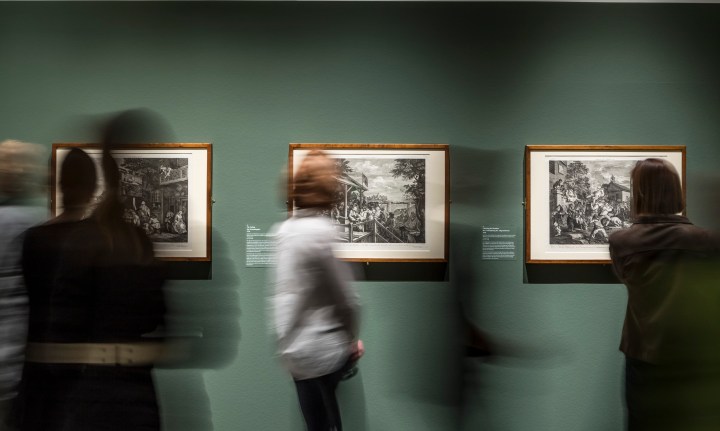
Installation view of the exhibition Vices of Life: The Prints of William Hogarth at Frankfurt’s Städel Museum (June 2015)
Progress Report on the New Berliner Stadtschloss

Belvedere © Berlin Palace–Humboldtforum Foundation /
Franco Stella
◊ ◊ ◊ ◊ ◊
As reported this past weekend by AFP (via ArtDaily). . .
The German capital celebrated a milestone Friday [12 June 2015] in the rebuilding of its Prussian-era royal palace that is set to house a world history museum billed as the country’s top cultural project. From 2019 the ‘Berliner Stadtschloss’ or Berlin City Palace replica will be the home of the Humboldt Forum global collection, to be curated by the British Museum’s outgoing chief Neil MacGregor, dubbed the “pop star of the museum world” by local media. On Friday, government ministers and culture officials met at what is now a raw concrete and steel structure for the so-called topping-out ceremony that marks the end of the major structural work which started two years ago. MacGregor, who was reportedly hand-picked for the job by German Chancellor Angela Merkel, hopes to “tell the story of humanity” with artefacts from Berlin’s many rich collections, ranging from European antiquity to East Asian arts.
The 590-million-euro ($660 million) domed venue is a reconstruction of a historical jewel of Baroque architecture located on the city’s Unter den Linden boulevard, near the Protestant Berlin Cathedral and Humboldt University. The original palace was badly damaged in World War II and its remains blown up by East Germany’s communist regime, which replaced it with its 1970s Palace of the Republic, a giant block with orange tinted windows that housed its assembly and a cultural and recreation centre. After the Berlin Wall fell in 1989 and Germany reunited the following year, bitter debate long raged about whether to keep the communist monument or raze it to rebuild Berlin’s original palace—with the latter option approved by the German parliament in 2007.
The replica, designed by Italian architect Franco Stella, will now be fitted on three sides with baroque sandstone facades recalling the old Hohenzollern palace built between the 15th and 18th centuries, and a fourth modern front facing the Spree River. The Humboldt Forum will house artefacts from Berlin’s Ethnological Museum, Asian Art Museum as well as Humboldt University, libraries and cultural centres. . . .
The full article is available here»
Call for Papers | AAH at the University of Edinburgh, 2016
By my quick count, 9 of the 34 sessions proposed for the Association of Art Historians 2016 conference could include eighteenth-century papers. Be sure to consult the conference website for things I’ve overlooked. –CH
42nd Annual AAH Conference and Bookfair
University of Edinburgh, 7–9 April 2016
Proposals due by 9 November 2015
AAH2016 will highlight the diversity, scope and importance of art-historical research and its application today. AAH2016 will engage with current art historical scholarship in exciting and innovative ways, across a range of periods, locations, and media. Academic Sessions will cross disciplinary boundaries. They will, for instance, explore relationships between the visual and the textual, between fashion and art history, between art and architecture, between art and economics, or between art and science. Other sessions will highlight issues of time and periodisation, exploring revivalism, re-enactment, and extinction. Or highlight advancing technologies and media, including video games and cybernetics. AAH 2016 also presents an opportunity to reflect on nationalism and its conflicts and contradictions in the past and present, as well as opening the discipline of art history up to broader audiences.
If you would like to offer a paper, please email the session convenor(s) direct, providing an abstract of a proposed paper of 30 minutes. Abstracts to be no more than 250 words, and to include your name and institution affiliation (if any). Download a Paper Proposal Guidelines here.
◊ ◊ ◊ ◊ ◊
Session 1 | Air and the Visual
Convenor: Amanda Sciampacone, Birkbeck, University of London, asciampacone@gmail.com
‘The air is unique among the elements in having this affinity with nothingness, in signifying the being of non-being, the matter of the immaterial’ (Steven Connor, The Matter of Air, 31).
The materiality of the air has long been at the forefront of our cultural and visual imaginary. Air has variously been associated with life and death, purity and pollution, circulation and stagnation. It is a thing that moves and flows across space and time. It is also a site of transmission, a force that conveys both the tangible and intangible. From vapours, microbes, and particulates to signals, sounds, and images, the air is heavy with matter and meaning. Air is an element that can produce, elude, and be captured by the visual.
Following Connor, this session seeks to investigate the relationship between air and representation, and to address issues of the visible in the invisible and the material in the immaterial. How has air, or its vacuum, been visualised in art? How do images of the air, and their very dissemination, highlight particular meanings and connections? How do new optical technologies, modes of visual reproduction, and methods of investigation allow people to study and depict the air? This session invites papers from across historical periods and media that engage with the visual, material, and metaphorical forms of air. Papers that explore the theme through a cross-disciplinary approach—for instance, linking art history to environmental studies, the history of science and medicine, or art theory and practice—are especially welcome.
◊ ◊ ◊ ◊ ◊
Session 4 | Art History Matters: Research and Writing as Material Practice
Convenors: Jennifer Walden, University of Portsmouth, jenny.walden@port.ac.uk; Veronica Davies, The Open University and Chair of Freelance & Independents’ Special Interest Group
Following the critique of art history as an ideological project, with the political urgency of the Marxist, feminist and postcolonial interventions in the latter 1970s and 1980s and later philosophical discursive turns, there comes a reawakening of the discipline’s work as itself material, to be understood in terms of its own affective force.
This is evidenced by a desire to foreground, often alongside practitioners, ‘creative’ art history practice, stretching the weave of its texts, expressing and performing encounters with its objects (see Art History Special Issue 34/2/April 2011 Creative Writing and Art History and Courtauld Art History Research Students’ Group: Performing Art History events 2010/11) or to reveal the tension between a discourse of ‘images’ and stubborn/elusive material objects (see Art History Special Issue 36/3/June 2013 The Clever Object) and by a (re) casting of art historical work in the wake of a turn to a new materialism, twisting from an emphasis on (de)constructivist characteristics towards the material emergence of its knowledge and affect. This is also provoked by the insistence coming from the practices of making art that there is an embodied material practice at stake as a form of knowledge which a hitherto preoccupation with signification and representation may not fully grasp.
This session will explore how art historical research and writing has worked and presently works as material practice. Papers are welcome which critically examine examples pushing the discipline’s methodological boundaries with materialist and creative urgencies, as contributions to these understandings of art historical mattering.
◊ ◊ ◊ ◊ ◊
Session 12 | From Antique Craft to Modern Ideology: Mosaics as Public Art
Convenor: Antonio David Fiore, The Open University, antodavidfiore@gmail.com
Mosaic, because of its close relationship with architecture, has always been an ideal vehicle for the symbolically and ideologically charged art to be found on the walls of public and religious buildings. Nevertheless, after the celebrated achievements of Antique masters, neglect seems to follow. Yet, the calling of Giovanni Belloni (1772–1863) to set up a national Mosaic School in post-revolutionary France in 1798, the decoration of Westminster Palace in London (1922; 1926) and Foro Mussolini in Rome (1931–38), Ben Shahn’s Passion of Sacco and Vanzetti (1967, Syracuse, USA) are but a few, deliberately disparate, examples of a modern renaissance.
More than other techniques of architectural decoration, such as fresco and sculpture, mosaic reflected ambiguities and uncertainties of a practice constantly suspended between experimentation and revival. Challenges included: the separation between designer and craftsman, the impact of new materials and semi-industrial practices such as the indirect method, and the relationship with the Antique traditions. For example, late Roman and Byzantine mosaics, with their anti-perspective and anti-naturalistic approach, were often referenced by modern artists when asked to justify their position theoretically. However, the varieties of motives and forms used in practice were often unorthodox.
This panel aims to highlight questions of relationship between artists and artisans, iconography, technique and materials, relationship with the architectural space, patronage, and reception. How do we inscribe mosaics into a socially engaged art history? Papers are invited that situate mosaic of any period as works of art that conjure up dialogue between tradition, revival, and renewal.
◊ ◊ ◊ ◊ ◊
Session 16 | Iteration
Convenor: Robin Schuldenfrei, The Courtauld Institute of Art, Robin.Schuldenfrei@courtauld.ac.uk
This session will consider the ways in which multiple stages, phases, or periods in an artistic or design process have served to arrive at the final artefact, with a focus on the meaning and use of the iteration, over the end result. In examining iteration this session seeks to explore ways of theorising ideas surrounding series of objects, whether the original, the interim object, the design proposal, or the copy, vis-à-vis antecedents and successive exemplars. This session asks how a closer look at iterations of a single object-type—whether art, architecture, book or media-object—might reveal new insight into the production of objects and the production of thought alike.
The palimpsestic qualities of the artistic or architectural sketchbook, as well as practices of urban renewal and urban design, represent one kind of iteration. New, often more numerous editions of earlier works, such as the plaster casts of Louise Bourgeois re-released in bronze, or the multiples of Joseph Beuys, are another example of this phenomenon. The relationship of works in a series to an inaccessible ‘original’ is also germane to discussions of iteration—especially when not executed by the artist’s own hand, such as copies of Renaissance studio painting, or in the use of reproductive media such as Andy Warhol’s silk screens executed by assistants, as well as the copy in its many forms. Iteration can have political implications, especially in the built environment, when a predecessor’s physical manifestations are over-written by that of the successor or a victorious nation. There is the potential to highlight the latent instability of art and architectural objects in instances of a lack of a single, identifiable original artefact or trajectory. Yet, in the case of lost or mysterious objects, what is not known might be as useful as what is known, as it allows successive cultures to ascribe new significance—or speculation—to these works, offering further cultural understanding. And how might a Derridian rethinking of iteration be helpful in contemplating a shift in emphasis from the subject to the object’s own agency in an iterability that is both a repetition and a differing?
From a range of perspectives, this session seeks to look broadly at meaning and insight offered by the iteration, the multiple, and the design process, for historical research and its methods. Particularly desired are papers considering theoretical formulations of iteration, in addition to historical case studies, from any period in art, architecture, and urban planning.
◊ ◊ ◊ ◊ ◊
Session 24 | Sculpture and the Decorative
Convenors: Claire Jones, Independent, jones.claire@gmail.com; and Imogen Hart, University of California, Berkeley, imogenhart@berkeley.edu
The history of sculpture has largely been written with an emphasis on free-standing, monumental, figurative, single-authored works created by named sculptors, primarily in bronze, marble and plaster. Decorative arts scholarship has been predominantly concerned with works created by named manufacturers, and with the impact of industrialisation on craft and related issues around mass production, taste, labour and commerce. Yet cross-fertilisations between sculpture and the decorative have played a vital role in the formal practices and aesthetics of art production, bringing sculptors into contact with diverse makers, materials, techniques, forms, colours, ornament, scales, styles, patrons, audiences and subject matter, to produce composite, multi-material, quasi-functional and multi-authored objects.
This session will explore the decorative as a historically fertile, parallel and contested field of sculptural production. We invite proposals that address affinities between sculpture and the decorative in any culture or period from the Middle Ages to the present day, and which explore the cross-disciplinary connections between the institutional, biographical, conceptual, visual, material and professional histories of the two fields. Topics might include artistic autonomy and creativity; the fragment and the composite work; figuration and relief; the hierarchy of the arts; copyright and authorship; originality and reproduction; and the languages and histories of making and materials. We also welcome papers that examine sculpture and the decorative in relation to the racialization, nationalisation and gendering of the practices of art, craft and manufacturing.
◊ ◊ ◊ ◊ ◊
Session 26 | Style as History: Self-reflective Moments in Drawing
Convenors: Amy Concannon, Tate Britain, amy.concannon@tate.org.uk; and Iris Wien, Institut für Kunstwissenschaften und Historische Urbanistik, Technical University Berlin, iris.wien@tu-berlin.de
Since the Renaissance drawings have been inextricably linked with their authors. Drawings were thought to embody in a seemingly direct and unmediated way the artist’s pictorial thinking. They were understood as both traces of the process of artistic creation and highly idiosyncratic demonstrations of the manipulation of line, form and texture. More recently, increased attention has been paid to drawing as a discipline replete with its own tacit conventions and handed-down formulae that not only guides the learner in the acquisition of a certain facility and skill but also reveals the collective aspect of the art as a system of rule-bound notations. Concurrent with the efforts of academies to promote drawing as a universal visual language, the drawing collections of the 16th and 17th centuries and more particularly the great 18th-century cabinets, along with the ensuing publications by renowned collectors and connoisseurs, fostered an historical understanding of this art.
This session explores how artists across Europe have dealt with these developments. How have they reacted to different conceptions of stylistic formation when developing their own manner of drawing or engaging with drawing styles of the past? What kind of role has the recourse to—or rejection of—past traditions of drawing played in the construction of artists’ identities and their self-positioning within the competitive arena of contemporary draughtsmanship? This session invites papers that examine how the historicity of form is reflected in drawings from the early modern period to the present day.
◊ ◊ ◊ ◊ ◊
Session 27 | The (After) Lives of Things: Deconstructing and Reconstructing Material Culture
Convenors: Sarah Laurenson, University of Edinburgh, sarah.laurenson@ed.ac.uk; and Freya Gowrley, University of Edinburgh, f.l.gowrley@gmail.com
Material things have been used to fashion identities and form social relationships throughout history. This panel seeks to shed light on the intersecting histories of materiality and process in the production and consumption of material culture. It invites papers that examine how physical and intellectual practices such as collecting, repurposing and remaking conveyed materially embedded messages about the subjective experience of their owner-makers, as well as the period in which they were undertaken more broadly. Such practices performed not only physical but semantic changes upon these objects which, due to their revised contexts, reciprocally enacted changes upon their possessors. Examining how these processes allowed individuals to construct identities, spaces, and social bonds, this panel will address issues central to the ‘material turn’ that has characterised recent scholarship within the humanities and, in particular, that of art history.
Papers concerning all geographical areas and time periods—from the beginning of human history to the present day—are welcome. Potential topics could include, but are not limited to
• object biographies
• construction, deconstruction, and reconstruction
• adaptation and alteration
• quotation and pastiche, bricollage and photomontage
• movement: mobility, translation, and geographical transformation
• composite forms of artistic production: quilting, shell/feather/paper-work, collaging
• affective, familial, and emotional objects
• modes of acquisition: collection, found objects, inheritance, and gift exchange
• the relationship between mass production and personal identity
◊ ◊ ◊ ◊ ◊
Session 28 | The Artist as Historian
Convenors: James J Bloom, Centre College, james.bloom@centre.edu; and Amy Reed Frederick, Centre College, amy.frederick@centre.edu
This session seeks to examine the scope and range of artistic activities that can be construed as historical enterprise. Although history is conventionally understood as the product of scholarly discourse, we invite papers that recognise in the historical engagements of artists the possibility of an alternative model of history making. To cite just a few examples, Jan van Scorel, Keeper of the Vatican Antiquities and celebrated 16th-century painter in his own right, was perhaps the first of many artists to have restored the Ghent Altarpiece (though his historicising efforts in both capacities have been broadly ignored); William Morris reportedly pursued extensive research into the production of medieval manuscripts (an historical exercise that has been dismissed as medievalist fantasy); and while it is well known that Pablo Picasso reproduced techniques and motifs won from the study of Rembrandt’s etchings, Picasso’s attentions have not been assessed for their historicist implications. While obviously different from traditional scholarly understandings of historical representation, can we yet discern or distinguish a discrete critical value in such explorations?
We welcome studies that identify instances from any historical moment or cultural geography in which artists and architects explicitly set themselves the task of excavating the past. These might include—but are not limited to—architectural reconstructions, pictorial or sculptural restorations, and explorations of facture (copying, forgery, appropriation) that are self-consciously historicising. Ultimately, we hope to collectively consider how an examination of artists’ conceptions of historical representation might affect our understanding of history itself.
◊ ◊ ◊ ◊ ◊
Session 33 | The Place of Fashion Studies in Academia
Convenors: Alessandro Bucci, The University of Edinburgh, a.g.bucci@sms.ed.ac.uk; and Chiara Faggella, Stockholm University, chiara.faggella@ims.su.se
Fashion Studies is a field of knowledge with deep historical roots within History of Art. However, as apparently disparate approaches flank the traditional historiographies of dress, its placement in scholarly settings is, today more than ever, up for discussion. Still innovating, even if Fashion Studies has been an academic topic for more than 30 years now, academics often feel the need to deconstruct disciplinary boundaries within this wide research area. While understanding fashion as a meaningful system within which the production of the cultural and aesthetic representations of the body is made possible, research in Fashion Studies all over the world is undertaken from different perspectives in diverse university departments, including History of Art, Media Studies, Design, Literature, and Cultural Studies. Thus, university programmes in Fashion Studies enrich their unique profiles alongside academic traditions connected to their own institutions, yet the global amount of graduates in this field undoubtedly shares a mutual ground. We believe that the interdisciplinarity of Fashion Studies is an advantage to all individuals and institutions involved. This panel aims to be an occasion to discuss what we have in common as scholars, our independent goals as researchers and our outlook on the future as educators. Therefore, we welcome contributions that highlight the copious nuances that can be explored within Fashion Studies, including, but not limited to
• collaborations between educational institutions and the fashion industry
• higher-education programs combining Fashion Design and Fashion Studies
• academic journals specialising in Fashion; the predominance of English-speaking contributions within Fashion academia
• pedagogical field research conducted within Fashion Studies programs
• the role of Fashion Studies in museums or heritage institutions
• historical trends in researching Fashion Studies among and across disciplines.










 Enfilade
leave a comment