Call for Papers | The Alhambra in a Global Context
From H-ArtHist (which includes the call in German and Spanish). . .
The Power of Symbols: The Alhambra in a Global Context
Zürich, 16–17 September 2016
Proposals due by 1 September 2015
Keynote Speakers: Fernando Valdés Fernández (Universidad Autónoma de Madrid) and Pedro A. Galera Andreu (Universidad de Jaén)
In view of the current international globalisation debate, this two-day conference intends to foster a re-interpretation of the Alhambra. Topics like the positioning of the Nasrid architecture in a global Islamic context, the phenomenon of cultural exchange on the Iberian Peninsula, the controversial debate of Orientalism after Said’s Orientalism (1978) or the political instrumentalisation of architecture will be the centre of attention.
Does the Alhambra—with its decorative motives and building techniques taken from the Islamic East, North Africa and the Christian Castile—not invite us to adopt a global point of view? Did the Alhambra of the 19th and early 20th century, famous through its neo-Nasrid buildings and interiors, not stand at the beginning of a global building tradition, which spread out to the New World? At the same time, the reception of the Alhambra raises conceptual questions. Has the significance of the Nasrid palace-town for the national identity of Christian Spain been perceived outside the Iberian Peninsula? Why did other nations, such as Brazil for instance, choose to represent themselves with neo-Nasrid pavilions at the International World Exhibitions?
The world-wide fame of the Alhambra, that mostly relies upon British and French travellers of the 18th and 19th century, has however also its negative sides. How can the Nasrid palaces be conserved for future generations? Can the increasing pressure of the tourism industry be faced, and how? Which are the actual challenges that Granada, the Patronato and the international research community have to face?
The following four sections are planned:
• The Alhambra in Islamic Times
• The Alhambra and National Identity
• The Alhambra in the World
• The Alhambra in the 21st Century—New Challenges
Conferences will have a duration of 20 minutes. Conference languages will be German, English and French. Abstracts of no more than 300 words, together with a short CV, should be sent to:
conference@transculturalstudies.ch.
New Book | Les Toiles de Jouy: Histoire d’un Art Décoratif, 1760–1821
From Le Comptoir des Presses d’Universités:
Aziza Gril-Mariotte, Les Toiles de Jouy: Histoire d’un Art Décoratif, 1760–1821 (Rennes: Presses Universitaires de Rennes, 2015), 280 pages, ISBN: 978-2753540088, 29€.
 L’ouvrage d’Aziza Gril-Mariotte, abondamment illustré, retrace l’histoire artistique d’une manufacture qui a marqué durablement l’histoire du textile. Toiles de Jouy, jamais dans l’histoire textile un terme n’aura été autant adulé, décrié, transformé car, plus qu’une étoffe, ces mots sont devenus l’expression d’un décor monochrome rouge, perçu comme le symbole d’une époque, le XVIIIe siècle, et l’expression d’un « art de vivre à la française ». L’étude des créations de la manufacture de Jouy et de la politique de son fondateur, Christophe-Philippe Oberkampf, nous emmène dans une aventure industrielle et artistique, bien loin de ces clichés. À partir d’une documentation variée et d’une grande richesse dont les photographies donnent un aperçu, l’auteur renouvelle la connaissance d’une production dont la variété des dessins semble inépuisable. Les archives révèlent les nombreuses collaborations artistiques et l’étude des motifs, les multiples influences, sources iconographiques, idées ou événements à l’origine de ces créations. L’évolution considérable que connaissent ces textiles pendant la durée de fonctionnement de la manufacture, entre 1760 et 1821, reflète les variations du goût et les transformations de la société française entre la seconde moitié du XVIIIe et la première moitié du XIXe siècle. L’histoire de ces toiles imprimées permet de pénétrer au cœur d’une production où art, technique et industrie opèrent de concert, sous l’instigation d’hommes de goût, attentifs aux désirs d’une clientèle diversifiée. Les toiles de Jouy parce qu’elles touchent à des domaines variés, économique, technique, et artistique, s’avèrent un vaste sujet d’étude. Ces dessins continuent aujourd’hui d’inspirer les éditeurs de tissus et les designers, la manufacture de Jouy a marqué durablement, pour ne pas dire éternellement, la création textile.
Aziza Gril-Mariotte est maître de conférences en histoire de l’art à l’université de Haute-Alsace.
◊ ◊ ◊ ◊ ◊
Gril-Mariotte also has this article due out in the fall: “Children and How They Came into Fashion on Printed Textiles between 1770 and 1840,” International Journal of Fashion Studies (October/November 2015). More information about her work is available here.
Exhibition | A Kingdom of Images: French Prints in the Age of Louis XIV

Louis XIV, King of France and Navarre, Robert Nanteuil after Nicolas Mignard, 1661
(Los Angeles: The Getty, 2010.PR.60)
◊ ◊ ◊ ◊ ◊
Press release (27 May 2015) from The Getty:
A Kingdom of Images: French Prints in the Age of Louis XIV, 1660–1715
Getty Research Institute, Getty Center, Los Angeles, 16 June — 6 September 2015
Bibliothèque Nationale de France, Paris, 2 November 2015 — 31 January 2016
Curated by Louis Marchesano, Christina Aube, Peter Fuhring, Vanessa Selbach, and Rémi Mathis
Louis XIV’s imperialist ambitions manifested themselves in every activity under his dominion, which included the production of etchings and engravings. Fully appreciating the beauty and utility of prints, he and his advisors transformed Paris into the single most important printmaking center in Europe, a position the city maintained until the 20th century. Fueled by official policies intended to elevate the arts and glorify the Sun King, printmakers and print publishers produced hundreds of thousands of works on paper to meet a demand for images that was as insatiable then as it is now.
On view at the Getty Research Institute (GRI) at the Getty Center June 16 through September 6, 2015, A Kingdom of Images: French Prints in the Age of Louis XIV, 1660–1715 was organized by the Getty Research Institute in special collaboration with the Bibliothèque nationale de France. This major exhibition surveys printmaking in the era of Louis XIV and commemorates the 300th anniversary of his death.
“In art history, too often certain media are neglected in favor of what is popular, such as painting and sculpture,” said Thomas W. Gaehtgens, director of the Getty Research Institute. “However, the truth is that at a time when France was positioned as the cultural capital of Europe, printmaking asserted itself as a fine art while printmakers successfully inserted themselves into the official art academy that had previously been the stronghold of painters and sculptors. Indeed, our understanding of the history of art and culture in France is a history told in French prints. A Kingdom of Images addresses a significant lacuna in scholarship and shows the rise of French printmaking to be richer and more complex than has been generally recognized.”

Mademoiselle d’Armagnac in a Dressing Gown, Antoine Trouvain, 1695 (Paris: Bibliothèque nationale de France, Département des Estampes et de la Photographie)
A Kingdom of Images features nearly 100 works produced during the golden age of French printmaking—from grand royal portraits to satiric views of everyday life, and from small-scale ornamental designs to unusually large, multi-sheet panoramas of royal buildings. The exhibition was curated by Louis Marchesano, curator of prints and drawings at the GRI; Christina Aube, curatorial assistant at the GRI; prints specialist Peter Fuhring of the Fondation Custodia in Paris; and Vanessa Selbach and Rémi Mathis, curators of seventeenth-century prints at the Bibliothèque nationale de France.
“No other medium served the Crown as well as prints,” said Marchesano. “Through prints, allies and enemies alike bore witness to the refinement of French technical skill, aesthetics, and taste. They not only learned about Louis XIV, they also saw that French fashion, design, and inventiveness had outmatched the rest of Europe. One of the reasons that this period has not been the subject of a large exhibition is that curators and scholars dismissed many of the prints as propaganda, the kind of over-the-top imagery in which the king appears, for example, as a mythological figure or a Roman emperor. While I do not disagree with the ‘propaganda’ label, I would urge viewers to consider the sophistication of both the message and the way that message is delivered. Also, I would argue that we need to think of propaganda in a wider sense. Remember, Louis XIV wanted to demonstrate to the world that France was the new cultural capital and in this respect it was under his reign that prints accomplished two goals. First, as works of art they attained unparalleled artistic sophistication and influence, which we can see for example in the portraits by Robert Nanteuil; and second, they carried a message that the rest of Europe came to envy: France was the center of fashion, design, and elegance.”
The works on display include fashion prints, portraits, religious and moralizing images, maps and views, and works depicting the fine and decorative arts, architecture, and lavish festivals. The first section of the exhibition, ‘Glory of the King’, contains one of the most exquisite portraits of Louis XIV ever created (Nanteuil’s engraving of 1676), along with huge illustrated calendars showing the king in various guises. In one he is a heroic warrior, and in another, an elegant dancer in exquisite garb.
The ‘Fashion’ section contains marvelous works of the greatest rarity, including a pair of figures whose engraved clothing has been replaced with real fabric from the late 1600s. These are commonly referred to as ‘dressed prints’. Images of design and style are not strictly limited to this section, but can be seen throughout the entire exhibition.
The section devoted to architecture highlights Louis XIV’s greatest building programs: the Louvre, the church of the Invalides, and the palace and gardens of Versailles. The megalomaniacal impetus behind the construction of these buildings also informed the unusual monumentality of the prints that represented them; these works were produced by the best printmakers of the day: Etienne Baudet, Antoine Coquart, Pierre Lepautre, and Jean Marot.
For Louis XIV, festivals were one way in which to keep the aristocracy entertained and in line. Festivals had to impress and overwhelm audiences and those organized by the Crown were so costly that they sometimes threatened the budget of the government. The illustrated books designed to record those events, several of which are on display in the ‘Festivals and Events’ section, were made with the highest production values. A notable example is The Pleasures of the Enchanted Island, a publication featuring the etchings of Jean Lepautre, whose work allowed the world to witness the perpetual entertainments of a mythological realm ruled by a benevolent king.
A Kingdom of Images is one four exhibitions across the Getty that mark the 300th anniversary of the death of Louis XIV.
• Coinciding with A Kingdom of Images, the exhibition Louis XIV at the Getty at the J. Paul Getty Museum June 9, 2015 to July 31, 2016 is a special installation in the Museum’s South Pavilion that will focus attention on a variety of extraordinary pieces in the Getty’s collection made during Louis’s lifetime when France became the leading producer of the luxury arts in Europe.
• Louis Style: French Frames, 1610–1792 on view at the Getty Museum September 15, 2015 – January 3, 2016 will draw on the Museum’s large collection of French frames, Louis Style presents a survey of the exquisite carved and gilded frames produced during the reigns of four French kings.
• Woven Gold: Tapestries of Louis XIV, exclusively on view at the Getty Museum December 15, 2015 through May 1, 2016, will be the first major museum exhibition of tapestries in the Western United States in four decades. The exhibition will feature 15 larger-than-life tapestries ranging in date from about 1540 to 1715 and created in weaving workshops across northern Europe. In an exclusive loan from the French nation, most of the tapestries are from the collection of the Mobilier National, which preserves the former royal collection.
Louis XIV Online
Starting May 30, curators and other experts will be blogging regularly about the exhibition and related themes on The Getty Iris under the series title Louis XIV at the Getty. Audiences can join the conversation about the Sun King and his artistic legacy on @thegetty Twitter with the weekly series #SunKingSunday.
◊ ◊ ◊ ◊ ◊
From The Getty Store:
Peter Fuhring, Louis Marchesano, Rémi Mathis, and Vanessa Selbach, eds., A Kingdom of Images: French Prints in the Age of Louis XIV, 1660–1715 (Los Angeles: Getty Publications, 2015), 344 pages, ISBN: 978-1606064504, $80.
 Once considered the golden age of French printmaking, Louis XIV’s reign saw Paris become a powerhouse of print production. During this time, the king aimed to make fine and decorative arts into signs of French taste and skill and, by extension, into markers of his imperialist glory. Prints were ideal for achieving these goals; reproducible and transportable, they fueled the sophisticated propaganda machine circulating images of Louis as both a man of war and a man of culture.
This richly illustrated catalogue features more than one hundred prints from the Getty Research Institute and the Bibliothèque nationale de France in Paris, whose print collection Louis XIV established in 1667. An esteemed international group of contributors investigates the ways that cultural policies affected printmaking; explains what constitutes a print; describes how one became a printmaker; studies how prints were collected; and considers their reception in the ensuing centuries.
A Kingdom of Images is published to coincide with an exhibition on view at the Getty Research Institute from June 18 through September 6, 2015, and at the Bibliothèque nationale de France in Paris from November 2, 2015, through January 31, 2016 (Images du Grand Siècle, l’estampe française au temps de Louis XIV, 1660–1715).
Peter Fuhring works at the Fondation Custodia, Paris, where he is in charge of Frits Lugt’s Marques de collections de dessins & d’estampes. Louis Marchesano is curator of prints and drawings at the Getty Research Institute. Rèmi Mathis and Vanessa Selbach are curators of seventeenth-century prints in the dèpartement des Estampes et de la Photographie at the Bibliothèque nationale de France in Paris, where Vanessa Selbach is also head of the Rèserve and old master prints service.
Exhibition | Fighting History

Gavin Hamilton, Agrippina Landing at Brindisium with the Ashes of Germanicus, 1765–72 (London: Tate)
◊ ◊ ◊ ◊ ◊
Press release (8 June 2015) from Tate Britain:
Fighting History
Tate Britain, London, 9 June — 13 September 2015
Curated by Greg Sullivan with Clare Barlow
Fighting History celebrates the enduring significance and emotional power of British history painting through the ages, from 18th-century history paintings by John Singleton Copley (1738–1815) and Benjamin West (1738–1820) to 20th-century and contemporary pieces by Richard Hamilton (1922–2011) and Jeremy Deller (b.1966). Juxtaposing work from different periods, the exhibition explores how artists have reacted to historical events, and how they capture and interpret the past.
Often vast in scale, history paintings engage with important narratives from the past, from scripture and from current affairs. Some scenes protest against state oppression, while others move the viewer with depictions of heroic acts, tragic deaths and plights of individuals swept up in events beyond their control. Amy Robsart exhibited in 1877 by William Frederick Yeames (1835–1918), which has been newly conserved for this exhibition, casts a spotlight on a historical mystery while John Minton’s (1917–1957) The Death of Nelson 1952 offers a tender perspective on the death of one of England’s greatest naval commanders.
During the 18th century, history painting was deemed the pinnacle of an academic painter’s achievements. These paintings traditionally depicted a serious narrative with moral overtones, seen in John Singleton Copley’s The Collapse of the Earl of Chatham in the House of Lords, 7 July, 1778 1779–80. The way history was presented in these works was not a precise description of events, but aimed more towards the Italian istoria—a narrative that pleased the eye and stimulated the mind.
While some conventional accounts suggest that history painting died off in the 19th century, this exhibition shows the continuing vibrancy of the genre, as new artists have engaged with its traditions to confront modern tragedies and dilemmas. Richard Hamilton’s The citizen 1981–3 offers one illustration of this, highlighting the ‘troubles’ in Northern Ireland in the late 20th century. Jeremy Deller’s The Battle of Orgreave 2001, a re-enactment of the 1984 clash between miners and police in South Yorkshire, is also featured. Comprising a film, map, miner’s jacket and shield amongst other things, the room immerses visitors in a pivotal moment in the history of the miners’ strike. In addition, Malcom Morley’s triptych Trafalgar-Waterloo 2013 venerates Admiral Lord Nelson and the Duke of Wellington, who are separated by a cannon based on one from the HMS Victory protruding from the canvas in the central panel.
The exhibition also compares traditional and contemporary renderings of historical events from scripture, literature and the classical world. There is a room dedicated to interpretations of the Deluge—the biblical flood that symbolises both the end and the beginning of history—including J.M.W. Turner’s (1775–1851) The Deluge 1805 and Winifred Knights’ (1899–1947) The Deluge 1920, which contains unmistakeable references to the former. There is also a section focusing on depictions of antiquity, seen in works such as Sir Edward Poynter’s (1836–1919) A Visit to Aesculapis 1880 and James Barry’s (1741–1806) King Lear Weeping over the Dead Body of Cordelia 1786–8, which frames the Shakespearian tragedy in a scene of ancient Britain.
From Ancient Rome to the Poll Tax Riots, Fighting History looks at how artists have transformed significant events into paintings that encourage us to reflect on our own place in history. It is curated by Greg Sullivan, Curator British Art 1750–1830, Tate Britain with assistance from Assistant Curator Clare Barlow.
◊ ◊ ◊ ◊ ◊
Clare Barlow, Mark Salber Phillips, Dexter Dalwood, and M. G. Sullivan, Fighting History (London: Tate Publishing, 2015), 64 pages, ISBN: 978-1849763585, £13.
Fighting History is the first book to engage with the story of British history painting and its survival into contemporary practice today. Beautifully illustrated with works from the Tate collection, as well as a number of paintings from other institutions and from practicing artists, the book traces the tradition of history painting from the baroque allegory of the seventeenth-century court to contemporary works by Dexter Dalwood, Jeremy Deller, Michael Fullerton, and others. Three short essays address themes in history painting, from the question of the shifting meanings of ‘history painting’ to an account of the great radical artists in the genre. In an interview with Dexter Dalwood, one of Britain’s most celebrated contemporary painters, the artist explains the enduring significance of history painting in twentieth-century art and in his own practice.
Conference | Ways of Seeing
2015 Queen’s House Conference | Ways of Seeing
Royal Museums Greenwich, 17 July 2015
‘The relation between what we see and what we know is never settled’
John Berger, Ways of Seeing (1972)
Greenwich has long been a site intimately connected with processes of looking. From court pageantry to astronomical observation, perfection of a maritime art genre to the training of boys for naval duties, its buildings have developed around concerns for presentation and representation, seeing and being seen.
For the 2015 Queen’s House conference, we take our current contemporary art exhibition as inspiration to think about processes of looking and recording. Unseen: The Lives of Looking by Dryden Goodwin (on view from 5 March to 26 July 2015) considers seven modern and historic lives that have had a particular relationship with looking: an eye surgeon, planetary explorer, human rights lawyer, contemporary artist, astronomer royal, marine draughtsman, and astronomy assistant. Their lives emerge through Dryden Goodwin’s intense drawn and filmed portraits, the tools and papers of their trades, and objects from the museum’s collection. Building on the themes and characters of the exhibition, this one-day conference aims to bring an interdisciplinary perspective to bear on ways of seeing.
Conference fee: £35, concessions £25 (available to students and people over 60). The booking form is available here, or call 020 8312 6716.
◊ ◊ ◊ ◊ ◊
F R I D A Y , 1 7 J U N E 2 0 1 5
9.00 Registration, coffee, and viewing the exhibition Unseen: The Lives of Looking
10.00 Welcome and introduction by Katy Barrett (Royal Museums Greenwich)
10.10 Keynote Lecture by Dryden Goodwin
11.00 Coffee and tea
11.30 Session 1 | Seeing from Afar
• Luci Eldridge (Royal College of Art, London), A Glimpse of Mars through Fractured Illusion: The Materiality of the Stereo Image
• Emily Casey (University of Delaware), Seeing Empire in J.F.W. des Barres’s Atlantic Neptune (1777)
• William Nelson (University of Toronto), Learning to See from Above: Eye-witnessing, Disorientation, and the Aerial View
13.00 Lunch and time to visit exhibition
14.00 Session 2 | Seeing with the Body
• Angela Breidbach (Hochschule für bildende Künste, Hamburg), Cut and Connect: Some Parallels between Anatomical Section, Image Montage, and the Theatre of Memory
• Maria Hayes (visual artist), Cubist Ways of Seeing
• Quoc Vuong, Gabriele Jordan, Michael Cox, and Yoav Tadmore (Newcastle University), Are Sketches Good Visual Representations of the World?
15.30 Coffee and tea
16.00 Session 3 | Seeing at the Surface
• Sarah Chapman (University of Plymouth), ‘The Body which throbs’: Photography and Graphic Intervention
• Rahma Khazam (art critic and independent scholar), ‘Eluding the All-Seeing Eye’
• Jacqui Knight (University of Plymouth), The Contact Sheet in Close Up
17.30 Wrap up and discussion led by Damian Smith, RMIT University, Melbourne
18.00 Drinks reception
Symposium | Céramiques sans Frontières
From the symposium programme (which includes complete abstracts and speaker biographies). . .
The French Porcelain Society Symposium | Céramiques sans Frontières
The Wallace Collection, London, 19–20 June 2015
Organized by Sebastian Kuhn
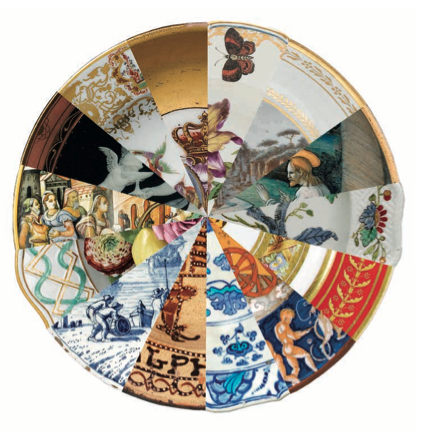 The 2015 French Porcelain Society Symposium examines the transfer of ceramic technologies and designs over the shifting borders of Europe. It represents something of a departure for the Society in that it explores the wider ceramic traditions of pottery and porcelain across the continent. We are thrilled to be able to present so many distinguished speakers, and to welcome members of the French Porcelain Society from around the world to London.
John Mallet will be giving the Sir Geoffrey de Bellaigue Lecture following the Annual General Meeting of the Society on Saturday 20th June. His subject, ‘The Travels of von Tschirnhaus’, will provide a fitting climax to two days of céramiques sans frontiers!
◊ ◊ ◊ ◊ ◊
F R I D A Y , 1 9 J U N E 2 0 1 5
9.45 Registration
10.15 Welcome
10.20 Antoinette Fay-Hallé, The influence of Japanese porcelain on the decoration of French ceramics
10.45 Rita Balleri, Copying, reworking and invention of the sculpture models at the Ginori Doccia factory in the 18th and 19th centuries
11.10 Tea and coffee
11.30 Monica Ferrero, The Royal porcelain manufactory of Vinovo: artists and sources
11.55 Angela Caròla-Perrotti, Naples porcelain in the time of Caroline Murat
12.20 Antoine d’Albis, Bartolomeo Ginori’s visit to Paris in 1771
12.45 Lunch
14.00 Jan Daniël van Dam, The three designers employed at the first porcelain factory in Weesp
14.30 Justin Raccanello, The transfer of the Istoriato maiolica tradition to France, part I (Italy)
14.55 Camille Le Prince, The transfer of the Istoriato maiolica tradition to France, part II (France)
15.20 Tea and coffee
15.50 Reino Liefkes, The Brühl Fountain
16.15 Martin Eberle, The porcelain cabinet of Luise Dorothea Saxe-Gotha Altenburg (1710–68)
16.40 Questions
17.00 Close of Day One
S A T U R D A Y , 2 0 J U N E 2 0 1 5
10.15 Welcome
10.20 Julia Weber, Boundless rivalry: Meissen and its competitors
10.50 María Ángeles Granados Ortega, Alcora’s French designs: a new approach to their source of inspiration and their influence in the Spanish ceramic of the 18th century
11.15 Tea and coffee
11.35 Maria Casanovas, Spanish porcelain and its international context
12.00 Rebecca Klarner, ‘Wedgwoodarbeit’: The influence of Wedgwood’s Jasperware on the German manufactories KPM and Meissen, 1750–1850
12.25 Rebecca Wallis, The French Connection: Minton and Sèvres in the 19th century
12.50 Lunch
14.00 Timothy Wilson, Antwerp and the tin-glaze diaspora in the 16th century
14.30 Tamara Préaud, Technical international exchanges to and from Sèvres, 18th and 19th centuries
14.55 Alfred Ziffer, The French influence on Nymphenburg porcelain in the early 19th century
15.20 Tea and coffee
15.50 Matthew Martin, Franco-Flemish models, English figures and Catholic consumers? The case of the Chelsea Virgin and Child and Pietà groups
16.15 Suzanne Lambooy, Dutch Delftware garden pots. A 17th-century royal fashion influenced by the formal French garden?
16.40 Questions and discussion
18.30 French Porcelain Society Annual General Meeting
19.00 The Sir Geoffrey de Bellaigue Lecture by J.V.G. Mallet, The Travels of von Tschirnhaus
John Mallet plans to discuss some of the places visited, and the people there who stimulated the Saxon nobleman, philosopher and mathematician Ehrenfried Walter von Tschirnhaus (1651–1708) and directed his attention to porcelain- making during the travels he undertook to European centres of learning such as Leiden, London, Paris and Milan. By the time Tschirnhaus involved Johann Friedrich Böttger in the researches that resulted in the invention of Meissen porcelain he had been in touch with many of the finest minds in Europe at a time when The Royal Society in London was only one of a number of academies stimulating scientific discovery, without regard to national frontiers.
20.00 The French Porcelain Society Annual Dinner at The Wallace Restaurant, The Wallace Collection (ticket only)
Call for Papers | Retail Realms in Eighteenth-Century Britain
◊ ◊ ◊ ◊ ◊
From the call for papers:
2015 Fairfax House Georgian Studies Symposium
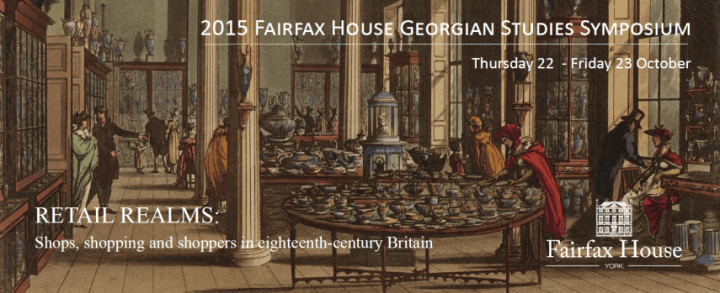
Retail Realms: Shops, Shoppers and Shopping in Eighteenth-Century Britain, c.1680–1830
York Hilton Hotel and Fairfax House, York, 22–23 October 2015
Proposals due by 31 July 2015
The eighteenth century was a transformative age for shops and shopping in Britain. Between the late seventeenth and the early nineteenth centuries far-reaching changes took place in the ways people shopped, the things they bought, the shops themselves and the ways in which they were run, and the systems of distribution and marketing which made possible the shopping experience.
For an increasing portion of Georgian ‘polite society’, shopping, from being primarily a matter of obtaining the necessities of life, became a pleasurable leisure activity in its own right, associated with sociability, sensory experience, the fashioning of selfhood and the expression of individual and collective identities. Many historians who have explored the social and cultural dynamics of shopping in the eighteenth century have argued that this period saw a ‘consumer revolution’.
Theorisations of eighteenth-century consumerism, however, tend to overlook or disregard the materiality and spatiality of the shopping experience: the Georgian retail realm was not just a social or economic process but a place, located in shops, showrooms, markets and high streets, and extending into the assembly rooms and drawing rooms, and indeed the bedrooms and dressing rooms, of polite society. From the packaging of goods and the display of signs and labels, print advertising and the design of shops, to the increasing prominence of shops in towns and cities and the refashioning of the urban environment around the shopping experience, the retail realm was an increasingly important factor in the physical reshaping of eighteenth-century British life.
This symposium, the third Fairfax House Symposium in Georgian Studies, aims to bring together interested parties from curatorial, conservation, academic and other backgrounds with an interest in the history of shops and shopping to explore the nature and significance of the retail realm in the long eighteenth century. The symposium, which is taking place over two days, will be organised around five broad themes:
• A consumer revolution? — the development and transformation of the retail realm in the long eighteenth century
• Shopping outside the shop — publicity, marketing, the retail realm interacting with the urban, rural and domestic realms
• Shopping inside the shop — the design, layout and furnishing of shops, the display of goods, the management of the shopping experience
• The shopper’s realm — shopping as a fashionable/leisure pursuit and a social activity, the sensory/haptic dimensions of shopping
• The retailer’s realm — how retailers perceived shopping and shoppers, new retail arenas and models, the materiality of the retail business
Proposals are invited for symposium contributions not exceeding 20 minutes in length addressing one or more of the themes identified above. Please send outlines of around 200 words, accompanied by a brief one-paragraph biography, to fairfaxhousesymposium@gmail.com by Friday 31 July 2015. Any queries about the symposium should be sent to the same email address.
Call for Papers | Understanding British Portraits
From H-ArtHist:
Understanding British Portraits Annual Seminar
National Portrait Gallery, London, 25 November 2015
Proposals due by 12 June 2015
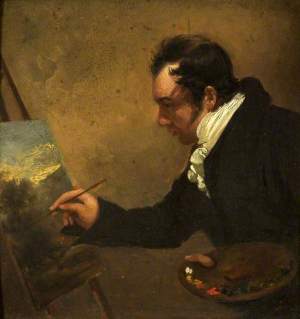
Nathan Cooper Branwhite, Portrait of Reverend John Eagles, ca.1820–25 (Bristol Museum & Art Gallery)
‘Understanding British Portraits’ is an active network with free membership for professionals working with British portraits including curators, museum learning professionals, researchers, academics and conservators. It aims to enhance the knowledge and understanding of portraits in all media in British collections, for the benefit of future research, exhibitions, interpretation, display and learning programmes.
This year’s Annual Seminar will take place on Wednesday 25 November at the National Portrait Gallery, London. It aims to highlight current scholarly research, museum-based learning programmes, conservation discoveries and curatorial practice relating to British portraits of all media and time periods.
We are now inviting proposals for 20-minute papers from museum professionals, scholars, conservators, and independent researchers which focus on these areas and seek to share innovation, challenges, or best practice case studies. Please send your abstract (max. 300 words) with a short biographical note (max. 100 words) in Word format to mail@britishportraits.org.uk before Friday 12 June.
More information is available here»
Display | Triumph and Disaster: Medals of the Sun King
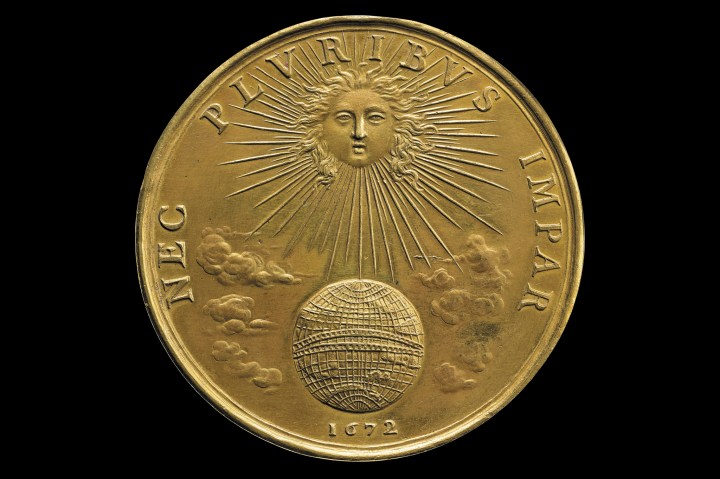
Gold medal. Obverse: portrait of Louis XIV facing right (now shown). Reverse: Louis XIV as the sun warming the earth. Made by Jean Warin, 1672.
◊ ◊ ◊ ◊ ◊
Now on view at The British Museum:
Triumph and Disaster: Medals of the Sun King
The British Museum, London, 4 June — 15 November 2015
Curated by Mark Jones
Louis XIV—known as the Sun King—was King of France for over 70 years, reigning from 1643 to 1715. In 1662 his Minister, Jean-Baptiste Colbert, put forward the idea of creating a series of medals commemorating the triumphs of Louis’ reign—a medallic history. This was to form an extraordinary work of collaborative art that resulted in a unique and fascinating self-portrait of the regime that dominated Europe for nearly 60 years.
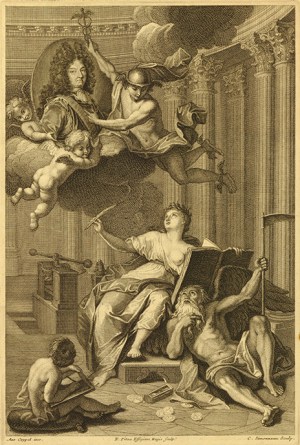
Frontispiece to Médailles sur les principaux évènements du règne de Louis le Grand (Medallic History of Louis the Great, 1702). Etching and engraving. Father Time lies defeated by the medallic history of Louis XIV which will last forever (London: The British Museum, Department of Coins and Medals’ Library Collection).
The display explores the background to the medallic history’s production, introducing some of the key people involved in its design and execution, including Colbert, artist and sculptor Jean Warin and authors Charles Perrault (best known today for his collection of fairy tales) and Jean Racine. The display uses a selection of the British Museum’s outstanding collection of medals produced during this period to tell this fascinating story—from the setting up of a ‘Little Academy’ (a committee established in 1663 to advise Louis on commemorating his reign) to the process of creation and production, and how Louis was represented.
The show also includes a 1702 folio edition of Médailles sur les principaux événements du règne de Louis le Grand—a catalogue of the medals produced, from the Department of Coins and Medals’ library collection (one of the most famous of all typefaces, Roman du Roi, was invented for the project). It is shown alongside two loan objects: a scrapbook from the British Library of ideas for medals in the form of sketches, descriptions and drawings by Sébastien Le Clerc, and an enamel portrait miniature of Louis from the V&A. Finally, a selection of satirical medals produced by Louis’ enemies in Germany and England represent responses to his medallic history.
At Christie’s | Three Country House Collections
Press release (28 May 2015) from Christie’s:
Glebe House, Mont Pellier, and Woodbury House
Three Country House Collections, Sale #11567
Christie’s, South Kensington, London, 17 June 2015
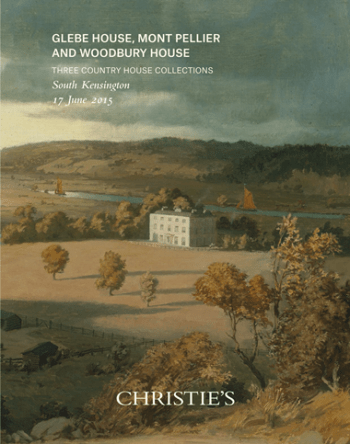 On 17 June Christie’s South Kensington will offer Three Country House Collections: Glebe House, the Property of the late Mr. Anthony Hobson; Mont Pellier, the Property of the late Mrs. Barbara Overland; and Woodbury House, the Property of the late The Hon. Mr. & Mrs. Anthony Samuel (Sale #11567). These three country house collections perfectly encapsulate the English home and together they present a superb selection of English and European furniture, Old Master paintings and drawings, decorative objects, silver and porcelain.
The sale comprises over 350 lots with estimates ranging from £500 to £50,000. The pre-auction viewing at Christie’s 85 Old Brompton Road will be open from 12 to 16 June for connoisseurs, decorators and collectors alike to explore the essence of the English country house.
Glebe House, the Property of the late Mr. Anthony Hobson
The late Anthony Hobson, a bibliophile of great distinction, and a world expert on Renaissance bookbinding, was appointed Head of Sotheby’s Book department when he was only 27, as well as being a past president of the Association Internationale de Bibliophilie (1985–1999). He was also a lifelong collector of art and furniture and amassed an extensive collection on which the taste of his wife, Tanya Vinogradoff, the granddaughter of the painter Algernon Newton, R.A, was also a significant influence.
Hobson was endlessly curious and maintained a voracious appetite for acquisition resulting in a collection which ranged with confidence across periods and registers: medieval Persian, Neoclassical, 18th-century Indian, Regency, Pre-Raphaelite—all individual delights which became part of a much larger whole in the beautiful Queen Anne Glebe House, Hampshire, where he lived for the last 55 years of his life. This sale is testament to an exceptional life led by the man singled out by Cyril Connolly as among the most “impressive scholar aesthetes of our day.” Highlights from the Hobson collection include The Interior of St Peter’s, Rome by Wilhelm Schubert van Ehrenberg (estimate: £20,000–30,000), alongside exceptional examples of English furniture and lighting, such as a pair of Louis XVI ormolu twin-branch wall-lights (estimate: £7,000–10,000) and a George II parcel-gilt mahogany rusticated architectural cabinet (estimate: £4,000–6,000).
Hobson’s remarkable library will also be offered at Christie’s South Kensington this June across two sales. The sale of Fine Printed Books and Manuscripts on 9 June includes scarce editions of the earliest known auction catalogues and inventories of the finest libraries in Europe from Hobson’s bibliographic library. Of immense importance to bibliographic study and provenance research, the library includes a first edition of the earliest Paris book auction which was held in 1706, sixty years before Christie’s held its first sale (estimate: £1,000–1,500). On 10 June Christie’s presents the sale of Modern Literature: The Personal Collection of Anthony Hobson—a truly personal collection in every sense: many of the books, editions, and manuscripts are affectionately inscribed with a message to Hobson from the authors with whom he became such great friends. Amongst the highlights are first edition presentation copies of Kingsley Amis’ Lucky Jim (estimate: £1,800–2,500) and a complete set of Anthony Powell’s A Dance to the Music of Time (estimate: £5,000–8,000).
Additionally, the sale includes a collection of love letters between the heiress and avant-garde literary muse Nancy Cunard and the African-American jazz musician Henry Crowder, containing a number of Cecil Beaton photographs of her (estimate: £3,000–5,000). These auctions present a unique opportunity to acquire a part of this illustrious library.
Mont Pellier, the Property of the late Mrs. Barbara Overland
The Overland family lived in Jersey for over 40 years, where they enjoyed the amenities of rural life and the unique privacy that the Channel Islands offer. They created a very special atmosphere at their house, Mont Pellier, which can be seen in the dedication and pride the late Mrs. Barbara Overland took in furnishing her home with English furniture, Old Master Paintings and decorative objects.
The pieces in her collection were acquired with great care and thought to enhance the serene interiors, which were so characteristic of Mont Pellier, such as the perfectly formed George II mahogany chest (estimate: £4,000–6,000) and the captivating trompe l’oeil painting of a letter rack by Edward Collier, acquired from Rafael Valls, London (estimate: £20,000–30,000). Further highlights include a George III polychrome-painted dummy-board (estimate: £3,000–5,000) and a group of ceramic fruit and vegetables by Anne Gordon (in two lots with estimates from £1,000).
The proceeds of the sale of the collection of the late Mrs. Barbara Overland will go to benefit the ongoing work of the charitable trust set up in the memory of the Overlands for generations to come.
Woodbury House, the Property of the late The Hon. Mr. & Mrs. Anthony Samuel
Woodbury House, an elegant Regency gothic villa in Hampshire, was the last home of the Hon. Mr and Mrs Anthony Samuel. Anthony Samuel was the younger son of Colonel Walter Samuel, 2nd Viscount Bearsted, and a grandson of Marcus Samuel, 1st Viscount Bearsted, the founder of The ‘Shell’ Transport and Trading Company, which in 1907 merged with its rival to form Royal Dutch Shell. After serving in the SOE during the Second World War, Samuel joined the family bank, Hill Samuel, as well as having interests in publishing, representing prominent authors such as P.G. Wodehouse. He also ventured into the world of horse racing owning several winners. In 1966 he married his third wife, the actress Mercy Haystead (1930–2015). Mercy rose to fame as a model and actress after being ‘discovered’ whilst holidaying in Positano in 1949 and was well known during the 1950s for her roles in films, such as What the Butler Saw and The Admirable Crichton.
The Samuels were renowned as generous hosts. They had houses in London and Scotland and frequently travelled to their suite in the Algonquin Hotel, New York. Their sophisticated London house on St. Leonard’s Terrace, Chelsea, had rich interiors designed by David Hicks, whilst their Scottish country house Arndilly, on the banks of the Spey, provided a more restrained setting, acting as a retreat from London and as a base from which country sports could be pursued and enjoyed.
Arndilly House was sold when the couple sought a quieter life and it was at this point that they acquired Woodbury House, a former rectory in Hampshire. A genteel decorative scheme was adopted, which not only suited the house’s rural location, but also its Regency architecture. It was decorated by Simon Playle under the keen eye of the ever stylish Mrs. Samuel. The Samuels had long been keen collectors. Their possessions had been inherited, collected and assembled over many decades and displayed all the characteristics of the discerning collector’s eye. Their collection of paintings ranged from Old Masters to the works of the Impressionist Edouard Vuillard, the Victorian painter John Atkinson Grimshaw and the 2oth-century artist Nicolas de Staël, the works of the latter being sold at Christie’s following the sale of the couple’s London home in 2008.
Highlights from Woodbury House include a painting of Two greyhounds in a wooded landscape with Parham House and a temple beyond (estimate: £10,000–15,000), a set of ten walnut rococo-style dining chairs (estimate: £3,000–5,000) and a set of four George III silver candlesticks and a pair of twin branch candelabra en suite (estimate: £6,000–8,000). La vie conjugale (Married Life) by Edouard Vuillard will be offered on 23 June in the Impressionist and Modern Art Evening Sale at Christie’s King Street (estimate: £500,000–800,000) and Rouen – les lumières sur la Seine, pris du Pont de Pierre by John Atkinson Grimshaw will be offered on 8 July at Christie’s South Kensington in the Victorian, Pre Raphaelite and British Impressionist Art, Sporting and Maritime Art sale (estimate: £80,000–120,000).










 Enfilade
leave a comment