Exhibition | Sir Hans Sloane’s Plants on Chelsea Porcelain
From the press release:
Sir Hans Sloane’s Plants on Chelsea Porcelain: A Loan Exhibition
Stockspring Antiques, London, 2–16 June 2015
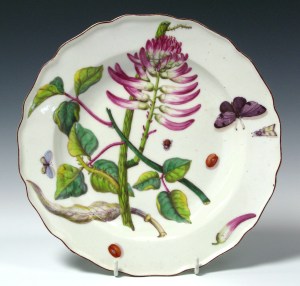
Chelsea plate with a wavy brown-edged rim, painted with a Corallodendron flower, leaves, floret, seed pod and seeds, and two butterflies, ca. 1753–56; Mark: red anchor over 34;
24.5 cm (Private Collection)
The exhibition Sir Hans Sloane’s Plants on Chelsea Porcelain aims to identify the plants on Chelsea porcelain botanical wares and link them to their source drawings and prints—many of which were by G. D. Ehret and were published by Philip Miller in Figures of the most Beautiful, Useful, and Uncommon plants described in the Gardeners Dictionary and other botanical publications of the period. The catalogue includes chapters on Sir Hans Sloane, the Chelsea Physic Garden, and Philip Miller’s role in receiving and propagating the imported plants and seeds from the New World, Africa, and Asia, as well as his influence on garden planting and design in Britain. The exhibition comprises of the loan of over 70 pieces of Chelsea porcelain from private and museum collections, which are shown with their relevant source engravings. Previously only about 10 plants on Chelsea porcelain had been correctly identified and linked to botanical engravings; so the exhibition includes significant new research.
The catalogue by Sally Kevill-Davies is generously sponsored by the Cadogan Estate (email stockspring@antique-porcelain.co.uk to order a copy, £30 + p&p). The exhibition is on view at Stockspring Antiques, 114 Kensington Church St., London W8 4BH, weekdays 10–5.30 and Saturdays 10–4; closed on Sundays.
Sally Kevill-Davies, Sir Hans Sloane’s Plants on Chelsea Porcelain (London: 2015), 229 pages, ISBN: 978-0956570222, £30.
Catherine Roach, “Working-Class Interpreters of Elite Collections”
From the latest posting at Homes Subjects:
Catherine Roach, “Working-Class Interpreters of Elite Collections,” Home Subjects: A Working Group Dedicated to the Display of Art in the Private Interior, c. 1715–1914 (4 June 2015).

A Greenwich Pensioner showing the Thornhill decorations in the Painted Hall to a family of visitors. Coloured etching by T. Rowlandson after [J. N.] Esq, 1807
(London: The Wellcome Institute)
Historic collections (and their present-day avatars, historic homes) are seductive. This field of study offers imaginative possession of desirable ensembles. In this, we are all like Eliza Bennet at Pemberley, imagining what we could have been mistress of, if things had been different. But, as curators of historic homes have come to realize in recent years, history need not be sanitized to interest visitors, or to interest us. Displays in historic homes have begun, haltingly but laudably, to grapple with the social systems that made such dwellings possible, including the enslavement of millions of people. The history of collecting can do the same. . . .
Catherine Roach is Assistant Professor of the History of Art at Virginia Commonwealth University. Her first book, Pictures-within-Pictures in Nineteenth-Century Britain, is forthcoming from Ashgate Press. She is currently working on a history of the British Institution.
The full posting is available here»
Colloquium | L’image Railleuse: La satire visuelle
From INHA:
L’image Railleuse: La satire visuelle du XVIIIe siècle à nos jours
Institut national d’histoire de l’art, Paris, 25–27 June 2015
En partenariat avec l’université du Québec à Montréal et le LARHRA-UMR 5190 de l’université de Lyon
La fonction critique des images s’incarne de manière privilégiée dans la satire. Si la satire s’est constituée en genre littéraire dès l’Antiquité, avant de gagner les beaux-arts et les arts graphiques à l’âge classique, ce sont les médias modernes – édition, presse, expositions, télévision, internet – qui, en élargissant progressivement sa sphère d’influence, ont renouvelé ses formes et ses objectifs tout en augmentant leur efficacité. Autorisant une diffusion planétaire et presque instantanée des images satiriques, internet et les technologies numériques n’ont pas seulement transformé la matérialité et les moyens d’action de cette imagerie et leurs effets socio-politiques, ils ont aussi affecté les formes de la recherche sur le satirique en donnant accès de plus en plus rapidement à des corpus extrêmement vastes. La satire est aujourd’hui partout, sans qu’aucun acteur ni canal de diffusion ne puisse prétendre en contrôler ses usages généralisés ni son effectivité. Ce colloque interroge la satire – entendue comme genre aussi bien que comme registre, selon que l’on s’intéresse à un type de représentations (caricaturale, en particulier) ou à une veine (le satirique) traversant de multiples champs, parmi lesquels celui de l’art contemporain – du point de vue de sa visualité, de ses objets, particuliers ou partagés, ses mécanismes et ses effets spécifiques. Les trois journées s’articuleront autour des Médiums, diffusion, réseaux, des Réflexivités satiriques, des Normes et modèles, des Violences satiriques et des Créativités satiriques. Une table-ronde finale réunira chercheurs et dessinateurs autour de l’actualité de la satire visuelle.
◊ ◊ ◊ ◊ ◊
J E U D I , 2 5 J U I N 2 0 1 5
8.30 Accueil des participants
9.00 Introduction, Laurent Baridon, Frédérique Desbuissons, Dominic Hardy
9.30 Médiums, Diffusion, Réseaux
Président de Séance: Laurence Grove
• Peggy Davis, La fureur de calicot : intermédialité et intervisualité de la satire
• Christina Smylitopoulos, Tegg’s Regency Satirical Books Reconsidered
• Erica Wicky, Caricatures de photographies et photographies caricaturales : la critique photographique dans la presse (1850–1870)
• Raphael Chavez, La satire au temps des imageboards : un humour punk ?
• Fabio Parasecoli, Eat it, don’t tweet it : l’alimentation et la satire vidéo aux États-Unis
12.30 Déjeuner
14.30 Réflexivités Satiriques
Président de Séance: Ségolène Le Men
• Kathryn Desplanque, L’autoréflexivité dans l’album comique. Les illustrateurs et les éditeurs contre eux-mêmes pendant la Restauration
• Sandro Morachioli, Le visage du journal. Stratégies d’auto-représentation et personnification de la presse satirique au xixe siècle
• Patricia Mainardi, Studio practice, art and caricature
• Miyuki Aoki-Girardelli, Self-Irony in context: Ito Chuta’s Caricature Works and the Beginning of Japanese Fûshi-Manga (satirical manga)
• Morgan Labar, Génération 1980 : affaiblissement du satirique et bêtise délibérée
V E N D R E D I , 2 6 J U I N 2 0 1 5
8.30 Accueil des participants
9.00 Normes et Modèles
Président de Séance: Annie Gérin
• Kate Grandjouan, La caricature et la « déqualification » de l’art : le cas de Henry Bunbury (1750–1810) et de Thomas Rowlandson (1756–1827)
• Ersy Contogouris, La mort de l’amiral Nelson représentée par James Gillray, Benjamin West et Ronald Searle
• Frédéric le Gouriérec, De la consubstantialité de l’art et de l’image railleuse en Chine, bien avant l’âge contemporain
• Aylin Koçunyan, La caricature ottomane entre art et préoccupations sociétales
• Juliette Bertron, Pères modèles, fils indignes. De quelques autoportraits parodiques, des années 1960 à nos jours
• Jean-Philippe Uzel, Art contemporain autochtone et satire visuelle
12.30 Déjeuner
14.30 Violences Satiriques
Président de Séance: Peggy Davis
• Barbara Stentz, Le motif du pressoir passé au crible de la caricature
• Brigitte friant-Kessler, L’encre et la bile : voyage dans les boyaux de Gulliver, de la caricature politique au roman graphique satirique
• Annie Gérin, Rire et dévastation : la rhétorique de la destruction dans la satire graphique soviétique et sa théorisation
• Yoann Moreau, Le rire du pire. Le tremblement de terre d’Edo (Japon, 1855)
• Ségolène Le Men, La Rue Transnonain, 15 avril 1834 de Daumier. La caricature au seuil de l’histoire
S A M E D I , 2 7 J U I N 2 0 1 5
8.30 Accueil des participants
9.00 Créativités Satiriques
Président de Séance: Philippe Kaenel
• Valentine Toutain-Quittelier, Le Diable d’argent et la Folie : enjeux et usages de la satire financière autour de 1720
• Laurence Grove, La caricature comme pilier du premier comic du monde : The Glasgow Looking Glass (1825)
• Frank Knoery, Le photomontage et la tradition satirique : subversion et propagande dans l’œuvre de John Heartfield
• Julie-Anne Godin-Laverdière, L’image raillée : les réponses ironiques, satiriques et parodiques à la censure de Robert Roussil, entre 1949 et 1965
• Josée Desforges, Cadrer la satire parodique. Repenser la théorie de la satire à partir du motif du cadre
• Clément De Gaulejac, Les dessins de l’eau tiède : petite fabrique d’agit-prop artisanale
12.30 Déjeuner
14.30 Synthèse et la Table Ronde
• Laurent Baridon, Frédérique Desbuissons, Clément de Gaulejac, Dominic Hardy, Martine Mauvieux
16.00 Conclusion
Exhibition | Bread and Wine
From the exhibition press release:
Bread and Wine: Traces of the Eucharist Mystery, 16th–18th Centuries
Pane e vino: Tracce del mistero eucaristico nella pittura a Como dal XVI al XVIII secolo
Cathedral of Como, 9 May — 31 October 2015
Curated by Eugenia Bianchi and Andrea Straffi
 La mostra Pane e vino: Tracce del Mistero eucaristico nella pittura a Como dal XVI al XVIII secolo, visitabile dal 9 maggio al 31 ottobre 2015 presso la cattedrale di Como, è uno dei fulcri del progetto Pane e vin non ci mancava: Uomini e merci in movimento tra campi, botteghe e chiese nel Comasco, promosso dal Centro studi ‘Nicolò Rusca’ in occasione di EXPO 2015. Con un allestimento appositamente ideato per gli spazi della cattedrale e un ricco apparato di testi e immagini, vengono illustrate trenta opere—tra dipinti e affreschi dal XVI al XVIII secolo—scelte all’interno del patrimonio artistico comasco per il loro contenuto esplicitamente eucaristico o per la presenza di segni e simboli che rimandano a quel Mistero. La tematica dominante della mostra è infatti l’Eucaristia, come si trova rappresentata o evocata nei dipinti che arricchiscono le chiese di Como e della sua provincia, a memoria di un popolo di fedeli desiderosi di abbellire e impreziosire i propri luoghi di culto con immagini di profondo significato teologico.
Non si tratta però di una mostra esclusivamente iconografica. Il valore aggiunto di questa iniziativa è offerto dai risultati delle ricerche storico-artistiche, che hanno permesso di aggiornare lo stato delle conoscenze su opere già note e di recuperare dall’oblio opere mai valorizzate e collocate spesso in contesti defilati rispetto ai più tradizionali circuiti turistici. Del Gonfalone di sant’Abbondio, realizzato da Morazzone per la confraternita del Santissimo Sacramento in cattedrale, si è trovata, ad esempio, la fonte iconografica (il testo di Nicola Laghi, I Miracoli del Santissimo Sacramento, Venezia 1597); nell’oratorio della Madonna Nera di Einsiedeln a Rogaro di Tremezzo si è scoperta una coppia di tele del valsesiano Giuseppe Antonio Pianca, artista originalissimo nel contesto barocchetto lombardo, di cui finora non si conosceva alcuna opera comasca; il San Carlo Borromeo comunica gli appestati della parrocchiale di San Gerardo a Olgiate Comasco dà invece un volto a Ludovico Mascarone, pittore probabilmente milanese noto solo a livello documentario. Ancora, è emersa a Bregnano una tela di Francesco Innocenzo Torriani e trova un’attribuzione più verosimile il ciclo con le Storie di san Rocco della chiesa di San Giacomo a Livo, da riferire al solo Ambrogio Arcimboldi e alla sua bottega.
La mostra non vuol essere un’iniziativa fine a sé stessa. Piuttosto è un caloroso invito a percorrere un ‘viaggio’ nei luoghi indicati, per prendere visione delle opere nel loro contesto, così da “toccare con mano” quell’imprescindibile rapporto, tra manufatto e luogo sacro, che va inevitabilmente a perdersi quando la fruizione avviene in un museo. Solo in questo modo prende effettivo risalto quell’hic et nunc che è insito nel ‘visibile parlare’ adottato dalla Chiesa nella sua storia millenaria al fine di diffondere e rendere comprensibile a tutti le verità del Vangelo.
Contestualmente alla mostra e per tutta la sua durata, sarà possibile visitare la Sacrestia dei Mansionari, eccezionalmente aperta per l’occasione. Sotto il suggestivo affresco con l’Incoronazione della Madonna di Morazzone e circondati da alcuni dipinti della collezione donata nel 1683 alla cattedrale di Como dal nobile comasco Giacomo Gallio, verranno esposte alcune antiche suppellettili legate alla liturgia eucaristica (calici, ostensori, pissidi, ecc. dal XVI al XIX secolo) e documenti della Confraternita del Santissimo Sacramento esistente in cattedrale.
◊ ◊ ◊ ◊ ◊
The catalogue is available from artbooks.com:
Eugenia Bianchi and Andrea Straffi, Pane e Vino: Tracce del Mistero eucaristico nella pittura a Como dal XVI al XVIII secolo (Milan: Silvana: 2015), 144 pages, ISBN: 978-8836631339, $45.
 Il catalogo della mostra Pane e vino: Tracce del mistero eucaristico nella pittura a Como dal XVI al XVIII secolo è dedicato a trenta opere—tra dipinti e affreschi dal XVI al XVIII secolo—scelte all’interno del patrimonio artistico comasco per il loro contenuto esplicitamente eucaristico o per la presenza di segni e simboli che rimandano a quel mistero. Il filo conduttore del volume è infatti l’eucarestia, come si trova rappresentata o evocata nei dipinti che arricchiscono le chiese di Como e della sua provincia, a memoria di un popolo di fedeli desiderosi di abbellire e impreziosire i propri luoghi di culto con immagini ricche di significato teologico.
Call for Submissions | British Art Studies, Issue 2

◊ ◊ ◊ ◊ ◊
British Art Studies, Issue 2 (April 2016)
Papers are due by 1 September 2015
We are currently soliciting submissions of articles for our second issue, which is due for publication in April 2016.
British Art Studies is an online journal published by the Paul Mellon Centre for Studies in British Art, London, and the Yale Center for British Art, New Haven. Launching in the autumn of 2015, the journal will provide an innovative space for new research and scholarship of the highest quality on all aspects of British art. The digital format of the journal offers new opportunities for displaying images alongside text and multimedia content. The editors are open to proposals and ideas from authors to develop innovative and visually stimulating ways to publish art-historical scholarship online.
British Art Studies, which is peer reviewed, encourages submissions on British art, architecture, and visual culture from all periods in their most diverse and international contexts. The journal will reflect the dynamic and broad ranging research cultures of the Paul Mellon Centre and the Yale Center for British Art, as well as the wider field of studies in British art and architecture today.
How to submit an article: Texts of between 5000 and 8000 words in length (although the editors are willing to discuss shorter and longer formats) should be submitted via email in a Word document, together with a document containing low resolution accompanying images (where possible), and a list of proposed images and sources, as outlined in our style guide, available online. The final number of figures and the process of sourcing and commissioning media for articles accepted for publication will be discussed with authors on an individual basis, but we recommend between 5 and 10. British Art Studies will endeavour to meet all reasonable costs and deal with copyright issues for illustrative materials essential to the argument of published text.
How to submit proposals for other formats: proposals are also welcomed for content which presents art-historical scholarship in innovative and dynamic ways using the online format of British Art Studies. Proposals outlining your ideas, use of images and/or multi-media content are encouraged by the Editorial Group.
Deadline for the submission of articles and proposal to be considered for the second issue: 1st September 2015. Contact Hana Leaper (journal@paul-mellon-centre.ac.uk) with any questions or to discuss a potential submission to the journal.
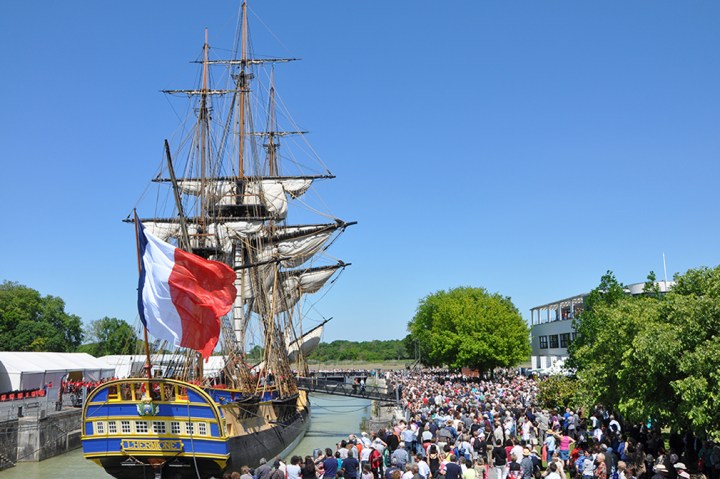
Hermione Voyage 2015
◊ ◊ ◊ ◊ ◊
From the Hermione Voyage 2015 website:
Twenty years ago, a small group dreamed of reconstructing an exact replica of General Lafayette’s 18th-century ship called the Hermione. Today, the majestic vessel is the largest and most authentically built Tall Ship in the last 150 years. The Hermione has set sail in France, launching an adventure that comes to the USA in the summer of 2015 for an unprecedented voyage.
In April 2015, after a period of sea trials and training in 2014, the Hermione set sail for the USA. The journey started from the mouth of the River Charente, in Port des Barques, where Lafayette boarded on March 10th, 1780. The transatlantic crossing was expected to take 27 days in total, before making landfall at Yorktown, Virginia.
As the Hermione moves up the Eastern seaboard, it will be accompanied by a range of pier side activities. These include in some ports a traveling exhibition and a heritage village that will be accessible to the public. The Hermione Voyage 2015 is part of an expansive outreach program with cultural events, exhibitions, and educational programs that celebrate the trip and mark its progress. A robust digital activation for the voyage expands the reach of the project to millions of people.
Objects from the Slave Ship São José To Be Displayed in D.C.
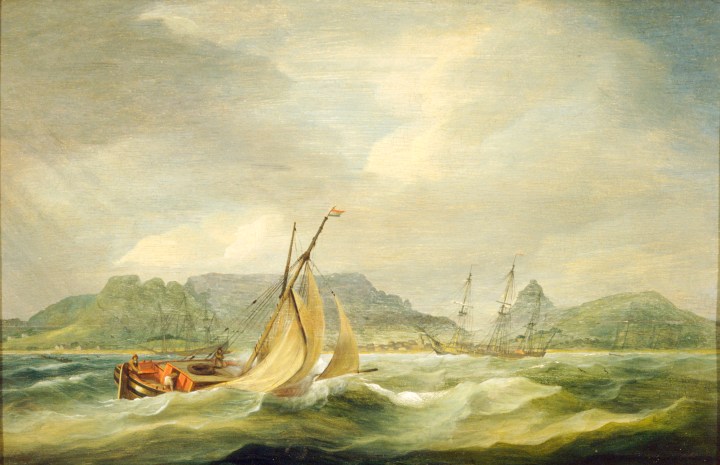
Thomas Luny, Table Bay Cape Town, 1790s, oil on panel (Iziko Social History Collections). Depiction of the port of Cape Town, South Africa where the São José slave ship planned to stop before continuing to Brazil. The ship wrecked near the Cape of Good Hope before arriving in Table Bay. Photo by Pam Warne.
◊ ◊ ◊ ◊ ◊
Press release (1 June 2015) from The Smithonian:
National Museum of African American History and Culture To Display Objects from Slave Shipwreck Found Near Cape Town, South Africa
Museum Joins Iziko Museums of South Africa and George Washington University in Slave Wrecks Research Project
Objects from a slave ship that sank off the coast of Cape Town in 1794 will be on long-term loan to the Smithsonian’s National Museum of African American History and Culture (NMAAHC). The announcement, scheduled for Tuesday, June 2, will take place at a historic ceremony at Iziko Museums of South Africa. The discovery of the ship marks a milestone in the study of the trans-Atlantic slave trade and showcases the results of the Slave Wrecks Project, a unique global partnership among museums and research institutions, including NMAAHC and six partners in the U.S. and Africa.
Objects from the shipwreck—iron ballast to weigh down the ship and its human cargo and a wooden pulley block—were retrieved this year from the wreck site of the São José-Paquete de Africa, a Portuguese slave ship that sank off the coast of Cape Town on its way to Brazil while carrying more than 400 enslaved Africans from Mozambique.
Lonnie G. Bunch III, founding director of NMAAHC, and Rooksana Omar, CEO of Iziko Museums, will join in the announcement of the shipwreck’s discovery and the artifact loan agreement.
“Perhaps the single greatest symbol of the trans-Atlantic slave trade is the ships that carried millions of captive Africans across the Atlantic never to return,” said Bunch. “This discovery is significant because there has never been archaeological documentation of a vessel that foundered and was lost while carrying a cargo of enslaved persons. The São José is all the more significant because it represents one of the earliest attempts to bring East Africans into the trans-Atlantic slave trade—a shift that played a major role in prolonging that tragic trade for decades.”
São José Wreck
The São José’s voyage was one of the earliest in the trans-Atlantic slave trade from East Africa to the Americas, which continued well into the 19th century. More than 400,000 East Africans are estimated to have made the Mozambique-to-Brazil journey between 1800 and 1865. The ship’s crew and some of the more than 400 enslaved on board were rescued after the ship ran into submerged rocks about 100 meters (328 feet) from shore. Tragically, more than half of the enslaved people perished in the violent waves. The remainder were resold into slavery in the Western Cape.
The São José wreck site is located between two reefs, a location that creates a difficult environment to work in because it is prone to strong swells creating challenging conditions for the archaeologists. To date, only a small percentage of the site has been excavated; fully exploring the site will take time.
Even the smallest artifact gives a clue into the shipwreck’s story:
1980s: Local amateur treasure hunters discovered a wreck near Cape Town and mistakenly identified it as the wreck of an earlier Dutch vessel. They applied for a permit under the legislation of the time and had to report their findings.
2008–2009: The Slave Wrecks Project (SWP) staff identified the São José as a target for location in its pilot project.
2010–2011: Jaco Boshoff, the co-originator of SWP, served as lead archaeologist for Iziko and primary investigator for the São José project. He discovered the captain’s account of the wrecking of the São José in the Cape archives. New interest was developed on the site. Copper fastenings and copper sheathing indicated a wreck of a later period, and iron ballast—often found on slave ships and other ships as a means of stabilizing the vessel—was found on the wreck.
2012–2013: SWP uncovered an archival document in Portugal stating that the São José had loaded iron ballast before she departed for Mozambique, further confirming the site as the São José wreck. Archaeological documentation of the wreck site began in 2013.
2014–2015: Some of the first artifacts are brought above water through a targeted retrieval process according to the best archaeological and preservation practices. Using CT scan technology because of the fragility of the site, the SWP identified the remains of shackles on the wreck site, a difficult undertaking because of extreme iron corrosion. Archival research locates a document in which a slave is noted as sold by a local sheikh to the São José’s captain before its departure, definitively identifying Mozambique Island as the port of departure for the slaving voyage. Archival and archaeological prospecting work was launched in Mozambique and Brazil in order to identify sites related to the São José story for future research.
2015–ongoing: Full archaeological documentation and retrieval of select items to help to tell of the São José wreck site continue; the search for descendant communities of Mozambicans from the wreck also continues.
A selection of artifacts retrieved from the São José wreck will be loaned by Iziko Museums and the South African government for display in an inaugural exhibition titled Slavery and Freedom at NMAAHC, opening fall 2016. Iziko Museums also plans an exhibition.
Memorial Service
On Tuesday, June 2, soil brought from Mozambique Island, the site of the São José’s embarkation, will be deposited on the wreck site by a team represented by divers from Mozambique, South Africa and the United States. A solemn memorial service will also be held close by and on shore honoring the 500 enslaved Mozambicans who lost their lives or were sold into slavery. SWP researchers, Cape Town dignitaries and delegations from the U.S. Consulate and South African government will attend the private ceremony.
Symposium
A daylong public symposium, Bringing the São José into Memory, will be held June 3 featuring a series of panel discussions focusing on the wreck, the slave trade, slavery, history and memory. The panels will take place at the Iziko Museums’ TH Barry Lecture Theatre and feature discussions and performances by scholars, curators, heritage activists, artists, hip-hop musicians and slave descendants from various academic, heritage and religious institutions, including Iziko, St. George’s Cathedral, NMAAHC, George Washington University, Syracuse University, Brown University, University of Western Cape, Cape Family Research Forum among others.
Maritime Archaeology and Conservation Workshop
The week’s activities will also include a conservation workshop for archaeologists, researchers and museum professionals from Mozambique, Senegal and South Africa to learn techniques in conservation and care for marine materials. This workshop, co-taught by Boshoff and George Schwarz of the U.S. Naval Heritage Command, is an opportunity to advance professional training and capacity for individuals and institutions, a core component of SWP’s mission. Representatives from Eduardo Mondlane University in Maputo, Mozambique, and Cheik Anta Diop University in Dakar, Senegal, will join with Smithsonian and Iziko professionals in a dialogue about current and future research and searches in their respective regions.
Slave Wrecks Project History
Founded in 2008, SWP brings together partners who have been investigating the impact of the slave trade on world history. It spearheaded the recent discovery of the São José wreck and the ongoing documentation and retrieval of select artifacts. In addition, extensive archival research was conducted on four continents in six countries that ultimately uncovered the ship captain’s account of the wrecking in the Cape archives as well as the ship’s manifest in Portuguese archives. Core SWP partners include George Washington University, Iziko Museums of South Africa, the South African Heritage Resource Agency, the U.S. National Park Service, Diving With a Purpose, a project of the National Association of Black Scuba Divers, and the African Center for Heritage Activities.
SWP, established with funding from the Ford Foundation, set a new model for international collaboration among museums and research institutions. It has been combining groundbreaking slave shipwreck investigation, maritime and historical archeological training, capacity building, heritage tourism and protection, and education to build new scholarship and knowledge about the study of the global slave trade.
Conference | Artistic Correspondences: Rome and Europe, 1700–1900
From the conference programme:
Artistic Correspondences: Rome and Europe in the 18th and 19th Centuries
Corrispondenze d’artista: Roma e l’Europa (XVIII-XIX secolo)
Koninklijk Nederlands Instituut Rome / Svenska Institutet i Rom, 15–16 June 201
Registration due by 11 June
Epistolary correspondence among artists is a privileged source to unravel the dynamics of intellectual exchange across regional and national boundaries, as it requires a research agenda necessarily focused on ‘mobility’, and a transnational approach and methodology avoiding the rhetorical pitfalls of past European historiography. By focusing on the cosmopolitan context of 18th- and 19th-century Rome as a paradigmatic field of enquiry, the research network Artistic Correspondences: Rome and Europe in the 18th and 19th Centuries convenes investigators and research groups working on the same topic throughout Europe in order to explore new opportunities for collaboration. The conference is free of charge, though registration is required (see the Svenska Institutet i Rom website for details).
◊ ◊ ◊ ◊ ◊
M O N D A Y , 1 5 J U N E 2 01 5
9.30 Saluti, Martin Olin, (Assistant Director, Svenska Institutet i Rom) & Mario De Nonno, (Direttore del Dipartimento di Studi Umanistici, Università degli Studi Roma TRE)
10.00 Plenary Session
Session Chair: Harald Hendrix (KNIR)
• Serenella Rolfi (Università degli Studi Roma TRE), Linee di una ricerca
• Elisabeth Oy-Marra (Gutenberg Universität Mainz), Lettere d’artista e le vite d’artisti: da Giovan Pietro Bellori a Giovanni Gaetano Bottari
• Cinzia Sicca (Università statale di Pisa), Rome as Competitive arena: The evolving nature of a friendship through the early eighteenth-century correspondence of John Talman and William Kent
• Martin Dönike (Martin-Luther-Universität Halle-Wittenberg), Rome in Weimar: The artistic correspondence between Goethe and German artists living in Rome around 1800
• Christoph Frank (Università della Svizzera italiana, Mendrisio), Da Grimm a Goethe: l’impatto di Parigi e Weimar sulle corrispondenze artistiche romane del ‘700
12:45 Pause
14:00 Session A1: Esperienza di Roma
Session Chair: Liliana Barroero (Università degli Studi Roma TRE)
• Raquel Gallego (Universitat de Barcelona), Il carteggio di Julien de Parme e la formazione degli artisti indipendenti a Roma
• Tomas Macsotay (Universitat Pompeu Fabra, Barcelona), Northcote, Theed, Tatham, Deare, Flaxman: Five British artists overcome Rome
• Sebastian Dohe – Malve Falk, Landesmuseum für Kunst und Kulturgeschichte), Oldenburg To princes, poets and painters: The ‘Tischbein bequest’ at Oldenburg
15.25 Session A2: Prospettive storiografiche
Session Chair: Susanne Adina Meyer (Università di Macerata)
• Raffaella Morselli (Università degli Studi di Teramo), Nostalgia di Roma: Riflessioni di Francesco Albani sulla pittura classicista nell’urbe
• Susanna Pasquali (Università degli Studi di Roma ‘La Sapienza’), Algarotti, Temanza e le lettere degli architetti nella prima edizione della ‘Raccolta’ di Bottari
• Stefano Ferrari (Accademia Roveretana degli Agiati di Scienze, Lettere e Arti), Il carteggio di Winckelmann con gli artisti
• Robert Skwirblies (Technische Universität Berlin), Lettere d’artista e ‘Künstlersozialgeschichte’: La dimensione storica e sociale nelle lettere giovanili di Johann David Passavant da Parigi e Roma a Francoforte
14:00 Session B1: Rapporti con le istituzioni
Session Chair: Maria Pia Donato, IHMC (CNRS-ENS-Paris 1)
• Emilie Roffidal (CNRS-Toulouse), Correspondances romaines d’une académie de province: l’Académie de peinture et de sculpture de Marseille, 1760–1790
• Adrian Fernandez Almoguera (Paris – Sorbonne Université), After the Antique: Correspondence between Rome’s Spanish artistic community and Madrid’s Academy, 1750–1820
• Michela Degortes e Maria Joao Quintas Lopes Baptista Neto, Universidade de Lisboa), La Real Accademia Portoghese di Belle Arti a Roma (1785–1798) nella corrispondenza dei diplomatici, degli artisti e del direttore Giovanni Gherardo De Rossi
15.25 Session B2: Contesti collezionistici e agenti
Session Chair: Christoph Frank (Università della Svizzera italiana)
• Matteo Borchia (Università degli Studi di Roma ‘La Sapienza’), Bartolomeo Cavaceppi e la corte di Berlino: stralci di una corrispondenza
• Johanna Selch (Ludwig-Maximilians-Universität München), An attentive glance at Rome: Ludwig I of Bavaria and his Roman correspondents
• Mathias Hofter (Ludwig-Maximilians-Universität München), Concetti del collezionismo nella corrispondenza di Ludovico I e Martin Wagner
• Ljerka Dulibi e Iva Tržec Pasini (Hrvatska akademija znanosti i umjetnosti, Zagreb), Artists in nineteenth-century Rome as mediators of cultural transfer of ideas and objects
18.30 Lecture
• Martin Olin (Svenska Institutet i Rom), Italian food and wine in letters and memoirs of Scandinavian artists
T U E S D A Y , 1 6 J U N E 2 0 1 5
9:30 Session A3: Corrispondenze cosmopolite
Session Chair: Ilaria Miarelli Mariani (Università di Chieti)
• Miguel Figueira de Faira (Universidade Autónoma de Lisboa), Rome, Paris, Lisbon: Political and Aesthetic Ideas in Portuguese artistic correspondence at the end of Ancient Regime
• Anna Frasca-Rath (Universität Wien), Antonio Canova nelle lettere di John Gibson
• Arnika Schmidt (Technische Universität Dresden), Nino Costa (1826–1903), A Roman painter and his cosmopolitan correspondence
9:30 Session B3: Pratiche artistiche e modelli
Session Chair: Carla Mazzarelli (Università della Svizzera italiana, Mendrisio)
• Valeria Rotili (Accademia di San Luca, Roma), Lo scultore al lavoro. Il carteggio Albacini per una geografia della prassi artistica
• Angela Windholz (Università della Svizzera italiana, Mendrisio), Lettere da Olevano Romano: La descrizione di un motivo ideale
• Rosalba Dinoia (Roma), Traduzione e migrazione del Rinascimento nella corrispondenza di Luigi Calamatta
11.00 Plenary Session
• Georg Schelbert (Humboldt Universität Berlin), Personal Networks and Biographical Data between Edition of Text Documents and Modeling of Historic Events
11:30 Roundtable
Chairs: Christoph Frank (Università della Svizzera italiana), Giovanna Capitelli (Università della Calabria)
• E. Jonas Bencard (Thorvaldsens Museum Copenaghen), The Thorvaldsens Museum Archives: An internet platform for primary written sources on Thorvaldsen & Co.
• Giulia Ericani, (Museo-Biblioteca-Archivio Bassano del Grappa), Il Fondo Canova
• Hannelore Putz (Ludwig-Maximilians-Universität München), Projekt Edition des Briefwechsels zwischen König Ludwig I. und Johann Martin von Wagner
• Amaya Alzaga Ruiz, Juan Antonio Yeves (Fundación Lázaro Galdiano, Madrid), La Literatura y las Artes en Epistolarios Españoles del siglo XIX
• Babette van Alphen (RKD Nederlands Instituut voor Kunstgeschiedenis), RKD Explore: Dutch artists and their societies in the databases of the RKD
American Art in Translation Book Prize
From Yale UP:
The Terra Foundation-Yale University Press American Art in Translation Book Prize
Applications due by 3 August 2015
 The Terra Foundation for American Art, in partnership with Yale University Press, is offering a new prize for an unpublished manuscript or previously published manuscript in a language other than English written by a non-U.S. author. The manuscript should make a significant contribution to scholarship on the historical visual arts of what is now the geographic United States.
 In helping to overcome the language barrier that often divides scholars and deters international research and collaboration, the prize aims to advance and internationalize scholarship on American art and seeks to recognize original and thorough research, sound methodology, and significance in the field. The award is especially intended to encourage authors who take the field of American art history into new historical and interpretive terrain, or who establish connections among the work of scholars within and outside the United States, providing a model of international exchange important to sustaining relevance and academic rigor for the future of the field.
The winner will receive a $5,000 cash prize; the Terra Foundation will fund production of the book, which will be published (in print and electronic form) in English by Yale University Press. In addition, Yale University Press will invite the winner to present a lecture on the book, upon publication, at Yale University. Scholars who have received PhDs within the past five years are strongly encouraged to apply.
Applicants must submit a letter of inquiry by August 3, 2015. The deadline for the receipt of completed applications is October 15, 2015. For more information about application guidelines and the application process, schedule, and checklist, please visit the Yale University Press website.
Exhibition | Canaletto: The Triumph of Light

Canaletto, Capriccio, A Palladian Design for the Rialto Bridge, with Buildings, 1744, 90 x 130 cm (London: The Royal Collection, RCIN 404029) © Her Majesty Queen Elizabeth II 2014.
◊ ◊ ◊ ◊ ◊
From the Centre d’Art de l’Hôtel de Caumont:
Canaletto, Rome—Londres—Venise: Le Triomphe de la Lumière
Centre d’Art de l’Hôtel de Caumont, Aix-en-Provence, 6 May — 13 September 2015
Curated by Bozena Anna Kowalczyk
Giovanni Antonio Canal, known as Canaletto (1697–1768), is recognised as the emblematic figure of the veduta genre, the most admired Venetian artistic creation of the 18th century in Europe. This inaugural exhibition at the art centre of the Hôtel de Caumont aims to provide new insights into the complete works of Canaletto, with a particular interest in the treatment of light in the Venetian master’s paintings. Fifty paintings and drawings from international public and private collections will present Canaletto the man and the different phases of his artistic career, in Rome, London and Venice.
We initially discover Canaletto’s first activity, as a painter of theatre scenery, carried out in collaboration with his father Bernardo Canal and his brother Cristoforo. Opera librettos on which Canaletto’s name appears will be exhibited alongside his first capricci, full of musical influences, painted in 1720–1722, and the first views of Venice, composed according to the criteria for staging.
The exhibition continues with a presentation of the major undertakings of Canaletto’s youth: the views of Venice commissioned by Joseph Smith (1722–1723), Joseph Wenzel of Liechtenstein (1723) and Stefano Conti (1725–1726), are large scale canvases that bear witness to the skill of the young painter.
Canaletto’s visit to England, his contact with new landscapes and the light of the Thames, led to changes in his palette and his touch. A series of paintings and drawings show the new solutions he adopted to capture the atmosphere and spirit of England. Canaletto painted London and lingered over Westminster Bridge, the second bridge over the Thames, then under construction. He also painted the English countryside, travelling as far as outskirts of Scotland to depict Alnwick Castle, home of the Duke of Northumberland.
A special section is devoted to technical experiments conducted by the artist throughout his career. Canaletto conceived a systematic and scientific way to rework drawings that had been made outdoors by means of a camera obscura (dark chamber). An example of the camera obscura used by the painter is presented next to a facsimile that allows the visitor to visualise for himself what the painter would see when using this device. A reproduction of pages from his sketchbook, as well as a film, illustrate the technical work of the artist during his portrayal of views of Venice.
This exhibition is also the occasion to conduct for the first time a comprehensive study of the last years of Canaletto in Venice. The works accomplished after his return from London at the end of 1755 illustrate Canaletto’s new interests and his response to the new artistic climate in Venice, where Francesco Guardi (1712–1793) was making a name for himself. Particular attention is devoted to the artist’s tireless passion for the study of new effects of light and atmosphere. The greatest international museums have granted their support. Among them: the Royal Collection and the National Gallery of London, the Metropolitan Museum of New York, the Uffizi Gallery of Florence as well as the Ca’Rezzonico of Venice.
◊ ◊ ◊ ◊ ◊
From artbooks.com:
Bozena Anna Kowalczyk, ed., Canaletto, Rome—Londres—Venise: Le Triomphe de la Lumière (Antwerp: Mercatorfonds, 2015), 224 pages, ISBN: 978-9462300835, 45€ / $85.
 For the inaugural exhibition at the Centre d’Art de l’Hôtel de Caumont in Aix-en-Provence, Mercatorfonds presents the first French monograph on Canaletto, and the first worldwide following the Metropolitan Museum’s publication in 1989. Numerous recent shows, focusing on specific aspects of Canaletto’s work or simply on his depictions of Venice, are a clear indication of the public’s interest in the painter’s oeuvre. This volume introduces the reader to Canaletto and, by tracing the various phases of his artistic path, provides a complete overview of his work. To highlight the development of Canaletto’s tastes, his reactions to Venice’s artistic and cultural trends and the atmosphere of England—where he worked for nine years—the paintings and drawings shown here have been selected from among the artist’s most remarkable pieces.










 Enfilade
leave a comment