The Art Bulletin, June 2015
The eighteenth century in The Art Bulletin:
The Art Bulletin 97 (June 2015)
A R T I C L E S
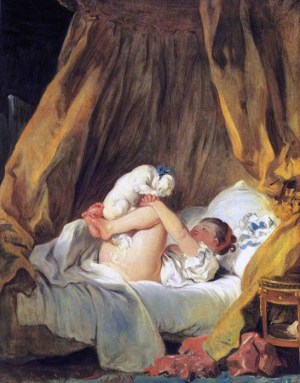
Jean-Honoré Fragonard, Young Girl in Bed Making Her Dog Dance, ca. 1768 (Munich: Alte Pinakothek)
• Jennifer Milam, “Rococo Representations of Interspecies Sensuality and the Pursuit of Volupté,” pp. 192–209.
Enlightenment writers proposed the existence of an animal soul, refuting the Cartesian beast-machine. Arguments credit the caresses of a dog to its master as direct visual evidence of the capacity of an animal to feel and show emotion. A focus on paintings by Jean-Honoré Fragonard sets the Rococo representation of lapdogs within the context of changing ideas about the relationship between animal and human. Eroticized images of lapdogs are related to radical materialist theories that assert the role of physical pleasure in human motivation.
Free access to the article is available here for the first fifty clicks (please don’t click if you already have access to the journal).
R E V I E W S
• Vittoria Di Palma, Review of Hanneke Grootenboer, Treasuring the Gaze: Intimate Vision in Late Eighteenth-Century Eye Miniatures (The University of Chicago Press,
2013), pp. 229–30.
The Art Bulletin, March 2015
The eighteenth century in The Art Bulletin:
The Art Bulletin 97 (March 2015)
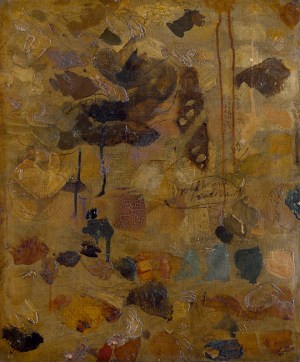
Joshua Reynolds, Studio Experiments in Colour and Media, ca. 1770–1790? (London: Royal Academy of Arts)
A R T I C L E S
• Matthew C. Hunter, “Joshua Reynolds’s ‘Nice Chymistry’: Action and Accident in the 1770s,” pp. 58–76.
The first president of Britain’s Royal Academy of Arts, Joshua Reynolds was described by contemporaries as a dangerously misguided chemist. Using a secretive laboratory of fugitive materials, he crafted visually striking images that came together quickly and stopped audiences dead in their tracks. But, just as rapidly, those paintings began to deteriorate as objects—flaking, discoloring, visibly altering in time. When framed around the “nice chymistry” he prescribed for aspiring artists in his famous Discourses, Reynolds’s risky pictorial enterprise can be situated within a broader problematic of making and thinking with temporally evolving chemical images in the later eighteenth century.
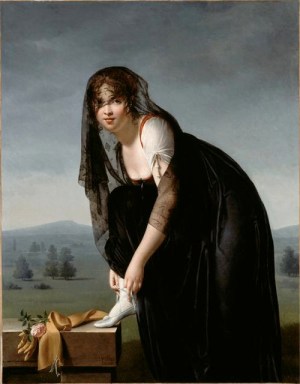
Marie-Denise Villers, Une étude de femme d’après nature, 1802 (Paris: Louvre)
• Susan L. Siegfried, “The Visual Culture of Fashion and the Classical Ideal in Post-Revolutionary France,” pp. 77–99.
In her little-known painting A Study of a Woman after Nature (1802), Marie-Denise Villers exploited a conjuncture between masculine-inflected ideals of Neoclassical art and feminine-inflected ideas of fashionability in the post-Revolutionary period in France by making a feature of female dress while emulating the standards of history painting. The artist’s confident synthesis of idioms is examined in the context of Albertine Clément-Hémery’s memoir of a women’s art studio. Walter Benjamin’s notion of gestus is enlisted as a means of understanding how the quite different image cultures invoked in this work communicated social ideas.
Exhibition | Made in the Americas: The New World Discovers Asia
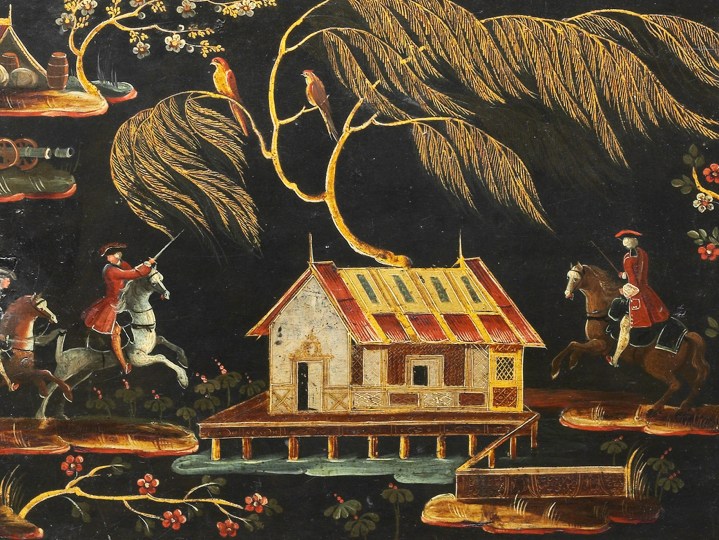
José Manuel de la Cerda, Desk-on-stand (detail), Pátzcuaro, Mexico, 18th century. Lacquered and polychromed wood with gilt decoration. On loan from The Hispanic Society of America, New York.
◊ ◊ ◊ ◊ ◊
From the MFA:
Made in the Americas: The New World Discovers Asia
Museum of Fine Arts, Boston, 18 August 2015 — 15 February 2016
Winterthur, Wilmington, Delaware, 26 March 2016 — 8 January 2017
Exquisite objects tell the story of the influence of Asia on the arts of colonial America.
Within decades of the ‘discovery’ of America by Spain in 1492, goods from Asia traversed the globe via Spanish and Portuguese traders. The Americas became a major destination for Asian objects and Mexico became an international hub of commerce. The impact of the importation of these goods was immediate and widespread, both among the European colonizers and the indigenous populations, who readily adapted their own artistic traditions to the new fashion for Asian imports.
Made in the Americas is the first large-scale, Pan-American exhibition to examine the profound influence of Asia on the arts of the colonial Americas. Featuring nearly 100 of the most extraordinary objects produced in the colonies, this exhibition explores the rich, complex story of how craftsmen throughout the hemisphere adapted Asian styles in a range of materials—from furniture to silverwork, textiles, ceramics, and painting. Exquisite objects from Mexico City, Lima, Quito, Quebec City, Boston, New York, and Philadelphia, dating from the 17th to the early 19th centuries, include folding screens made in Mexico in imitation of imported Japanese and Chinese screens, blue-and-white talavera ceramics copied from imported Chinese porcelains, and luxuriously woven textiles made to replicate fine silks and cottons imported from China and India.
The timing of the exhibition marks the 450th anniversary of the beginning of the Manila-Acapulco Galleon trade between the Philippines and Mexico, which was inaugurated in 1565 and ended in 1815, two and a half centuries later.
◊ ◊ ◊ ◊ ◊
From the MFA:
Dennis Carr, with contributions by Gauvin Alexander Bailey, Timothy Brook, Mitchell Codding, Karina H. Corrigan, and Donna Pierce, Made in the Americas: The New World Discovers Asia (Boston: Museum of Fine Arts, 2015), 160 pages, ISBN: 978-0878468126, $50.
 Made in the Americas reveals the largely overlooked history of the profound influence of Asia on the arts of the colonial Americas. Beginning in the sixteenth century, European outposts in the New World, especially those in New Spain, became a major nexus of the Asia export trade. Craftsmen from Canada to Peru, inspired by the sophisticated designs and advanced techniques of these imported goods, combined Asian styles with local traditions to produce unparalleled furniture, silverwork, textiles, ceramics, lacquer, painting, and architectural ornaments.
Among the exquisite objects featured in this book, from across the hemisphere and spanning the seventeenth to the early nineteenth centuries, are folding screens made in Mexico, in imitation of imported Japanese and Chinese screens; blue-and-white talavera ceramics copied from Chinese porcelains; luxuriously woven textiles, made to replicate fine silks and cottons from China and India; devotional statues that adapt Buddhist gods into Christian saints; and japanned furniture produced in colonial Boston that simulates Asian lacquer finishes. The stories these objects tell, compellingly related by leading scholars, bring to life the rich cultural interchange and the spectacular arts of the first global age.
Dennis Carr is Carolyn and Peter Lynch Curator of American Decorative Arts and Sculpture, Museum of Fine Arts, Boston.
Gauvin Alexander Bailey is Professor and Alfred and Isabel Bader Chair in Southern Baroque, Department of Art History and Art Conservation, Queen’s University, Kingston, Ontario.
Timothy Brook holds the Republic of China Chair in the Department of History and Institute of Asian Research, University of British Columbia, Vancouver.
Mitchell Codding is Executive Director, The Hispanic Society of America, New York.
Karina H. Corrigan is H. A. Crosby Forbes Curator of Asian Export Art, Peabody Essex Museum.
Donna Pierce is Frederick & Jan Mayer Curator of Spanish Colonial Art, Denver Art Museum.
Conference | The Enlightenment—Continuity, Challenge or Change?
From the forum flyer:
Benedictus Academic Research Forum 2015 | Continuity, Challenge or Change?
European Cultural and Intellectual Identity before and after the Enlightenment
Linnean Society, London, 19–20 June 2015
This year the Benedictus Academic Research Forum focuses on the Enlightenment, a pivotal moment in European culture and thought. Speakers from a wide range of disciplines including philosophy, music, art, theology and politics will introduce ideas and discuss contexts that enrich our understanding of the period and its continuing relevance. Tickets: £30 (both days), £15 (one day only) , includes entrance, drinks reception and Saturday lunch. Reservation essential; please email info@benedictus.org.uk or visit our website.
Sessions chaired by Thomas Pink (King’s College London), Anthony O’Hear (University of Buckingham), and Edward Chaney (Southampton Solent)
• Keynote presentation by Roger Scruton,
The Idea of a Secular Culture
• Adriano Aymonino (University of Buckingham),
The Classical Ideal from the Renaissance to the Nineteenth Century
• George Corbett (Trinity College Cambridge), Reframing the Seven Deadly Sins in the Christian Moral Life: Continuity and Change in Aquinas
• John Cottingham (Reading University
and Heythrop College London),
Descartes, God and Secularism
• Fernando Cervantes (University of Bristol),
The Ethics of Elfland: The Notion of Virtue in
Cervantes, Shakespeare and Montaigne
• Michael Lang (Heythrop College London),
Re-approaching Ritual and the Sacred in Late Modernity
• Peter Leech (Swansea University),
The Cultural Patronage of Cardinal Henry Benedict Stuart (1725–1807) in Rome
• Sebastian Morello (Centre for Catholic Formation),
Democracy and Royal Power: Nature and the Ideal of European Government
• Giuseppe Pezzini (Magdalen College, Oxford),
Receptions of Classical Texts from Late Medieval
to Early Modern Europe
• Clare Hornsby (Benedictus
) and Rafal Szepietowski (Manchester University),
Paintings of Astronomy in Early Eighteenth-Century Bologna
Young Scholars’ Competition
This year we launched the Benedictus Scholar’s Competition to give 6th form students the chance to present their ideas in front of an audience of international academics. Our two winners Shakil Karim (Harrow School) and Imogen Wade (Perse School) will be presenting their papers on Saturday morning.
New Book | George Romney: A Complete Catalogue of His Paintings
Scheduled for August publication by The Paul Mellon Centre for Studies in British Art:
Alex Kidson, George Romney: A Complete Catalogue of His Paintings (London: The Paul Mellon Centre for Studies in British Art, 2015), 960 pages, ISBN: 978-0300209693, $350.
 This magnificent catalogue, in three volumes and with nearly 2,000 illustrations, will restore George Romney (1734–1802) to his long-overdue position—with his contemporaries Reynolds and Gainsborough—as a master of 18th-century British portrait painting. The product of impressive and thorough research undertaken over the course of 20 years, Alex Kidson asserts Romney’s status as one of the greatest British painters, whose last catalogue raisonné was published over 100 years ago. In more than 1,800 entries, many supported by new photography, Kidson aims to solve longstanding issues of attribution, distinguishing genuine pictures by Romney from works whose traditional attribution to him can no longer be supported. The author’s insights are guided by rich primary source material on Romney—including account books, ledgers, and sketchbooks—as well as secondary sources such as prints after lost works, newspaper reports and reviews, and writings by Romney’s
contemporaries.
Alex Kidson is special projects fellow, Paul Mellon Centre for Studies in British Art, and was curator of the 2002 bicentennial exhibition George Romney 1734–1802.










 Enfilade
leave a comment