Exhibition | 18th-Century Masterpieces in the Churches of Paris
From the press release for the exhibition:
Enlightenment Baroque: 18th-Century Masterpieces in the Churches of Paris
Le Baroque des Lumières: Chefs-d’œuvre des églises parisiennes au XVIIIe siècle
Petit Palais, Paris, 21 March — 9 July 2017
Curated by Christophe Leribault and Marie Monfort
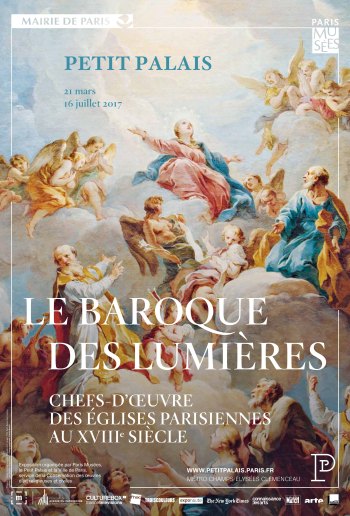 For the first time the Petit Palais is offering the public a spectacular ensemble of 18th-century religious paintings created for the churches of Paris. Through some 200 works the museum will reveal the significance and diversity of artistic output in Paris from the Regency to the French Revolution: from such heirs to the age of Louis XIV as Largillière and Restout to the exponents of rocaille, from Lemoine to Carle Van Loo, and the best of Neo-Classicism, from Vien to David. Produced in partnership with COARC (Conservation of Religious and Secular works of Art for the City of Paris), this exhibition is an extension of the one at the Musée Carnavalet (Paris) in 2012, which focused on 17th-century painting in Paris churches and the rediscovery of an enormous, little-known heritage.
The emphasis of 18th-century French painting was more on the sophistication of the fête galante and the portrait than the elaborateness of great religious art. Outside the Salon season, however, it was in the churches of Paris that art lovers could view contemporary painting, and so the city’s artists gave of their best there. Indeed, parishes and congregations bent on renovating the capital’s places of worship were among the main sponsors of history painting, and it is this forgotten segment of 18th-century art that Enlightenment Baroque aims to reassess. In a spectacular decor evocative of the inside of a church and its related spaces—the chapels and the sacristy, for example—the exhibition itinerary highlights numerous masterpieces, often very large, that have benefited from unprecedentedly thorough renovation. In addition to the pictures still to be seen in churches today, the exhibition brings together works which since the Revolution have been scattered. The masterpieces come from institutions (the Louvre, the Château de Versailles, and the art museums of Lyon, Rennes, Marseille, Brest, and elsewhere), churches and cathedrals nearby (Saint Denis and Villeneuve-Saint-Georges, for example), or further away (Mâcon, Lyon).
Divided into eight sections, the exhibition delights the eye with the finesse and varying styles of altarpieces, the colourful grace of François Lemoine, Jean-François de Troy and Noël Hallé, and the unadorned Neo-Classicism of Drouais and, of course, David, whose large portrait of Christ closes the exhibition. There are also references to ornamental ensembles, some of which, like Charles Natoire’s decor for the Chapelle des Enfants Trouvés have been lost or destroyed. Other sections are devoted to images of the new saints of the Counter-Reformation, smaller works intended for private devotion, commissioning procedures and the restorations that took place at the time in ancient buildings like the Invalides.
Along the way viewers will find two educational spaces, one given over to restoration campaigns and the other to religious imagery. Visitors will also be able to take part in guided tours of various religious edifices in Paris. This groundbreaking panorama of religious painting in 18th-century Paris is nothing short of a revelation: the pictures brought together for the occasion have been endowed with an unsuspected vividness of colour harking back to what we find so agreeable in the art of the Age of Enlightenment.
Christine Gouzi and Christophe Leribault, eds, Le Baroque des Lumières: Chefs-d’œuvre des églises parisiennes au XVIIIe siècle (Paris: Paris musées, 2017), 368 pages, ISBN : 978 27596 03442, 50€.
Curators
Christophe Leribault, Director, Petit Palais
Marie Monfort, Head of Conservation of Religious and Secular works of Art for the City of Paris
Associate Curators
Maryline Assante di Panzillo (Petit Palais), Lionel Britten (Musée d’Orsay), Jessica Degain, Nicolas Engel et Emmanuelle Federspiel (COARC), Christine Gouzi (Université de Paris- Sorbonne), et Guillaume Kazerouni (Musée des Beaux-Arts de Rennes)
Exhibition | From Watteau to David: The Horvitz Collection
From the press release for the exhibition:
From Watteau to David: The Horvitz Collection
Petit Palais, Paris, 21 March — 9 July 2017
Curated by Alvin Clark, Isabelle Mayer-Michalon, and Christophe Leribault
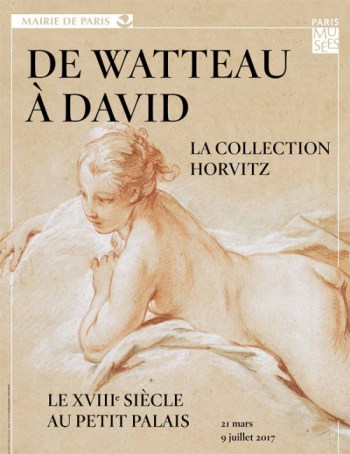 The Petit Palais is delighted to present an anthology of some 200 18th-century French paintings, sculptures, and drawings from the Horvitz Collection in Boston. The work of thirty years, this is the largest private collection of 18th-century French drawings outside of France and is home to such artists of the first rank as Watteau, Boucher, Fragonard, Greuze, and David. It also offers an overview of all the major artists of the period, ranging from Oudry to De Troy, from Natoire to Bouchardon, and from Hubert Robert to Vincent—and all of them at their best.
The exhibition offers the visitor an exhaustive panorama of French painting and drawing from the Regency to the Revolution, together with a small but impeccable selection of of sculptures, including pieces by Lemoyne, Pajou, and Houdon. It comprises fifteen chronologically organised thematic and monographic sections, whose elegant scenography provides an overview of a century rich in artistic innovation.
The exhibition opens with portraits by Rigaud, Largillière, and Jean-François de Troy, before addressing the mythological and religious painting of the early 18th century via works by François Lemoyne and Charles de la Fosse. The viewer then moves on to the fête galante, with drawings by Watteau and Lancret, and to landscape and animal painting, with Oudry and Desportes. The exhibition also takes in architecture and the triumph of ornamentation as typified by the whimsicality of Oppenord and Lajoüe. An entire section given over to François Boucher is followed by a group of academic nudes and head studies by Coypel, Lépicié, Vien, and others. Next comes mid-century history painting, represented by Natoire and Carle Van Loo, and the tour continues with drawings by sculptors like Bouchardon and Pajou. A second monographic section is dedicated to Fragonard, after which visitors are treated to views of ruins and landscapes by Hubert Robert and Joseph Vernet, and, in a more sentimental vein, works by Greuze, Prud’hon, and Boilly. The exhibition closes with an assertion of neo-Classicism by Jacques-Louis David, Perrin, and Vincent.
The Horvitz Collection—with its meticulous documentation and works in perfect condition—has become a touchstone for the period. Its presentation in Paris is a major event whose prestige and intimist character make it a perfect complement to Enlightenment Baroque: 18th-century Masterpieces in the Churches of Paris, an exhibition devoted to the big, forgotten religious paintings of the period.
Curators
Alvin L. Clark, Jr., The Horvitz Collection and The J.E Horvitz Consultative Curator Department of Drawings, Division of European and American Art, Harvard Art Museum, in association with Isabelle Mayer-Michalon, Doctor of Philosophy in Art History. Christophe Leribault, Director, Petit Palais.
Alvin Clark, ed, Tradition & Transitions: Eighteenth-Century French Art from The Horvitz Collection (Boston: The Horvitz Collection, 2017), 701 pages, ISBN: 9780991262519, $115.
Note (added 21 January 2018) — The original posting did not include information on the catalogue.
Conference | Enchanted Isles, Fatal Shores: Living Versailles

Hall of Mirrors (Galerie des Glaces), 1678–84
(Château de Versailles)
◊ ◊ ◊ ◊ ◊
From the conference programme and website:
Enchanted Isles, Fatal Shores: Living Versailles
NGA, the Australian National University, and the University of Sydney, 17–18 March 2017
Organized by Mark Ledbury, Robert Wellington, and Lucina Ward
On the occasion of the Versailles: Treasures from the Palace exhibition at the NGA, which brings major works of art from the Palace of Versailles to Canberra, this conference explores the history of art, design and architecture, and the enduring influence and resonance of Versailles, its desires and self-perceptions of modernity, from film to fashion to architecture. Gathering a generation of scholars whose work is shifting our perceptions of the art, culture and life of the ancien régime, Versailles and its reception, this is the occasion for fresh and challenging research, and new perspectives on canon-defining works.
The conference will be live streamed from the Australian National University School of Art & Design Facebook page on Friday March 17 (10:00–16:30 AEST) and Saturday March 18 (9:30–16:30 AEST). Please note the following time differences: Los Angeles -18hrs, New York -15hrs, London -11hrs, Paris -10hrs, Perth -3hrs, NZ +2hrs.
◊ ◊ ◊ ◊ ◊
F R I D A Y , 1 7 M A R C H 2 0 1 7
10.00 Director’s Welcome
10.30 Session One: Making the Palace
• Hannah Williams (London), The Other Palace: Versailles and the Louvre
• Wolf Burchard (National Trust, UK), At the Centre of the World: Charles Le Brun’s Ambassadors Staircase at Versailles
• Bénédicte Gady (Louvre), The Grands Décors of Charles Le Brun: Between Plan and Serendipity
1.00 Session Two: The Culture Industry
• Sing d’Arcy (UNSW), Heavenly Voice, Earthly Bodies: The Physical Presence of Music Making in the Architectural Space of Versailles
• Matthew Martin (NGV), Porcelain and Power: The Meaning of Porcelain in Ancien Régime France
• Florian Knothe (HKU), Artisans du Roi: Collaborations at the Gobelins, Louvre and the Academie Royale de Peinture et de Sculpture under the Influence of the Petite Académie
3.00 Session Three: Living at Versailles
• Mimi Hellman (Skidmore), (Re)Imagining the ‘Government’ of a Royal Governess
• Sarah Grant (V&A), Courting Favour: The Apartments and Residence of the Princess of Lamballe at Versailles
• Kimberly Chrisman-Campbell (LA), Bigwigs: Hair, Politics, and Power at the Court of Versailles
S A T U R D A Y , 1 8 M A R C H 2 0 1 7
9.30 Session Four: Outsiders
• David Maskill (Wellington), A Turk in the Hall of Mirrors
• Meredith Martin (NYU/IFA), From Port to Palace: Maritime Art and Mediterranean Servitude at Louis XIV’s Versailles (via video link)
• Daniëlle Kisluk-Grosheide (Met), Outside Insider: Cornelis Hop (1685–1762), Dutch Ambassador to the Court of Louis XV
11.30 Session Five: Representation
• Mark de Vitis (USyd), The Politics of Embellishment in Prints of Louis XIV
• Louis Marchesano (Getty), Strategies of Engraving and Etching in Description de la Grotte de Versailles 1676
• Sophie Matthiesson (NGV), From Fountains of Apollo to Fountains of Liberty: Artificial Landscapes as Political Spectacle in Eighteenth-Century France
2.00 Session Six: Versailles Now
• Allison Holland (Perth), Reverberations of Japanese Art at Versailles
• Jennifer Ferng (USyd), American Versailles: Kitsch Opulence, Capitalism and McMansion Dreams in Florida
• Robert Wellington (ANU), Tanned by the Sun King: Donald Trump and Louis XIV
3.30 Round Table
◊ ◊ ◊ ◊ ◊
Note (added 8 May 2017) — Video recordings of the presentations are available via YouTube.
Exhibition | The Art of Power: Treasures from the Bute Collection
Opening at the end of the month at both The Hunterian and Mount Stuart:
The Art of Power: Treasures from the Bute Collection at Mount Stuart
Hunterian Museum and Art Gallery, Glasgow, 31 March 2017 — 14 January 2018
Mount Stuart, Isle of Bute, 31 March 2017 — 14 January 2018
Curated by Caitlin Blackwell and Peter Black

Sir Joshua Reynolds, Portrait of John Stuart, 3rd Earl of Bute, 1773 (The Bute Collection at Mount Stuart).
This new exhibition offers a unique opportunity to see major paintings from the Bute Collection at Mount Stuart on the Isle of Bute. Merging art, biography and cultural history, Art of Power uncovers the fascinating Enlightenment figure, John Stuart, Third Earl of Bute, and his collection of rarely-seen masterpieces.
The exhibition is split across two venues—The Hunterian and Mount Stuart—offering visitors the chance to experience two world-class collections. Art of Power: Treasures from Mount Stuart marks the tercentenary of Mount Stuart, an architectural jewel on the Isle of Bute which houses the Bute Collection, one of the foremost private collections of artworks and artefacts in the UK.
The exhibition reveals a selection of rarely-seen masterpieces collected by the fascinating Enlightenment figure, John Stuart, Third Earl of Bute (1713–1792), the first Scottish-born Prime Minister and ‘favourite’ of George III. After retiring from politics, Bute amassed a great art collection, which was particularly renowned for its Dutch and Flemish paintings. This major exhibition brings a selection of European and British masterpieces from the Bute Collection to the Hunterian Art Gallery, many of which have not been on public display in over a century.
Highlights include works by Dutch Golden Age masters like Jan Steen and Jacob van Ruisdael, Grand Manner portraits by Sir Anthony Van Dyck, Joshua Reynolds and Allan Ramsay, and Italianate landscapes and history subjects by Claude Lorrain and Veronese. A portion of these works will be displayed at the Hunterian, along with works on paper, including botanical illustrations and satirical engravings from the collection. The remainder of the paintings will be displayed at Mount Stuart, where they will be accompanied by historical artefacts, such as costume, letters, and rare books.
◊ ◊ ◊ ◊ ◊
Caitlin Blackwell, Peter Black, and Oliver Cox, Art of Power: Masterpieces from the Bute Collection at Mount Stuart (New York: Prestel, 2017), 144 pages, ISBN: 978 37913 56631, $50.
John Stuart, 3rd Earl of Bute, was one of history’s most enthusiastic art collectors. As tutor to Prince George, Bute became indispensable to the royal household. Soon after his accession to the throne, the King made Bute Prime Minister―a career that was cut short after the Peace of Paris in 1763.
Forced out of London by an angry mob, Bute retired to an estate at Luton, where he spent the rest of his years in private study and amassing a collection of 500 paintings, including major works by Venetian painters such as Tintoretto, Bordone, and Veronese. Bute had a special interest in Dutch and Flemish pictures, building the greatest collection of its kind in Britain. This book features over thirty masterpieces, mainly genre paintings and landscapes, and including jewel-like landscapes by Brueghel and Savery. The collection is housed at the Bute family’s Scottish seat, Mount Stuart, on the Isle of Bute. Essays by leading scholars delve into the history of Bute’s collection, focusing on his relationship with King George III, and his wide ranging passions, which resulted in rooms filled floor to ceiling with works of art.
Caitlin Blackwell is the inaugural Bute Fellow at Mount Stuart, which is located on the Isle of Bute off the coast of Scotland. Peter Black is curator at the Hunterian and has published widely on Dutch and Flemish art. Oliver Cox is Heritage Engagement Fellow at the University of Oxford.
◊ ◊ ◊ ◊ ◊
From CODART, with text from Peter Black, Curator of Dutch and Flemish Paintings and Prints, Hunterian Museum and Art Gallery (12 December 2016). . .
The Bute Collection is housed at Mount Stuart (1880–1912), the Gothic Revival Palace by Robert Rowand Anderson on the Isle of Bute. It contains, besides a truly great collection of 18th-century portraits, important Dutch and Flemish works that were collected in the 1760s and 1770s by John Stuart, Third Earl of Bute (1713–1792). Bute was tutor to King George III when he was Prince of Wales, advising him, among other things, on acquisitions for the royal collection. Soon after the coronation in 1760, Bute was given power by his former pupil, becoming Prime Minister in 1762. His main business was to negotiate the Peace of Paris, ending the Seven Years’ War. Within one year, however, Bute resigned and was forced to leave London to escape the London mob. He bought a country house at Luton, which he had remodeled by Adam, and landscaped by Capability Brown. There he settled down to become the most important British collector of Dutch paintings, assembling for the purpose a library and collection of prints and drawings (dispersed 1794–1809). At the time of his death, there were 500 works in the house. Bute had more than a penchant for Venetian art and the grand rooms on the ground floor were hung with works by Tintoretto, Veronese and Bordone, as well as some of the finest examples of the work of Francesco Zuccarelli. Masterpieces by Dutch artists in the library included a magnificent Windy Autumn Day landscape by Berchem (Mount Stuart), and Cuyp’s River Landscape with Horseman and Peasants (now in the National Gallery, London). That painting is said to have started the craze for Cuyp among British collectors when Bute acquired it in the early 1760s. The smaller Dutch paintings were accommodated on the upper floor, clustered in dense thematic hangs in the bedrooms and dressing rooms.
The exhibition of 26 pictures in Glasgow University provides a window onto the riches of Mount Stuart, which can be visited in a day-trip by train and ferry from Glasgow. They are generally smaller works, including jewel-like landscapes by Savery, De Momper/Brueghel, Jan van der Heyden, Cuyp, Berchem, and Ruisdael, as well as genre scenes by Steen, Teniers, Verelst, Metsu and Bega. Visitors to Mount Stuart will see the extraordinary collection of family portraits by Batoni, Ramsay and Reynolds as well as works by Hobbema, Steen, Willem van Herp and Pieter van Slingelandt.

Mount Stuart, Isle of Bute (Wikimedia Commons, July 2006).
Exhibition | Aert Schouman and the Imagination of Nature

From CODART regarding the exhibition now on view at the Dordrechts Museum:
A Royal Paradise: Aert Schouman and the Imagination of Nature
Een Koninklijk Paradijs: Aert Schouman en de verbeelding van de natuur
Dordrechts Museum, 19 February — 17 September 2017
The Dordrechts Museum dedicates an exhibition to the Dordrecht painter Aert Schouman (1710–1792). On view will be a wall decoration of the Il Pastor Fido series. The paintings, only rediscovered in 2016, are an example of Schouman’s early work. The recently restored wall paintings of the Huis ten Bosch Palace will also be display. Due to the renovation work taking place at the palace, the series depicting the menagerie of Willem V may be exhibited in Dordrecht exclusively.
Het mooiste werk van dierenschilder Aert Schouman (1710–1792) komt samen in een feestelijke tentoonstelling voor kunst- en natuurliefhebbers. Absoluut hoogtepunt vormt de complete kamerbeschildering van Willem V uit Huis ten Bosch met daarop zijn bijzondere dierenverzameling. Deze ‘kamer in het rond’ is onlangs gerestaureerd en straks in het Dordrechts Museum nog één keer te bewonderen, voordat ze weer binnen de muren van het toekomstige woonpaleis van koning Willem-Alexander en koningin Máxima verdwijnt.
Met stukken uit musea en particuliere collecties in binnen- en buitenland laat de tentoonstelling het paradijs van Schouman zien vol inheemse en exotische dieren. Vooral zijn werken met schitterende vogels spreken tot de verbeelding. Schouman tekende bovendien de buitenplaatsen en tuinen die zijn rijke opdrachtgevers als aardse paradijzen lieten aanleggen.
Emile Havers, ed., Een Koninklijk Paradijs: Aert Schouman en de verbeelding van de natuur (Zwolle, W Books, 2017), 360 pages, ISBN: 978 94625 81852, 30€.
New Book | Inclinations: A Critique of Rectitude
The eighteenth century comes into the argument primarily only through Kant, but there might be wider implications: might the Rococo serve as a useful counter-example to the upright independence that Cavarero sees in Kant? –CH
Published in November by Stanford UP:
Adriana Cavarero, Inclinations: A Critique of Rectitude (Stanford: Stanford University Press, 2016), 208 pages, ISBN: 978 08047 92189 (cloth), $70 / ISBN: 978 15036 00409 (paperback), $20.
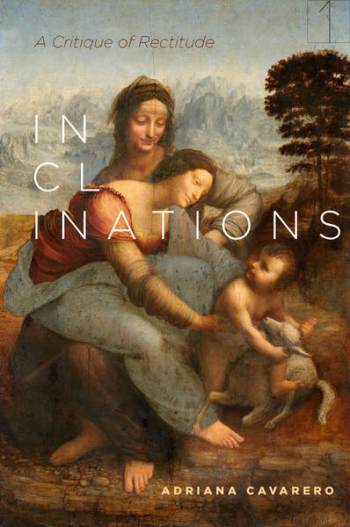 In this new and accessible book, Italy’s best known feminist philosopher examines the moral and political significance of vertical posture in order to rethink subjectivity in terms of inclination. Contesting the classical figure of homo erectus or ‘upright man’, Adriana Cavarero proposes an altruistic, open model of the subject—one who is inclined toward others. Contrasting the masculine upright with the feminine inclined, she references philosophical texts (by Plato, Thomas Hobbes, Immanuel Kant, Hannah Arendt, Elias Canetti, and others) as well as works of art (Barnett Newman, Leonardo da Vinci, Artemisia Gentileschi, and Alexander Rodchenko) and literature (Marcel Proust and Virginia Woolf).
Adriana Cavarero is Professor of Political Philosophy at the University of Verona. Her books in English include For More than One Voice (2005) and Horrorism (2008).
Call for Papers | Naples and the Capodimonte
From the Call for Papers:
Naples and the Museo e Real Bosco di Capodimonte in a Global Context
Naples, 12–14 October 2017
Proposals due by 24 April 2017

‘Transport des Antiquités d’Herculanum du Museum de Portici au Palais des Etudes à Naples’, in J. C. R. de Saint-Non, Voyage pittoresque, ou Description des Royaumes de Naples et de Sicile, vol. II (Paris, 1782). J. Duplessi-Bertaux after L.-J. Desprez. Included in Arturo Fittipaldi, “Museums, Safeguarding and Artistic Heritage in Naples in the Eighteenth Eentury: Some Reflections,” Journal of the History of Collections 19 (2007): 191–202.
One of the world’s oldest cultural centers and one of the largest ports in Europe, the city of Naples is a node in a cultural and economic network that spans the Mediterranean and beyond. The story of art in Naples is one of encounter and exchange, of rupture and unexpected convergence. It is above all a story of movement: of people, artworks, and forms, of technologies, traditions, and ideas. Naples thus challenges us to envision a new history of art that ranges across geography, chronology, and medium. Art in Naples has long been marginalized or misunderstood. Instead, we take Naples as a laboratory for new art historical research with global implications.
To launch a new collaboration between the Edith O’Donnell Institute of Art History and the Museo e Real Bosco di Capodimonte dedicated to innovative research on art in Naples and on the cultural histories of port cities, this symposium brings together an international group of scholars for two days of on-site presentations that will set Naples and the Capodimonte in a global context. After a public keynote lecture and celebratory reception on the evening of Thursday, October 12, a group of around 30 scholars will spend the next two days participating in a series of presentations in the form of gallery talks and site visits that will focus on individual artworks in the Capodimonte collections and on sites within its surrounding gardens. Each presentation will be followed by discussion. Moderated roundtables and shared meals will provide further opportunities for participants to respond to each other’s presentations and to engage with broader themes.
We invite scholars at all professional stages (including advanced graduate students) to propose 20-minute presentations that focus either on individual artworks at the Capodimonte or on specific sites in the Bosco. Through these individual objects and sites, presentations should open onto larger questions related to Naples and the Capodimonte in a global context: for example, the formation of the Capodimonte’s collections and gardens, the cultural history of Naples as a port city, the mobility of objects and people, and processes of circulation, encounter, and exchange. Presentations may be made in Italian or English. To propose a presentation on a specific artwork or site at the Capodimonte, please submit via email attachment a proposal of under 350 words and a short CV to Elizabeth Ranieri, The Edith O’Donnell Institute of Art History (enr101020@utdallas.edu), by April 24, 2017. Proposals will be reviewed by collaborators at the O’Donnell Institute and the Capodimonte. A certain number of presenters not based in Naples will be offered a small grant to contribute toward the cost of travel.
New Book | Making Magnificence
Scheduled for May release from Yale UP:
Christine Casey, Making Magnificence: Architects, Stuccatori, and the Eighteenth-Century Interior (New Haven: Yale University Press, 2017), 320 pages, ISBN: 978 03002 25778, $75.
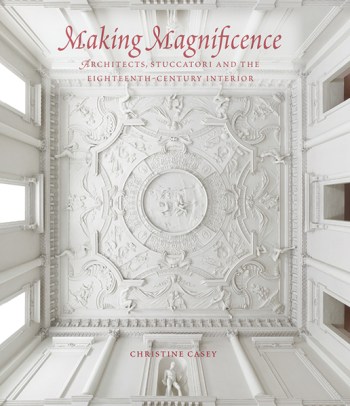 This book tells the remarkable story of the craftsmen of Ticino, in Italian-speaking Switzerland, who took their prodigious skills as specialist decorative plasterworkers throughout Northern Europe in the 18th century, adorning classical architecture with their rich and fluent décor. Their names are not widely known—Giuseppi Artari (c.1690–1771), Giovanni Battista Bagutti (1681–1755), and Francesco Vassalli (1701–1771) are a few—but their work transformed the interiors of magnificent buildings in Italy, Austria, Germany, the Netherlands, Britain, and Ireland. Among the interiors highlighted in this deeply researched, beautifully illustrated volume are Palazzo Reale in Turin, Upper Belvedere in Vienna, St. Martin in the Fields in London, the Radcliffe Camera in Oxford, Houghton Hall in Norfolk, and Carton House in Ireland.
Christine Casey is associate professor in architectural history, and the head of the Art Department, at Trinity College Dublin.
Conference | The Queen’s House and Court Culture, 1500–1750

Adriaen van Stalbemt, A View of Greenwich, ca 1632; oil on canvas, 83.5 × 107 cm (Royal Collection Trust, 405291). More information is available here
◊ ◊ ◊ ◊ ◊
From Royal Museums Greenwich and the conference programme:
Queen’s House Conference 2017: European Court Culture and Greenwich Palace, 1500–1750
National Maritime Museum and the Queen’s House, Greenwich, 20–22 April 2017
Royal Museums Greenwich and the Society for Court Studies are pleased to announce a major international conference to mark the 400th anniversary year of the Queen’s House, Greenwich. Designed by Inigo Jones in 1616 and completed in 1639, this royal villa is an acknowledged masterpiece of British architecture and the only remaining building of the 16th- and 17th-century palace complex. Today the Queen’s House lies at the centre of the World Heritage Site of Maritime Greenwich.
The site as a whole is often celebrated as quintessentially ‘British’—historically, culturally and artistically. Yet the sequence of queens associated with the Queen’s House and Greenwich more generally reflect a wider orientation towards Europe—from Anne of Denmark, who commissioned the House, to Henrietta Maria of France, Catherine of Braganza and Mary of Modena—in addition to Greenwich’s transformation under the patronage of Tudor and Stuart monarchs. Located on the River Thames at the gateway to London and to England, royal residences at Greenwich served an important function in the early modern period as a cultural link with the continent, and in particular, with England’s nearest neighbours in the Low Countries and France.
Conference themes include: Royal portraiture; ‘Princely magnificence’ and the design of royal spaces (such as the division between a King’s and Queen’s sides); dynastic links between the houses of Stuart, Orange, Bourbon, Wittelsbach (Palatinate), and Portugal; the history of Greenwich Palace as a royal residence and centre of power and culture; other areas patronized by the court, such as maritime exploration, scientific advances, prints, as represented by the Royal Observatory Greenwich.
Conference organisers: Janet Dickinson (University of Oxford), Christine Riding (Royal Museums Greenwich), and Jonathan Spangler (Manchester Metropolitan University). With support from the Society for Court Studies.
For queries about the programme, please e-mail janet.dickinson@conted.ox.ac.uk. For bookings, e-mail research@rmg.co.uk. Booking information is available here.
◊ ◊ ◊ ◊ ◊
T H U R S D A Y , 2 0 A P R I L 2 0 1 7
12.30 Registration
13.00 Introduction
• Jemma Field, Brunel University: Greenwich Palace and Anna of Denmark: Royal Precedence, Royal Rituals, and Political Ambition
• Karen Hearn, University College London: “‘The Queenes Picture therein’: Henrietta Maria amid Architectural Magnificence”
• Anna Whitelock, Royal Holloway, University of London: Title to be confirmed
15.00 Coffee and tea
15.30
• Christine Riding, Royal Museums Greenwich: Private Patronage, Public Display: The Armada Portraits and Tapestries, and Representations of Queenship
• Natalie Mears, Durham University: Tapestries and Paintings of the Spanish Armada: Culture and Horticulture in Elizabethan and Jacobean England
• Charlotte Bolland, National Portrait Gallery: The Armada Portrait of Elizabeth I
17.00 Keynote Lecture
• Simon Thurley, Institute of Historical Research: Defining Tudor Greenwich: Landscape, Religion, and Industry
18.00 Wine reception in the Queen’s House
F R I D A Y , 2 1 A P R I L 2 0 1 7
9.30
• Catriona Murray, University of Edinburgh: Raising Royal Bodies: Stuart Authority and the Monumental Image
• Hannah Woodward, University of Glasgow: An Embroidered Truth? The Painted Brocades in Sixteenth-Century Portraits of Marie Of Guise
• Jessica Malay, University of Huddersfield: Building the Palaces of the North: Anne Clifford’s Antiquarian Impulse
11.00 Coffee and tea
11.30
• Maureen Meikle, Leeds Trinity University: Queen Anna and Her Architects: A Tale of Two Queen’s Houses
• Jane Spooner, Historic Royal Palaces: Framing Rubens: The Architectural Polychromy of the Banqueting House Ceiling in Context
• Anya Matthews, Old Royal Naval College: Queens, Patronesses and Goddesses: Royal Women and the Painted Hall at Greenwich, 1707–26
13.00 Lunch and tours of the site. Scaffold tours of the ceiling at the Painted Hall are available during the conference.
14.30
• Wendy Hitchmough, Historic Royal Palaces: Anna of Denmark, Inigo Jones, and the Performance of Monarchy
• Gilly Lehmann: Henry VIII’s Great Feast at Greenwich in May 1527
15.30 Refreshments
16.00
• Janet Dickinson, University of Oxford: The Tudors and the Tiltyard: Constructing Royal Authority at Greenwich
• Sara Ayres, National Portrait Gallery: Paul van Somer’s Portrait of Anne of Denmark in Hunting Costume (1617)
• 17.30 Keynote Lecture
Susan Foister, National Gallery: Holbein and Greenwich
S A T U R D A Y , 2 2 A P R I L 2 0 1 7
9.30
• Birgitte Dedenroth-Schou: The Danish / German Influence on Anne of Denmark’s Cultural Interests
• Fabian Persson, Linnaeus University: Protestant Prize? Princess Elizabeth, Marriage Negotiations, and Dynastic Networking
• Ineke Huysman, Huygens Institute: Epistolary Power: Anglo-Dutch Affairs in the Correspondence of the Dutch and Frisian Stadtholders’ Wives, 1605–1725
11.00 Coffee and tea
11.30
• Laura-Maria Popoviciu, Government Art Collection: ‘Great Britain’s New Solomon’? A Portrait of William III by Jan van Orley
• David Taylor, National Trust: ‘Her Majesty’s Painter’: Jacob Huysmans and Catherine of Braganza
12.30 Lunch
13.30
• Michele Frederick, University of Delaware: ‘Crossing the Sea’: Gerrit van Honthorst and Portraiture at the Stuart Courts
• Julie Farguson, University of Oxford: ‘Glorious Successes at Sea’: The Artistic Patronage of Prince George of Denmark as Lord High Admiral, 1702–08
• J. D. Davies: Greenwich, the Sovereignty of the Seas, and Naval Ideology in the Restoration
15.00 Coffee and tea
15.30
• José Eloy Hortal Muñoz, Universidad Rey Juan Carlos, Madrid: The Shape of the Courtly Space at the European Royal Sites of the Seventeenth Century: Merging Court, Household, and Territory
• Jacqueline Riding, Birkbeck College, University of London: A Stuart Court at the Palace of Holyroodhouse in 1745
• Barbara Arciszewska, University of Warsaw: Claiming Grunnewitsch: Architecture of Inigo Jones and Dynastic Identity of the Hanoverians, ca. 1700
At Christie’s | Collection of Boniface de Castellane and Anna Gould
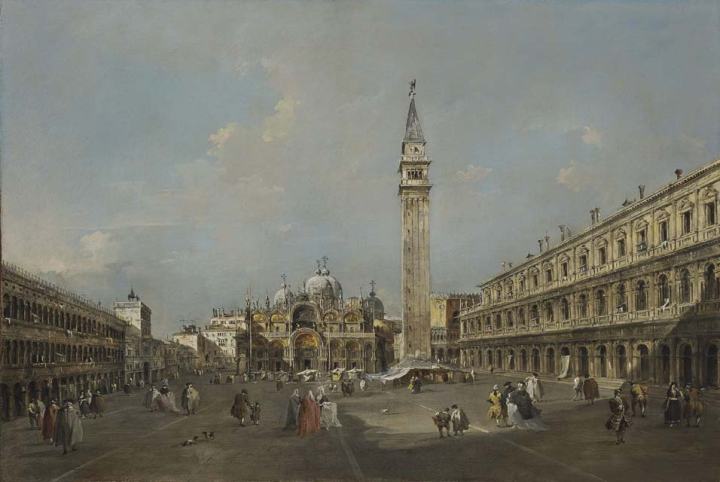
Francesco Guardi, Piazza San Marco with the Basilica and the Campanile, ca. 1770–80, oil on canvas, 70 × 102 cm. The painting sold for $7.1million.
◊ ◊ ◊ ◊ ◊
Press release from Christie’s:
Boniface de Castellane and Anna Gould: ‘A Way of Life’, Sale 14636
Christie’s, Paris, 7 March 2017
On 7 March 2017, Christie’s Boniface de Castellane and Anna Gould: ‘A Way of Life’ auction [Sale 14636] realised a total of €14,266,563 / £12,342,004 / $15,155,370. These exceptional results reflect the relevant choices Boni made when furbishing his legendary Palais Rose with the most exquisite works of art.

Interior of Diane de Castellane’s Apartment (Christie’s Images Ltd, 2017).
Lionel Gosset, Head of Collection sales, Christie’s France: “Continuing Christie’s long history of offering prestigious collections at auction, we are honoured to have paid such a beautiful tribute to this important collection. Its celebrated provenance and the pristine quality of its works have attracted bidders from nineteen countries across five continents, establishing once again Christie’s France’s leadership in selling collections with success.”
Connoisseurs, collectors, and institutions, such as the Sèvres Museum (lot 145) and Lyndhurst—Anna Gould’s childhood home in the state of New York (lots 2, 6, 10, and 16)—have acquired 96% of the sale, demonstrating continued interest in high quality 18th-century pieces. The Palais Rose’s famous Boulle furniture achieved strong prices, as illustrated by the Louis XVI pair of meubles-à-hauteur-d’appui by Etienne Levasseur and Adam Weisweiler that sold for €818,500 (lot 132) and the Louis XIV console attributed to André-Charles Boulle that sold for €506,500 (lot 140). Important decorative art from the period also performed very well, as shown by the Sèvres porcelain ‘vases’ that realised €206,500 against a presale estimate of €80,000–120,000 (lot 52) and a George III clock attributed to James Cox that achieved €290,500 (lot 89). Art Déco works by Cartier where among the highlights of the sale, as the Mystery Clock achieved €686,500 against a presale estimate of €150,000–200,000 (lot 18) and the Jardin Japonais desk set achieved €1.118.500 (lot 19), a new record for an object by Cartier sold at auction. Finally, leading the sale was the magnificent View of Piazza San Marco with the Basilica and the Campanile by Francesco Guardi (lot 46), for which determined bidding resulted in a total of €6,738,500 / £5,829,476 / $7,158,309, making it the highest price achieved by far for an Old Master painting sold at auction in France over the past two decades.
The pre-sale press release from Christie’s is available here»
Emily Selter provided a brief preview of the auction and profile of the “Ultimate Paris ‘It Couple’,” for Town & Country (21 February 2017).










 Enfilade
leave a comment