Exhibition | The Philosophy Chamber
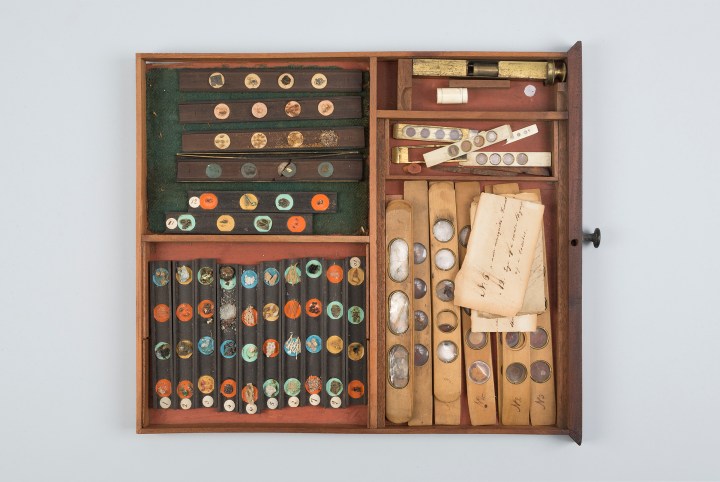
William and Samuel Jones, Jones’s Most Improved and Solar Compound Microscope, ca. 1798; drawer removed from box, displaying slides, mounted specimens, and accessories; brass, glass, and mahogany, with slides of paper and organic materials (Collection of Historical Scientific Instruments, Harvard University, 1184).
◊ ◊ ◊ ◊ ◊
Press release from Harvard Art Museums:
The Philosophy Chamber: Art and Science in Harvard’s Teaching Cabinet, 1766–1820
Harvard Art Museums, Cambridge, 19 May — 31 January 2017
The Hunterian, University of Glasgow, 23 March — 24 June 2018
Curated by Ethan Lasser
This spring, the Harvard Art Museums will present The Philosophy Chamber: Art and Science in Harvard’s Teaching Cabinet, 1766–1820, a special exhibition that brings together many long-forgotten icons of American culture. It will present new findings on this unique space—equal parts laboratory, picture gallery, and lecture hall—that stood at the center of artistic and intellectual life at Harvard and in New England for more than 50 years.
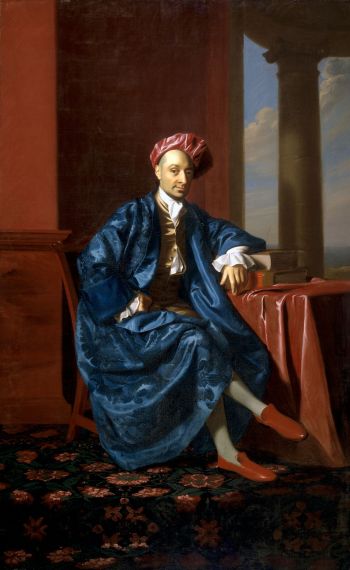
John Singleton Copley, Nicholas Boylston, 1773,oil on canvas (Harvard University Portrait Collection, H20, Harvard Art Museums).
Celebrated at the time as one of the grandest spaces in America, the original Philosophy Chamber and its adjacent rooms housed an extraordinary collection of paintings, portraits, and prints; mineral, plant, and animal specimens; scientific instruments; indigenous American artifacts; and relics from the ancient world—all of which was used regularly for lectures, discussions, and demonstrations. Highlights include: full-length portraits by John Singleton Copley, Native Hawaiian feather work, carving by indigenous artists of the Northwest Coast, Stephen Sewall’s 1768 mural-sized copy of the Native American inscription on the famous Dighton Rock in southeastern Massachusetts, and the elaborately ornamented grand orrery (a model of the solar system) created by Joseph Pope between 1776 and 1787. Many of the objects in the exhibition have not been shown publicly since the collection was dispersed almost 200 years ago.
The reassembled Philosophy Chamber invites visitors to examine the role that images and objects play in building, organizing, and transmitting knowledge; and as a historical study, it deepens our understanding not only of Harvard’s past, but also the history of early American art and culture.
The exhibition presents more than 70 objects from the earliest days of Harvard’s collecting, shown together with a small group of objects with 18th-century American provenances that closely match the description of original pieces in the collection that have been lost or destroyed, or that survive but are too fragile for display. In addition, the show includes period representations of other teaching cabinets to contextualize the material on display. The exhibition’s accompanying catalogue expands on the research into the chamber’s collection, history, and uses, presenting information on the approximately 200 objects that have been tracked thus far—just one-fifth of the original collection once housed in Harvard Hall.
The exhibition and catalogue provide a 360-degree view of early American history through the examination of the artwork displayed in the Philosophy Chamber, the instruments and specimens handled by the students and faculty who met there, and the cultural artifacts dispatched to the college by foreign envoys and the nation’s first merchant explorers. The project considers what the convergence of these objects in a New World college can tell us about the transfer of knowledge, burgeoning trade, the role of collections, and New England’s emerging self-identity in the mid-18th to early 19th century.
“Rooted in deep research and fresh curatorial insight, this exhibition invites audiences—both American and international—to explore a cultural landmark of the 18th-century Atlantic World,” said Martha Tedeschi, the Elizabeth and John Moors Cabot Director of the Harvard Art Museums. “Our efforts to unearth this largely forgotten landmark of early American art and culture led us to map collections, library archives, herbaria, and other museums across campus, in addition to public and private institutions throughout the Northeast and abroad. Thanks to this exceptional cross-institutional collaboration, we can present an immersive interdisciplinary experience that brings an important period of history to life for all visitors.”
“Weaving together art and science, this exhibition considers one of the most vibrant spaces in early America and presents a veritable cross-section of the period’s art and material culture,” said Ethan W. Lasser, curator of the exhibition, and the Theodore E. Stebbins Jr. Curator of American Art and head of the Division of European and American Art at the Harvard Art Museums. “The Philosophy Chamber opens a window into a forgotten piece of American history; the story of this room intersects with some of the most admirable—and the most challenging—aspects of Harvard’s past.”
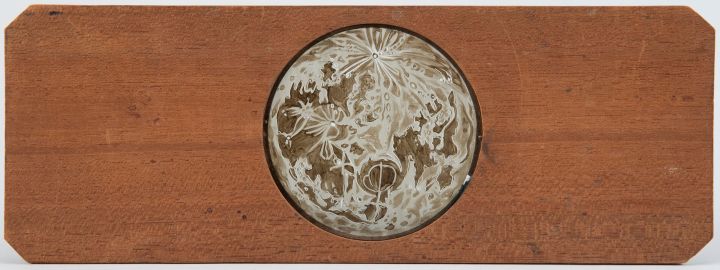
Unknown maker, possibly William and Samuel Jones, Lantern Slide of Painted Moon, late 18th century; painted glass and wood (Collection of Historical Scientific Instruments, Harvard University, 1998-1-1272).
◊ ◊ ◊ ◊ ◊
History of the Philosophy Chamber
Between 1766 and 1820, Harvard College assembled an extraordinary collection of specially commissioned scientific instruments and benefactor portraits, as well as donations from supporters around the globe. These objects were displayed in a set of three rooms adjacent to the college library in Harvard Hall, a large brick building that still stands at the center of campus today. The largest of these spaces, the Philosophy Chamber, was an ornately decorated room named for the discipline of natural philosophy, a field of study that wove together the sciences that sought to explain the natural world.
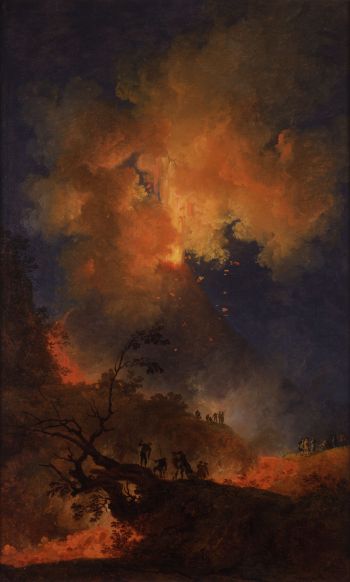
Pierre-Jacques Volaire, Vesuvius Erupting at Night, 1767, oil on canvas (Compton Verney Art Gallery and Park, Warwickshire).
The collection and the chamber, which came into existence when Harvard Hall was rebuilt after the Great Fire of 1764, played a vital role in teaching and research at Harvard, while also serving as the center of artistic and intellectual life in the greater New England region for over 50 years. Artists, scientists, students, and advocates of American Independence—including George Washington—came to the Philosophy Chamber to discover, discuss, and disseminate new knowledge. Students attended lectures and demonstrations there, and visitors from around the globe flocked to the space to see works by some of the Atlantic World’s greatest artists and artisans, including John Singleton Copley and John Trumbull.
The only repository of its kind in New England when it was established, the Philosophy Chamber was deeply connected to the network and ideology of other teaching cabinets established in Europe, the United States, and South America, such as the Ashmolean Museum at Oxford University, the Académie des Sciences in Paris, the American Philosophical Society in Philadelphia, and the University of Córdoba in Argentina. These teaching cabinets were offspring of the 17th-century Wunderkammer, or privately held cabinets of curiosities, and ultimately foreshadowed the beginnings of the modern museum.
While the chamber’s collection survived the Revolutionary War thanks to a temporary relocation (along with all of Harvard College) to Concord, Massachusetts, in 1775, an expansion of the college library in 1820 ultimately led to the dispersal of the collection to various university departments and local museums.
Research
The exhibition has its origins in curator Ethan Lasser’s early days at the Harvard Art Museums. While researching the Fogg Museum’s holdings of early American art, Lasser repeatedly came across references to the Philosophy Chamber. Intrigued, he initiated a campaign to locate the artifacts with a team of researchers at the museums. Lasser then expanded on the research by co-teaching a graduate seminar with Harvard professor Jennifer Roberts in Fall 2014. They enlisted their students to research the history of the chamber, the objects that were accessioned, and the people who visited. To date, the growing team of researchers—including curators, professors, conservators, scientists, and students from across the university—has tracked approximately 200 objects, or roughly one-fifth of the collection once housed in Harvard Hall. The whereabouts of the remaining four-fifths of the collection are unknown. Over the past 200 years, many objects have no doubt been lost, stolen, or destroyed, while some may be stored undetected in various campus and regional collections.
The Installation / Works on View
The Philosophy Chamber features more than 100 works displayed within four thematic sections.
The first section addresses how the collection was used in teaching and research, and includes tools and specimens that were regularly deployed for teaching in the 18th century. Included is the large-scale orrery, a dazzling astronomical model created by Joseph Pope. Labored over by Pope for 12 years, it was only the third orrery made in America, and was among the most celebrated objects to enter the chamber. Also included: one of two portable electrical machines for conducting demonstrations related to electricity (Benjamin Franklin advised on its purchase) and a group of six recently discovered drawings of skulls by Harvard professor and naturalist William Dandridge Peck, dated to around 1810. A projector installed in this gallery will show large-scale digitized images of solar microscope specimens and magic lantern slides.
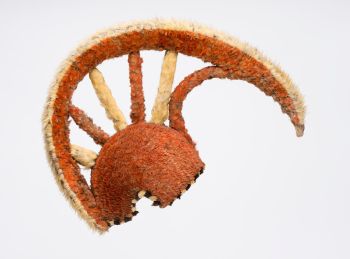
Unknown artist, Native Hawaiian, Mahiole (Crested Feathered Helmet), 18th century; ‘I’iwi (Vestiaria coccinea) and ‘ō’ō (Moho nobilis) feathers; and olonā (Touchardia latifolia) and ‘ie’ie (Freycinetia arborea) fibers (Peabody Museum of Archaeology and Ethnology, Harvard University, Gift of the Heirs of David Kimball, 99-12-70/53559).
A second gallery explores how the non-commissioned objects in the chamber’s collection arrived at Harvard and reflects on the collecting practices of wealthy alumni, entrepreneurial merchants, and scholars who sent objects from abroad. At the time, there was no curator of the collection, and very few objects were specifically solicited, resulting in a rather haphazard and idiosyncratic collection. This gallery features gifts sent to Harvard by five different donors or donor groups. In the late 18th century, as American ships began circumnavigating the globe, new courses were charted, and trade routes were established. An early 19th-century French map in this gallery shows the routes around North and South America that Captain James Cook and other explorers used. Shipmates on these missions brought back the exceptional examples of Native Hawaiian feather work on a colorful cape and a crested helmet seen in this space, as well as examples of carving by indigenous artists of the Northwest Coast. A touchscreen monitor in this gallery presents an animated map with points of origin of some of the objects in the collection, as well as demonstrations of two objects from Harvard’s Collection of Historical Scientific Instruments.
A third section addresses the entangled histories of the objects gathered in the chamber and the origin story of the United States after the Revolutionary War. Works here show how artists and scholars were actively writing American history. Included are engravings after paintings by John Trumbull, who gave a portrait of Cardinal Guido Bentivoglio to the college, which also hangs in this space. The gallery includes another celebrated object in the chamber’s history: Stephen Sewall’s mural-sized copy of the Native Americans’ inscriptions on the landmark known as Dighton Rock, an 11-foot boulder formerly located in the Taunton River, and now housed in a museum. Sewall was a professor at Harvard and his 1768 drawing is the only life-size representation of the monument known to exist. The rock was puzzled over by scholars from Harvard and around the world, and a variety of theories about the origin of the inscriptions were posited. Today, scholars attribute the inscriptions on the rock to the Algonquian-speaking peoples of the Eastern Woodlands, and more specifically to the Wampanoag who lived in the rock’s vicinity. By contrast, in the period when Sewall made his drawing, European interpreters actively disavowed the possibility of Native American authorship.
The final room is a loose reconstruction of the Philosophy Chamber itself, an experiential space complete with a re-created version of the red wallpaper that John Hancock had donated to the original room. Three early full-length portraits of Harvard benefactors by John Singleton Copley are included, as is a series of six mezzotints after Copley paintings that were given to Harvard by the artist’s heirs. Harvard was Copley’s first major patron, and plans to turn the Philosophy Chamber into a space dedicated to the artist’s life were never realized; the gift of mezzotints has never been shown until now. A bust of William Pitt the Elder, Earl of Chatham, given by Benjamin Franklin in 1769, was the first gift of sculpture the college received after the Great Fire consumed Harvard Hall in 1764. This gallery will be complemented by a digital tool, accessible on the museums’ website, that allows visitors to access recordings of present-day Harvard students reading from period sources, offering a sense of the kinds of conversations and debates that took place in the original chamber. The tool will also include deeper information about the objects displayed in the gallery.
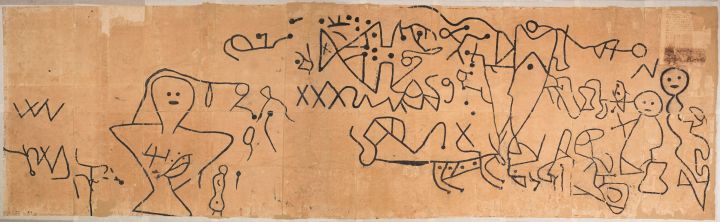
Stephen Sewall, Copy of Inscription on Dighton Rock, 1768, black ink on paper (Peabody Museum of Archaeology and Ethnology, Harvard University, 967-28-10/45474, digital file 99270006).
◊ ◊ ◊ ◊ ◊
Conservation
The research and rediscovery of objects once belonging to the Philosophy Chamber collection has led to exciting research by conservators and conservation scientists in the museums’ Straus Center for Conservation and Technical Studies. Several members of the Straus Center staff contributed essays to the exhibition catalogue on the following topics:
• Conservators were able to examine two of the full-length portraits by John Singleton Copley. Use of X-radiography and infrared digital photography helped them determine earlier iterations of a portrait of Thomas Hancock, painted between 1764 and 1766, showing Copley had reworked the painting twice to arrive at the formal, dignified pose seen in the final portrait. By contrast, a painting of college benefactor Thomas Hollis III was shown to have very few changes.
• Joseph Wilton’s bust of William Pitt the Elder, Earl of Chatham—given to Harvard by Benjamin Franklin—underwent scientific, technical, and art historical research, allowing staff to assess how the ceramic sculpture was made and to document its alteration over the centuries at Harvard. Guided by this research, the conservation treatment included removal of later overpaint layers and cleaning to uncover the original white painted surface.
• A close examination of Stephen Sewall’s drawing of the inscription on Dighton Rock sheds light on his chosen materials and processes. Conservators believe Sewall directly traced the markings rather than using a rubbing or chalking method.
Publication
Ethan Lasser, ed., The Philosophy Chamber: Art and Science in Harvard’s Teaching Cabinet, 1766–1820 (Cambridge: Harvard University Press, 2017), 312 pages, ISBN 978 0300 225921, $55.
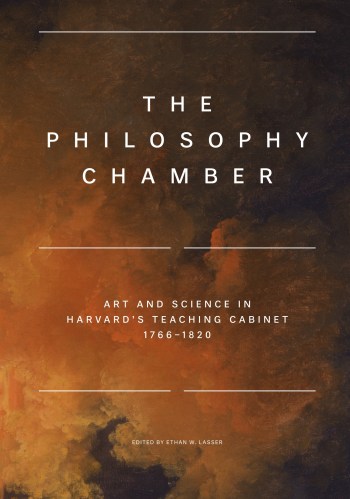 A catalogue, edited by Ethan Lasser, with essays by a mix of curators, professors, conservators, conservation scientists, and doctoral candidates, will be published in conjunction with the exhibition. The publication will advance new understandings of early American art history, and will serve as a rich resource for any reader interested in the art and culture of the Atlantic World. The catalogue is published by the Harvard Art Museums and distributed by Yale University Press. Contributors include Aleksandr Bierig, Anne Driesse, Katherine Eremin, Andrew Gelfand, Claire Grech, Teri Hensick, Jane Kamensky, Ethan W. Lasser, Georgina Rayner, Jennifer L. Roberts, Whitney Barlow Robles, María Dolores Sánchez-Jáuregui, Anthony Sigel, Kate Smith, Lucie Steinberg, and Oliver Wunsch.
Online Resources
Once the exhibition opens, supplementary digital content will be accessible via the exhibition page on the museums’ website. The digital tool complementing the room within the exhibition that loosely reconstructs the Philosophy Chamber will include “Voices of the Philosophy Chamber,” a group of audio recordings by present-day Harvard students reading from period sources. The recordings will give a sense of the conversation and debate that once filled the Philosophy Chamber. The tool will also provide additional information about the works on view.
The website will also include a series of audio recordings of gallery talks planned for the run of the exhibition. The robust series of talks by the students, staff, faculty, and scholars involved with the Philosophy Chamber research will explore the range of objects and themes in the exhibition as well as the history of the chamber. New recordings will be added on a regular basis.
Programming
A wide range of events, including lectures, a symposium, gallery talks, Materials Lab Workshops on Wampum jewelry making, and special member events, will be offered throughout the duration of the exhibition. Harvard professor Jane Kamensky will give a free public lecture, The Hungry Eye: Art and Ambition in Copley’s Boston, on Tuesday, May 23, at 3pm. Kamensky is the author of the recent biography A Revolution in Color: The World of John Singleton Copley, and also contributed to the Philosophy Chamber catalogue. During the fall semester, programming includes major lectures by artist Simon Starling and James Delbourgo (Rutgers University); The Room Where It Happens: On the Agency of Interior Spaces, a two-day public symposium featuring a keynote lecture by Louis Nelson (University of Virginia) and a full day of panel discussions; and a special late-night event for Harvard students. Detailed information about programs is forthcoming here.
Credits
The Philosophy Chamber: Art and Science in Harvard’s Teaching Cabinet, 1766–1820 is organized by the Harvard Art Museums. Curated by Ethan W. Lasser, the Theodore E. Stebbins Jr. Curator of American Art and Head of the Division of European and American Art at the Harvard Art Museums. The exhibition is supported in part by major grants from the Terra Foundation for American Art and the Henry Luce Foundation. The exhibition and catalogue also received support from the following endowed funds: the Bolton Fund for American Art, Gift of the Payne Fund; the Henry Luce Foundation Fund for the American Art Department; the William Amory Fund; and the Andrew W. Mellon Publication Funds, including the Henry P. McIlhenny Fund.
Lenders at Harvard University include: the Collection of Historical Scientific Instruments; the Harvard Map Collection, Pusey Library; the Harvard University Archives; Houghton Library; the Mineralogical and Geological Museum; the Museum of Comparative Zoology; the Peabody Museum of Archaeology & Ethnology; and the Warren Anatomical Museum, Countway Library of Medicine.
Other lenders from private, academic, and public collections in the United States and the United Kingdom include: the American Academy of Arts and Sciences, Cambridge, MA; the Richard Balzer Collection, Brookline, MA; Compton Verney Art Gallery and Park, Warwickshire, U.K.; The Library Company of Philadelphia; the Massachusetts Historical Society, Boston; Metropolitan Museum of Art, New York; Museum of Fine Arts, Boston; Peabody Essex Museum, Salem, MA; and a private collection in Boston.
New Book | The Power of Objects in Eighteenth-Century British America
From UNC Press:
Jennifer Van Horn, The Power of Objects in Eighteenth-Century British America (Chapel Hill: The University of North Carolina Press, 2017), 456 pages, ISBN: 978 14696 29568, $55.
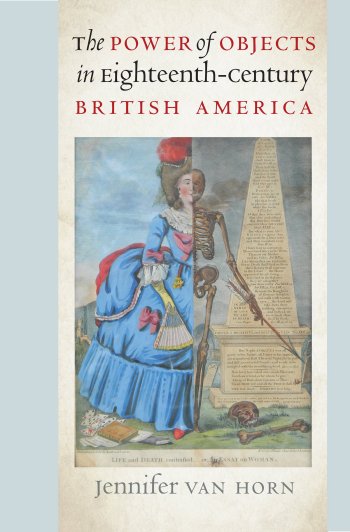 Published for the Omohundro Institute of Early American History and Culture, Williamsburg, Virginia.
Over the course of the eighteenth century, Anglo-Americans purchased an unprecedented number and array of goods. The Power of Objects in Eighteenth-Century British America investigates these diverse artifacts—from portraits and city views to gravestones, dressing furniture, and prosthetic devices—to explore how elite American consumers assembled objects to form a new civil society on the margins of the British Empire. In this interdisciplinary transatlantic study, artifacts emerge as key players in the formation of Anglo-American communities and eventually of American citizenship. Deftly interweaving analysis of images with furniture, architecture, clothing, and literary works, Van Horn reconstructs the networks of goods that bound together consumers in Boston, New York, Philadelphia, and Charleston.
Moving beyond emulation and the desire for social status as the primary motivators for consumption, Van Horn shows that Anglo-Americans’ material choices were intimately bound up with their efforts to distance themselves from Native Americans and African Americans. She also traces women’s contested place in forging provincial culture. As encountered through a woman’s application of makeup at her dressing table or an amputee’s donning of a wooden leg after the Revolutionary War, material artifacts were far from passive markers of rank or political identification. They made Anglo-American society.
Jennifer Van Horn is assistant professor of art history and history at the University of Delaware.
C O N T E N T S
Acknowledgments
List of Illustrations
Introduction
1 Imprinting the Civil
2 The Power of Paint
3 Portraits in Stone
4 Masquerading as Colonists
5 The Art of Concealment
6 Crafting Citizens
Epilogue
Index
Exhibition | Hidden From View: The 5th Duke of Portland’s Art Collection
Press release (via Art Daily) from The Harley Gallery:
Hidden From View: The 5th Duke of Portland’s Art Collection
The Harley Gallery, Welbeck, Nottinghamshire, 31 March — 30 September 2017
Curated by Vanessa Remington
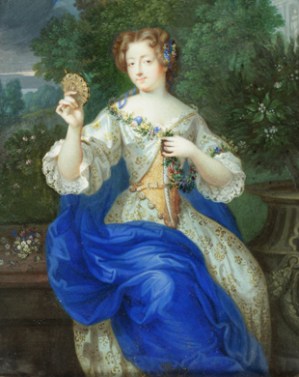
Marie Angélique de Scorailles, Duchess of Fontanges, Continental School, 18th Century.
Best known for the extensive tunnels he built underneath the family home at Welbeck Abbey on the Welbeck Estate, the eccentric and reclusive 5th Duke of Portland (1800–1879) is revealed in a new light through his “extraordinary collection” of miniature paintings says Senior Curator of Paintings at the Royal Collection, Vanessa Remington. Having catalogued the miniatures in the Royal Collection, Remington was invited to curate a new exhibition of more than 25 paintings opening at The Harley Gallery on the Welbeck Estate in Nottinghamshire on 31 March and running until 30 September 2017.
She describes the Portland Collection’s miniatures as “probably second only to the Royal Collection,” and the new exhibition focuses on the 5th Duke to show a man very different from his public persona. Despite his reputation as a recluse with little social life who avoided the outside world, Remington’s research shows a Duke who was nevertheless fascinated by youth, beauty, celebrities, and high society.
“Unfortunately, we have no diary or memoirs from the 5th Duke, and so he’s been very much defined by the miles of tunnels he built under the family home. By examining his collection of miniatures though we see a man fascinated by women, despite being a recluse who had no personal relationships with them other than his sister.
“There is a very clear focus on beautiful and famous young women so it’s a sad irony of his life that he felt unable to engage and enter that world despite the access his wealth and social status gave him,” says Remington.
Miniatures were very popular across Europe in the 18th and 19th centuries and were usually intimate and informal portraits painted by specialist artists for rich patrons who often gave them as love tokens. The 5th Duke was an avid collector, and among more than 80 miniatures he collected personally are key pieces including:
• Emperor Napoleon Bonaparte and Empress Josephine of France
• The beautiful but doomed mistress of Louis XIV, the Duchess of Fontanges
• Two young girls dressed as angels
• Louis XV, King of France and his consort, Marie Leszczynska, Queen of France
• The famous soprano, Adelaide Kemble, with whom the Duke was once in love, and her sister, the actress Frances ‘Fanny’ Kemble. Also on show will be a series of pastel paintings of the opera singer, which he commissioned.
Painted on vellum and ivory, the miniatures of the Portland Collection are displayed very infrequently and for short periods because of the risk of light damage. Many of the miniatures are painted with watercolour paint which is light sensitive. A specialist viewing area uses sophisticated PIR technology to manage light levels in order to protect the works for generations to come.
The Portland Collection at Welbeck houses treasures assembled over 400 years by the Dukes of Portland and their families. It opened to the public on Sunday 20th March 2016 and includes masterpieces such as Michelangelo’s Madonna del Silenzio, on show for the first time in 50 years; Van Dyck’s paintings of a young Charles II in armour and Thomas Wentworth, 1st Earl of Strafford, not publicly exhibited since 1960; as well as the pearl earring worn by Charles I at his execution in 1649. The Portland Collection was named RIBA East Midlands’ building of the year, as well as winning the East Midlands Sustainability Award, Heritage award and a prestigious national RIBA award. The Gallery most recently won a silver award in the American Architecture Prize, and is currently in the running for a ‘Building’ award and a Civic Trust award.
New Book | Textile Terms: A Glossary
From Gebr. Mann Verlag (and soon to be available from Amazon) . . .
Anike Reineke, Anne Röhl, Mateusz Kapustka, and Tristan Weddigen, eds., Textile Terms: A Glossary (Berlin: Edition Imorde 2017), 359 pages, ISBN: 978 39428 10364, 360 pages, 40€ / $60.
 The glossary is addressed to scholars and students of art and architectural history and related fields as well as to artists and curators. It offers a new point of reference and departure for future research on the textile medium as such. It presents sixty-five critical terms that define the textile medium as a specific form, material, technique, and metaphor from antiquity to the present through contributions by international specialists in the field. Each entry discusses one illustrated object which epitomizes the main concepts related to one of the volume’s keywords:
Absorption, Abstraction, Affect, Canopy, Canvas, Carpet, Case, Clothing, Cotton, Craft, Curtain, Cushion, Cut, Digitality, Display, Drapery, Dye, Embroidery, Felt, Flag, Flatness, Fold, Formlessness, Gender, Globalism, Glove, Grid, Hair, Hem, Knitting, Knot, Labor, Lace, Marginalization, Mobility, Network, Ornament, Patchwork, Pattern, Rags, Recto/Verso, Revival, Sacredness, Sampler, Screen, Sewing, Silk, Skin, Space, Spider, Stockings, Tactility, Tapestry, Tear, Technology, Tent, Texture, Textus, Thread, Upholstery, Veil, Wallpaper, Weaving, Wrapping, Wool.
Anika Reineke, Anne Röhl, Mateusz Kapustka, and Tristan Weddigen are part of the SNF Research Project Textile: An Iconology of the Textile in Art and Architecture, University of Zurich.
Conference | The Sacred at European Courts
From H-ArtHist:
Sakralität an europäischen Höfen: Bau—Bild—Ritual—Musik, 1648–1740
LWL-Museum für Kunst und Kultur, Münster, 4–6 May 2017
Die Tagung widmet sich der Frage, wie und in welchen Kontexten Konzepte von Sakralität des Königs bzw. Kaisers als Legitimationsressource und Repräsentationsstrategie in den künstlerischen Medien zu einem zentralen Thema werden. Im Mittelpunkt stehen zwischen dem Westfälischen Frieden und dem Tod Kaiser Karls VI. der kaiserliche und die königlichen sowie solche Höfe Europas, die sich im Streben nach einer Königskrone an royalen Repräsentationsstandards orientiert haben.
Ein zentraler Fokus liegt auf traditionellen ebenso wie neuen Symbolvorräten und Symbolisierungsprozessen, die dabei zum Tragen kommen, sowie auf dem Beitrag, den sie (oder auch der Verzicht auf sie) im Hinblick auf die Konstitution und Stabilisierung der Institution ‚Kaiser- bzw. Königtum‘ konkret leisten. Davon nicht zu trennen ist die Frage, auf welche medialen Bezugssysteme, gattungsbezogenen Kontexte und repräsentativen Modelle jeweils zurückgegriffen wird und inwiefern diese dabei auch eine Neusemantisierung erfahren. Schließlich sollen in diesem Zusammenhang das Verhältnis der ‚Sakralität‘ zu anderen dem Kaiser bzw. König zugeschriebenen Attributen seiner Macht sowie die Rolle konfessioneller und politischer Verbindungen oder Gräben in den Blick genommen werden.
D O N N E R S T A G , 4 M A I 2 0 1 7
13:30 Begrüßung und Einführung
14:00 Dietrich Erben (München), Das ‚Sakrale‘ als Handlungsalternative zur Antikenrezeption
14:45 Alexandre Maral (Versailles), L’architecture et le décor au service d’une conception du pouvoir : l’exemple de la chapelle royale de Versailles sous Louis XIV
15:30 Kaffeepause
16:00 Jens Niebaum (Münster), Symbolisierungen sakraler Kaiser-und Königsmacht: Kirchenfassaden für Paris, Berlin und Wien
16:45 Cornelia Jöchner (Bochum), Dynastischer Kirchenbau in Piemont-Savoyen: die Superga und ihre Vorgänger
19:30 (Abendvortrag) Ronald G. Asch (Freiburg), Das Trauma des Königsmordes und die Sakralität des englischen Königtums nach 1660
F R E I T A G , 5 M A I 2 0 1 7
9:15 Štepan Vacha (Prag), Aus frommer Pflicht: Das Engagement Kaiser Karls VI. für die Vollendung des Veitsdoms in Prag (1728)
10:00 Sabrina Leps (Münster), Reliquienkult und Königsmacht am sächsischpolnischen Hof unter August III. und Maria Josepha
10:45 Kaffeepause
11:15 Eva-Bettina Krems (Münster), Konzepte der Sakralisierung zwischen Bildnis und Performanz
12:00 Herbert Karner (Wien), Habsburg und die Sakralisierung des öffentlichen Raums: Wien und Preßburg im 17. Jahrhundert
12:45 Mittagspause
14:15 Hendrik Ziegler (Reims), Der Erlanger Hugenottenbrunnen des Markgrafen Christian Ernst. Zu den Sakralisierungsstrategien eines kaisertreuen protestantischen Reichsfürsten
15:00 Peter Schmitz (Münster), Musik und Tod im Augusteischen Zeitalter
15:45 Kaffeepause
16:15 Panja Mücke (Mannheim), Musikalische Imagepflege und sakrale Repräsentation: Die Oratorien für Kaiser Karl VI.
17:00 Josef Johannes Schmid (Mainz), Westminster 1727 – God, the King and Mr Handel
S A M S T A G , 6 M A I 2 0 1 7
9:15 Birgitte Boggild Johannsen (Kopenhagen), Death and the Absolute Monarch: Mediating the Myth of Sacral Kingship at Royal Funerals in Denmark during the Second Half of the 17th Century
10:00 Barbara Arciszewska (Warschau), Constructing ‘here’ and ‘hereafter’: Pompa funebris as a court ritual in the Polish-Lithuanian Commonwealth, c.1650–1750
10:45 Kaffeepause
11:15 Mark Hengerer (München), Herrschertod, Memoria und Sakralität. Europäische Perspektiven um 1700
12:00 Werner Telesko (Wien), Mors et Aeternitas. Der Sarkophag für Kaiser Joseph I. in der Wiener Kapuzinergruft
Konzept und Organisation
Prof. Dr. Eva-Bettina Krems (eva.krems@uni-muenster.de)
Dr. Jens Niebaum (niebaumj@uni-muenster.de)
Institut für Kunstgeschichte der Universität Münster / Exzellenzcluster
“Religion und Politik”
Univ.-Doz. Mag. Dr. Herbert Karner
Univ.-Doz. Mag. Dr. Werner Telesko
Institut für kunst- und musikhistorische Forschungen der
Österreichischen Akademie der Wissenschaften, Wien
Exhibition | America Collects Eighteenth-Century French Painting
From the NGA:
America Collects Eighteenth-Century French Painting
National Gallery of Art, Washington, D.C., 21 May — 20 August 2017

When Joseph Bonaparte, elder brother of Napoleon, arrived in the United States in 1815, he brought with him his exquisite collection of eighteenth-century French paintings. Put on public view, the works caused a sensation, and a new American taste for French art was born. Over the decades, appreciation of French eighteenth-century art has fluctuated between preference for the alluring decorative canvases of rococo artists such as François Boucher and Jean Honoré Fragonard to admiration for the sober neoclassicism championed by Jacques Louis David and his pupils. This exhibition brings together sixty-eight paintings that represent some of the best and most unusual examples of French art of that era held by American museums and tells their stories on a national stage: Who were the collectors, curators, museum directors and dealers responsible for bringing eighteenth-century French painting to America? Where are the paintings now?
The exhibition highlights smaller museum collections, less well-known paintings, and diverse locations across the United States, from Pittsburgh and Indianapolis to Birmingham and Phoenix. It considers eighteenth-century America’s very real fascination with France—a staunch ally in the American Revolution, an intellectual model for Benjamin Franklin, Thomas Jefferson, and other Americans abroad—and how the cultural ideal of eighteenth-century France has continued to endure in the American imagination to this day.
Image: Joseph Ducreux, Le Discret, ca. 1791, oil on aluminum, transferred from canvas (Lawrence: Spencer Museum of Art, University of Kansas).
◊ ◊ ◊ ◊ ◊
Note (added 28 May 2017) — A checklist for the exhibition is available here. Online, there’s also a useful chronology (condensed from the catalogue), establishing larger contexts and tracing the history of selected works in the exhibition.
Note (added 30 May 2017) — The catalogue is published by Lund Humphries:
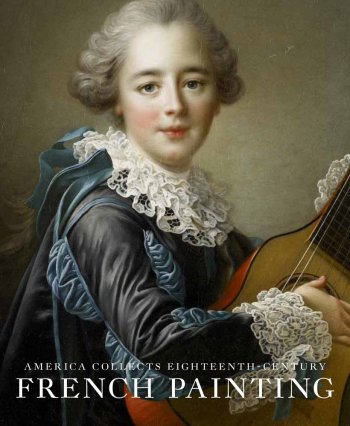
Yuriko Jackall, Philippe Bordes, Jack Hinton, Melissa Hyde, Joseph Rishel, and Pierre Rosenberg, with Joseph Baillio, Susan Earle, Christophe Leribault, Robert Schindler, and D. Dodge Thompson, America Collects Eighteenth-Century French Painting (London: Lund Humphries, 2017), 304 pages, ISBN: 978 18482 22342, £50 / $70.
 C O N T E N T S
Director’s Foreword
Acknowledgments
Lenders to the Exhibition
Essays
• Pierre Rosenberg, Only in America
• Yuriko Jackall, American Visions of Eighteenth-Century France
• Joseph Bailliom, Wildenstein in America
• Jack Hinton, Fiske Kimball and French Period Rooms in America
• Christophe Leribault, The Tuck Donation to the Petit Palais: A Mirror of American Taste
• Melissa Hyde, Femmes-Artistes and America from the Early Republic to the Gilded Age
• Robert Schindler, Eugenia Woodward Hitt Collects
• Philippe Bordes, Buying against the Grain: American Collections and French Neoclassical Paintings
• Susan Earle, Joseph Ducreux, John Maxon, and the Spencer Museum of Art
• D. Dodge Thompson, When the Eighteenth Century Was New: Joseph Bonaparte in America
• Joseph Rishel, Notes on the American Reception of Eighteenth-Century French Painting
Plates
Yuriko Jackall
• Collector’s Century: From the King’s Mistress to the Shores of San Francisco
• Sensual Century: Pursuit of Love
• Opulent Century: Douceur de Vivre
• Playful Century: Games and Pastimes
• Fanciful Century: Masquerade and the Pleasures of the Imagination
• Inspired Century: Artists and Artistic Practice
• Virtuous Century: Institutional Taste
• Enlightened Century: Science, Nature, and the Passage of Time
Checklist of the Exhibition
Chronology
Bibliography
Index
Symposium | The Royal Palace in the Europe of Revolutions
From the conference programme:
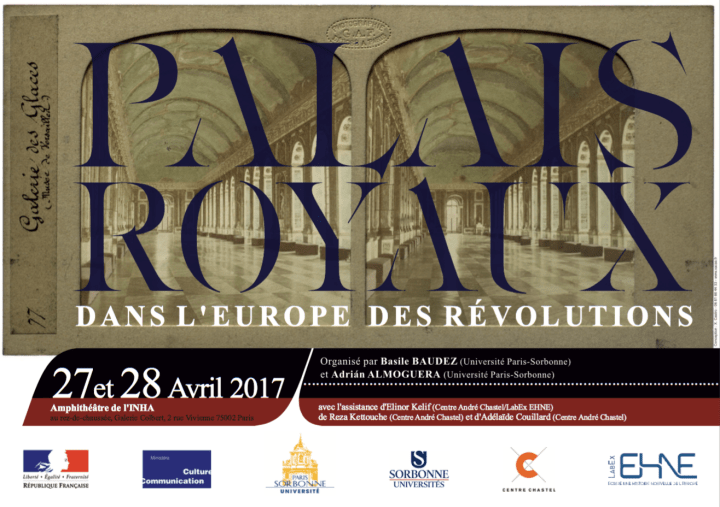
The Royal Palace in the Europe of Revolutions, 1750–1850
Palais Royaux dans l’Europe des Révolutions
Institut national d’histoire de l’art, Paris, 27–28 April 2017
Organized by Basile Baudez and Adrián Almoguera
Since the publication of Nikolaus Pevsner’s History of Building Types in 1976, architectural historians have been alert to the importance of typologies for rethinking their discipline. As analyzed by Werner Szambien or Jacques Lucan, thinking through types allowed for the articulation of concepts of convenance, character and composition in both public and private commissions. Along with metropolitan churches and royal basilicas, in ancien régime Europe princely palaces represented the most prestigious program an architect could expect. For a period in which the divine right of kings was being called into question, however, what happened to the physical structures of royal or princely power, symbol of political authority and dynastic seats? Did the national models of the Escorial, Versailles, Het Loo, or Saint James palaces still hold, even in light of new models made available through the publication of archeological discoveries in Rome or Split? The second half of the eighteenth and first half of the nineteenth century represent a moment of intense construction or reconstruction of the principal European palaces, from Caserta to Buckingham Palace, Saint-Petersburg to Lisbon, Versailles to Coblenz. This trend, addressed by Percier and Fontaine in their Résidences des souverains de France, d’Allemagne, de Russie, etc. (1833), took place in a Europe that was undergoing political developments that altogether changed the nature and symbolic structure of princely power.
This symposium, focused on Europe from roughly 1750 to 1850, aims to interrogate the manner in which architects and their patrons integrated the changing concepts of character in architecture and symbolic place of dynastic palaces, reconciling them with theory and/or practice through rethinking issues of distribution, construction, environmental situation, décor, function, reuse of interpretations of printed or drawn sources.
T H U R S D A Y , 2 7 A P R I L 2 0 1 7
9.30 Introduction
10.00 Basile Baudez (Université Paris-Sorbonne), Reconstruire Versailles, de Louis XV à Louis-Philippe
10.30 Francesco Guidoboni (Université Paris 1 Panthéon-Sorbonne) et Pierre Geoffroy (Université Paris-Sorbonne), Napoléon Ier empereur ou citoyen? Du choix de la résidence privée du souverain
11.15 Fabien Passavy (architecte du patrimoine, Versailles), Au service de la nouvelle élite au tournant du siècle: les cas des hôtels de Bourrienne et de Beauharnais
12.00 Mathieu Caron (Université Paris-Sorbonne), La France en ses meubles: Une symbolique du décor dans les palais du Domaine étranger (Italie, Belgique, Hollande) de l’an X à 1815
14.00 Guillaume Nicoud (Archivio del Moderno, Accademia di Architettura Università della Svizzera italiana), Fastes, étiquette et collection: regard croisé sur la nécessaire transformation des complexes palatiaux des Tuileries et du Louvre, du palais d’Hiver et de l’Ermitage vers 1800
14.30 Elizaveta Renne (Musée de l’Ermitage, Saint-Pétersbourg), The Chesma Palace in St. Petersburg and Catherine II’s Shifting Political Ambitions
15.30 Delfín Rodríguez (Universidad Complutense de Madrid), Théories et typologies de l’idée de palais royal dans la culture espagnole du XVIIIe siècle: histoire d’un conflit artistique et politique
16.15 Adrián Almoguera (Université Paris-Sorbonne), Le Palais du roi au temps de l’empereur: réflexions sur le Palacio Nuevo de Madrid
F R I D A Y , 2 8 A P R I L 2 0 1 7
10.00 Susanna Pasquali (Università di Roma La Sapienza), Nouvelles façades pour un palais trop sévère: projets inédits de Raffaele Stern pour le Palais Impérial de Rome, 1811–14
10.30 Ludovica Cappelletti (Politecnico di Milano), Towards a Modern Imperial Palace: The Ducal Palace of Mantua in the Eighteenth Century
11.15 Paolo Cornaglia (Politecnico di Torino), La forteresse et le palais: Plusieurs projets pour la dynastie de Savoie dans une ville juste annexée et hostile après la tempête napoléonienne 1818–25
12.00 Alba Irollo (chercheur indépendant), Changements de goût et d’étiquette: les souverains français et les palais royaux des Bourbons de Naples
14.00 Pablo Vázquez Gestal (Université Paris-Sorbonne), Pour le roi, pour l’État: Caserte et Charles de Bourbon
14.30 Dirk Van de Vijver (Université d’Utrecht), Le projet de Barnabbé Guimard pour un palais à Bruxelles vers 1768
15.00 Nilay Ozlu (Bogazici University, Istanboul), Showcases of Modernity in the Age of Reforms: Nineteenth-Century Ottoman Palaces of Istanbul
Call for Papers | Celebrating Female Agency in the Arts
From H-ArtHist:
Celebrating Female Agency in the Arts
Christie’s Education New York, 26–27 June 2018
Proposals due by 15 July 2017
Following the success of the 250-anniversary conference held in London in July 2016, Christie’s Education is organizing its second academic conference on the theme of women in the arts. The conference will take place at Christie’s, 20 Rockefeller Plaza in New York on Tuesday June 26th and Wednesday June 27th 2018.
From Antiquity to today, women have always played a significant role in the arts and their markets. With this call for sessions, we welcome proposals coming from a wide range of disciplines that would consider women’s diverse contributions to the arts from a transnational and transhistorical perspective. We hope that the sessions will reflect the global and historical diversity of the issues at stake.
This conference is not advocating for a separate history nor an alternative history of art and its markets, but rather we want to look at the central role played by women in the creation, development, support and preservation of the arts and, also how their contribution has changed over time. Sessions should consider globally and throughout history women as artists, patrons and collectors of art and architecture, dealers and brokers, art historians and art critics as well as curators and preservers of culture. From the presence of women in emerging and established art centers to historical aristocratic patronage and back in time to the medieval period and antiquity we hope that the sessions will investigate a diverse range of topics.
We encourage academics across disciplines and art professionals to submit proposals for individual sessions. Sessions will be 115 (4 x 20 minute papers) or 90 minutes (3 x 20 minute papers) in length. Please send a 250/300-word abstract to Dr. Cecily Hennessy (chennessy@christies.com) and Dr. Véronique Chagnon-Burke (vchagnon-burke@christies.edu) by July 15th 2017. We look forward to receiving your proposal.










 Enfilade
leave a comment