Cincinnati Receives $11.75million for Bimel Asian Art Endowment
Press release (16 May 2017) from the Cincinnati Art Museum:
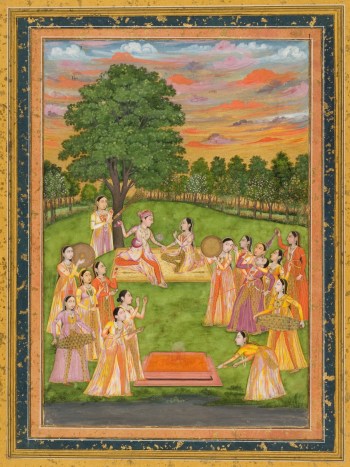
A Royal Couple and Women of the Court Playing Holi, ca. 1760, Mughal period, Mughal/India; opaque watercolor, gold, and silver on paper (Cincinnati Museum of Art, 1986.1174).
A landmark $11.75 million gift to the Cincinnati Art Museum to establish the Alice Bimel Endowment for Asian Art was announced at the museum’s 137th Annual Meeting of the Shareholders of the Cincinnati Museum Association on May 15. The largest single monetary gift in the museum’s history, the endowment will enhance collections in the arts of South Asia, Greater Iran, and Afghanistan.
During their lifetimes, the Bimels developed a fascination with South Asian art of all periods and extended their interests to include the regions of Greater Iran and Afghanistan. Their gifts to the Cincinnati Art Museum followed closely their own art collecting, study, and travel interests. In sum, Alice and Carl Bimel generously donated more than $14 million in addition to significant collection objects to the museum.
“It would be impossible to express in full our gratitude for what Carl and Alice Bimel have given to the public through their museum. The Bimels’ act of immense generosity will advance a key area of study that is immeasurably important and highly relevant in contemporary society. The Bimels gave countless volunteer hours, support and collections while they were with us. Now they add their vision to the future,” said Cameron Kitchin, the Louis and Louise Dieterle Nippert Director of the museum.
Newly appointed Curator of South Asian Art, Islamic Art and Antiquities, Dr. Ainsley Cameron, adds, “The opportunity to build an ambitious collection in a public museum today is rare. Alice and Carl Bimel have made that possible for Cincinnati. With this endowment, we can create an exceptional collection, one that represents the vibrancy and vitality prevalent in the arts of the region, from both the historic period and the contemporary.”
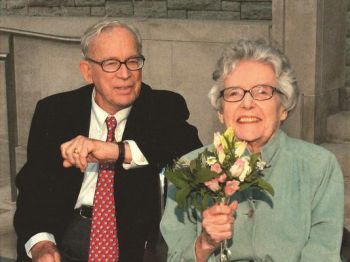 Alice and her husband, Carl, were longtime supporters of the museum who, with their passing, left a legacy of philanthropy. Alice died in 2008 and Carl in 2013. Alice was a Cincinnati Art Museum volunteer for more than 40 years, and was a member of the first docent class in 1960. In 1972, she was the first woman named to the museum’s board of trustees. She was one of the principal volunteers assisting with the museum’s fundraising efforts before the Development department was established in the fall of 1981. Alice was passionate about art and fiercely committed to the excellence of the Cincinnati Art Museum. She has been described as “thoughtful, energetic, patrician and deeply caring.” Former director Millard Rogers said in 1990: “Alice Bimel represents all the good qualities of volunteerism. She has provided many firsts through her insight and creativity; she is a worker as well as a leader, and has continued to be active long after others with less dedication and perseverance have quit.”
The Bimels traveled extensively throughout Asia. They collected miniature paintings and other South Asian works of art which are now in the Cincinnati Art Museum’s permanent collection, and also provided support for the purchase of acquisitions in other regions represented in the Art Museum’s Asian collections.
In 2004, the Cincinnati Art Museum dedicated its courtyard in honor of Alice in recognition of a major gift. Other gifts included endowing several galleries in honor of Alice and their daughters Carlyn and Natalie. The Bimel family has previously provided more than $2 million in other endowments and gifts to the Cincinnati Art Museum since 1977. In 1998, Carl and Alice Bimel gifted the museum a 9th-century carved stone pillar from the Pala dynasty depicting a Serpent King and Queen. In 2008 the Art Museum celebrated a gift of Indian paintings from the Bimels that included exquisite works of art created in the 17th and 18th centuries at the royal Hindu courts of Rajasthan and the Punjab Hills. This gift enhanced the collection of courtly and sacred Indian paintings, most of which were given by the Bimels over many years. In 2006, Alice was awarded the Cincinnati Art Museum’s George Rieveschl Medal for Distinguished Service.
The American Historical Review (April 2017)
The “AHR Forum: Mapping the Republic of Letters” in the current issue of The American Historical Review will likely be of interest to anyone engaged with questions of art history and big data, the Grand Tour, and mapping projects. Historiographical questions are central and addressed in fascinating ways. –CH
The American Historical Review 122.2 (April 2017)
“AHR Forum: Mapping the Republic of Letters”
Dan Edelstein, Paula Findlen, Giovanna Ceserani, Caroline Winterer, and Nicole Coleman, “Historical Research in a Digital Age: Reflections from the Mapping the Republic of Letters Project,” pp. 400–24.
What can a big data approach bring to the study of the early modern Republic of Letters? This is the question we asked ourselves in our collaborative project Mapping the Republic of Letters. For the past nine years, we have been exploring the limits and possibilities of computation and visualization for studying early modern correspondences, whose massive and dispersed character have long challenged their students. Beyond cliometrics, what new ways of discovery and analysis do today’s big data offer? What can we learn by visualizing the archives and databases that are increasingly accessible and viewable online? In a variety of case studies focusing on metadata (in the letters of John Locke, Athanasius Kircher, Benjamin Franklin, and Voltaire, and in the travels of those engaging in the Grand Tour), we experimented with visualizations to produce maps of the known and unknown quantities in our datasets, and to represent intellectual, cultural, and geographical boundaries. In the process, we experienced collaborative authorship, and worked with designers and programmers to create an open access suite of visualization tools specifically for humanities scholars, Palladio. What might the next research steps be, as linked data rapidly develops further possibilities?
Giovanna Ceserani, Giorgio Caviglia, Nicole Coleman, Thea De Armond, Sarah Murray, and Molly Taylor-Poleskey, “British Travelers in Eighteenth-Century Italy: The Grand Tour and the Profession of Architecture,” pp. 425–50.
Drawing on a dynamic digital database of eighteenth-century British travelers in Italy, in this article we offer a case study focused on British architects to demonstrate the potential of digital resources for historical research. Based on the entries in John Ingammels’s Dictionary of British and Irish Travellers in Italy, 1701–1800 (1997)—which covers the itineraries and lives of more than five thousand travelers—our project adds a new richness and granularity to the understanding of the Grand Tour. We see what these tours were like and what they did for British architects in Italy and beyond. We show the patterns of places visited, of funding, of social and professional gains and interactions, and we thus catch sight of a history of architecture that goes beyond the influence of Italian architectural models on British thought and design. This approach to the Grand Tour reveals the transformation of “architecture” from a gentlemanly passion and artisanal craft into a modern profession and discipline. By indicating some of the ways in which the Grand Tour served this transformation, this case study also suggests the broader promise of our digital approach for scholars of various interests.
Jason M. Kelly, “Reading the Grand Tour at a Distance: Archives and Datasets in Digital History,” pp. 451–63.
This essay uses Giovanna Ceserani, Giorgio Caviglia, Nicole Coleman, Thea De Armond, Sarah Murray, and Molly Taylor-Poleskey’s essay “British Travelers in Eighteenth-Century Italy: The Grand Tour and the Profession of Architecture” as a point of departure from which to examine the limits and potentials of digital history, especially as it relates to the construction of archives and digital datasets. Through a critical reading of the sources used to create the Grand Tour Project—part of the Mapping the Republic of Letters project at Stanford University—it shows the ways in which datasets can both hide and embody hierarchies of power. Comparing the Grand Tour Project to other digital projects currently in production, such as Itinera and Legacies of British Slave-Ownership, this piece offers suggestions for alternative readings of the Grand Tour narrative. It ends by summarizing a series of challenges faced by historians as they contemplate best practices for creating and maintaining digital datasets in the twenty-first century.
Lecture | John Chu on Philip Mercier
From the Paul Mellon Centre:
John Chu, ‘Newly Invented Original Paintings’:
Philip Mercier and the Origins of the British Fancy Picture
Paul Mellon Centre for Studies in British Art, London, 13 June 2017
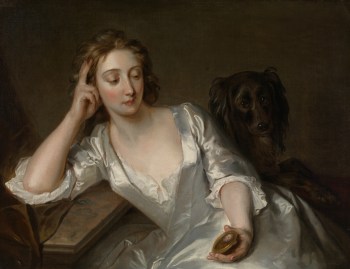
Philip Mercier, Portrait of Margaret (Peg) Woffington, oil on canvas (London: The Garrick Club).
The Huguenot painter Philip Mercier (1689–1760) was at the vanguard of one of the most intriguing of eighteenth-century British art forms: the fancy picture. Playful in tone and fluttering in execution, Mercier’s fancies typically depict a non-too-serious world of modern men, women and children living a life of fashion, pleasure and the senses. Though manifestly trivial in theme and decorative by design, these are often nonetheless rather imposing works of art, presenting their life-scale characters close to the viewer so as to evoke a palpable sense of presence. Mercier’s role in adapting Continental prototypes of this kind of picture for the diversifying and growing British art market has long been recognised. This talk offers an enhanced version of this origin story, setting the imagery of this first wave of fancies in the context of extraordinary expansion in the British consumption of fine and modish goods of all kinds. It also takes a close look at how, as a maker of novel luxuries, Mercier both profited by and fell victim to the very world of fleeting fashions that he took as his primary subject, exposing the tribulations that lurked beneath the surface of the British fancy picture during its light-hearted beginnings.
John Chu is Assistant Curator of Pictures and Sculpture for the National Trust and has taught at the Courtauld Institute of Art and the University of Reading. He has published on the art of Thomas Gainsborough, Joshua Reynolds, and French artists working in eighteenth-century Britain, as well as on various dimensions of the National Trust’s picture collections. He read English literature at the University of Cambridge before pursuing postgraduate studies in the history of art at the Courtauld. Having specialised in eighteenth-century British and French art during his masters’ degree, he gained his doctorate in 2015 for ‘The Fortunes of Fancy Painting in Eighteenth-Century England’. He is currently writing a book on the same subject with a Postdoctoral Fellowship from the Paul Mellon Centre for Studies in British Art.
The Fellows Lunch Series is a series of free lunchtime research talks given by recipients of Paul Mellon Centre Fellowships. All are welcome but please book a ticket in advance. Tuesday, 13 June 2017, 12:30–2:00pm.
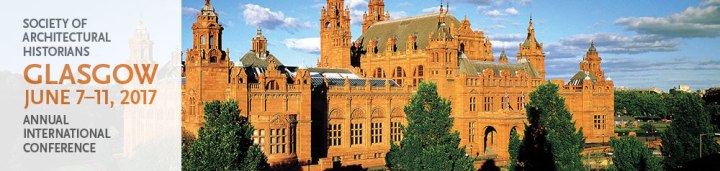
SAH 2017, Glasgow
◊ ◊ ◊ ◊ ◊
A selection of offerings at this year’s SAH conference relevant to the eighteenth century:
2017 Society of Architectural Historians Conference
Glasgow, 7–11 June 2017
The Society of Architectural Historians will host its 70th Annual International Conference in Glasgow, Scotland, June 7–11, 2017. This is the first time that SAH has met outside North America in over 40 years. Meeting in Scotland’s largest city, world renowned for its outstanding architectural heritage, reflects the increasingly international scope of the Society and its conference. Architectural historians, art historians, architects, museum professionals and preservationists from around the world will convene to share new research on the history of the built environment. The Glasgow conference will include 36 paper sessions, eight roundtables, an introductory address and plenary talk, architecture tours, the SAH Glasgow Seminar, and more.
◊ ◊ ◊ ◊ ◊
Piranesi at 300
Thursday, 8 June, 8:30–10:40am
Chairs: Heather Hyde Minor (University of Notre Dame) and John Pinto (Princeton University)
1. Dirk De Meyer (Ghent University), Lauding the Republic: Piranesi, Sallust, the Romans and the French
2. Eleonora Pistis (Columbia University), Scipione Maffei, Piranesi, and the Construction of Etruscan Magnificence
3. John Stamper (University of Notre Dame), Piranesi’s Roman Bridges: Engineering to Art
4. Elizabeth Petcu (Ludwig-Maximilians-Universität), ‘Nature, the great renewer’: Piranesi Visualizes Architectural Imitation
5. Victor Plahte Tschudi (The Oslo School of Architecture and Design), Rediscovering Piranesi in the Twentieth Century
◊ ◊ ◊ ◊ ◊
Chinese Architecture and Gardens in a Global Context
Thursday, 8 June, 8:30–10:40am
Chair: Tracy Miller (Vanderbilt University)
1. Zhu Xu (The University of Hong Kong), From Monastic Cells to Corridors: Historical Significance of Sixth–Seventh-Century Changes in the Chinese Buddhist Monastery
2. Lizhi Zhang (Tsinghua University), Hindu Features in the Vernacular Architecture of Southeast China
3. Lianming Wang (Heidelberg University), Hybrid Spaces Reconsidered: Knowledge, Identity and Publicity in Eighteenth-Century Jesuit Gardens in Beijing
4. Yiping Dong (Xi’an Jiaotong-Liverpool University), Historical Study on Modern Textile Mills in Yangtze Delta
5. Mark Hinchman (University of Nebraska), Modern Chinese Association Buildings: Exit Nation, Enter Ethnicity
◊ ◊ ◊ ◊ ◊
EAHN Roundtable: Architectural History and Open Access in Europe
Thursday, 8 June, 1:15–2:45
Chair: Maarten Delbeke (ETH Zürich)
After the successful roundtable Architectural History Online at the SAH 2016 annual conference, the EAHN plans to discuss the possibilities and challenges of digital publishing and open access policies in the European context. The requirements of national funding agencies, as well as the financial support they offer, play a different role than in the U.S. The panel, consisting of journal editors and others active in the field, also will address questions of how journals deal with the proliferation of online publications, how they negotiate between the academic world and architecture culture writ large, and how they deal with the handling and sustainability of digital data.
1. Caroline Edwards (Open Library of Humanities, UK)
2. Irina Davidovici (ETH Zürich, bauforschungonline
3. Juliette Hueber (InVisu/National Center for Scientific Research France
4. Françoise Gouzi (Université Toulouse)
5. Eduard Fuehr (Brandenburg Technical University at Cottbus)
◊ ◊ ◊ ◊ ◊
Discovering Georgian Glasgow: Allan Dreghorn’s City
Saturday, 10 June, 1:00–4:30
Tour led by Anthony Lewis (Glasgow Museums)
Allan Dreghorn (1706–1764) made his mark on Georgian Glasgow as an architect, builder, developer, and entrepreneur. This tour will include both a walking tour in central Glasgow to understand his influence on the layout and buildings of the Merchant City, including the extant St Andrews in the Square Church, and the Tontine Heads, the sculptural keystones from Dreghorn’s Tontine Hotel (no longer standing), available for viewing in the garden of the Provand’s Lordship Museum. This tour will also visit Pollok House, Glasgow’s grand Georgian seat of the Maxwell and Jardine families, with its associations with both Dreghorn and the Adam family.
◊ ◊ ◊ ◊ ◊
Edinburgh: The New Town and William Playfair
Sunday, 11 June, 11:00–7:30
Tour led by John Lowrey (University of Edinburgh)
This tour will explore Edinburgh’s 18th- and 19th-century development, with a special focus on the planned New Town (part of the World Heritage Site, begun in the 1770s and celebrating its 250th anniversary in 2017) and the work of William Playfair, Edinburgh’s leading 19th-century architect. The day will begin with an exclusive focused session at Edinburgh University Library, where Playfair’s archive is housed. The group will be given special access to Playfair’s drawings and, guided by the tour leader, the University’s archive team, and expert historian colleagues, will consider Playfair’s career in context. After lunch, the tour will walk to the New Town and will see key sites and buildings, including Calton Hill (the epitome of Edinburgh’s tag as ‘Athens of the North’), St. Andrew’s Square, and Charlotte Square. At the end of the day, participants will join those from the other two Edinburgh tours for a drinks reception in the University of Edinburgh’s historic New College.
Symposium | Sculpture Collecting and Display, 1600–2000
From The Frick:
Sculpture Collecting and Display, 1600–2000
The Frick Collection, New York, 19–20 May 2017
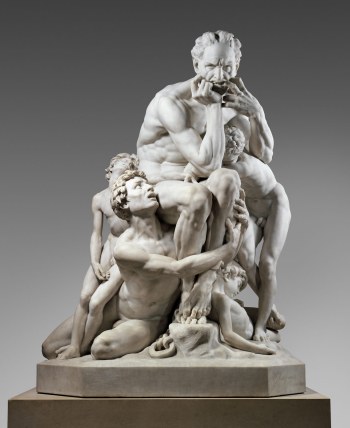
Jean-Baptiste Carpeaux, Ugolino and His Sons, 1865–67 (New York: The Metropolitan Museum of Art).
Presented by the Center for the History of Collecting, Frick Art Reference Library, this two-day symposium will showcase how approaches to collecting and displaying sculpture have varied and changed over the centuries, from the Kunstkammer of late Renaissance princes, to the sculpture galleries of the eighteenth century, to garden sculpture ensembles and, finally to the challenges of displaying sculpture in public museums. Tickets for both days are $50 ($35 for members); single-day tickets are $30 ($25 for members). The symposium is made possible through the support of the Robert H. Smith Family Foundation.
F R I D A Y , 1 9 M A Y 2 0 1 7
3:15 Registration
3:30 Welcome and Opening Remarks by Ian Wardropper (Director, The Frick Collection) and Inge Reist (Director, Center for the History of Collecting, Frick Art Reference Library)
3:45 Keynote Address
• Malcolm Baker (Distinguished Professor, University of California, Riverside), What Do We Mean by a ‘Sculpture Collection’?
4:30 Coffee break
4:55 Wunderkammer and Kunstkammer: Mixing the Media
• Jeremy Warren, Honorary Curator of Sculpture, Ashmolean Museum, Oxford, and Sculpture Research Curator, The National Trust), The Collecting of Small Bronze Sculptures in Renaissance Italy
• Michael Yonan (Associate Professor of Art History, University of Missouri), Porcelain as Sculpture: Medium, Materiality, and the Categories of Eighteenth-Century Collecting
• Thomas DaCosta Kaufmann (Frederick Marquand Professor of Art and Archaeology, Princeton University), Messy History? Sculpture Collecting and the Kunstkammer
6:25 Questions from the Audience
S A T U R D A Y , 2 0 M A Y 2 0 1 7
10:00 Registration
10:15 Welcome by Inge Reist (Director, Center for the History of Collecting, Frick Art Reference Library)
10:25 Garden Sculptures as Collections
• Betsy Rosasco (Research Curator of European Painting and Sculpture, Princeton University Art Museum), Versailles, Marly, Dresden: Magnificence and Its Limits
• Julius Bryant (Keeper of Word & Image, Victoria and Albert Museum), Gentlemen Prefer Bronze: Garden Sculpture and Sculpture Gardens in Eighteenth-Century England
11:25 Coffee break
11:50 Sculpture Galleries
• Jeffrey Collins (Professor, Bard Graduate Center), Staging Statues: The Challenge of the Group
• Anne-Lise Desmas (Curator and Department Head of Sculpture and Decorative Arts, The J. Paul Getty Museum), The ‘Gallerie du S.r Girardon Sculpteur Ordinaire du Roy’
12:50 Lunch break
11:50 Sculpture Galleries, continued
• Alison Yarrington (Professor of Art History and Dean of the School of Arts, English, Drama and Publishing, Loughborough University), Myth, Memory, and Marble: The Country House Sculpture Gallery in the Post-Napoleonic Period
2:45 The Changing Place of Sculpture in the Public Museum
• Andrew McClellan (Professor of Art History, Tufts University), The Problem of Sculpture in the Public Museum
• Alan Darr (Senior Curator of the European Art Department and Walter B. Ford II Family Curator of European Sculpture & Decorative Arts, Detroit Institute of Arts), The Legacy of William Valentiner in Shaping the Display of European Sculpture in American Museums, 1900–Present: Case Studies
• James Fenton and Ian Wardropper in Conversation: Collecting Sculpture for Private and Public Collections during the Late Twentieth and Early Twenty-First Centuries
Conference | The Art of Beefing it Up
From The Museum of English Rural Life:
The Art of Beefing it Up
The Museum of English Rural Life, University of Reading, 19 June 2017
Registration due by 1 June 2017
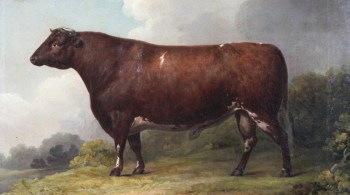 A one-day conference on how paintings and prints of farm livestock functioned during the late-18th and early-19th centuries. Spaces are limited, please book by 1 June 2017. Cost includes buffet lunch and refreshments.
P R O G R A M M E
9.30 Registration and coffee
9.45 Morning Session
• Ollie Douglas, Fat Beasts at the Museum of English Rural Life
• Hilary Matthews, The Woburn Sheepshearing
• Lawrence Weaver, The Iconic Paintings of Thomas Weaver
11.30 Coffee break
11.45 Visit to see relevant paintings, prints, artefacts, and archives in the Museum
13.00 Lunch
14.00 Afternoon Session
• Alison Wright, Paul Potter on the Thames: Landscape and Cattle Painting in Early-19th-Century Britain
• Pat Stanley, The Bakewell Effect
15.30 Panel discussion chaired by Jeremy Burchardt
16.00 Tea and departure
Exhibition | Peter the Great: A Tsar in France, 1717
Press release for the exhibition at Versailles, with thanks to Elizabeth Jane Timms for noting it:
Peter the Great: A Tsar in France, 1717
Grand Trianon, Château de Versailles, 30 May — 24 September 2017
Cuarated by Gwenola Firmin, Thierry Sarmant, and George Vilinbakhov
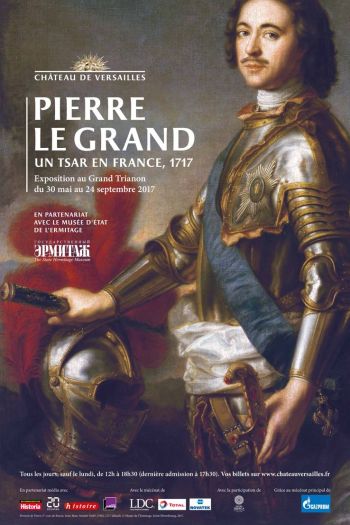 The exhibition Peter the Great: A Tsar in France, 1717 will be on display in the Grand Trianon from 30 May to 24 September 2017. It is dedicated to Tsar Peter the Great’s trip in and around Paris in May and June 1717 and will commemorate the 300th anniversary of this diplomatic visit. The fruit of exceptional collaboration between the Palace of Versailles and the Hermitage Museum, the exhibition will present over 150 works including paintings, sculptures, decorative artworks, and tapestries, as well as plans, medallions, scientific instruments, books and manuscripts, two thirds of which belong to the collections of the prestigious museum in Saint Petersburg.
A member of the house of Romanov and son of Tsar Alexis Mikhailovich (1645–1676) and Nataliya Naryshkina (1651–1694), Peter I (1672–1725) embarked on a second journey to the West twenty years after the Grand Embassy, which took him to Europe for the first time in 1697–98. He arrived in France on 21 April 1717 and remained until 21 June. He stayed at Versailles twice and was accommodated in the Grand Trianon, from 24 to 26 May and from 3 to 11 June. The exhibition will lead visitors step by step through the trip, which, although official, nonetheless allowed a certain amount of freedom since Peter I, being little accustomed to French etiquette and with his imposing figure and unpredictability, departed from protocol on multiple occasions. His encounter with Louis XV particularly shocked onlookers when, flouting the ceremonial custom of the court, he spontaneously took the young king, aged 7, in his arms. A number of memorialists, including Saint-Simon, the Marquis de Dangeau and Jean Buvat, left precious testimonies allowing us to retrace the journey.
Although there were political and economic aims to the stay—a project for an alliance with France against Sweden and the signature of a trade agreement—the reforming Tsar and founder of modern Russia most particularly wanted to see the finest of France in order to adapt certain models for his own empire. During the two months that Peter the Great spent in Regency Paris, his visits and discussions with French people provided him with food for thought and had an influence on the works he started in 1703 in Saint Petersburg and the surrounding area.
Pierre le Grand: Un Tsar en France, 1717 (Paris: 2017), 240 pages, ISBN: 978 23590 62014, 38€.
Curators
• Gwenola Firmin Curator in charge of paintings from the 18th century at the Palace of Versailles
• Thierry Sarmant Chief curator, head of the Archives historic Center, historic department of the Defence
• George Vilinbakhov Vice-director of the State Hermitage Museum in Saint Petersburg
Call for Articles | Fall 2018 Issue of J18: Albums

From J18:
Journal18, Issue #6 (Fall 2018) — Albums
The Culture of Albums in the Long 18th Century
Proposals due by 1 October 2017; finished articles will be due by 1 April 2017
Selecting, collecting, classifying, curating, displaying, narrating, disseminating, transporting, entertaining, educating, subverting: what other single object does all of that at once? Ordering knowledge through the rationale of a sequenced and empirical display of data (visual, textual, material), the album became an archetypical site of the eighteenth century’s way of thinking about and representing the world. Neither a treatise implementing a master-hypothesis nor a random gathering of material, albums can be described as both hybrid and structured objects. They have the physical structure of a book and the appearance of a narrative but are also pure displays, a rhetorical organization of iconic discourses and a virtual folding or unfolding of a larger idea having a specific program. They simultaneously contain pictorial imagery (paintings, cut-ups, and, later in the nineteenth century, photographs) and are themselves artistic creations. They provide microcosmic and portable representations of a polity, a culture, or an individual. Unexpected mixtures of media and topics also form the repertoire of many albums. They invite us to think through regimes of readability, visibility, and seriality. Often studied for their contents rather than as creations in their own right, albums raise many important questions regarding their status as archival or museum objects. Their contrived nature makes them ideal objects to be studied in terms of social practice, identity politics, and interconnectedness. They invoke relationships, compositions, and collectivity. The album offers a very fertile ground for probing the material and intellectual productivity of cultures.
What does album-making tell us about cultural and individual identities? And how do these identities utilize and make sense of this specific practice? How do albums work iconographically and textually? What is their historical significance and how can we interpret them? For Issue 6 of Journal18, we invite papers that explore these and related questions to appraise this hitherto neglected object of our discipline. In particular, we call for an investigation of parallel developments of albums around the globe across the long eighteenth century (1650–1850), as well as the theoretical debates informing notions of serialization and authenticity. Drawing upon neighboring fields of anthropology, literary criticism, philosophy, and museum studies, we invite scholars to think about these objects as ubiquitous and intimately interconnected artefacts, and to investigate them within cultures of imperialism, colonialism, identity politics, and theoretical approaches of artistic hybridity and difference.
Issue Editor
Nebahat Avcioglu, Hunter College/CUNY
Proposals for issue #6 Albums are now being accepted. Deadline for proposals: October 1, 2017. To submit a proposal, send an abstract (200 words) and a brief CV to editor@journal18.org and navciogl@hunter.cuny.edu. Articles should not exceed 6000 words (including footnotes) and will be due on April 1, 2018. For further details on the submission process see Information for Authors.
UK Export Ban Placed on Meissen Commedia dell’Arte Figure
Press release (2 May 2017) from Gov.UK’s Department for Culture, Media & Sport:
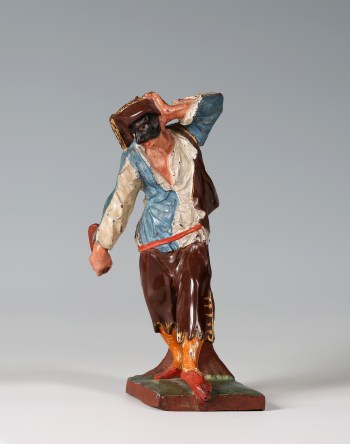
Meissen Böttger stoneware commedia dell’arte figure, partly polished and with original colouring, ca. 1710–13, 16.4 cm high; sold in the Emma Budge Sale, Paul Graupe, Berlin (27–29 September 1937, Lot 779).
A commedia dell’arte figure is at risk of being exported from the UK unless a buyer can be found to match the asking price of £270,000. Meissen is renowned across Europe as being the first true hard-paste porcelain factory in 18th-century Europe. The rare, fragile, and translucent porcelain imported from China and Japan was a source of wonder to kings, princes, and aristocrats across Europe at the time, with many attempting to replicate these efforts. The production of hard-paste porcelain was preceded by the creation of a very fine high-fired earthenware. This stoneware figure is an outstanding example, which demonstrates the cutting-edge technology of the time. It is one of an extremely rare group of models after the Italian commedia dell’arte theatre, for which the factory at Meissen subsequently became famous.
The item was formerly owned by Emma Budge, a prominent Jewish art collector whose collection was sold at the Graupe Auction House in Berlin in 1937 following her death. The Nazis replaced the executors of her will with their own and the proceeds from the sale were paid into a blocked account. Emma’s heirs never received any of the money. The figure was eventually acquired by a prominent member of the Jewish community who escaped Nazi Germany in April 1938.
The decision to defer the export licence follows a recommendation by the Reviewing Committee on the Export of Works of Art and Objects of Cultural Interest (RCEWA), administered by The Arts Council England. The RCEWA made its recommendation on the grounds of the figure’s aesthetic importance and for its outstanding significance to the study of Meissen porcelain and 18th-century sculpture.
The decision on the export licence application for the figure will be deferred until 1 October. This may be extended until 1 January 2018 if a serious intention to raise funds to purchase it is made at the recommended price of £270,000 (plus VAT of £4,500). Organisations or individuals interested in purchasing the figure should contact the RCEWA.
New Book | Collecting the World: Hans Sloane
From the Royal College of Physicians:
James Delbourgo, The Life and Curiosity of Hans Sloane
Royal College of Physicians, London, 7 June 2017
This lecture by Professor James Delbourgo explores the astonishing story of Sir Hans Sloane, a young Irish doctor who became one of the greatest physicians, collectors, and figures of the eighteenth century. Wednesday, 7 June 2017, 18:00–20:00. Please note that places for this free event are extremely limited and advance booking is essential. For additional details, please see the Royal College of Physicians website.
◊ ◊ ◊ ◊ ◊
From Harvard UP:
James Delbourgo, Collecting the World: Hans Sloane and the Origins of the British Museum (Cambridge: Belknap Press, 2017), 544 pages, ISBN 978 06747 37334, $35 / £28 / €32.
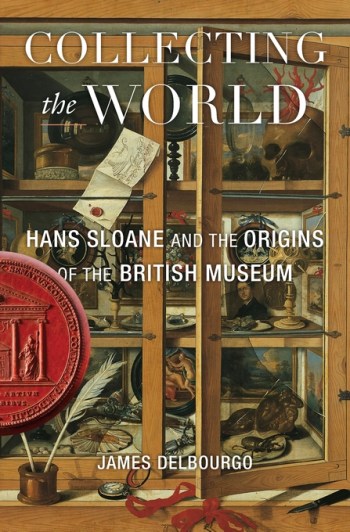 In 1759 the British Museum opened its doors to the general public—the first free national museum in the world. James Delbourgo’s biography of Hans Sloane recounts the story behind its creation, told through the life of a figure with an insatiable ambition to pit universal knowledge against superstition and the means to realize his dream.
Born in northern Ireland in 1660, Sloane amassed a fortune as a London society physician, becoming a member of the Whig establishment and president of the Royal Society and Royal College of Physicians. His wealth and contacts enabled him to assemble an encyclopedic collection of specimens and objects—the most famous cabinet of curiosities of its time. For Sloane, however, collecting a world of objects meant collecting a world of people, including slaves. His marriage to the heir of sugar plantations in Jamaica gave Sloane access to the experiences of planters and the folkways of their human property. With few curbs on his passion for collecting, he established a network of agents to supply artifacts from China, India, North America, the Caribbean, and beyond. Wampum beads, rare manuscripts, a shoe made from human skin—nothing was off limits to Sloane’s imagination. This splendidly illustrated volume offers a new perspective on the entanglements of global scientific discovery with imperialism in the eighteenth century. The first biography of Sloane based on the full range of his writings and collections, Collecting the World tells the rich and complex story of one of the Enlightenment’s most controversial luminaries.
James Delbourgo is Associate Professor of History at Rutgers University.
◊ ◊ ◊ ◊ ◊
C O N T E N T S
List of Illustrations
List of Maps
Introduction: The Original Sloane Ranger
I. Empire of Curiosities
1 Transplantation
2 Island of Curiosities
3 Keeping the Species from Being Lost
II. Assembling The World
4 Becoming Hans Sloane
5 The World Comes to Bloomsbury
6 Putting the World in Order
7 Creating the Public’s Museum
Conclusion: The Man Who Collected the World
Acknowledgements
Notes
Bibliography
Index










 Enfilade
leave a comment