Call for Papers | The Roman Art World and the Academy in Britain
From the Call for Papers:
The Roman Art World in the 18th Century and the Birth of the Art Academy in Britain
The Accademia di San Luca and the British School at Rome, Rome, 10–11 December 2018
Proposals due by 12 March 2018
The Accademia di San Luca and the British School at Rome (BSR) invite submissions for papers for the conference The Roman Art World in the 18th Century and the Birth of the Art Academy in Britain, to be held in Rome between 10 and 11 December 2018. The conference will focus on the role of the Roman pedagogical model in the formation of the British academic art world in the long 18th century.
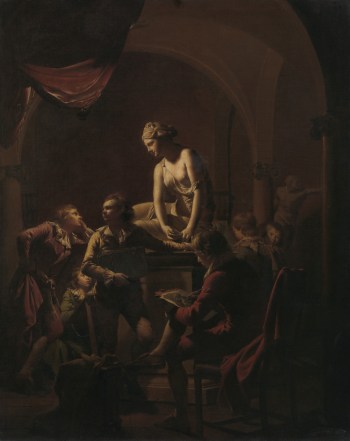
Joseph Wright of Derby, Academy by Lamplight, 1769, oil on canvas (New Haven: Yale Center for British Art, Paul Mellon Collection).
Even as Paris progressively dominated the modern art world during the 18th century, Rome retained its status as the ‘academy’ of Europe, attracting a vibrant international community of artists and architects. Their exposure to the Antique and the Renaissance masters was supported by a complex pedagogical system. The Accademia di San Luca, the Capitoline Accademia del Nudo, the Concorsi Clementini, and numerous studios and offices, provided a network of institutions and a whole theoretical and educational model for the relatively young British art world, which was still striving to create its own modern system for the arts. Reverberations of the Roman academy system were felt back in Britain through initiatives in London such as the Great Queen Street Academy, the Duke of Richmond’s Academy, the Saint Martin’s Lane Academy, and the Royal Society of Arts. But it was a broader national phenomenon too, inspiring the likes of the Foulis Academy in Glasgow and the Liverpool Society of Artists. The foundation of the Royal Academy of Arts in London in 1768 officially sanctioned the affirmation of the Roman model.
If past scholarship has concentrated mainly on the activities of British artists while in Rome, this conference wishes to address the process of intellectual migration, adaptation and reinterpretation of academic, theoretical and pedagogical principles from Rome back into 18th-century Britain. It responds to the rise of intellectual history, building on prevalent trends in the genealogy of knowledge and the history of disciplines, as well as the mobility and exchange of ideas and cultural translation across borders.
The conference welcomes diverse approaches to investigating the dissemination of the academic ideal from Rome to Britain. These might address, but are by no means limited to, the following topics:
• The impact of the Roman academic structure, theory and pedagogy on British art academies, artists’ studios and architects’ offices.
• The impact of art and architectural theory in Rome on the formation of a public discourse on art and architecture in Britain.
• The process of adaptation and reinterpretation of Roman theoretical and pedagogical principles to the British artistic and architectural context, and the extent to which British art academies developed new principles, absorbed the Roman model, or derived them from elsewhere.
• The role played by Roman and Italian artists and architects in the formation and structuring of the 18th-century British art academies and, in particular, of the Royal Academy of Arts.
• The presence and activities of British artists and architects in Roman studios, offices and academies and the presence of Italian artists in British academies.
• The role played by other relevant academies—such as those at Parma and Florence—on the formation of British artists and architects in relationship/opposition to the Roman model.
This conference will conclude a series of events celebrating the 250th anniversary of the foundation of the Royal Academy of Arts in London. It will also be part of a series of conferences and exhibitions focusing on the role of the Accademia di San Luca in the spread of the academic ideal in Europe and beyond, inaugurated in 2016 with an exhibition and conference on the relationship between Rome and the French academy, held at the Accademia di San Luca and at the Académie de France à Rome.
Please provide a concise title and abstract (250 words maximum) for a 20-minute paper. Send your proposal, with a current CV of no more than two pages, to humanities@bsrome.it. Proposals must be received by midnight, Monday 12 March 2018. Speakers will be notified of the committee’s decision in mid-April 2018. Travel grants will be available.
Adriano Aymonino
Carolina Brook
Gian Paolo Consoli
Thomas-Leo True
PhD Research Placements at the British Library
From the BL:
William Blake at the British Library: PhD Research Placement
3 months during the period from June until December 2018
Applications due by 19 February 2018
PhD students are invited to apply to undertake one of our forthcoming research placements. These are specially-selected projects that have been developed by the Library to support current doctoral researchers to develop and apply transferrable skills and expertise. Amongst the opportunities being offered in the current Call is a placement on William Blake, focused on the Library’s large collection of prints by Blake. Further details and profiles for each of the other placements are available here.
A PhD research placement at the British Library provides the chance to experience research in a different environment to that of a university, to engage with a range of research users and audiences, to gain insights into different potential postdoctoral career paths, and to make a tangible contribution to the purposes and programmes of a national library and major cultural organisation. A broad range of research placement opportunities have been identified by the Library for 2018–19.
To Apply
Application Guidelines and the application form are available here. Please refer to the guidelines and email the completed application form and a CV to Research.Development@bl.uk. Please note that all applications must be approved by the applicant’s PhD supervisor and Graduate Tutor (or equivalent senior academic manager). The application deadline is 4pm on 19 February 2018.
Eligibility
This scheme is open to all PhD students, as long as they have the support of their PhD supervisor and their Graduate Tutor (or equivalent). International students are eligible if they have the right to study in the UK.
Funding
The research placements offered through the scheme are opportunities for current PhD students to apply and enhance research skills and expertise outside of Higher Education as part of their wider research training and professional development. They are training and development opportunities to be undertaken within this specific context—and are therefore different to the paid internships or other fixed-term posts that the Library may occasionally make available. See the Application Guidelines for further details and background. Please note that—unlike for an internship or a fixed-term post—the British Library is unable to provide stipends or payment to PhD placement students. It is therefore essential that applicants to the placement scheme obtain the support of their PhD supervisor and Graduate Tutor (or someone in an equivalent senior academic management role) in advance and that, as part of their process, they consult their HEI to ascertain what funding is available to support them. To support self-funded and part-time students, most placements can be done on a part-time basis, with some remote working also sometimes possible—see the individual projects for details.
Jonny Yarker Joins Lowell Libson
Press release (January 2017) from Lowell Libson & Jonny Yarker Ltd:
 Lowell Libson Ltd is delighted to announce that from January 2018 it will be trading as Lowell Libson & Jonny Yarker Ltd. Lowell Libson is one of the great names in the world of London dealing: for the last seventeen years his gallery has been synonymous with British paintings, drawings, and sculpture of the highest quality. It is unusual for a gallery owner, with over forty years’ experience and his name above the door to embrace such a radical transformation, and it signals an important change for the future.
“Jonny joined the business five years ago and during that time we have worked very happily and successfully together. Jonny has made a huge impact on the gallery, and he has played an extremely significant role in developing the business with me; now is the right time to recognize this working partnership in a tangible way,” Lowell Libson commented. “I am very excited about the future, Jonny is a talented dealer, a leading scholar and a good friend and I look forward to our new venture together.”
Jonny Yarker had recently finished his PhD when Lowell approached him to come and work at the gallery. “I admired Lowell long before I met him. He had this amazing reputation for supporting scholarship and exhibitions of British art; I remember when I was a student seeing his name everywhere,” says Yarker, “Little did I think I would end up working with him.” Libson has a reputation for supporting innovative scholarship in British art and the gallery has sponsored major exhibitions at the Royal Academy, British Museum, Courtauld, Ashmolean, and Morgan Library and Museum in New York.
With Jonny on board, the company’s outlook became more routed in research and their projects were able to become more ambitious. For example, in 2014 they mounted the largest selling exhibition of drawings by Gainsborough for a century. Lowell and Jonny have also recently made a number of notable discoveries including newly identified works by Samuel Palmer, John Constable, Johan Zoffany as well uncovering a previously unknown cache of drawings by Sir Peter Lely.
Each brings complimentary talents to the business (as Libson says, “It’s not particularly constructive working with a clone of oneself”). They see their great strength as a willingness to embrace change and think laterally. “We operate in an apparently narrow field, but Lowell has an amazing ability to reinvent what we do, at the same time preserving a continuity of taste,” Yarker observes.
In March, the gallery will be exhibiting at the Salon du dessin in Paris for the first time and in July they will mount a major exhibition of drawings made in Britain before 1730. Libson has been collecting for the exhibition for over a decade but observes: “Jonny has really made the project his own, he has brought an academic rigour and flair to my initial idea; it is going to be a truly groundbreaking exhibition, I can’t wait!”
This is the essence of what Libson and Yarker do: bring high levels of scholarship and their own personal taste to British art. It is a formula that has won them an international group of clients, both institutional and private.
Exhibition | Thomas Gainsborough: Modern Landscape

Thomas Gainsborough, Mr. and Mrs. Andrews, ca. 1750
(London: National Gallery)
◊ ◊ ◊ ◊ ◊
On view this spring at the Hamburger Kunsthalle:
Thomas Gainsborough: The Modern Landscape / Die moderne Landschaft
Hamburger Kunsthalle, 2 March — 27 May 2018
Curated by Katharina Hoins and Christoph Martin Vogtherr
Thomas Gainsborough (1727–1788) was a pioneering artist in the development towards ›modern‹ landscape painting of around 1800. He was mainly perceived as a painter of brilliant society portraits by his contemporaries, although he personally far preferred his landscapes. They reflect the dramatic technological and artistic developments of his time and the growing contradictions in British society. Landscape painting served Gainsborough as a laboratory to transform impressions into innovation. He experimented with colours and techniques, painted on glass and combined natural materials into landscape models. Establishing England as a centre of European landscape painting, he created images of timeless power. Iconic works like Mr and Mrs Andrews will feature in the exhibition. Gainsborough: Modern Landscape is the first exhibition by a German museum devoted to Gainsborough. For a German and an international public it promises the (re-)discovery of an exceptional painter.
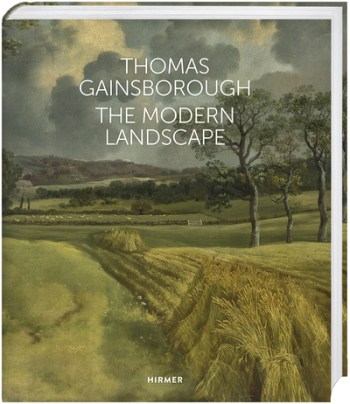 M. Bills, B. Gockel, M. Hallett, K. Hoins, R. Jones, J. Karg, S. Pisot, and C. Vogtherr, Thomas Gainsborough: The Modern Landscape (Munich: Hirmer, 2018), 224 pages, ISBN: 978 37774 29977, $65.
Gainsborough himself favoured landscape painting, a field to which he made important contributions, over his well-known portraits. His works are fascinating for their painterly subtlety and technical variation. This volume brings together German and British traditions of viewing, interpreting, and studying Gainsborough. It looks at the connections to the Dutch landscapes, explains Gainsborough’s unusual and experimental techniques from an art technological point of view, and situates his landscapes in the context of the social tensions of early industrialisation.
Williamsburg Acquires Rare Danish Abolitionist Medal

Abolition of the Slave Trade Medal, dies by Pietro Leonardo Gianelli, Denmark, bronze, 1792 (Colonial Williamsburg Foundation, Museum Purchase, Lasser Numismatics Fund and Partial Gift, John Kraljevich).

Abolition of the Slave Trade Medal, dies by Pietro Leonardo Gianelli, Denmark, bronze, 1792 (Colonial Williamsburg Foundation, Museum Purchase, Lasser Numismatics Fund and Partial Gift, John Kraljevich).
Press release (10 January 2018). . .
One of the most important medallic items related to the Atlantic slave trade and one of Denmark’s most iconic medals is now part of the Colonial Williamsburg Foundation’s collections. Designed by the Danish artist Nicolai Abildgaard and struck in bronze in 1792 from dies by the Italian medalist Pietro Leonardo Gianelli, the extremely rare piece commemorates that year’s royal edict ending trade in enslaved persons on Danish ships. Only a small handful of these medals produced in a variety of metals are known to exist: white metal examples are in Danish museums and others, held in private collections, were struck in bronze and silver.
“The items of Colonial Williamsburg’s collections capture tangibly our complex, shared history,” said Mitchell B. Reiss, Colonial Williamsburg president and CEO. “In this rare 1792 medal we see an Atlantic power affirming the humanity of a people exploited as property, as well as a foretelling of abolition in America. We welcome our guests 365 days a year—and especially in February during Black History Month—to experience the diverse stories of our nation’s founding.”
In Denmark in 1792, as the move towards banning slavery was taking hold throughout Europe and two years before Congress prohibited the slave trade between the United States and foreign countries, Crown Prince Frederik VI, acting as regent for his mentally unstable father, Christian VII, issued what is considered to be the Prince’s most important proclamation: the Edict of the Abolition of the Slave Trade. This decree made Denmark the first European nation to outlaw trade in enslaved persons on ships flying its flag, though the measure did not fully take effect until 1802. This medal, made at the beginning of the abolitionist movement on the European continent, marks a dramatic shift in the way Denmark sought to treat the enslaved African population in the nation’s Caribbean colonies, the Danish West Indies. The male head depicted in profile on the face of the medal is likely the oldest Danish naturalistic portrait of an African. The Latin phrase ‘Me Miserum’ (‘Woe is me’ or ‘Poor me’) is imprinted as a border around the profile. The reverse image shows the mythological winged goddess Nemesis, who was thought to be the avenging goddess of divine indignation against and retribution for evil deeds and undeserved good fortune. She is depicted seated and facing forward on a platform decorated with a shield that bears her name while holding an apple branch in one hand and touching her wing with the other. The Latin legends indicate the medal was produced under the Danish King’s law and includes the date of the edict, March 16, 1792.
“Objects in the Colonial Williamsburg collection are remarkable not only for their aesthetic qualities, but for the history they illustrate,” said Ronald L. Hurst, the Foundation’s vice president for collections, conservation, and museums and its Carlisle H. Humelsine chief curator. “This medal sheds light on some of the first steps toward the end of slavery, a painful chapter in the Atlantic world’s history.”
“This masterfully executed work of medallic art is a benchmark piece for two reasons,” said Erik Goldstein, Colonial Williamsburg’s senior curator of mechanical arts and numismatics. “Not only does it beautifully and sensitively display the portrait of an African man, it also marks the beginnings of the abolitionist movement in Europe.”
The medal was acquired through the Lasser Numismatics Fund and a partial gift by John Kraljevich. It is scheduled for public display in 2020 following completion of the entirely donor-funded $41.7 million expansion of the Art Museums of Colonial Williamsburg. Both institutions, the DeWitt Wallace Decorative Arts Museum and the Abby Aldrich Rockefeller Folk Art Museum, remain open throughout construction.
Conference | Circulating Crafts
I’m always interested to see how one might extend the significance of a CAA panel beyond the conference itself. Here’s an interesting attempt with programming in Paris and LA. Last month I noted the first CAA panel, but I didn’t connect it to these other events. –CAH
From the programme:
Circulating Crafts: Art, Agency, and the Making of Identities, 1600–2000
Paris, 24 January 2018 / Los Angeles, 21 February 2018
Organized by Yaëlle Biro and Noémie Étienne
 Circulation and imitation of cultural products are key factors in shaping the material world—as well as identities. Many objects or techniques that came to be seen as local, authentic and typical are in fact entangled in complex transnational narratives tied to a history of appropriation, imperialism, and the commercial phenomenon of supply and demand.
In the 17th and 18th centuries, artists and craftspeople in Europe appropriated foreign techniques such as porcelain, textiles, or lacquers that eventually shaped local European identities. During the 19th century, Western consumers looked for genuine goods produced outside of industry, and the demand of Bourgeois tourism created a new market of authentic souvenirs and forgeries alike. Furthermore, the 20th century saw the (re)-emergence of local ‘Schools’ of art and crafts as responses to political changes, anthropological research, and/or tourist demand. This multi-part conference will explore how technical knowledge, immaterial desires, and political agendas impacted the production and consumption of visual and material culture in different times and places. A new scrutiny of this back and forth between demanders and suppliers will allow us to map anew a multi-directional market for cultural goods in which the source countries could be positioned at the center.
Contacts: yaelle.biro@metmuseum.org and noemie.etienne@ikg.unibe.ch
2 4 J A N U A R Y 2 0 1 8
Part 1 | Workshop: Circulating Crafts
La Colonie, 178 boulevard Lafayette, 75010 Paris
9.00 Welcome and Introduction by Yaëlle Biro and Noémie Étienne
9.15 Session A
• Ariane Fennetaux (Université Paris Diderot), From Coromandel with Love: The Glocalisation of Indian Cottons in the 17th and 18th Centuries
• Chonja Lee (Bern University), Made in Switzerland: How Swiss Indiennes Became Autochtone and Dressed the World at the Same Time
• Aziza Gril-Mariotte (Université de Haute-Alsace), Modèles, emprunts et circulation des formes occidentales dans les toiles peintes au XVIIIe siècle
11.15 Coffee break
11.30 Session B
• James Green (University of East Anglia), Appropriating Kongo Colors: Red, White and Black in 19th-Century English Trade Cloth
• Manuel Charpy, CNRS, Lille), Changing Sides? Consumption and Political Uses of Western Clothing in Congo, 1830–1960
13.00 Lunch break
14.00 Session C
• Thomas Grillot (CNRS, Paris), Marketing Family Heirlooms: Three Generations of American Indian Artists in the Northern Plains
• Rémi Labrusse (Université Paris-Nanterre), Hybridité et identité en Algérie à la veille de l’invasion française: le cas du palais du Bey de Constantine
15.20 Coffee break
15.35 Session D
• Julien Volper (Tervuren Museum), Du Bénin à l’Inde en passant par le Congo: Origines, in uences et voyages d’objets africains du XIXe et du XXe siècles
• Jonathan Fine (Ethnologisches Museum, Berlin), Crafting Culture: The Co-Production of ‘Bamum’ Art in the 1920s
• Gaëlle Beaujean (Musée du quai Branly – Jacques Chirac), Sirène, vierge, charmeuse de serpent et Atlantique
17.35 Discussion
2 1 F E B R U A R Y 2 0 1 8
Part 2 | Conference Panels: Art, Agency, and the Making of Identities, 1600–2000
College Art Association, Convention Center, Los Angeles
2.00 Panel I
• Helen Glaister (SOAS, University of London / Victoria & Albert Museum, London), The Picturesque in Peking: European Decoration at the Qing Court
• Dorothy Armstrong (Royal College of Art / Victoria & Albert Museum, London), A Transnational Loop: Pakistan’s Repossession of the Oriental Carpet Imaginary and its Production
• Tingting Xu (University of Chicago), The Rivers Folded: Souvenir Accordion Panoramas in the Late 19th-Century Global Tourism
• Karen Milbourne (Smithsonian National Museum of African Art), Lozi Style: King Lewanika and the Marketing of Barotseland
4.00 Panel II
• Ashley Miller (UC Berkeley), ‘What is Colonial Art and Can It Be Modern?’: Moroccan Modernisms at the Art Deco Exposition in Paris, 1925
• Victoria Rovine (University of North Carolina), A Wider Loom: Textiles and Colonial Politics of Authenticity in the Soudan Français
• Gail Levin (The City University of New York), Frida Kahlo’s Invention of Jewish Identity
• Niko Vicario (Amherst College), From Duco to Comex: The Politics of Synthetic Paint in the Americas
Illustration: French textile design for the West African slave trade market, Nantes, 18th century., “L’album des indiennes de traite de Favre, Petitpierre et Cie” (Henry-René d’Allemagne, La Toile imprimée et les indiennes de traite, Paris, Gründ, 1942, plate 69).
Symposium | Taking Exception: Women, Gender, Representation
From the symposium announcement:
The 2018 Bettie Allison Rand Symposium in Art History
Taking Exception: Women, Gender, Representation in the Eighteenth Century
A Symposium in Honor of Mary D. Sheriff
Ackland Art Museum, University of North Carolina at Chapel Hill, 1–3 February 2018
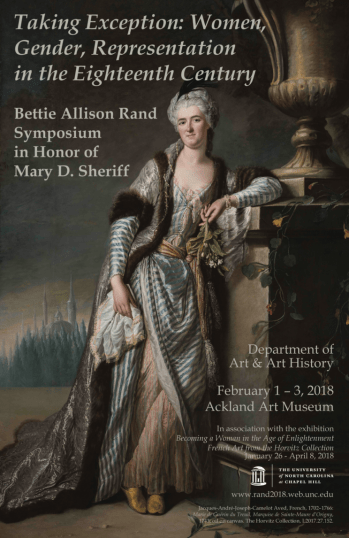 The 2018 Bettie Allison Rand Symposium will take place in tandem the Ackland Art Museum exhibition, Becoming a Woman in the Age of Enlightenment: French Art from the Horvitz Collection (open in Chapel Hill from 26 January until 8 April 2018). The exhibition is curated by Melissa Hyde, Professor of Art History, University of Florida Research Foundation Professor, University of Florida, and the late Mary D. Sheriff, W.R. Kenan Jr. Distinguished Professor of Art History, The University of North Carolina at Chapel Hill. It is organized by Alvin L. Clark, Jr, Curator, The Horvitz Collection and The J.E. Horvitz Research Curator, Harvard Art Museums/Fogg.
Through a generous gift to the UNC Arts and Sciences Foundation, William G. Rand established this lecture series in memory of his late wife, Bettie Allison Rand. This funding allows the Department of Art to bring one or more eminent art historians to UNC-CH every other year for residencies of various lengths. While they are in Chapel Hill, these scholars present a series of lectures and interact with undergraduate and graduate art history and studio art students. More information about the series can be found here.
Speakers will include
• Vivian Cameron, Independent Scholar
• Susanna Caviglia, Assistant Professor of Art, Art History & Visual Studies, Duke University
• Melissa Hyde, Professor of Art & Art History, University of Florida
• Anne Lafont, Director of Studies, L’Ecole des Hautes Etudes En Sciences Sociales
• Christopher Johns, Norman L. and Roselea J. Goldberg Professor of History of Art, Vanderbilt University
• Dorothy Johnson, Roy J. Carver Professor of Art History, University of Iowa
• Kathleen Nicholson, Professor Emerita of the History of Art and Architecture, University of Oregon
• Suzanne Pucci, Professor of Modern & Classical Languages, Literatures, & Cultures, University of Kentucky
• Abigail Solomon-Godeau, Professor Emerita of the History of Art & Architecture, University of California Santa Barbara
• Susan Taylor Leduc, Independent Scholar
• Michael Yonan, Associate Professor of Art History and Archaeology, University of Missouri
A memorial for Mary D. Sheriff will be held on Saturday, February 3rd at 1:00pm.
For more schedule details and to register to attend, visit the symposium website.
Contact: Tania C. String, tcstring@email.unc.edu
New Book | The Gardens of La Gara
Distributed by ACC Publishing and The University of Chicago Press:
Anette Freytag, ed., The Gardens of La Gara: An 18th-Century Estate in Geneva with Gardens Designed by Erik Dhont and a Labyrinth by Markus Raetz (Zurich: Scheidegger and Spiess, 2017), 272 pages, ISBN: 978 38588 18027, $99 / £85.
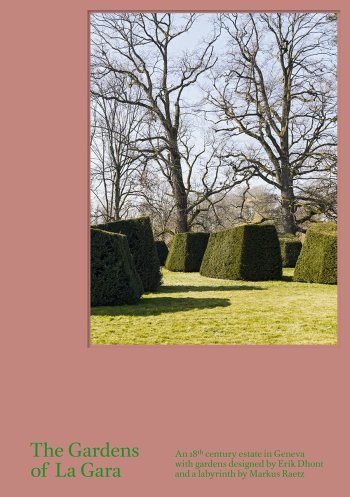 La Gara is an 18th-century country estate in Jussy, a village near Geneva, Switzerland. The buildings have been carefully restored by Swiss architect Verena Best, who also added inspired touches to the interior design. The renowned Belgian landscape designer Erik Dhont reinterpreted and subtly redesigned the gardens and surrounding grounds, completed by a palindrome-like labyrinth designed by Swiss artist Markus Raetz. This new book tells the story of the La Gara estate and illustrates its beauty. The essays investigate its preservation and restoration of buildings and gardens and the contemporary interventions. They highlight features such as the historic watering system for the gardens and the fishponds and look at the specific Genevan garden tradition and characteristics of the rural landscape around Jussy with its biodiversity. Moreover, they contextualise La Gara with the ‘ferme ornée’, a villa with agricultural and ornamental features following ancient Roman models. The beautiful volume is rounded out with newly commissioned photographs by renowned Swiss photographer Georg Aerni.
Anette Freytag is Professor of Landscape Design at Rutgers University in New Brunswick, New Jersey.
New Book | Joseph Banks’ Florilegium
From Thames & Hudson:
David Mabberley, Mel Gooding, and Joe Studholme, Joseph Banks’ Florilegium: Botanical Treasures from Cook’s First Voyage (London: Thames & Hudson, 2017), 320 pages, ISBN: 978 050051 9363, £65, $85.
 This is the first full-colour publication of some of the most extraordinary botanical prints of the 18th century. Banks’ Florilegium is not only a great scientific record, but also a major achievement of collaborative Enlightenment art and a work of botanical illustration of outstanding beauty.
Joseph Banks accompanied James Cook on his first voyage around the world between 1768 and 1771. A gifted and wealthy young naturalist, Banks collected exotic flora from Madeira, Brazil, Tierra del Fuego, the South Pacific, New Zealand, Australia and Java, bringing back over 1,300 species hitherto unknown to science. On his return, Banks commissioned over 700 superlative engravings as a scientific record. Known collectively as Banks’ Florilegium, they are some of the most precise and exquisite examples of botanical illustration ever made—yet they were never published in Banks’s lifetime.
The present selection has been made from a unique limited colour edition of the prints, with expert botanical commentaries provided by Professor David Mabberley. Mel Gooding describes the Endeavour voyage and the making of the Florilegium. An afterword by Joe Studholme outlines the history of the modern printing.
David Mabberley has served as Executive Director of the Royal Botanic Gardens and Domain Trust in Sydney. He is an Emeritus Fellow at Wadham College, Oxford, Adjunct Professor at Macquarie University, Sydney, and Professor Extraordinary at the University of Leiden, The Netherlands.
Mel Gooding is an art historian, writer and curator. He has taught at Edinburgh and Wimbledon Schools of Art, among others, and contributes regularly to the art press.
Joe Studholme co-founded Editions Alecto and undertook the printing of Banks’ Florilegium from the original copper plates between 1980 and 1990.
C O N T E N T S
• The Making of Banks’ Florilegium I: The Voyage of Endeavour, Mel Gooding
• The Plates, David Mabberley
• The Making of Banks’ Florilegium II: The Florilegium, 1772–1990, Mel Gooding
• The Modern Printing of the Florilegium, Joe Studholme
Call for Papers | Museums, Collections, and Conflict, 1500–2010
From the Museums and Galleries History Group:
MGHG Biennial Conference | Museums, Collections, and Conflict, 1500–2010
National Maritime Museum, Greenwich, 13–14 July 2018
Proposals due by 1 March 2018
Museums have been profoundly shaped by war and armed conflict, and have also played a significant part in shaping understandings and memories about them. Yet there has been little sustained examination of the way museums in war and war in museums has played out. Since Gaynor Kavanagh’s foundational study Museums and the First World War in 1994 and with the publication this year of Catherine Pearson’s similarly ground-breaking Museums in the Second World War, it is clear that museums have played and can play an important role in helping society address such crisis situations. On the home front, for example, museums have helped society prepare for war and armed conflict. In leading commemoration in the aftermath of war and armed conflict, museums have helped society come to terms with what happened, understand why it happened, and remember sacrifices. Yet museums have equally served as arenas where issues such as commemoration have been contested and negotiated and where particular narratives legitimising war and conflict have been developed. This conference hopes to address a broad range of questions, including on collecting (in) war and armed conflict, on the deliberate targeting and destruction or safeguarding of museums and cultural property, and the broader range of institutions brought forth or which are strongly influenced by war and armed conflict.
Keynote speaker: Annie Coombes, Professor of Material and Visual Culture, Birkbeck, University of London
We seek papers which particularly address but are not restricted to the following questions over a period from the early modern to the end of the twentieth century:
• What have museums done during periods of conflict and what has happened to them? Have they been responsible for morale, have they been targets of attack, have they physically moved and how has their staffing been affected?
• How have museums and collections acted to commemorate conflict?
• In what ways have wars and other conflicts affected museums’ and collectors’ collecting activities, positively or negatively? How have wars and conflicts been collected, and by whom?
• How have museums represented war, civil war and other conflicts such as rebellions? Have museums promoted peace by interpreting war?
• How have museums OF conflict, of the armed forces and of weaponry/armouries developed historically?
We welcome proposals for papers which deal with the history of museums and collecting in a British, European, or wider context or which address the relationships between different geographical areas.
Paper proposals should be for papers of 20 minutes’ length. Proposals should be 250 words max and include the name, contact details and affiliation (if applicable) of the speaker. Panel proposals are strongly encouraged and should consist of a panel title, proposals for 3 papers, along with a rationale for the panel theme, and contact details and affiliations (if applicable) of all participants. Please indicate whether you will provide a chair for your session or not (it does not matter which). Poster proposals are also welcomed. Please contact Kate Hill (khill@lincoln.ac.uk) for more information. All proposals should be sent to contact@mghg.info by 1 March 2018. Please note that all speakers and poster presenters will be expected to pay the conference registration fee.
The Museums and Galleries History Group (MGHG) was founded in 2002 and inaugurated in 2003 with the symposium Museums and their Histories, held at the National Gallery in London. The MGHG provides a platform for debate and contact among all those who seek to understand museums and galleries from historical and theoretical perspectives. The interests represented are wide-ranging, interdisciplinary and international and the Group also acts as a forum for considerations of the place of museum history within academic discourse and its importance for current museum practice.










 Enfilade
leave a comment