Conference Papers | Académies d’art et mondes sociaux, 1740–1805
Conference papers from the study day on ‘Académies d’art et mondes sociaux, 1740–1805’, held last November in Rouen, are now available from the ACA-RES website. Also please note that the research programme’s next conference will be held in Paris 26–28 March 2020. Proposals for papers related to ‘Art Academies and Their Networks in the Age of Enlightenment’ are being accepted until 6 September 2019.
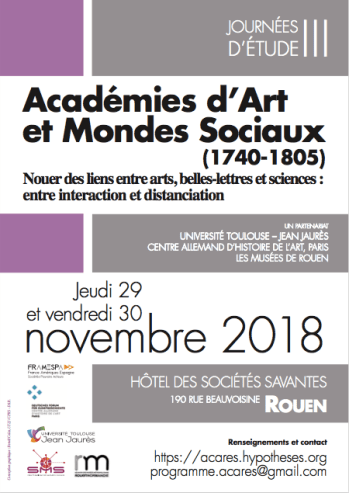
Journées d’étude III: Académies d’art et mondes sociaux, 1740–1805
Hôtel des Sociétés Savantes, Rouen, 29–30 November 2018
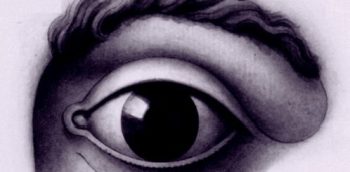
Jean-Jacques Lequeu, Études de l’œil (detail), 1798.
Nouer des liens entre arts, belles-lettres et sciences: entre interaction et distanciation
En partenariat Université Toulouse – Jean Jaurès ; Centre allemand d’histoire de l’art, Paris ; Les musées de Rouen
Les troisièmes journées d’étude du programme ACA-RES se sont tenues les 29 et 30 novembre 2018 à Rouen, en voici le compte rendu synthétique et les différents articles auxquels il renvoie :
• Anne Perrin Khelissa and Émilie Roffidal, « Nouer des liens entre arts, belles-lettres et sciences : entre interaction et distanciation », Les papiers d’ACA-RES, Actes des journées d’étude, 29–30 novembre 2018, Rouen, Hôtel des Sociétés Savantes, mis en ligne juin 2019 (PDF à télécharger : perrin khelissa-roffidal-2019)
1. Architecture, peinture, sculpture, des sœurs jumelles ?
• Émilie d’Orgeix, « L’ingénieur, les écoles du génie et les arts », à venir
• Dominique Massounie, « La place de l’architecture et de l’École des arts de Jacques-François Blondel dans l’histoire des académies artistiques provinciales du XVIIIe siècle », mis en ligne juin 2019 (PDF à télécharger : massounie-2019)
• Théodore Guuinic, « L’École des arts, ponts et chaussées de Montpellier sous la Révolution, 1787–1796 : un enseignement conjoint des sciences et des arts », mis en ligne juin 2019 (PDF à télécharger : guuinic-2019)
 2. L’art est-il utile à l’économie ?
• Aude Gobet, « Jean-Baptiste Descamps, les négociants et les manufactures à Rouen au XVIIIe siècle, 1741–1791 », mis en ligne juin 2019 (PDF à télécharger : gobet-2019)
• Moïra Dato, « État des lieux sur la question des rapports entre l’école de dessin et la Grande Fabrique à Lyon : les dessinateurs et marchands fabricants en étoffes d’or, d’argent et de soie », mis en ligne juin 2019 (PDF à télécharger : dato-2019)
• Céline Paul, « La Société d’agriculture, des arts et des sciences de la Haute-Vienne et la mise en place progressive d’un enseignement du dessin », à venir
3. Arts et lettres, quelles rencontres possibles ?
• Émilie Roffidal, « Marseille, contacts et relations inter-académiques : les liens entre l’Académie des sciences et belles-lettres et l’Académie de peinture et de sculpture », mis en ligne juin 2019 (PDF à télécharger : roffidal-2019)
• Véronique Krings, « Anne-Marie d’Aignan, marquis d’Orbessan, un curieux toulousain, entre arts, littérature et antiquarisme », mis en ligne juin 2019 (PDF à télécharger : krings-2019)
• Julie Lablanche, « Échos de la vie artistique et des progrès techniques dans les éloges, discours et mémoires de l’académie de Besançon », mis en ligne juin 2019 (PDF à télécharger : lablanche-2019)
4. Quelles sciences pour les arts ?
• Nelly Vi-Tong, « Entre les sciences et les arts : les ambitions pédagogiques de l’Académie des sciences, arts et belles-lettres de Dijon », mis en ligne juin 2019 (PDF à télécharger : vi-tong-2019)
• Flore César, « Des arts dans une ville de sciences, des sciences dans une école d’art : la Société des beaux-arts de Montpellier, 1777–1784 », mis en ligne juin 2019 (PDF à télécharger : cesar-2019)
• Jérôme Lamy, « Sciences, arts et belles-lettres, les académies entre ‘travail aux frontières’ et ‘objets frontières’ à l’époque moderne », mis en ligne juin 2019 (PDF à télécharger : lamy-2019)
New Book | From Stone to Paper: Architecture as History
From Yale UP:
Chanchal Dadlani, From Stone to Paper: Architecture as History in the Late Mughal Empire (New Haven: Yale University Press, 2019), 232 pages, ISBN: 978-0300233179, $65.
 By the 18th century, the Mughal Empire was well beyond its so-called golden age. Its control of the Indian subcontinent was increasingly threatened by regional Indian states, as well as by the encroaching British Empire. In response to a rapidly changing sociopolitical landscape, the Mughal emperors used architecture to harness their illustrious past and stage cultural authority for contemporary audiences. Chanchal Dadlani provides the first in-depth look at this crucial period of architectural history. Discussing a rich array of built forms and urban spaces—from grand imperial mosques to Delhi’s bustling thoroughfares—the volume sheds light on long-overlooked buildings. It also explores representations of architectural monuments that circulated in the form of building plans, manuscript paintings, and postcards. Ultimately, the book reveals how Mughal architects, artists, and patrons built on the cultural legacy of their imperial predecessors to create the very concept of a historical style identifiable as Mughal.
Chanchal B. Dadlani is associate professor of art and architectural history at Wake Forest University.
C O N T E N T S
Acknowledgments
Note on Translation and Transliteration
Introduction: The Mughal Eighteenth Century
1 Between Experimentation and Regulation: The Foundation of an Eighteenth-Century Style
2 The Urban Culture of Mughal Delhi
3 ‘The Last Flicker in the Lamp of Mughal Architecture’: Transforming the Imperial Capital
4 Codifying Mughal Architecture on Paper
5 Mughal Architecture between Manuscript and Print Culture
Conclusion: From Historicization to Abstraction
Notes
Select Bibliography
Index
Illustration Credits
Call for Papers | Lithography in Asia
From The University of Chicago, Delhi:
Global Technology in Local Contexts: Lithography in Asia
The University of Chicago Center in Delhi, 16–17 March 2020
Proposals due by 15 August 2019
Organized by Ulrike Stark, Thibaut d’Hubert, and Abhijit Gupta
The year 2022 will mark the bicentenary of the arrival of lithography in India, a watershed moment in the history of printing in South Asia. In anticipation of this anniversary, the University of Chicago Center in Delhi will host a two-day workshop on 16–17 March 2020. We invite scholars working on various aspects of lithography in Asia to submit proposals for papers. We especially welcome proposals from scholars based in South Asia and from early career researchers.
The upcoming anniversary provides a timely moment to review the history of lithography in its technological, sociocultural, economic, and aesthetic dimensions, and from both local and transregional perspectives. Rather than focusing on India alone, the workshop aims to look at the rise of lithography across Asia, from Teheran to Shanghai, and to address the impact of a global technology that bridged traditional and modern practices of textual production from a variety of disciplinary lenses, languages, and local contexts. The workshop will bring together junior and senior scholars from the US, Europe, India and other Asian countries to discuss approaches to the study of lithography in light of recent interest in material cultures, entangled histories, and the circulation of knowledge and technologies. We will explore new lines of inquiry into the relationship between manuscript and print production and the competition between lithography and typography. Possible topics of discussion may include: the social history of lithography; lithography’s trajectory from the sphere of artistic book production to commercial mass printing, lithography as a religious technology, lithography as an art form, the democratizing effect of lithography, lithography and community formation, lithography and the rise of vernacular journalism, global flows of technology and expertise, missionary uses of lithography, lithography in graphic design and advertising.
The workshop will be free and open to invited guest participants. We are unable to cover travel costs for international presenting participants from outside South Asia, but will cover two nights of accommodation in Delhi as well as refreshments and meals for the duration of the workshop. For speakers based in South Asia, we will cover two nights of accommodation and travel expenses (domestic economy round-trip travel).
We invite proposals for papers of 30-minute duration. Proposals should be submitted no later than 15 August 2019 and must include:
1 An abstract of no more than 350 words outlining your research presentation
2 A current CV
3 A completed contact information form, available here.
Please email these materials to Shruti Brar at shrutibrar@uchicago.edu. Proposals may also be sent via mail to the following address:
University of Chicago Center
Attn: Shruti Brar
DLF Capitol Point
Baba Kharak Singh Marg
New Delhi, India 110001
Workshop Conveners
Professor Ulrike Stark, Department of South Asian Languages and Civilizations, University of Chicago
Professor Thibaut d’Hubert, Department of South Asian Languages and Civilizations, University of Chicago
Professor Abhijit Gupta, Department of English, Jadavpur University, Kolkata
New Book | The Anarchy: The Relentless Rise of the East India Company
From Bloomsbury this fall:
William Dalrymple, The Anarchy: The Relentless Rise of the East India Company (London: Bloomsbury Publishing, 2019), 320 pages, ISBN: 978-1408864371, £25 / $30.
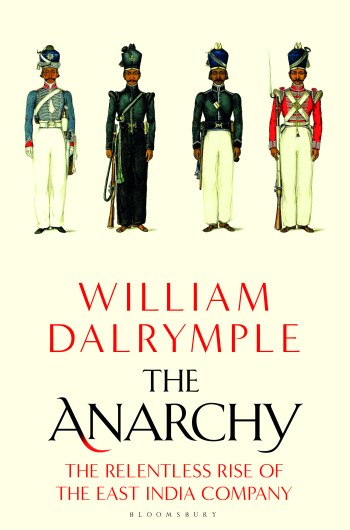 In his most ambitious book to date, bestselling historian William Dalrymple tells the timely and cautionary tale of the rise of the East India Company and one of the most supreme acts of corporate violence in world history.
In August 1765 the East India Company defeated and captured the young Mughal emperor and forced him to set up in his richest provinces a new government run by English traders who collected taxes through means of a vast and ruthless private army. The creation of this new government marked the moment that the East India Company ceased to be a conventional international trading corporation, dealing in silks and spices, and became something much more unusual: an aggressive colonial power in the guise of a multinational corporation. In less than half a century it had trained up a private security force of around 260,000 men—twice the size of the British army—and had subdued an entire subcontinent, conquering first Bengal and finally, in 1803, the Mughal capital of Delhi itself. The Company’s reach stretched relentlessly until almost all of India south of the Himalayas was effectively ruled from a boardroom in London.
The Anarchy tells the remarkable story of how one of the world’s most magnificent empires disintegrated and came to be replaced by a dangerously unregulated private company, based thousands of miles overseas and answerable only to its shareholders. In his most ambitious and riveting book to date, William Dalrymple tells the story of the East India Company as it has never been told before, unfolding a timely cautionary tale of the first global corporate power.
William Dalrymple is the bestselling author of In Xanadu, City of Djinns, From the Holy Mountain, The Age of Kali, White Mughals, The Last Mughal and, most recently, Nine Lives. He has won the Thomas Cook Travel Book Award, the Sunday Times Young British Writer of the Year Award, the Ryszard Kapuscinski Award for Literary Reportage, the Hemingway Prize, the French Prix d’Astrolabe, the Wolfson Prize for History, the Scottish Book of the Year Award, the Duff Cooper Memorial Prize, the Asia House Award for Asian Literature, the Vodafone Crossword Award and has three times been longlisted for the Samuel Johnson Prize. In 2012 he was appointed Whitney J. Oates Visiting Fellow in Humanities at Princeton University. He lives with his wife and three children on a farm outside Delhi.
Exhibition | Indian Painting for the East India Company
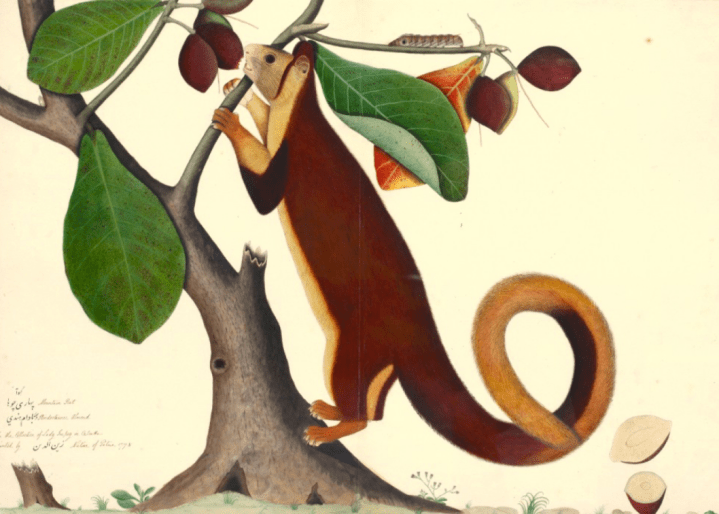
Shaikh Zain al–Din, Malabar Giant Squirrel, Eastern India, Calcutta, 1778
(Private Collection; photo by Margaret Nimkin)
◊ ◊ ◊ ◊ ◊
From the press release related to the exhibition:
Forgotten Masters: Indian Painting for the East India Company
The Wallace Collection, London, 4 December 2019 — 19 April 2020
Curated by William Dalrymple
In September 2019, the Wallace Collection presents Forgotten Masterpieces of Indian Painting for the East India Company. Curated by renowned writer and historian William Dalrymple, this is the first UK exhibition of Indian paintings commissioned by East India Company officials in the late eighteenth and nineteenth centuries. Reflecting both the beauty of the natural world and the social reality of the time, these dazzling and often surprising artworks offer a rare glimpse of the cultural fusion between British and Indian artistic styles during this period.
Comprising works from a wide variety of Indian traditions, the exhibition belatedly honours historically overlooked Mughal artists including Shaikh Zain al–Din, Bhawani Das, Shaikh Mohammad Amir of Karriah, Sita Ram, and Ghulam Ali Khan. It will shed light on a forgotten moment in Anglo-Indian history, recognising the vivid and highly original paintings it produced as among the greatest masterpieces of Indian painting.
William Dalrymple, ed., Forgotten Masters: Indian Painting for the East India Company (London: Philip Wilson Publishers, 2019), 192 pages, ISBN: 978-1781300978, $40.
Note (added 25 September 2019) — The original posting listed the exhibition as being open from September until December.
Note (added 22 October 2021) — The original posting listed the title as ‘Forgotten Masterpieces’, rather than ‘Forgotten Masters’.
Exhibition | Un brin de panache, éventails de Chine

Opening this week at the Museum of the French East India Company:
Un brin de panache, éventails de Chine
Musée de la Compagnie des Indes, Port-Louis (Brittany), 15 June — 25 November 2019
Les aristocrates européens se piquent d’exotisme extrême-oriental au 17e siècle. Cette passion entraîne l’apparition, en Asie, d’une production d’objets à destination de l’exportation européenne. L’éventail devient l’objet indispensable des cours royales européennes dès le début du 17e siècle.
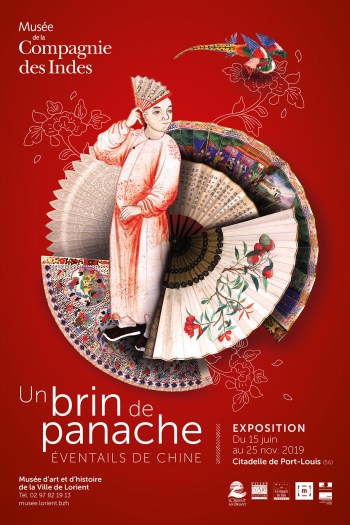 Les premiers éventails chinois destinés au marché occidental sont faits de brins d’ivoire repercés dont les motifs évoquent la finesse de la production de la porcelaine. Les scènes représentent des figures animales et de riches décors floraux. L’usage de l’éventail se démocratise au 18e siècle et ce sont plus de 45,000 éventails qui sont importés par la Compagnie française de 1722 à 1741. Ils sont majoritairement en bambou mais les plus beaux sont en ivoire, en écailles de torture ou en laque. L’iconographie des feuilles évolue et la variété des scènes représentées se multiplie. L’engouement pour les éventails chinois perdure au 19e siècle. Ainsi, le navire Le Fils de France, armé par l’armateur nantais Thomas Dobrée, rapporte dans ses cales 2,200 éventails qui sont vendus à Nantes en 1819.
Bien que le thé, les porcelaines et la soie soient les marchandises principales importées de Chine par les compagnies des Indes, cette exposition présente une sélection d’éventails, ces objets d’art qui ont participé au goût particulier de certains amateurs de l’exotisme asiatique.
About the Museum
Since 1984, the musée de la Compagnie des Indes de Lorient (the Museum of the French East India Company) has been housed in one of the buildings of the Port-Louis Citadel, a marvel of seventeenth-century military architecture initiated by the Spanish and completed by the architect Jacques Corbineau. The musée de la Compagnie des Indes is the only museum in France dedicated to the story of the great trading companies of the seventeenth and eighteenth centuries. Ship models, engravings, maps, Indo-European furniture, China porcelains, and Indian cottons shed light on this maritime epic.
Lecture | Susan Sloman, Mapping Gainsborough in Bath and London
From the Society of Antiquaries:
Susan Sloman, Mapping Thomas Gainsborough’s Career in Bath and London
Society of Antiquaries of London, 9 July 2019
Much of Susan Sloman’s research into the Thomas Gainsborough’s life and career has involved mapping and architecture. She is primarily interested in how the streets and buildings in which he lived affected his practice.
In Bath, Gainsborough shared a large central town house built for the Duke of Kingston with his sister (a milliner). This was destroyed at the time of the excavation of the Roman Baths in the last decade of the nineteenth century, and photographs of the excavation show Gainsborough’s house teetering at the edge of the Great Bath held up by wooden props. For the exhibition catalogue accompanying Gainsborough’s Family Album (National Portrait Gallery, November 2018 – February 2019), Sloman has written about the roles the artist’s wife and sister played within his professional life, and how his and his sister’s use of property created wealth for the family as a whole and supported his portrait-painting practice.
In the course of research for another exhibition (Gainsborough and the Theatre, Holburne Museum, Bath, October 2018 – January 2019), the changes in London’s streetscape south of Piccadilly that took place at the time of the construction of Regent Street were discovered to be particularly striking. The area Gainsborough frequented in the vicinity of Pall Mall looked very unlike the place we know now. He was only a short walk from the ‘Little’ Theatre (the site of the later Haymarket Theatre) and the King’s Theatre or Italian Opera House, also in Haymarket. Across Pall Mall from these theatres was Dalton’s Warehouse, home to the Royal Academy for the first ten years of its existence, between 1769 and 1779. It is hoped that these elements of geography and archaeology will be of wider interest beyond the confines of art history—and will form a key focus of this talk on Gainsborough’s career.
This public lecture will begin at 13.00; doors open at 12.30. It is free and open to the public, but space is limited and reservations are strongly recommended to avoid disappointment. To book online, simply click the ‘Reserve Your Seat’ button, available here.
Call for Papers | Visualizing Sound and Silence
From Case Western:
Visualizing Sound and Silence in Art and Architecture
45th Annual Cleveland Symposium for Current and Recent Graduate Students
Case Western Reserve University and the Cleveland Museum of Art, 25 October 2019
Proposals due by 28 June 2019
When we examine visual images, we often concentrate solely on the sense of sight. In contrast, art and architecture, whether employing musical, ritual, or acoustic components, have a long history of incorporating aural elements that engage with the sense of hearing. Whether audible or silent, art, in any form, is not a ‘mute’ medium. The question of who speaks, who is silent, and who is listening echoes within the chambers of power in any society.
How do artists throughout history visualize sound and silence? How does performance alter the experience of an object or space? How does the ephemeral nature of a melody or of a cacophony change our experiences of art and architecture over time? How does conversation or contemplation reshape our understanding of an image?
The Art History Department at Case Western Reserve University invites graduate students to submit abstracts for its 2019 Annual Symposium: Visualizing Sound & Silence in Art & Architecture. We welcome innovative research papers that engage with acoustics, music, sounds, and silence in and around art.
With keynote speaker: Vincent Debiais, L’École des Hautes Études en Sciences Sociales
Presentations may explore aspects of this theme as it applies in any medium and from any historical period, geographical location, or methodological perspective. Papers that engage with the art or architecture of the Cleveland Museum of Art are encouraged, but are not required.

Leaf from a Gradual, circle of Girolamo dai Libri (Italian, 1474–1555), Verona (?), ink, tempera, and gold on parchment (The Cleveland Museum of Art, 1921.140.1.a).
Potential topics may include, but are not limited to:
• Depictions of sound
• Discussion of who is given a voice
• Music in art
• Liturgy and recitation
• Conversation pieces
• Internalization of drama
• Acoustics in architecture
• Silent films
• Performance art
• Sound installations
• The augmentation of other senses
• The role of labels and audio guides in museums
• Resonance with political environment
For consideration, current and recent graduate students in art history, musicology, and related disciplines are invited to submit a 350-word abstract, alongside a CV to clevelandsymposium@gmail.com by June 28, 2019. Selected participants will be notified by the end of July. Paper presentations will be 20 minutes in length. Please direct all questions to Reed O’Mara and Rebecca Woodruff at clevelandsymposium@gmail.com. Three papers will be awarded prizes.
Call for Papers | Work on Furniture and Interiors from Emerging Scholars
From ArtHist.net:
British, Continental, and American Furniture and Interiors
The Wallace Collection, London, 22 November 2019
Proposals due by 1 July 2019
Call for papers from PhD/Post-Doc students, junior museum/heritage curators and professionals
As part of the Furniture History Society’s programme of supporting researchers at an early stage in their careers, the Society organises a dedicated study day for emerging scholars to present on a variety of topics connected to the history, construction, design, conservation of furniture, and historical interiors. For our fifth of these conferences we particularly welcome papers on the transmission of design and manufacture as a result of immigration and emigration to and from, or within different countries. We thus invite investigation into the connections made between craftsmen, patrons and clients as well as networks of manufacture and retailing at any period. We hope to explore the rich and varied history of furniture that emerges from such an approach and develop a better understanding of how design, taste and fashion were created in the evolving modern world.
Interested speakers are requested to send an abstract of about 300 words outlining their proposed topic, research methodologies, and sources. They should also send a current Curriculum Vitae and arrange for one reference to be sent to the Jill Bace, FHS Grants Secretary, grants@furniturehistorysociety.org by 1 July 2019.
Some limited assistance with travel expenses may be available, and any requests should be included, with justification, with the applicant’s abstract. The Society is also happy to provide further details, outlining the aims and objectives of the seminar, to enable participants to apply to their own institution for funding.
Getty Plans to Acquire Wright’s ‘Two Boys with a Bladder’
Press release (4 June 2019) from The Getty:
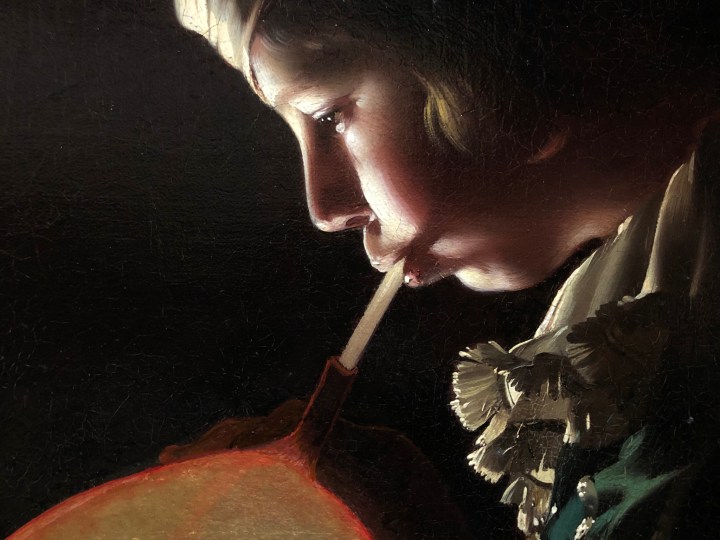
The J. Paul Getty Museum announced today its intent to acquire Two Boys with a Bladder, about 1769–70, a painting by Joseph Wright of Derby, which has not been on public view since the 18th century and was previously unknown to scholars. The Museum also announced the acquisition of Corpus Christi, about 1490–1500, a small-scale wooden sculpture depicting the crucified body of Christ by Veit Stoss.
“These two works of art offer exceptional opportunities to enrich our collections,” said Timothy Potts, director of the J. Paul Getty Museum. “The striking depiction of the crucified Christ represents a rare opportunity to acquire a masterwork from the great era of early Renaissance German sculpture. It joins our growing collection of late-Medieval and early-Renaissance sculpture and decorative arts, complementing the manuscripts and paintings collections, to offer a more complete picture of the visual culture of the period.
“Two Boys with a Bladder is a masterpiece that counts among Joseph Wright of Derby’s most accomplished nocturnal subjects and reflects the experimental interests of artists and scientists of the Enlightenment,” continued Potts. “Should we obtain the necessary export license from England, the painting will join two other works by the artist at the Getty, adding a completely new and engaging note to our 18th-century paintings collection.”
Corpus Christi
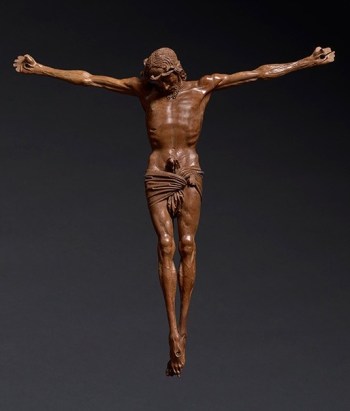
Veit Stoss, Corpus Christi, ca. 1490–1500, wood.
Corpus Christi, about 1490–1500, by Veit Stoss, depicts the crucified body of Christ following the traditional representation of Jesus of Nazareth nailed to a Latin cross at his hands and feet. His head, lowered slightly toward his right shoulder, bears the woven crown of thorns. His right side bears the wound left after Longinus pierced Christ’s chest to ensure he was dead. The body is depicted with astonishing realism, emphasizing the bodily stress and physical pain caused by the crucifixion. The small scale of this Corpus Christi (it is 13 inches tall) and the care with which the details were carved on both the front and back of the figure indicate that it was intended for private devotion, its patron being able to hold it for worship.
One of the most important German sculptors of the late 15th and early 16th centuries, Stoss, who was also an engraver and painter, excelled at carving wood and was renowned for his work in that medium. The great Florentine art historian Giorgio Vasari described Stoss’s virtuosity as a “miracle in wood.” In the Getty’s Corpus Christi that skill is evident in highly detailed curls of the hair and beard, elaborate drapery folds, the realistic representation of swollen veins in Christ’s legs and arms, the backbone pressing through the flesh, and the deep wrinkles in his feet.
“This Corpus Christi is a rare and striking work of art from the great era of early Renaissance German sculpture, of which Veit Stoss was a master,” said Anne-Lise Desmas, senior curator of sculpture and decorative arts at the Getty Museum. “It is among a handful of surviving examples of the master’s small-scale figures. Comparable in quality to the monumental crucifixions that Stoss created for churches in Krakow (Poland) and Nuremberg (Germany), this statuette stands out for the compelling power of its realistic rendering of the anatomy of the martyred body and its intensely expressive representation of human suffering.”
Two Boys with a Bladder

Joseph Wright of Derby, Two Boys with a Bladder, ca. 1769–70, oil on canvas.
The acquisition of Two Boys with a Bladder is subject to an export license being granted by the Arts Council of England, which is being applied for on the Getty’s behalf by the seller’s representative, Lowell Libson and Jonny Yarker Ltd., London.
The recently rediscovered painting depicts two young boys, boldly lit by a concealed candle, inflating a pig’s bladder. In the 18th century, animal bladders served as toys, either inflated and tossed like balloons or filled with dried peas and shaken like rattles. While bladders appeared frequently in 17th-century Dutch painting they were depicted less frequently in 18th-century Britain. It was a motif that Wright made his own; the elaborate costumes that the boys wear are of the artist’s own invention, in the style of British ‘fancy pictures’. The dramatic pictorial effect created by the concentrated candle light within a dark interior setting was in vogue in much of Europe in the late 16th and 17th centuries, but it was not until the 18th century that English artists picked up the theme, Wright being among the first to do so.
The previously unpublished masterpiece is Wright’s earliest known treatment of the subject. Unseen in public since the 18th century, the painting forms part of a sequence of dramatic nocturnal paintings that includes The Experiment on a Bird in the Air Pump (1768, National Gallery, London) and An Academy by Lamplight (1770, Yale Center for British Art, New Haven). It was painted as a pendant to Two Girls Dressing a Kitten by Candlelight, which is now at Kenwood House in London.
“Two Boys with a Bladder is a remarkable discovery that sheds new light on Wright’s work at the most important moment of his career,” said Davide Gasparotto, senior curator of paintings at the Getty Museum. “It is a compelling example from his most important and successful genre, candlelight paintings. Moreover, Wright’s innovative experimentation with the use of metal foil embodies a sense of technical and scientific exploration that typifies the intellectual milieu of the midlands on the eve of the industrial revolution. It is a major addition to the Getty’s holdings of art from the English golden age.”










 Enfilade
leave a comment