Turner on the Twenty, Replacing Adam Smith
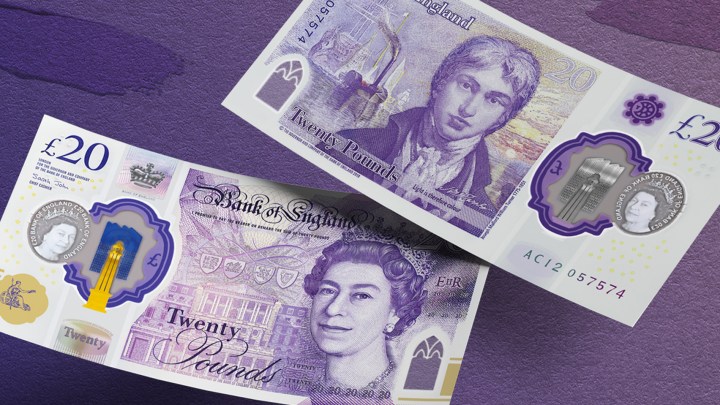
As reported several weeks ago by Simon Read for BBC News (20 February 2020) . . .
You’ll soon no longer find Adam Smith in your wallet or purse. The economist has been replaced as the face of the £20 note by artist JMW Turner. . . . It includes two see-through windows and a two colour foil to help beat forgers. . . . The new £20 is the third plastic banknote to be issued by the Bank of England after the fiver featuring Winston Churchill—launched in 2016—and the tenner featuring Jane Austen, which was first issued in 2017. It replaces the paper one featuring Adam Smith which has been in circulation since 2007.
The portrait is based on Turner’s ca. 1799 Self-Portrait now part of the Tate Collection.
Church Monuments Essay Prize
From ArtHist.net:
Church Monuments Essay Prize
Submissions due by 31 December 2020
The Council of the Church Monuments Society offers a biennial prize of £500 called the Church Monuments Essay Prize, to be awarded with a certificate for the best essay submitted in the relevant year along with publication of the winning essay in the peer-reviewed international annual CMS journal Church Monuments. The competition is open only to those who have not previously published an article in Church Monuments. The subject of the essay must be an aspect of church monuments—of any period in Britain or abroad. The length, including notes, shall not exceed 10,000 words and a maximum of 10 illustrations, preferably in colour. The prize will be awarded only if the essay is considered by the judges to be of sufficiently high standard to merit publication in Church Monuments. The closing date for new entries is 31 December 2020. For a copy of the rules and the contributor guidelines, please see the Society’s website, or contact the Hon. Journal Editors for more details or advice on the suitability of a particular topic. For details and for submission of articles, please email the editors: Jonathan Trigg (jrtrigg@liverpool.ac.uk) and Ann Adams (cmsed.aja@gmail.com).
Church Monuments Society
Patron HRH Duke of Gloucester KG GCVO
Registered Charity 279597
Conservation of The Blue Boy Completed
Press release from The Huntington (27 February 2020) . . .
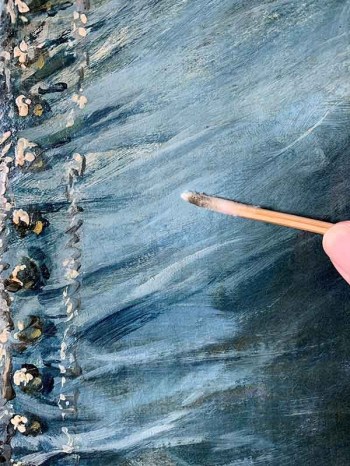
The conservator removed dirt trapped underneath the varnish (as seen on the cotton swab), which clouded the clarity of Gainsborough’s masterful brushwork (The Huntington Library, Art Museum, and Botanical Gardens).
The Huntington Library, Art Museum, and Botanical Gardens announced today that the extensive 18-month initiative to analyze, conserve, and restore The Blue Boy (ca. 1770) by Thomas Gainsborough (1727–1788) is complete, and the iconic painting will go back on view Thursday, March 26, in the Thornton Portrait Gallery. With much of the process carried out in public view during the Project Blue Boy exhibition (22 September 2018 — 30 September 2019), the major undertaking involved high-tech data gathering and analysis as well as more than 500 hours of expert conservation work to remove old overpaint and varnish, repair and reattach the lining and other structural materials, and inpaint areas of loss as a result of flaking and abrasion. Now, minute shades of color, fine brushstroke textures, and nuanced details of the famous figure of a young man in a blue satin costume, as well as the landscape in which he stands, are once again legible and closer to what Gainsborough intended.
“The Blue Boy has been a star of The Huntington’s collections since we opened as the first old masters museum in Los Angeles in 1928, when visitors flocked to see this magnificent work of 18th-century British portraiture,” said Huntington President Karen R. Lawrence. “Now the painting is again the center of a joyous occasion, as we celebrate the completion of a robust and thoughtful conservation project. A well-attended exhibition showcasing the conservator at work, more than 100 public talks, and the convening of experts in the field all helped to define Project Blue Boy as an ambitious and successful project with an educational focus.”
More than 217,000 people visited the Project Blue Boy exhibition. Christina O’Connell, The Huntington’s Mary Ann and John Sturgeon Senior Paintings Conservator and leader of the project, gave about 170 gallery talks, emphasizing the guidelines and code of ethics in the field of conservation as she responded to visitor questions on topics ranging from the history of the painting, to details of the technical study, to the structural elements of the work.
The conservation project involved slowly removing several uneven layers of dirt and discolored varnish with small cotton swabs to reveal Gainsborough’s original brilliant blues and other pigments. Then, with tiny brushes, the artist’s brushstrokes were reconnected across the voids of past damage as part of the inpainting process.
As O’Connell worked on the painting, she became intimately aware of Gainsborough’s every brushstroke. “It’s been an incredibly deep professional experience,” she said. “Conservation work is very much a process of discovery. I’ve not only had a view of the painting at the microscopic level, but I was also able to observe each stroke as the true colors of Gainsborough’s palette were revealed from underneath many layers of dirt and discolored varnish.” During the process, O’Connell discovered that although Gainsborough painted The Blue Boy on a recycled canvas (as revealed in earlier X-rays), he made considerable use of a complex network of paint layers and pigments to create a painting that truly showed off his skills.
“We have to remember that this painting wasn’t commissioned, but rather was produced by Gainsborough for the express purpose of showing off his prowess at the Royal Academy exhibition of 1770—where it would be seen next to the work of his rivals,” said Melinda McCurdy, The Huntington’s associate curator for British art and co-curator of Project Blue Boy. “Gainsborough intended it to grab attention, and conservation work has revealed the incredible technical skill he brought to this showpiece.”
Other discoveries made over the course of the project, which was supported by a grant from Bank of America as a part of its global Arts Conservation Project, include one relating to the painting’s lining. After observation and analysis, conservators determined that the lining adhesive for The Blue Boy correlated to a historic recipe for a paste made of rye flour and ale. O’Connell enlisted the help of a food historian to recreate the paste with modern ingredients to construct a mock-up in order to observe how the materials for the lining behaved. More discoveries should be forthcoming once the copious data that was collected during the project is analyzed. Information was gathered via X-radiography, infrared reflectography, cross-section microscopy, and macro X-ray fluorescence scanning. The results of the analysis will take several more months.
Conservation was funded by a grant from the Bank of America Art Conservation Project. Additional generous support for this project was provided by the Getty Foundation, Friends of Heritage Preservation, and Haag-Streit USA
Call for Papers | Antiquities and the Art Market in Britain and Italy
Postponed: It is with regret that we have decided to postpone the Antiquities, the Art Market and Collecting in Britain and Italy in the 18th Century conference at Birkbeck this year (17–18 September 2020), due to the ongoing Covid-19 health crisis. Given the current limitations on travel and the closure of university campuses, research institutions, libraries, archives and collections, as well as the obvious challenges to personal safety, the conference will not take place this year. It will instead be held on 16–17 September 2021. The Call for Papers is therefore temporarily closed. To all who have submitted abstracts so far, thank you very much for your interest; we hope that you will consider submitting an abstract again when the Call for Papers is reissued closer to the new deadline. Note added 24 March 2020.
From ArtHist.net:
Antiquities, the Art Market, and Collecting in Britain and Italy in the 18th Century
Birkbeck, University of London, 17–18 September 2020
Organized by Caroline Barron, Catharine Edwards, and Kate Retford
Proposals due by 15 April 2020
Recent years have seen a resurgence of interest in the formation and display of country house collections of art and antiquities in Britain, and particularly those created as a result of a Grand Tour to Italy in the eighteenth century. From The English Prize at the Ashmolean Museum in 2012 and the collaboration between Houghton Hall and The Hermitage State Museum, Houghton Revisited, in 2013, to The Lost Treasures of Strawberry Hill: Masterpieces from Horace Walpole’s Collection in 2018, curators and academics have sought to investigate the antiquities, paintings and collectibles that were brought to Britain in such large quantities.
However, the organisation of the art market at that time has received less attention, and far less than it deserves given its fundamental role in the processes by which objects arrived in collections at that time. New contexts for collecting have also emerged, such as the history of consumption and the economic background to the acquisition of so-called ‘luxury’ goods and prestige objects. The art market of the eighteenth century continues to play a vital role in collecting today; with so many of the objects acquired during a Grand Tour since dispersed in house sales and auctions, or bequeathed or sold to museums. The antiquities and paintings that once adorned the galleries of the cultured in Britain are also still to be found for sale, indicating the longevity of their appeal and value for collectors.
This conference seeks to explore the processes by which these collections were formed, interrogating the relationship between the Italian and British art markets of the eighteenth century, the role of the dealers in Italy, and the auction houses in Britain, through which many of the objects were later to pass, encompassing in depth discussion of the objects themselves. We invite abstracts of no more than 500 words for 30 minute papers to be submitted to the organising committee by 15th April 2020 (antiquitiesartmarketconference@gmail.com) as well as a short CV. We welcome proposals from scholars working in museums, collections, and archives, as well as from academics from across disciplines such as History, Art History, Museum Studies, and Classics. PhD students and ECRs are particularly encouraged to submit abstracts.
Topics may include, but are not limited to:
• Dealers in antiquities between Rome and Britain
• Auctions and auction houses in Britain
• Object biographies of antiquities, old master paintings, modern paintings, rare books, prints, and neo-classical sculpture circulating in the 18th-century art market
• Customers and collectors in the 18th century
• Networks and communities of dealers and collectors
• The economic history of the art market
• The afterlife of collections from the 18th century to today
Print Quarterly, March 2020
The eighteenth century in the current issue of Print Quarterly:
Print Quarterly 37.1 (March 2020)

Antoine Trouvain and Pierre Lepautre after Bon Boullogne, Thesis Print of François Bourgarel for Mathematics, 1695, engraving, top 336 x 540 mm, bottom 462 x 540 mm (Paris, Bibliothèque Nationale de France).
N O T E S A N D R E V I E W S
• John Roger Paas, Review of Simon Turner, ed., The New Hollstein German Engravings, Etchings, and Woodcuts, 1400–1700: Johann Stridbeck the Elder and the Younger, compiled by Dieter Beaujean and based on the research material of Josef H. Biller, parts 1–4 (Ouderkerk aan den IJssel: Sound & Vision Publishers, 2018), pp. 72–73.
The fact that artists are prolific and find a market in their lifetime is no guarantee that their work will enjoy critical acclaim in the long run or be avidly sought after by collectors. Such is the case of the Stridbecks, Johann the Elder (1641–1716) and Johann the Younger (1666–1714), Augsburg printmakers active from the late seventeenth century to the second decade of the eighteenth. . . . [But] their prints help to give us a deeper understanding of the print market and of public taste at the time, and we are fortunate that the more than a thousand prints of the Stridbecks have now been carefully collected and catalogued.
• Louis Marchesano, Review of Véronique Meyer, Pour la plus grand gloire du roi: Louis XIV en theses (Rennes: Presses Universitaires de Rennes, 2017), pp. 73–75.
This book provides an insightful account of the thesis print phenomenon by focusing on prints dedicated to the French king. It explores the function of these prints in the candidate’s life at university and outside, the production, reception and diffusion of the sheets and analyses the king’s image and its evolution in the period from his birth in 1638 to his death in 1715.
• Niklas Leverenz, “Isidore-Stanislas Helman and J. Pélicier,” pp. 75–76.
This short note focuses on a recently discovered signature of J. Pélicier on the proof state of a 1787 print previously attributed to Isidore-Stanislas Helman (1742–1809). This evidence suggests that Helman must have relied on a team of etchers for his large body of work, unusually allowing some of them to put their name on the plates.
P U B L I C A T I O N S R E C E I V E D
• Who is Who Chez les Colbert? La collection d’estampes de Joseph de Colbert, exhibition catalogue (Sceaux: Musée du Domaine départemental de Sceaux / Ghent: Éditions Snoeck, 2019), p. 96.
• Sandra Pisot, ed., Goya, Fragonard, Tiepolo: Die Freiheit der Malerei, exhibition catalogue (Hamburg: Hamburger Kunsthalle / Munich: Hirmer Verlag, 2019), p. 96.
• Laurent Baridon, Jean-Philippe Garric, and Martial Guédron, eds., Jean-Jacques Lequeu: Bâtisseur des Fantasmes, exhibition catalogue (Paris: Petit Palais, Bibliothèque Nationale de France / Éditions Norma, 2018), p. 97.

J. Pélicier, Emperor Qianlong Welcoming the Elderly Citizens of his Empire for a Celebration in their Honour, 1787, etching, 303 x 428 mm (Private Collection).
Book Launch | The Art of the Jewish Family
This month at BGC:
Book Launch—Laura Leibman, The Art of the Jewish Family
Bard Graduate Center, New York, 23 March 2020, 6:00–7:30pm
Author Laura Leibman in conversation with Jonathan Sarna and Barbara Kirshenblatt-Gimblett, moderated by Dean Peter N. Miller, to celebrate the publication of The Art of the Jewish Family: A History of Women in Early New York in Five Objects.
Laura Arnold Leibman, The Art of the Jewish Family: A History of Women in Early New York in Five Objects (Chicago: The University of Chicago Press, 2020), 350 pages, ISBN: 978-1941792209, $35.
 In order to rethink early Jewish American women’s lives, The Art of the Jewish Family examines five objects owned by Jewish women who lived at least a portion of their lives in early New York between 1750 and 1850. Each chapter creates a biography of a single woman through her object, but also uses her story to shed light on larger changes in Jewish American women’s lives. The women Leibman discusses are diverse: some rich, some poor; some Sephardi, some Ashkenazi; some born enslaved, and some who were slave owners themselves. In creating these biographies, Leibman proposes a new methodology for early American Jewish women’s history, one which could be applied to other areas in Jewish history for which records on women are sparse. This method looks at both material objects and fragmentation as important evidence for understanding the past. What social and religious structures, Leibman asks, caused early Jewish women to disappear from the archives?
The objects she considers span the 1750s through the 1850s. They are (1) a letter written in 1761 by an impoverished Hannah Louzada requesting assistance from Congregation Shearith Israel; (2) a famous set of silver cups owned by Reyna Levy Moses (1753–1824); (3) a beautiful ivory miniature of Sarah Brandon Moses (1798–1829), who was born enslaved in Barbados but became one of the wealthiest Jewish women in New York; (4) a commonplace book created by Sarah Ann Hays Mordecai (1805–1894); and (5) a family silhouette of Rebbetzin Jane Symons Isaacs (1823–1884) and her young brood.
Looking past texts to material culture, Leibman expands our ability to understand early Jewish American women’s lives and restores some of their agency as creators of Jewish identity. While the vast majority of early American texts about Jewish women were written by men with men as the primary intended audience, objects made for and by Jewish women help us consider women as consumers and creators of identity. Everyday objects provide windows into those women’s daily lives, highlighting what they themselves valued, how they wanted their contemporaries to see and understand them, and how they passed identity on to their children and grandchildren.
Laura Arnold Leibman is professor of English and humanities at Reed College.
Art of the Jewish Family is published in Cultural Histories of the Material World, a series dedicated to publishing monographs, works in translation, and collective project volumes that mark out the frontiers of BGC’s knowledge map. All books derived from the Leon Levy Foundation lectures in Jewish Material Culture will be published in this series.
Workshop | Nobility without Limits? Prussian Identities, 1525 –1795

Johann Hennenberger: Stemmata genealogica praecipuarum in Prussia Familiarum Nobilium, Ende 16. Jh., Seite der Familie Dohna (Detail), public domain: http://kpbc.umk.pl/dlibra/doccontent?id=3096
◊ ◊ ◊ ◊ ◊
From the posting at ArtHist.net, which includes the Polish:
Adel ohne Grenzen? Identitäten und Repräsentation zwischen Königlichem Preußen und Herzogtum Preußen //
Szlachta bez granic? Tożsamości i reprezentacje w Prusach Królewskich i Książęcych
Deutsches Historisches Institut, Warsaw, 26–27 March 2020
Organized by Sabine Jagodzinski and Rahul Kulka
In dem Workshop werden vor allem kunsthistorische Fragen zum Adel in den beiden Teilen Preußens und dessen künstlerischen Repräsentationen, den Visualisierungen und dem materiellen Ausdruck von regionalen oder überregionalen Identifikationen und Loyalitäten zu den Höfen diskutiert. Außerdem interessiert die künstlerisch-architektonische Prägung seiner Handlungsräume. Im Zentrum der Betrachtung stehen die Entwicklungen nach dem Zweiten Frieden von Thorn 1466, insbesondere im Zeitraum von der Schaffung des Herzogtums Preußen (1525) über die Lubliner Union (1569) bis zu den Teilungen Polen-Litauens 1772/1793/1795.
Die Beiträge und Diskussionen werden simultan ins Polnische bzw. Deutsche übersetzt. Anmeldungen zum Workshop werden bis zum 16. März 2020 erbeten an: dhi@dhi.waw.pl.
Konzeption und Organisation
Dr. Sabine Jagodzinski (DHI Warschau)
Rahul Kulka, Ph.D. Candidate (Harvard University / ZI München)
Kontakt
Deutsches Historisches Institut / Niemiecki Instytut Historyczny
Pałac Karnickich
Aleje Ujazdowskie 39
00-540 Warszawa
D O N N E R S T A G , 2 6 M Ä R Z 2 0 2 0
17.00 Ankunft der Teilnehmerinnen und Teilnehmer
17.15 Begrüßung und Einführung, Sabine Jagodzinski (Warszawa), Rahul Kulka (Cambridge, MA / München)
18.00 Keynote
Moderation: Miloš Řezník (Warszawa)
• Karin Friedrich (Aberdeen) – Zwischen Republik und Dynastie. Adelswelten und adelige Identitäten zwischen Preußen Königlichen Anteils und Herzogtum Preußen, 1569–1772
F R E I T A G , 2 7 M Ä R Z 2 0 2 0
10.00 Kirchenraum und Konfession
Moderation: Dorota Piramidowicz (Warszawa)
• Franciszek Skibiński (Toruń) – Adelige Stiftungen des 17. und 18. Jh. in Kirchen Thorns und anderen preußischen Städten im Kontext von Religion, Gesellschaft und Politik. Ein Problemaufriss
• Piotr Birecki (Toruń) – Der Innenraum evangelischer Kirchen als Ausdruck gesellschaftlichen Konservatismus im Herzogtum Preußen
11.00 Kaffeepause
11.15 Kult und Liturgie
Moderation / Prowadzenie: Agnieszka Gąsior (Leipzig)
• Michał F. Woźniak (Toruń) – Stiftungen der katholischen Geistlichkeit im Königlichen Preußen im Bereich der liturgischen Ausstattung
• Sabine Jagodzinski (Warszawa) – Heiligenverehrung des katholischen Adels im Königlichen Preußen. Zu Schnittmengen regionaler und überregionaler Identitäten
12.15 Mittagspause
13.30 Bildnis und Symbol
Moderation: Magdalena Górska (Warszawa)
• Rahul Kulka (Cambridge, MA / München) – Die Stemmata genealogica des Königsberger Hofmalers Johann Hennenberger. Heraldik und Genealogie als Medien adeliger Repräsentation um 1600
• Agnieszka Gąsior (Leipzig): Geprägte Identität. Medaillenkunst und die Elitennetzwerke des frühen 17. Jahrhunderts
14.30 Kaffeepause
14.45 Residenzen und Landgüter
Moderation: Konrad Morawski (Warszawa)
• Anna Oleńska (Warszawa) – Versailles im Herzen der Rzeczpospolita. Repräsentationsstrategien und Struktur der künstlerischen Vorhaben Jan Klemens Branickis (1689–1771)
• Wulf D. Wagner (Palermo) – Ein Handbuch ostpreußischer Güter als Quellengrundlage weiterer Forschungen
New Book | The Pocket: A Hidden History of Women’s Lives
The book appeared last summer in hardback and is already sold out; a paperback is scheduled for release in the coming months from Yale UP.
Barbara Burman and Ariane Fennetaux, The Pocket: A Hidden History of Women’s Lives, 1660–1900 (New Haven: Yale University Press, 2020), 264 pages, ISBN: 978-0300253740 (paperback), $25.
 Pencils, a sketchbook, cake, yards of stolen ribbon, thimbles, snuff boxes, a picture of a lover, two live ducks: these are just some of the fascinating things carried by women and girls in their tie-on pockets, an essential accessory throughout the 18th and 19th centuries.
This first book-length study of the tie-on pocket combines materiality and gender to provide new insight into the social history of women’s everyday lives—from duchesses and country gentry to prostitutes and washerwomen—and explore their consumption practices, work, sociability, mobility, privacy, and identity. The authors draw on an unprecedented study of surviving pockets in museums and private collections to identify their materials, techniques, and decoration; their use is investigated through sources as diverse as criminal trials, letters, diaries, inventories, novels, and advertisements. Richly illustrated with paintings, satirical prints, and photographs of artifacts in detail, this innovative book reveals the unexpected story of these deeply evocative and personal objects.
Barbara Burman is an independent scholar, and Ariane Fennetaux is associate professor of 18th-century British history at the Université Paris Diderot.
Lecture | Wendy Wassyng Roworth on Angelica Kauffman
At SLAM (and conveniently enough, coinciding with ASECS) . . .
Wendy Wassyng Roworth, Angelica Kauffman: An Enterprising Artist in 18th-Century Britain
Saint Louis Art Museum, 20 March 2020
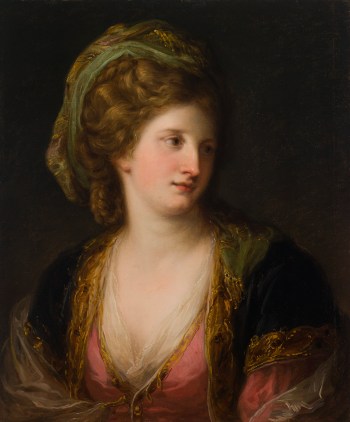
Angelica Kauffman, Woman in Turkish Dress, 1767, oil on canvas, 25 × 20 inches (Saint Louis Art Museum, Funds given by Dr. E. Robert and Carol Sue Schultz 704.2018).
Angelica Kauffman (1741–1807), an Austrian-Swiss artist, began her career in Italy, where her clients included British tourists who encouraged the young painter to pursue her profession in England. Over the fifteen years she worked in London, Kauffman achieved fame and fortune and returned to Italy as an international celebrity. Celebrating a portrait recently acquired by the Museum, this lecture will discuss Kauffman’s life and work in England as a fashionable painter and member of the Royal Academy of Arts, a rare distinction for a woman, and how she used her talents to advantage.
Friday, 20 March 2020, 7pm, Farrell Auditorium at the Saint Louis Art Museum. The lecture is offered free of charge, thanks to the Mary Strauss Women in the Arts Endowment. Tickets are, however, required. Advance tickets are recommended and may be reserved in person at the Museum’s Information Centers or through MetroTix, 314.534.1111 (all tickets reserved through MetroTix incur a service charge).
Wendy Wassyng Roworth is Professor Emerita of Art History, University of Rhode Island.
Journal for Eighteenth-Century Studies, March 2020
In the latest issue of the Journal for Eighteenth-Century Studies:
Journal for Eighteenth-Century Studies 43.1 (March 2020).
 A R T I C L E S
• Amanda Vickery, “Branding Angelica: Reputation Management in Late Eighteenth‐Century England,” 3–24.
• Alberto del Campo Tejedor, “The Barber of Enlightened Spain: On the Politics and Practice of Grooming a Modern Nation,” pp. 25–42.
• Ana Sáez‐Hidalgo, “Anglo‐Spanish Enlightenment: Joseph Shepherd, an English ‘ilustrado’ in Valladolid,” pp. 46–60.
• Robert W. Jones, “Elizabeth Sheridan’s Post‐Celebrity,” pp. 61–78.
• Jonathan Taylor, “‘Who Bravely Fights, and Like Achilles Bleeds’: The Ideal of the Front‐Line Soldier during the Long Eighteenth Century,” pp. 79–100.
E D I T E D M A N U S C R I P T S
• Jessica Wen Hui Lim, “Barbauld’s Lessons: The Conversational Primer in Late Eighteenth‐Century British Children’s Literature,” 101–20.
R E V I E W S
• Madeleine Pelling, Review of Susanna Avery‐Quash and Kate Retford, eds., The Georgian London Town House: Building, Collecting and Display, pp. 121–22.
• Megan Kitching, Review of Keith Michael Baker and Jenna Gibbs, eds., Life Forms in the Thinking of the Long Eighteenth Century, pp. 122–24.
• Charlotte Fletcher, Review of Barbara Burman and Ariane Fennetaux, The Pocket: A Hidden History of Women’s Lives, 1660–1900, pp. 124–25.
• Hannah Hutchings‐Georgiou, Review of Andrew Carpenter, ed., The Poems of Olivia Elder, pp. 125–26.
• Thomas Lalevée, Review of Gabriel Galice and Christophe Miqueu, eds., Rousseau, la république, la paix: actes du colloque du GIPRI (Grand‐Saconnex, 2012), pp. 126–28.
• Helen Metcalfe, Review of Sally Holloway, The Game of Love in Georgian England: Courtship, Emotions, and Material Culture, pp. 128–29.
• Olive Baldwin Thelma Wilson, Review of Berta Joncus, Kitty Clive, or The Fair Songster, pp. 129–31.
• Joachim Whaley, Review of Claudia Keller, Lebendiger Abglanz: Goethes Italien‐Projekt als Kulturanalyse, pp. 131–32.
• Ben Wilkinson‐Turnbull, Review of A. C. Elias, John Irwin Fischer, and Panthea Reid, eds., Jonathan Swift’s Word‐Book: A Vocabulary Compiled for Esther Johnson and Copied in Her Own Hand, pp. 132–33.
• Max Skjönsberg, Review of Margaret Watkins, The Philosophical Progress of Hume’s Essays, pp. 133–35.










 Enfilade
leave a comment