Call for Papers | Shaped by Greed
From the Call for Papers:
Shaped by Greed: Reflections and Impacts of Environmental Exploitation in European Visual Cultures, 1200–1900
Masaryk University, Brno, Czech Republic, 8–9 June 2023
Proposals due by 22 January 2023
How have environmental exploitation, industrialization, and urbanization shaped late medieval and modern visual cultures, landscapes, environments, and the built environment in Europe (and beyond)? An international conference hosted by the Art History Department of Masaryk University in Brno, 8–9 June 2023, organized by Tomáš Valeš, Jan Galeta, Martin F. Lešák, and Veronika Řezníčková as 3rd Biennale of the University’s Centre for Early Modern Studies.
During the Anthropocene, the planet Earth has witnessed several environmental shifts, closely affecting not only the current existence of living species but also the overall future of the planet. The exploitation of the environment creates wealth and simultaneously leads to the various ecological, social, economic, and humanitarian crises that contemporary societies are forced to address, especially in reaction to climate change. In the past centuries, the extraction of precious materials (silver, gold, coal, pearls, coral, whale bones, ivory, or even wood) financed the running of states, cities, churches, monasteries, influential families, and clergy who, in turn commissioned luxurious art and opulent buildings, using the mined materials themselves. Industrialization and urbanization had a tremendous impact on the environment and landscape. Currently, these issues also resonate in the field of art history, or rather eco-art history, for example, in connection with groundbreaking studies and edited volumes, such as those by Sugata Ray (Climate Change and the Art of Devotion Geoaesthetics in the Land of Krishna, 1550–1850), Andrew Patrizio (Ecological Eye: Assembling an Ecocritical Art History), and Karl Kusserow (Picture Ecology: Art and Ecocriticism in Planetary Perspective). Following this line of research, the conference’s main aim is to tackle a broad spectrum of relevant questions that have not yet been asked.
We intend to investigate the interconnections between the environment, its exploitation, art, architecture, and urbanism in a broader European frame with global overlap between 1200 and 1900 (thus taking a longue durée perspective). This explicitly includes the transformation of raw mined materials into luxurious objects; sumptuous and prestigious artistic and urbanistic projects financed by the wealth raised by exploiting nature; iconographies that reflect how the environment was treated, shaped and used in late medieval and modern times.
We are particularly interested in bringing together scholars specialized in different academic areas to confront the human impact on past environments and connect it with the sometimes somewhat self-righteous world of art and beauty. Ultimately, the aim is to explore future perspectives of environmental approaches in art history and lay the foundations for further cooperation between researchers from diverse academic backgrounds.
Possible topics may include but are by no means limited to such issues as:
1. The role of industrialization and urbanization and their foot prints on the landscape, environment, and built environment.
2. Visual representation of human impact on the natural world, e.g., mining, logging, whaling, etc.
3. The mechanisms of exploitation of natural resources in connection to artistic production, e.g., in the case of ivory, coral, or various building materials.
4. Appropriation of nature for collecting purposes or personal representation (taxidermies, live specimens, parts of animal bodies, herbariums, portraits of animals, menageries and zoos, etc.)
5. The origins of appreciating wild nature and the reflection of this appreciation in visual culture, e.g., the beginning of mass tourism, scientific research of nature or how travellers mediated non-European nature in their homelands.
The keynote lecture of the conference will be given by Dr. Hannah Baader (Kunsthistorisches Institut in Florenz – Max-Planck-Institut).
We invite proposals for papers (in English) from senior as well as junior scholars and advanced PhD candidates; presentations will be 20 minutes. Please submit your proposals of around 200–300 words, accompanied by a short CV, by 22 January 2023 to brno.conference.2023@gmail.com. Notification of acceptance of proposals will be issued before 22 February 2023. Selected papers will be published in an edited volume with Brepols publishing house (Belgium).
The Burlington Magazine, November 2022
The eighteenth century in the November issue of The Burlington . . .
The Burlington Magazine 164 (November 2022) — Sculpture

Massimiliano Soldani Benzi, Lamentation over the Dead Christ, 1690–92(?), gilded bronze, 57 × 40 cm (Córdoba Cathedral).
E D I T O R I A L
• The Parthenon Sculptures, p. 1063.
A R T I C L E S
• Fernando Loffredo, “Soldani’s Lamentation in Córdoba,” pp. 1118–22.
R E V I E W S
• Colin Bailey, Review of the exhibition catalogue, Renoir: Rococo Revival (Städel Museum, Frankfurt am Main, 2022), pp. 1150–53.
• Joseph Connors, Review of Livio Pestilli, Bernini and His World: Sculpture and Sculptors in Early Modern Rome (Lund Humphries, 2022), pp. 1160–62. [Pestilli “mines the correspondence of the directors of the Académie de France and sorts through student drawings in the Accademia de San Luca to find that well into the eighteenth century Bernini was copied more than any other artist” (1162).]
• Jamie Mulherron, Review of Alexandre Maral and Valérie Carpentier-Vanhaberbeke, Antoine Coysevox (1640–1720): Le sculpteur du Grand Siècle (Arthena, 2020), pp. 1165–66.
• Hugo Chapman, Review of Carel van Tuyll van Serooskerken, The Italian Drawings of the Seventeenth and Eighteenth Centuries in the Teyler Museum (Primavera Pers, 2021), pp. 1166–67.
• Christopher Martin Vogtherr, Review of Sarah Salomon, Die Kunst der Außenseiter: Ausstellungen und Künstlerkarrieren im absolutistischen Paris jenseits der Akademie (Wallstein Verlag, 2021), pp. 1167–68. [Salomon’s book focuses on four institutions: the Académie de Saint-Luc, the Colisée, the Salon de la Correspondence, and the Exposition de la Jeunesse.]
• Stephen Lloyd, Review of Magnus Olausson, Miniature Painting in the Nationalmuseum: A World-Class Collection (Nationalmuseum Stockholm, 2021), pp. 1168–70.
O B I T U A R I E S
• Michael Hall, Obituary for Mark Girouard (1931–2022), pp. 1171–72.
Call for Papers | Bodily Autonomies, Autonomous Bodies
From the Call for Papers, from IU Bloomington’s Center for Eighteenth-Century Studies:
Bodily Autonomies, Autonomous Bodies
Indiana Center for Eighteenth-Century Studies, Bloomington, 18–20 May 2023
Proposals due by 20 January 2023; accepted papers due mid-April 2023
The Indiana Center for Eighteenth-Century Studies announces its twenty-first annual Bloomington Workshop: Bodily Autonomies, Autonomous Bodies. The idea of ‘autonomy’ arises in the early modern period in relation to political entities, rather than individuals. A borrowing from the Greek (αὐτο + νόμος) meaning self law, autonomy referred to ability of an institution or a state to govern itself. In the eighteenth century, that scope began to apply increasingly to the capacities of individuals. Indeed, one strong tradition in eighteenth-century studies identifies our period with the invention of the author and the origins of the modern, autonomous individual. Looking back to the early modern, eighteenth-century conceptions of autonomy draw from the foundations that would lead to the birth of the nation state, and from contrasting models of internal and external virtue. From out of the eighteenth-century, the application of the term will spread from Montesquieu’s political philosophy, to Kant’s moral philosophy, and extend across the natural and social sciences. And yet the questions of autonomy—of self governance of a human or a political body—do not move in straight lines or toward easy answers.
Self-governance is often a sweet lie that hides the abuse of power, from the personal level to the geopolitical. Foucault has taught us that the individual operates within a network of power systems—religious, gendered, political, racial, geographic, and colonial, among others—that can influence, abridge, inhibit, or reinforce their ability to exercise agency or will over their life and body. More recently, methodological approaches such as New Materialisms, object-oriented ontologies, and alternative ontological frameworks such as those drawn from Black and indigenous studies often serve to unsettle the concept of autonomy, probing the spaces between the ephemeral capacity to self-govern, the material acts of self-determination, and the very notion of a ‘self’ who can be governed and determined at all. Therefore, with this Workshop theme, we hope to explore the limits of self-governance within the network of power structures that make up the world, to recognize the ways that autonomies exist against the grain of social discourse, and to acknowledge long-running ramifications—both positive and negative—of the aspirational quality of this ideal. At the same time, we look to question whether this idealization has contributed to dogmas of personal responsibility and economic self-interest at the expense of collective forms of action and care.
Within the sphere of the eighteenth century, we invite papers about autonomy as it applies to individuals across the spectrums of power and privilege; of groups whose identity or enforced social status inhibits or countermands their capacity to exercise agency; of national or political entities whose formation, liberation, and sovereignty are impacted by colonial pressures, and work that questions and probes autonomy’s drawbacks and boundaries as they figure in eighteenth-century histories, archives, and texts.
We look forward to reading your abstracts and ideas. A non-exhaustive list of topics they might address would include:
• negotiating questions of self and autonomy for enslaved persons
• the autonomy of gendered bodies
• autonomy within or of a colonized state
• freedom of movement: border-crossings, gatherings, quarantines, departures
• approaches that complicate or question ideas of personal or political sovereignty
• scientism and visions of the body as machine
• the individual figured against a backdrop of control or systems of power
• disenfranchisement: debt, citizenship, exile, etc.
In last year’s Workshop, which focused on Collaborations, questions arose about the limits of what can be considered labor performed together (col + labōrāre) in the context of radically inequal power relationships or within systems of sanctioned oppression. This year we hope to continue these conversations, which hold the echoes of the Center’s first workshop, Signs of the Self, and resound into a present where the concept of the autonomous individual is being questioned for political gain.
During the Workshop, we will discuss pre-circulated texts (due in mid-April) and perhaps have an occasional lecture or library, museum, or archive visit. Given the theme, we are especially open to co- and multi-authored contributions, including those that work across hitherto conventional boundaries of genre, discipline, and media. We intend and hope that the workshop will largely take place in person (and that participants will be present for the entire event), but anticipate making provision for some online participation as well.
The application deadline is Friday, 20 January 2023. Please send a paper proposal (1–2 pages) and current brief CV (3 pages, max) to Dr. Barbara Truesdell, Administrator, Center for Eighteenth-Century Studies. Please email to voltaire@indiana.edu. We will acknowledge all submissions within a fortnight: if you do not receive an acknowledgment by 31 January 2022, please email voltaire@indiana.edu or the Center’s Director, Jesse Molesworth (jmoleswo@indiana.edu).
Papers will be selected by an interdisciplinary committee. We cover most expenses for visiting scholars chosen to present their work: accommodations, travel (up to a certain limit), and most meals. Expanded abstracts and/or entire papers may be published in the Center’s The Workshop, along with discussion transcripts or summaries.
New Book | The Moving Statues of Seventeenth-Century Amsterdam
From Penn State UP:
Angela Vanhaelen, The Moving Statues of Seventeenth-Century Amsterdam: Automata, Waxworks, Fountains, Labyrinths (University Park: Penn State University Press, 2022), 236 pages, ISBN: 978-0271091402 (hardcover), $115. Also available as an ebook, with a paperback edition scheduled for release in March 2023.
 This book opens a window onto a fascinating and understudied aspect of the visual, material, intellectual, and cultural history of seventeenth-century Amsterdam: the role played by its inns and taverns, specifically the doolhoven.
Doolhoven were a type of labyrinth unique to early modern Amsterdam. Offering guest lodgings, these licensed public houses also housed remarkable displays of artwork in their gardens and galleries. The main attractions were inventive displays of moving mechanical figures (automata) and a famed set of waxwork portraits of the rulers of Protestant Europe. Publicized as the most innovative artworks on display in Amsterdam, the doolhoven exhibits presented the mercantile city as a global center of artistic and technological advancement. This evocative tour through the doolhoven pub gardens—where drinking, entertainment, and the acquisition of knowledge mingled in encounters with lively displays of animated artifacts—shows that the exhibits had a forceful and transformative impact on visitors, one that moved them toward Protestant reform.
Deeply researched and decidedly original, The Moving Statues of Seventeenth-Century Amsterdam uncovers a wealth of information about these nearly forgotten public pleasure parks, situating them within popular culture, religious controversies, global trade relations, and intellectual debates of the seventeenth century.
Angela Vanhaelen is Professor of Art History at McGill University. She is the author of the award-winning book The Wake of Iconoclasm: Painting the Church in the Dutch Republic, also published by Penn State University Press.
C O N T E N T S
List of Illustrations
Acknowledgements
Introduction
1 The Closed Door: Walking In
Ritual Routes
2 The Courtyard Fountain: Bacchic Rites
3 Into the Labyrinth: Containing the Human Monster
The Moving Statue Strikes
4 Automata: Activating Human Behavior
5 Strange Things for Strangers: Transcultural Automata
Protestant Paganism
6 Wax Portraits: Body Politics
7 Time Machines in the Golden Age: The Kairos of Clockwork
Epilogue: Obsolescence
Notes
Bibliography
Index
Exhibition | Beyond Boundaries
From the introduction of the catalogue, available online, for the show now on view at Robert Simon Fine Art:
Beyond Boundaries: Historical Art by and of People of Color
Robert Simon Fine Art, New York, 27 October — 16 December 2022
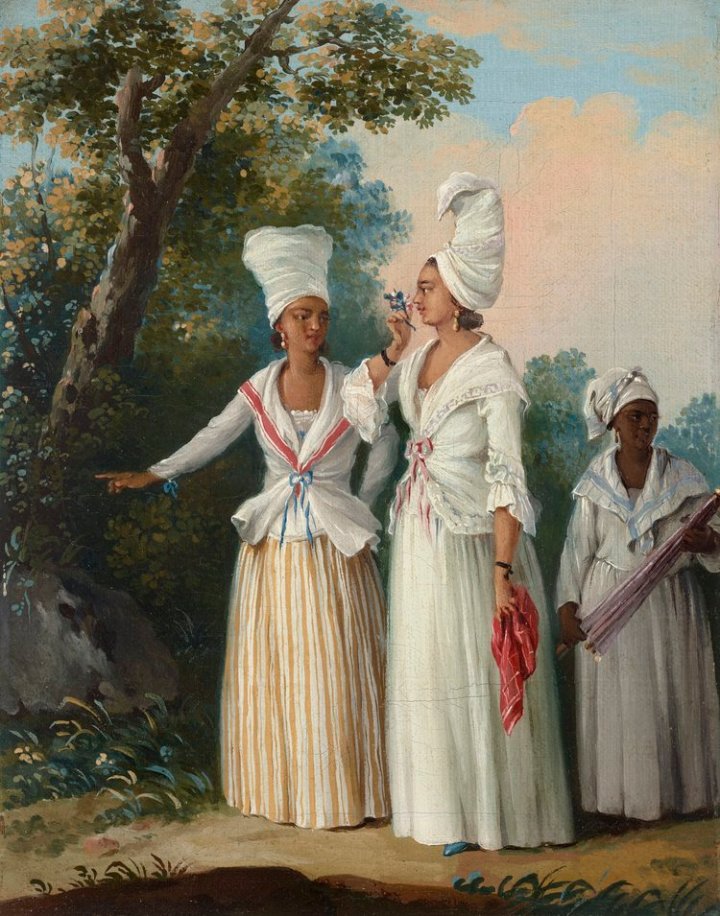 Diversity is a crucial issue in the contemporary art world today. But what of the art of the past? Beyond Boundaries brings to light an array of paintings, sculpture, and other works of art from the 17th to 19th centuries, from Europe and the Americas, that explore subjects and makers often overlooked in traditional art history. But unlike many thematic exhibitions, there is no underlying social or political philosophy. Rather we have attempted to explore diversity simply by exhibiting diverse works of art—each chosen as it in some ways illustrates an aspect of the historical past, some surprising and empowering, others uncomfortable or disturbing.
Agostino Brunias, one of six paintings in a series here identified as Free Men and Women of Dominica and an Indigienous Family of St Vincent, oil on canvas, 12 × 9 inches.
Exhibitions | Stitched in Time / The Art of the Quilter
From the press release (25 October 2022) for the new exhibitions:
Stitched in Time: American Needlework
DeWitt Wallace Decorative Arts Museum, Colonial Williamsburg, 3 December 2022 — 2 January 2025
The Art of the Quilter
Abby Aldrich Rockefeller Folk Art Museum, Colonial Williamsburg, 3 December 2022 — August 2023
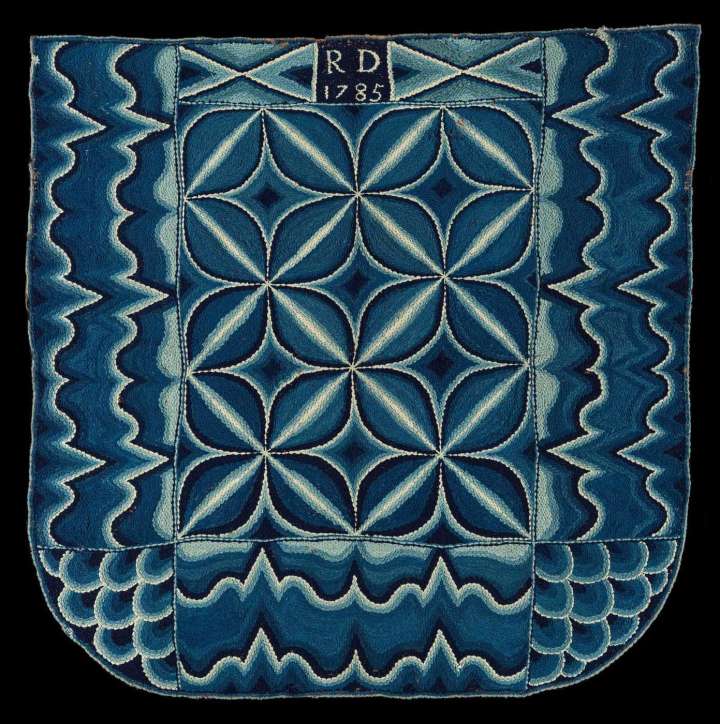
Bed Rug, Connecticut, possibly Norwich or New London, 1785 (Colonial Williamsburg, Museum Purchase, Dr. and Mrs. T. Marshall Hahn Jr. Fund, 2014.609.6).
Two new textile exhibitions opening at the Art Museums of Colonial Williamsburg on 3 December 2022 are sure to delight museum visitors. Stitched in Time: American Needlework, an exhibition of nearly 60 examples of bedrugs, whitework, embroidered hand towels, quilted petticoats, samplers, mourning and commemorative needlework, crewelwork, needlework with religious and geographical influences as well as sewing accessories, will remain on view through 2 January 2025 at the DeWitt Wallace Decorative Arts Museum. Additionally, an entirely new rotation of objects in the popular exhibition The Art of the Quilter that opened in 2021 will feature 15 pieces, 12 of which are recent acquisitions that have never before been displayed. This configuration of the exhibition, which will remain on view through August 2023 at the Abby Aldrich Rockefeller Folk Art Museum, will include eleven large quilts, one woven coverlet and three doll-size quilts that tell stories about people from America’s past and the societies in which they lived.
“For decades The Colonial Williamsburg Foundation has collected textiles from a broad and highly diverse array of ethnic, cultural, and regional communities,” said Ronald Hurst, senior vice president for education and historic resources. “These new exhibitions allow us to share these beautiful and story-laden documents of early American society with the visiting public.”
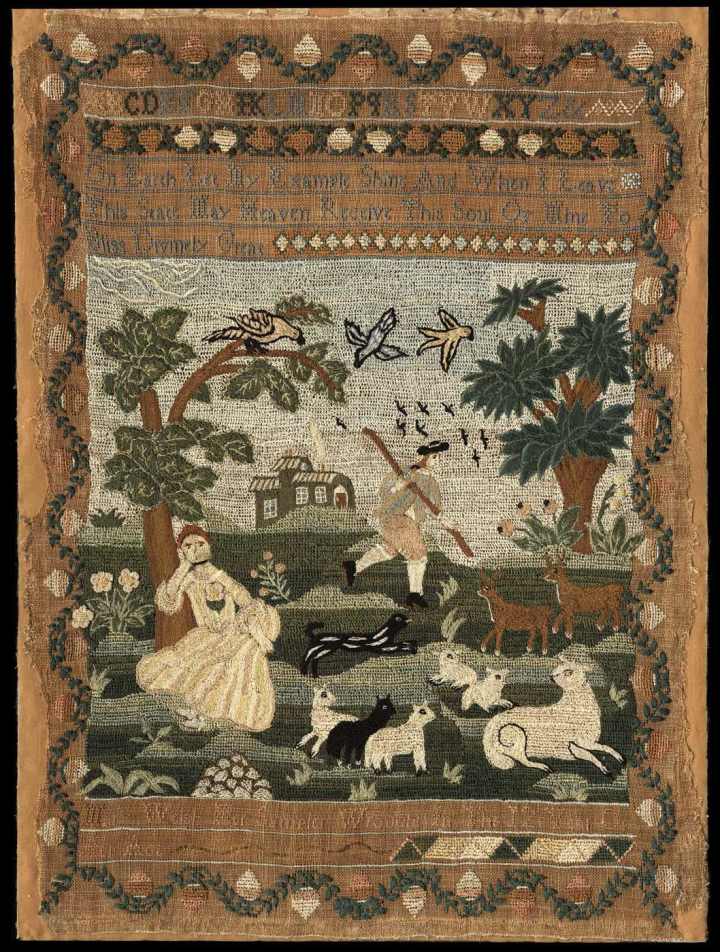
Sampler by Mary Welsh, Massachusetts, ca. 1770 (Colonial Williamsburg, Museum Purchase, 1962-309).
Needlework and sewing were common threads in the lives of most 18th- and 19th-century females across social, economic, and geographical boundaries. Early American women—whether poor, enslaved, indigenous, middle class, or wealthy—contributed to their family’s household furnishings and enriched their homes and clothing by embellishing textiles with decorative stitches. Sewing and mending everyday household textiles, such as bed and table linens and clothing, was another way for women to contribute economically to their family. Stitching needlework projects was not only a creative outlet for many housewives, but was also an educational tool for young schoolgirls. These themes are the basis for Stitched in Time: American Needlework, which will be on view in the Len and Cyndy Alaimo Gallery. The exhibition will also highlight the diversity and regional variations of American needlework that can be traced through the ethnic origins of the makers, trade and migration patterns, influential teachers and artists, current fashions, religious affiliations, geography, and even climate.
“We are excited to share The Colonial Williamsburg Foundation’s regionally and ethnically diverse needlework collection with our museum visitors,” said Kimberly Smith Ivey, senior curator of textiles. “Over 50 textiles for comparison have been selected from regions of New England, the Mid-Atlantic, the South, and the Western Frontier. Highlights of the exhibition include a schoolgirl sampler created by a young Jewish girl who inscribed her work with her hometown of Chicago. Another extraordinary embroidery was created by an Irish immigrant in Frenchtown, Michigan, at the Oblate Sisters of Providence School, which was cofounded by Mother Theresa Maxi Duchermin, a Catholic of color.”
Among the many other highlights of Stitched in Time is a rare bed rug made probably in Norwich, Connecticut, in 1785 by an unknown maker who signed the rug “RD.” The rug relates to a group of embroidered rugs created in the Connecticut River Valley. It was made by darning, or stitching, closely spaced rows of heavy wool yarn through a woolen ground, leaving most of the stitches visible on the surface. The side and bottom borders consist of abstract scalloped and peaked lines similar in appearance to Irish stitch needlework, but worked with darning stitches. This bed rug is especially attractive because of its remarkable condition.
Among the many examples of extraordinary samplers in the exhibition is one made in 1827 by Mary Rees, a student of Elizabeth Robinson (1778-1865), in Montgomery County, Pennsylvania. Robinson, an unmarried woman who lived with her five unmarried sisters in their family homestead left to them by their father, worked as a schoolmistress to help support the family. At least eight samplers or pictures have been identified from Elizabeth Robinson’s school. Mary Rees’ cross-stitched verse and her pictorial composition made of silk and wool embroidery threads on a linen ground are perfectly suited to each other. The verse implores all living things to praise their Maker, while the imagery shows some of the plants and animals requested to pay such tribute. Rees’ careful selection of thread color and the direction and type of stitching makes the scene both decorative and naturalistic. The embroidered scene bordered in black stitches to imitate a reverse painted glass mat and the title, date, and signature worked in bright threads to mimic a more expensive gold leaf inscription are characteristics found on other embroideries worked under the instruction of Elizabeth Robinson.
A highly sophisticated embroidered picture attributed by family history to Orra Sears (1798–1872) of Bloomfield, New York, is another highlight of Stitched in Time. It is believed that Orra created the picture in 1816, when she was a boarding student at the Litchfield Female Academy in Connecticut. School records indicate that Orra attended the school that year; she was one of at least 2,000 girls from nearly every state who attended the academy from 1792 through 1833 when the school operated. Students from out of town, such as Orra, boarded with Litchfield families. American educational goals of the period stressed the proficient duplication in embroidery of idealized themes that were widely recognized and approved of, rather than the development of individual creativity. Needlework compositions were taken from existing illustrations, usually English engravings or other printed images. Here, at least four different prints depicting views of Chiswick, an English country house, were used to create the scene on Orra’s embroidered and painted picture.
In its second year of a three-year exhibition, The Art of the Quilter’s latest rotation in the Foster and Muriel McCarl Gallery promises to continue delighting quilt aficionados with its new selection of quilts from The Colonial Williamsburg Foundation’s heralded collection from the early 19th century to present day. These diverse quilts allowed women to express artistic instincts while also creating a warm and practical bedcover for their loved ones. Making quilts was often a community activity, in which neighbors and relatives enjoyed the pleasures of joint work and socializing.
Ivey said of the exhibition, “We are literally covering America with this exhibition. The bed coverings display a variety of techniques, colors and materials, and demonstrate America’s multicultural society with examples from the Anglo-American, German, Amish and Mennonite communities.” . . .
The full press release is available here»










 Enfilade
leave a comment