Conference | Thinking through Tea
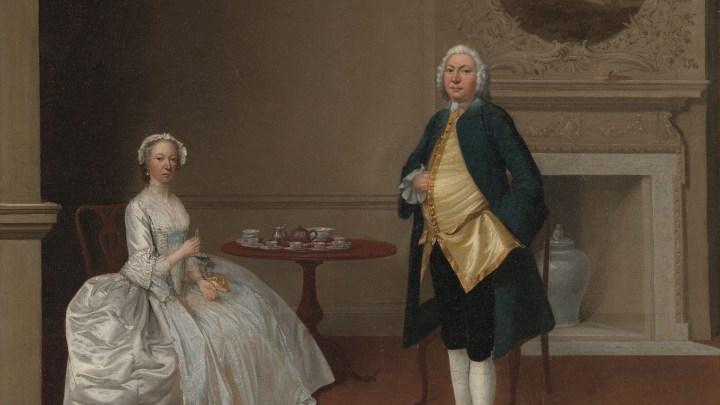
Arthur Devis, A Couple, Traditionally Identified as Mr. and Mrs. Hill, detail, 1750–51, oil on canvas
(New Haven: Yale Center for British Art, Paul Mellon Collection, B1981.25.226).
◊ ◊ ◊ ◊ ◊
From YCBA:
Thinking through Tea: Art, Resistance, and
Global Entanglements in the Age of American Independence
Online and in-person, Yale Center for British Art, New Haven, 7–8 May 2026
Marking the 250th anniversary year of the Declaration of Independence, this program reconsiders American resistance not as a singular political rupture, but as a material and visual process shaped through objects, images, and everyday rituals. Rather than treating independence as an abstract ideal, it asks how freedom was experienced, negotiated, resisted, and contested through practices often far from the political stage yet deeply enmeshed in global systems of extraction and exploitation. From drinking tea and sweetening foodstuffs with sugar, to furnishing interiors with tropical woods, wearing imported or locally adapted textiles, or handling silver objects, these material acts encoded both refinement and refusal.
Across multiple sessions held over two days, the program brings objects to the center of inquiry, examining how global goods circulating through colonial households acquired new meanings. Turning to the present moment, the program questions how museums have inherited, framed, and sometimes obscured these histories. The conversations will invite reflection on the ethical responsibilities of collecting institutions as stewards of objects that bear the uneven legacies of revolution, extraction, and empire.
Join the livestream, beginning at 5.30pm ET on Thursday, May 7, and at 10am on Friday, May 8. Registration, available here, is recommended but not required.
The event is made possible through the support and partnership of the Lunder Institute for American Art, the Colby College Museum of Art.
t h u r s d a y , 7 m a y
5:30 Roundtable 1 | Ritual, Tradition, and Fashion
This roundtable examines how everyday rituals—tea drinking, fashionable dress, and interior furnishing—became charged sites of negotiation in the decades surrounding the American Revolution. Far from being peripheral to political life, these practices were central arenas in which identity, allegiance, and resistance were actively produced and contested. Treating tea and related goods as both commodities and ritual objects, the session explores how colonial communities engaged global materials through practices of adaptation, refusal, and diplomacy. It considers how imported fashions and customs from Africa, the Caribbean, India, and England were reworked into hybrid practices that signaled loyalty, dissent, or strategic ambivalence, and in doing so challenged imperial norms.
Moderator: Mark Peterson, Edmund S. Morgan Professor of History, Yale University
Speakers
• Anna Arabindan-Kesson, Associate Professor of Art and Archaeology and African American Studies, Princeton University
• Catherine E. Kelly, Professor of History and Executive Director of the Omohundro Institute of Early American History and Culture, William & Mary
• Ellen Hartigan-O’Connor, Professor of History and Associate Dean, Graduate Studies, University of California, Davis
f r i d a y , 8 m a y
10.15 Roundtable 2 | Trade, Movement, and Empire
How did the movement of commodities (and the people who cultivated, transported, taxed, and consumed them) create new traditions, dependencies, and inequalities? Rather than treating American independence as a self-contained national event, this session situates it within global networks of trade, labor, and extraction, in order to think through the networks that both enabled revolutionary protest and reproduced new inequalities.
Moderator: Romita Ray, Associate Professor and Director of Undergraduate Studies in Art History, Syracuse University, College of Arts and Sciences
Speakers
• Zara Anishanslin, Associate Professor of History and Art History | Director, Museum Studies & Public Engagement, University of Delaware
• John Stuart Gordon, Benjamin Attmore Hewitt Curator of American Decorative Arts, Yale University Art Gallery
• Jennifer L. Anderson, Associate Professor of History, Stony Brook University
11.30 Break
11.45 Roundtable 3 | The Art of Refusal and Everyday Resistance
What does resistance look like when it happens quietly, domestically, and collectively, through everyday objects, plant commodities, and rituals rather than overt political action? By beginning with domestic refusal—such as tea boycotts and the political meaning of American tea silver—this session reframes revolutionary resistance as embedded in everyday material practice, much of it undertaken by women.
Moderator: Jennifer Van Horn, Professor, Joint Appointment with History, Director of Graduate Studies, Art History, North American Art and Material Culture, University of Delaware
Speakers
• Yota Batsaki, Executive Director and Principal Investigator, Plant Humanities Initiative, Dumbarton Oaks, Washington, DC
• Catherine Molineux, Associate Professor of History, Vanderbilt University
1.00 Lunch Break
2.15 Roundtable 4 | The Afterlives of Curating Resistance
The closing roundtable reflects on institutional and curatorial responsibilities. As the United States marks the 250th anniversary of independence, this session asks how American museums should curate objects of resistance that are inseparable from empire, enslavement, and extraction. What does responsible commemoration look like in material terms? How should we bring out these stories that might not be visible in the archive?
Moderator: Stephanie Sparling Williams, Andrew W. Mellon Curator of American Art, Brooklyn Museum of Art
Speakers
• Stéphanie Delamaire, Curator of European and American Art, Carnegie Museum of Art, Pittsburgh, Pennsylvania
• Erica Lome, Curator of Collections, Historic New England
3.45 Closing Reception










leave a comment