New Book | The Provenance of Monumental Vases
Feng was keen to share the following, “I am extremely grateful to the HECAA community— for the Career Advancement Award, for the mentorship program and mentors, and to the members whose scholarship has laid the foundation for this book.” From De Gruyter:
Feng Schöneweiß, The Provenance of Monumental Vases: Chinese Porcelain, German Curators, and Global Art History in Dresden since 1700 (Berlin and Boston: De Gruyter, 2026), 264 pages, ISBN: 978-3689242831 (hardcover), $98. Digital copies are available for free as open access.
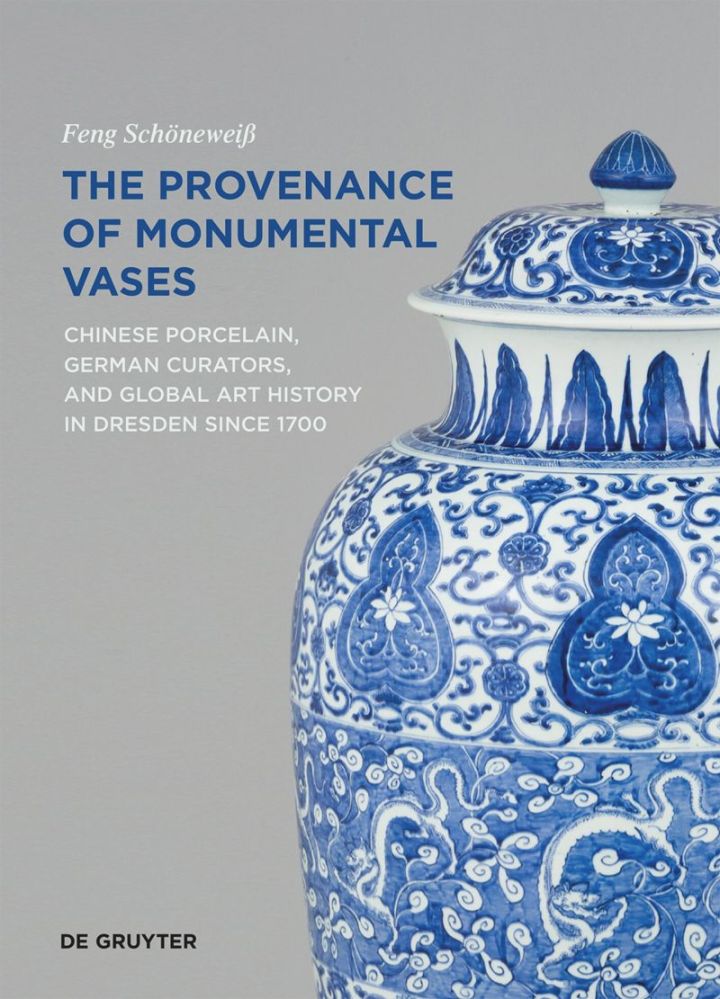 This book focuses on a rare group of Chinese monumental vases in relation to four generations of leading curators at Dresden Porcelain Collection. Over three centuries, various communities perceived the vases as material evidence of social identity and as a referential device of cultur-al memory. As curators clarified, demonstrated, and publicized the provenance of the vases, they also transformed global objects into local heritage. The book offers new insights into the production, periodization, and typology of the largest porcelain made in China after the coldest years of the Little Ice Age. Revealing a transcultural history of provenance research, it sheds critical light on the naming and transfers of the renowned Dragoon Vases (Dragonervasen), and shows how Dresden became a center of Chinese art history until 1945.
• Proposing novel methods to treat provenance research as global art history
• Revealing transcultural connections in inventories, archives, manuscripts, and local gazetteers
• Advancing ecocritical art history with analyses of energy consumption and energy literacy
Feng Schöneweiß is a postdoctoral scholar at the Max Planck Institute for the History of Science. He holds a PhD in East Asian art history and transcultural studies from the University of Heidelberg, and a Marie Skłodowska-Curie postdoctoral fellowship at the University of Warwick. He is the German PI of the UK-Germany Knowledge Frontiers Project “Art and Conflict in Times of Climate Change” funded by the British Academy, and a member of the Energy Research Networks funded by German Federal Ministry for Economic Affairs and Energy (BMWE), a guest researcher at the Kunsthistorisches Institut in Florenz – Max-Planck-Institut (MPI), and an incoming visiting scholar at the University of Oxford. Feng has been a 4A_Lab postdoctoral fellow at the Kunsthistorisches Institut in Florenz MPI and the Stiftung Preußischer Kulturbesitz in Berlin, an Albert-Ottenbacher-Fellow for Provenance Research at the Zentralinstitut für Kunstgeschichte in Munich, and a doctoral fellow in the Cluster of Excellence “Asia and Europe in a Global Context” in Heidelberg. His academic interests include critical heritage studies, histories of collecting and museums, histories of disciplinary knowledge, provenance research, histories of lunar exploration, and energy history.
c o n t e n t s
Introduction
The Provenance of Monumental Vases
Vases, Curators, and the Collection
Provenance as Method: Evidence, Process, Action, Relation
From Global Objects to Disciplinary Knowledge
1 | Making the Monumental Vases: Materiality, Periodization, and Realization from 1690 to 1715
Dentrecolles and the Large ‘Urns’: Interpretation and Periodization of Text
Pied, Pyramide, and Periodization of Vases, 1690–1715
The Realization of Monumental Vases: An Ecocritical Perspective
Terminology, Materiality, and Typology
Concluding Remarks
2 | Inventing the Dragoon Vases: Inventories, Legend, and Provenance Research
Manifest Provenance: Dresden Inventory Marks in Three Systems
Legendary Provenance: Revisiting the Dragoon–Porcelain Exchange, 1715–1717
Standardized Documentation of Provenance Information
Provenance Research as Process: Johann G. T. Graesse and the ‘Dragoon Vases’
Concluding Remarks
3 | Forging Cultural Memory: Communities, Identity, and the Provenance of Monumental Vases
The Prussian Porcelain Regiment
Objects of Wonder in Dresden
Representation, Appropriation, and Cultural Memory
Museum Discourse and Historicist Display
Concluding Remarks
4 | Shaping Global Art History: Curatorial Agency, Disciplinary Methods, and Chinese Ceramic Studies in Dresden
Gustav F. Klemm (1802–1867): Cultural History, Private Collection, and an Imagined Museum
Johann G. T. Graesse (1814–1885): Literary Studies, Museology, and Ceramic Studies
Ernst Zimmermann (1866–1940): Chinese Porcelain as Art History
Fritz Fichtner (1890–1969): Formal Analysis and Object Biography
Dresden’s Position in the Historiography of Art in and from China
Concluding Remarks
Conclusion
Monumental Vases and Museum Professionals
Provenance Research as Global Art History
Acknowledgments
Appendix 1
Table 1 Typology of Chinese Monumental Vases
Table 2 List of Chinese Monumental Vases in Public and Private Collections
Table 3 Inventory Systems of the Dresden Porcelain Collection
Table 4 Sample of Standardized Documentation of Provenance Information
Table 5 Historical Awareness of the Dragoon-Porcelain Exchange
Table 6 Formation of the Dragoon-Regiment von Wuthenau in 1717
Table 7 Development of the Dragoon-Regiment von Wuthenau after 1717
Table 8 Museum Professionals, Dresden Porcelain Collection since 1833
Appendix 2
Transcription of Two Delivery Notes Dated 1717
Bibliography
Image Credits
Index










leave a comment