Exceptions and the Market
It’s a point I try to make with my students: art historical narratives at the introductory level (perhaps within the field generally) are built around exceptional works—pieces, for instance, that are especially well executed, can boast a remarkable provenance, or mark a shift in style (if all three, then so much the better). Quality distinctions carry important market implications, too; and as Scott Reyburn reports for The New York Times, demand for lower- and mid-level priced antiques remains low, in contrast to the market for rare items—exemplified by the September sale of a ca. 1720 writing table by André-Charles Boulle, which sold for 3.15million USD, well beyond its estimate. –CH
From the article:
Scott Reyburn, “A Shift in the Antiques Market,” The New York Times (3 October 2014).
So the question on many collectors’ minds now is just how low can the price of period English furniture go? The British-based Antique Collectors’ Club’s Annual Furniture Index (AFI), based on a mix of auction and retail prices of 1,400 typical items, fell by 6 percent to 2,238 in 2013. The index has been on a slide for more than a decade after reaching a peak of 3,575 in 2002.
“For nice furnishing things, prices are as low as I can remember,” said Paul Beedham, an early oak specialist dealer in Derbyshire. “The professional classes who used to buy just don’t have the money any more. They’re struggling to pay their mortgages and car loans.”
The full article is available here»
At Auction | Un Bureau Plat by André-Charles Boulle
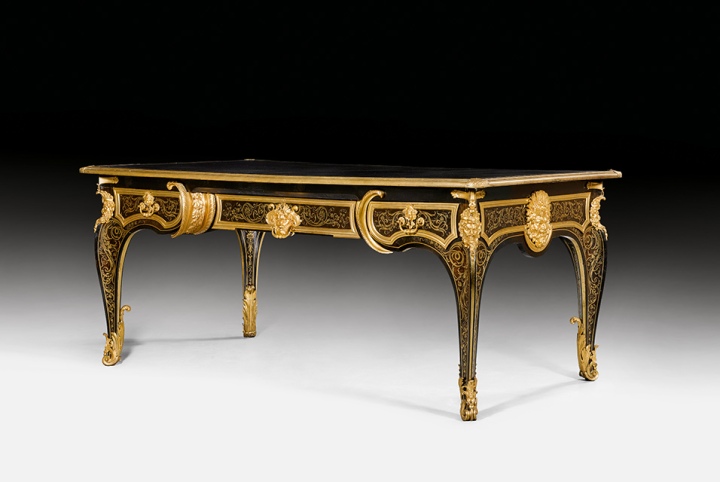
André-Charles Boulle, Bureau-plat aux têtes de satyre, ca. 1720.
◊ ◊ ◊ ◊ ◊
Press release from Koller Auctions for its upcoming Furniture & Sculpture Sale:
Koller Auctions presents a bureau plat by the most important French cabinetmaker André-Charles Boulle to be offered at the upcoming auction for furniture and decoration in Zurich on September 18, 2014 [Sale A170, Lot 1078]. It is the discovery of a previously unknown masterpiece and the world’s first auction of a Boulle desk since 2005. The estimate for this museum piece is set at CHF 1.5 to 2.5 million (€1.25 to 2.083 million). In the early 18th century, André-Charles Boulle, first cabinetmaker at the court of the Sun King Louis XIV, delivered one of his prestigious writing tables (bureau plat) to a French aristocratic family, where it remained and was passed down over the centuries within the family until it eventually reached private castle estate in western Switzerland. Here it was rediscovered by Koller and consigned to an auction. The excellent quality of the desk, the complete provenance, and the fact that this piece of furniture has been unknown to the art market and research to date makes this current discovery a sensation.
 The large, four-legged bureaux plats by André-Charles Boulle can be divided into three categories: desks with rolled corner bronzes, desks with têtes de femme, and desks with têtes de satyre. The latter made by Boulle as early as 1690 in several variations, for which reason it is his largest category. Among them is the example offered at Koller Auctions on September 18. It was created around 1720 in the style of the Regency, measures 195 x 98 x 80 cm, and is made of ebony and red and brown tortoiseshell. It offers an extremely fine brass inlay in the form of flowers, cartouches, and leaves. The desktop is covered with black leather and rests on the typical, distinctive curved legs. The desks name derives from the lush bronze fittings, designed as satyrs, gargoyles, leaves, and decorative friezes.
 All known desks aux têtes de satyre can be found in the most prestigious museums of the world. The one to be offered at Koller is almost identical to the bureau plat acquired in 1985 by the Getty Museum in Los Angeles. Four other specimens are in the Royal Collection at Windsor Castle, The Wallace Collection in London, The Budapest Museum of Fine Arts, and at The Frick Collection in New York. Boulle desks are very rarely found at auction. The last time a comparable bureau plat was offered for sale was on 14 December 2005 as part of the famous Wildenstein auction in London. At that time the piece achieved 2.9 million pounds [Christie’s Sale 7171, Lot 15].
The bureaux plats of André-Charles Boulle were already much desired among the most important exponents of his time. The list of original first owners therefore stretches from family members of King Louis XIV, to King Philip V of Spain, the Prince of Condé, Cardinal Prince de Rohan, the financier family Bernard to the ministers of Louis XV, such as his infamous Treasurer, Abbot Joseph Marie Terray. The early popularity of such desks is also
apparent in the numerous illustrations from the 18th century.
Click on the two smaller pictures for extraordinarily rich images.
André-Charles Boulle and His Work
André-Charles Boulle was born on November 10 1642 in Paris, where he later died, on Saturday, 1 March 1732. His long and successful career as a cabinetmaker makes him one of the most important figures in the history of art under King Louis XIV and the Regency era. This success is due, in addition to the perfect aesthetics of his furniture, in particular to an ambitious business plan, according to which Boulle as designer of exclusive furniture made from innovative materials had his designs implemented by the greatest craftsmen and artists in his workshop. Thereby Boulle controlled the production and guaranteed their uniformity. Already at the age of 29, on instruction of Louis XIV and by decree of Maria Theresa, he received one of the coveted logements under the gallery of the Louvre on May 20 1672, where he worked until old age.
Due to the high degree of organisation of work, which he introduced in his workshop after bottlenecks in production and conflicts with dealers, he could still coordinate 17 bureaux plats at the same time at the age of 78. He was able to counter the extremely time-consuming production of luxury furniture by relying on prefabrication. The furniture, especially the desks, were stored in a kind of raw state, only completed in their basic structure with partial Marquetry and not yet decorated with bronze fittings. This made it possible for Boulle’s studio to adjust and complete the furniture according to the customer requirements, despite the time pressure. Albeit his success, recurring financial difficulties, such as outstanding wage payments to his employees and tax problems, forced André-Charles Boulle to sign over his company to his four sons in 1715, without, however, giving away the reins.
◊ ◊ ◊ ◊ ◊
Note (added 28 September 2014 ) — From the post-sale press release:
The sensational result of 3 million Swiss francs [3.15 million USD] obtained for the writing desk by the French cabinetmaker André-Charles Boulle was the highlight of the furniture auction (Lot 1078). This is the highest price ever paid for a piece of furniture at an auction in Switzerland and one of the highest prices ever paid for a piece of furniture world-wide. A private collector from London outbid three telephone bidders and an interested party in the auction hall. . . .
J & A Beare and Amati Release Books on 18th-Century Violins
“With the closure of Sotheby’s and Christie’s music departments, Amati is leaping into the gap in the market with gusto and is changing the shape of the industry. Amati not only provides owners with a valuation service but allows dealers and makers around the world to upload their instruments, with full provenance and documentation for the valuable instruments.” More usefully for most of us, Amati’s online magazine includes reviews of concerts and recordings. –CH
From Art Daily (24 August 2014). . .

Antonio Stradivari ‘La Pucelle’ Violin, 1709
The Monograph Collection is a collaboration between J & A Beare and Amati, who will be releasing a series of books each dedicated to a single masterwork of the classical school of violin making. The Monograph Collection books are sold as an annual subscription and are available to pre-order, with the first three books due out in September and the fourth in December. Each volume includes a detailed history as well as descriptive text on the technical and aesthetic features of each instrument, alongside professional photos and measurements. Written by strings specialist John Dilworth, it is hoped that the books will become treasured collector’s items.
Extract from I – Antonio Stradivari ‘La Pucelle’ Violin 1709: “The soundholes are wonderfully elegant and beautifully finished, as one would expect. They sit with great poise and balance on the front, the edges still looking sharp enough to cut paper. Comparing these virtually perfect soundholes with those on other celebrated instruments by Stradivari brings home the great variation observable in position, inclination, widths, and even symmetry in the work as a whole. These particular soundholes on ‘La Pucelle’ are cut with a quite generous width in the arm, a feature going back to the 1680s. Amongst these and later examples there are soundhole pairs that lean inwardly at the upper hole, and later there appear soundholes cut with a slender arm, set sometimes very upright and parallel. Then, in the Golden Period and beyond, there appear mixtures of all these traits in pairs of soundholes on the same instrument. The explanations for all this apparently random treatment lie in the techniques Stradivari used to draw out the soundholes and the obvious fact that there were more than one pair of hands at work in the atelier.”
Amati, the marketplace for stringed instruments, was set up to offer free evaluations and to provide transparency in the sale and purchase of violins, cellos, violas and bows—from a child’s violin to mid-range instruments for young professionals and antique violins of the highest calibre. By taking the market online, it empowers buyers and sellers to become better informed about an industry often shrouded in mystique. For those with a violin gathering dust in an attic, Amati is the first port of call for finding out the value of an instrument and sourcing comparisons, to enable those with little knowledge to access accurate information in the public domain. Amati will also be providing access to illustrated, hardbound monographs written by John Dilworth on some of the most famous Stradivarius violins and cellos in existence. With the closure of Sotheby’s and Christie’s music departments, Amati is leaping into the gap in the market with gusto and is changing the shape of the industry. Amati not only provides owners with a valuation service but allows dealers and makers around the world to upload their instruments, with full provenance and documentation for the valuable instruments.
Amati was co-founded by husband and wife team James and Sarah Buchanan in July 2013. Sarah is the company Director, while James offers specialist expertise in valuations. He has gained expert knowledge of the industry, having co-founded a specialist auction house in 2006, after running the Music Department at Christie’s Auctioneers in London.
At Auction | The Contents of Bantry House

◊ ◊ ◊ ◊ ◊
Press release from Edinburgh’s Lyon & Turnbull, as posted at Art Daily:
Lyon & Turnbull | The Contents of Bantry House (Sale #426)
Bantry House, County Cork, 21 October 2014
Lyon & Turnbull are to sell the contents of Bantry House, County Cork, one of the finest and best loved historic houses in the Republic of Ireland. The sale will take place the 21st of October, 2014 on the premises at Bantry House. Formerly the principal seat of the Earls of Bantry, the house was owned and run by the late Egerton Shelswell-White and his wife, latterly with the help of their eldest daughter Sophie, who has been General Manager since 2010.
“It is a wonderful house with an extraordinary history” says Mrs. Shelswell-White, whose husband’s family have lived in the house for over 300 years. “It has been a very difficult decision, but also an exciting and stimulating one. The funds from the sale will inject a new energy into the house and also into us, as a family. This decision will free us to make new plans and allow us to be open to different proposals and new ideas. I feel it will make it possible for Bantry House to have a future as a successful place, more in step with the times we live in.” She continued: “I feel certain that every single item will go to a good home and be treasured and looked after as we have tried to do. Many of the objects in the sale are of museum quality and need to be expertly cared for, a luxury we could only afford with great difficulty. The house and gardens will continue to be open to the public and we will continue to run and possibly expand our successful bed and breakfast business. We will be able to hold more weddings, concerts, exhibitions and other events, aiming to extend the season into the winter months, securing and creating jobs for those involved with the house. This season will be the last opportunity to see the house with its contents as it is now and has been for many years.”
Items in the sale include many paintings, furniture and books collected by the second Earl of Bantry, including some exquisite French tapestries that adorn the walls of several of the rooms. Produced in the workshops of Gobelins and Aubusson in the 18th century, one of the two Gobelins panels is said to have hung in the Palace of Versailles and there is a particularly beautiful rose-coloured set of Aubussons, which are said to have been made by order of Louis XV for Marie Antoinette on her marriage to the Dauphin of France.
Gavin Strang, Director of Lyon & Turnbull said “Lord Bantry’s collection has long been recognised as having great artistic and historical interest. As a young man, Viscount Berehaven, who later became the second Earl, travelled extensively in Europe; visiting countries as far distant as Russia and Poland, seeking out the pieces which were to form his remarkable collection of furniture, tapestries and other works of art that are included in the sale.”
Among the furniture in the sale is a Russian household shrine which contains 15th- and 16th-century icons and an impressive pair of William Kent style console tables. The paintings in the collection include a pair of portraits from the studio of Allan Ramsay of George III and Queen Charlotte, presented by King George to the First Earl of Bantry on his elevation to the peerage. Immediately prior to the sale the house and contents will be on view to the public on October the 17th, 18th 19th and 20th of October, with the sale on the 21st October 2014.
At Auction | From the Collections of the Dukes of Northumberland

From Sotheby’s (click to view the very grand 3-minute preview). . .
Spanning 2000 years of art history and formed over several centuries, the collection of the Dukes of Northumberland, from Syon House and their primary residence Alwnick Castle, is one of the great British collections. Henry Wyndham, Mario Tavella and Andrew Fletcher present a selection of the 73 lots from this remarkable collection to be sold at Sotheby’s in 2014.
◊ ◊ ◊ ◊ ◊
Property from the Collections of the Dukes of Northumberland
Medieval and Renaissance Manuscripts
8 July 2014, London
Old Master Drawings
9 July 2014, London
Treasures
9 July 2014, London
Old Master and British Paintings
9 July 2014, London
English Literature and History
15 July 2014, London
Indian and South East Asian
1 October 2014, New York
Arts of the Islamic World
8 October 2014, London
Travel, Atlases and Natural History
4 November 2014, London
Clive Aslet writes about the family for Sotheby’s Magazine (30 May 2014).
Might & Magnificence: Silver in the Georgian Age
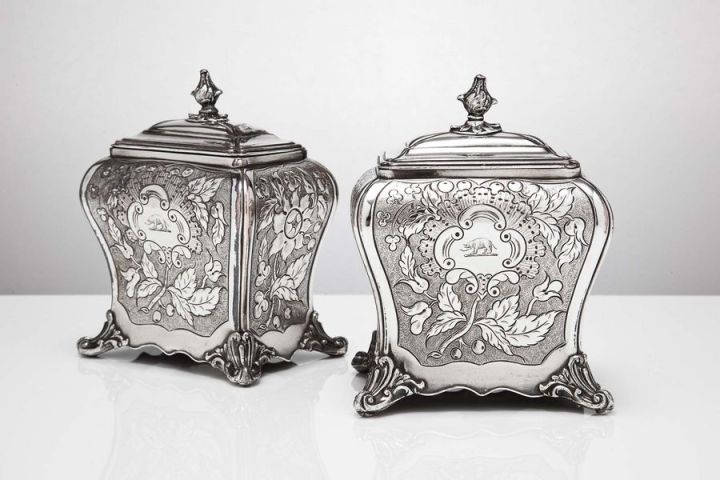
Pair of Sheffield Plate tea caddies, ca. 1800/1810,
of earlier rococo style.
◊ ◊ ◊ ◊ ◊
Press release from London’s Silver Vaults:
Might & Magnificence: Silver in the Georgian Age
The London Silver Vaults, Chancery Lane, London 2 June — 4 October 2014
Curated by Philippa Glanville
The summer selling exhibition at the London Silver Vaults, Might & Magnificence: Silver in the Georgian Age, will display a wide variety of Georgian silver design, drawn from all 30 Vaults shops, encompassing the major design trends of the period, from the effusively embellished rococo to the restrained neo-classical. With added curating expertise from Philippa Glanville, silver historian, author and former Keeper of Metalwork at the Victoria & Albert Museum, key pieces will be selected that demonstrate the finest Georgian design and craftsmanship. All items are for sale, offering an opportunity to acquire a beautifully crafted piece of design history from this elegant era.
In the Georgian period silverware gradually ceased to be the exclusive preserve of aristocrats, diplomats and bishops. A new middle and merchant class was emerging in Britain, wanting to buy impressive objects for their new homes. Throughout the Georgian period silver remained one of the most popular expressions of taste, style and innovative manufacturing techniques. Ingenious designers ensured a flow of novel objects for these new consumers, in Britain and overseas. England was already a rich country by the early 1700s, and in the 120 years spanning George I’s accession in 1714 to the end of William IV’s reign in 1837, the country went through an explosion of commercial growth, technical development and social improvement. Silver design and manufacture reflected these changes.
Until the 1760s most silver was entirely made by hand, the alloy hammered into shape and raised or chased to form decoration so the pattern was shown in relief on the exterior. Cast elements, like handles and feet, were soldered on. These purely hand-decorated pieces were quite heavy, making silver a super-luxury product that only the very wealthy could afford. Retailers sold silver mostly by weight, with an extra charge per ounce for workmanship and more for any engraved heraldry. In the 1750s a London goldsmith would charge £50 for a new set of eight cast candlesticks, essential lighting for the dinner table. This is a large sum, as much as a portrait or the year’s wages for a smart French chef. (An English cook was paid half as much.) In 1765 the young Duke of Portland bought a complete Wedgwood creamware dinner service for £13, but in silver that would have bought a single sauceboat. Pre-owned silver sold well too, by weight, as the ‘fashion’ or workmanship charge was reduced. (more…)
Fair | Art Antiques London, 2014
From the fair’s website:
 Art Antiques London
London, 11–18 June 2014
The Albert Memorial and Kensington Gardens once again provide the stunning backdrop to one of London’s most exciting and glamorous art and antique fairs. Held in a beautiful bespoke pavilion opposite the Royal Albert Hall and close to the site of the Great Exhibition of 1851, Art Antiques London brings together leading international dealers and discerning visitors from all over the world, who can buy with confidence at this strictly vetted sumptuous summer showcase for the arts.
◊ ◊ ◊ ◊ ◊
From the fair’s lecture series (with information about each speaker available here) . . .
Jewellery in the Age of Queen Victoria: A Mirror to the World
Thursday, 12 June, 11:30
Judy Rudoe (Curator of Jewellery and Decorative Arts, The British Museum)
This lecture emerges from the speaker’s recent book co-authored with Charlotte Gere (see biography). The ‘age of Victoria’ is taken in its widest sense to encompass jewellery from across Europe and America, at a time when expanding foreign trade, the new illustrated press and a growing tourist industry brought jewellery from many parts of the world to a wide audience. Queen Victoria played a huge role: what she wore and did had tremendous impact, so what might seem a narrow subject acts as a key to our understanding of the entire Victorian age. Using examples from the British Museum and collections worldwide, Judy Rudoe considers Victorian jewellery against its global background and uncovers what jewellery meant to those who wore it, both literally and metaphorically. She will show how it was used in private and in public to reveal that politics, nationalism and even humour of the period are all embodied in jewellery.
◊ ◊ ◊ ◊ ◊
J.M.W. Turner: The Artist and His House at Twickenham
Thursday, 12 June, 2:30
Catherine Parry-Wingfield (Chairman of Turner’s House Trust)
Turner is rightly one of the most famous names in the history of British art, and remains an inspiration to painters today. Tucked away in Twickenham is a small unknown work by this great artist, not a painting, but a work in three dimensions. Sandycombe Lodge was designed by Turner himself as a country retreat from the pressures of the London art world; his ‘old Dad’ kept house here, Turner sketched, fished the river and occasionally entertained. This talk will explore a little-known side of Turner’s life and work, against the backdrop of the ‘Matchless Vale of Thames’, the beautiful Thames scenery which inspired much of his work. Sandycombe Lodge is now owned by Turner’s House Trust, which is developing plans for major conservation and future use of this beautiful and important building.
◊ ◊ ◊ ◊ ◊
A Matter of Fashion: The Collecting of English Ceramics
Friday, 13 June, 11:30
Anton Gabszewicz (Independent ceramics researcher)
Since the death of Lady Charlotte Schreiber in 1895, English ceramics have been collected with increasing enthusiasm. The founding of the English Porcelain Circle in 1927, under the Presidency of Mrs Radford, brought leading enthusiasts together and since then, through the yearly publication of the ECC Transactions their knowledge has been disseminated to a wider public. Yet the collections the speaker will discuss are markedly varied in their content and in the way they have been assembled. The names form a roll call of the influential collectors of the last 70 years. This lecture identifies those influences and how they informed the taste of succeeding generations.
◊ ◊ ◊ ◊ ◊
Of Soup and Love: The Campbell Collection of Soup Tureens at Winterthur Museum
Friday, 13 June, 2:30
Pat Halfpenny (Independent researcher)
The Campbell Collection of soup tureens is the finest collection of its type in the world. Although this lecture will focus on the magnificent ceramic pieces, they will be set in a context that includes highly prized silver and gilt examples that will help us understand the evolution of high style in the eighteenth and early nineteenth centuries. As grand gilded baroque examples, fanciful rococo porcelain, and elegant neoclassical forms will be discussed, the speaker will share some of the changes in social life and dining practices that created the environment in which tureens were first introduced, rose to great prominence, declined, and found new purpose in the twentieth and twenty-first centuries.
◊ ◊ ◊ ◊ ◊

Early Chelsea Model of a Finch, ca. 1745–49, exhibited by the Brian Haughton Gallery.
Nature, Porcelain and Enlightenment: Early English Porcelain and its Place in the Eighteenth-Century Home
Friday, 13 June, 4:30
Paul Crane (Lecturer, researcher, and dealer)
England in the mid-eighteenth century was a country riveted by an insatiable appetite for knowledge, exploration, and discovery. This forged a new scientific approach which was to spearhead the Age of Enlightenment. Through new eminent publications Science and Nature became the pinnacle of taste and fashion within the Aristocracy, who decorated their homes with this organic natural force. The birth of English porcelain in London in the 1740s provided an opportunity for enlightenment to fuse with the arts. Examples of the production at the porcelain manufactories of Bow, Chelsea, Worcester, and Vauxhall together with the Liverpool factories of Samuel Gilbody, William Reid, and Richard Chaffers will illustrate these natural recreations that were to fill the eighteenth-century home with a totally re-invented Cabinet of Natural Curiosity.
◊ ◊ ◊ ◊ ◊
The Silver Society Study Day: New Silver Projects
Saturday, 14 June, 11:00–6:00
Dirk-Jan Biemond, Michèle Bimbenet Privat, Hazel Forsyth, Christopher Hartop, James Rothwell, Peter Taylor, and Charles Truman
Tickets: £50 society members / £65 non-members. Please note that The Silver Society Study Day is booked separately from the Art Antiques London lecture programme. To book, visit The Silver Society’s website or email events@thesilversociety.org.
◊ ◊ ◊ ◊ ◊
Around the World in 80 Figures: Highlights of the Pauls-Eisenbeiss-Stiftung, Basel
Sunday, 15 June, 11:30
Samuel Wittwer (Director, Prussian Palaces and Gardens Foundation, Berlin-Brandenburg)
Established in 1975 in Basel, the Pauls-Eisenbeiss Foundation is one of the world’s leading collections of eighteenth-century German porcelain figures. The collection concentrates on four leading manufactories (Meissen, Frankenthal, Ludwigsburg, and Höchst) bringing together 750 objects, mainly figures. This treasure trove of German porcelain has been open to the public since 1977. It is not just a collection of important examples of each manufactory; it is a collection cleverly put together in the 1950s and 1960s and is the perfect study base enabling collectors to compare variations of decoration and modelling, discovering unique pieces and also enabling students to gain insight to a wide range of topics such as fashion and social aspects of the eighteenth century. This lecture introduces us to this important collection in a multifaceted way by giving us a general overview as well as concentrating on new aspects of research and details.
◊ ◊ ◊ ◊ ◊
Freedom of Expression: The Fantastic Range of du Paquier Porcelain
Sunday, 15 June, 3:30
Claudia Lehner-Jobst (Art historian and curator, Vienna)
This lecture will pay homage to two personalities: Claudius Innocentius du Paquier, the founder of the first porcelain manufactory in Vienna and his artistic resourcefulness and to one of the first collectors of his work, Marchese Emanuele d’Azeglio whose objects now form the heart of the ceramics collection at the Palazzo Madama in Turin. The speaker will discuss the history of that collection and some outstanding objects in depth.
◊ ◊ ◊ ◊ ◊
A Behind the Scenes Look at Ming: 50 Years that Changed China
Monday, 16 June, 11:30
Jessica Harrison-Hall (Curator of Chinese Ceramics, British Museum and Sir Percival David Collections and Vietnamese Art)
This year the British Museum will open a major exhibition on Ming courts and their international engagement. Ming: 50 Years that Changed China shows how fifty years of the Ming dynasty transformed China in ways which still affect the country we know today. Ming China was thoroughly connected with the rest of the world in these years and absorbed many influences. The staggering wealth of the courts included some of the most beautiful porcelain, gold, jewellery, furniture, paintings, sculptures, and textiles ever made. Many of these objects were undiscovered until recently and have never been shown within the context of China’s multiple courts and of Ming China’s interaction with foreign countries ranging from Mogadishu to Kyoto. This lecture takes a behind the scenes look at the four years of collaborative research and international co-operation which culminate in the exhibition.
◊ ◊ ◊ ◊ ◊
Face to Face: Dame Rosalind Savill in Conversation with the Duke of Devonshirec
Monday, 16 June, 4:00
Where do you find the essential combination of sensibility and pizzazz needed to cherish the traditional and celebrate the innovative in a great country house? The answer is simple: at Chatsworth with the Duke and Duchess of Devonshire. Throughout its history the individual contribution of each generation has enabled it to evolve and flourish, often against huge odds, but the pressures and challenges today are more formidable than ever. Stoker and Amanda Devonshire have spent the last ten years reinventing Chatsworth in a myriad of inspirational ways, giving it a new twenty-first century lease of life, and using their magic touch to turn a possible millstone into a marvel. This discussion will attempt to discover the secrets of their success in bringing a thrilling new edge to Chatsworth. It will touch on the history of the house and its great collections, and will explore their daunting responsibilities and prospects when he inherited in 2004, how their grand plans took shape, the highs and lows of achievement, and the continuing excitement of future projects and dreams. Conversation sponsored by 1stdibs.
◊ ◊ ◊ ◊ ◊
The French Porcelain Society Study Day: Sèvres and China
Tuesday, 17 June, 11:00–5:30
Dame Rosalind Savill, John Whitehead, Juliet Carey, Kee Il Choi, Vincent Bastien, and David Peters
Tickets: £45 Society members / £65 non-members. Please note that The French Porcelain Study Day is booked separately from the Art Antiques London lecture programme. To book, visit The French Porcelain Society’s website or email rmcpherson@orientalceramics.com.
◊ ◊ ◊ ◊ ◊
Porcelain Figures in the Royal Court Pantries in Dresden, Warsaw and Hubertusburg: A Crash-Course in the Hof-Conditorei Inventories
Wednesday, 18 June, 2:30
Maureen Cassidy Geiger (Independent ceramic researcher)
Meissen figures have typically been studied via the work reports in the manufactory archives, which were suspended from 1748 to 1764, or the Japanese Palace inventories. By comparison, the highly detailed inventories of the court pantries of the Saxon-Polish realm have been overlooked as an essential resource for understanding the types and numbers of figures produced for table decoration, especially during the gap in the work reports. This Hof-Conditorei crash course will focus on three inventories taken between 1750 and 1755 at three royal palaces: Dresden, Warsaw, and Hubertusburg.
◊ ◊ ◊ ◊ ◊
Dining Culture in Enlightenment Europe
Wednesday, 18 June, 4:30
Ivan Day (British food historian)
From the town houses of Edinburgh to the palaces of St Petersburg, from the chocolate houses of Madrid to the grand salons of Stockholm, the cuisine and dining protocol of the French ancien regime spread rapidly during the course of the eighteenth century to all of the great European centres, frequently obliterating the native high status food traditions of those who adopted it. In this illustrated lecture, British food historian Ivan Day will examine the dramatic cultural impact that the spread of French court dining protocol had on the non-French speaking aristocratic world. He will not discuss not only the remarkable food itself, with a particular emphasis on the dessert course, but also its mode of service and the glittering material culture it spawned.
At Auction | Eighteenth-Century Cognac at Bonhams
Press release (5 May 2014) from Bonhams:

Lot 947: Cognac 1762. Gautier. Wax seal, driven cork. Hand-blown bottle. Bottled circa 1840s. Handwritten label, coated in cellar grime. Writing clearly visible. Level: (u.5.1cm below bottom of cork) No bottle size indicated, approximately half bottle size. Sold for $59,500 including premium.
Very old and ultra-rare cognacs led the successful sale of the Whisky, Cognac & Rare Spirits Auction on April 30 at Bonhams, New York (21633), the third largest international fine art auction house. The auction’s top lot and front cover catalog highlight, a 1762 vintage Gautier that is one of the oldest authenticated cognac vintages known, experienced spirited bidding amongst an international clientele, eventually selling to an online bidder from Poland for a final price of $59,500. A further rare 18th-century vintage cognac, a 1790 Grande Champagne, sold for $49,980, also purchased by the same bidder. Additional cognac highlights include an 1840 AE Dor, which found its new owner for $5,355.
Overall, the auction sold 94 percent of its lot offerings and about 74 percent of all lots sold either above or within their estimated values, proving the items on offer accurately reflect the current market demand for luxury spirits. A majority of the bidders were based in the U.S., followed by the U.K. and particularly Hong Kong, which is indicative of increasing popularity of this collecting category in Asia.
The 987-lot auction notes other top selling highlights of whisky, bourbon, rye, cognac, and rare spirits, which includes a 40-year-old Royal Salute 1953–1993 that sold for $10,115. It was a limited edition offering in a ruby red Baccarat crystal decanter for the 40th anniversary of the introduction of Royal Salute to honor the Queen’s Coronation. A highlight among the fine examples of top-tier Scotch whiskies is a 40-year-old 1961 Macallan Fine & Rare that fetched $8,925. Also of note, a 1965 Macallan Fine & Rare sold for $4,760. Of the bourbon and rye selection, Hannisville Rye distilled in the 1860s and bottled in 1913 reached a final sale of $7,735, and from the Pappy Van Winkle line, a rare presentation of a 23-year-old bourbon in a crystal decanter with two accompanying crystal glasses in a leather lined cherry wood case fetched $5,712.
Other noteworthy highlights that sold include a seven bottle set of Erte Edition from Courvoisier ($5,950) and a 38-year-old Bowmore 1964 vintage ($5,355). Moreover, the two demi-johns of pre-prohibition bourbon from Chapin & Gore, a favorite of Chicago’s late 19th- and early 20th-century gangsters, fetched final prices of $2,975 each.
At Auction | Rare Books at Ketterer Kunst in Hamburg

Cornelis Haak’s, Vues des palais, bâtiments célèbres, places mascarades,
et autres beautés singulières de la ville de Venise (Leiden, 1762)
More information is available here»
◊ ◊ ◊ ◊ ◊
As noted at ArtDaily (3 May 2014). . .
It was nothing less but a revolution in the history of nautical cartography—the sea atlas by Lucas Janszoon Waghenaer. The extremely scarce work in first French edition with a Spanish title sheet will be sold in the auction of Rare Books at Ketterer Kunst in Hamburg on 19 and 20 May with an estimate of €85.000. Lucas Janszoon Waghenaer’s Spieghel der Zeevaert offers a variety of information, such as an innovative illustration of the coastal line in combination with coast profiles. Additionally, his maps are particularly captivating for their accuracy and their rich artful adornment with ornaments, ships and sea monsters.
Besides ships and regattas, Cornelis Haak’s rare series of views of Venice from 1762 also show splendid palaces, manors, churches and bridges in the city of lagoons, as well as its masked balls, acrobats and religious processions. The series of vedutas in the style of Canaletto and Marieschi is especially impressive for the two large city maps of Venice published by Pieter van der Aa. The estimate is at €35.000.
Next to the first print of the first Latin edition of Abraham Ortelius’ Theatrum Orbis Terrarum, its style and content paved the path for later atlases, Johann Heinrich Zedler’s 64-volume encyclopedia will enter the race with an estimate of €30.000. The monumental lexicon, also called Der Zedler after its publisher, may well hold the claim of being the occident’s greatest reference work in print in those days, together with the Spanish Espasa.
While the French natural scientist Jean Baptiste Audebert entirely dedicated his main work in two volumes Oiseaux dorés ou à reflets métalliques from 1802 to the splendid illustration of humming birds (estimate: €15.000), Frederic Moore and Charles Swinhoe committed themselves to the world of exotic butterflies. The extremely rare book in ten volumes, released over a period of 23 years, comprises all Indian butterflies known of in 1913. The work in an excellent coloring will be called up with an estimate of €25.000.
The full press release is available here»

Map of Venice by Pieter van der Aa from Cornelis Haak’s, Vues des palais, bâtiments célèbres, places mascarades, et autres beautés singulières de la ville de Venise (Leiden, 1762). Click on the image to enlarge. More information is available here»
At Auction | The Gustave Leonhardt Collection at Sotheby’s
Press release from Sotheby’s:
Sotheby’s: The Gustave Leonhardt Collection: Property from the Bartolotti House, L14307
London, 29 April 2014
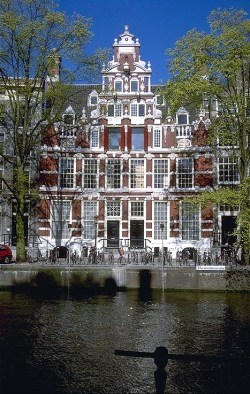
Hedrick de Keyser, Bartolotti House, Amsterdam, 1617. Photo: The Amsterdam Municipal Department for the Preservation and Restoration of Historic Buildings and Sites (bMA), via Wikimedia Commons.
On 29 April 2014, Sotheby’s London will present The Collection of the legendary musician, Gustav Leonhardt (1928–2012) from the Bartolotti House, a magnificent canal residence in Amsterdam situated at 170 Herengracht. There, in the middle of the city, in a sanctuary of tranquillity overlooking a French‐style garden, the world‐renowned organist, harpsichordist, conductor and pedagogue—considered the finest Bach interpreter of his generation—would welcome visitors and students to a vast drawing room with his famous courtesy and natural gravitas. Guests would be equally impressed by the beautiful furnishings and works of art of 170 Herengracht. Every single piece of the Leonhardt Collection seems to have been commissioned for the celebrated 17th-century house, designed by Hendrick de Keyser and later partly embellished with 18th-century paintings, sculpture, stucco and woodwork. The superb ensemble of furniture, silver, ceramics, sculpture, books and Old Masters were all intended to recreate an 18th‐century setting and made a perfect backdrop for Leonhardt’s music, once described as “a simple sound, a clean line and minimal ornamentation.” The inspiration he drew from art was also reflected in his teaching, as he often urged his students to think of a painting or a sculpture to help them interpret a piece of music. The sale will comprise of approximately 300 lots and is estimated to raise around £1.5 million.
 Commenting on the forthcoming sale, Mario Tavella, Deputy Chairman, Sotheby’s Europe and Head of House Sales and Single Owner Collections said: “Few houses evoke more vividly the authentic beauty of the Dutch 17th and 18th centuries. It is not difficult to imagine the strong impression that Leonhardt’s students must have experienced when entering the house and being invited to play music in front of the great master and surrounded by his extraordinary collection. I only wish I had been there myself.”
Albertine Verlinde, Senior Director, Co‐Chairman of Sotheby’s Amsterdam said: “It is a huge honour to have been entrusted with the collection of one of the greatest musicians of the 20th century. This sale continues Sotheby’s long tradition of presenting house sales and private collections with extraordinary provenance.” Johan Bosch van Rosenthal, Art consultant representing Gustav Leonhardt’s family added: “This sale offers a unique opportunity for lovers of Baroque music and of 17th‐ and 18th‐century works of art alike to acquire a piece from this refined collection, formed by a man who managed to reconcile effortlessly the knowledge, taste and elegance of past eras with present‐day life.”
Sculpture
The austerity and search for perfection of the Dutch Baroque is reflected in the classicism that runs through the group of European sculpture. The cabinet objects, on the other hand, are more playful. Made in the Workshop of Artus Quellinus in the mid‐17th century, a relief of Diana the Huntress is one of three terracotta versions of the Quellinus marble in the Amsterdam Town Hall (est. £30,000–50,000). The other two versions are in the Rijksmuseum and in a private collection respectively. A further highlight of this section is a bronze depiction of Amphitrite made by the French sculptor Michel Anguier in the second half of the 17th century. It has recently been revealed by Philippe Malgouyres of the Musée du Louvre, that Anguier’s series of bronze gods was possibly inspired by an important manuscript collection of lute pieces assembled around 1652 by the amateur musician Anne de Chambré, who moved in the same circles as Anguier. The musical meaning may not have been known to Gustav Leonhardt, but must have revealed itself through the statuette’s composition (est. £30,000–50,000).

Lot 481: A German silver glass cooler, probably by Philipp Heggenauer, Augsburg, 1711–15, lion masks and drop ring handles, lion paw feet, 35cm, 13 3/4 in wide (estimate £25,000–35,000)
◊ ◊ ◊ ◊ ◊
Silver
The collection includes spectacular silver pieces, mostly from the Netherlands. Gustav Leonhardt always preferred candlelight to electric lighting, be it at home, or in a concert hall. It is therefore no surprise that this collection is rich in candlesticks, among which two unusual sets of four from The Hague and Amsterdam stand out (est. £25,000–45,000 and 15,000–25,000). A fine example of German silver is to be found in a rare verrière (glass cooler) with superbly expressive lion faces, made in Augsburg in 1711–15 (est. £25,000–35,000).
Ceramics and Glass
Similar to the furniture, many of the ceramic and glass pieces in this collection were primarily made in the Netherlands, England, Germany and France, with the addition of a good element of Chinese Export porcelain, altogether demonstrating Gustav Leonhardt’s excellent eye for style and quality. The core of the ceramic collection however is presented by an extensive and diverse array of 17th‐ and 18th-century Dutch Delft, made by celebrated factories. Painted in a luminous blue, or in a sophisticated polychrome palette, they offer an exciting diversity of forms. The collection also includes a charming group of German porcelain figures, including two Meissen figures of musicians by Kändler, circa 1745 (est. £2,000–3,000).
Old Masters
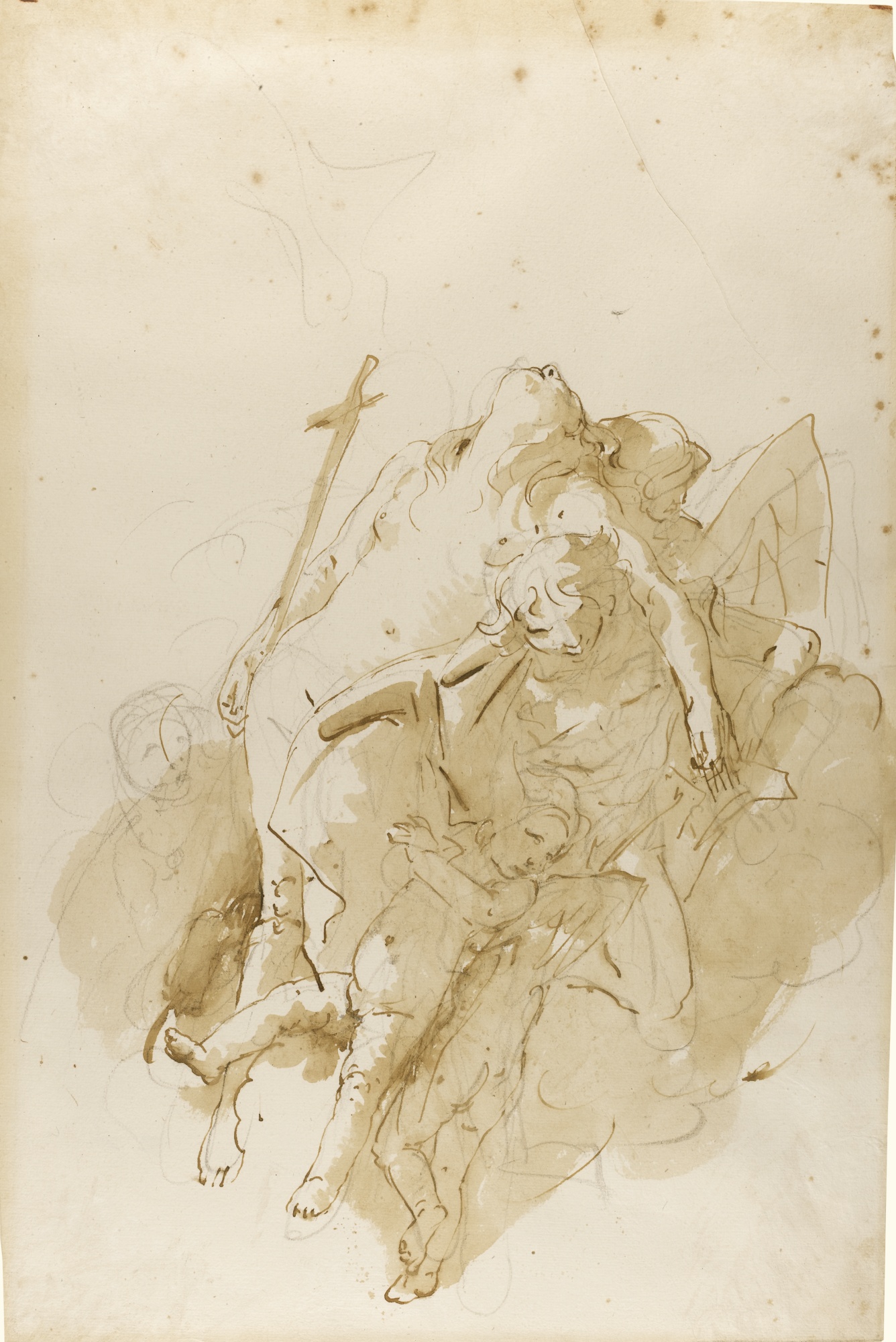
Lot 422: Giovanni Battista Tiepolo, The Assumption of Mary Magdalene, pen and brown ink and wash over black chalk
(estimate: £30,000–40,000).
The collection is further augmented by Old Master paintings, drawings and prints. At the core of this section is the dashing Assumption of Mary Magdalena by Giovanni Battista Tiepolo coming from the famous group of Tiepolo drawings assembled in the late 19th century by Prince Alexei Orloff (est. £30,000–40,000). 17th-century paintings in the collection celebrate the musical theme, including a group of Musicians and a Dog in an Interior by Gerard Pietersz Zijl, a Man with a Glass and Violin after the famous Hendrick Terbrugghen, and A Young Man with Flute from the Utrecht School. Reflecting the connoisseurship of Gustav Leonhardt’s print collection are works by important printmakers such as Canaletto, Goltzius, and Rembrandt—a large proportion of which also follow the theme of music.
Furniture
The Baroque keynote weaves through the furniture collection which spans Anglo Dutch, Flemish, French, and German pieces. Highlights include an attractive Louis XIV ebony, tortoiseshell, and brass Boulle marquetry bureau Mazarin, late 17th century (est. £25,000–40,000) and a fine Anglo‐Dutch William and Mary ivory floral marquetry two-door cabinet on stand, late 17th century (est. £25,000–40,000).
Gustav Maria Leonhardt
(30 May 1928 – 16 January 2012)
Gustav Leonhardt was a pioneer and a leading figure in the world of period instrument performance and Baroque music. A master harpsichordist, organist, scholar, conductor and teacher, he contributed to the rediscovery of the pre‐Mozart repertory. Throughout the second half of the 20th century, he exercised a considerable influence on the international musical scene, performing around the world and making hundreds of recordings. As Le Monde noted, “Gustav Leonhardt was to the harpsichord what Sviatoslav Richter had been to the piano: mysterious, self‐effacing, introspective, uncompromising and prone to flashes of unexpected brilliance within an already brilliant performance.”
Gustav Leonhardt was born in ’s‐Graveland, North Holland on 30 May 1928 and turned to the harpsichord at an early age. In 1947, Leonhardt entered the Schola Cantorum in Basel, Switzerland, where he studied organ and harpsichord with Eduard Müller. After three years, however, his parents, concerned with the few prospects of early music, sent him to Vienna to enrol on a conducting course with Hans Swarowsky. In the early 1950s, he rapidly established his reputation as outstanding harpsichordist and Bach interpreter and became professor of the instrument at the Vienna Academy of Music, and the Amsterdam Conservatoire. He also taught at Harvard in 1969 and 1970.
Considered the finest Bach interpreter of his generation, he methodically recorded Bach’s keyboard music, revisiting works like the Goldberg Variations. In 1971 Gustav Leonhardt and Nikolaus Harnoncourt jointly undertook a project, completed in 1990, to record all J.S. Bach’s sacred cantatas, one of the great projects of recorded classical music and one that has and will continue to inspire early music performers of the future. With the Leonhardt Consort, founded in 1955, Leonhardt and his wife, the violinist Marie Amsler performed a broad selection of the Baroque chamber, orchestral and dramatic repertory, and helped revive works by Rameau, Lully, André Campra and other Baroque composers. He also had a brief screen career in 1968, portraying Bach in Jean‐Marie Straub’s Chronicle of Anna Magdalena Bach. Back in Amsterdam, Mr. Leonhardt was appointed organist of the Waalse Kerk and later the Nieuwe Kerk (New Church), both of which still boast historic instruments.
Gustav Leonhardt continued to perform and teach, with his studio producing several important harpsichordists and early‐music conductors, among them Christopher Hogwood, Ton Koopman, Bob van Asperen, Alan Curtis, Pierre Hantaï and Skip Sempé. Musicians who worked with him described the experience as “life changing.”
He gave his last public performance on 12 December 2011 at the Théâtre des Bouffes du Nord in Paris.
The Bartolotti House, Herengracht 170, Amsterdam
The Herengracht is one of the most prominent canals in Amsterdam. It has been a prestigious address since the 17th century. The Bartolotti House was built circa 1617–21, after a design by Hendrick de Keyser. It was commissioned by Willem van den Heuvel, one of the richest merchants in Amsterdam who inherited an enormous fortune from his uncle Giovanni Battista Bartolotti and thereafter took his name, becoming Guillielmo Bartolotti. Today the house is one of the best surviving examples of early 17th-century Dutch architecture. The cartouches incorporated in the facade reflect merchant’s virtues underpinning commercial success: Ingenio et assiduo labore (‘through ingenuity and unremitting labour’) and Religione et probitate (‘through religion and virtue’). Gustav Leonhardt and his family lived in the Bartolotti House from 1974 to 2012, publishing his extensive research about the house and its residents in 1979.
◊ ◊ ◊ ◊ ◊
Note (added 2 May 2014) — As reported at ArtDaily, “The sale . . . surpassed pre-sale expectations and achieved £1,949,244 (€2,370,674) (est. £1.1–1.6 million / 1.3–1.9 million), with 92% of lots sold.” Results for individual lots are available here»










 Enfilade
leave a comment