New Book | Collecting and Empires
From Brepols:
Maia Wellington Gahtan and Eva-Maria Troelenberg, eds., Collecting and Empires: An Historical and Global Perspective (Turnhout: Harvey Miller Publishers, 2019), 404 pages, ISBN: 978-1909400634, 125€ / $156.
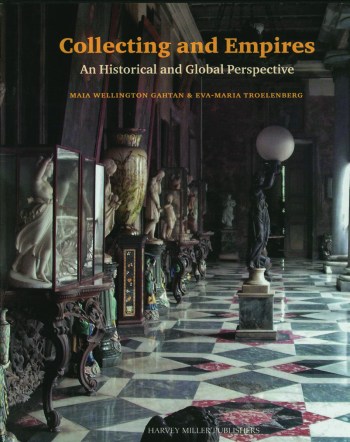 The comparative historical investigation of imperialism through the lens of collecting practices, museum archetypes, and museums proper helps shape our understanding of contemporary aesthetics and diversity management as well as helps identify what is imperial about our own approaches to material culture.
The creation and dissolution of empires has been a constant feature of human history from ancient times through the present day. Establishing new identities and new power relationships, empires also irrevocably altered social structures and the material culture on which those social structures were partly based. The political activities of empires are materially reflected in the movement of objects from periphery to center (and vice versa) and in the formation and display of collections which represent the potential for the production and the dissemination of knowledge. Imperial collecting practices tell stories that are complementary to and go beyond the classical sources of official history, the statistics of social history and even the narratives of collective or individual oral history. Building on previous work on European and Colonial object histories, this collection of essays—for the first time—approaches the subject of collecting and empires from a global and inclusive comparative perspective by addressing selection of the greatest empires the world has known from Han China to Hellenistic Greece to Aztec Mexico to the Third Reich.
C O N T E N T S
• Collection and Power in the Near Eastern World — Alain Schnapp
• The Biopolitics of Collecting: Empires of Mesopotamia — Zainab Bahrani
• Princely Treasures and Imperial Expansion in Western Han China (second/first century BC) — Michèle Pirazzoli-t’Serstevens
• Collecting like Caesar: The Pornography and Paideia of Amassing Artefacts in and after the Roman Empire — Caroline Vout
• From a Culture of the Intimate to a Culture of the Remote. A Latin Epigram Collection between Two Universal Powers: Papal Rome and the Holy Roman Empire — Nadia Cannata and Maia Wellington Gahtan
• The Mexica Empire: Memory, Identity, and Collectionism — Enrique Florescano
• Jahangir’s Hazelnut and Shah Jahan’s Chini Khana: The Collections of the Mughal Emperors — Ebba Koch
• Global Aspects of Habsburg Imperial Collecting — Thomas Da Costa Kaufmann
• Collecting in the Dutch Colonial Empire, Seventeenth and Eighteenth Centuries — Michael North
• The Musée Napoléon as an Imperial Louvre — Dominique Poulot
• The Object Flows of Empire: Cross-Cultural Collecting in Early Colonial India — Tapati Guha-Thakurta
• The Other Victoria and Albert Museum: Royal Souvenirs, Victorian Science and the Itineraries of Empire at the Swiss Cottage Museum, Osborne House — Ruth B. Phillips
• The (Still)Birth of the Ottoman ‘Museum’: A Critical Reassessment — Edhem Eldem
• The Ruin and Restoration of the Russian Art Empire — Katia Dianina
• Collecting and the ‘Visual Evidence of Events’: Exemplary Reflections on Berlin between the Imperial and Post-Imperial Age — Eva Maria Troelenberg
• Looted Art, Booty Art, ‘Degenerate Art’: Aspects of Art Collecting in the Third Reich — Christoph Zuschlag
• The (De)Colonized Object: Museums and the Other in France since 1960 — Daniel J. Sherman
• Signs of Empire: Islamic Art Museums from European Imperialism to the Global Empire of Capital — Wendy Shaw
• Afterword: The Imperial Style of Collecting — Krzysztof Pomian
New Book | Les foyers artistiques à la fin du règne de Louis XIV
From Brepols:
Anne-Madeleine Goulet, Rémy Campos, Mathieu da Vinha, and Jean Duron, eds., Les foyers artistiques à la fin du règne de Louis XIV (1682–1715): Musique et spectacles (Turnhout: Brepols, 2019), 446 pages, ISBN: 978-2503586199, 65€.
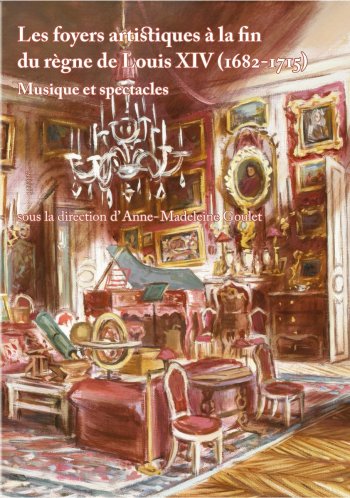 Grâce à la notion de «foyer», une série d’études pluridisciplinaires porte un regard nouveau sur les productions musicales et théâtrales en dehors de la cour de Versailles à la fin du règne de Louis XIV.
Les demeures aristocratiques de Paris et d’Île-de-France ont généralement été perçues comme des lieux périphériques, pâles reflets de la cour de Versailles. En réalité, les hôtels particuliers du Marais, où dominaient les sociabilités féminines, la résidence de Philippe d’Orléans au Palais-Royal, celle de la princesse de Conti à Versailles, les pavillons de plaisance bâtis entre Versailles et Paris, les demeures du duc et de la duchesse du Maine à Sceaux ou encore du roi d’Angleterre en exil à Saint-Germain-en-Laye, s’imposaient comme autant de foyers artistiques fort dynamiques, ouverts au théâtre et à la musique.
Le présent ouvrage, qui prend en considération ces différents lieux d’activité artistique comme un ensemble à la fois complémentaire et concurrent, enquête sur leur hiérarchie, leur fonctionnement concret ainsi que sur les relations qu’ils entretenaient avec la cour. Il met en lumière la tension entre le modèle versaillais, toujours prompt à imposer une norme artistique, et le développement d’autres espaces de création entre 1682 et 1715.
En illustrant la faculté des musiciens provinciaux à s’insérer dans les milieux artistiques de la capitale, en cernant l’identité de ceux qui façonnaient les goûts de leur époque et en considérant aussi les stratégies discursives et politiques qui visaient à constituer en foyers certains lieux de production et de performance alternatifs à la Cour, il propose une image plus complète de la vie musicale et spectaculaire de la France à la fin du règne de Louis XIV.
Direction de l’ouvrage
Anne-Madeleine Goulet, chercheuse en Arts du spectacle au CNRS (CESR).
En collaboration avec
Rémy Campos, professeur d’histoire de la musique au Conservatoire de Paris et responsable de la recherche de la Haute école de musique de Genève.
Mathieu da Vinha, directeur scientifique du Centre de recherche du château de Versailles et spécialiste de la cour de France aux XVIIe et XVIIIe siècles.
Jean Duron, fondateur et directeur (1989–2007) de l’Atelier d’études sur la musique française des XVIIe & XVIIIe siècles du CMBV, et spécialiste de la musique à l’époque de Louis XIV.
C O N T E N T S
• Rémy Campos et Anne-Madeleine Goulet — De la pertinence de la notion de foyer pour l’étude de la musique et des formes spectaculaires à Paris et à Versailles, 1682–1715
La Cour, les cours
• David Hennebelle — « La grande dépense et le fracas ». Recherches sur l’économie matérielle des patronages artistiques de l’aristocratie au tournant des XVIIe et XVIIIe siècles
• Don Fader — Monsieur and Philippe II d’Orléans: A Cultural Influence Beyond their Residences
• Tarek Berrada — La musique dans les appartements : Mlle de Guise, le roi et les princes de Condé
• Thomas Vernet — Musique et théâtre dans la « maison de ville » de Marie-Anne de Bourbon Conti à Versailles
• Catherine Cessac — Les Nuits de Sceaux : derniers feux du Grand Siècle ?
• Laurent Lemarchand — Les arts entre Paris et Versailles: le Palais-Royal de Philippe II d’Orléans ou l’absolutisme rénové
Des musiciens en partage
• Jean Duron — Composer pour les nouveaux foyers : la « fureur » des musiciens d’église au crépuscule du Grand Siècle
• Marie Demeilliez — Les collèges, des foyers pour la musique et la danse de théâtre
• Thomas Leconte — De la cour à la ville : les musiciens du roi face à l’émergence de nouveaux foyers cuturels
• Catherine Massip — Amateurs, professionnels : foyers et professionnalisation progressive des artistes, 1680–1715
Un esprit nouveau
• Christian Biet — Foyers, chaufooirs, chaleur et hétérogénéité des publics au theatre. La séance comme contre-pouvoir ?
• Thierry Favier — Foyers et dynamique des genres musicaux à la fin du règne de Louis XIV
• Nathalie Berton — Le Mercure galant, un révélateur et un passeur de répertoire : l’exemple du petit opéra
• Guy Spielmann — Le « théâtre de société », foyer de création ( ?)
• Louis Delpech — « Abends zu einer Concert de Musique eingeladen » : aspects musicaux du séjour parisien de Friedrich August II de Saxe, 1714–1715
Foyers réels, foyers imaginaires
• Mathieu da Vinha — Fêtes privées entre Versailles et Paris : éléments pour une typologie
• Anne Piéjus — Une galanterie très politique : l’image des foyers artistiques dans le Mercure galant
• Laura Naudeix — Foyers et territoire: l’espace de la musique dans la Comparaison de la musique italienne et de la musique française de Le Cerf de la Viéville
• Barbara Nestola — L’art d’assembler, le choix de partager : la collection de musique italienne des Stuart en France, 1689–1718
• Tatiana Senkevitch — The Making of Taste: Rembrandt and French Painting in the End of the Reign of Louis XIV
• Rebekah Ahrendt — L’activité des foyers musicaux et théâtraux en Europe vers 1700. Une enquête en coulisses
Perspectives
• Jean Boutier — Pour continuer l’enquête
Index des noms propres
The Burlington Magazine, February 2020
The eighteenth century in The Burlington:
The Burlington Magazine 162 (February 2020) — Northern European Art

Anton von Maron, Portrait of Johann Joachim Winckelmann, 1767, oil on canvas, 136 × 99 cm (Weimar: Stadtschloss).
E D I T O R I A L
• “The National Trust at 125,” p. 87.
A R T I C L E S
• Gauvin Alexander Bailey, “A Bavarian Pilgrimage Shrine in Seventeenth-Century Paraguay,” pp. 115–25. The Jesuit priest Anton Sepp was one of the first Germanic missionaries to be admitted to the Spanish territories in South America. Arriving in 1691, he brought with him a copy of the miracle-working sculpture of the Virgin of Altötting in Bavaria, and in 1697 he emphasised the German character of his mission by commissioning a version of the octagonal chapel in which the original was housed.
• Clare Hornsby, “J. J. Winckelmann and the Society of Antiquaries of London: New Documents,” pp. 126–35. Three new documents in the archive of the Society of Antiquaries, published here for the first time, provide evidence about Winckelmann’s aspirations for promoting his works in antiquarian circles in England. They include the first statement in English of his theory of art history, written in 1761.
R E V I E W S
• Arthur Wheelock, Review of the exhibition De Wind is Op!: Climate, Culture and Innovation in Dutch Maritime Painting (New Bedford Whaling Museum, 2019–20), pp. 150–52.
• Olivier Bonfait, Review of Gaëtane Maës, De l’expertise artistique à la vulgarisation au siècle des Lumières: Jean-Baptiste Descamps (1715–1791) et la peinture flamande, hollandaise et allemande (Brepols, 2016), pp. 171–72.
• Anna Arabindan Kesson, Review of Sarah Thomas, Witnessing Slavery: Art and Travel in the Age of Abolition (Yale University Press, 2019), pp. 172–74.
Exhibition | De Wind is Op!
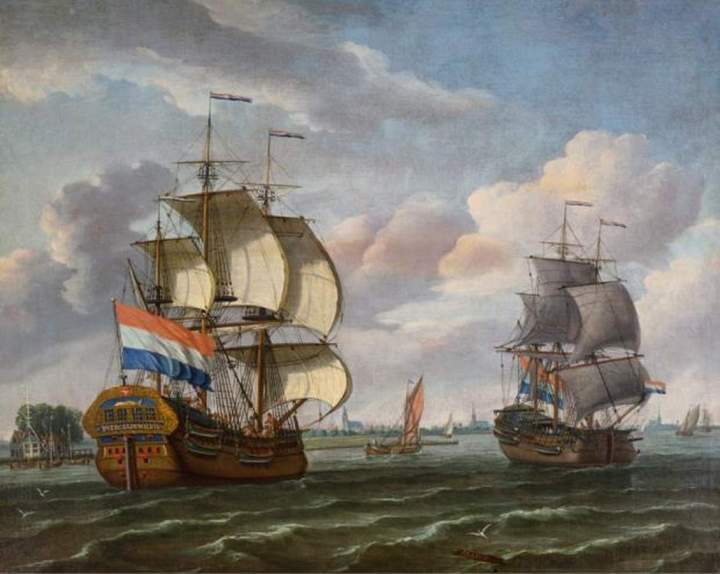
Johanes de Blaauw, Whaleship D’Vergulde Walvis (‘The Golden Whale’) Passing the Tollhouse at Buiksloot on the IJ River, North of Amsterdam, 1759, oil on canvas, 55 × 68 cm (New Bedford Whaling Museum, Kendall Whaling Museum Collection, 2001.100.4604).
◊ ◊ ◊ ◊ ◊
Now on view at the New Bedford Whaling Museum:
De Wind is Op! Climate, Culture and Innovation in Dutch Maritime Painting
New Bedford Whaling Museum, 2 July 2019 — 15 May 2020
Curated by Christina Connett Brophy and Roger Mandle
De Wind is OP! explores our extraordinary collections of Golden Age Dutch and Flemish paintings through a fresh lens. These works interpret around the themes of wind, climate, and sea as the drivers behind a uniquely Dutch national identity represented in maritime works of art of this period. Dutch artists arguably invented seascape painting, and were the first to specialize in this genre. Their influence reverberates in all that followed, from the work of J.M.W. Turner to Winslow Homer to New Bedford artists William Bradford and Albert Pinkham Ryder. The exhibition includes up to 50 paintings, prints, and other related artifacts drawn from the Museum’s Dutch collections, one of the largest and important of this genre outside of the Netherlands. There will also be a complementary exhibition in the fall of 2019 of European and American prints, paintings, and charts related to wind and climate themes.
The sea and seafaring shaped the Dutch collective identity. They were a political entity without precedence, and the art world followed the new cultural and societal models unique to the newly formed Dutch Republic. The Dutch were a dominant superpower in all things maritime, including worldwide trade, military strength, and whaling. They were a world emporium, trading timber, grain, salt, cloth, luxury materials throughout the global waterways. This was a time of great artistic production to keep up with a high demand for collecting, when a baker was as likely to have fine artwork in his home as a banker. Popular taste was for greatly refined compositions, exquisiteness of detail, and plausible reality. Dutch openness to innovation allowed them to manipulate their own watery landscapes with dams and wind power and to design ship modifications that maximized successful access to the Northern seas and the dramatic fluctuating climate during the Little Ice Age. Vulnerability to tidal deluge and to tempests at sea carried moral and nationalistic themes in paintings from this era. These themes and others are the foundation of the exhibition.
This exhibition was timed to coincide with the inaugural Summer Winds 2019 run by the New Bedford group Design Art Technology Massachusetts (DATMA), a creative and educational city-wide platform for discussion and exploration of wind energy. Multiple partners in the cultural sector contributed programs, exhibitions, and educational events to this initiative throughout the summer. De Wind is Op! is a major contribution to the Summer Winds project and serves as a cornerstone of summer programming events. The Museum partnered with the Museum of Fine Arts, Boston (MFA), Harvard Art Museums, and the Dutch Culture USA Program of the Consulate General of the Kingdom of the Netherlands to collaborate on a major symposium in fall 2019 to examine Dutch maritime artwork in accordance with the major exhibition themes.
Curators
Dr. Christina Connett Brophy, The Douglas and Cynthia Crocker Endowed Chair for the Chief Curator
Dr. Roger Mandle, Co-Founder of Design Art Technology Massachusetts (DATMA); Former Deputy Director and Chief Curator of the National Gallery of Art; and former President of the Rhode Island School of Design
A 41-page catalogue is available as a PDF file from the museum website.
Exhibition | Highlights from the Dietrich American Foundation
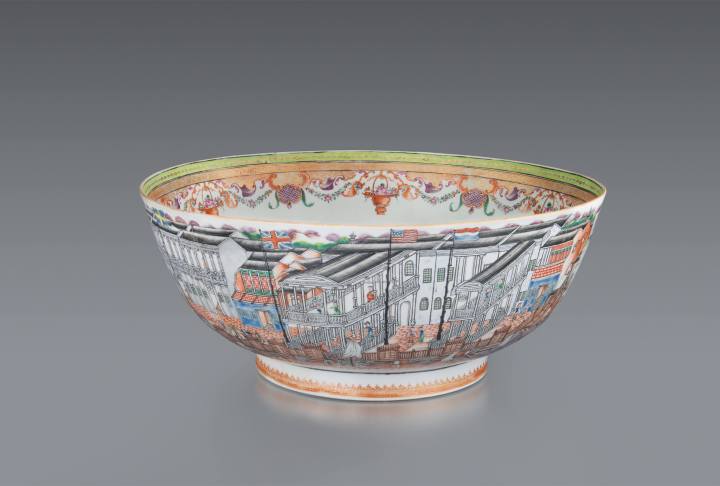
Punch Bowl with View of Hongs of Canton, ca. 1790, made in China
(Dietrich American Foundation)
◊ ◊ ◊ ◊ ◊
Now on view at the Philadelphia Museum of Art:
A Collector’s Vision: Highlights from the Dietrich American Foundation
Philadelphia Museum of Art, 1 February — 7 June 2020
A rare selection of American art from the 1700s and 1800s, including portraits of George Washington, a teapot made by Paul Revere, and silver from colonial Philadelphia. Explore H. Richard Dietrich Jr.’s vision as a collector and his foundation’s mission to share important examples of American art with the public.
H. Richard Dietrich Jr. (1938–2007) began to collect American art and artifacts for himself as a young man and later to furnish his home in Chester County, Pennsylvania. He saw his extensive collection as a tool for understanding American history, often acquiring objects by known makers or with a strong family history. In 1963 he established the Dietrich American Foundation, to which he contributed much of his wealth, energy, and time. The foundation has lent works from its collection to more than a hundred institutions, including the Philadelphia Museum of Art. In addition to pursuing a career in business, Dietrich devoted his time to the museum—as a patron and a member of the Board of Trustees and Chair of the American Art Advisory Committee—as well as to other public institutions in the region. The foundation’s long-term loans to the museum, including objects in this exhibition, began in 1966 and continue to this day.
The catalogue is distributed by Yale University Press:
H. Richard Dietrich III and Deborah Rebuck, eds., with contributions by H. Richard Dietrich III, David Barquist, Edward Cooke, Michael Dyer, Kathleen Foster, Morrison Heckscher, Philip Mead, Lisa Minardi, Deborah Rebuck, and William Reese, In Pursuit of History: A Lifetime Collecting Colonial American Art and Artifacts (Philadelphia Museum of Art in association with Dietrich American Foundation, 2020), 304 pages, ISBN: 978-0876332931, $50.
 This book showcases highlights from the Dietrich American Foundation, established in 1963 by H. Richard Dietrich Jr. and focused on 18th-century American fine and decorative arts. Essays explore the formation of the collection and its many areas of strength, enhancing current understandings of colonial history and material culture. The volume’s coeditor, H. Richard Dietrich III, unfolds an American story of a family’s entrepreneurship and speaks to his father’s varied yet interconnected collecting interests, as well as the common threads that unified them. An array of specialists explore the scope and uncommon richness of the foundation’s holdings, of which books and manuscripts account for half. Chinese export wares, furniture, silver, fraktur, and other decorative arts, and paintings of historical importance speak in varied ways to the nature of colonial identity, while objects related to the whaling trade signal the new nation’s maritime focus.
Exhibition | Painting Edo
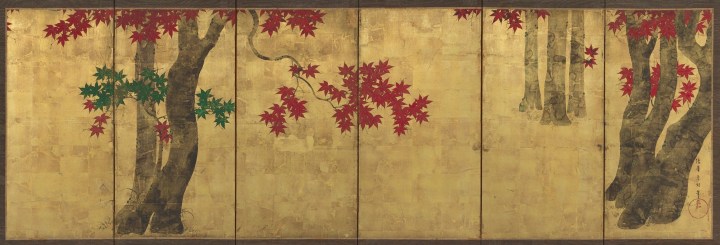
Tawaraya Sōri, Autumn Maple Trees, painted screen, second half of the eighteenth century
(Feinberg Collection, TL42147.39)
◊ ◊ ◊ ◊ ◊
Press release (3 February 2020) for the exhibition:
Painting Edo: Japanese Art from the Feinberg Collection
Harvard Art Museums, 14 February — 18 July 2021
Curated by Rachel Saunders and Yukio Lippit
Beginning February 14, 2020, the Harvard Art Museums present Painting Edo: Japanese Art from the Feinberg Collection, a special exhibition of more than 120 of the finest works from the preeminent collection of Robert S. (Harvard class of 1961) and Betsy G. Feinberg; the exhibition runs through July 26, 2020. Painting Edo offers a window onto the supremely rich visual culture of Japan’s early modern era and explores how the Edo period (1615–1868), and the city of Edo (present-day Tokyo), expressed itself during a time of artistic renaissance. A striking array of paintings in all the major formats will be on display—hanging scrolls, folding screens, sliding doors, fan paintings, and woodblock-printed books, among others—from virtually every stylistic lineage of the era, telling a comprehensive story of Edo painting on its own terms.
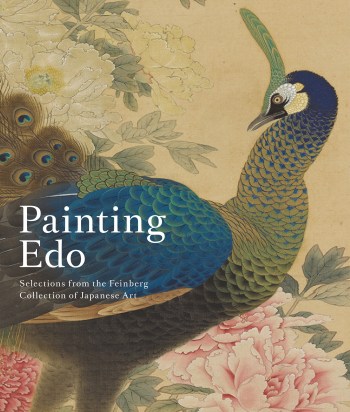 Painting Edo, organized by the Harvard Art Museums, is co-curated by Rachel Saunders, the Abby Aldrich Rockefeller Curator of Asian Art at the Harvard Art Museums, and Yukio Lippit, the Jeffrey T. Chambers and Andrea Okamura Professor of History of Art and Architecture at Harvard University. The exhibition will be on view exclusively at the Harvard Art Museums; an illustrated publication by Saunders and Lippit accompanies the show.
“Painting Edo is one of the largest exhibitions ever presented at the Harvard Art Museums—and fittingly so, since the Feinberg Collection is one of the largest gifts of art ever promised to this institution,” said Martha Tedeschi, the Elizabeth and John Moors Cabot Director of the Harvard Art Museums. “We are immensely grateful to the Feinbergs, whose great care and vision will ensure that the beauty and material ingenuity of these works reach viewers today and for generations to come.”
Robert S. and Betsy G. Feinberg generously promised their collection of more than 300 works of Japanese art to the Harvard Art Museums in 2013. Judiciously assembled over nearly fifty years, the collection—the finest private collection of Edo period Japanese painting in the United States—offers an exceptional opportunity to explore continuities and disruptions in artistic practice in early modern Japan. The museums’ stewardship of the collection ensures access by students, faculty, scholars, and the public, and allows for teaching, research, and further documentation of these important works.
The Feinberg Collection is notable not only for its size and remarkable quality, but also for its comprehensiveness. It comprises representative paintings from virtually every stylistic lineage of the era: from the gorgeous decorative works of the Rinpa School to the luminous clarity of the Maruyama-Shijō School, from the monochromatic indexes of interiority of so-called Nanga, or Southern School, painting to the actors and courtesans of the pleasure quarters depicted in ukiyo-e, to the inky innovations of the so-called eccentrics. A complete catalogue of the Feinberg Collection will be published by the museums in late summer 2020.
 Over the last five years, since the museums reopened in 2014, select objects from the Feinberg Collection have been on display in extended thematic installations in the East Asian gallery on Level 2. The rotating presentation of these works was designed not only to introduce strengths of the collection to visitors, but also to broaden access for teaching and research. These initial installations provided a preview of the amazing range of works now united in the powerhouse Painting Edo exhibition.
“I had the pleasure of meeting the Feinbergs and viewing their collection for the first time in the late 1990s while I was a student,” said Professor Lippit. “That experience gave me an appreciation for the study of new objects and cultural histories, and since becoming a faculty member at Harvard I have been actively teaching with the Feinberg Collection, inviting students to view and discuss the paintings.”
Painting Edo begins in the Special Exhibitions Gallery on Level 3 and expands into three adjacent galleries typically reserved for installations that support university coursework. This is the first time the museums mount a single exhibition across all four spaces. Visitors are greeted by Tani Bunchō’s Grasses and Moon (1817), a large painting that encapsulates the Japanese tradition of moon-viewing, before being immediately enveloped by Sakai Hōitsu’s Birds and Flowers of the Twelve Months (c. 1820–28), a stunning group of 12 hanging scrolls that together create a paradisal garden in which all the seasons flower simultaneously. From this introductory gallery, visitors are encouraged to wander at will to discover the major schools and styles of painting. Galleries are organized to reflect Edo period conceptions of lineage, offering a view of how “Edo” was articulated by and for its own creators and consumers.
“The Feinbergs have collected so carefully and with such dedication over the years that they have formed a truly comprehensive collection,” said Saunders. “That is particularly significant for us as a teaching museum because it allows us to look at the whole gamut of Edo painting within the exhibition, including virtually every major lineage and painting format.”
Additional Highlights
• Maruyama Ōkyo’s Peacock and Peonies (1768), a hanging scroll with a resplendent peacock rendered with Western-style anatomical precision against a luxuriant background of peonies [Intro section]
• A Portuguese Trading Ship Arrives in Japan (17th century), a pair of six-panel folding screens that depicts the arrival of a ship into port and the procession of its captain into town, an annual voyage made by the Portuguese to trade silver, silks, and spices [Floating Worlds section]
• Tawaraya Sōri’s Autumn Maple Trees (second half 18th century), one of only a handful of works that survive by the artist and widely regarded as his masterpiece [School of Kōrin section]
• Ikeno Taiga’s The Poet Su Shi and Meng Jia Loses His Hat (18th century), a pair of six-panel folding screens depicting two renowned figures in acts of elegant disregard for societal norms [Eccentricity section]
• Lotus in Autumn (1872), a wildly brushed hanging scroll by the female artist Okuhara Seiko, whose Chinese-style ink paintings became hugely popular in the years immediately following the Meiji Restoration of 1868, a time that ushered in Japan’s modern era [Remembering Edo section]
• Twenty fans by Suzuki Kiitsu, displayed against a deep blue backdrop, evoking the moment at the end of summer when Japanese men and women would cast their used fans into the river in celebration of the arrival of autumn [Remembering Edo section]
A rotation of select exhibition objects will take place between May 4 and 7 to preserve light-sensitive works as well as to add other fine examples of painting. Galleries will remain open to the public on these dates.
Publications
Two catalogues will be released in conjunction with the exhibition, both published by the Harvard Art Museums and distributed by Yale University Press. The first, Painting Edo: Selections from the Feinberg Collection of Japanese Art, is a companion to the exhibition; it offers a sweeping and lavishly illustrated overview of a transformative era in Japanese art-making as told through superb examples from the finest private collection of Edo period painting in the United States. It includes essays by Rachel Saunders and Yukio Lippitt. The second book, a comprehensive Catalogue of the Feinberg Collection of Japanese Art, will be published in late Summer 2020. Edited by Rachel Saunders, the volume includes new photography and commentary from a range of authors on each of the more than 300 works in the Feinberg Collection.
Rachel Saunders and Yukio Lippit, Painting Edo: Selections from the Feinberg Collection of Japanese Art (Cambridge: Harvard Art Museums, 2020), 180 pages, ISBN: 978-030025089, $35.
Rachel Saunders, ed., Catalogue of the Feinberg Collection of Japanese Art (Cambridge: Harvard Art Museums, 2020), 264 pages, ISBN: 978-0300250909, $65.
Exhibition | Colonists, Citizens, Constitutions
From the New-York Historical Society:
Colonists, Citizens, Constitutions: Creating the American Republic
New-York Historical Society, 28 February — 31 May 2020
Curated by James Hrdlicka with Michael Ryan and Sue Ann Weinberg
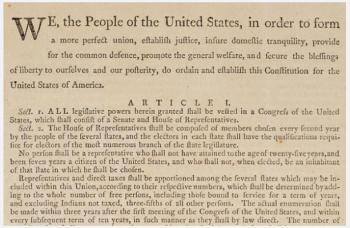
First printing of the U. S. Constitution (Philadelphia: Dunlap & Claypoole, 1787)
America has been singular among nations in fostering a vibrant culture of engagement with constitutional matters and the fundamental principles of government. Featuring 40 books and documents from collector and philanthropist Dorothy Tapper Goldman’s collection—including constitutions from the federal and state levels—Colonists, Citizens, Constitutions: Creating the American Republic depicts the story of America’s unique constitutionalism from the founding era through the turn of the 20th century. The exhibition, which sketches the often troubled history of the country as it expanded across the continent, serves as a timely reminder of our country’s democratic foundations and its relentless quest for improvement. Curated by James F. Hrdlicka of Arizona State University with Michael Ryan, vice president and Sue Ann Weinberg director of the Patricia D. Klingenstein Library.
Exhibition | In Sparkling Company: Glass and Social Life

Pair of covered green vases, ca. 1765 and a pair of vases, 1750–75, probably from the workshop of James Giles, London, gilded copper-green lead glass (Corning, New York: Corning Museum of Glass, 2003.2.4 A-B, 54.2.4 A-B).
◊ ◊ ◊ ◊ ◊
Press release (30 October 2019) for the exhibition:
In Sparkling Company: Glass and the Costs of Social Life in Britain during the 1700s
Corning Museum of Glass, Corning, New York, 9 May 2020 — 3 January 2021; new dates: 22 May 2021 — 2 January 2022
Curated by Christopher Maxwell
The Museum’s spring exhibition, In Sparkling Company: Glass and Social Life in Britain during the 1700s, will open May 9, 2020. With exhibition design by Selldorf Architects, In Sparkling Company will present the glittering costume and jewelry, elaborate tableware, polished mirrors, and dazzling lighting devices that delighted the British elite, and helped define social rituals and cultural values of the period. Through a lens of glass, this exhibition will show visitors what it meant to be ‘modern’ in the 1700s, and what it cost.
The exhibition will also include a specially created virtual reality reconstruction of the remarkable and innovative spangled-glass drawing room completed in 1775 for Hugh Percy, 1st Duke of Northumberland (1714–1786), and designed by Robert Adam (1728–1792), one of the leading architects and designers in Britain at the time. An original section of the room (which was dismantled in the 1870s), on loan from the Victoria and Albert Museum in London, will be on view in North America for the first time as part of the exhibition. It will be accompanied by Adam’s original colored design drawings for the interior, on loan from the Sir John Soane’s Museum, London.
“One medium that is often overlooked in scholarly discussions of 18th-century art, design, and material culture is glass,” said Christopher L. Maxwell, Curator of European Glass at CMoG, who has organized the exhibition. “In Britain, developments in glass formulas and manufacturing techniques resulted in new and better types of glass, from windowpanes and mirrors to heavy, clear ‘crystal’ tableware, perfectly suited to the tastes and needs of Britain’s growing urban elite whose wealth derived from new enterprises in finance, manufacture, international trade and colonial expansion. In Sparkling Company will demonstrate the many functions and meanings of glass in the exuberant social life of the 1700s.”
The smooth, ‘polished’ and reflective properties of glass perfectly embodied 18th-century ideals of sociability, in what is considered by many as the ‘age of politeness.’ As urban centers grew in size and prosperity, sociability became ever more sophisticated. The terms ‘polite’ and ‘polished’ were often used interchangeably in the numerous etiquette manuals eagerly read by those wishing to take their place in the polite world. Examples of such literature will be displayed alongside fashionable glass of the period, including embroidered costume, mirrors, a chandelier, cut glass lighting and tableware, and paste jewelry that accessorized and defined the lives of the ‘polished’ elite.
In the 1700s Britain was a prosperous and commercial nation. Its growing cities were hubs of industry, scientific advancement, trade and finance, and its colonies were expanding. British merchants navigated the globe carrying a multitude of cargoes: consumable, material, and human. Underpinning Britain’s prosperity was a far-reaching economy of enslavement, the profits of which funded the pleasures and innovations of the fashionable world, among them luxury glass. Alongside the beauty and innovation of glass during this period, the exhibition will consider the role of the material as a witness to colonization and slavery. Using artifacts and documents relating to the slave trade, it will reveal a connection that permeated all levels of British society.
From glittering costume and elaborately presented confectionery, to polished mirrors and dazzling chandeliers, glass helped define the social rituals and cultural values of the period. While it delighted the eyes of the wealthy, glass also bore witness to the horrors of slavery. Glass beads were traded for human lives while elegant glass dishes, baskets and bowls held sweet delicacies made with sugar produced by enslaved labor.
In Sparkling Company: Glass and Social Life in Britain during the 1700s will include important examples of 18th-century British glass, including:
• Glass embroidered costume: a spectacular men’s coat intricately decorated with glass ‘jewels’ made around 1780; a pair of women’s shoes covered in glass beads; shoe buckles set with glass paste jewels; jewelry and other accessories.
• Cut glass lighting and tableware, all made possible through the perfection of British lead ‘crystal’ in the late 1600s and exported throughout Europe and the British colonies in America and beyond.
• A number of large mirrors, which became the tell-tale sign of a fashionable interior, and reverse-painted glass meticulously decorated in China for the British luxury market.
• Opulent glass dressing room accessories, including a magnificent gilded silver dressing table set, with a looking glass as its centerpiece, made in about 1700 for the 1st Countess of Portland; perfume bottles, patch boxes, a dazzling cut glass washing basin and pitcher and an exquisite blue glass casket richly mounted in gilded metal, used in the ‘toilette’ a semi-public ritual of dressing which was adopted from France for men and women alike and became a feature of British aristocratic life in the 18th century.

Robert Adam, Design for the end wall of the drawing room at Northumberland House, 1770–73, pen, pencil, and colored washes, including pink, verdigris, and Indian yellow on laid paper, 52 × 102 cm (London: Sir John Soane’s Museum, SM Adam, volume 39/7; photo by Ardon Bar Hama).
◊ ◊ ◊ ◊ ◊
Glass Drawing Room for the Duke of Northumberland
Over the course of the 18th century, domestic interiors were transformed by the increasing presence of clear and smooth plate glass. A remarkable example is the lavish drawing room designed by the celebrated British architect Robert Adam for Hugh Percy, 1st Duke of Northumberland (1714–1786) and his wife, the Duchess Elizabeth Percy (1716–1776), and completed in 1775. This unique room, measuring 36 by 22 feet, was paneled between dado rail and architrave with red glass panels sprinkled on the reverse with flakes of metal foil, like large-scale glitter. Similarly spangled green glass pilasters, large French looking glasses, and intricate neo-classical ornament in gilded lead completed the dazzling scheme. The room was altered in the 1820s and finally dismantled in the 1870s, when Northumberland House was demolished. Many of the panels were acquired by the V&A Museum in the 1950s, but their poor condition meant that they could only be partially displayed. The panels on display at The Corning Museum of Glass incorporate newly-conserved elements from the V&A’s stores.
In Sparkling Company will feature a virtual reality reconstruction of the drawing room, created by Irish production house Noho. Visitors to the exhibition will be transported into the interior, experiencing the original design scheme—last seen almost 200 years ago. This will be the first virtual-reality experience ever offered at CMoG. Visitors will also be able to see Robert Adam’s design drawings, on loan from the Sir John Soane’s Museum, London, and a section of the original Northumberland House Glass Drawing Room on loan from the V&A Museum, which has never been on view in North America.
In Sparkling Company: Glass and Social Life in Britain during the 1700s will include loans from the Victoria and Albert Museum; Sir John Soane’s Museum; the Museum of London; the Fashion Museum, Bath; Royal Museums Greenwich; Los Angeles County Museum of Art (LACMA); Penn State University Library; Cleveland Museum of Art; and The Museum of Fine Arts in Boston.
The exhibition is accompanied by a catalogue, In Sparkling Company: Reflections on Glass in the 18th-Century British World (The Corning Museum of Glass, 2020). Publication contributors include Marvin Bolt, Kimberly Chrisman Campbell, Jennifer Chuong, Melanie Doderer Winkler, Christopher Maxwell, Anna Moran, Marcia Pointon, and Kerry Sinanan.
◊ ◊ ◊ ◊ ◊
Note (added 2 May 2021) — The posting was updated with revised dates for the exhibition.
Note (added 16 September 2021) — The posting has been updated to include the revised title; the original title was In Sparkling Company: Glass and Social Life in Britain during the 1700s.
New Book | Mural Painting in Britain, 1630–1730
Forthcoming from Routledge:
Lydia Hamlett, Mural Painting in Britain 1630–1730: Experiencing Histories (London: Routledge, 2020), 184 pages, ISBN: 978-1138205833, £120 / $155.
 This book illuminates the original meanings of seventeenth- and early eighteenth-century mural paintings in Britain. At the time, these were called ‘histories’. Throughout the eighteenth century, though, the term became directly associated with easel painting and, as ‘history painting’ achieved the status of a sublime genre, any link with painted architectural interiors was lost. Whilst both genres contained historical figures and narratives, it was the ways of viewing them that differed. Lydia Hamlett emphasises the way that mural paintings were experienced by spectators within their architectural settings. New iconographical interpretations and theories of effect and affect are considered an important part of their wider historical, cultural, and social contexts.
Lydia Hamlett is Academic Director in Visual Culture at the Institute of Continuing Education, University of Cambridge, and a Fellow of Murray Edwards College.
C O N T E N T S
Introduction: Re-experiencing British Murals
1 Animating Histories
2 Triumph and Return: Bringing the Gods onto Man’s Stage
3 Murals and Metamorphoses
4 Poetry, Painting, and Politics: The Early 1700s
5 The Frenzied Age of Mural Painting
Conclusion: Defining Mural Painting as a Genre
Exhibition | British Baroque: Power and Illusion

John James Baker, The Whig Junto, 1710, oil on canvas, 319 × 365 (London: Tate, from the collection of Richard and Patricia, Baron and Baroness Sandys, accepted by HM Government in Lieu of inheritance tax and allocated to Tate in 2018, T15046).
◊ ◊ ◊ ◊ ◊
From the press release (3 February 2020) for the exhibition:
British Baroque: Power and Illusion
Tate Britain, London, 4 February — 19 April 2020
Curated by Tabitha Barber, with David Taylor and Tim Batchelor
British Baroque: Power and Illusion is the first ever exhibition to focus on baroque culture in Britain. From the Restoration of Charles II in 1660 to the death of Queen Anne in 1714, the exhibition explores the rich connections between art and power in this often-overlooked era. The show includes many new discoveries and works displayed in public for the first time, many on loan from the stately homes for which they were originally made.
 The baroque is usually associated with the pomp and glory of European courts, epitomised by that of Louis XIV, but baroque visual culture also thrived in Britain under very different circumstances. From the royal court’s heyday as the brilliant epicentre of the nation’s cultural life, to the dramatic shift in power that saw the dominance of party politics, this exhibition shows how magnificence was used to express status and influence. As well as outstanding paintings by the leading artists of the day, including Sir Peter Lely, Sir Godfrey Kneller and Sir James Thornhill, the show also uncovers pivotal works by lesser known names.
British Baroque begins by exploring art’s role in the construction of a renewed vision of monarchy, including portraits of Charles II and idealised representations of his power. It looks at the splendour, colour and vivacity of the Restoration court, as well as the critiques of its tone and morals. Portraits by Lely, including Barbara Villiers, Duchess of Cleveland with her son, as the Virgin and Child 1664, were used to illustrate the important position held by royal mistresses while works by Jacob Huysmans, such as Catherine of Braganza c.1662–64, shaped the independent visual identity of the Queen consort.
The visual and devotional differences between Protestant and Catholic worship are examined in the religious art of the period. Emotionally charged altarpieces from the contentious Catholic chapels of Mary of Modena and James II are on show, as well as beautiful carvings by Grinling Gibbons and Thornhill’s designs for the painted dome of St Paul’s Cathedral. Another theme explored is the wonder and artifice of still life and perspective trompe l’oeil, including works by Samuel van Hoogstraten collected by members of the Royal Society, Chatsworth’s famous violin painted as if hanging on the back of a door, and the hyper-real flower paintings of Simon Verelst which looked so real that they fooled the diarist Samuel Pepys.

Godfrey Kneller, Portrait of Matthew Prior, 1700 (Cambridge, Trinity College).
The profound visual impact and drama of baroque architecture is represented with works by the great architects of the age: Wren, Hawksmoor, and Vanbrugh. Architectural designs, lavish prints, and wooden models relating to the significant buildings of the age, such as St Paul’s Cathedral, Hampton Court Palace, and Blenheim Palace, are shown alongside vast painted birds-eye views of estates. As well as architecture, the exhibition looks at the awe-inspiring illusion of painted baroque interiors. Mythological mural paintings, which frequently carried contemporary political messages, were designed to overwhelm spectators and impress upon them the power, taste, and leadership of their owners.
War and politics dominated the reigns of William III and Anne. The exhibition includes heroic equestrian portraiture, panoramic battle scenes, and accompanying propaganda. Victories such as Blenheim celebrated individuals such as the Duke of Marlborough, but they also embodied the might of the nation on a European stage. The show concludes with the dignified grandeur of portraiture made in the last two decades of the Stuart period, when party politics offered an alternative avenue to power. As well as imposing portraits of courtiers and aristocrats, the new political elite is seen in Kneller’s depiction of the Whig Kit-Cat Club and John James Baker’s enormous group portrait The Whig Junto from 1710.
British Baroque: Power and Illusion is curated by Tabitha Barber, Curator, British Art 1550–1750, Tate Britain, with David Taylor, Curator of Pictures and Sculpture, National Trust, and Tim Batchelor, Assistant Curator, British Art 1550–1750, Tate Britain. It is accompanied by a fully illustrated catalogue and a programme of talks and events in the gallery.
Tabitha Barber and Tim Bachelor, British Baroque: Power and Illusion (London: Tate Publishing, 2020), 176 pages, ISBN 978-1849766814, £25 / $35.










 Enfilade
leave a comment