Exhibition | Napoleon the Strategist
From the press release for the exhibition:
Napoleon the Strategist / Napoléon stratège
Musée de l’Armée, Paris, 6 April — 22 July 2018
 Following on from the presentation of Napoleon’s political vision with the 2013 exhibition Napoleon and Europe and an exploration in 2016 of his fall and his legend with Napoleon in Saint Helena: His Fight for His Story, in spring 2018 the Musée de l’Armée will tackle another aspect of the history of Napoleon, whose skills as a ‘military genius’ are universally recognised.
Any examination of Napoleon the strategist has to start by defining the notion of strategy and how it evolved. For it was in Napoleon’s time that the notion became inextricably linked to power and the abilities of the person wields it. The word ‘strategy’ emerged in the military world, gradually taking on the meaning and form that are now applied more broadly to politics, the economy, finance, and communications. The idea behind the exhibition is therefore to train the spotlight on strategy, the intangible expression of Napoleonic thinking where the skill lies in mastering a vast range of parameters and their interactions. The exhibition will draw on maps, documents illustrating the master strategist’s deliberations, and objects—vestiges, symbols and representations of historical facts—that embody the tangible reality that strategic thinking seeks to control.
To ensure that the theme is as widely accessible as possible, Napoleon’s role will be illustrated in the context of his era, including a description of his education, abilities, and the means available to him and to his enemies. The exhibition sets out to show the strategist at work, explain the issues at stakes and how campaigns progressed, and get to the heart of the action to analyse his most famous battles, defeats as well as victories.
Although the new event is separate from the permanent collection galleries devoted to the Revolution and the Empire, it contributes to them with a complementary viewpoint. Multimedia tools will offer an immersive experience to help visitors grasp what is an abstract and complex notion. The permanent galleries will feature new digital installations providing a more narrative and explanatory approach to Napoleon’s strategic ideas. Visitors will be able to move freely between these two approaches. The visit continues on the Invalides site with an exploration of the Dome church, home to Napoleon’s tomb.
François Lagrange and Émilie Robbe, eds., Napoléon stratège (Paris: Lienart, 2018), 296 pages, ISBN: 978-2359062328, 29€.
New Book | European Porcelain in the Metropolitan Museum of Art
Distributed by Yale UP:
Jeffrey Munger, with an essay by Elizabeth Sullivan, European Porcelain in the Metropolitan Museum of Art (New York: The Metropolitan Museum of Art, 2018), 288 pages, ISBN: 9781588396433, $65.
 The quest to discover the process of making porcelain was one of the defining aspects of post-Renaissance Europe, and it had significant artistic, technical, and commercial ramifications. This beautifully illustrated book showcases ninety works, spanning the late 16th to the mid-19th century, and reflecting the major currents of European porcelain production. Each work is shown in glorious new photography, accompanied by analysis and interpretation by one of the leading experts in European decorative arts. Featuring blue-and-white wares from Italy, rare examples of German Meissen, French Sèvres, British Chelsea porcelain, and much more, this is a long-overdue survey of the greatest porcelain treasures from The Met’s vast collection.
Jeffrey H. Munger is former curator, and Elizabeth Sullivan is former associate research curator, both in the Department of European Sculpture and Decorative Arts at The Metropolitan Museum of Art.
Exhibition | France Viewed from the Grand Siècle
Now on view at the Louvre:
France Viewed from the Grand Siècle: Drawings by Israël Silvestre (1621–1691)
Musée du Louvre, Paris, 15 March — 25 June 2018
Curated by Bénédicte Gady and Juliette Trey
 While Israël Silvestre’s engravings circulated widely, his drawings remain relatively unknown. The Musée du Louvre is home to a remarkable collection of them, to be shown to the public for the first time.
After training as an engraver under Jacques Callot, Israel Silvestre very quickly turned to the cityscape. Small and picturesque, his early ‘views’ were of his native Nancy and the cities he passed through on the several journeys he made between Paris and Rome. By contrast, his mature works offer broad panoramas of the French capital, with its royal festivities and the changes it was undergoing, and outlines of the cities conquered by Louis XIV in Lorraine and the Ardennes. In addition, his series devoted to the handsome Ile-de-France châteaux—Vaux-le-Vicomte, Meudon, Montmorency, Versailles—brought a fresh eye to architecture and gardens.
The exhibition is organized by Bénédicte Gady and Juliette Trey of the Department of Prints and Drawings, Musée du Louvre.
Benedicte Gady and Juliette Trey, La France vue du Grand Siècle: Dessins d’Israël Silvestre (1621–1691) (Paris: Lienart, 2018), 208 pages, ISBN: 978-2359062311, 29€.
New Book | The Queen’s Embroiderer
From Bloomsbury:
Joan DeJean, The Queen’s Embroiderer: A True Story of Paris, Lovers, Swindlers, and the First Stock Market Crisis (London: Bloomsbury, 2018), 400 pages, ISBN: 978-1632864741, £30.
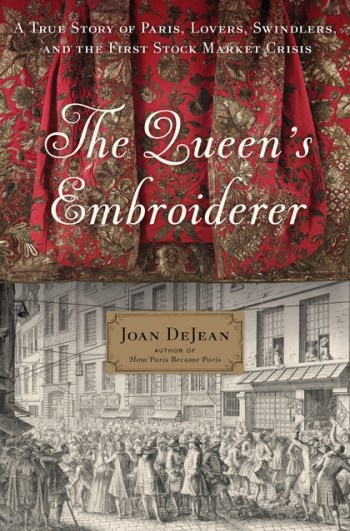 From the author of How Paris Became Paris, a sweeping history of high finance, the origins of high fashion, and a pair of star-crossed lovers in 18th-century France.
Paris, 1719. The stock market is surging and the world’s first millionaires are buying everything in sight. Against this backdrop, two families, the Magoulets and the Chevrots, rose to prominence only to plummet in the first stock market crash. One family built its name on the burgeoning financial industry, the other as master embroiderers for Queen Marie-Thérèse and her husband, King Louis XIV. Both patriarchs were ruthless money-mongers, determined to strike it rich by arranging marriages for their children.
But in a Shakespearean twist, two of their children fell in love. To remain together, Louise Magoulet and Louis Chevrot fought their fathers’ rage and abuse. A real-life heroine, Louise took on Magoulet, Chevrot, the police, an army regiment, and the French Indies Company to stay with the man she loved.
Following these families from 1600 until the Revolution of 1789, Joan DeJean recreates the larger-than-life personalities of Versailles, where displaying wealth was a power game; the sordid cells of the Bastille; the Louisiana territory, where Frenchwomen were forcibly sent to marry colonists; and the legendary ‘Wall Street of Paris’, Rue Quincampoix, a world of high finance uncannily similar to what we know now. The Queen’s Embroiderer is both a story of star-crossed love in the most beautiful city in the world and a cautionary tale of greed and the dangerous lure of windfall profits. And every bit of it is true.
Joan DeJean is Trustee Professor at the University of Pennsylvania. She is the author of ten books on French literature, history, and material culture, including most recently The Age of Comfort: When Paris Discovered Casual and the Modern Home Began and The Essence of Style: How the French Invented High Fashion, Fine Food, Chic Cafés, Style, Sophistication, and Glamour. She lives in Philadelphia and, when in Paris, on the street where the number 4 bus began service on July 5, 1662.
Exhibition | The Chocolate Girl by Liotard
On view this fall at the Zwinger in Dresden:
‘The Most Beautiful Pastel Ever Seen’: The Chocolate Girl by Jean-Étienne Liotard
Zwinger, Staatliche Kunstsammlungen Dresden, 28 September 2018 — 6 January 2019

Jean-Étienne Liotard, The Chocolate Girl, ca. 1744–45 (Dresden: SKD, Gemäldegalerie Alte Meister).
The exhibition focuses on one of the most famous works in the collection of the Dresden Gemäldegalerie, The Chocolate Girl by the Swiss artist Jean-Étienne Liotard (1702–1789). Liotard enjoyed enormous success as a pastel painter; even Rosalba Carriera, whose mastery of the medium had helped transform it into a serious and highly-admired art form, declared The Chocolate Girl to be “the most beautiful pastel ever seen.”
It was thanks to the art dealer Count Francesco Algarotti, who purchased the picture in Venice in 1745, buying it directly from the artist for the Dresden collection of Augustus III, that the gallery first began to show works by contemporary artists. The pastel medium suited the Rococo taste for lifelike, brilliant portraits and allowed Liotard to create flawless, porcelain-smooth surfaces. The great popularity of the picture, however, also rests on the fact that it depicts a simple, unidentified housemaid, a hitherto rare motif. The clear-eyed precision of Liotard’s observation anticipated not only the art of the Enlightenment but also nineteenth-century Realism.
Equally worthy of mention are the countless adaptations and appropriations of the motif for other, often trivial purposes. Of no less interest is the eccentric painter himself. A true cosmopolitan, he travelled far and wide, sported a luxuriant beard, exotic clothing and a turban and called himself ‘Le peintre turc’. The exhibition’s epilogue showcases Hann Trier’s take on Liotard’s masterpiece. Painted in 1991, Trier’s three-part sequence La Tasse au chocolat, reinterpreted The Chocolate Girl for the twentieth century.
Stephan Koja and Roland Enke, eds., ‘The Most Beautiful Pastel Ever Seen’: The Chocolate Girl by Jean-Étienne Liotard in the Dresden Gemäldegalerie (Munich: Hirmer Verlag, 2018), 272 pages, ISBN: 978-3777431369, $42.
A full press release is available via Art Daily.
◊ ◊ ◊ ◊ ◊
Note (added 28 September 2018) — The posting was updated to include details of the catalogue and a link to the press release.
New Book | Poetry and the Idea of Progress, 1760–1790
From Anthem Press:
John Regan, Poetry and the Idea of Progress, 1760–1790 (London: Anthem Press, 2018), 222 pages, ISBN 9781783087723, £70 / $115.
 Poetry and the Idea of Progress, 1760–1790 explores under-examined relationships between poetry and historiography in the eighteenth century, deepening our understanding of the relationship between poetry and ideas of progress with sustained attention to aesthetic, historical, antiquarian, and prosodic texts from the period. Its central contention is that the historians and theorists of the time did not merely instrumentalize verse in the construction of narratives of human progress, but that the aesthetics of verse had a kind of agency—it determined the character of—historical knowledge of the period. With numerous examples from poems and writing on poetics, Poetry and the Idea of Progress, 1760–1790 shows how the poetic line became a site at which one could make assertions about human development even as one experienced the expressive effects of metred language.
John Regan is a research fellow in English literature at the University of Cambridge. His research interests centre on the cultural dialogue between poetics and historical writing in the long eighteenth century.
C O N T E N T S
List of Figures
Acknowledgements
Introduction
1 Progress by Prescription
2 Thomas Sheridan and the Divine Harmony of Progress
3 ‘There Is a Natural Propensity in the Human Mind to Apply Number and Measure to Every Thing We Hear’: Monboddo, Steele and Prosody as Rhythm
4 ‘[C]ut into, distorted, twisted’: Thomas Percy, Editing and the Idea of Progress
5 ‘Manners’ and ‘Marked Prosody’: Hugh Blair and Henry Home, Lord Kames
Afterword: Rude Manners, ‘Stately’ Measures: Byron and the Idea of Progress in the New Century
Conclusion
Notes
Bibliography
Index
Exhibition | Visitors to Versailles

An earlier posting included information for the exhibition at Versailles, but here’s information for the exhibition at The Met, including details for the English edition catalogue, distributed by Yale UP:
Visitors to Versailles: From Louis XIV to the French Revolution
Château de Versailles, 24 October 2017 — 25 February 2018
The Metropolitan Museum of Art, New York, 16 April — 29 July 2018
Curated by Bertrand Rondot and Daniëlle Kisluk-Grosheide
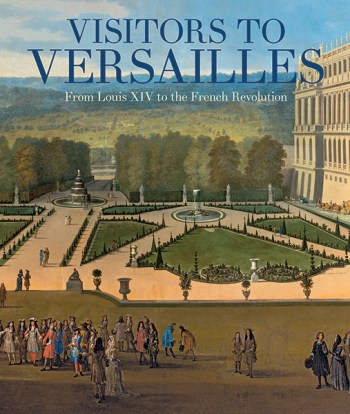 The palace of Versailles and its gardens have attracted travelers ever since it was transformed under the direction of the Sun King, Louis XIV, from a simple hunting lodge into one of the most magnificent and public courts of Europe. French and foreign travelers, including royalty, ambassadors, artists, musicians, writers, scientists, grand tourists, and day-trippers, all flocked to the royal palace surrounded by its extensive formal gardens. Versailles was always a truly international setting, and not only drew visitors from Europe and America, but also hosted dignitaries from as far away as Thailand, India, and Tunisia. Their official receptions at Versailles and gift exchanges with the king were among the attractions widely recorded in tourists’ diaries and court gazettes.
Bringing together works from The Met, the Château de Versailles, and over 50 lenders, this exhibition will highlight the experiences of travelers from 1682, when Louis XIV moved his court to Versailles, to 1789, when the royal family was forced to leave the palace and return to Paris. Through paintings, portraits, furniture, tapestries, carpets, costumes, porcelain, sculpture, arms and armor, and guidebooks, the exhibition will illustrate what visitors encountered at court, what kind of welcome and access to the palace they received, and, most importantly, what impressions, gifts, and souvenirs they took home with them.
Daniëlle O. Kisluk-Grosheide and Bertrand Rondot, eds., Visitors to Versailles: From Louis XIV to the French Revolution (New York: The Metropolitan Museum of Art, 2018), 392 pages, ISBN: 9781588396228, $65.
New Book | Picturing War in France
From Yale UP:
Katie Hornstein, Picturing War in France, 1792–1856 (New Haven: Yale University Press, 2018), 208 pages, ISBN: 9780300228267, $70.
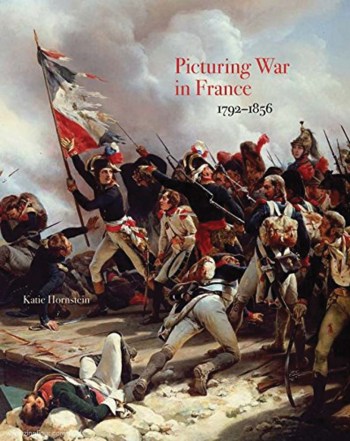 From the walls of the Salon to the pages of weekly newspapers, war imagery was immensely popular in postrevolutionary France. This fascinating book studies representations of contemporary conflict in the first half of the 19th century and explores how these pictures provided citizens with an imaginative stake in wars being waged in their name. As she traces the evolution of images of war from a visual form that had previously been intended for mostly elite audiences to one that was enjoyed by a much broader public over the course of the 19th century, Katie Hornstein carefully considers the influence of emergent technologies and popular media, such as lithography, photography, and panoramas, on both artistic style and public taste. With close readings and handsome reproductions in various media, from monumental battle paintings to popular prints, Picturing War in France, 1792–1856 draws on contemporary art criticism, war reporting, and the burgeoning illustrated press to reveal the crucial role such images played in shaping modern understandings of conflict.
Katie Hornstein is assistant professor of art history at Dartmouth College.
Exhibition | France, Between Enlightenment and Gallantry
From the Städtischen Museen Freiburg:
La France, Zwischen Aufklärung und Galanterie: Meisterwerke der Druckgraphik
La France au siècle des Lumières et de la galanterie: Chefs-d’œuvre de la gravure
La France, Between Enlightenment and Gallantry: Masterworks of Graphic Reproduction
Augustinermuseum, Freiburg, 24 February — 3 June 2018
 Das französische Bürgertum des 18. Jahrhunderts liebte gute Unterhaltung: galant und charmant, mit Witz und scharfem Verstand. Reich bebilderte Bücher erfreuten sich größter Beliebtheit. Die Verlage druckten Romane, Gedichte und Theaterstücke mit Illustrationen und gaben Graphikserien heraus, gestochen nach Gemälden des Rokoko.
Angespornt durch die große Nachfrage schufen die Künstler der Zeit wahre druckgraphische Meisterwerke. Das Haus der Graphischen Sammlung zeigt Zeichnungen, Graphiken und illustrierte Ausgaben galanter Literatur, satirischer Romane und moralischer Fabeln aus der Schenkung des Freiburger Sammlers Josef Lienhart, darunter Radierungen von François Boucher und Bilderfindungen Antoine Watteaus.
Hélène Iehl and Felix Reusse, eds., La France—Zwischen Aufklärung und Galanterie: Meisterwerke der Druckgraphik aus der Zeit Watteaus (Petersberg: Michael Imhof Verlag, 2018), 192 pages, ISBN: 9783731906339, $53. [French and German Text]
Exhibitions | Colony: Australia and Colony: Frontier Wars

Press release (6 February 2018) for the exhibitions:
Colony: Australia 1770–1861
National Gallery of Victoria, Melbourne, 15 March — 15 July 2018
Colony: Frontier Wars
National Gallery of Victoria, Melbourne, 15 March — 2 September 2018
NGV Australia will host two complementary exhibitions that explore Australia’s complex colonial history and the art that emerged during and in response to this period. Presented concurrently, these two ambitious and large-scale exhibitions, Colony: Australia 1770–1861 and Colony: Frontier Wars, offer differing perspectives on the colonisation of Australia.

Richard Browne (illustrator), Insects, 1813, p. 52 in Select Specimens from Nature of the Birds Animals &c &c of New South Wales collected and arranged by Thomas Skottowe, 1813, watercolour (Sydney: Mitchell Library, State Library of New South Wales, SAFE/PXA 555).
Featuring an unprecedented assemblage of loans from major public institutions around Australia, Colony: Australia 1770–1861 is the most comprehensive survey of Australian colonial art to date. The exhibition explores the rich diversity of art, craft, and design produced between 1770, the arrival of Lieutenant James Cook and the Endeavour, and 1861, the year the NGV was established.
The counterpoint to Colony: Australia 1770–1861, Colony: Frontier Wars presents a powerful response to colonisation through a range of historical and contemporary works by Indigenous and non-Indigenous artists dating from pre-contact times to present day. From nineteenth-century drawings by esteemed Wurundjeri artist and leader, William Barak, to the iridescent LED light boxes of Jonathan Jones, this exhibition reveals how Aboriginal people have responded to the arrival of Europeans with art that is diverse, powerful, and compelling.
Tony Ellwood, Director, NGV said: “Cook’s landing marks the beginning of a history that still has repercussions today. This two-part exhibition presents different perspectives of a shared history with unprecedented depth and scope, featuring a breadth of works never-before-seen in Victoria. In order to realise this ambitious project, we have drawn upon the expertise and scholarship of many individuals from both within and outside the NGV. We are extremely grateful to the Aboriginal Elders and advisory groups who have offered their guidance, expertise and support,” said Ellwood.
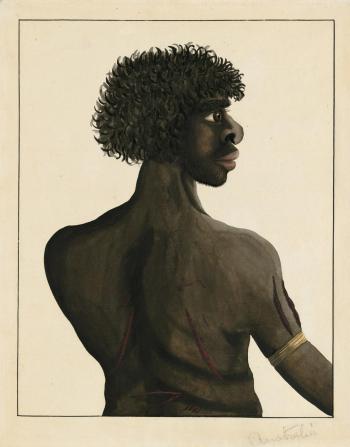
Port Jackson Painter, Half-length Portrait of Gna-na-gna-na, ca. 1790, gouache (Canberra, National Library of Australia, Rex Nan Kivell Collection NK144/D).
Joy Murphy-Wandin, Senior Wurundjeri Elder, said: “I am overwhelmed at the magnitude and integrity of this display: such work and vision is a credit to the curatorial team. The NGV is to be congratulated for providing a visual truth that will enable the public to see, and hopefully understand, First Peoples’ heartache, pain and anger. Colony: Australia 1770–1861 / Frontier Wars is a must-see for all if we are to realise and action true reconciliation.”
Charting key moments of history, life, and culture in the colonies, Colony: Australia 1770–1861 includes over 600 diverse and significant works, including examples of historical Aboriginal cultural objects, early watercolours, illustrated books, drawings, prints, paintings, sculpture, and photographs, to a selection of furniture, fashion, textiles, decorative arts, and even taxidermy specimens.
Highlights from the exhibition include a wondrous ‘cabinet of curiosities’ showcasing the earliest European images of Australian flowers and animals, including the first Western image of a kangaroo and illustrations by the talented young watercolourist Sarah Stone. Examples of early colonial cabinetmaking also feature, including the convict made and decorated Dixson chest containing shells and natural history specimens, as well as a rarely seen panorama of Melbourne in 1841 will also be on display.
Following the development of Western art and culture, the exhibition includes early drawings and paintings by convict artists such as convicted forgers Thomas Watling and Joseph Lycett; the first oil painting produced in the colonies by professional artist John Lewin; work by the earliest professional female artists, Mary Morton Allport, Martha Berkeley and Theresa Walker; landscapes by John Glover and Eugene von Guérard; photographs by the first professional photographer in Australia, George Goodman, and a set of Douglas Kilburn’s silver-plated daguerreotypes, which are the earliest extant photographs of Indigenous peoples.
Colony: Frontier Wars attests to the resilience of culture and community, and addresses difficult aspects of Australia’s shared history, including dispossession and the stolen generation, through the works of Julie Gough, Brook Andrew, Maree Clarke, Ricky Maynard, Marlene Gilson, Julie Dowling, S. T. Gill, J. W. Lindt, Gordon Bennett, Arthur Boyd, Tommy McRae, Christian Thompson, and many more.
Giving presence to the countless makers whose identities have been lost as a consequence of colonialism, Colony: Frontier Wars also includes a collection of anonymous photographic portraits and historical cultural objects, including shields, clubs, spear throwers and spears, by makers whose names, language groups and Countries were not recorded at the time of collection. Challenging global museum conventions, the exhibition will credit the subjects and makers of these cultural objects as ‘once known’ rather than ‘unknown’.
Colony: Australia 1770–1861 / Frontier Wars (Melbourne: National Gallery of Victoria, 2018), 394 pages, ISBN: 9781925432503, $50.
 This publication accompanies the two-part exhibition Colony: Australia 1770–1861 and Colony: Frontier Wars, which explores Australia’s shared history. Featuring works from the National Gallery of Victoria and key collections throughout Australia, it highlights the multiple perspectives on our colonial history through new scholarship and first-person statements from contemporary artists. This volume is a valuable addition to existing analyses of Australia’s complex colonial past.
Contributors
Brook Andrew, Robert Andrew, Louise Anemaat, Alisa Bunbury, Maree Clarke, Bindi Cole Chocka, Michael Cook, Carol Cooper, Julie Dowling, Amanda Dunsmore, Rebecca Edwards, Daina Fletcher, Elle Freak, Joanna Gilmour, Dr Ted Gott, Dr Julie Gough, Genevieve Grieves, Dr David Hansen, Peter Hughes, David Hurlston, Julia Jackson, Jonathan Jones, Cathy Leahy, Greg Lehman, Dr Donna Leslie, Dr Jane Lydon, John McPhee, Kimberley Moulton, Aunty Joy Murphy-Wandin AO, Richard Neville, Sarina Noordhuis-Fairfax, John Packham, Steaphan Paton, Cara Pinchbeck, Elspeth Pitt, Dr Joseph Pugliese, r e a, Beckett Rozentals, Dr Lynette Russell, Myles Russell-Cook, Judith Ryan AM, Yhonnie Scarce, Caitlin Sutton, Dr Christian Thompson, James Tylor (Possum), Michael Varcoe-Cocks, Judy Watson, H. J. Wedge, Danielle Whitfield, Nat Williams, Susan van Wyk.










leave a comment