New Book | Japanese Gardens and Landscapes, 1650–1950
From Penn Press:
Wybe Kuitert, Japanese Gardens and Landscapes, 1650–1950 (Philadelphia: University of Pennsylvania Press, 2017), 384 pages, ISBN: 978 08122 44748, $70 / £60.
 Moss, stone, trees, and sand arranged in striking or natural-looking compositions: the tradition of establishing and refining the landscape has been the work of Japanese gardeners and designers for centuries. In Japanese Gardens and Landscapes, 1650–1950 Wybe Kuitert presents a richly illustrated survey of the gardens and the people who commissioned, created, and used them and chronicles the modernization of traditional aesthetics in the context of economic, political, and environmental transformation.
Kuitert begins in the Edo period (1603–1868), when feudal lords recreated the landscape of the countryside as private space. During this same period, and following Chinese literary models, scholars and men of letters viewed the countryside itself, without any contrivance, as the ideal space in which to meet with friends and have a cup of tea. Stewards of inns, teahouses, and temples, on the other hand, followed increasingly clichéd garden designs prescribed in popular, mass-produced pattern books. Over the course of the late nineteenth and early twentieth centuries, the newly wealthy captains of industry in Tokyo adopted the aesthetic of the feudal lords, finding great appeal in naturalistic landscapes and deciduous forests.
Confronted with modernization and the West, tradition inevitably took on different meanings. Westerners, seeking to understand Japanese garden culture, found their answers in the pattern-book clichés, while in Japan, private landscapes became public and were designed in environmentally supportable ways, all sponsored by the government. An ancient, esoteric, and elite art extended its reach to every quarter of society, most notably with the extensive rebuilding that occurred in the aftermath of the Tokyo earthquake of 1923 and the end of World War II. In the wake of destruction came a new model for sustainable public parks and a heightened awareness of ecological issues, rooted above all in the natural landscape of Japan.
Featuring more than 180 color photographs and reproductions, Japanese Gardens and Landscapes, 1650–1950 illustrates a history of changes and continuities across a span of three centuries and makes an eloquent case for the lessons to be learned from the Japanese tradition as we face the challenges of a rapidly changing human habitat.
Wybe Kuitert is a licensed landscape architect and Professor of Environmental Studies at Seoul National University. He is author of Themes in the History of Japanese Garden Art.
C O N T E N T S
Preface
1 Landscape Enjoyed at Ease
2 Garden Stuff and Blueprints for the Masses
3 Time and Space in a Cup of Tea
4 Defining the Japanese Garden: Science, Vacuum, and Confusion
5 Passion and Emotion in the Meiji Landscape
6 Reforming the Tradition
7 Everybody’s Landscape
Epilogue: The Cricket Cage
Notes
Bibliography
Index
Acknowledgments
Exhibition | Fired by Passion: Masterpieces of Du Paquier Porcelain
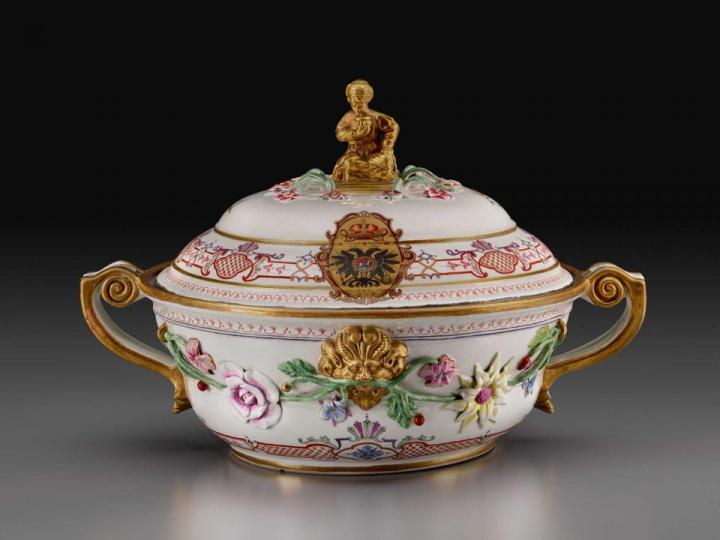
Du Paquier Manufactory, Tureen from the Service for Czarina Anna Ivanovna,; ca. 1735; hard-paste porcelain, 23.2 × 36.5 × 28.9 cm (The Frick Collection; gift of from the Melinda and Paul Sullivan Collection, 2016).
◊ ◊ ◊ ◊ ◊
Now on view at The Frick:
Fired by Passion: Masterpieces of Du Paquier Porcelain from the Sullivan Collection
The Frick Collection, New York, 8 June 2017 — 12 August 2018
Curated by Charlotte Vignon
The Frick Collection announces a new year-long installation in the Portico Gallery, Fired by Passion, inspired by the generous gift of fourteen pieces of Du Paquier porcelain made to the Frick in 2016 by Paul Sullivan and Trustee Melinda Martin Sullivan. The Du Paquier Manufactory was established in Vienna in 1718 by Claudius Innocentius du Paquier, an entrepreneur and official at the Viennese Court, and was only the second manufactory in Europe to produce true porcelain, after the Royal Meissen Manufactory, outside Dresden. Although in operation for only twenty-five years, Du Paquier left an impressive body of inventive and often whimsical work, forging a distinct identity in the history of European porcelain production.
 Fired by Passion presents about forty tureens, drinking vessels, platters, and other objects produced by Du Paquier between 1720 to 1740, which were coveted by aristocrats in Vienna and throughout Europe. In addition to exploring the rivalry between the Du Paquier and Meissen manufactories, the exhibition highlights the eclectic mix of references—many of them East Asian—that inspired Du Paquier porcelain. Splendid examples with coats of arms and heraldic symbols from commissions across Europe also illustrate the manufactory’s success and influence beyond Vienna. Fired By Passion is organized by Charlotte Vignon, Curator of Decorative Arts, The Frick Collection.
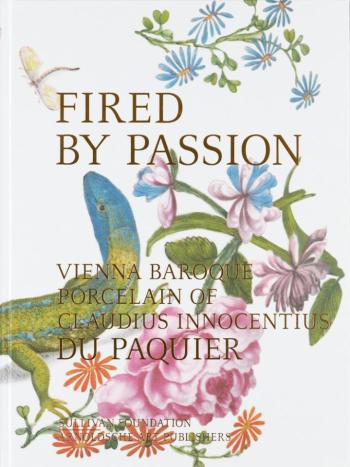
Meredith Chilton and Claudia Lehner-Jobst, Fired by Passion: Vienna Baroque Porcelain of Claudius Innocentius du Paquier (Stuttgart: Arnoldsche Art Publishers, 2009), 1432 pages, ISBN: 978 38979 03043 (English) / ISBN: 978 38979 03081 (German), $200.
The first comprehensive publication on this important porcelain manufactory, this work has been made possible through a five-year research program conducted by the Melinda and Paul Sullivan Foundation for the Decorative Arts. The objects shown, many of them for the first time here, are in major public and private collections. This 3-volume set presents the distinctive style and the exciting history of Du Paquier porcelain in the context of Baroque Vienna.
Extensive additional information, including photographs of all objects in the exhibition, is available here»
◊ ◊ ◊ ◊ ◊
Note (added 14 June 2017) — The original version of this posting mistakenly listed the date of the catalogue as 2017; in fact, it appeared in 2009.
New Book | Roma hispánica
Published by CEEH, and now available from Artbooks.com:
Pablo González Tornel, Roma hispánica: Cultura festiva española en la capital del Barroco (Madrid: Centro de Estudios Europa Hispánica, 2017), 392 pages, ISBN: 978 8415245 582, 34€ / $65.
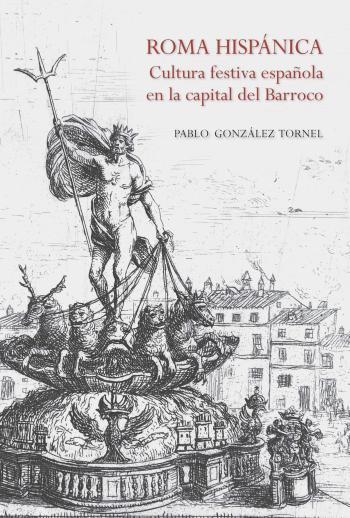 Roma y España mantuvieron un vínculo muy intenso desde tiempos de los Reyes Católicos hasta los albores del mundo contemporáneo. La ciudad era la sede del príncipe de la Iglesia, y la Monarquía Hispánica—que hizo del catolicismo militante el eje de su teología política, sobre todo bajo el gobierno de los Habsburgo—necesitaba de manera imperiosa la aprobación papal. Este lazo indisoluble entre la Monarquía Hispánica y el Papado durante la Edad Moderna dio lugar a una intensísima labor diplomática. La presencia española en Roma fue, desde finales del siglo xv, cada vez más numerosa, y las necesidades representativas de los súbditos de la Corona dieron lugar a una verdadera geografía hispánica en la ciudad, cuyos hitos principales eran el palacio de la Embajada de España y las iglesias nacionales de aragoneses y castellanos de Santa Maria di Monserrato y San Giacomo degli Spagnoli.
Gonzalez Tornel estudia en este libro uno de los elementos fundamentales de la rica y polifacética presencia hispana en Roma: la fiesta. Los rituales y las celebraciones que protagonizaron allí los españoles sirvieron para cohesionar a la comunidad y, sobre todo, tuvieron un papel clave en la acción propagandística de la Corona. Canonizaciones, entradas triunfales, celebraciones de éxitos políticos, fiestas religiosas o funerales regios hicieron presente a España tanto o más que las personas que los protagonizaron o los lugares donde se desarrollaron. Durante la Edad Moderna la fiesta fue capital a la hora de entender tanto el poder como las relaciones entre la Iglesia y los Estados, y aquella que protagonizó la Monarquía Hispánica en Roma es imprescindible para explicar ambas realidades.
Pablo González Tornel, doctor en Historia del Arte, es profesor en la Universitat Jaume I de Castellón. Durante sus estancias en la Università degli Studi di Palermo, la Biblioteca Hertziana, la Università di Roma La Sapienza o la Villa I Tatti (Harvard University), se ha centrado en la historia cultural de la Monarquía Hispánica, especialmente en la arquitectura y la cultura festiva durante la Edad Moderna. Entre sus trabajos destacan Los Habsburgo. Arte y propaganda en la colección de grabados de la Biblioteca Casanatense de Roma (2013), La fiesta barroca: los reinos de Nápoles y Sicilia (2014) o Cuatro reyes para Sicilia. Proclamaciones y coronaciones en Palermo 1700–1735 (2016).
Exhibition | Cristóbal de Villalpando: Mexican Painter of the Baroque
Press release from The Met:
Cristóbal de Villalpando: Mexican Painter of the Baroque
Palacio de Cultura Banamex – Palacio de Iturbide, Mexico City, 9 March — 4 June 2017
The Metropolitan Museum of Art, New York, 25 July — 15 October 2017
Curated by Ronda Kasl, Jonathan Brown, and Clara Bargellini
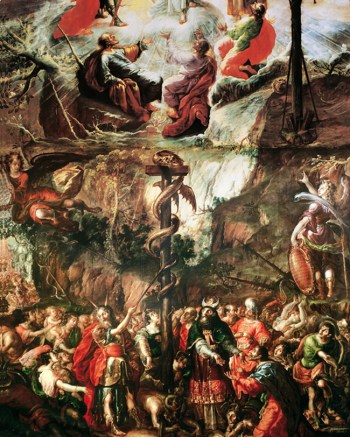
Cristóbal de Villalpando, Moses and the Brazen Serpent and the Transfiguration of Jesus (detail), 1683; oil on Canvas. Col. Propiedad de la Nación Mexicana, Secretaría de Cultura, Dirección General de Sitios y Monumentos del Patrimonio Cultural Acervo de la Catedral de Nuestra Señora de la Inmaculada Concepción, Puebla, Mexico.
Cristóbal de Villalpando (ca. 1649–1714) emerged in the 1680s not only as the leading painter in viceregal Mexico, but also as one of the most innovative and accomplished artists in the entire Spanish world. Opening July 25 at The Metropolitan Museum of Art, the exhibition Cristóbal de Villalpando: Mexican Painter of the Baroque features his earliest masterpiece, a monumental painting depicting the biblical accounts of Moses and the brazen serpent and the Transfiguration of Jesus that was painted in 1683 for a chapel in Puebla Cathedral. Newly conserved, this 28-foot-tall canvas has never been exhibited outside its place of origin. Ten additional works, most of which have never been shown in the United States, will also be exhibited. Highlights include Villalpando’s recently discovered Adoration of the Magi, on loan from Fordham University, and The Holy Name of Mary, from the Museum of the Basilica of Guadalupe.
Born in Mexico City around mid-century, Cristobal de Villalpando may have begun his career in the workshop of Baltasar de Echave Rioja (1632–1682). Villalpando’s rise to prominence coincided with the death of Echave Rioja in 1682, just one year before Villalpando painted his ambitious Moses and the Brazen Serpent and the Transfiguration of Jesus. Villalpando was celebrated in his lifetime, rewarded with prestigious commissions, and honored as an officer of the Mexico City painters’ guild.
The exhibition begins with Villalpando’s masterful Moses and the Brazen Serpent and the Transfiguration of Jesus, which was painted to decorate a chapel in Puebla Cathedral that was dedicated to a miracle-working image of Christ at the Column. In wealth and importance, Puebla Cathedral was second only to the Metropolitan Cathedral in Mexico City.
This painting—the first in a series of important ecclesiastical commissions—marks a breakthrough in Villalpando’s work, in terms of its grand scale and its audacious conception and execution. He signed it Villalpando inventor, an inscription that distinguishes the artist’s intellectual achievement from his manual skill and asserts his professional status as the learned practitioner of a noble art. In a bold and erudite arrangement, Villalpando juxtaposed the Old Testament story of Moses and the brazen serpent with the New Testament account of the Transfiguration—an unprecedented pairing of subjects. The two biblical events are staged within a single, continuous sacred landscape that encompasses the wilderness of Exodus and the holy mounts of Calvary and Tabor. Life-size figures of every age and gender, clothed and nude and in an astounding variety of poses and attitudes, populate the composition. The painting’s lower half features the story of Moses making and using the image of the brazen serpent according to God’s instructions to heal Israelites bitten by poisonous serpents. This episode provides a scriptural precedent for the making and use of images in worship, while also affirming the importance of art and artists. The upper half of the composition represents the transfiguration of Jesus’s corporeal body into light, a scene that demanded nothing less than the materialization of light in paint, which Villalpando attained through shimmering color and fluid brushwork.
Ten additional paintings by Villalpando will demonstrate his intense striving as an inventor; his great originality and skill; his ability to convey complex subject matter; and his capacity to envision the divine.
Catalogues in English and Spanish published by Fomento Cultural Banamex will accompany the exhibition. Essays address the major themes of the exhibition. The catalogues will be available for purchase in The Met book shop. A series of exhibition tours will complement the exhibition.
The exhibition was curated by Ronda Kasl, Curator of Latin American Art in The American Wing at The Met; Jonathan Brown, Carol and Milton Petrie Professor of Fine Arts, Institute of Fine Arts, New York University; and Clara Bargellini, Professor, Instituto de Investigaciones Estéticas, Universidad Nacional Autónoma de México. The work of Dr. Brown and Dr. Bargellini was commissioned by Fomento Cultural Banamex. At The Met, the exhibition is designed by Michael Langley, Exhibition Design Manager; graphics are by Mortimer Lebigre, Graphic Designer; and lighting is by Clint Ross Coller and Richard Lichte, Lighting Design Managers, all of the Museum’s Design Department.
New Book | Elfenbeinkunst im Grünen Gewölbe zu Dresden
This catalogue of ivory works in the Green Vault in Dresden is distributed by Sandstein Verlag:
Jutta Kappel, Elfenbeinkunst im Grünen Gewölbe zu Dresden (Staatliche Kunstsammlungen Dresden, 2017), 652 pages, ISBN: 978 395498 2264, 78€.
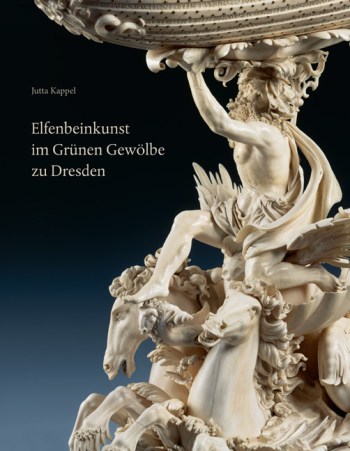 Das Grüne Gewölbe zu Dresden verwahrt eine der umfangreichsten, kunsthistorisch höchst bedeutsamen Elfenbeinsammlungen der Welt. Nach Jahren intensiver Forschung kann erstmalig der Bestand an aus Elfenbein geschnittenen Statuetten, Figurengruppen, Reliefs und in Silber gefassten Prunkgefäßen in diesem opulent illustrierten wissenschaftlichen Katalogwerk zusammenfassend vorgestellt werden.
Die frühesten Werke stammen aus byzantinischer Zeit, der Großteil aus dem 17. und 18. Jahrhundert, darunter Arbeiten solch berühmter, mit Dresden eng verbundener Elfenbeinkünstler wie Jacob Zeller, Melchior Barthel, Balthasar Permoser und Johann Christoph Ludwig Lücke. Die chronologische Gliederung des Bestandskataloges basiert auf den Inventaren der Dresdner Kunstkammer und des Grünen Gewölbes.
Dem Leser erschließt sich über stilkritische Analysen, Vergleiche, ikonographische und künstlermonographische Darlegungen zum Einzelwerk ein facettenreiches Spektrum an Motiven, Themen und Vorlagen. Zugleich werden die Geschichte dieser historisch gewachsenen Sammlung, deren Entwicklungslinien und dynastische Traditionen sichtbar gemacht. Mit dieser »Spurensuche« wird Neuland betreten.
New Book | Das Kloster der Kaiserin
Vienna’s Salesianerinnenkirche, home of the monastery of the Salesian nuns, was founded in 1717 by the widow of Emperor Joseph I, Empress Amalia Wilhelmina (the uncle and aunt of Maria Theresa), with foundations laid on May 13, the same day the future Holy Roman Empress was born. From Michael Imhof Verlag:
Helga Penz, ed., Das Kloster der Kaiserin: 300 Jahre Salesianerinnen in Wien (Petersberg: Michael Imhof Verlag, 2017), 264 pages, ISBN: 978 37319 03390, 35€.
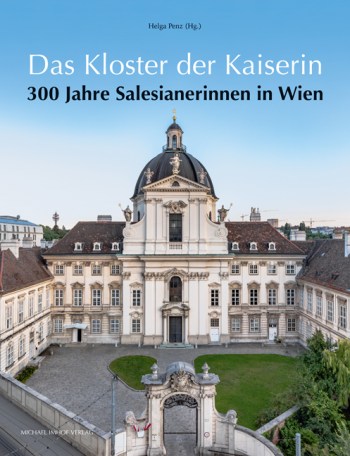 Eines der ältesten Frauenklöster Wiens feiert sein 300-jähriges Jubiläum. Am 13. Mai 1717, dem Tag, an dem die nachmalige Kaiserin Maria Theresia geboren wurde, fand die Grundsteinlegung für die großzügige Klosteranlage statt. Gestiftet wurde das Kloster von Kaiserin Amalia Wilhelmina, Gemahlin Kaiser Josephs I. Sie richtete sich in dem prachtvollen Barockbau von Donato Felice Allio ihre Witwenresidenz ein.
Die Ordensfrauen des französischen „Ordens von der Heimsuchung Mariens“ werden nach ihrem Gründer, dem hl. Franz von Sales, Salesianerinnen genannt. Der Orden ist kontemplativ und lebt eine strenge Klausur. Das Kloster in Wien führte lange Zeit ein Mädchenpensionat, das sich beim Adel der Habsburgermonarchie besonderer Beliebtheit erfreute. Die Salesianerinnen gehörten zu einem bedeutsamen adeligen Frauennetzwerk.
Das Jubiläumsbuch würdigt die reiche Geschichte und das kostbare kulturelle Erbe der Wiener Salesianerinnen. 16 Autorinnen und Autoren stellen die Stifterin und ihre Klosterresidenz vor, erörtern die Geschichte und die Bedeutung des Ordens im europäischen Kontext, beleuchten verschiedene Aspekte des klösterlichen Lebens von den Anfängen bis ins 20. Jahrhundert und bieten neue Erkenntnisse zu Baugeschichte und künstlerischer Ausstattung. Zahlreiche farbige Abbildungen geben einen einzigartigen Einblick in das barocke Kloster und seine Kunstschätze.
I N H A L T
Grußworte
• 300 Jahre Kloster der Heimsuchung Mariens in Wien, Kardinal Dr. Christoph Schönborn, Erzbischof von Wien
• Ein Werk des Herzens Jesu, Mutter Maria Gratia Baier OVSM und die Schwestern von der Heimsuchung Mariens in Wien
• Die Kraft der Stille. St. Georgs-Orden
• Im Schatten der Lilien vom Rennweg – anstatt eines Grußwortes, Prof. Dr. Christian Meyer, Vizerektor der Universität für Musik und darstellende Kunst Wien
• Gott, Kaiserin, Vaterland, Verein der Freunde der Salesianerinnen
Einleitung
Helga Penz, Vive Jésus: 300 Jahre Salesianerinnen in Wien
Die Stifterin Kaiserinwitwe Wilhelmina Amalia
• Michael Pölzl, Wie der regenbogen in der lufft: Die Stifterin Amalia Wilhelmina von Braunschweig-Lüneburg
• Elisabeth Germs-Cornides, Zur spirituellen Prägung der Stifterin: Jugendjahre der Wilhelmina Amalia von Braunschweig-Lüneburg in Paris
• Maureen Cassidy-Geiger, In der und ausser der Clausur: Kaiserinwitwe Wilhelmina Amalias Appartement im Kloster am Rennweg
Der Orden von der Heimsuchung Mariens und das Kloster in Wien
• Herbert Winklehner OSFS, Ein einzigartiges Beispiel geistlicher Freundschaft. Johanna Franziska von Chantal und Franz von Sales
• Gisela Fleckenstein OFS, Der Orden von der Heimsuchung Mariens: Grundlagen, Entwicklung, Struktur
• Christine Schneider, Der Konvent und das Pensionat des Wiener Heimsuchungsklosters von der Gründung bis zum Tod der Stifterin im Jahre 1742
• Peter Wiesflecker, Kloster, Kaiserhaus und Adel: Die Salesianerinnen am Rennweg und der habsburgische Hof
• Johann Weissensteiner, Die Visitation des Klosters der Salesianerinnen durch Erzbischof Vinzenz Eduard Milde im Jahr 1846
• Peter Wiesflecker, Unter fremden Dächern wohnt Ihr Frauenchor: Das Salesianerinnenkloster als „Benediktinerinnen- abtei“ und Exilort im Zweiten Weltkrieg
Architektur und künstlerische Ausstattung
• Herbert Karner, Die Kirche zur Heimsuchung Marias: Ein Sakral- raum zwischen kaiserlicher Repräsentation und salesianischer Spiritualität
• Werner Telesko, Die Ausstattung der Salesianerinnenkirche mit Deckenmalereien und Altarbildern: Überlegungen zum ikonografischen Programm
• Herbert Karner, Das Heimsuchungskloster: Architektur und Raumkonzept
• Gernot Mayer, Kloster/Residenz: Ein Ort des Rückzugs, ein Ort der Repräsentation? Zur Ambiguität der Residenz von Kaiserinwitwe Wilhelmina Amalia am Rennweg
• Helmut Halb, Die Bildausstattung der Innenräume und ihre Funktion im klösterlichen Leben
• Manfred Koller, Restaurierergebnisse nach 1945: Gemälde, Altarbilder und Kuppelmalerei
• Markus Santner, Robert Linke, Johann Nimmrichter, Johannes Jacob, Die gotische Madonna des Heimsuchungsklosters: Restauriergeschichte und Konservierung
• Werner Telesko, Die Sammlung von Thesenblättern
• Eva Voglhuber, Vom Hofkleid zum liturgischen Gewand: Die Para- mentensammlung der Wiener Salesianerinnen
Die Musikuniversität im Kloster
• Stefan Weiss, Die Geschichte der mdw am Standort Salesianerinnenkloster
Anhang
Liste der Oberinnen
Literaturverzeichnis
Verzeichnis der Abkürzungen und Siglen
Abbildungsnachweis
New Book | Heinrich Graf von Brühl
Papers from the March 2014 conference, which marked the 250th anniversary of Heinrich Graf von Brühl’s death, have recently been published by Sandstein Verlag.
Ute Koch and Cristina Ruggero, eds., Heinrich Graf von Brühl: Ein sächsischer Mäzen in Europa—Akten der internationalen Tagung zum 250. Todesjahr (Dresden: Sandstein Verlag, 2017), 548 pages, ISBN: 978 39549 82974, 68€. With essays in German, English, French, and Italian.
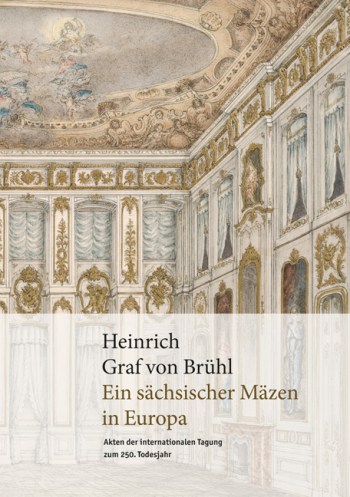 Die Brühlsche Terrasse, das Schwanenservice oder auch die Sixtinische Madonna—sie alle sind auf das Engste mit dem sächsischen Premierminister Heinrich Graf von Brühl (1700–1763) verbunden. Als Mäzen setzte er zudem—mit eigenen kostbaren Sammlungen und Schlössern—Maßstäbe in ganz Europa. Die vorliegende Publikation bricht die Verengung des Blicks auf Brühls regionale Bedeutung für Dresden und Sachsen auf und legt erstaunliche Verbindungen frei. Sie versteht sich als »Türöffner« für die Erforschung der kulturellen und politischen Bedeutung Sachsens im 18. Jahrhundert in Europa und der Welt.
Brühl’s Terrace, the Swan Service, and the Sistine Madonna are all closely connected with the Saxon Prime Minister Heinrich Count von Bruhl (1700–1763). He was a patron of the arts whose precious collections and castles set standards in the whole of Europe. The present publication moves away from the somewhat narrow focus on Brühl’s regional importance for Dresden and Saxony. It reveals unexpected connections and opens the door for the study of the cultural and political importance of 18th-century Saxony in Europe and the rest of the world.
New Book | Early Professional Women in Northern Europe, c. 1650–1850
Scheduled for release in July from Routledge:
Johanna Ilmakunnas, Marjatta Rahikainen, and Kirsi Vainio-Korhonen, eds., Early Professional Women in Northern Europe, c. 1650–1850 (New York: Routledge, 2017), 312 pages, ISBN: 978 14724 71345, $150.
 This book focuses on early examples of women who may be said to have anticipated, in one way or another, modern professional and/or career-oriented women. The contributors to the book discuss women who may at least in some respect be seen as professionally ambitious, unlike the great majority of working women in the past. In order to improve their positions or to find better business opportunities, the women discussed in this book invested in developing their qualifications and professional skills, took economic or other kinds of risks, or moved to other countries. Socially, they range from elite women to women of middle-class and lower middle-class origin.
In terms of theory, the book brings fresh insights into issues that have been long discussed in the field of women’s history and are also debated today. However, despite its focus on women, the book is conceptually not so much focused on gender as it is on profession, business, career, qualifications, skills, and work. By applying such concepts to analyzing women’s endeavours, the book aims at challenging the conventional ideas about them.
Johanna Ilmakunnas is acting professor of Finnish history at the University of Turku, Finland.
Marjatta Rahikainen is a docent of social history at the University of Helsinki, Finland.
Kirsi Vainio-Korhonen is a professor of Finnish history at the University of Turku, Finland.
◊ ◊ ◊ ◊ ◊
C O N T E N T S
1 Johanna Ilmakunnas, Marjatta Rahikainen and Kirsi Vainio-Korhonen, Women and Professional Ambitions in Northern Europe, c.1650–1850
2 Kirsi Vainio-Korhonen, Midwives: Birthing Care Professionals in Eighteenth-Century Sweden and Finland
3 Britta Kägler, Serving the Prince as the First Step of Female Careers: The Electoral Court of Munich, c.1660–1840
4 Johanna Ilmakunnas, From Mother to Daughter: Noblewomen in Service at the Swedish Royal Court, c.1740–1840
5 Anna Lena Lindberg, Remarkable Women Artists: Flower Painting and Professional Changes in Copenhagen, c.1690–1790
6 Marie Steinrud, Performing Women: The Life and Work of Actresses in Stockholm, c.1780–1850
7 Deborah Simonton, ‘Sister to the Tailor’: Guilds, Gender and the Needle Trades in Eighteenth-Century Europe
8 Galina Ulianova, Independent Managers: Female Factory Owners in the Northern Provinces of the Russian Empire, c.1760–1810
9 Marjatta Rahikainen, Urban Opportunities: Women in the Restaurant Business in Swedish and Finnish Cities, c.1800–1850
10 Åsa Karlsson Sjögren, Desirable Qualifications and Undesirable Behaviour: Teachers in Swedish Schools for Poor Children, c.1780–1820
11 Olga Solodyankina, Cross-Cultural Closeness: Foreign Governesses in the Russian Empire, c.1700–1850
12 Marjatta Rahikainen, Shaping Middle-Class and Upper-Class Girls: Women as Teachers of Daughters of Good Families in the Baltic Sea World, c.1780–1850
New Book | Baroque Seville: Sacred Art in a Century of Crisis
The focus rests on the 1660s and 70s—with plenty, nonetheless, relevant for the eighteenth century. –CH.
From Penn State UP:
Amanda Wunder, Baroque Seville: Sacred Art in a Century of Crisis (University Park: Penn State University Press, 2017), 232 pages, ISBN: 978 02710 76645, $85.
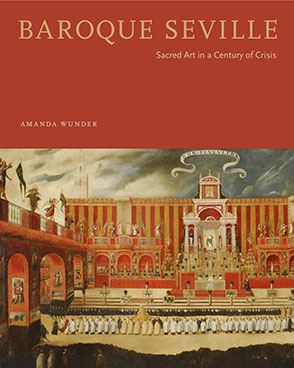 Baroque art flourished in seventeenth-century Seville during a tumultuous period of economic decline, social conflict, and natural disasters. This volume explores the patronage that fueled this frenzy of religious artistic and architectural activity and the lasting effects it had on the city and its citizens.
Amanda Wunder investigates the great public projects of sacred artwork that were originally conceived as medios divinos—divine solutions to the problems that plagued Seville. These commissions included new polychromed wooden sculptures and richly embroidered clothing for venerable old images, gilded altarpieces and monumental paintings for church interiors, elaborate ephemeral decorations and festival books by which to remember them, and the gut renovation or rebuilding of major churches that had stood for hundreds of years. Meant to revive the city spiritually, these works also had a profound real-world impact. Participation in the production of sacred artworks elevated the social standing of the artists who made them and the devout benefactors who commissioned them, and encouraged laypeople to rally around pious causes. Using a diverse range of textual and visual sources, Wunder provides a compelling look at the complex visual world of seventeenth-century Seville and the artistic collaborations that involved all levels of society in the attempt at its revitalization.
Amanda Wunder is Associate Professor of History at Lehman College and of Art History at the Graduate Center of the City University of New York.
◊ ◊ ◊ ◊ ◊
C O N T E N T S
List of Illustrations
Acknowledgments
Currency, Weights, and Measures
Introduction
1 The Art of Disillusionment: The Patronage of Mateo Vázquez de Leca
2 The Piety of Powerful Neighbors: The Renovation of Santa María la Blanca
3 A Temporary Triumph: The Seville Cathedral’s Festival for San Fernando
4 The Nobility of Charity: The Church and Hospital of the Santa Caridad
5 The Phoenix of Seville: Rebuilding the Church of San Salvador
Conclusion
Chronology
Notes
Bibliography
Index
Exhibition | Casanova: The Seduction of Europe
From the Kimbell Art Museum and Distributed Art Publishers (DAP) . . .
Casanova: The Seduction of Europe / Casanova’s Europe: Art, Pleasure, and Power
Kimbell Art Museum, Fort Worth, 27 August — 31 December 2017
The Legion of Honor, San Francisco, 10 February — 28 May 2018
Museum of Fine Arts, Boston, 1 July — 8 October 2018

Jean-Marc Nattier, Portrait of Manon Balletti, 1757, oil on canvas, 54 × 47.5 cm (London: National Gallery). Balletti was the fiancée (1757–60) of Giacomo Casanova and then wife (1760–74) of the architect Jacques-François Blondel.
Casanova: The Seduction of Europe explores the 18th century across Europe through the eyes of one of its most colorful characters, Giacomo Casanova (1725–1798). Renowned in modern times for his amorous pursuits, Casanova lived not only in Italy, but in France and England, and his travels took him to the Ottoman Empire and to meet Catherine the Great in Saint Petersburg. Bringing together paintings, sculpture, works on paper, furnishings, porcelains, silver, and period costume, Casanova will bring this world to life. Following its display in Fort Worth, the exhibition will be on view at the Fine Arts Museum of San Francisco and the Museum of Fine Arts, Boston.
Frederick Ilchman, Thomas Michie, C.D. Dickerson III, and Esther Bell, with texts by Meredith Chilton, Jeffrey Collins, Nina Dubin, Courtney Leigh Harris, James Johnson, Pamela Parmal, Malina Stefanovska, Susan Wager, and Michael Yonan, Casanova: The Seduction of Europe (Boston: MFA Publications, 2017), 344 pages, ISBN: 978 087846 8423, $45.
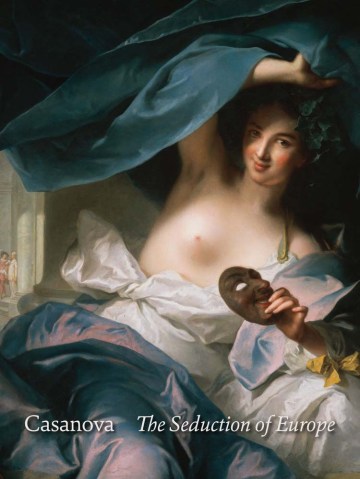 In 18th-century Europe, while the old order reveled in the luxurious excesses of the Rococo style and the Enlightenment sowed the seeds of revolution, the shapeshifting libertine Giacomo Casanova seduced his way across the continent. Although notorious for the scores of amorous conquests he recorded in his remarkably frank memoirs, Casanova was just as practiced at charming his way into the most elite social circles, through an inimitable mix of literary ambition, improvisational genius and outright fraud. In his travels across Europe and through every level of society from the theatrical demimonde to royal courts, he was also seduced by the visual splendors he encountered.
This volume accompanies the first major art exhibition outside Europe to lavishly recreate Casanova’s visual world, from his birthplace of Venice, city of masquerades, to the cultural capitals of Paris and London and the outposts of Eastern Europe. Summoning up the people he met and the cityscapes, highways, salons, theaters, masked balls, boudoirs, gambling halls and dining rooms he frequented, it provides a survey of important works of 18th-century European art by masters such as Canaletto, Fragonard, Boucher, Houdon, and Hogarth, along with exquisite decorative arts objects. Twelve essays by prominent scholars illuminate multiple facets of Casanova’s world as reflected in the arts of his time, providing a fascinating grand tour of Europe conducted by a quintessential figure of the 18th century as well as a splendid visual display of the spirit of the age.
◊ ◊ ◊ ◊ ◊
Note (added 20 August 2018) — This article might be of interest for anyone thinking about the exhibition and its reception within our own political/cultural context: Cynthia Durcanin, “Casanova as Case Study: How Should Art Museums Present Problematic Aspects of the Past?,” ArtNews (13 August 2018). As noted in the essay: “The MFA also changed the show’s title from the Legion of Honor’s, removing the word ‘seduction’ so that it became ‘Casanova’s Europe: Art, Pleasure and Power in the 18th Century’.” According to Katie Getchell, the chief brand officer and deputy director of the MFA Boston, “It’s an important nuance. The show is not about Casanova—it’s about Europe in Casanova’s time.”










 Enfilade
leave a comment