The Burlington Magazine, July 2017
The eighteenth century in The Burlington:
The Burlington Magazine 159 (July 2017), Decorative Arts

E D I T O R I A L
• “Furniture History: The Digital Future,” p. 519.
On the eve of the 300th anniversary of the birth of Thomas Chippendale in 2018, the editorial addresses the British and Irish Furniture Makers Online Project (BIFMO), which updates the The Dictionary of English Furniture Makers 1660–1840, edited by Geoffrey Beard and Christopher Gilbert and published by the Furniture History Society in 1986. The BIFMO—a collaboration between the FHS and the Centre for Metropolitan History (CMH) at the Institute of Historical Research, University of London—is an open-access searchable database of all the entries from The Dictionary, together with the names of furniture makers from Laurie Lindey’s recent PhD thesis (Lindey, as a post-doctoral research fellow is overseeing the project at the IHR with Mark Merry of the CMH). The first phase of the BIFMO’s launch is scheduled for 30 September.
A R T I C L E S
• Koenraad Brosens and Astrid Slegten, “Creativity and Disruption in Brussels Tapestry, 1698–1706: New Data on Jan van Orley and Judocus de Vos,” pp. 528–35.
• Francesco Morena, “The Emperor of Mexico’s Screen: Maximilian I’s ‘Biombo’ in Trieste,” pp. 536–43.
R E V I E W S
• Simonetta Prosperi Valenti Rodinò, Review of Sabina de Cavi, ed., Dibujos y ornamento: Trazas y Dibujos de Artes decorativas entre Portugal, España, Italia, Malta y Grecia: Estudio en honor de Fuensanta García de la Torre (De Luca Editori d’Arte, 2015), pp. 559–60.
• Pierre Terjanian, Review of A. V. B. Norman and Ian Eaves, Arms & Armour in the Collection of Her Majesty The Queen, European Armour (Royal Collection Trust, 2016),” pp. 560–61.
• Robin Hildyard, Review of Brian Gallagher, Barbara Stone Perry, Letitia Roberts, Diana Edwards, Pat Halfpenny, Maurice Hillis and Margaret Ferris Zimmerman, British Ceramics, 1675–1825: The Mint Museum (D. Giles, 2015), pp. 561–62.
• Gauvin Alexander Bailey, Review of Christopher M.S. Johns, China and the Church: Chinoiserie in Global Context (University of California Press, 2016) and Marco Musillo, The Shining Inheritance: Italian Painters at the Qing Court, 1699–1812 (Getty Publications, 2016),” pp. 562–63.
• Philippa Glanville, Review of James Rothwell, Silver for Entertaining: The Ickworth Collection (Philip Wilson, 2017), pp. 563–64.
• Humphrey Wine, Review of the exhibition Le Baroque des Lumières: Chefs-d’œuvre des églises parisiennes au XVIIIe siècle (Paris: Petit Palais, 2017), pp. 572–73.
• Patrick Bade, Review of the exhibition La Quête de la ligne: Trois siècles de dessin en Allemagne (Hamburg: Kunsthalle, 2016 and Paris: Fondation Custodia, 2017), pp. 574–75.
• Jamie Mulherron, Review of the exhibition Marie Madeleine: La Passion révélée (Bourg-en-Bresse: Monastère Royal de Brou; Carcassonne: Musée des Beaux Arts; and Douai: Musée de la Chartreuse, 2017), pp. 577–79.
• Elsje van Kessel, Review of the newly refurbished gallery of Portuguese painting and sculpture at the Museu Nacional de Arte Antiga (MNAA), pp. 579–80.
• Philippe Bordes, Review of the exhibition Charles Percier: Architecture and Design in an Age of Revolutions (New York, Bard Graduate Center Gallery; and Château de Fontainebleau, 2016–17), pp. 583–84.
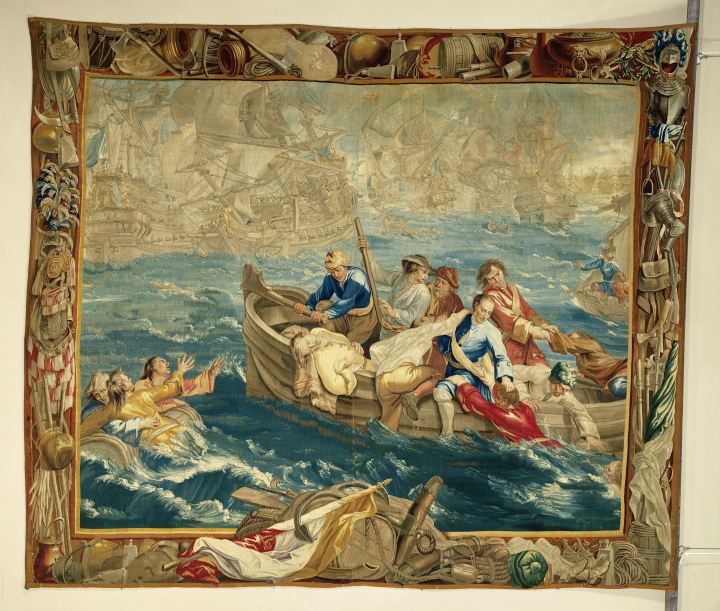
Judocus de Vos, after Lambert de Hondt, Lucas Achtschellinck, and Jan van Orley, Naval Battle from the Art of War series, ca. 1715–20; wool and silk, 344 × 400 cm (Amsterdam: Rijksmuseum).
New Book | Pour la plus grande gloire du roi: Louis XIV en thèses
As Pierre-Henri Biger notes on his Facebook page (with thanks to him for forwarding the notice for publication here at Enfilade) . . .
Comment réaliser des ouvrages traitant de l’Art abondamment illustrés et savants sans qu’ils coûtent une fortune ? Cela les écarte de leur public, car les savants sont rarement riches, et les riches rarement savants dans ce domaine. Mme Véronique Meyer, qui me fit l’honneur d’être membre de mon jury de thèse (et donné le plaisir de lire son élogieux pré-rapport) a élégamment, intelligemment et généreusement résolu le problème. Pour accompagner l’ouvrage Pour la plus grande gloire du Roi qu’elle publie aux Presses Universitaires de Rennes, elle met en ligne un impressionnant catalogue, plein d’images de thèses à la gloire de Louis XIV et de commentaires détaillés. Et ce document a vocation à s’enrichir. Bravo, Madame (et bravo aux PUR et au Centre de Recherches du Château de Versailles) !
From PUR:
Véronique Meyer, Pour la plus grande gloire du roi: Louis XIV en thèses (Rennes: Presses Universitaires de Rennes, 2017), 372 pages, ISBN: 978 27535 54641, 23€.
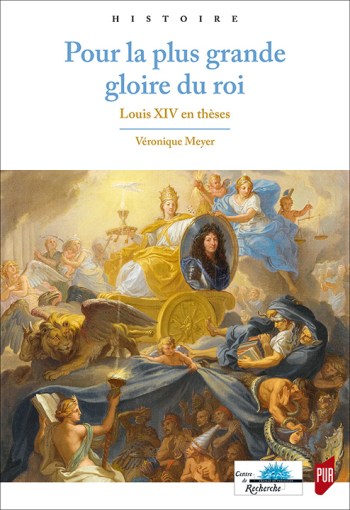 C’est au xviie siècle en France que la thèse illustrée connaît son apogée. À l’exemple de Richelieu et de Mazarin, Louis XIV accorda aux thèses une place de choix dans la di usion de son image. De 1638 à 1704, plus de 130 thèses de philosophie, théologie, droit et médecine lui furent dédiées. Même si certaines sont destinées à son père, à sa mère ou aux parlements de province, il apparaît en haut de l’a che en personne ou par ses armoiries. Les étudiants étaient issus de l’entourage royal, ls de ministres ou de parlementaires, membres de congrégations religieuses, et quelquefois même étrangers. Courtisans, parlementaires et ecclésiastiques de haut rang participaient à la soutenance publique où le candidat et sa famille adressaient des éloges au roi. On y distribuait des a ches ornées de son portrait ou d’une allégorie à sa gloire exécutées par les meilleurs artistes du temps, aussi les dépenses engagées étaient-elles considérables. Soutenues à Paris, mais également en province et à l’étranger, les thèses, et avec elles l’image du roi, pénétraient les demeures des Français et se di usaient à l’extérieur du royaume. Cet ouvrage décrit successivement la place des thèses dans le cursus universitaire, leur soutenance, leur dédicace et leur di usion ainsi que l’élaboration de leurs illustrations, en insistant sur le rôle des peintres, graveurs et éditeurs. Il montre comment elles rendent compte de l’histoire du roi et de l’évolution de son portrait physique et moral. Ce volume est accompagné d’un catalogue raisonné, abondamment illustré, des thèses dédiées au roi, consultable sur les sites du Centre de recherche du château de Versailles et des Presses universitaires de Rennes.
Veronique Meyer, professeur d’histoire de l’art à l’université de Poitiers, est spécialiste de l’estampe à l’époque moderne. Elle a publié notamment avec la Commission des travaux historiques de la Ville de Paris L’illustration des thèses à Paris dans la seconde moitié du xviie siècle. Peintres, graveurs, éditeurs (2002) et L’œuvre gravé de Gilles Rousselet (2004), et participé à l’exposition Images du Grand Siècle. L’estampe française au temps de Louis XIV (1660–1715), (Bnf-Getty Research Institute, 2015–16).
T A B L E D E S M A T I È R E S
Remerciements
Avertissement
Introduction
Première partie: LA THÈSE : L’UNIVERSITÉ, LE CANDIDAT ET LE DÉDICATAIRE
1 Les thèses dans le cursus universitaire
La faculté des arts
La faculté de théologie
La faculté de médecine et de pharmacie
La faculté de droit
2 La soutenance
Les candidats
L’invitation à la soutenance
Le décor de la salle: tapisseries et tentures
Le dais et le portrait du roi
Le public
Protocole et préséance
Panégyriques, harangues et odes
3 L’illustration des thèses
Le placard et le livret
La dédicace et ses raisons d’être
Les cadres
La réception
Deuxième partie: ÉLABORATION, DIFFUSION, RÉCEPTION
4 Les peintres
Charles Le Brun
Pierre Mignard
Nicolas Mignard
Pierre-Paul Sevin
Antoine Paillet
5 Les graveurs
Les portraitistes
Les graveurs d’histoire
Les graveurs en lettres
6 Contrats et dépenses
Le prix des gravures
Diffusion et réutilisation
Troisième partie: LE ROI, SON HISTOIRE ET SON PORTRAIT
7 L’histoire du roi
De la naissance au règne personnel, 1638–1660
Célébration du roi en province et à l’étranger, 1649–1653
Vers l’affirmation du pouvoir royal, 1653–1660
Le pouvoir personnel : le roi triomphant, 1661–1715
8 Le portrait du roi
Le portrait physique : du visage au costume
Le portrait moral dans les sujets d’histoire : l’allégorie et l’emblème
Les vertus
Le portrait en buste : attributs et symboles
Conclusion
Abréviations
Table des thèses dédiées au roi
Annexe : table des thèses dédiées à la famille royale, aux fils légitimés de Louis XIV et aux favorites
Sources et bibliographie
Table de concordance
Table des illustrations
Crédits photographiques
Index des noms de personnes
More information about the online Catalogue des theses dediees à Louis XIV is available here»
New Book | Tin-Glazed Earthenware
Distributed by The University of Chicago Press:
Ulla Houkjær, Tin-Glazed Earthenware from the Netherlands, France, and Germany, 1600–1800 (Copenhagen: Museum Tusculanum Press, 2017), 415 pages, ISBN: 978 8763545 655, $75.
 Designmuseum Denmark is home to a large collection of ceramic works that is quite unique in terms of size and width of representation, since the collection covers all known techniques within the main groups of earthenware, stoneware, tin-glazed earthenware, and porcelain as well as new hybrid materials and techniques. This catalogue covers an extremely important period in the history of European glazed ceramic ware from c. 1600 to 1800 when the technique enjoyed the widest distribution. Ulla Houkjaer focuses on three central areas: the Netherlands, France, and Germany. This comprehensive and highly illustrated introduction to the history of tin-glazed earthenware in these three countries offers an overview of the history of important developments within the field during the period and highlights important changes in aesthetics and usage.
Ulla Houkjær is curator at Designmuseum Denmark. She is the author of Tim-Glazed Earthenware, 1300–1750: Spain, Italy, France.
New Book | Malleable Anatomies
From OUP:
Lucia Dacome, Malleable Anatomies: Models, Makers, and Material Culture in Eighteenth-Century Italy (Oxford: Oxford University Press, 2017), 320 pages, ISBN: 978 01987 36189, $99.
 Malleable Anatomies offers an account of the early stages of the practice of anatomical modeling in mid-eighteenth-century Italy. It investigates the ‘mania’ for anatomical displays that swept the Italian peninsula and traces the fashioning of anatomical models as important social, cultural, and political as well as medical tools. Over the course of the eighteenth century, anatomical specimens offered particularly accurate insights into the inner body. Being colored, soft, malleable, and often life-size, they promised to foster anatomical knowledge for different audiences in a delightful way. But how did anatomical models and preparations inscribe and mediate bodily knowledge? How did they change the way in which anatomical knowledge was created and communicated? And how did they affect the lives of those involved in their production, display, viewing, and handling?
Examining the circumstances surrounding the creation and early viewing of anatomical displays in Bologna and Naples, Malleable Anatomies addresses these questions by reconstructing how anatomical modeling developed at the intersection of medical discourse, religious ritual, antiquarian and artistic cultures, and Grand Tour display. While doing so, it investigates the development of anatomical modeling in the context of the diverse worlds of visual and material practices that characterized the representation and display of the body in mid-eighteenth-century Italy. Drawing attention to the artisanal dimension of anatomical practice and to the role of women as both makers and users of anatomical models, it considers how anatomical specimens lay at the center of a composite world of social interactions, which led to the fashioning of modelers as anatomical celebrities. Moreover, it examines how anatomical displays transformed the proverbially gruesome practice of anatomy into an enthralling experience that engaged audiences’ senses.
Lucia Dacome is an associate professor and Pauline M.H. Mazumdar Chair in the History of Medicine at the IHPST, University of Toronto. She received her PhD from the University of Cambridge and held postdoctoral fellowships at the Max Planck Institute for the History of Science in Berlin, the Wellcome Trust Centre for the History of Medicine at UCL, the UCLA Centre for seventeenth- and eighteenth-century studies in Los Angeles, and a Marie Curie Intra-European Fellowship supported by the European Commission at the Centre Alexandre Koyre/CNRS in Paris. Her research focuses on themes at the intersection of the history of medicine, the history of the body, the history of visual and material cultures of medicine, gender history, the history of the self, and that of medical practices and exchanges in the Mediterranean world.
C O N T E N T S
Acknowledgments
List of Plates
List of Figures
List of Abbreviation
Introduction
1 Prospero’s Tools
2 Artificer and Connoisseur
3 Anatomy, Embroidery, and the Fabric of Celebrity
4 Women, Wax, and Anatomy
5 Blindfolding the Midwives
6 Transferring Values
7 Injecting Knowledge
Epilogue: Becoming Obsolete
Selected Bibliography
Index
New Book | Cottages Ornés
From Yale UP:
Roger White, Cottages Ornés: The Charms of the Simple Life (New Haven: Yale University Press, 2017), 272 pages, ISBN: 978 03002 26775, $50.
 Tracing the history of cottages ornés (ornamental cottages), this copiously illustrated volume offers an engaging survey of an often-overlooked architectural genre. An invention of mid-18th-century England, these cottages were designed to facilitate a more informal way of living and were built in different guises that range from royal and imperial cottages to the working-class lodges that still dot the English countryside. Analyzing cottage designs by some of the leading architects of late-Georgian England—including Robert Adam, John Soane, and John Nash—Roger White explores the aesthetic values that made the form so appealing. As he follows the development of cottages ornés from the Celtic fringes to the Continent and the British colonies, White reveals the significant impact of the genre on social, cultural, and political history and examines the influence of cottage design on the architectural developments of the Victorian period and even the 20th century.
Roger White is an architectural historian specializing in the Georgian period.
New Book | A World Trimmed with Fur
From Stanford UP:
Jonathan Schlesinger, A World Trimmed with Fur: Wild Things, Pristine Places, and the Natural Fringes of Qing Rule (Stanford: Stanford University Press, 2017), 288 pages, ISBN: 978 080479 9966, $65.
 In the eighteenth and nineteenth centuries, booming demand for natural resources transformed China and its frontiers. Historians of China have described this process in stark terms: pristine borderlands became breadbaskets. Yet Manchu and Mongolian archives reveal a different story. Well before homesteaders arrived, wild objects from the far north became part of elite fashion, and unprecedented consumption had exhausted the region’s most precious resources.
In A World Trimmed with Fur, Jonathan Schlesinger uses these diverse archives to reveal how Qing rule witnessed not the destruction of unspoiled environments, but their invention. Qing frontiers were never pristine in the nineteenth century—pearlers had stripped riverbeds of mussels, mushroom pickers had uprooted the steppe, and fur-bearing animals had disappeared from the forest. In response, the court turned to ‘purification’; it registered and arrested poachers, reformed territorial rule, and redefined the boundary between the pristine and the corrupted. Schlesinger’s resulting analysis provides a framework for rethinking the global invention of nature.
Jonathan Schlesinger is Assistant Professor of History at Indiana University.
C O N T E N T S
Introduction
1 The View from Beijing
2 Pearl Thieves and Perfect Order
3 The Mushroom Crisis
4 The Nature in the Land of Fur
Conclusion
Exhibition | Fragonard: The Fantasy Figures

Jean Honoré Fragonard, Sketches of Portraits, ca. 1769, drawing, 23 × 35 cm
(Private Collection, Paris)
◊ ◊ ◊ ◊ ◊
From the press release (11 July 2017) for the exhibition:
Fragonard: The Fantasy Figures
National Gallery of Art, Washington, D.C., 8 October — 3 December 2017
Curated by Yuriko Jackall
Combining art, fashion, science, and conservation, the revelatory exhibition Fragonard: The Fantasy Figures brings together—for the first time—a newly discovered drawing by Jean Honoré Fragonard (1732–1806) and some 14 of his paintings that have been identified with it including the Gallery’s own Young Girl Reading (c. 1769). Fragonard is considered among the most characteristic and important French painters of his era, and this series casts light on the development of his career, the identity of his sitters and patrons, and the significance of his innovative imagery. Fragonard: The Fantasy Figures and the fully illustrated catalog that accompanies it not only present new art-historical and scientific research into this series but also examine the 18th-century Parisian world in which these paintings were created. The exhibition may be seen only at the National Gallery of Art, Washington, in the West Building, from October 8 through December 3, 2017.

Jean Honoré Fragonard, Young Girl Reading, ca. 1769, oil on canvas, framed: 104.9 × 89.5 cm (National Gallery of Art, Washington, D.C., Gift of Mrs. Mellon Bruce in memory of her father, Andrew W. Mellon).
Covered with 18 thumbnail-sized sketches and apparently annotated in the rococo artist’s own hand, the drawing now known as Sketches of Portraits emerged at a Paris auction in 2012 and upended several long-held assumptions about the fantasy figures—a series of rapidly executed, brightly colored paintings of lavishly costumed individuals.
“The first exhibition to unite the fantasy figures with the recently discovered drawing focuses on this aspect of Fragonard’s production in a powerful and intimate way,” said Earl A. Powell III, director, National Gallery of Art, Washington. “We are grateful to the public and private collections, both here and abroad, that have generously lent to this exhibition, as well as to Lionel and Ariane Sauvage whose gift supported the catalog’s publication.”
Fragonard: The Fantasy Figures explores the many interpretations of this series in the context of the artist’s career. Fragonard strove to create a specific portrait type that showcased the painterly skill for which he was renowned. The fantasy figures also enabled him to experiment and to refine his ideas of artistic reference and emulation. Created within the competitive atmosphere of the Parisian art world, these works were influenced by a range of events, artworks, and visitors to his studio.
The fantasy figures depict men and women posed at leisure or employed in various pursuits, such as acting, reading, writing, playing instruments, or singing. Wearing extravagant attire, these figures are dressed in what was known in 18th-century France as à l’espagnole (Spanish style)—plumed hats, slashed sleeves, ribbons, rosettes, ruffs, capes, and accents of red and black. Shaped by artistic imagination, these paintings pushed the boundaries of accepted figure painting at the time.

Jean Honoré Fragonard, The Writer, ca. 1769, oil on canvas, framed: 115 x 91 cm (Paris: Musée du Louvre, Département des Peintures).
Exhibited for the first time is the newly discovered Sketches of Portraits (c. 1769), a thin sheet of paper with three rows of 18 small sketches—all but one are annotated with a name, 14 have been identified with one of Fragonard’s painted fantasy figures, and four remain unknown. The emergence of Sketches of Portraits prompted a two-year investigation of Young Girl Reading, conducted as a collaborative effort by the Gallery’s Yuriko Jackall, assistant curator of French paintings, John K. Delaney, senior imaging scientist, and Michael Swicklik, senior conservator of paintings. Published in the April 2015 issue of The Burlington Magazine, the findings established Young Girl Reading as a part of the fantasy figure series and shed light upon Fragonard’s approach to the ensemble as a whole.
Other works in the exhibition include the rarely lent, privately held portraits of the Harcourt brothers François-Henri, duc d’Harcourt (c. 1770) and Anne-François d’Harcourt, duc de Beuvron (c. 1770)—which are on view together for the first time since the 1987 exhibition Fragonard at The Metropolitan Museum of Art and the Musée du Louvre—as well as The Vestal (c. 1769–71), The Actor (c. 1769), and The Singer (c. 1769). Also on view is the Louvre’s M. de La Bretèche (c. 1769), which depicts the wealthy brother of one of Fragonard’s most devoted patrons, Jean-Claude Richard, abbé de Saint-Non.
The exhibition is curated by Yuriko Jackall, assistant curator, department of French paintings, National Gallery of Art.
Yuriko Jackall ed., with essays by Carole Blumenfeld, Kimberly Chrisman-Campbell, Jean-Pierre Cuzin, John Delaney, Elodie Kong, Satish Padiyar, and Michael Swicklik, Fragonard: The Fantasy Figures (London: Lund Humphries, 2017), 160 pages, ISBN: 978 184822 2489, £40 / $50.
 The fully illustrated catalog includes an overview and technical examination by Yuriko Jackall with John K. Delaney and Michael Swicklik, all at the National Gallery of Art, and essays by Carole Blumenfeld, research associate at the Palais Fesch-Musée des Beaux-Arts d’Ajaccio; Kimberly Chrisman-Campbell, fashion historian; Jean-Pierre Cuzin, former director of the department of paintings at the Musée du Louvre, Paris; Elodie Kong, an art historian specializing in the collecting habits of financiers in 18th-century Paris; and Satish Padiyar, senior lecturer in 19th-century European art at The Courtauld Institute of Art, London.
P R O G R A M M I N G
Lecture and Book Signing
An Introduction to the Exhibition—Fragonard: The Fantasy Figures
October 8, 2:00pm
East Building Auditorium
Yuriko Jackall, assistant curator, department of French paintings, National Gallery of Art
Lecture
Fashion à la Figaro: Spanish Style on the French Stage
November 26, 2:00pm
Kimberly Chrisman-Campbell, fashion historian
Concert
New York Opera Society
November 26, 3:30pm
West Building, East Garden Court
New York Opera Society performs The Three Lives of Rosina Almaviva
Exhibition | Alexandre-Évariste Fragonard
Now on view in Grasse:
Alexandre-Évariste Fragonard: Une Collection Grassoise
Villa-Musée Jean-Honoré Fragonard, Grasse, 1 July — 1 October 2017
Curated by Rébecca Duffeix with Côme Fabre
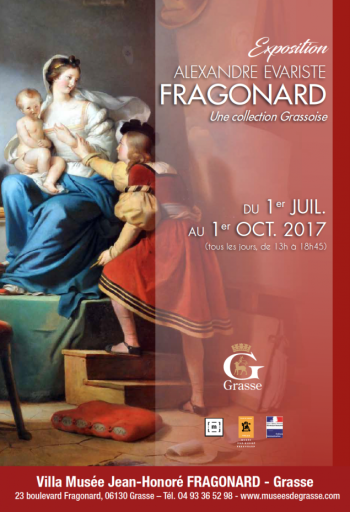 Né à Grasse le 26 octobre 1780 et mort le 11 novembre 1850 à Paris, Alexandre-Evariste Fragonard est le fils de Jean-Honoré. Considéré comme un enfant prodige, il expose au Salon à Paris dès 13 ans et est placé par son père dans l’atelier de David. Ses deux influences, néoclassique avec David et celle de la peinture amande et hollandaise qui lui vient de son père, vont être présentes dans ses œuvres tout au long de sa longue et proli que carrière de peintre, de sculpteur et de décorateur. Artiste of ciel très actif, il accepte de nombreuses commandes pour la manufacture de Sèvres et participe à plusieurs réalisations pour l’État sous l’Empire et la Restauration. Rattaché au courant Troubadour, son style demeure tout de même très enlevé et tumultueux. Il va également travailler dans le domaine de la gravure et participer notamment à l’édition des Voyages pittoresques et romantiques dans l’ancienne France du baron Taylor.
Injustement oublié aujourd’hui, Alexandre-Évariste Fragonard et son œuvre méritent largement d’être remis en lumière. Cette exposition estivale, du 1er juillet au 1er octobre 2017, a l’ambition de faire découvrir plus largement sa carrière à travers ses dessins et ses tableaux conservés dans notre collection grassoise.
Depuis la création des musées de Grasse dans les années 20 et l’ouverture de la Villa-musée Jean- Honoré Fragonard en 1977, les collections n’ont cessé de s’enrichir de dessins et de peintures de cet artiste pour constituer aujourd’hui une des collections publiques les plus importantes en France qui lui soit consacrée. Nous aurons ainsi le plaisir de présenter plusieurs dessins inédits, notamment des feuilles préparatoires à ses plafonds peints du Louvre, toujours en place, commande prestigieuse sous la Restauration pour le musée Charles X.
Le commissariat de l’exposition est assuré par Rebecca Duffeix, Docteur en Histoire de l’art et spécialiste de l’artiste, et nous avons eu l’honneur de béné cier également de la contribution de Côme Fabre, conservateur des peintures au Musée du Louvre.
The press release is available here»
The catalogue is available from ArtBooks.com:
Rebecca Duffeix and Olivier Quiquempois, Alexandre-Évariste Fragonard: Une Collection Grassoise (Milan: Silvana, 2017) 48 pages, ISBN: 978-8836636303, $23.
Exhibition | Caroline, Sister of Napoleon, Queen of the Arts
Now on view at the Palais Fesch (as noted at Napoleon.org). . .
Caroline, Sister of Napoleon, Queen of the Arts
Palais Fesch, Musée des Beaux-Arts, Ajaccio, Corsica, 30 June — 2 October 2017
Curated by Jehanne Lazaj and Maria Teresa Caracciolo with Laëtitia Giannechini
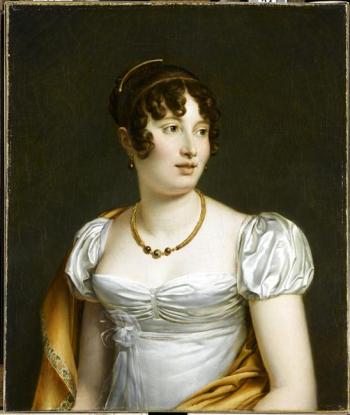
François Gérard, Portrait of Caroline Murat, Queen of Naples (Ajaccio: Palais Fesch, Musée des Beaux-Arts / Gérard Blot).
Caroline Bonaparte (1782–1839) was a woman of a complex and difficult temperament, yet she won over hearts by her beauty, culture, and spirit, along with a deep political intelligence that reflected her ambition. Napoleon affirmed in this respect: “Of all my family, she is the one that resembles me the most.” And while her political strategy has been much criticized, her keen intelligence, her great literary culture, her relationship with the artistic sphere, and her talents as a patron and collector have long been hidden.
If this exhibition intends to honour the younger sister of Napoleon, who has often been considered the ‘capricious’ one, its primary aim is to offer the widest possible panorama of the taste of an era and to give back to Caroline Murat the place which she deserves, that of a sovereign from both a political and artistic point of view. As a princess and later a dazzling queen, despite her almost tragic destiny, she embodied the giddy era in which she lived and which allowed her to encourage artistic creation as well as to enjoy the luxury, refinement, and strategies that power allowed her.
The exhibition is divided into five thematic sections presenting works and objects from the collections of the Palais Fesch and the Mobilier National, as well as loans from private collectors and large institutions including the Musée du Louvre, the Palace of Versailles, and the Museum of Capodimonte of Naples.
The press release is available here»
The catalogue is available from ArtBooks.com:
Maria Teresa Caracciolo and Jehanne Lazaj, Caroline, Soeur de Napoléon, Reine des Arts (Milan: Silvana, 2017), 300 pages, ISBN: 978 88366 36426, $45.
New Book | Arachné: Un regard critique sur l’histoire de la tapisserie
Published by PUR and available from ArtBooks.com:
Pascal-François Bertrand and Audrey Nassieu Maupas, eds., Arachné: Un regard critique sur l’histoire de la tapisserie (Rennes: Presses Universitaires de Rennes, 2017), 304 pages, ISBN: 978 27535 53927, 39€ / $68.
 Médium polysémique, la tapisserie touche des domaines variés comme l’histoire politique, économique ou sociale. Médium complexe dans son élaboration, elle permet, en histoire de l’art à proprement parler, d’aborder des questions essentielles, comme celles de l’invention, de la reproduction ou de la réception, à travers notamment l’étude toujours renouvelée des rôles respectifs des différents intervenants dans son processus de création.
Avec le soutien du programme ANR Arachné de l’université Bordeaux Montaigne, de la région Aquitaine et de l’École pratique des hautes études.
T A B L E D E S M A T I È R E S
• Elsa Karsallah, Stéphanie Trouvé, Audrey Nassieu Maupas, et Pascal-François Bertrand, Introduction: Replacer la tapisserie au sein de l’histoire de la création artistique
I. Sens et politique
• Katherine Sowley, La femme, symbole de l’homme: La tenture de la Dame à la licorne et le rôle de la figure féminine dans la représentation du statut social
• Cindy Kang, Georges Rochegrosse, La Conquête de l’Afrique: Interweaving Technology and Colonialism
• Élisabeth Pillet, Les joies et les fêtes de Paris: Cartons de tapisseries d’Émile Gaudissard pour l’Hôtel de Ville, 1941–45
II. La France et l’étranger: diffusions et échanges
• Elizabeth Cleland, Cupid and Psyche from Brussels to Paris: Questions of Attribution and Augmentation of Sixteenth-Century Flemish Designs Repurposed in Seventeenth-Century French Tapestries
• Anne Rivoallan, L’art des lices et la Casa Raggi aux XVIIe et XVIIIe siècles
• Mei Mei Rado, Qing Imperial Encounters with European Tapestries: The Tenture chinoise and Beyond
III. Tapisserie et technique
• Astrid Castres, La tapisserie à l’aiguille au XVIe siècle: Pratique domestique ou œuvre de professionnels?
• Grace Chuang, Artisans, Chemists, and Administrators: Interactions at the Dyeing Workshop of the Manufacture Royale des Gobelins, 1665–1792
IV. Les manufactures royales au XVIIIe siècle: choix esthétiques
• Charissa Bremer-David, Rare Comedy: Oudry’s Molière for Beauvais
• Jean Vittet, Charles Coypel et la tenture des Fragments d’opéra, 1733–41
• Akiko Kobayashi, François Boucher et les tapisseries de Beauvais: Une approche dans le contexte de la rivalité avec la manufacture des Gobelins
• Marie-Hélène De Ribou, Une tapisserie de Thétis reçoit Apollon de Lagrenée retrouvée au Louvre: Compléments d’informations sur la tenture des Sujets mythologiques
• Florence Patrizi, Tapisseries néoclassiques: La tenture de Beauvais à bordures de grotesques
V. Tapisseries des XIXe et XXe siècles : la question de la modernité
• Zané Purmale, De la tapisserie-peinture à la tapisserie-décoration: Rapprocher la tapisserie et l’architecture au début de la IIIe République
• Agathe Le Drogoff, « Remonter aux sources de l’art vrai du passé »: Jules Diéterle, peintre et administrateur de la manufacture de Beauvais, 1876–82
• Sophie Guérin Gasc, Genèse de L’Été, première tapisserie de Dom Robert, 1941–42, à partir de la correspondance croisée entre ce dernier, Jean Lurçat et Paul Tabard
• Audrey Nassieu Maupas et Pascal-François Bertrand, Conclusion
Les auteurs
Crédits iconographiques










leave a comment