New Book | Witchcraft and Folk Belief
From Palgrave Macmillan:
Lizanne Henderson, Witchcraft and Folk Belief in the Age of Enlightenment Scotland, 1670–1740 (New York: Palgrave Macmillan, 2016), 382 pages, ISBN: 978-0230294387, $110.
 Taking an interdisciplinary perspective, Witchcraft and Folk Belief in the Age of Enlightenment represents the first in-depth investigation of Scottish witchcraft and witch belief post-1662, the period of supposed decline of such beliefs, an age which has been referred to as the ‘long eighteenth century’, coinciding with the Scottish Enlightenment. The late seventeenth and early eighteenth centuries were undoubtedly a period of transition and redefinition of what constituted the supernatural, at the interface between folk belief and the philosophies of the learned. For the latter the eradication of such beliefs equated with progress and civilization, but for others, such as the devout, witch belief was a matter of faith, such that fear and dread of witches and their craft lasted well beyond the era of the major witch-hunts. This study seeks to illuminate the distinctiveness of the Scottish experience, to assess the impact of enlightenment thought upon witch belief, and to understand how these beliefs operated across all levels of Scottish society.
Lizanne Henderson has been a lecturer and cultural historian at the School of Interdisciplinary Studies, University of Glasgow since 2004. She is Editor of Review of Scottish Culture and has published on the Scottish witch-hunts, folk belief, ballads, critical animal studies, Scottish diaspora, polar explorers, and the transatlantic slave trade. Her books include Fantastical Imaginations: The Supernatural in Scottish History and Culture (2009) and, with Edward J. Cowan, Scottish Fairy Belief: A History (2001), and A History of Everyday Life in Medieval Scotland, 1000–1600 (2011).
◊ ◊ ◊ ◊ ◊
C O N T E N T S
List of Illustrations, Figures, and Tables
Preface
Acknowledgments
List of Abbreviations
Introduction: Following the Witch
1 Fixing the Limits of Belief
2 The Idea of Witchcraft
3 Demons, Devilry, and Domestic Magic: Hunting Witches in Scotland
4 Darkness Visible
5 Bemused, Bothered, and Bewildered: Witchcraft Debated
6 ‘Worshipping at the Altar of Ignorance’: Some Late Scottish Witchcraft Cases Considered
7 The Survival of Witch Belief in South West Scotland: A Case Study
8 The Persistence of Witch Belief
Conclusion
Appendices
Bibliography
Index
Display | Garnitures: Vase Sets from National Trust Houses

Five-piece vase set, porcelain, China, ca. 1690, H: 26.9 cm; rescued from Clandon Park, Surrey, the night of the fire, 29 April 2015 (The Mrs. David Gubbay Collection, Clandon Park, Surrey, National Trust, 1440409.1-5 / National Trust Images/ James Dobson).
◊ ◊ ◊ ◊ ◊
Now on view at the V&A:
Garnitures: Vase Sets from National Trust Houses
Victoria and Albert Museum, London, 11 October 2016 — 30 April 2017
This ground-breaking display at the Victoria and Albert Museum, organised in collaboration with the National Trust, explores the phenomenon of matching sets of vases and garnitures. In the 1650s, assembled sets of Chinese porcelain beakers, bottles, bowls, and jars—often in odd numbers—were used in elite European interiors as an integral part of the decorative scheme— displayed on chimney-pieces, cupboards, tables, or over doors. Specifically for the display, a mid-seventeenth-century garniture in the French taste has been recreated from Chinese porcelain of the 1630s. When imports of Chinese porcelain officially ceased between 1657 and 1683, European potters at Delft and Nevers copied the exotic Asian forms but unified the elements with matching patterns to form sets of from three to eleven vessels. In the Netherlands, merchants also ordered jars and beakers from Japan, and, in England, sets were ordered from London silversmiths. In France, merchants in luxury goods applied matching metal mounts to form sets from assembled objects and vessels. When the export trade resumed in the 1680s, ornamental jars and beakers with matching patterns were produced in Jingdezhen specifically for the West. The fashion continued throughout the 1700s, with almost every ceramic manufactory producing examples. It came to its conclusion during the Arts and Crafts period, when the singular vase became the rage and sets were broken up and dispersed.
A day-long symposium on ceramics and interiors is planned for 17 March 2017. The display, publication, and symposium are generously sponsored by The Headley Trust.
Patricia Ferguson’s blog entry on the display is available here»
◊ ◊ ◊ ◊ ◊
Patricia Ferguson, Garnitures: Vase Sets from National Trust Houses (London: V&A Publishing, 2016), 64 pages, ISBN: 978-1851779000, £10.
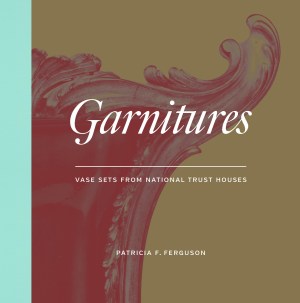 This exquisite book brings together some of the National Trust’s most important sets of garnitures, showing them in their historic context and drawing on their rich narratives. Following an introductory essay, the catalogue records the 15 garnitures in the display borrowed from 13 National Trust properties: Blickling, Norfolk; Dunham Massey and Tatton Park, Cheshire; Nostell Priory, Yorkshire; Ickworth, Suffolk; Kingston Lacy, Dorset, Stourhead, Wiltshire, Saltram, Devon, Clandon Park, Surrey, Scotney Castle and Knole, Kent; Petworth, West Sussex; and Upton House, Warwickshire (with more information here). The entries are richly supported by engraved sources, paintings and photographs of vase sets and garnitures in situ. As many have never been published before, the publication will be an important souvenir of a unique exhibition.
Patricia F. Ferguson, an adviser on ceramics to the National Trust, has been researching their ceramics collection for a publication on elite ceramic patronage in Britain. She has an MA in Chinese ceramics from the School of Oriental and African Studies and works as a curatorial consultant in the Asian department of the V&A.
◊ ◊ ◊ ◊ ◊
This 4-minute film showcases rare surviving examples of vase sets and ceramic ornaments from National Trust houses being displayed on furniture and in period rooms at the V&A that would have been typical at the time of their manufacture. Reino Leifkes, curator of ceramics at the V&A, discusses this ceramic phenomenon and its rise to the height of fashion.
Exhibition | 1,000 m2 of Desire: Architecture and Sexuality

From the Centre de Cultura Contemporània de Barcelona:
1,000 m2 of Desire: Architecture and Sexuality
1.000 m2 de Desig: Arquitectura i Sexualitat / 1.000 m2 de Deseo: Arquitectura y Sexualidad
Centre de Cultura Contemporània de Barcelona, 25 October 2016 — 19 March 2017
Curated by Adélaïde de Caters and Rosa Ferré
The exhibition looks at the way Western society has planned, built, and imagined spaces for sex from the 18th century to the present day. With some 250 exhibits, including drawings and architectural models, art installations, audiovisuals, books, and other materials, the exhibition explores the power of spaces as the driving force of desire and shows how architecture has been a tool that controls behaviour and creates gender stereotypes in our patriarchal society.
 It presents some of the projects that have subverted traditional models and advocated utopias of sexual cohabitation or private spaces designed solely for pleasure. It looks afresh at the proposals of Claude-Nicolas Ledoux, Charles Fourier, De Sadeand Guy Debord, the radical architecture of the 1960s and 1970s, Carlo Mollino, Adolf Loos, Nicolas Schöffer, Wilhelm Reich, Playboy architecture, and works by contemporary architects and artists.
1000m2 of Desire underpins the need to reappraise, for contemporary times, the validity and interest of some of the radical, speculative projects that seem to speak directly to us today, even though some of them date back more than 200 years. It invite us to consider how sexualities are constructed in accordance with specific cultural codes subject to norms that govern bodies and discourses and the nature of the space of desire and pleasure in our society. The exhibition highlights the way certain forms of resistance to established norms have largely originated from informal architecture and the appropriation of places. It shows how architectural practice has been dominated by men until very recently and, as a result, how spaces designed for pleasure have been imagined from male desires and fantasies. Architecture as the physical design of a space and setting makes up a substantial part of our sexual fantasies. Many of the exhibits have never been created before and are constructed through language or the projected image.
The exhibition is divided into three thematic sections—sexual utopias, libertine refuges, and sexographs—and includes several independent spaces that act as ‘mini exhibitions’, each one curated by different specialists: a recreation of Nicolas Schöffer’s Centre for Sexual Leisure (Eléonore de Lanvandeyra Schöfferand Guillaume Richard), a reading room containing libertine novels (Marie-Françoise Quignard), an installation dedicated to Playboy Magazine and its architecture (Beatriz Colomina and Pep Avilés), and an archetypal 1970s’ porn cinema (Esther Fernández). It also presents William Kentridge’s new installation Right into Her Arms, which the South African artist created for his production of Alban Berg’s Lulu.
Sexual Utopias (18th–20th Centuries)
The exhibition begins with some of the speculative projects by architects, thinkers, artists and communities who have sought to have an impact on sexual behaviour by monitoring spaces. It examines the sexual utopias of the 18th century such as the temple of pleasure, the Oikema, imagined by the architect Claude-Nicolas Ledoux; the Parthenions, which Restif de la Bretonne organised according to detailed rules in his treatise on prostitution, Le Pornographe; and Charles Fourier’s settings for erotic and gastronomic orgies. Fourier’s proposal reveals an imagination, a radicalism and extreme relevance with the phalanstery as the engine of a utopian community governed solely by its inhabitants’ desires. The exhibition also features one of the Marquis de Sade’s cabinets which reveals how he constructed his narrative utopia of excess through his passion for architecture and the performing arts.
Reformist or subversive, these sexual architectures of the 18th and early 19th centuries are contrasted and establish a certain continuity with more contemporary utopias from the modus vivendi of hippy communities to the radical architecture of the 20th century: Ettore Sottsass, the Archigram and Superstudio groups, Rem Koolhaas/OMA, Haus-Rucker-Co and Ricardo Bofill’s Taller de Arquitectura.
The exhibition also seeks to put the spotlight on the visionary work of Nicolas Schöffer who was closely associated with the Situationists and part of the French radical architecture movement in the 1960s. He designed a utopian city, the Ville Cybernétique (1955–69), which contained its own Centre for Sexual Leisure. A vast installation recreates this space made up of sex, volts, dancing cybernetic sculptures, and perfume.
Libertine Refuges (18th–20th Centuries)
This section explores the power wielded by spaces as driving forces of desire and analyses the nature of private realms conceived entirely as settings for pleasure, from the French aristocracy’s petites maisons of the 18th century, with their rooms, décor, and specialist furnishings, to the bachelor pads suggested by Playboy Magazine. It shows the role of architecture as a sensorial experience in seduction strategies and how sophistication in the design of constructional and mechanical devices can fire the erotic imagination.
Architecture and storytelling worked osmotically during the 18th century in a game of mutual fascination. The exhibition presents the architecture of two iconic novels in this regard, La Petite Maison (1758) by Jean-François de Bastide and Point de Lendemain (1777) by Vivant Denon.
The reading room containing libertine novels is presented in this section of the exhibition. Devised by the specialist Marie-Françoise Quignard, it features novels by Nerciat, Crébillon, Servigné, Choderlos de Laclos, and De Sade, among others. The libertine novel, related to the materialistic philosophy of the day, has a single objective: to celebrate desire and the enjoyment of the body. Entering the libertine’s chamber is like entering an imaginary world where the characters are subjected to all the fantasies of desire. It is also like stepping into the atmosphere of enclosed places: into boudoirs, convent cells or brothels where we follow the narrator, the clandestine observer, while the story unfolds.
The exhibition devotes a whole section to Playboy, curated by Beatriz Colomina. The magazine defined a new identity for men that included how they should dress, what they should listen to, drink and read, as well as the environment they ought to live in as well as the furnishings and interior décor. From Frank Lloyd Wright to Mies van der Rohe and including John Lautner and Ant Farm, alongside designs by the Eames, George Nelson, Eero Saarinen and Harry Bertoia, architecture and design are presented as tools capable of altering a code of conduct. As a media machine that had an enormous impact by treating women and buildings as objects of fantasy and desire, Playboy made a significant contribution to the transformation of ‘intimacy’ into a public spectacle. This section reproduces Hugh Hefner’s legendary bed (in contrast to the traditional double bed invented in the 18th century which remains the dominant setting for our sex lives today). According to another of the leading specialists in the Playboy phenomenon, Beatriz Preciado: “The round, revolving bed, connected to a radio-cum-phone-cum-hi-fi system, was used as a place for orgies as well as an office for Hefner who ran his business for years in his pyjamas and without leaving the house. The bed has become a true multimedia platform, the direct predecessor of our laptop computer and a media extension of our libido, as well as a new centre of production and consumption.”
The exhibition also reveals that the architecture of the Modern Movement is a project based on masculinity, which underplays its erotic dimension. Beatriz Colomina sums it up by saying “women are the ghosts of modern architecture.” Adolf Loos designed a bedroom for his wife, Lina, as if it were a fur-lined case and dreamt up a Parisian house for Joséphine Baker. The exhibition also presents the enigmatic and sensualised home interiors designed by Carlo Mollino, and, as a counterpoint to these intimate spaces, the home of Rudolph Schindler in California, which features an experimental programme for two couples living together, with outdoor beds/sleeping baskets.
Sexographs (20th–21st Centuries)
Following in the wake of Guy Debord’s Situationism, the exhibition presents a number of maps of contemporary passions through pieces by architects and artists (such as Bernard Tschumi, ecoLogicStudio [Claudia Pasquero and Marco Poletto], Jean-Didier Bergilez, Danli Wang, Pol Esteve, Marc Navarro and Ania Soliman). It reveals public spaces coded for sex, among them parks, streets, and public toilets. The exhibits in this section include two impressive series of photographs: The Valley by Larry Sultan and The Park by Kohei Yoshiyuki.
The screening room was one of the spaces transformed by the discourses of the sexual revolution of the late 1960s. It was a space that embraced an increasing sexualisation until the advent of the first legal porn films. The so-called ‘porn chic’ that emerged in the United States in the 1970s opened up spaces for the consumption of pornography to the female gaze and envisaged an experience of collective viewing that continued until the mid-1980s, when video technology moved porn into people’s homes. The exhibition features an archetypal porn cinema of the 1970s, where clips from legendary X-rated films will be shown, curated by Esther Fernández,
We will see how venues for sexual encounters (from luxury resorts to brothels, whorehouses-cum-hotels on highways, bathhouses and gay dark rooms, discotheques and bars, oubliettes and BDSM spaces, as well as sex shops) are all highly ritualised social systems. They are domains in which initiation and transgression act as the driving force of desire: a particular type of lighting, smells and music are part of this informal architecture. They are designed for and, at the same time, govern particular practices. They are all spaces of representation that reflect group mythologies.
But what are the spaces for sex today? Undoubtedly cyberspace, with internet porn and encounters apps for every taste, is growing in importance. Now that we are fully steeped in the technological utopia, artists, such as Yann Mihn, are engaged in a search for telepathic ecstasy. Mihn is working on the prototype of a machine that will enable total immersion in virtual reality and stimulation (teledildonics), his “NooScaphe-X1 Cybersex immersion engine”.
In Hacer el amor en abstracto: la arquitectura de la cultura de baile, the architect and artist Pol Esteve examines the spatial experience of discotheques and raves and the way in which a combination of technologies such as stroboscopic lights, music and drugs can produce orgasmic effects and a displaced sexuality.
Ingo Niermann proposes a community of sex volunteers with his platform of an army of love, thearmyoflove.net, who will create situations and spaces of satisfaction for those who are ‘usually excluded’, people with physical problems or with a body that does not match conventions of attractiveness.
Desire in the 21st century is the desire of others expressed through recognition and in the competition for representation. From the selfie to Instagram, we are compelled to look sexy and happy; the internet makes the laborious construction of the image of our private lives compulsory. Do sexual images on the web represent or replace relationships by sublimating them? Is the hypersexualisation of society, as it is represented by the media, substituting actual sexual life? Society seems to have plunged into a narcissistic depression in which the internet functions as a masturbatory machine. In the Western context, in which permissiveness is no longer transgression but the norm, what role does space play in reviving transgressive eroticism, in re-eroticising society?
This project explores the interstices of freedom in certain non-normative spaces for desire, such as the queer movement, and the way these constitute revolutionary resistance to commodified scenarios and to the control of increasingly all-encompassing social structures.
Adélaïde de Caters, Rosa Ferré, Beatriz Colomina, Marie-Françoise Quignard, Pol Esteve, Ester Fernández Cifuentes, Ingo Niermann, Fulvio Ferrari, and Rem Koolhaas, 1,000 m2 of Desire: Architecture and Sexuality / 1.000 m2 de Desig: Arquitectura i Sexualitat / 1.000 m2 de Deseo: Arquitectura y Sexualidad (Barcelona: CCCB and Direcció de Comunicació de la Diputació de Barcelona, 2016), 200 pages, ISBN: 978-8498037500 (Català / English), ISBN: 978-8498037517 (Castellano / English), 20€.
S E L E C T E D O B J E C T S
The exhibition has received loans from prestigious international institutions, including FracTurbulence Orleans, the MoMA Architecture Department New York, the Bibliothèque Nationale de France (BNF), the Biblioteca Nacional de España (BNE), and from the collections of the architects who have taken part in the project and given generously of their time.
Architectural Originals
• Drawings by Jeremy Bentham and his Panopticon
• The Campo Marzio by Giovanni Battista Piranesi
• Drawings by Jean-Jacques Lequeu, Pierre-Adrien Pâris, Charles Fourier, Ettore Sottsass, Superstudio, Archigram, Madelon Vriesendorp, Ant farm, Douglas Darden, Coop Himmelb(l)au, and Haus-Rucker-Co, among others
Original Photographs
• Polaroids by Carlo Mollino
• The Valley series by Larry Sultan
• The Park series by Kohei Yoshiyuki
Installations
• Centre for Sexual Leisure (CLS) with original works by Nicolas Schöffer
• METAfolly Pavilion by ecoLogicStudio
• Right into Her Arms, a new work by William Kentridge for the exhibition
• In front of the Green Door by Johannes Wohnseifer
• Hacer el amor en abstracto: la arquitectura de la cultura de baile by Pol Esteve
• Army of Love, Ania Soliman
• Playboy installation with a reproduction of Hugh Hefner’s bed
• Reproduction of Wilhelm Reich’s Orgone
Maquettes and Models
• Reproduction of the city of the Royal Saltworks at Arc-et-Senans and the Oikema Temple of Pleasure
• Reproduction of the room in the Château de Silling where stories are told in The 120 Days of Sodom by the Marquis de Sade
• Models of the Playboy Townhouse and of Hugh Hefner’s private jet Big Bunny
• Model of the Villa Rosa by the Coop Himmelb(l)au
Treatises on Architecture
• Fransesco Colonna, Hypnerotomachia Poliphili ou Le Songe de Poliphile (first edition published in Venice in 1499)
• Jacques-François Blondel, De la distribution des maisons de plaisance et de la décoration en général (1737–38), 2 volumes
• Claude-Nicolas Ledoux, L’architecture considérée sous le rapport de l’art, des mœurs et de la législation (1804), 2 volumes
• Nicolas Le Camus de Mézières, Le génie de l’architecture, ou L’analogie de cet art avec nos sensations (1780)
Libertine Books
• Crébillon, Le Sofa, 1742
• Boyer d’Argens, Thérèse philosophe, 1748
• Julian Offray de la Mettrie, L’art de jouir, 1751
• Jean-Baptiste-Marie Guillard de Servigné, Les sonnettes ou Mémoires du marquis D**, 1751
• Marquis de Sade, La philosophie dans le boudoir, 1795
• Marquis de Sade, Histoire de Juliette, 1797
Prints from the 18th and 19th Centuries
• Rebus sur l’Amour by Stefano Della Bella (18th century)
• Le Phallus phénoménal and Le Roi Phallus malade et défait reçoit la visite de ses médecins by Dominique Vivant Denon, 1793–94
• Works by unknown artists and printmakers, such as Portes et fenêtres (19th century)
• Le verrou and Les heureux hasards de l’escarpolette by Jean-Honoré Fragonard
Audio-Visual Materials
• Documentaries on Bentham’s Panopticon and hippie communes by Andrés Hispano and Félix Pérez Hita
• Virtual 3D reproduction of the house designed by Adolf Loos for Joséphine Baker
• Playboy’s Progress, an animated work by Olivier Otten
• Documentaries by Ant Farm, Haus-Rucker-Co and Superstudio
• Films such as Un chant d’amour by Jean Genet and Army of Love by Ingo Niermann
Exhibition | Charles Percier: Architecture and Design
Press brochure for the exhibition at Bard Graduate Center:
Charles Percier: Architecture and Design in an Age of Revolutions
Bard Graduate Center Gallery, New York, 18 November 2016 — 5 February 2017
Château de Fontainebleau, 18 March — 19 June 2017
Curated by Jean-Philippe Garric
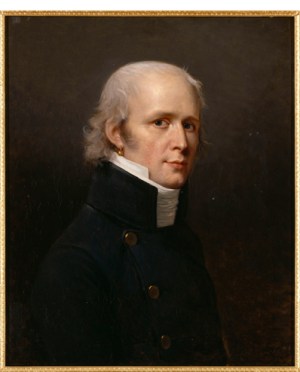
Robert Lefèvre, Portrait of Charles Percier, 1807, oil on canvas (Chateaux de Versailles et de Trianon, Versailles; photo by Gerard Blot).
Charles Percier: Architecture and Design in an Age of Revolutions will be the first large-scale exhibition to survey the magnificent range of projects undertaken by the French architect and designer from the end of the eighteenth to the beginning of the nineteenth century. Jean-Philippe Garric, professor of the history of architecture at the University of Paris I, Panthéon- Sorbonne, is the curator.
Although largely remembered for his close collaboration with Pierre François Léonard Fontaine (1762–1853)—together they defined the Empire style and created the decorative program of Napoleon’s reign—Charles Percier’s (1764–1838) artistic style was unique, complex, and ever-evolving. From the last years of the ancien régime, when Percier was a promising student—first at the Académie royale d’architecture in Paris and then at the French Academy in Rome, where he concentrated on graphic work—his commissions for public and private clients significantly influenced decorative arts and architecture during an extremely turbulent and rapidly changing period in French history.
Charles Percier: Architecture and Design in an Age of Revolutions breaks with the tradition of considering Percier and Fontaine together. This choice, shaped by the discovery of new documents relating to the production of the two partners, allows a better understanding of Percier’s multifaceted artistic practice. The exhibition will feature more than 130 art works from principal museums and cultural institutions in France and the United States, as well as key objects from private collections, including his designs for furniture, porcelain, metalwork, and the renovation of the rue de Rivoli—the construction of which transformed the center of Paris. Rare drawings and spectacular examples of early nineteenth-century cabinets, candelabras, and tureens will also be displayed. By focusing on his most famous and seminal works, such as sketches for the arc du Carrousel, the interior designs for Josephine Bonaparte’s rooms in the Tuileries Palace, and the magnificent books dedicated to Roman palaces and interior decoration, the exhibition will demonstrate the diverse and extraordinary creations of an artist whose work brilliantly bridged ancien régime court culture and the industrial production of the nineteenth and early twentieth centuries.
Organized by Bard Graduate Center Gallery, New York, in association with the château de Fontainebleau and the Réunion des musées nationaux-Grand Palais, Paris. Following its presentation at Bard Graduate Center Gallery, Charles Percier: Architecture and Design in an Age of Revolutions will be on view at château de Fontainebleau from March 18, 2017 to June 19, 2017.
Background
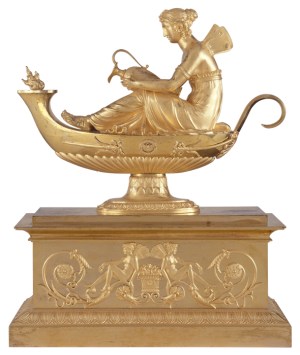
Pierre Phillippe Thomire after design by Charles Percier, Andiron with Psyche, 1809, chased and gilt bronze (Château de Fontainebleau, inv. F 943 C)
With thousands of drawings in public and private collections, several architectural and urban interventions of prime importance in the heart of Paris, numerous furniture and interior designs commissioned by prestigious patrons, publications that left their mark on several generations of architects and decorators, and, among his students, sixteen Prix de Rome winners and seven members of the Institut de France, the genius of Charles Percier was evident to his contemporaries. While his importance has been acknowledged by most historians of art, architecture, and decorative arts, no exhibition or book has yet attempted an overview of his production as a whole. This is not merely an injustice to him given his central role in the arts at a time of transition between the ancien régime and the modern period and his proximity to those in power under Napoleon, it has compromised our understanding of the architecture and decorative arts produced during this time, not just in France but throughout Europe.
While there are many surviving graphic documents and other works by Percier, there is no Percier archive. The principal sources—Fontaine’s journal and memoirs, the former written for posterity and the latter for his grandchildren—purport to be accurate, but often overlook entire aspects of his career. Fontaine failed to mention all of the projects undertaken by Percier alone. As a result, this exhibition, by concentrating on Percier, offers a biographical synthesis of his career that focuses on specific projects, whether realized, published, or drawn.
Percier and His Circles
Charles Percier owed a great deal to the academic world, and he gave a great deal back to it. After studying drawing at an exemplary philanthropic institution of the last years of the ancien régime, the École gratuite de dessin (Free Drawing School), he was a model student at the Académie royale d’architecture (Royal Academy of Architecture) and then, after winning the prestigious Prix de Rome in 1786, an enthusiastic pensioner (fellow) at the Académie royale d’architecture. He began teaching students of his own in 1791—almost immediately after returning to Paris from Italy—and gradually became one of the most important French architecture professors of the first third of the nineteenth century, entering the Institut de France in 1811. Percier lived alone but often worked with others—Pierre Fontaine, the most important of these, was by no means the only one—and befriended many of his fellow Rome pensioners as he would later do with several of his students, many of whom collaborated with him. His circle included fellow École gratuite de dessin pupils such as Anne Louis Girodet-Trioson (1767–1824); his teacher Antoine François Peyre (1739–1823); fellow Rome pensioners, most notably Jean German Drouais (1763–1788); architects and painters including François Gérard (1770–1837); and several generations of students who engaged in com- mon projects and socialized, both casually and within more structured frameworks such as the dinners of the society of artists known as the Duodi.
This theme presents Percier’s various academic projects, including his Grand Prix winning architectural design, sketches he made in Rome, his graphic reconstruction of Trajan’s Column, as well as portraits of and work by his students.
Between Italy and France
Percier’s Italian sojourn (1786–91) had a profound effect on him. Like many fellowship students at the French Academy in Rome, his stay there was characterized by enthusiasm and wonder, but, more than any other, he made this experience a key moment in his emotional, artistic, and intellectual life. A relentless campaign of measuring and drawing made it possible for him to gather material for two volumes of engravings that were to have considerable influence on his con- temporaries and later designers. For the rest of his life, he remained a fervent admirer of Italian antiquity and Renaissance art and architecture, and planned a second trip to Italy that never happened.
Despite his ardent Italophilia, Charles Percier was not indifferent to French architecture, especially that of the French Renaissance, and he admired the decorative and sculptural production of Jean Goujon (active 1540–65) and Pierre Lescot (ca. 1515–1578). Consistent with his admiration of Italian architecture, he carefully studied the château de Fontainebleau through hundreds of drawings. He also collaborated with art historian Alexandre Lenoir (1761–1839) on the installation and graphic reproduction of works in the Musée des monuments français, a museum dedicated to French architectural heritage, which Lenoir opened in 1795.
This theme evokes the artistic context of Percier’s Italian sojourn through drawings from his stay at the French Academy in Rome, a volume on Roman palaces and villas, and sketches. It also examines his involvement with the Musée des monuments français.
A Graphic Artist
Apart from a few letters, Percier left behind almost no writings. From the several thousand carefully organized drawings he bequeathed, it is apparent, even during his early training at the École gratuite de dessin, that his skill as a draftsman enabled him to stand out, consolidate his position, and prevail over his contemporaries. His line is fine and precise, and he was less interested in the art of perspective than in delineation and linear agility. His mastery of outline and contour coupled with his passion for abundant ornament were the very heart of his creative work. This ability, cemented by his prolonged study of the bas-reliefs of Trajan’s Column, enabled him to stand out as the illustrator, graphic designer, and decorator of his own publications and other prestigious editions, as well as of luxury objects.
Percier’s most remarkable achievements, given that he’s an architect, are his drawings for the editions of Horace and the Fables of La Fontaine published by Didot. –Alexandre Lenoir, 1805
This theme emphasizes Percier’s graphic work, considered both as an independent artistic domain and as the unifying thread between Percier’s other creative projects. Exquisite drawings from the Louvre, luxury books, including a commemorative book for Napoleon’s coronation, prints, and even a fan for Josephine will be on view.
The Recueil de décorations intérieures

Charles Percier, Clock, by Sèvres Porcelain Manufactory, 1813, bisque porcelain, gold highlights (Sèvres, Cité de la céramique, MNC 13022).
Percier’s production in the realm of interior decoration and furniture design was considerable. Not only was he called upon to design a great many interiors, furnishings, and objects—from his first commissions for the National Convention in 1793 to the carriage for the coronation of Charles X—his major works were much publicized by the Recueil de décorations intérieures (1801–12). This collection of 72 plates of furniture and interior designs was one of the most important and influential ornament books in France and indeed in Europe of the time. It established an international neoclassical taste and became a model for commercial catalogues of ornaments, unwittingly inaugurating an era of industrial arts production. The Recueil was a major source of inspiration for generations of decorators and designers. It ensured Percier’s legacy while simultaneously linking it inextricably to that of Fontaine.
Percier, whose temperament and taste, indeed his gifts, were ill-suited to the trouble and demands of business, left all practical matters to me. I handled the correspondence as well as the accounts, and he focused almost exclusively on study drawings and graphic compositions. –Pierre Fontaine, 1804
As Fontaine acknowledged himself, the Recueil was Percier’s masterwork. Percier drew and engraved the plates largely on his own, despite including both of their signatures. ‘Percier and Fontaine’ is thus perhaps more akin to a luxury brand than an indication of shared artistic paternity. Separating Percier from Fontaine, this exhibition restores Percier’s role and singular contribution to the decorative arts as an expert draftsman and designer.
But the contributions Charles Percier made to the realms of furniture and interior decoration do not all fall within the chronological parameters of the Recueil de decorations intérieures, nor are they limited to the ensembles and objects represented there. His work for artisanal firms like Jacob frères and that of Martin Guillaume Biennais and his designs for manufactories like Sèvres were the point of departure for national and international diffusion of the style Percier. This diffusion ran parallel to the gradual industrialization of the arts, as well as a certain democratization of access to luxury objects.
This theme first focuses on the Recueil de décorations intérieures, juxtaposing rare hand-colored prints from the publication with corresponding drawings, furniture, and objects. It will include extraordinary pieces made for Napoleon, Josephine, and members of the imperial circle from the collections of Versailles, Fontainebleau, and the Elysée Palace. It also demonstrates the dissemination of Percier’s style and its vulgarization, as well as Percier’s continued artistic development after 1815.
The Louvre, the Tuileries and the rue de Rivoli
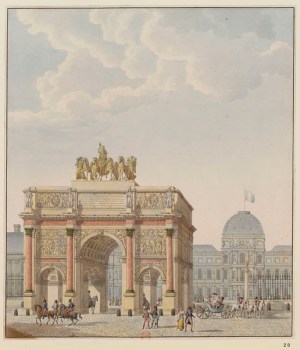
Charles Percier and Pierre Fontaine, Arc du Carrousel, south side view, 1806–15, watercolor and pen (Paris: Bibliothèque nationale de France, département Estampes et photographie, RESERVE FOL-VE-53 C).
At the beginning of the nineteenth century Napoleon engaged Percier and Fontaine to execute one of the most ambitious projects of his reign and of their careers—linking the Louvre and Tuileries palaces. This large-scale enterprise had three principal ambitions. The first and oldest one was to connect the Louvre with the Tuileries, thereby creating a palace of unmatched magnitude. As heir to the Revolution, Napoleon could not reside at Versailles, and he wanted to complete a project that a century of royal rule had been unable to bring to fruition. The Tuileries became the principal imperial residence, with all its practical and symbolic consequences. The second ambition was to transform the surrounding city. Given their dimensions and location, connecting the Louvre with the Tuileries meant recasting the center of Paris. From this perspective, the operation constitutes a link between the great urban embellishment projects of the eighteenth century and the transformations of the Second Empire. Finally, the third ambition, doubtless the most contemporary, was cultural in nature: to complete and restore buildings considered jewels of French architectural patrimony as well as to create, within the Louvre, the world’s largest museum.
This theme presents Percier and Fontaine’s designs for the Louvre and the Tuileries, from an urban scale to the arrangement of interiors and decoration. It will also include their designs for the renovation of the arcades on the nearby rue de Rivoli.
Paper Architecture
Much of the architecture Charles Percier designed with Pierre Fontaine was never built. Paper architecture, or plans for unrealized structures, was the reality for architects during this era of political turmoil. In fact, paper architecture became a practice in itself at the Académie royale d’architecture when Percier was a student there during the late eighteenth century. Economic crises in the 1780s resulted in a lack of architectural commissions and architects like Percier began defining themselves as artists who produced beautiful drawings of hypothetical structures, rather than builders.
When Percier left Paris for Rome, he was still training to be a court architect. By the time he returned in the midst of the French Revolution, the world he knew was shattered. Percier’s talent for drawing enabled him to be flexible and versatile in seeking other forms of work. Besides book illustration, in the 1790s, Percier and Fontaine served as co-directors of set design at the Paris Opera, where they created spectacular yet ephemeral scenery for the stage.
Despite being swept into Napoleon’s extravagant ambitions, including his plans for a Palace of the King of Rome, Percier and Fontaine managed to build only a small number of important structures. Their contributions to the staging of Napoleonic power, notably the emperor’s coronation and his marriage to Marie-Louise, represent a significant portion of their realized work. The fact that they produced more ephemeral projects and—especially—designs for buildings that were never constructed resulted in a corpus of works on paper that reveal the richness and diversity of their imaginations. This final theme presents architectural drawings, water- colors, commemorative volumes, and objects, related to Napoleonic ceremonies and commissions, as well as opera sets designed by both Percier and Fontaine.
◊ ◊ ◊ ◊ ◊
Symposium | Percier: Antiquity and Empire
Bard Graduate Center, New York, 18 November 2016
Taking place on Friday afternoon, 18 November 2016, the symposium will feature speakers including Jean-Philippe Garric, Ulrich Leben, Iris Moon, Darius Spieth, and more. RSVP is required. Please click on the registration link here or email public.programs@bgc.bard.edu.
◊ ◊ ◊ ◊ ◊
From Yale UP:
Jean-Philippe Garric, ed., Charles Percier: Architecture and Design in an Age of Revolutions (New Haven: Yale University Press, with Bard Graduate Center, 2017), 304 pages, ISBN: 978-0300221589, $75.
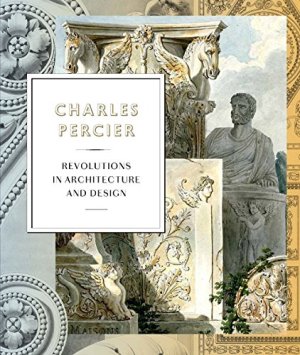 Handsomely designed and richly illustrated, this publication surveys the magnificent spectrum of projects undertaken by French architect and interior designer Charles Percier (1764–1838). After gaining an illustrious reputation for supervising the scenery at the Paris Opéra during the French Revolution, Percier was later appointed by Napoleon Bonaparte. With the Emperor’s support, he developed the opulent versions of neoclassicism closely associated with the Napoleonic era, and now known as Directoire style and Empire style. Percier worked on the renovation or redecoration of many of France’s royal palaces, including the Louvre, the Tuileries, and the chateaux of Malmaison, Saint-Cloud, and Fontainebleau. The full scope and variety of Percier’s design projects are revealed in this book, which also includes archival material detailing Percier’s relationships with patrons and peers.
Jean-Philippe Garric is professor of architecture at the University of Paris I, Panthéon Sorbonne.
◊ ◊ ◊ ◊ ◊
Note (added 28 November 2016) — The symposium included the following presentations:
• Jean-Philippe Garric (Professor, History of Architecture, University of Paris I, Panthéon-Sorbonne and curator of the exhibition Charles Percier: Architecture and Design in an Age of Revolutions), Charles Percier: Beyond the Antique Model
• Iris Moon (Visiting Assistant Professor, School of Architecture, Pratt Institute), New Heads for Old Bodies: Percier’s Designs for the French Revolution
• Ulrich Leben (Research Scholar and Visiting Professor, Bard Graduate Center), Charles Percier’s Vision of Antiquity
• Darius Spieth (Professor, Art History, Louisiana State University), Percier and Piranesi
• Jean-François Bédard (Associate Professor, School of Architecture, Syracuse University), Franks, Not Romans: Medieval Imagery and the Making of Imperial France
New Book | Le Comte de Caylus et Edme Bouchardon
In noting the Bouchardon exhibition at the Louvre this fall, I omitted this publication from Somogy, which accompanies the show (along with an exhibition catalogue and a catalogue raisonné). –CH
Marc Fumaroli, Le Comte de Caylus et Edme Bouchardon: Deux réformateurs du goût sous Louis XV (Paris: Somogy, 2016), 96 pages, ISBN: 978-2757211861, 7€.
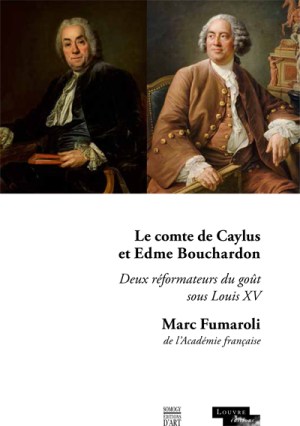 Tout semblait éloigner, dans l’ordre social et dans ses apparences, le grand seigneur Anne Claude de Caylus, né sur les marches du trône, et le roturier de province, né dans une obscure famille de sculpteurs champenois, Edme Bourchardon, sinon leur foi ardente et commune dans la supériorité des Anciens et un zèle commun et acharné à remonter la pente du déclin. (…) La rencontre en janvier 1733 entre Caylus l’amateur savant et réformateur et Bouchardon, jeune sculpteur déjà célèbre à Rome et en Europe comme la réincarnation française des sculpteurs grecs Polyclète et Polygnote, infléchit leurs deux carrières alliées dans le grand dessein de faire revivre en France et ensuite en Europe le pur goût grec et « à la grecque ». (…) Un peu forcé, comme l’avait été le retour de Poussin à Paris en 1640, le voyage Rome-Paris de Bouchardon, en 1732–33, ramena en France le nouvel archétype du grand artiste « à l’antique », pierre angulaire éventuelle de la reconstruction de l’Académie royale et d’une restauration de son système éducatif, accusé d’avoir dégénéré les intentions de ses fondateurs.
Marc Fumaroli, né en 1932, historien de la littérature et des arts de l’Ancien Régime français, est membre de l’Académie française, professeur émérite au Collège de France, président honoraire de la Société des Amis du Louvre. Il est l’auteur de L’École du silence, le sentiment des images au XVIIe siècle (Paris, Flammarion, 1994), de Peinture et pouvoirs, de Rome à Paris aux XVIIe et XVIIIe siècles (Dijon, Faton, 2007), et de Paris – New York et retour, voyage dans les arts et les images (Paris, Fayard, 2009, et Flammarion, 2011, quatrième édition). Il prépare une ample biographie du comte de Caylus en son siècle, un essai sur la réception du Traité du Sublime de Tacite à Winckelmann, de Kant à Adorno, et un recueil d’articles sur l’art français sous la monarchie à paraître aux éditions Gallimard.
New Book | Of Arms and Artists
From Bloomsbury Press:
Paul Staiti, Of Arms and Artists: The American Revolution through Painters’ Eyes (London: Bloomsbury Press, 2016), 400 pages, ISBN: 978-1632864659, $30.
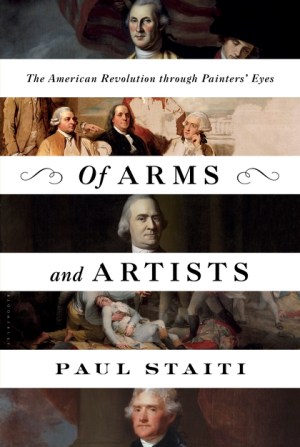 The images accompanying the founding of the United States—of honored Founders, dramatic battle scenes, and seminal moments—gave visual shape to Revolutionary events and symbolized an entirely new concept of leadership and government. Since then they have endured as indispensable icons, serving as historical documents and timeless reminders of the nation’s unprecedented beginnings.
As Paul Staiti reveals in Of Arms and Artists, the lives of the five great American artists of the Revolutionary period—Charles Willson Peale, John Singleton Copley, John Trumbull, Benjamin West, and Gilbert Stuart—were every bit as eventful as those of the Founders with whom they continually interacted, and their works contributed mightily to America’s founding spirit. Living in a time of breathtaking change, each in his own way came to grips with the history being made by turning to brushes and canvases, the results often eliciting awe and praise, and sometimes scorn. Ever since the passing of the last eyewitnesses to the Revolution, their imagery has connected Americans to 1776, allowing us to interpret and reinterpret the nation’s beginning generation after generation. The collective stories of these five artists open a fresh window on the Revolutionary era, making more human the figures we have long honored as our Founders, and deepening our understanding of the whirlwind out of which the United States emerged.
Paul Staiti teaches at Mount Holyoke College and is the author of several books and essays on American artists. He has co-curated exhibitions at the Metropolitan Museum of Art and the Museum of Fine Arts in Boston. The recipient of three fellowships from the National Endowment for the Humanities and a two-time Senior Fellow at the Metropolitan Museum of Art, Staiti has spoken internationally on the intersection of American art and history. He lives in South Hadley, Massachusetts.
New Book | A Revolution in Color: The World of John Singleton Copley
From W. W. Norton:
Jane Kamensky, A Revolution in Color: The World of John Singleton Copley (New York: W. W. Norton & Company, 2016), 544 pages, ISBN: 978-0393240016, $35.
 Boston in the 1740s: a bustling port at the edge of the British empire. A boy comes of age in a small wooden house along the Long Wharf, which juts into the harbor, as though reaching for London thousands of miles across the ocean. Sometime in his childhood, he learns to draw. That boy was John Singleton Copley, who became, by the 1760s, colonial America’s premier painter. His brush captured the faces of his neighbors—ordinary men like Paul Revere, John Hancock, and Samuel Adams—who would become the revolutionary heroes of a new United States. Today, in museums across America, Copley’s brilliant portraits evoke patriotic fervor and rebellious optimism.
The artist, however, did not share his subjects’ politics. Copley’s nation was Britain; his capital, London. When rebellion sundered Britain’s empire, both kin and calling determined the painter’s allegiances. He sought the largest canvas for his talents and the safest home for his family. So, by the time the United States declared its independence, Copley and his kin were in London. He painted America’s revolution from a far shore, as Britain’s American War.
An intimate portrait of the artist and his extraordinary times, Jane Kamensky’s A Revolution in Color masterfully reveals the world of the American Revolution, a place in time riven by divided loyalties and tangled sympathies. Much like the world in which he lived, Copley’s life and career were marked by spectacular rises and devastating falls. But though his ambivalence cost him dearly, the painter’s achievements in both Britain and America made him a towering figure of both nations’ artistic legacies.
Jane Kamensky is a a professor of history at Harvard University and the faculty director of the Schlesinger Library on the History of Women in America at the Radcliffe Institute for Advanced Study. Her many books include The Exchange Artist, a finalist for the George Washington Book Prize.
New Book | Irish Fine Art in the Early Modern Period
From Irish Academic Press:
Jane Fenlon, Ruth Kenny, Caroline Pegum, Brendan Rooney, eds., Irish Fine Art in the Early Modern Period: New Perspectives on Artistic Practice, 1620–1820 (Newbridge: Irish Academic Press, 2016), 276 pages, hardback ISBN: 978-1911024262, paperback ISBN: 978-1911024354, €30 / €85.
 This richly illustrated book presents the latest research into Irish fine art from the 17th and 18th centuries. It is comprised of a rich selection of case studies into artistic practice that showcase the burgeoning nature of fine art media in Ireland, the quality of production, and the breadth of patronage. Investigating these signifiers of a ‘cultured’ lifestyle—their production, consumption, appreciation, display, and discourse—provides fascinating insights into the sensibility of Ireland’s minority-rule elites, and the practitioners it fostered.
Featuring contributions from emergent and established art historians, Irish Fine Art in the Early Modern Period takes its subject matter beyond the realms of academic journals, exhibitions and conferences, and presents it within a lavishly designed and vital publication that presents substantial new insights into Ireland’s artistic and social history.
Jane Fenlon is the author/editor of several books and essays on the subject of seventeenth-century Irish art and architecture, including The Ormonde Picture Collection and Clanricard’s Castle (2012). Her most recent work includes essays in Art and Architecture in Ireland, Vol. II (2014) and in the forthcoming Cambridge History of Ireland, Vol. II ( 2017).
Ruth Kenny is a freelance curator and art historian; she is currently curator of an exhibition on the Society of Artists for the Irish Georgian Society and teaches at the School of Art History and Cultural Policy, University College Dublin.
Caroline Pegum is an historian of British and Irish art in the late Stuart period and is currently researching a catalogue raisonné of the Irish-born portraitist Charles Jervas (1669–1739) for publication by the Walpole Society.
Brendan Rooney is Curator of Irish Art at the National Gallery of Ireland, and author/editor of numerous works on Irish art, including Thomas Roberts: Landscape and Patronage in Eighteenth-Century Ireland (2009) and Creating History: Stories of Ireland in Art (2016).
◊ ◊ ◊ ◊ ◊
C O N T E N T S
1 Fintan Cullen, ‘Parliament as Theatre: Francis Wheatley’s The Irish House of Commons Revisited’
2 William Laffan, ‘Theft, Concealment and Exposure: Nathaniel Hone’s The Spartan Boy’
3 Siobhan McDermott, ‘Commerce, Conquest and Change: Thomas Hickey’s John Mowbray, Calcutta Merchant, attended by a Banian and a Messenger’
4 Jacqueline Riding, ‘Artistic Connections between Dublin and London in the Early-Georgian Period: James Latham and Joseph Highmore’
5 M.G. Sullivan, ‘The “Strange and Unaccountable” John Van Nost: The Making of a Sculptural Career in Eighteenth-Century Ireland’
6 Mary Jane Boland, ‘An Irish Teniers? The Development of Paintings of Everyday Life in Ireland, c.1780–1810’
7 Jane Fenlon, ‘The Portrait Collection in the Great Hall of the Royal Hospital Kilmainham, Dublin’
8 Nicola Figgis, ‘The Contribution of Foreign Artists to Cultural Life in Eighteenth-Century Dublin’
9 Elaine Hoysted, ‘Visualising the Privileged Status of Motherhood: The Commemoration of Women in Irish Funerary Monuments, c.1600–1650’
New Book | The Dublin Civic Portrait Collection
From Four Courts Press:
Mary Clark, The Dublin Civic Portrait Collection: Patronage, Politics, and Patriotism, 1603–2013 (Dublin: Four Courts Press, 2016), 238 pages, ISBN: 978-1846825842, €40 / $65.
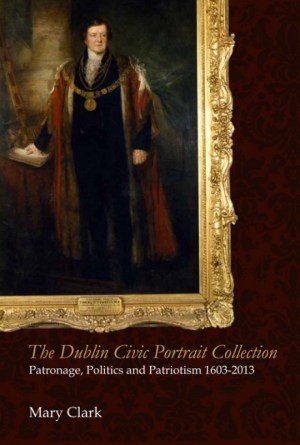 Beginning in the early 17th century and continuing to the present day, the city of Dublin has built up a portrait collection that is unique on the island of Ireland in terms of range and diversity and is brilliantly expressive of the political aspirations and realities that have informed its creation. The collection contains sixty-six works in oil-on-canvas and eight statues in bronze and marble. These can be placed in three principal categories: royal personages; lord lieutenants of Ireland; and lord mayors and aldermen of Dublin. It includes works by Irish artists Thomas Hickey, Hugh Douglas Hamilton, Martin Cregan, Stephen Catterson Smith, Dermod O’Brien, Robert Ballagh and Carey Clarke and by leading English portraitists including Sir Joshua Reynolds, George Romney, Sir William Beechey, and Sir Thomas Lawrence.
This book contains a catalogue of the entire collection with an introduction placing it within the broader context of civic imagery and regalia, giving due regard to ceremony, heraldry, dress and accoutrements of office. The Dublin collection is placed within its historical context to show how developments in Dublin and in Ireland as a whole influenced its formation. This lavishly illustrated book illuminates the complex relationship between politics, pageantry, art and history in the Irish capital over a sustained period of 400 years.
Mary Clark is the Dublin City Archivist and curator of the Dublin Civic Portrait Collection.
New Book | The British School of Sculpture, c. 1760–1832
From Routledge:
Sarah Burnage and Jason Edwards, eds., The British School of Sculpture, c. 1760–1832 (New York: Routledge, 2016), 292 pages, ISBN: 978-1472435767, $150.
 The British School of Sculpture is the first essay collection examining the rich array of sculpture produced and exhibited in Britain between 1768 and 1837. Featuring nearly 60 illustrations, many never reproduced before, and combining essays from leading scholars in the field with exciting new voices, the volume challenges the notion that neoclassicism dominated British art history in the period, and returns to centre stage a number of compelling baroque works. The volume also emphasises the regional specificities of the British School, paying particular attention to the importance of country house collections and Scottish influences, and the British School’s broader cosmopolitanism, revealing how sculptors also engaged with contemporary continental artists, especially in Rome, and ancient classical and Indian antiquities. In addition, the volume combines a novel account of some of the period’s most significant anti-war memorials, emphasises the importance of religion, and reveals sculpture’s relation to contemporary prints and literary sources. Featuring an unprecedentedly extensive bibliography, the volume is specifically designed for art historians and cultural historians of the period, as well as for visitors to British churches and country houses, and heritage sites such as St Paul’s Cathedral and Westminster Abbey.
Sarah Burnage is an Independent art historian and curator based in the UK. Jason Edwards is Professor of Art History, University of York.
◊ ◊ ◊ ◊ ◊
C O N T E N T S
List of Illustrations
Acknowledgements
Notes on Contributors
1 Jason Edwards, Introduction: Sculpture Victorious, or, The British School, c. 1760–1832?
2 Sarah Burnage, Introduction: The British School of Sculpture – A Case Study
3 Joan Coutu, Sculpture and the Forming of National Tastes in the Middle of the Eighteenth Century
4 Matthew Craske, Extracting the Meaning of a Pile of Pancakes: An Analysis of Nicholas Read’s Monument to Admiral Tyrrel, 1766–70
5 Sarah Burnage, ‘Delighting the Common People’: John Bacon’s Monuments to the Earl of Chatham, 1778–84
6 Tomas Macsotay, Artistic Labour and Cosmopolitan Sociability: British Sculptors in Accounts from Late Eighteenth-Century Visitors to Rome
7 Roberto Ferrari, Before Rome: John Gibson and the British School of Art
8 Martin Myrone: ‘The Chatterton of Sculpture’: Thomas Procter and the Limits of the British School
9 Eleanor Hughes, Smoke and Marble: Thomas Banks’s Monument to Captain George Blagdon Westcott
10 Jason Edwards, John Charles Felix Rossi’s Cornwallis Monument (1807–11) and the Colonial Cosmopolitanism of the British School
11 M. G. Sullivan, Cunningham, Chantrey, and the British School of Sculpture
Bibliography
Index










leave a comment