Exhibition| Wordplay: Matthias Buchinger’s Drawings
Press release (19 November 2015) from The Met:
Wordplay: Matthias Buchinger’s Drawings from the Collection of Ricky Jay
The Metropolitan Museum of Art, New York, 5 January — 11 April 2016
Curated by Freyda Spira with Femke Speelberg and Jennifer Farrell

Approximately 22 drawings by the 18th-century German artist Matthias Buchinger (1674–1739), who was born without hands or feet, will be presented in Wordplay: Matthias Buchinger’s Drawings from the Collection of Ricky Jay, opening on January 5, 2016. Despite his disabilities, Buchinger was celebrated in his own time as a draftsman and calligrapher as well as a magician and musician, and poems were written in Europe about his many talents and achievements. Known as ‘the Little Man of Nuremberg’, because he was only 29 inches tall, Buchinger was said to have performed for German emperors, European princes, and for King George I of England. He was also a frequent guest at noble houses in England and Ireland, and performed at local fairs and inns from Amsterdam and Stockholm to Leipzig and Paris.
The Metropolitan Museum’s two drawings by Buchinger will be displayed alongside some 20 works from the collection of Ricky Jay, the celebrated illusionist, actor, and author. Framing Buchinger’s stupendous works, which were composed largely through calligraphy and micrography (employing minuscule script to create abstract shapes or figurative designs), will be works from the Metropolitan Museum’s collection that will demonstrate text as image. These additional works will include late medieval manuscripts, Renaissance typographical prints, 17th-century writing books, and contemporary works on paper.
Wordplay: Matthias Buchinger’s Drawings from the Collection of Ricky Jay is organized by Freyda Spira, Associate Curator with Femke Speelberg and Jennifer Farrell, also Associate Curators, of the Metropolitan Museum’s Department of Drawings and Prints.
The New York Times architecture critic Michael Kimmelman and Ricky Jay will discuss Matthias Buchinger in a ‘MetSpeaks’ ticketed talk on January 21, 2016.
◊ ◊ ◊ ◊ ◊
The accompanying publication is due out next March from Siglio:
Ricky Jay, Matthias Buchinger: The Greatest German Living (New York: Siglio Press, 2016), 160 pages, ISBN: 978-1938221125, $40.
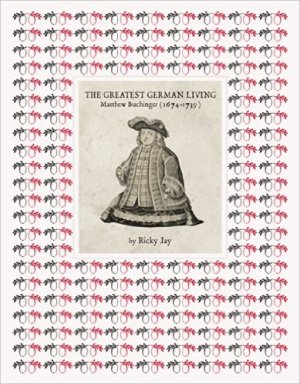 Matthias Buchinger (1674–1739) performed on more than a half-dozen musical instruments, some of his own invention. He exhibited trick shots with pistols, swords and bowling. He danced the hornpipe and deceived audiences with his skill in magic. He was a remarkable calligrapher specializing in micrography—precise handsome letters almost impossible to view with the naked eye—and he drew portraits, coats of arms, landscapes and family trees, many commissioned by royalty. Amazingly, Matthias Buchinger was just twenty-nine inches tall, and born without legs or arms. He lived to the ripe old age of sixty-five, survived three wives, wed a fourth, and fathered fourteen children.
Accompanying the Metropolitan Museum of Art exhibition Wordplay: Matthias Buchinger’s Inventive Drawings from the Collection of Ricky Jay, this book is a cabinet containing a single, multi-faceted wonder, refracted through acclaimed sleight-of-hand master Ricky Jay’s scholarship and storytelling. Alongside an unprecedented and sumptuously reproduced selection of Buchinger’s marvelous drawings and etchings, Jay delves into the history and mythology of the ‘Little Man’, while also chronicling his encounters with the many fascinating characters he meets in his passionate search for Buchinger.
Ricky Jay, one of the world’s great sleight-of-hand artists, has received accolades as a performer, actor, and author. He was recently profiled on the series American Masters and is the subject of the film Deceptive Practice: The Mysteries and Mentors of Ricky Jay. Jay has written frequently on unusual entertainments, and his Learned Pigs & Fireproof Women and Jay’s Journal of Anomalies were both New York Times ‘Notable Books of the Year’. The former curator of the Mulholland Library of Conjuring and the Allied Arts, he has defined the terms of his profession for the Encyclopedia Britannica and the Cambridge Guide to American Theater.
Exhibition | Schalcken: Painted Seduction
Press release for the exhibition now on view at the Wallraf-Richartz Museum:
Schalcken: Gemalte Verführung / Painted Seduction
Wallraf-Richartz-Museum & Fondation Corboud, Cologne, 25 September 2015 — 24 January 2016

Godefridus Schalcken, Self-Portrait, 1694 (Leamington Spa Art Gallery and Museum)
A lady looking into a mirror in the soft candlelight, proud, a little pert perhaps, but certainly enigmatic. Few artists have matched the ability of Godefridus Schalcken (1643–1706) to capture such magical moments on canvas so powerfully that they still compel attention three centuries later. In autumn 2015 the Wallraf-Richartz-Museum & Fondation Courboud launched in cooperation with the Dordrechts Museum the first-ever exhibition to survey Schalcken’s oeuvre as a whole, inviting a reassessment of this unique painter and seducing visitors to have a detailed look at the charming and enchanting art of Schalcken. More than eighty loans from public and private collections worldwide are on show, a third of his known painted oeuvre. Lenders include the Leiden Collection, New York, The Rose-Marie and Eijk van Otterloo Collection, Naples, Uffizi Florence, Rijksmuseum Amsterdam, Mauritshuis The Hague, National Gallery London, Národní galerie in Prague, Statens Museum Copenhagen, National Gallery of Scotland, Edinburgh, National Gallery of Ireland, Dublin, Ashmolaen Museum, Oxford, Städel Museum, Frankfurt, Hamburger Kunsthalle, Gemäldegalerie Dresden, Staatliche Kunsthalle Karlsruhe and Gemäldegalerie Alte Meister Kassel.
Schalcken will not have seemed predestined for an artistic career when he was born in 1643 into a family headed by a Protestant pastor. At the age of nineteen, following an apprenticeship with Samuel van Hoogstraten, a pupil of Rembrandt, he entered the workshop of Gerrit Dou, the celebrated founder of the school of artists known as the Leiden ‘fine’ painters. Dordrecht, London, The Hague and Dusseldorf were further stages in his impressive career. Despite the political and economic turmoils and an ailing art market: Schalcken established himself as a “self-branded artist”. His paintings fetched top prices and entered the most illustrious collections. Royal clients, such as Florence’s Grand Duke Cosimo III de’ Medici and Elector Palatine Johann Wilhelm in Dusseldorf, helped Schalcken to international fame.
As a master of light, especially candlelight, Schalcken entered the canon of art history and was lauded by art lovers—including even Johann Wolfgang von Goethe. First with the changes in taste that came in the nineteenth century did the ‘typically Dutch’, bourgeois art by painters like Vermeer, Rembrandt and Frans Hals gain in preference. Schalcken’s elegantly painted aristocratic gems languished in obscurity. With the consequence that the artist ranks today among the great unknowns of the Golden Age of Netherlandish painting.
Here in the first ever exhibition of his work, we are invited to set out on a journey of rediscovery. With rarely shown masterpieces, including many works from private collections, it opens up the painter’s rich world of imagery. A world that captivates by its wide range of genres and subjects, its tromp-l’oeil illusionism, and the gallant conversations that Schalcken invites us viewer to join.
The exhibition catalogue, with essays and extensive entries by Guido M.C. Jansen, Wayne Franits, Anja K. Sevcik, Nicole Elizabeth Cook, Eddy Schavemaker, Sander Paarlberg and Marcus Dekiert aims to update the meritorious catalogue raisonée by Thierry Beherman of 1988.
Wayne Franits, et al., Schalcken: Gemalte Verführung (Stuttgart: Belser Verlag, 2015), 312 pages, ISBN: 9783763027217, $88.
Exhibition | Pearls on a String
Press release (24 July 2015) for the exhibition now on view at The Walters:
Pearls on a String: Artists, Patrons, and Poets at the Great Islamic Courts
The Walters Art Museum, Baltimore, 8 November 2015 — 31 January 2016
Asian Art Museum, San Francisco, 25 February — 8 May 2016
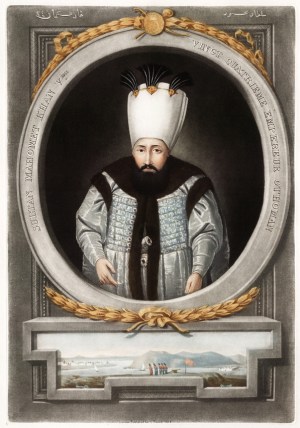
Portrait of Ottoman Sultan Mahmud I, 1815 (Baltimore: The Walters Art Museum)
The great Mughal, Safavid, and Ottoman empires flourished during a time of rapid change and artistic innovation in the Islamic world, as people, ideas, and technologies spread across Europe and Asia. At the heart of the empires’ courts were networks of individuals—writers, poets, artists, craftsmen— who produced extraordinary works of art for the ruling elite. From November 8, 2015, through January 31, 2016, the Walters Art Museum will present Pearls on a String: Artists, Patrons, and Poets at the Great Islamic Courts, the first major exhibition to focus on these influential and often charismatic individuals. The free exhibition features more than 120 works including paintings, calligraphy, textiles, ceramics, and jeweled luxury objects. Dating from the 16th to the 18th century, these exquisite works of art were created in historic India, Iran, and Turkey, a vast geographic area that extends from the Bay of Bengal to the Mediterranean Sea.
“Pearls on a String seeks to broaden public engagement with the cultural histories of Muslim societies by demonstrating how human imagination and collaboration can ignite extraordinary artistic creativity,” said Amy Landau, curator of the exhibition.
Three Vignettes
Pearls on a String is organized in a series of vignettes that spotlight a 16th-century writer, a 17th-century artist, and an 18th-century patron. Through poignant quotes, startling juxtapositions of artwork, and subtle references to the protagonists’ architectural surroundings, the exhibition will offer a rare glimpse into their worlds. The individuals also inform the exhibition’s poetic title: viewed independently, each is a gleaming ‘pearl’, yet collectively they constitute an even more vibrant ‘string of pearls’.
• Writer Abu’l Fazl (1551–1602): A prolific writer, visionary historian and intimate at the court of the third Mughal emperor Akbar in India, he was the most powerful voice in defining Akbar’s policies of political inclusion in the context of a demographically diverse empire.
• Painter Muhammad Zaman (c. 1650–1700): At the court of Safavid ruler Shah Sulayman, this imperial artist radically changed the course of Persian painting by introducing farangi-sazi, a European style, into the Persian tradition.
• Patron Sultan Mahmud I (1696–1754): An Ottoman ruler and active patron of the arts and architecture, this once-forgotten sultan commissioned fanciful jeweled objects as well as lavish libraries and mosques that define Istanbul’s skyline to this day.
“The Walters’ initiative to organize its first international loan exhibition dedicated to Islamic art springs from the quality of the museum’s collection, its intellectual resources and its dedication to providing free access,” said Julia Marciari-Alexander, the Andrea B. and John H. Laporte Director of the Walters Art Museum.
Loans and Support
Loans from national and international institutions include the Victoria and Albert Museum, London; the British Library, London; the Aga Khan Museum, Toronto; the Metropolitan Museum of Art, New York; and the National Gallery of Art, Washington, D.C. Approximately a third of the works are from the collection of the Walters Art Museum, which has one of the most comprehensive collections of Islamic art in North America. The exhibition was organized by the Walters Art Museum in partnership with the Asian Art Museum, and will be on view at the Asian Art Museum in San Francisco February 25 through May 8, 2016.
Pearls on a String has been generously supported by the National Endowment for the Humanities: Celebrating Fifty Years of Excellence; the Institute of Museum and Library Services; the National Endowment for the Arts; the Gary Vikan Exhibition Endowment Fund; Ellen and Edward Bernard; Douglas and Tsognie Hamilton; the Herb Silverman Fund; the Maryland Humanities Council and several anonymous donors.
◊ ◊ ◊ ◊ ◊
The catalogue is distributed by the University of Washington Press:
Amy Landau, ed., Pearls on a String: Artists, Patrons, and Poets at the Great Islamic Courts (Baltimore: Walters Art Museum, 2015), 256 pages, ISBN: 978-0295995243, $60.
 Pearls on a String presents the arts of historical Islamic cultures by focusing on specific people and relationships among cultural tastemakers, especially painters, calligraphers, poets, and their patrons. Through a series of chapters, the book spotlights certain historical moments from across the Islamic world. Each chapter pivots around patrons and their social networks. These independent sections allow different voices and perspectives to emerge, enabling the reader to see that Islamic societies are not monolithic but made up of a tapestry of individuals with distinct and varying views. Pearls on a String pays particular attention to individuals from different sectors of society, giving voice to anonymous artists and translators, merchants, and women of the harem. Islamic historical sources reinforce the book’s themes of writing in Islamic societies, artistic patronage, biographical traditions, and human connectivity.
Amy Landau is associate curator of Islamic and South Asian Art at the Walters Art Museum, Baltimore. Contributors include Paul Losensky, Sussan Babaie, Avinoam Shalem, Glaire Anderson, Mariam Rosser-Owen, Persis Berlekamp, Vivienne Lo, Wang Yidan, Willem Flinterman, Jo Van Steenbergen, David Roxburgh, Qamar Adamjee, Audrey Truschke, Bora Keskiner, Unver Rustem, and Tim Stanley.
New Book | The Bauers: Joseph, Franz & Ferdinand
From Prestel:
Hans Walter Lack, The Bauers: Joseph, Franz & Ferdinand, Masters of Botanical Illustration (London: Prestel, 2015), 496 pages, ISBN: 978-3791354897, $85, £60.
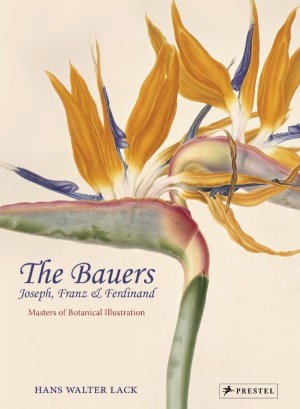 Filled with stunning 18th- and 19th-century illustrations of plants and other living creatures, this book is the first to bring together the life and art of the three Bauer Brothers, who came to be some of the most celebrated botanical artists of all time.
As artists, Joseph, Franz and Ferdinand Bauer were independently successful: Joseph as court painter to the Prince of Lichtenstein; Franz (later Francis) was employed at Kew Gardens as the ‘Botanick Painter to His Majesty’; and Ferdinand’s seminal collection of 1500 paintings created from sketches he made traveling in and around Australia is the first detailed account of the natural history of that continent. Drawn from all known worldwide sources of the Bauers’ extant illustrations, this illustrated history of the Bauers and their work unfolds chronologically, starting with the brothers’ formative years in Feldsberg, Austria, where they produced more than two thousand drawings of plant specimens under the guidance of the local abbot. Learning how to dissect plants as well as how to use microscopes to paint them in intricate detail, the Bauers became well known for their extraordinary precision. Their detail work, along with their incredibly beautiful and highly developed methods of coloring their paintings, comes to life in numerous superbly reproduced illustrations. A celebration of an indelible body of work, this unique volume recalls the Golden Age of botanical artistry through the lives and contributions of the renowned Bauer brothers.
Hans Walter Lack is Director of the Botanic Garden and Botanical Museum in Berlin, Germany. He has written extensively about botanical art.
New Book | Palais Royal: à la table des rois
From BnF:
Alina Cantau, Frédéric Manfrin et Dominique Wibault, Palais Royal: à la table des rois (Paris: Éditions de la Bibliothèque nationale de France, 2015), 224 pages, ISBN: 978-2717726695, 35€.
 De François Ier à Napoléon III, en passant par Louis XIV et Bonaparte, Palais royal invite les gourmands d’images et d’histoire à découvrir la cour de France sous un autre jour : quand elle passe à table. Au fil des siècles et des règnes, la culture culinaire évolue. Les voyages et leur cortège de découvertes viennent métisser les repas, au gré des échanges diplomatiques, des mariages princiers et du commerce. Mais toujours la gastronomie est affaire de plaisir. Comme l’écrit Guy Martin qui signe ici la préface, le palais naît d’une sensibilité, à la fois personnelle et collective, qui se cultive. À l’origine de la « cuisine française », les tables royales de France posaient les bases de ce qui allait faire sa renommée.
Alina Cantau est coordinatrice scientifique Gallica au sein du département de la Coopération à la Bibliothèque nationale de France. En charge de la gastronomie, elle a collaboré à plusieurs revues spécialisées et à l’Agenda gourmand (BnF). Elle a également participé à des actions de valorisation des collections gourmandes de la Bibliothèque nationale de France et de ses partenaires.
Frédéric Manfrin, conservateur, est depuis 2008 chef du service Histoire à la Bibliothèque nationale de France. Il a assuré le commissariat des expositions « Esprit[s] de Mai 68 », « Casanova, la passion de la liberté » et « Été 14 : les derniers jours de l’ancien monde », dont il a également codirigé le catalogue. Il donne depuis quelques années de nombreuses conférences sur l’histoire culturelle et politique de l’Europe aux XVIIe et XVIIIe siècles.
Dominique Wibault, chargée de collection en gastronomie au département Sciences et Techniques de la Bibliothèque nationale de France, a collaboré à l’édition 2015 de l’Agenda gourmand (BnF) et au dossier gastronomie « Du sens aux sens » du numéro 49 de la Revue de la BnF.
Exhibition | Artist and Empire: Facing Britain’s Imperial Past
Opening this week at Tate Britain:
Artist and Empire: Facing Britain’s Imperial Past
Tate Britain, London, 25 November 2015 — 10 April 2016
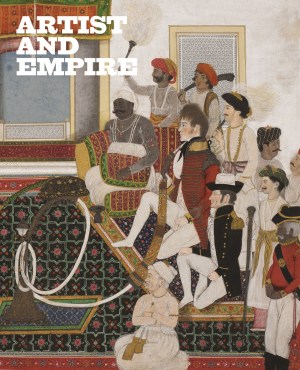 This autumn Tate Britain presents a major exhibition of art associated with the British Empire from the 16th century to the present day. In 21st-century Britain, ‘empire’ is highly provocative. Its histories of war, conquest and slavery are difficult and painful to address but its legacy is everywhere and affects us all. Artist and Empire will bring together extraordinary and unexpected works to explore how artists from Britain and around the world have responded to the dramas, tragedies and experiences of the Empire. Featuring a vast array of objects from collections across Britain, including maps, flags, paintings, photographs, sculptures and artefacts, the exhibition examines how the histories of the British Empire have shaped art past and present. Contemporary works within the exhibition suggest that the ramifications of the Empire are far from over. The show raises questions about ownership, authorship and how the value and meanings of these diverse objects have changed through history, it also asks what they still mean to us today.
Historic works by artists such as Joshua Reynolds and George Stubbs are shown with objects including Indian miniatures and Maori artefacts, as well as contemporary works by Hew Locke and Sonia Boyce. Through this variety of artworks from a complex mix of traditions, locations and cultures the fragmented history of the Empire can be told.
Alison Smith, David Blayney Brown, Carol Jacobi, Artist and Empire: Facing Britain’s Imperial Past (London: Tate, 2015), 240 pages, ISBN: 978-1849763431, $65.
◊ ◊ ◊ ◊ ◊
From Tate Britain:
Artist and Empire: New Dynamics, 1790 to the Present Day
Tate Britain, London, 24–26 November 2015
Tate Britain’s major conference, held in collaboration with Birkbeck, University of London and culture at King’s College London, marks the opening of the exhibition Artist and Empire. Scholars, curators and artists from around Britain and the world consider art created under the conditions of the British Empire, its aftermath, and its future in museum and gallery displays.
Scholarship of art associated with the British Empire has expanded over the last two decades, across a huge span of disciplines and locations. This conference takes the historic opportunity of the exhibition, featuring diverse artists from the sixteenth century to the present day, to bring together people to meet and share the latest research being developed around this subject. The papers, roundtables and audience discussions will consider the cosmopolitan character of objects and images, and the way geographical, cultural and chronological dislocations have in many instances obscured, changed or suppressed their history, significance and aesthetics. We will also explore how approaches to contemporary art, archives, curation and collecting can help develop new ways to look at them now.
T U E S D A Y , 2 6 N O V E M B E R 2 0 1 5
18.00 Opening Conversation
Introduction by Nicholas Serota, Director, Tate
Frank Bowling OBE, Artist and Writer, with Zoe Whitley, Curator, International Art, Tate Modern
W E D N E S D A Y , 2 5 N O V E M B E R 2 0 1 5
9.00 Registration and refreshments
9.30 Introduction
9.40 Panel 1 | Displaced Practices: Artists and Exchanges
Chaired by Felix Driver, Professor of Human Geography at Royal Holloway
• Michael Rosenthal (Emeritus Professor of Art History at the University of Warwick), Augustus Earle: Seeing Straight
• Geoff Quilley (Professor of Art History at the University of Sussex), Inside Empire Looking Out: The View from Dent’s Veranda
• Partha Mitter (Emeritus Professor of Art History at the University of Sussex), Art Education in India
11.20 Refreshment break
11.40 Panel 2 | Moving Objects: Collecting, Archives, Display
Chaired by John Mack, Professor of World Art Studies at the University of East Anglia and Chairman of the Sainsbury Institute for Art
• Alison Inglis (Associate Professor in Art History at the University of Melbourne), Collecting and Displaying British Art in the Australian Colony
• Zachary Kingdon (Curator of the African Collections at the World Museum in Liverpool), Unofficial Exchanges: Investigating West Africans’ Gifts to UK Museums in the Early Colonial Period
• Nick Thomas (Director of the Museum of Archaeology and Anthropology, Cambridge), Artefacts of Encounter: Rethinking Objects and Collections
13.20 Lunch break
14.00 Panel 3 | Face to Face: Figures, Portraits and Identities
Chaired by Elizabeth Edwards, Research Professor in Photographic History and Director of Photographic History Research Centre, De Montfort University
• Temi Odumosu (Marie Curie Postdoctoral Fellow at Copenhagen University), This Is How You See Her? Rachel Pringle of Barbados by Thomas Rowlandson’s Hand
• Gillian Forrester (Senior Curator of Prints and Drawings at the Yale Center for British Art), Noel B. Livingston’s Gallery of Illustrious Jamaicans
• Ruth Phillips (Canada Research Chair in Modern Culture and Professor of Art History at Carleton University), Sir Henry Acland Mi’kmaq Woman from Nova Scotia and a Mi’kmaq Dressed Doll: The Tensions of Imperialism and Indigenous Survivance and Resistance
15.40 Refreshment break
16.00 Plenary: Reflecting on the Future
Chaired by Augustus Casely-Hayford, Historian, Writer and Curator
Catherine Hall, Professor of Modern British Social and Cultural History at University College London
Zareer Masani, Historian and Writer
T H U R S D A Y , 2 6 N O V E M B E R 2 0 1 5
9.00 Registration and refreshments
9.30 Introduction
9.40 Panel 4 | Confronting Empire: Curating Artistic Legacies
Chaired by Sarah Victoria Turner, Assistant Director for Research at the Paul Mellon Centre
• Elisabeth Lalouschek (Artistic Director of the October Gallery)
• Devika Singh (Smuts Research Fellow at the Centre of South Asian Studies, Cambridge University)
10.55 Refreshment break
11.15 Panel 5 | Archived Futures: Mediating Collections and Archives
Chaired by Hammad Nasar, Head of Research and Programmes at the Asia Art Archive in Hong Kong
• Brook Andrew (Artist), Re-envisioning Archives and Aboriginal Culture
• Caroline Bressey (Director of the Equiano Centre, Department of Geography at UCL)
• Shaheen Merali (Writer, Curator and Co-founder of Panchayat), Panchayat
12.55 Lunch break
13.35 Panel 6 | Curating in Transnational Contexts in London
Chaired by Professor Paul Goodwin, Director of the Research Centre for Transnational Art, Identity and Nation (TrAIN) at the University of the Arts London
• The India Festival (Victoria and Albert Museum, June 2015 — March 2016)
Kriti Kapila, Lecturer in Social Anthropology and Law at King’s College, London
• West Africa: Word, Symbol, Song (British Library, October 2015 — February 2016)
Toby Green, Lecturer in Lusophone African History and Culture at King’s College, London, Marion Wallace, Lead Curator, African Collections, British Library, Co-curator
• Artist and Empire: Facing Britain’s Imperial Past (Tate Britain, November 2015 — April 2016)
Javed Majeed, Professor of English and Comparative Literature at King’s College London, Alison Smith, Senior Curator of British Art at Tate Britain
14.50 Refreshment break
15.10 In Conversation: Reflecting on Artists and Empire
Chaired by Achim Borchardt-Hume, Director of Exhibitions, Tate Modern
• Lubaina Himid, MBE (Artist, Curator, Professor of Contemporary Art at the School Art, Design and Fashion University of Central Lancashire)
• Yinka Shonibare, MBE (Artist and Curator)
16.05 Plenary: Reflecting on the Future
Chaired by Paul Gilroy, Professor of American and English Literature, King’s College London
Baroness Lola Young of Hornsey OBE
Mike Phillips, Novelist, Historian and former curator at Tate
Panellist TBC
Exhibition | Italian Dreams: Watteau and French Landscape Painting
From the website for Valenciennes:
Réveries Italiennes: Watteau et les paysagistes français au XVIIIe siècle
Italian Dreams: Watteau and French Landscape Painting in the Eighteenth Century
Musée des Beaux-Arts, Valenciennes, 25 September — 17 January 2016
Curated by Martin Eidelberg
 La Ville de Valenciennes a la chance d’avoir vu naître l’un des artistes français les plus illustres : Jean Antoine Watteau (1684–1721). La réouverture de son musée des Beaux-Arts, qui conserve un ensemble d’œuvres du peintre, est couronnée par le don exceptionnel d’une œuvre tout récemment redécouverte d’Antoine Watteau, La Chute d’eau, rare paysage du peintre des fêtes galantes inspiré des cascades de Tivoli près de Rome, qui témoigne de la fascination de l’artiste pour l’Italie, pays où il n’eut pourtant jamais l’occasion de se rendre !
L’exposition Rêveries italiennes, propose ainsi de souligner les emprunts que le maître fit tout au long de sa carrière au modèle italien, soit à travers l’exemple des peintres vénitiens du XVIe siècle qui constituèrent pour l’artiste une source importante d’inspiration, soit à travers le filtre des œuvres réalisées à Rome par ses contemporains. Autour d’un ensemble de peintures et de dessins d’Antoine Watteau, des œuvres des XVIe, XVIIe et XVIIIe siècles montreront comment ce peintre des songes puisa dans la culture artistique européenne pour créer des œuvres qui ouvriront la voie à une nouvelle école de paysage, née au siècle des Lumières, autour de Natoire, Boucher, Fragonard et Hubert Robert. À partir des rêveries italiennes de Watteau, l’exposition valenciennoise souhaite ainsi éclairer sous un jour nouveau la fécondité d’un modèle artistique qui, bien au-delà d’une iconographie séduisante, mena à l’éclosion du Romantisme.
L’exposition s’intègre dans la programmation liée à l’élection de la cité voisine belge de Mons comme capitale européenne de la culture pour l’année 2015. Elle bénéficie également du soutien exceptionnel du Musée du Louvre, qui a accordé pour l’occasion un prêt conséquent d’œuvres et a proposé, dans le cadre de la programmation du Louvre Lens, une exposition venant en écho à l’initiative valenciennoise, consacrée à Antoine Watteau et la fête galante, Dansez, embrassez qui vous voudrez. Fêtes et plaisirs d’amour au siècle de Mme de Pompadour, du 5 décembre 2015 au 29 février 2016.
Commissariat scientifique
Martin Eidelberg, Professeur émérite d’Histoire de l’Art, Rutgers University
Commissariat général
• Emmanuelle Delapierre, anciennement conservatrice du musée des Beaux-Arts de Valenciennes, actuelle conservatrice du musée des Beaux-Arts de Caen
• Vincent Hadot, directeur du musée des Beaux-Arts de Valenciennes
• Virginie Frelin-Cartigny, Attachée de conservation du Patrimoine, musée des Beaux-Arts de Valenciennes
Martin Eidelberg, Réveries Italiennes: Watteau et les paysagistes français au XVIIIe siècle (Heule: Snoeck, 2015), 163 pages, ISBN: 978-9461612397, 29€ / $55.
More information is available at Culture.Fr, and the press release is available as a PDF file here»
Save Ashgate Publishing
I know many of you are already aware of the bad news regarding the planned closures of Ashgate’s Burlington and UK offices. The online petition now includes 3,700+ signatures (and counting). –CH
Save Ashgate Publishing
Petition to Rachel Lynch, Managing Director, Ashgate Publishing & Managing Director, Humanities & Social Science Books, Taylor & Francis Group Jeremy North
Ashgate Publishing Company was purchased by Informa (Taylor & Francis Publishing) in 2015. On November 24th, 2015, the North American office of the press in Burlington, Vermont will close and Ashgate’s US staff members, including Erika Gaffney, Ann Donahue, Margaret Michniewicz, Alyssa Berthiaume, Kathy Bond Borie, Seth Hibbert, Stephanie Peake, Martha McKenna, Lea Durfee, Suzanne Sprague, and Emilly Ferro will cease to be representatives of Ashgate.
According to an e-mail sent to series editors, plans are still being discussed for Ashgate’s publishing business in the UK. However, information has since emerged that the UK office is scheduled to close in December.
Independent academic presses like Ashgate have offered a safe haven for scholars working in certain subfields as University presses closed entire publishing specializations and fired editorial staff in response to campus austerity measures. Academic presses are more than profit margins, income from the backlist, utility bills, payroll, and marketing campaigns. Ashgate flourished through the bonds formed between editors and authors, the care and attention of copy editors, and above all, the good will of authors and readers. We the undersigned authors, readers, and reviewers of Ashgate books write to voice our appreciation for the accomplishments of Ashgate’s North American office. We urge Taylor & Francis to reverse course immediately and restore Ashgate’s US and UK offices.
New Book | Piranesi’s Lost Words
From Penn State UP:
Heather Hyde Minor, Piranesi’s Lost Words (University Park: The Pennsylvania State University Press, 2015), 264 pages, ISBN: 978-0271065496, $80.
 Giovanni Battista Piranesi was one of the most important artists eighteenth-century Europe produced. But Piranesi was more than an artist; he was an engraver and printmaker, architect, antiquities dealer, archaeologist, draftsman, publisher, bookseller, and author. In Piranesi’s Lost Words, Heather Hyde Minor considers Piranesi the author and publisher, focusing on his major publications from 1756 to his death in 1778. Piranesi designed and manufactured twelve beautiful, large-format books combining visual and verbal content over the course of his lifetime. While the images from these books have been widely studied, they are usually considered in isolation from the texts in which they originally appeared. This study reunites Piranesi’s texts and images, interpreting them in conjunction as composite art. Minor shows how this composite art demonstrates Piranesi’s gift for interpreting the classical world and its remains—and how his books offer a critique of both the Enlightenment project of creating an epistemology of the classical past and how eighteenth-century scholars explicated this past. Piranesi’s books, Minor argues, were integral to the emergence of the modern discipline of art history. Using new, previously unpublished archival material, Piranesi’s Lost Words refines our understanding of Piranesi’s works and the eighteenth-century context in which they were created.
New Book | The Frick Collection: Decorative Arts Handbook
Press release (10 June 2015) from The Frick:
Charlotte Vignon, The Frick Collection: Decorative Arts Handbook (New York: The Frick Collection in association with Scala Arts Publishers, 2015), 172 pages, ISBN: 978-1857599398 $25.
 The unique atmosphere of The Frick Collection has as much to do with the decorative arts as with the old master paintings that line the museum’s walls. Indeed the enamels, clocks and watches, furniture, gilt bronzes, porcelain, ceramics, silver, and textiles far exceed in number, and are the equal in quality, of the works on canvas and panel. The institution announces the publication of the first handbook devoted to the decorative arts in the collection. This long overdue book will help convey the balance among the various art forms represented in the house and provide a valuable introduction to this area. Comments Director Ian Wardropper, “Despite the manifest importance of decorative arts at the Frick, until recently our small staff did not include a specialist in the field. Thanks to an endowment campaign and the generosity of a number of supporters a permanent curatorial position was created in September 2009. With energy and imagination, the first incumbent of this curatorship, Charlotte Vignon, has initiated a series of exhibitions that highlight this aspect of the collection. The present handbook is another indication of her scholarly dedication to the decorative arts.”
The Frick Collection: Decorative Arts Handbook offers fresh insight on various works long in the museum’s holdings and also includes commentary on more recently acquired examples. Exquisitely illustrated with new photography, this paperback volume is available in English and French editions.
Henry Clay Frick: Developing a Decorative Arts Collection
Acquiring paintings preoccupied Henry Clay Frick when he moved to New York in the first years of the twentieth century. While renting William H. Vanderbilt’s mansion at Fifth Avenue and 51st Street, he devoted his attention to collecting masterpieces by Rembrandt, Velázquez, and other masters. As the sumptuous house he constructed at 70th Street took shape between 1912 and 1914, he recognized the need for furnishings of a caliber that matched his painting collection. Interestingly, most of his purchases in this area were made just before or after he began to occupy the house and in a very concentrated period of time.
A trip to London and Paris in the spring of 1914 inspired many of the choices Frick would make for his New York mansion. After meeting Victor Cavendish, the ninth Duke of Devonshire, at Landsdowne House in London and his country house at Chatsworth, Frick acquired from him a suite of tapestry furniture thought to be eighteenth-century Gobelins. Impressed by the Wallace Collection and wishing to emulate it, he set out to acquire high-quality decorative arts of different periods and materials, especially porcelain, oriental carpets, and French Renaissance enamels and furniture, such as pieces made by André-Charles Boulle, with their distinctive turtle-shell and brass veneers. In Paris, through the intermediary of the American decorator Elsie de Wolfe, he purchased French furniture from the collection of Sir John Murray Scott (inherited from Lady Wallace, the widow of the founder of the Wallace Collection). In a single month, he spent more than $400,000, more than he had ever spent on collecting in this field.
In some cases, furniture and decorative arts were assembled to complement specific rooms of the house. Elsie de Wolf, for example, counseled the acquisition of a desk by the great French eighteenth-century cabinetmaker Jean-Henri Riesener together with Sèvres porcelain for Adelaide Frick’s second-floor dressing room, which was lined with wall panels painted by François Boucher’s workshop. The room and its furnishings were transferred to the first floor in 1935. Other great eighteenth-century French furnishings for Adelaide’s dressing room came through Joseph Duveen, then the head of Duveen Brothers. After Fragonard’s cycle of paintings was installed in the drawing room in 1915–16, Duveen sold Frick many more works to embellish its decor. French Renaissance furniture was bought to complement the collection of sixteenth-century enamels acquired in 1916; Henry’s office was transformed into a gallery for its display. The Italian Renaissance cassoni were always intended to be placed beneath masterpieces of painting in the West Gallery or elsewhere.
Carefully selected blocs of decorative arts, such as the forty-six pieces of Limoges enamel Frick acquired through Duveen from the estate of J. Pierpont Morgan, were one means by which the collection grew quickly. Morgan’s death in 1913 gave Frick the opportunity to choose from one of the finest and largest collections in the world just when he was seeking to expand in this area. Another example was the group of fifty Chinese porcelain jars and vases that Duveen had also acquired from Morgan’s estate. Apart from the windfall of the availability of the Morgan collection, Duveen’s own stock was so extensive and of such quality that Frick could buy from him French royal commissions, such as Gilles Joubert’s chest of drawers, which was among some twenty-five pieces of furniture that arrived at Fifth Avenue and 70th Street during the year 1915.
Later Acquisitions
Generous gifts from members of the Frick family and other donors have continued to enrich the decorative arts collection. The founder’s son, Childs, gave about two hundred pieces of Chinese blue-and-white porcelain in 1965, considerably augmenting those works his father had purchased fifty years earlier. In 1999, Winthrop Kellogg Edey’s extraordinary collection of some forty clocks and watches arrived at the Frick. Henry Arnhold has recently given us the Great Bustard from his distinguished and comprehensive collection of Meissen porcelain, and another one hundred and thirty-five works are pledged to the Frick as a bequest. Individual objects of great merit are prized additions to our holdings. Diane Modestini gave us our first piece of Italian majolica in honor of her husband Mario Modestini in 2008. On occasion, acquisitions are also made, such as the unusual vase japon, purchased in 2011.










 Enfilade
leave a comment