Exhibition | The Luxury of Time: European Clocks and Watches
From The Met:
The Luxury of Time: European Clocks and Watches
The Metropolitan Museum of Art, New York, 16 November 2015 — 27 March 2016

Clockmaker: Ferdinand Berthoud (French, 1727–1807); Case maker: Balthazar Lieutaud (French, ca. 1720–1780, master 1749). Longcase astronomical regulator (detail), ca. 1768–70. Case: oak veneered with ebony and brass, with gilt-bronze mounts; Dial: white enamel; Movement: gilded brass and steel; Height: 90.5 in. (229.9 cm). The Metropolitan Museum of Art, New York, (1982.60.50).
Time is all around us, displayed on our phones and computers. Today, almost nobody needs to own a watch or a clock to tell the time. Access to the right time is not the luxury it once was. Yet the fascination with clocks and watches persists, and the thriving market for mechanical timekeepers is deeply aware of their history. Clocks and watches have always been about more than just telling time: they have been treasured as objects of desire and wonder, personal items imbued with value that goes beyond pure functionality. As works of art, they represent the marriage of innovation and craftsmanship.
This exhibition explores the relationship between the artistry of the exterior form of European timekeepers and the brilliantly conceived technology that they contain. Drawn from the Museum’s distinguished collection of German, French, English, and Swiss horology from the sixteenth through the nineteenth century, the extraordinary objects on view show how clocks and watches were made into lavish furniture or exquisite jewelry.
The creation of timekeepers required that clockmakers work with cabinetmakers, goldsmiths and silversmiths, enamelers, chasers and gilders, engravers, and even those working in sculpture and porcelain. These craftsmen were tasked with accommodating internal mechanisms by producing cases that, in both shape and function, adapted to timekeeping technologies. Their exteriors are often as complicated as the movements they house. Examining the dialogue between inside and out, adornment and ingenuity, The Luxury of Time
reveals the complex evolution of European clockmaking and
the central place of timekeepers in the history of decorative arts.
◊ ◊ ◊ ◊ ◊
The catalogue is scheduled for publication in February. From Yale UP:
Clare Vincent and Jan Hendrik Leopold, with Elizabeth Sullivan, European Clocks and Watches in The Metropolitan Museum of Art (New York: The Metropolitan Museum of Art, 2016), 288 pages, ISBN: 978-1588395795, $65.
 Among the world’s great technological and imaginative achievements is the invention and development of the timepiece. Examining for the first time the Metropolitan Museum’s unparalleled collection of European clocks and watches created from the early middle ages through the 19th century, this fascinating book enriches our understanding of the origins and evolution of these ingenious works. It showcases 54 extraordinary clocks, watches, and other timekeeping devices, each represented with an in-depth description and new photography showing the exterior as well as the inner mechanisms. Included are an ornate celestial timepiece that accurately predicts the trajectory of the sun, moon, and stars and a longcase clock by David Roentgen that shows the time in the ten most important cities of the day. These works, created by clockmakers, scientists, and artists in England, Germany, France, Italy, and the Netherlands, have been selected for their artistic beauty and design excellence, as well as for their sophisticated and awe-inspiring mechanics. Built upon decades of expert research, this publication is a long-overdue survey of these stunning visual and technological marvels.
Clare Vincent is associate curator, European Sculpture and Decorative Arts, The Metropolitan Museum of Art. J. H. Leopold was former assistant keeper in charge of the horological collections at The British Museum. Elizabeth Sullivan is research associate, European Sculpture and Decorative Arts, The Metropolitan Museum of Art.
New Book | How to Read Chinese Ceramics
Published by The Met and distributed by Yale UP:
Denise Patry Leidy, How to Read Chinese Ceramics (New York: The Metropolitan Museum of Art, 2015), 144 pages, ISBN: 978-1588395719, $25.
 Chinese ceramics are among the most significant and widely collected decorative arts produced anywhere in the world, with a history that spans millennia. Despite the saturation of Chinese ceramics in global culture—in English, the word ‘china’ has become synonymous with ‘porcelain’—the function of these works and the meaning of their often richly decorated surfaces are not always readily apparent.
This new installment in the successful How to Read series enlightens readers on Chinese ceramics of all kinds, using highlights from the outstanding collection of The Metropolitan Museum of Art as a teaching tool. Accessible to a general audience and written by an expert on the subject, this book explains and interprets 40 masterworks of Chinese ceramics. The works represent a broad range of subject matter and type, from ancient earthenware to 20th-century porcelain, and from plates and bowls to vases and sculptural figures. Lavish illustrations showcase these stunning works and the decorations that adorn them, including symbolic scenes, flowers, and Buddhist and Chinese historical figures.
Denise Patry Leidy is curator in the Department of Asian Art, The Metropolitan Museum of Art.
An interview with Leidy is available here»
New Book | Venetian Painting Matters, 1450–1750
Forthcoming from Brepols:
Jodi Cranston, ed., Venetian Painting Matters, 1450–1750 (Turnhout: Brepols, 2015), 200 pages, ISBN: 9782503535265, $115.
 This book brings together essays about painting in Venice during three centuries of remarkable artistic production, influence, and exchange. The chronological scope of the anthology reflects the crucial interrelationship between the life of the arts and the republic, but also indicates the longevity of the distinctive, but not in the least isolated, mode of making and looking that engaged painters and viewers both inside and outside of Venice. The focused themes that emerge in the essays—the artist’s self-perception, the role of innovation and tradition in formal and material aspects of pictorial composition, the artistic exchange between Venice and other cities, both east and west, and the unique political and social pressures on artistic production and reception—reflect the Venetian engagement with many of the central concerns that preoccupied early modern artists. The dialogue established between Venetian art and society underpins all of the essays in the anthology; however, their critical focus remains on the formal, stylistic, and structural aspects of the pictures and how these visual mechanisms express meaning and shape viewer response.
Exhibition | Living for the Moment: Japanese Prints
Press release (5 October 2015) from LACMA:
Living for the Moment: Japanese Prints from the Barbara S. Bowman Collection
Los Angeles County Museum of Art, 11 October 2015 — 1 May 2016

Suzuki Harunobu, Lucky Dream for the New Year: Mt. Fuji, Falcon, and Eggplants, ca. 1768–69 (promised gift of Barbara S. Bowman, Museum Associates/LACMA).
The Los Angeles County Museum of Art (LACMA) presents Living for the Moment: Japanese Prints from the Barbara S. Bowman Collection. The exhibition features over 100 prints of transformative promised gifts of Japanese works to LACMA, representing the work of 32 artists. Included are examples of rare early prints of the ukiyo-e genre (pictures of the floating world); works from the golden age of ukiyo-e at the end of the eighteenth century by Suzuki Harunobu, Kitagawa Utamaro, and Katsukawa Shunshō; and nineteenth-century prints by great masters such as Utagawa Hiroshige, Katsushika Hokusai, Utagawa Kuniyoshi, and others.
Barbara S. Bowman (née Safan) was born in Los Angeles in 1925 and attended the University of Southern California (USC) for a degree in fine art. Barbara became captivated by Japanese woodblock prints early on after receiving two prints as a gift from her mother. She and her husband Morton visited Japan for the first time in 1962, and by 1978 she began actively collecting Japanese woodblock prints. Never intending to have an encyclopedic collection, Barbara sought out scenic designs in superb condition with stellar impressions, as she held the printing process in high esteem. The power of line and the importance of color were and remain defining factors of the collection. Assembled over 35 years, the Barbara S. Bowman Collection includes some of the finest impressions available.
“Living for the Moment represents a momentous gift to the Japanese Art Department of LACMA, in that we can now present the history of Japanese prints with high-quality works of art,” remarks Hollis Goodall, Curator of Japanese Art at LACMA.
Living for the Moment is presented in two locations at LACMA. Commercially printed ukiyo-e, mostly produced in Edo (modern Tokyo), will be displayed chronologically and by artistic group in the Ahmanson Building, level 2. Privately published surimono and theatrical prints of Osaka are installed in the Pavilion for Japanese Art, level 3.
Ukiyo-e developed as an independent genre in painting and book illustration by the late 1600s. The idea of the ‘floating world’ (ukiyo), initially based on a Buddhist phrase referring to the transience of life, was adopted by popular writers to evoke fleeting moments of beauty and pleasure that provided distraction from the cares of a regimented society. Book illustrations on these topics gained such popularity that artists began creating single-sheet woodblock prints to sell. Edo became the center for the production of ukiyo-e prints. In response to government restrictions placed on floating world subject matter in the early 1800s, artists explored new topics such as travel and heroes of ancient lore. Prints were also a perfect medium for artistic experimentation. After a breakthrough by Suzuki Harunobu in 1765, which allowed the production of multiblock color prints, artists explored realism, nature, perspective, framing, and light with a level of intensity that spread their influence not only across Japan but also, after the country opened to foreign trade in 1868, to Europe. There, the Impressionists, struck by the Japanese printmakers’ use of color, atmosphere, and composition, created a watershed style embarking upon Modernism.
The artist Utagawa Hiroshige (1797–1858) was from a samurai family with an inherited position as a fire man in Edo Castle. In 1823 he passed on this job to a relative and became a full-time artist, having been trained by the Utagawa school master, Toyohiro (1773–1828). Hiroshige excelled at evoking the human experience of the landscape, with its varying seasons, times of day, and weather events. His sensitivity toward shifting light is best seen in early impressions of prints where he supervised color choice, as exemplified by his finest print in the Bowman collection entitled, Minowa, Kanasugi, and Mikawashima (1857). In this print, a broad strip of pink marks the horizon. The still-dark middle ground indicates light at daybreak which has not reached the nearby plains, and roofs in the distance already reflect the growing daylight. In his late years, Hiroshige developed a unique viewpoint, looking beyond an object set close at hand to a landscape which receded into deep distance. His framing of subjects directly influenced the Impressionists and Post- Impressionists in Europe, and later Frank Lloyd Wright in the United States.
The majority of ukiyo-e prints were produced by publishers for general sale. Government censors enforced laws restricting the subject matter of prints and their price, by limiting the number of blocks and quality of pigments. These laws were not applied to private groups, who made prints called surimono (printed things) for distribution to a specified clientele. These groups mostly consisted of poets of kyōka (mad verse), which was based on courtly poetry but played with the rules of language and content. Fan clubs for musicians and actors also occasionally commissioned surimono. The heyday of surimono lasted from the late 1700s through the first third of the 1800s, with the majority produced after 1800. These prints were most frequently distributed at the New Year to kyōka group members and would often bear poems related to that season. Printed on thick, luxurious paper, surimono often featured richly hued dyes too expensive for general use and metals such as brass, tin, and copper. Viewing these prints closely, one may also detect exquisite embossed details and areas that mimic the appearance of lacquer.
Surimono artists, led by Katsushika Hokusai (1760–1849), his followers, and contemporaries, drew designs based on the poetry to be printed on the surimono, either portraying, embellishing, or playfully skewing the content with their illustrations. The design was there for the enhancement of the poetry, rather than vice versa. Hokusai’s Salt Shells (Shiogai) from 1821, for example, is a still life that depicts a box of open salt cakes, a pipe case and tobacco pouch attached to a netsuke container, and a small pine tree planted in a bowl. The work is from a series of 36 surimono that included verse by many followers of the noted contemporary poet Yomo no Magao. The series title and poem refer to the New Year game of matching bifurcated shells, each containing a segment of the same poem.
◊ ◊ ◊ ◊ ◊
The catalogue is published by Prestel:
Hollis Goodman with an essay by Joan B. Mirviss, Living for the Moment: Japanese Prints from the Barbara S. Bowman Collection (London: Prestel, 2015), 184 pages, ISBN: 978-3791354729, $65 / £35.
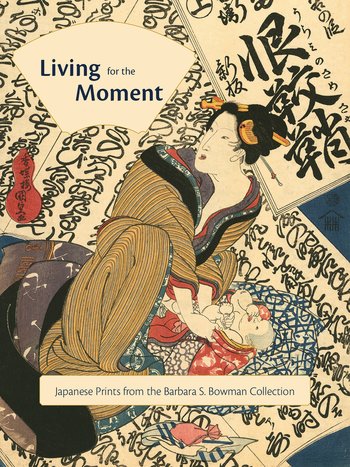 Spanning the late 18th and early 19th centuries, the exquisite examples of Japanese prints included in this book offer insights into the history of an art form and vision that is distinctively Japanese and was highly inspirational to later European painters. Polychrome prints, or ukiyo-e, first appeared in Japan in the late 18th century. Delicately hued and intricate, they depicted landscapes, scenes, and figures that epitomized the country’s idea of ‘the floating world’: a place whose denizens lived for the moment and appreciated the pleasures of the natural world. This volume surveys the prominent Barbara S. Bowman collection of prints notable for a number of reasons: an excellently preserved print of Lucky Dream for the New Year: Mount Fuji, Falcon, and Eggplants by Suzuki Harunobu; a number of surimono, or privately published prints that were created with unusually luxurious materials; and numerous works by Hiroshige and Hokusai, who are considered the masters of the art form. Each of the over one hundred prints in this book is reproduced in large color plates that highlight their subtle beauty and charm and are accompanied by extensive analysis of the pieces’ remarkable qualities. This comprehensive overview of the collection by LACMA curator Hollis Goodall addresses the significance and history of the Bowman collection and the many ways it enhances the museum’s extensive holdings of Japanese art.
Hollis Goodall is curator of Japanese art at the Los Angeles County Museum of Art.
New Book | Sir Joshua Reynolds: Propos sur l’art
Forthcoming from Brepols:
Jan Blanc, Sir Joshua Reynolds: Propos sur l’art (Turnhout: Brepols, 2015), 800 pages, ISBN: 978-2503543376, 175€.
Réunis pour la première fois et présentés de façon systématique et comparative, ces textes offrent une révision complète des théories et des pratiques artistiques du peintre, sir Joshua Reynolds.
 Après la mort de sir Joshua Reynolds, les premiers visiteurs de son atelier y ont découvert, en plus de plusieurs tableaux inachevés et des œuvres de son abondante collection, un nombre considérable de manuscrits—plus de 2000 pages de sa main ou de celle de ses secrétaires. Certains de ces manuscrits ont fait l’objet de publications partielles, tout comme c’est le cas des quelques textes publiés par Reynolds tout au long de sa carrière—pour l’essentiel, ses trois articles pour l’Idler et ses quinze discours académiques. Il n’existait pourtant aucune édition complète de ses écrits, tant en anglais qu’en français.
Présentant pour la première fois l’intégralité des textes connus de sir Joshua Reynolds, qu’ils aient été publiés de son vivant et après sa mort ou restés à l’état de manuscrits, cet ouvrage propose ainsi une révision complète des théories et des pratiques artistiques du peintre, à l’aune de textes connus, méconnus et inconnus. Réunis pour la première fois et présentés de façon systématique et comparative, ceux-ci permettent de mieux éclairer une carrière et une pensée plus cohérentes qu’on ne l’a dit, moins conformiste qu’on ne l’a prétendu. Ils constituent surtout des documents capitaux pour une histoire artistique mais aussi culturelle, sociale, historique, littéraire, théâtrale et politique du Siècle des Lumières.
À travers une présentation strictement chronologique des différents documents, qui mêlent les textes publics ou publiés, les lettres privées ainsi que les notes demeurées confidentielles, il s’agit de souligner la cohérence des idées développées par le premier président de la Royal Academy tout autant que leur évolution et leur adaptation à des publics et des attentes différents. L’ensemble de ces sources fait l’objet d’une présentation qui permet d’en restituer les enjeux, d’en rappeler le contexte d’énonciation et d’en marquer les principaux apports. Par une série de renvois intertextuels, le lecteur pourra également mettre en relation les propos de l’artiste à différents moments de sa vie, afin de mesurer ce qui les sépare ou les réunit.
Par ailleurs, afin que ces textes ne soient pas réduits aux innombrables chapitres d’une théorie de l’art homogène et unifiée qui n’a jamais existé, et arrachée à la pratique d’un peintre qui a constamment cherché à la fonder sur les problèmes strictement artistiques, techniques et artistiques qui se posaient à lui, lorsqu’il concevait un portrait ou une peinture d’histoire, des éléments d’information concernant sa carrière, ses principales œuvres et les débats les entourant ont été insérés entre les textes afin d’en favoriser la compréhension et d’en saisir les enjeux circonstanciels.
Il serait vain, même en une longue préface, de résumer en quelques points des théories artistiques qui s’étalent sur près de 2000 pages et couvrent près d’un demi-siècle, du premier manuscrit connu de la main d’un Reynolds à peine entré dans l’adolescence—un arbre généalogique—à la dernière lettre que nous connaissons du peintre, écrite à peine un mois après avoir proposé—sans succès—sa démission de la Royal Academy. J’ai donc choisi la solution d’un dictionnaire, regroupant les principales notions et les personnages les plus importants que nous pouvons rencontrer au fil des pages écrites par Reynolds, tout au long de sa carrière. J’y insiste sur les problèmes de définition posés par des concepts dont les acceptions ne sont parfois qu’implicites, et sont le plus souvent flottantes, au gré des enjeux et des problèmes contextuels posés à la pratique du peintre. J’y montre aussi que, dans bien des cas, Reynolds fait constamment évoluer sa théorie, en la réélaborant en fonction de ses rencontres mais aussi des résistances ou des débats que ses idées font surgir au sein de l’institution académique, auprès de ses collègues ou dans la presse. Reynolds ne prétend jamais détenir une vérité qu’il cherche à imposer à ses auditeurs ou ses lecteurs—ou à lui-même. Bien au contraire, il trouve, à travers le travail de formulation par l’écrit et de formalisation par l’explicitation théorique les moyens de construire ou de déconstruire cette pensée. Tel est, sans doute, le principal enseignement d’une édition qui, je l’espère, contribuera à montrer que la pensée de sir Joshua Reynolds est l’une des plus audacieuses et des plus ouvertes de son temps.
Exhibition | Dangerous Liaisons: The Art of the French Rococo

◊ ◊ ◊ ◊ ◊
Now on view at the Liebieghaus Skulpturensammlung:
Gefährliche Liebschaften: Die Kunst des französischen Rokoko
Dangerous Liaisons: The Art of the French Rococo
Liebieghaus Skulpturensammlung, Frankfurt, 4 November 2015 — 28 March 2016
Curated by Maraike Bückling
Featuring more than eighty outstanding works on loan, the show entitled Dangerous Liaisons focuses on the newly emerging concept of sentimental love and its preferred style of representation in French art around 1750, vividly illustrating the seductive powers of the Rococo. On view will be sculptures, biscuit-porcelain statuettes, paintings, and prints as well as arts-and-crafts objects from renowned international lenders such as the Rijksmuseum, the Musée du Louvre, the British Museum, the Victoria and Albert Museum, the Museo Thyssen-Bornemisza, the Wallraf-Richartz Museum & Fondation Corboud, and Munich’s Alte Pinakothek.
During the reign of French king Louis XV, not only art theoreticians and writers, but also visual artists began to reassess the meaning of passions and emotions. While formulaic enunciations of sentiments had still been commonplace in the seventeenth century, such preset expressions of passion lost the more of their significance in the first half of the eighteenth century, the more love came to be understood as an individual emotion that was glorified as giving meaning to life. New models of love and—along with them—nature as a courtly Arcadia informed the representational vocabulary of the fine arts. What is in the foreground of works by sculptors Étienne-Maurice Falconet (1716–1791) and Jean-Baptiste Pigalle (1714–1785) as well as painters Jean-Antoine Watteau (1684–1721), Nicolas Lancret (1690–1743), and François Boucher (1703–1770) and of porcelain sculptures by Johann Joachim Kaendler (1706–1775) is an artistic conception of naturalness. In addition, one room in the exhibition recreates, with mirrors, furniture, paintings, prints, and porcelain, the look of a typical eighteenth-century salon.
“The art of the French Rococo polarizes and enthralls. Back then, like today, it prompted widely diverse responses between fascination and repudiation, admiration and incomprehension. Thanks to noted works on loan from the most important collections of the world our large-scale exhibition at the Liebieghaus is able to convey the style-defining power of this unique epoch with its new ideas about love and the idealization of rural life by the aristocracy,” Max Hollein, director of the Liebieghaus Skulpturensammlung, explains.
“In the eighteenth century, artists like Jean-Antoine Watteau, François Boucher, Étienne-Maurice Falconet, Jean-Baptiste Pigalle, or Jean-Honoré Fragonard discovered quiet and serene loves scenes as their subject matter. Yet only a few years later, their pictures full of naturalness and the comforts of love were denounced as reprehensible, devoid of truth, and even dangerous by critics like Choderlos de Laclos. That they nevertheless count among the most beautiful works of Rococo art is what we want to show in this exhibition,” says Maraike Bückling, curator of the exhibition and head of the departments Renaissance to Neoclassicism at the Liebieghaus Skulpturensammlung.
In the early eighteenth century, love was considered to be the most common of feelings, which all people were capable of. Drawing on theater plays, fables, operas, and narratives, visual artists like Jean-Antoine Watteau or François Boucher gave pictorial expression to the new concepts of love. Love scenes no longer showed the destructive passions of gods and heroes, but depicted tender affection between individuals. By and by, the divine personages transformed into characters of the pastoral, the bucolic play. Genre scenes of shepherds and gardeners become almost paradigmatic of the portrayals of a more tranquil, tender love in the Arcadian courtly settings of the period. The aristocracy’s enthusiasm for these scenes with their leisurely casualness and naturalness also found its expression in their self-fashioning. Costume plays arranged around the shepherd and the shepherdess were highly popular. This fascination even led to the setting-up of idealized fake farmsteads, for example in the parks of Versailles, most of them lavishly furnished with exquisite wall coverings and porcelain services especially made in Sèvres. Given this enthusiasm for bucolic themes, it is quite unsurprising that they soon gained ground in all art genres. The sculptors Étienne-Maurice Falconet and Jean-Jacques Bachelier (1724–1806) also took to developing pastoral scenes, as for example in the biscuit groups Annette et Lubin (1764, Düsseldorf, Hetjens-Museum – German Museum of Ceramics) or La fée Urgèle (1767, Sèvres, Cité de la Céramique – Sèvres et Limoges, Musée national de Céramique). Like their painter colleagues, they drew on models from literature. Johann Joachim Kaendler, Laurentius Russinger (1739–1810), and Johann Peter Melchior (1747–1825) created entire countrified theme worlds for the porcelain manufactories in Meißen and Höchst. Without exception, these pastoral couples are depicted in the outdoors, in a nature that appears not at all pristine or uncultivated: rather, the lovers—always looking elegant and more like aristocratic figures in their rustic garb—are seen strolling through gardens or enchanted overgrown park landscapes.
While the Académie royale de peinture et de sculpture, founded in 1648, still only knew formulaic patterns for the representation of emotions, artists eventually discarded the seventeenth-century rulebook in turning toward spheres of more individualized emotions. The fact that the viewer’s gusto was increasingly seen as a valid critical category finally led to the abandonment of traditional precepts and guidelines. The goal was to move viewers. And this was to be effectuated through works that tapped into their own world, their living environment and emotional sphere. Rococo painting and porcelain sculpture did not depict high-flown ideals of virtue or admirable heroic exploits. Rather, the figures are characterized by mild manners and tenderness and, whether it is pastoral themes or scenes from ancient mythology, appear in graceful everyday postures.
 In the opening section of the exhibition Dangerous Liaisons: The Art of the French Rococo viewers are given an idea of the character of a Rococo salon. The first room shows a set of furnishings, as is typical of the time around 1750. Wall coverings, paintings, armchairs, chests of drawers, mirrors, candelabra, porcelain, tapestries—all details were carefully matched with one another so as to create a harmonious overall picture at that time. Following the model of literature and painting, different artisans also devoted themselves to genre scenes. This connection is illustrated by the coverings of two armchairs from the Munich Residency which were made after children’s portraits of François Boucher. These ‘Enfants Boucher’ were very popular in the mid-eighteenth century, also as motifs of porcelain groups.
Costumes are shown in the passageway from the first room to Villa Liebieg. These are garments made for a production of Un ballo in maschera by Guiseppe Verdi (1813–1901) at the Frankfurt Opera House. They correspond to historical Rococo attire and convey a specific idea of the life-world of the period. French Rococo fashion was informed by courtly taste. One type of gown that was particularly in vogue was the ‘Robe à la française’ which accentuated the female back with full-length pleats from the neckline down to the floor; a fashion detail that was given special attention by Jean-Antoine Watteau and his successors, so that it later came to be known as ‘Watteau pleat’.
After the prologue introducing visitors to the Rococo lifestyle, the adjoining room features one of the most celebrated works by sculptor Étienne-Maurice Falconet. His Menacing Love (Amour menaçant) of 1757 (Rijksmuseum, Amsterdam), created for Madame de Pompadour (1721–1764), ushers in the theme of love in the presentation. The marble sculpture marks a change of style in Falconet’s oeuvre, as the Seated Cupid, as its also called, is the first instance that he addresses what appears to be a lighter, less grave theme. The secretive look and the raised finger commanding silence make the viewer a confidant let in on the love god’s secret plans. With his other hand, the little boy is already pulling an arrow from his quiver. The poignancy with which Falconet engages the viewer in the work is reminiscent of the dramatic and theatrical stylistic devices of Roman Baroque.
 In the subsequent rooms the presentation is continued with a number of paraphrases and variants of sentimental love. An extraordinary couple of lovers Pygmalion and Galathea (1763, Paris, Musée du Louvre) by Falconet is juxtaposed with suggestive scenes such as The See-Saw (around 1755, Madrid, Museo Thyssen-Bornemisza) by Jean-Honoré Fragonard (1732–1806), Falconet’s biscuit pieces The Kiss (1765, London, British Museum) and La Feuille à l’envers (1760, Sévres, Cité de la Céramique-Sèvres et Limoges) or Les Trois Contents (1765, Munich, Bavarian National Museum).
Around the mid-eighteenth century, visual artists frequently took the inspiration for their modern ideas of naturalness and love from fables and theater plays. The pastoral works of, for example, François Boucher enjoyed such popularity that his compositions were mass-reproduced as prints and disseminated throughout Europe. So, eventually, Boucher’s renditions of motifs from popular tales, plays, or operas came to grace tableware services, tapestries, furniture, and porcelain statuettes. The exhibition juxtaposes a number of etchings illustrating a play entitled Grape Harvest in the Vale of Tempe with pastoral porcelain statuettes, including, for example, The Flute Lesson (c. 1752, Paris, Musée Jacquemart-André) after René Gaillard (c. 1719–1790) and The Grape Eaters (c. 1766–1772, Hamburg, Museum of Arts and Crafts) by Jean-Jacques Bachelier, both after François Boucher.
The predilection for the cutely small and intimate inherent in those pastoral motifs is carried on in Boucher’s work in a turn toward children’s figures, which is illustrated in the final section of the exhibition. Sculptors like Falconet and Bachelier soon followed the example of the painter and also produced children’s statuettes. Mostly acting like grown-ups, these children appear as street musicians, macaroon sellers, milkmaids, or organ grinders.
A different matter are the almost life-size marble statues created by both Pigalle and Falconet. The sculpture Boy with a Birdcage (1749, Musée du Louvre) is a much closer rendering of childlike physiognomy and agility. Pigalle very precisely brings out the fleshiness of the child, which gives the piece an appearance somewhere between putto, allegory, and portrait.
Dangerous Liaisons: The Art of the French Rococo is supported by Kulturfonds Frankfurt RheinMain gGmbH and the Georg und Franziska Speyer’sche Hochschulstiftung.
Mareike Bückling, ed., Gefährliche Liebschaften: Die Kunst des französischen Rokoko (Munich: Hirmer, 2015), 280 pages, ISBN: 978-3777424637, 45€.
Exhibition | Georgia’s Girlhood Embroidery
Press release (21 September 2015) from the Georgia Museum of Art:
Georgia’s Girlhood Embroidery: ‘Crowned with Glory and Immortality’
Georgia Museum of Art, University of Georgia, Athens, 31 October 2015 — 28 February 2016
Curated by Kathleen Staples and Dale Couch

Frances Roe (Savannah, Georgia), Sampler, ca. 1815 (Georgia Museum of Art, University of Georgia)
The Georgia Museum of Art at the University of Georgia will present the exhibition Georgia’s Girlhood Embroidery: ‘Crowned with Glory and Immortality’ October 31, 2015, through February 28, 2016. Organized by curators Kathleen Staples, independent scholar, and Dale Couch, curator of decorative arts at the museum, it focuses on ornamental needlework created in Georgia and is the first comprehensive exhibition of Georgia samplers.
Girls between the ages of 8 and 12 created embroidered samplers during the 18th and 19th centuries in Georgia as an exercise to gain skills in sewing, needlework and embroidery. Wealthier girls were expected to possess such skills as part of their participation in polite society. Girls from humbler backgrounds and free African Americans could use their skills to find paid employment. The samplers include rows of alphabets, quotations in prose and verse, images of architecture and embellished floral borders. Written documents from the period show that needlework took part in many different settings: public and private, elective and required, urban and rural.
Couch said, “The Henry D. Green Center for the Study of the Decorative Arts, at the Georgia Museum of Art, is keen to examine and present the art of all groups of people who were present in Georgia’s history. My predecessor Ashley Callahan and I searched for embroidery examples that represented the work of Georgia’s women for more than a decade. With the help of textile specialist Kathy Staples, we have been able to decipher the needlework done by elite women in early Georgia. These women were literate and educated, which provided them with the means of creating such ornamental needlework. In spite of the elite nature of embroidery, Staples has touched on many important tangents of Georgia experience, including African American sewing and girlhood education.”
The exhibition includes about two dozen samplers created in Georgia or by Georgians between the mid-18th century and about 1860, on loan from public and private collections, including those of the Museum of Early Southern Decorative Arts (MESDA), the Midway Museum, the Charleston Museum, the Telfair Museums, St. Vincent’s Academy (Savannah, Georgia) and the President James K. Polk Home and Museum. It will be accompanied by a fully illustrated catalogue published by the museum and for sale through the Museum Shop.
One example, worked by Martha ‘Patsey’ Bonner McKenzie (1775–1851), was used as evidence by its maker to claim a Revolutionary War widow’s pension. Another, by Eliza S. Blunt, consisted of architectural embroideries, which were very uncommon in Georgia at the time. Blunt’s needlework probably shows the Eatonton Academy, built ca. 1807.
Associated museum events include a public tour at 2 p.m. on November 11; a Family Day focusing on embroidered holiday ornaments at 10 a.m. on December 5; and the eighth biennial Henry D. Green Symposium of the Decorative Arts, organized by the museum and held at the UGA Hotel and Conference Center February 2–4, 2016. The museum will also host and co-organize this year’s MESDA Textile Seminar, Interwoven Georgia: Three Centuries of Textile Traditions, to be held January 14–16, 2016.
The exhibition is sponsored by the National Endowment for the Arts, the W. Newton Morris Charitable Foundation and the Friends of the Georgia Museum of Art.
New Book | Visual Cultures of Death in Central Europe
From Brill:
Aleksandra Koutny-Jones, Visual Cultures of Death in Central Europe: Contemplation and Commemoration in Early Modern Poland-Lithuania (Leiden: Brill, 2015), 256 pages, ISBN: 978-9004305076, 110€ / $142.
 In Visual Cultures of Death in Central Europe, Aleksandra Koutny-Jones explores the emergence of a remarkable cultural preoccupation with death in Poland-Lithuania (1569–1795). Examining why such interests resonated so strongly in the Baroque art of this Commonwealth, she argues that the printing revolution, the impact of the Counter-Reformation, and multiple afflictions suffered by Poland-Lithuania all contributed to a deep cultural concern with mortality.
Introducing readers to a range of art, architecture and material culture, this study considers various visual evocations of death including ‘Dance of Death’ imagery, funerary decorations, coffin portraiture, tomb chapels and religious landscapes. These, Koutny-Jones argues, engaged with wider European cultures of contemplation and commemoration, while also being critically adapted to the specific context of Poland-Lithuania.
Aleksandra Koutny-Jones, Ph.D. (2007), University of Cambridge, is an art historian of early modern Central Europe. She has published on artistic and cultural transmission within Europe, dealing especially with macabre art, orientalising portraiture, and the impact of the printed image.
Exhibition | Ceci n’est pas un portrait: Figures de fantaisie
Opening next month at the Musée des Augustins in Toulouse:
Ceci n’est pas un portrait: Figures de fantaisie de Murillo, Fragonard, Tiepolo…
Musée des Augustins, Toulouse, 21 November 2015 — 28 February 2016
Curated by Melissa Percival and Axel Hémery
Le Musée des Augustins, musée des beaux arts de Toulouse présentera, à partir du 21 novembre 2015, une exposition totalement inédite sur les figures de fantaisie en Europe du XVIe au XVIIIe siècle. Encore peu étudiées comme un sujet à part entière dans l’histoire de l’art, les figures de fantaisie regroupent des peintures illustrant la fascination qu’ont pu exercer la figure et le corps humains sur l’art européen pendant plus de deux siècles.

Jean-Honoré Fragonard, Cavalier assis près d’une fontaine, ca. 1769 (Barcelone, MNAC, Museu Nacional d’Art de Catalunya de Bellas Artes)
Centrées sur les émotions et les passions humaines, elles offrent au regard une intimité au plus près du sujet et abordent des thèmes universels, toujours étonnement modernes, comme l’apparence des sentiments, l’ambivalence des êtres humains ou la question du genre. Loin de l’art du portrait contraint par la commande ou la mode, cette exposition est un véritable éloge à la liberté, à l’invention et à la virtuosité en peinture.
Quatre-vingt tableaux provenant de musées français et européens seront réunis au musée des Augustins pour évoquer cet art intemporel en marge des traditionnelles classifications et mouvements de l’histoire de l’art. Les plus grands comme les plus attachants des peintres y seront représentés comme Annibal Carrache, Van Dyck, Jordaens, Hals, Murillo, Fragonard, Greuze, Tiepolo, mais aussi Dosso Dossi, Sweerts, Schalcken, Giordano, Piazzetta, Grimou, Ceruti, Morland… Cette sélection d’œuvres exceptionnelles sera présentée sous un angle inhabituel mélangeant provenances, époques et écoles pour se concentrer sur des sections dynamiques.
Les thèmes développés par le parcours de l’exposition seront les suivants : Jeux de regards ; Musiciens ; Vies intérieures ; Dormeurs ; Rires et sarcasmes ; Le laboratoire du visage ; L’atelier du costume. Tous ces sujets permettront de mettre en valeur l’originalité profonde de cette peinture et la cohérence de ces œuvres à travers le temps et l’espace.
Commissariat de l’exposition
Melissa Percival : professeur d’histoire de l’art et de français à l’université d’Exeter, auteur de Fragonard and the Fantasy Figure (auteur pour le catalogue qui accompagnera cette exposition de l’essai principal et des notices sur le XVIIIème siècle)
Axel Hémery, Co-commissaire : Directeur du musée des Augustins de Toulouse, conservateur en chef du patrimoine spécialiste de peinture du XVIIème siècle (auteur pour le catalogue d’un avant-propos et des notices XVIème et XVIIème).
Pour plus d’information, téléchargez le communiqué de presse.
◊ ◊ ◊ ◊ ◊
The catalogue is published by Somogy:
Melissa Percival and Axel Hémery, ed., Figures de fantaisie du XVIe au XVIIIe siècle (Paris, Somogy éditions d’Art, 2015), 288 pages, ISBN: 978-2757209981, 35€.
 Figures de fantaisie du XVIe au XVIIIe siècle explore les recherches et inventions des artistes européens autour de la figure humaine, sur presque trois siècles. Le rapprochement d’œuvres jusque-là rattachées aux catégories usuelles de l’histoire de l’art (peinture d’histoire, portrait, scène de genre, etc.) éclaire de façon saisissante la récurrence de certains types de figures, dans différents pays et à différentes périodes de l’histoire : ici, les mendiants italiens se comparent aux vagabonds d’Espagne, les courtisanes de la Renaissance rencontrent les bergères du Nord du XVIIe siècle, les tronies nordiques renvoient aux figures caravagesques, les têtes d’expression de Tiepolo, aux figures de fantaisie de Fragonard, et Greuze répond aux fancy pictures anglaises. Il s’en dégage un ensemble d’une cohérence inattendue, véritable éloge de la liberté et de la virtuosité en peinture.
S O M M A I R E
Avant-propos
• Les figures de fantaisie. Un phénomène européen / Melissa Percival
• Sensualité des figures à mi-corps et théâtralité de la peinture / Bronwen Wilson
• Pathos et mystère : la figure de fantaisie endormie / Petra ten-Doesschate Chu
• La tête de vieillard dans l’art européen : sacrée et profane / Martin Postle
• Les fenêtres du possible : la figure de fantaisie et l’esprit d’entreprise au début du XVIIIe siècle / John Chu
Œuvres exposées
Jeux de regards, cat. 1–15
Musiciens, cat. 16–22
Vies intérieures, cat. 23–34
Dormeurs, cat. 35–41
Rires et sarcasmes, cat. 42–55
Le laboratoire du visage, cat. 56–69
L’atelier du costume, cat. 70–83
Annexes
Index des artistes exposés
Bibliographie
New Book | From the Shadows: Nicholas Hawksmoor
Published by Reaktion and distributed by The University of Chicago Press:
Owen Hopkins, From the Shadows: The Architecture and Afterlife of Nicholas Hawksmoor (London: Reaktion Books, 2015), 304 pages, ISBN: 9781780235158, £25 / $40.
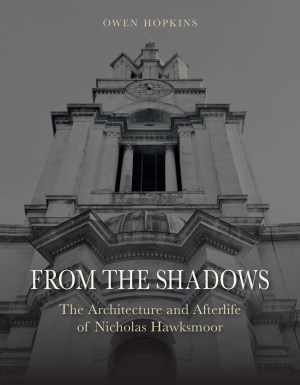 Nicholas Hawksmoor (1662–1736) is considered one of Britain’s greatest architects. He was involved in the grandest architectural projects of his age and today is best known for his London churches: six idiosyncratic edifices of white Portland stone that remain standing today, proud and tall in the otherwise radically changed cityscape. Until comparatively recently, however, Hawksmoor was thought to be, at best, a second-rate talent—merely Sir Christopher Wren’s slightly odd apprentice, or the practically minded assistant to Sir John Vanbrugh. This book brings to life the dramatic story of Hawksmoor’s resurrection from the margins of history.
Charting Hawksmoor’s career and the decline of his reputation, Owen Hopkins offers fresh interpretations of many of his famous works—notably his three East End churches—and shows how over their history Hawksmoor’s buildings have been ignored, abused, altered, recovered and celebrated. Hopkins also charts how, as Hawksmoor returned to prominence during the twentieth century, his work caught the eye of observers as diverse as T. S. Eliot, James Stirling, Robert Venturi and, most famously, Peter Ackroyd, whose novel Hawksmoor (1985) popularized the mythical association of his work with the occult. Meanwhile, passionate campaigns were mounted to save and restore Hawksmoor’s churches, reflecting the strange hold his architecture can have over observers. There is surely no other body of work in British architectural history with the same capacity to intrigue and inspire, perplex and provoke as Hawksmoor’s has done for nearly three centuries.
Owen Hopkins is a writer, historian and Architecture Programme Curator at the Royal Academy of Arts. He is the author of Reading Architecture: A Visual Lexicon (2012) and Architectural Styles: A Visual Guide (2014) and regularly leads a variety of walking tours of London architecture.
◊ ◊ ◊ ◊ ◊
C O N T E N T S
Introduction: The Man and the Myth
1 Emergence
2 Achievement
3 Falling into Shadow
4 Neglect and Rehabilitation
5 Into the Light
6 Rebirth
7 Hawksmoor Today
References
Select Bibliography
Acknowledgements
Photo Acknowledgements
Index










 Enfilade
leave a comment