New Book | Fashion Plates: 150 Years of Style
Due out next month from Yale UP:
April Calahan, edited by Karen Trivette Cannell, with a foreword by Anna Sui, Fashion Plates: 150 Years of Style (New Haven: Yale University Press, 2015), 440 pages, ISBN: 978-0300212266, $150.
 Prior to the invention of photography, European and American magazines used colorful prints to depict the latest fashion trends. These illustrations, known as ‘fashion plates’, conveyed the cutting-edge styles embraced by the fashion-conscious elite and proved inspirational to the upwardly mobile. Fashion Plates: 150 Years of Style is a comprehensive survey containing 200 fashion plates, many reproduced at actual size, from publications dating from 1778 to the early 20th century.
A number of these charming illustrations are extremely rare, and have not appeared in print since their publication in the periodicals in which they first ran. Organized chronologically and featuring both men’s and women’s garments, these lively and colorful vignettes not only are beautiful, but also clearly illustrate the evolution of fashion over time. Many of the plates were produced by important artists of the day, including Léon Bakst, George Barbier, and Georges Lepape. With texts by April Calahan on the social, political, and economic significance of fashion and its industries, and a foreword by award-winning fashion designer Anna Sui, this exquisite slipcased publication fills an important gap in the literature on the history of fashion and provides an entertaining historical overview for the general reader.
April Calahan is a fashion historian, writer and art appraiser, as well as special collections associate at the Fashion Institute of Technology, New York. Karen Trivette Cannell is assistant professor and head of special collections and the archive at the Fashion Institute of Technology, New York. Anna Sui is a fashion designer living in New York City.
Exhibition | The Edible Monument: The Art of Food for Festivals

Marcantonio Chiarini and Giacomo-Maria Giovannini, Disegni del convito fatto dall’illustrissimo signor senatore Francesco Ratta all’illustrissimo publico, eccelsi signori anziani and altra nobilità: terminando il svo confalonierato li 28. febraro 1693 (The Getty Museum). More information is available here.
◊ ◊ ◊ ◊ ◊
The Edible Monument revisits the exhibition mounted at the Getty in 2000, with the publication this fall of an accompanying catalogue.
The Edible Monument: The Art of Food for Festivals
The Getty Research Institute, Los Angeles, 13 October 2015 — 23 March 2016
Detroit Institute of Arts, 16 December 2016 — 16 April 2017
Curated by Marica Reed
Elaborate artworks made of food were created for royal court and civic celebrations in early modern Europe. Like today’s Rose Bowl Parade on New Year’s Day or Mardi Gras just before Lent, festivals were times for exuberant parties. Public celebrations and street parades featured large-scale edible monuments made of breads, cheeses, and meats. At court festivals, banquet settings and dessert buffets displayed magnificent table monuments with heraldic and emblematic themes made of sugar, flowers, and fruit. This exhibition, drawn from the Getty Research Institute’s Festival Collection, features rare books and prints, including early cookbooks and serving manuals that illustrate the methods and materials for making edible monuments.
Edited by Marcia Reed with contributions by Charissa Bremer-David, Joseph Imorde, Marcia Reed, and Anne Willan, The Edible Monument: The Art of Food for Festivals (Los Angeles: Getty Publications, 2015), 192 pages, ISBN 978-1-60606-454-2, $35.
 The Edible Monument considers the elaborate architecture, sculpture, and floats made of food that were designed for court and civic celebrations in early modern Europe. These include popular festivals such as Carnival and the Italian Cuccagna. Like illuminations and fireworks, ephemeral artworks made of food were not well documented and were challenging to describe because they were perishable and thus quickly consumed or destroyed. In times before photography and cookbooks, there were neither literary models nor a repertoire of conventional images for how food and its preparation should be explained or depicted. Although made for consumption, food could also be a work of art, both as a special attraction and as an expression of power. Formal occasions and spontaneous celebrations drew communities together, while special foods and seasonal menus revived ancient legends, evoking memories and recalling shared histories, values, and tastes. Drawing on books, prints, and scrolls that document festival arts, elaborate banquets, and street feasts, the essays in this volume examine the mythic themes and personas employed to honor and celebrate rulers; the methods, materials, and wares used to prepare, depict, and serve food; and how foods such as sugar were transformed to express political goals or accomplishments.
Marcia Reed is chief curator at the Getty Research Institute. She is coeditor of China on Paper (Getty Publications, 2007).
◊ ◊ ◊ ◊ ◊
C O N T E N T S
Acknowledgments
1 Marcia Reed—Food, Memory, and Taste
2 Marica Reed—Court and Civic Festivals
3 Marcia Reed—Feasting in the Streets: Carnivals and the Cuccagna
4 Joseph Imorde—Edible Prestige
5 Charissa Bremer-David—Of Cauliflower and Crayfish: Serving Vessels to Awaken the Palate
6 Anne Willan—Behind the Scenes
Contributors
Illustration Credits
Index
◊ ◊ ◊ ◊ ◊
Note (added 2 November 2016) — The DIA venue was not included in the original posting.
Exhibition | The Fabric of India
I noted this exhibition last fall, but it’s worth following up now that the show is on view at the V&A (3 October 2015 — 10 January 2016). The press release is available as a PDF file here, with information on the catalogue included below. –CH
◊ ◊ ◊ ◊ ◊
From the V&A shop:
Rosemary Crill, The Fabric of India (London: V&A Publishing, 2015), 240 pages, ISBN: 978-1851778539, £30 / $60.
 This is the first truly comprehensive book on Indian textiles, featuring stunning examples from all over the country. Lavishly illustrated, it begins with an in-depth exploration of the different materials, techniques, and dyeing processes used in the creation of these sumptuous fabrics before exploring the central importance of cloth to Indian life and culture from ancient times to the present day. Special features focus on objects of historical importance, including a Kashmir map shawl, Tipu Sultan’s tent, and a remarkable 18th-century temple hanging from South India.
While many are familiar with Mughal velvets, western-market chintzes, or rural embroideries, for example, this book will surprise, inspire, delight, and inform with an extraordinary range of material, much of it new. Along with presenting great historical masterpieces, the importance and variety of the basic fibers—silk, cotton, wool—from which Indian textiles are traditionally made is emphasized, and the remarkable techniques of weaving, printing, dyeing, and embroidery that have made them prized across the world are illustrated in specially taken photographs.
Exhibition | Woven Gold: Tapestries of Louis XIV
Press release (30 April 2015) from The Getty:
Woven Gold: Tapestries of Louis XIV
The Getty Center, Los Angeles, 15 December 2015 — 1 May 2016
Curated by Charissa Bremer-David
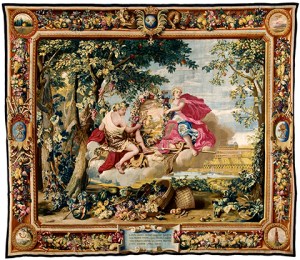
Autumn, after 1664, tapestry, wool, silk and gilt-metal wrapped thread, Gobelins Manufactory, cartoon attributed to Beaudrin Yvart (French, 1611–1690), after Charles Le Brun (French, 1619–1690), The Mobilier National, France. Photo by Lawrence Perquis.
It was during the reign of the Sun King, Louis XIV (r. 1643– 1715), that the art of tapestry weaving in France blossomed. Three hundred years after his death, the Getty Museum will showcase 15 monumental tapestries—from the French royal collection during the reign of Louis XIV. Woven Gold: Tapestries of Louis XIV will be the first major museum exhibition of tapestries in the Western United States in four decades.
During Louis XIV’s time, colorful and glittering tapestries, handwoven after designs by the most renowned artists, were the ultimate expression of status, power, taste, and wealth. The exhibition will feature 15 larger-than-life tapestries ranging in date from about 1540 to 1715 and created in weaving workshops across northern Europe. In an exclusive loan from the French nation, most of the tapestries are from the collection of the Mobilier National, which preserves the former royal collection. Eleven have never before been exhibited in the Unites States. The Getty Museum is supporting the conservation of two of the tapestries.
At the Getty, preparatory drawings, related prints and a life-sized cartoon (oil) will accompany the immense hangings. The tapestries in the exhibition are after works of art by Raphael (Raffaello Sanzio, Italian, 1483–1520), Peter Paul Rubens (Flemish, 1577–1640), Charles Le Brun (French, 1619–1690), and others. They come from the most notable workshops in Europe, including the Gobelins, which rose to preeminence under Louis XIV’s patronage. Several of the best-preserved and most famous examples of Gobelins weaving will be on view in the exhibition.
Woven Gold: Tapestries of Louis XIV is curated by Charissa Bremer-David, curator of sculpture and decorative arts at the Getty, and was organized by the J. Paul Getty Museum in association with the Mobilier National et les Manufactures Nationales des Gobelins, de Beauvais et de la Savonnerie.
◊ ◊ ◊ ◊ ◊
Charissa Bremer-David, with essays by Pascal-François Bertrand, Arnauld Brejon de Lavergnée, and Jean Vittet, Woven Gold: Tapestries of Louis XIV (Los Angeles: Getty Publications, 2015), 168 pages, ISBN: 978-1606064610, $50.
 Meticulously woven by hand with wool, silk, and gilt-metal thread, the tapestry collection of the Sun King, Louis XIV of France, represents the highest achievements of the art form. Intended to enhance the king’s reputation by visualizing his manifest glory and to promote the kingdom’s nascent mercantile economy, the royal collection of tapestries included antique and contemporary sets that followed the designs of the greatest artists of the Renaissance and Baroque periods, including Raphael, Giulio Romano, Rubens, Vouet, and Le Brun. Ranging in date from about 1540 to 1715 and coming from weaving workshops across northern Europe, these remarkable works portray scenes from the bible, history, and mythology. As treasured textiles, the works were traditionally displayed in the royal palaces when the court was in residence and in public on special occasions and feast days. They are still little known, even in France, as they are mostly reserved for the decoration of elite state residences and ministerial offices. This catalogue accompanies an exhibition of fourteen marvelous examples of the former royal collection that will be displayed exclusively at the J. Paul Getty Museum at the Getty Center from December 15, 2015, to May 1, 2016. Lavishly illustrated, the volume presents for the first time in English the latest scholarship of the foremost authorities working in the field.
Charissa Bremer-David is curator in the Department of Sculpture and Decorative Arts at the J. Paul Getty Museum. She is author of French Tapestries and Textiles in the J. Paul Getty Museum (Getty Publications, 1997) and has published extensively on French tapestries.
◊ ◊ ◊ ◊ ◊
Also on view at the Getty
As 2015 is the tercentenary of the death of Louis XIV, several exhibitions at the Getty Center will explore the Sun King’s tremendous influence on Western Art and his distinctive role as collector, heir, and patron of the art of tapestry and other arts.
• A Kingdom of Images: French Prints in the Age of Louis XIV, 1660–1715
16 June to 6 September 2015
• Louis XIV at the Getty
9 June 2015 to 31 July 2016
• Louis Style: French Frames, 1610–1792
15 September 2015 – 3 January 2016
New Book | Conundrum: Puzzles in the Grotesques Tapestry Series
Forthcoming from The Getty:
Charissa Bremer-David, Conundrum: Puzzles in the Grotesques Tapestry Series (Los Angeles: Getty Publications, 2015), 76 pages, ISBN: 978-1606064535, $20.
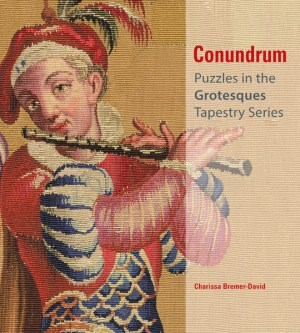 The whimsical imagery of four tapestries in the permanent collection of the J. Paul Getty Museum and currently on display at the Getty Center is perplexing. Created in France at the Beauvais manufactory between 1690 and 1730, these charming hangings, unlike most French tapestries of the period, appear to be purely decorative, with no narrative thread, no theological moral, and no allegorical symbolism. They belong to a series called the Grotesques, inspired by ancient frescos discovered during the excavation of the Roman emperor Nero’s Domus Aurea, or Golden House, but the origins of their mysterious subject matter have long eluded art historians. Based on seven years of research, Conundrum: Puzzles in the Grotesques Tapestry Series reveals for the first time that the artist responsible for these designs, Jean-Baptiste Monnoyer (1636– 1699), actually incorporated dozens of motifs and vignettes from a surprising range of sources: antique statuary, Renaissance prints, Mannerist tapestry, and Baroque art, as well as contemporary seventeenth-century urban festivals, court spectacle, and theater.
Conundrum illustrates the most interesting of these sources alongside full-color details and overall views of the four tapestries. The book’s informative and engaging essay identifies and decodes the tapestries’ intriguing visual puzzles, enlightening our understanding and appreciation of the series’ unexpectedly rich intellectual underpinnings.
Charissa Bremer-David is curator in the Department of Sculpture and Decorative Arts at the J. Paul Getty Museum. She is author of French Tapestries and Textiles in the J. Paul Getty Museum (Getty Publications, 1997) and has published extensively on French tapestries.
Study Day | Maria Hadfield Cosway
This colloquium accompanies a two-day conference (16-17 October) held in Bergamo on Luigi Marchesi, the international castrato singing superstar, who was portrayed by Richard Cosway in London and who had a close musical friendship with Maria Cosway in both London dung the late 1780s and in northern Italy during the early 1790s. From the flyer:
Maria Hadfield Cosway: Musa e benefattrice nell’età di Luigi Marchesi (1754–1829)
Fondazione Maria Cosway, Lodi, 18 October 2015
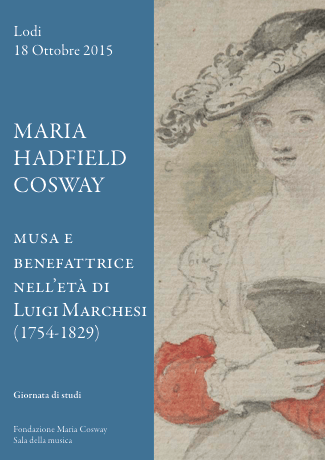 10.00 Saluti istituzionali: Francesco Chiodaroli (Fondazione Maria Cosway, Lodi), Angelo Bianchi (Università Cattolica del Sacro Cuore, Milano), Gabriella Molina (Fondazione Ospedale Marchesi, Inzago)
• Riccardo Benzoni, Napoleone a scuola: rinnovamento dell’istruzione e celebrazione del potere negli anni del Primo Impero (1804–1814)
• Cristina Cenadella, «Figlie di tutti sono le figlie di nessuno». L’orfanotrofio della Stella di Milano e le scuole di formazione interne
• Laura Giuliacci, Donne e società in Italia e in Francia ai tempi di Maria Cosway: l’educazione distinta
• Giliola Barbero, L’Europa di Maria Cosway nella sua biblioteca.
13.00 Pausa pranzo
14.30 Sessione pomeridiana
• Rosa Cafiero, L’insegnamento della musica nel Collegio delle dame inglesi: modelli europei per Maria Cosway
• Stephen Lloyd, ‘Wonderment for the table-talk of the town’: Regency London’s social and artistic context for Richard Cosway’s portrait of Luigi Marchesi (1790)
• Stefano Aresi, «If you want to hear what Italian Singing is, come to London»: Marchesi, Londra e il rapporto con Maria Cosway
16.00 Presentazione volume
Gian Carlo Sciolla presenta il nuovo volume di Tino Gipponi, La veridica storia di Maria Hadfield Cosway e il ritratto ritrovato (Lodi: PMP Editore, 2015).
New Book | The Hanoverian Succession
From Ashgate:
Andreas Gestrich and Michael Schaich, eds., The Hanoverian Succession: Dynastic Politics and Monarchical Culture (Farnham: Ashgate, 2015), 304 pages, ISBN: 978-1472437655, $135.
 The Hanoverian succession of 1714 brought about a 123-year union between Britain and the German electorate of Hanover, ushering in a distinct new period in British history. Under the four Georges and William IV Britain became arguably the most powerful nation in the world with a growing colonial Empire, a muscular economy and an effervescent artistic, social and scientific culture. And yet history has not tended to be kind to the Hanoverians, frequently portraying them as petty-minded and boring monarchs presiding over a dull and inconsequential court, merely the puppets of parliament and powerful ministers. In order both to explain and to challenge such a paradox, this collection looks afresh at the Georgian monarchs and their role, influence and legacy within Britain, Hanover and beyond.
Concentrating on the self-representation and the perception of the Hanoverians in their various dominions, each chapter shines new light on important topics: from rivalling concepts of monarchical legitimacy and court culture during the eighteenth century to the multi-confessional set-up of the British composite monarchy and the role of social groups such as the military, the Anglican Church and the aristocracy in defining and challenging the political order. As a result, the volume uncovers a clearly defined new style of Hanoverian kingship, one that emphasized the Protestantism of the dynasty, laid great store by rational government in close collaboration with traditional political powers, embraced army and navy to an unheard of extent and projected this image to audiences on the British Isles, in the German territories and in the colonies alike. Three hundred years after the succession of the first Hanoverian king, an intriguing new perspective of a dynasty emerges, challenging long held assumptions and prejudices.
Andreas Gestrich is Director of the German Historical Institute London. His present research interests comprise the history of family, childhood and youth, the history of poverty and poor relief, media history and the social history of religious groups. His publications include, among others, Absolutismus und Öffentlichkeit: Politische Kommunikation in Deutschland zu Beginn des 18. Jahrhunderts (1994), Familie im 19. und 20. Jahrhundert (1999) and (ed. with Christiane Eisenberg) Cultural Industries in Britain and Germany: Sport, Music and Entertainment from the Eighteenth to the Twentieth Century (2012).
Michael Schaich is Deputy Director of the German Historical Institute London. His current research focuses on the symbolic representation of the British monarchy and state during the seventeenth and eighteenth centuries. His publications include Staat und Öffentlichkeit im Kurfürstentum Bayern der Spätaufklärung (2001), (ed.) Monarchy and Religion: The Transformation of Royal Culture in Eighteenth-Century Europe (2007) and (ed. with R.J.W. Evans and Peter H. Wilson) The Holy Roman Empire, 1495–1806 (2011).
◊ ◊ ◊ ◊ ◊
C O N T E N T S
1 Introduction, Michael Schaich
I. Dynastic Legacies
2 The Hanoverian Monarchy and the Legacy of Late Stuart Kingship, Ronald G. Asch
3 The House of Brunswick-Lüneburg and the Holy Roman Empire: The Making of a Patriotic Dynasty, 1648–1714?, Martin Wrede.
II. Representing Protestantism
4 George I, the Hanoverian Succession, and Religious Dissent, David Wykes
5 Hanover-Britain and the Protestant cause, 1714–1760, Andrew C. Thompson
6 The Hanoverians and the Colonial Churches, Jeremy Gregory
III. Image Policies
7 The Hanoverian Monarchy and the Culture of Representation, Tim Blanning
8 ‘Every Inch Not a King’: The Bodies of the (First Two) Hanoverians, Robert Bucholz
9 Monarchy, Affection and Empire: The Hanoverian Dynasty in Eighteenth-Century America, Brendan McConville
10 Visions of Kingship in Britain under George III and George IV, G.M. Ditchfield
IV. Contested Loyalties
11 The Hanoverian Succession and the Politicisation of the British army, Hannah Smith
12 Jacobitism and the Hanoverian Monarchy, Gabriel Glickman
13 The Alternative to the House of Hanover: The Stuarts in Exile, 1714–1745, Edward Corp
14 Radical Popular Attitudes to the Monarchy in Britain during the French Revolution, Amanda Goodrich
Index
New Book | Scenes of Projection: Recasting the Enlightenment Subject
From the University of Minnesota Press:
Jill H. Casid, Scenes of Projection: Recasting the Enlightenment Subject (Minneapolis: University of Minnesota Press, 2014), 328 pages, ISBN: 978-0816646692 (cloth), $83 / ISBN: 978-0816646708 (paper), $28.
 Theorizing vision and power at the intersections of the histories of psychoanalysis, media, scientific method, and colonization, Scenes of Projection poaches the prized instruments at the heart of the so-called scientific revolution: the projecting telescope, camera obscura, magic lantern, solar microscope, and prism. From the beginnings of what is retrospectively enshrined as the origins of the Enlightenment and in the wake of colonization, the scene of projection has functioned as a contraption for creating a fantasy subject of discarnate vision for the exercise of ‘reason’.
Jill H. Casid demonstrates across a range of sites that the scene of projection is neither a static diagram of power nor a fixed architecture but rather a pedagogical setup that operates as an influencing machine of persistent training. Thinking with queer and feminist art projects that take up old devices for casting an image to reorient this apparatus of power that produces its subject, Scenes of Projection offers a set of theses on the possibilities for felt embodiment out of the damaged and difficult pasts that haunt our present.
Jill H. Casid is professor of visual studies at the University of Wisconsin–Madison. She is the author of Sowing Empire:
Landscape and Colonization (Minnesota, 2005).
◊ ◊ ◊ ◊ ◊
C O N T E N T S
Introduction: Shadows of Enlightenment
1 Paranoid Projection and the Phantom Subject of Reason
2 Empire through the Magic Lantern
3 Empire Bites Back
4 Along Enlightenment’s Cast Shadows
5 Following the Rainbow
Conclusion: Queer Projection, Theses on the ‘Future of an Illusion’
Acknowledgments
Notes
Index
Exhibition | The Italian Travels of Louis-François Cassas
Opening in November at the Musée des Beaux-Arts:
Voyages en Italie de Louis-François Cassas (1756–1827)
Musée des Beaux-Arts, Tours, 21 November 2015 — 22 February 2016
 Louis-François Cassas compte parmi les grands artistes voyageurs du XVIIIe siècle. L’exposition dévoile ici les dessins de l’artiste réalisés lors de son Grand Tour en Italie. Cette manifestation s’inscrit dans le thème transversal et séduisant du voyage et de l’Italie dans toute sa diversité archéologique, urbaine, insulaire… à la fin du Siècle des Lumières. La découverte récente de nombreux dessins inédits en Angleterre est venue confirmer l’opportunité de cette exposition : cinquante dessins prêtés par le National Trust et provenant de la collection du marquis de Bristol à Ickworth (Suffolk) seront montrés pour la première fois en France.
L’exposition s’articulera autour des deux grands voyages en Italie de L.-F. Cassas et de ses différents mécènes tous grands amateurs et collectionneurs, à l’origine de l’évolution de la carrière de l’artiste. Parmi les 116 œuvres exposées figurent des prêts de musées français et étrangers prestigieux : Paris : Bibliothèque Mazarine, Bibliothèque Nationale, Ecole Nationale Supérieure des Beaux-Arts, Fondation Custodia / New-York : Metropolitan Museum of Art / Londres : Victoria and Albert Museum, The National Trust : Ickworth (Suffolk), The Bristol Collection / Cologne : Wallraf-Richartz Museum / Vienne : Albertina Museum, et de collections privées.
Le premier voyage en Italie, 1778–83
Le Grand Tour pour le plaisir de dessiner
Grâce au mécénat du duc de Chabot, Cassas découvre l’Italie et peut obtenir une chambre d’externe à l’Académie de France à Rome. Seront évoquées les grandes étapes de cette pérégrination : Lyon, Genève, les Alpes, Bologne, Parme, Rome, Naples, Paestum… Invité à Venise au printemps 1782, puis à Trieste par le Baron Pittoni, Cassas travaille alors pour l’Empereur Joseph II jusqu’aux frontières de l’Empire ottoman. À l’automne 1782, Cassas part en Sicile travailler pour l’abbé de Saint-Non. Ses vues de Messine, de Catane, du Val di Noto… seront particulièrement remarquées.
Le second voyage en Italie, 1787–92
Les années romaines d’un artiste indépendant
Le nouveau mécène de Cassas, le comte de Choiseul- Gouffier (1752–1817), ambassadeur de France à Constantinople, permit à l’artiste de découvrir les provinces de l’Empire ottoman de 1784 à 1786. Désormais c’est dans son atelier à Rome, Piazza di Spagna, que Cassas accroche ses aquarelles de Palmyre, du Caire, de la Corne d’Or, de Chypre… qui suscitent l’admiration, notamment celle de Goethe, et des amateurs qui font le Grand Tour. Trois maquettes de monuments romains, provenant de la collection de Cassas, restaurées pour l’exposition : le Temple de la Fortune Virile, le Temple de Tivoli et l’Arc de Constantin, seront exceptionnellement présentées.
The catalogue will be available from Artbooks.com:
Sophie Join-Lambert, Louis-François Cassas (1756–1827): Ses Voyages en Italie et Ses Mécènes (Milan: Silvana Editoriale, 2015), 280 pages, ISBN: 978-8836631636, $65.
New Book | Figures Publiques: L’invention de la Célébrité, 1750–1850
From Fayard:
Antoine Lilti, Figures Publiques: L’invention de la Célébrité, 1750–1850 (Paris: Fayard, 2014), 436 pages, ISBN: 978-2213682389, 24€.
 Bien avant le cinéma, la presse à scandale et la télévision, les mécanismes de la célébrité se sont développés dans l’Europe des Lumières, puis épanouis à l’époque romantique sur les deux rives de l’Atlantique. Des écrivains comme Voltaire, des comédiens comme Garrick, des musiciens comme Liszt furent de véritables célébrités, suscitant la curiosité et l’attachement passionné de leurs « fans ». À Paris comme à Londres, puis à Berlin et New York, l’essor de la presse, les nouvelles techniques publicitaires et la commercialisation des loisirs entraînèrent une profonde transformation de la visibilité des personnes célèbres. On pouvait désormais acheter le portrait de chanteurs d’opéra et la biographie de courtisanes, dont les vies privées devenaient un spectacle public. La politique ne resta pas à l’écart de ce bouleversement culturel : Marie-Antoinette comme George Washington ou Napoléon furent les témoins d’un monde politique transformé par les nouvelles exigences de la célébrité. Lorsque le peuple surgit sur la scène révolutionnaire, il ne suffit plus d’être légitime, il importe désormais d’être populaire.
À travers cette histoire de la célébrité, Antoine Lilti retrace les profondes mutations de la société des Lumières et révèle les ambivalences de l’espace public. La trajectoire de Jean-Jacques Rousseau en témoigne de façon exemplaire. Écrivain célèbre et adulé, celui-ci finit pourtant par maudire les effets de sa « funeste célébrité », miné par le sentiment d’être devenu une figure publique que chacun pouvait façonner à sa guise. À la fois désirée et dénoncée, la célébrité apparaît comme la forme moderne du prestige personnel, adaptée aux sociétés démocratiques et médiatiques, comme la gloire était celle des sociétés aristocratiques. C’est pourtant une grandeur toujours contestée, dont l’histoire éclaire les contradictions de notre modernité.
Antoine Lilti est directeur d’études à l’École des hautes études en sciences sociales. Ses travaux portent sur l’histoire sociale et culturelle des Lumières. Il a notamment publié Le Monde des salons. Sociabilité et mondanité à Paris au xviiie siècle (Fayard, 2005).
For a review of the book, see Jessica Goodman, French Studies 69 (2015): 535–36.










 Enfilade
leave a comment