Exhibition | Drawn from the Antique: Artists and the Classical Ideal
From the Teylers Museum:
Drawn from the Antique: Artists and the Classical Ideal
Teylers Museum, Haarlem, 11 March – 31 May 2015
Sir John Soane’s Museum, London, 25 June — 26 September 2015
Curated by Adriano Aymonino and Anne Varick Lauder
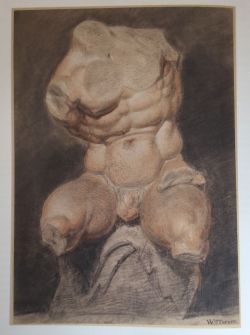
J.M.W. Turner, Study of the Belvedere Torso, black, red, and white chalks (London: V&A)
Famous statues from classical antiquity such as the Apollo Belvedere, the Laocoön and the Venus Pudica were for many centuries the chief attractions of Rome. These ‘heroes’, or plaster copies of them, were depicted in innumerable paintings, drawings and prints. It was above all the heroic nude from antiquity that inspired artists from all over Europe to produce new—in some cases trail-blazing—creations. Young artists depicted antique sculptures, or copies of them, as part of their training: this was believed to be the best way of learning how to render the classical ideal. The exhibition will include paintings and drawings of academies of art, workshops, and individual studios in which artists are hard at work vying with the ancients.
The works on display are of outstanding quality. Some of them have never been exhibited before. For this exhibition, the private collector and art dealer Katrin Bellinger has provided on loan a substantial proportion of her collection of works featuring artists’ studios. Bellinger, whose husband is the well-known entrepreneur Christoph Henkel, is a leading actor in the international art trade, specialising in old drawings. Besides the works from Katrin Bellinger’s private collection, the exhibition also includes loans from museums including the British Museum, the Rijksmuseum, and the Victoria and Albert Museum.
A useful review is available at Lowell Libson, Ltd.
◊ ◊ ◊ ◊ ◊
The catalogue will be available from Artbooks.com:
Adriano Aymonino and Anne Varick Lauder, Drawn from the Antique: Artists and the Classical Ideal (London: Sir John Soane’s Museum, 2015), 256 pages, ISBN: 978-0957339897, $50.
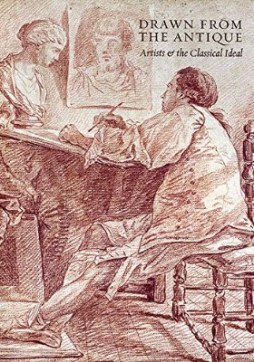 This exhibition and the accompanying catalogue examine one of the most important educational tools and sources of inspiration for Western artists for over five hundred years: drawing after the Antique. From the Renaissance to the nineteenth century, classical statues offered young artists idealised models from which they could learn to represent the volumes, poses and expressions of the human figure and which, simultaneously, provided perfected examples of anatomy and proportion. For established artists, antique statues and reliefs presented an immense repertory of forms that they could use as inspiration for their own creations. Through a selection of thirty-nine drawings, prints and paintings, covering more than four hundred years and by artists as different as Baccio Bandinelli, Federico Zuccaro, Hendrick Goltzius, Peter Paul Rubens, Michael Sweerts, Charles-Joseph Natoire, Henry Fuseli and Joseph Mallord William Turner, this catalogue provides the first overview of a phenomenon crucial for the understanding and appreciation of European art.
Exhibition | Drawn with Spirit: Pennsylvania German Fraktur
The exhibition at the Philadelphia Museum of Art closed last week; the catalogue is distributed by Yale UP:
Lisa Minardi, with an interview by Ann Percy, Drawn with Spirit: Pennsylvania German Fraktur from the Joan and Victor Johnson Collection (New Haven: Yale University Press, 2015), 364 pages, ISBN: 978-0300210521, $65.
 Among the most beloved forms of American folk art, fraktur is a Germanic tradition of decorated manuscripts and printed documents noted for its use of bold colors and whimsical motifs. This publication makes a landmark contribution to the study of Pennsylvania German fraktur, and offers the most comprehensive study of the topic in over 50 years. The featured objects, most of which have never been published, accompany significant new information about the artists who made these works and the people who owned them. An introductory essay sets the renowned Johnson Collection within the context of collecting and scholarship on Pennsylvania German folk art and then highlights major new discoveries, including connections between fraktur and related examples of furniture and prints. An interview with the collectors offers valuable insights into the formation of this special group of objects, which includes birth and baptismal certificates, bookplates, religious texts, writing samples, house blessings, cutworks, and printed broadsides. The splendid color illustrations reveal schools of artistic and regional influence, giving a nuanced understanding of how artists took inspiration from one another and how designs were transferred to new locations. Detailed catalogue entries include extensive information about each piece as well as complete translations.
Lisa Minardi is an assistant curator at Winterthur Museum and a specialist in Pennsylvania German art and culture.
New Book | Perspectives on the Honours Systems
From The Royal Swedish Academy:
Antti Matikkala and Staffan Rosén, eds., Perspectives on the Honours Systems: Proceedings of the Symposiums Swedish and Russian Orders 1700–2000 and the Honour of Diplomacy (Stockholm: The Royal Swedish Academy of Letters, History and Antiquities, 2015), 322 pages, ISBN: 978-9174024302, 311SEK.
 Perspectives on the Honours Systems opens new multidisciplinary avenues for research on both historical and current methods by which monarchs, heads of state and governments have honoured individuals in different contexts, primarily in the Nordic countries and Russia. The essays are mostly based on papers given at two symposiums (in Stockholm 2009 and in Helsinki 2011).
The essays have been arranged in six thematic and broadly chronological parts. The first part analyses the foundation of the Swedish orders of knighthood and the background debates beginning in the 1690s. The second part looks at the orders of knighthood as instruments of diplomacy from the late Middle Ages mostly up to the Napoleonic period, while the third part approaches the material aspect of honours. The fourth part is chronological, concentrating on the first half of the twentieth century from the perspective of diplomacy as well as the wearing of orders and decorations. The fifth part, with emphasis on the Far East, discusses honorific contacts with Denmark and Russia. The sixth and last part describes the current diplomatic use of Finnish and Swedish orders as well as the Russian award system of today.
By taking a long perspective, 14 historians, archivists, museum curators, officers of orders and diplomats address fundamental questions related to honours: why honours systems have been established, what kind of role they have played in different historical situations and their current relevance in modern societies.
Antti Matikkala is a historian specializing in the honours systems. He was Fellow at the Helsinki Collegium for Advanced Studies, University of Helsinki, 2009–2012.
Staffan Rosén is Vice Chancellor and Secretary of the Swedish Royal Orders of Knighthood. He is retired Professor of Korean Studies at Stockholm University and a member of the Royal Swedish Academy of Letters, History and Antiquities.
New Book | Textual Vision
From Rowman & Littlefield:
Timothy Erwin, Textual Vision: Augustan Design and the Invention of Eighteenth-Century British Culture (Lewisburg, PA: Bucknell University Press, 2015), 310 pages, ISBN: 978-1611485691 (hardback), ISBN: 978-1611485707 (ebook), $95 / £60.
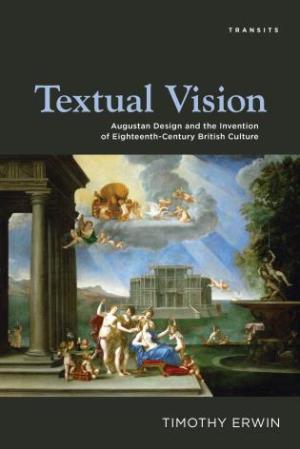 A stylish critique of literary attitudes towards painting, Textual Vision explores the simultaneous rhetorical formation and empirical fragmentation of visual reading in enlightenment Britain. Beginning with an engaging treatment of Pope’s Rape of the Lock, Timothy Erwin takes the reader on a guided tour of the pointed allusion, apt illustration, or the subtle appeal to the mind’s eye within a wide array of genres and texts, before bringing his linked case studies to a surprising close with the fiction of Jane Austen.
At once carefully researched, theoretically informed and highly imaginative, Textual Vision situates textual vision at the cultural crossroads of ancient pictura-poesis doctrine and modernist aesthetics. It provides reliable interpretive poles for reading enlightenment imagery, offers vivid new readings of familiar works, and promises to invigorate the study of Restoration and eighteenth-century visual culture.
Timothy Erwin is professor of English at the University of Nevada, Las Vegas.
◊ ◊ ◊ ◊ ◊
C O N T E N T S
List of Illustrations
Acknowledgments
Abbreviations and Short Titles
Introduction: Image, Ekphrasis, and Verbal Coloring
1 Bold Design in Alexander Pope
2 Promise and Performance in Johnson’s Life of Savage Plates Gallery
3 Visual Discourse in Hogarth, the Early Novel, and History
4 Picturing Jane Austen
Bibliography
Index
New Book | The Danish Country House
Published by Museum Tusculanum Press and distributed by The University of Chicago Press:
John Erichsen and Mikkel Venborg Pedersen, The Danish Country House (Copenhagen: Museum Tusculanum Press, 2014), 253 pages, ISBN: 978-8763543064, 51€ / $80.
 Denmark’s many manors are a treasure trove of natural and cultural riches. As well as the scenic beauty and magnificent architecture they have to offer, they also stand as monuments to more than five centuries of Danish history. The landscapes and buildings of Denmark’s manors form a fascinating universe and a key part of the country’s cultural heritage. Denmark’s famous fairytale author Hans Christian Andersen and the internationally renowned storyteller Karen Blixen (Isak Dinesen) were both fascinated by the unique atmosphere of the Danish country house, which—as their fairy tales and stories reveal—was a lasting source of inspiration in their writings. Also today, the cultural and natural environment of the manor appeals to the heart and soul. This book provides the reader with the key to understanding and experiencing this cultural heritage. More than one hundred of Denmark’s 700 manors are now partially or wholly open to the public. This book is your guide to them all.
John Erichsen, M.A. in History and Art History, is the former director of The Museum of Copenhagen and Vice Director of The National Museum of Denmark. Since 1997 he has run the cultural history research and publishing company HISTORISMUS. He has published extensively, also on the cultural history of the manor.
Mikkel Venborg Pedersen, PhD and DPhil. in European Ethnology and Cultural History. Senior researcher at The National Museum of Denmark. He has worked professionally with both elite and mass culture in Early Modern Europe, and has published extensively on cultural history, as well as on ethnological and historical theory and methodology.
New Book | Studies in Ephemera
First published in 2013, Studies in Ephemera was recently released in paperback:
Kevin Murphy and Sally O’Driscoll, eds., Studies in Ephemera: Text and Image in Eighteenth-Century Print (Lewisburg, PA: Bucknell University Press, 2015), 318 pages, ISBN: 978-1611484946 (hardback), ISBN: 978-1611486612 (paperback), ISBN: 978-1611484953 (ebook), $90 / $45.
 Studies in Ephemera: Text and Image in Eighteenth-Century Print brings together established and emerging scholars of early modern print culture to explore the dynamic relationships between words and illustrations in a wide variety of popular cheap print from the seventeenth to the early nineteenth century. While ephemera was ubiquitous in the period, it is scarcely visible to us now, because only a handful of the thousands of examples once in existence have been preserved. Nonetheless, single-sheet printed works, as well as pamphlets and chapbooks, constituted a central part of visual and literary culture, and were eagerly consumed by rich and poor alike in Great Britain, North America, and on the Continent. Displayed in homes, posted in taverns and other public spaces, or visible in shop windows on city streets, ephemeral works used sensational means to address themes of great topicality. The English broadside ballad, of central concern in this volume, grew out of oral culture; the genre addressed issues of nationality, history, gender and sexuality, economics, and more.
Richly illustrated and well researched, Studies in Ephemera offers interdisciplinary perspectives into how ephemeral works reached their audiences through visual and textual means. It also includes essays that describe how collections of ephemera are categorized in digital and conventional archives, and how our understanding of these works is shaped by their organization into collections. This timely and fascinating book will appeal to archivists, and students and scholars in many fields, including art history, comparative literature, social and economic history, and English literature.
Kevin D. Murphy is professor and executive officer in the PhD Program in Art History at the CUNY Graduate Center. He is the author of Jonathan Fisher of Blue Hill, Maine: Commerce, Culture, and Community on the Eastern Frontier (2010), as well as articles on nineteenth- and twentieth-century subjects in the Journal of the Society of Architectural Historians, Winterthur Portfolio, and the Journal of Urban History.
Sally O’Driscoll teaches English at Fairfield University. Her work on eighteenth-century literature and culture has appeared in such journals as Signs, Tulsa Studies in Women’s Literature, and Eighteenth-Century: Theory and Interpretation.
◊ ◊ ◊ ◊ ◊
C O N T E N T S
Illustrations
Acknowledgments
1 Introduction — ‘Fugitive Pieces’ and ‘Gaudy Books’: Textual, Historical, and Visual Interpretations of Ephemera in the Long Eighteenth Century, Kevin D. Murphy and Sally O’Driscoll
Part I: Definitions and Categorizations
2 Of Grubs and Other Insects: Constructing the Categories of ‘Ephemera’ and ‘Literature’ in Eighteenth-Century British Writing, Paula McDowell
3 Digitizing Ephemera and Its Discontents: EBBA’s Quest to Capture the Protean Broadside Ballad, Patricia Fumerton
4 What Gets Printed from Oral Tradition: Anna Gordon’s Ephemeral Ballads, Ruth Perry
5 Approaches to Ephemera: Scottish Broadsides, 1679–1746, Adam Fox
6 Ephemera at the American Antiquarian Society: Perspectives on Commercial Life in the Long Eighteenth Century, Georgia Barnhill
Part II: Text and Image
7 Making Sense of Broadside Ballad Illustrations in the Seventeenth and Eighteenth Centuries, Alexandra Franklin
8 ‘A Battleground Around the Crime’: The Visuality of Execution Ephemera and Its Cultural Significances in Late Seventeenth-Century England, Tara Burk
9 From ‘The Easter Wedding’ to ‘The Frantick Lover’: The Repeated Woodcut and Its Shifting Roles, Theodore Barrow
10 What Kind of Man Do the Clothes Make? Print Culture and the Meanings of Macaroni Effeminacy, Sally O’Driscoll
Bibliography
Index
New Book | Les Chasseurs de Marly et les œuvres de Nicolas Coustou
From Somogy:
Geneviève Bresc-Bautier, Les Chasseurs de Marly et les œuvres de Nicolas Coustou au musée du Louvre (Paris: Somogy éditions d’Art, 2015), 144 pages, ISBN: 978-2757207598, 19€.
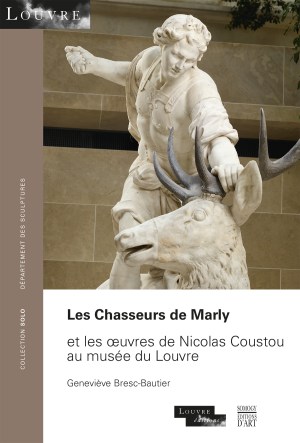 Le sculpteur Nicolas Coustou a manifesté ses talents à la fin du règne de Louis XIV et au début du règne de Louis XV par de grands marbres, animés par un souffle épique ou par la grâce féminine. La plupart de ses œuvres destinées au parc de Marly sont désormais exposées dans la cour Marly au Louvre. Art royal, officiel, il est cependant traversé de touches personnelles, faites de dynamisme, et d’un sens puissant des volumes que magnifient des draperies volantes et des mouvements contrastés.
Le parc de Marly et son décor appartiennent aux grandes réalisations du règne de Louis XIV. C’est en effet sur cette colline, déjà habitée mais en lisière des grandes forêts de chasse, que Louis XIV a choisi de se faire construire, par Jules Hardouin-Mansart, une résidence plus intime que Versailles. Alors que les bâtiments ont été détruits à la Révolution, et que le parc reste seul à évoquer la grandeur passée, la sculpture a été transférée dès le XVIIIe siècle au jardin des Tuileries. Le musée du Louvre, gestionnaire du jardin, s’en trouve donc l’héritier et a entrepris depuis 1870 la sauvegarde et l’exposition des œuvres provenant du parc de Marly. En 1993, l’ouverture de la cour Marly qui présente la majeure partie des sculptures connues a été l’occasion de mettre en valeur les marbres les plus célèbres, dont les emblématiques Chevaux de Marly d’Antoine Coysevox et de Guillaume Coustou.
En 1703, une commande prestigieuse fut adressée à Nicolas Coustou, neveu d’Antoine Coysevox, celle de deux grands groupes en marbre, Méléagre tuant le cerf et Méléagre tuant le sanglier, première œuvre d’envergure pour l’artiste. Dès 1706, les Chasseurs sont achevés et mis à une place d’honneur à proximité du Pavillon royal de Marly.
Le Louvre expose déjà dans la cour Marly l’ensemble des sculptures de la grande perspective du domaine de Marly : les chevaux de Coysevox, les groupes de fleuves, les statues de Neptune, Amphitrite, la Seine et la Marne, et les deux groupes de trois statues qui étaient situées non loin des deux Méléagre, Faune, Adonis et des Nymphes. Les deux Méléagre étaient les seules pièces manquantes à ce grand axe, rythmé par des statues qui se répondent deux à deux. Ils sont le complément du groupe d’Adonis et des Nymphes, pour évoquer la glorification de la nature sauvage qui est un thème majeur de l’iconographie du lieu, fait d’eaux et de bois.
◊ ◊ ◊ ◊ ◊
S O M M A I R E
Nicolas Coustou, dans le sillage de son oncle et de son frère
À Rome : la découverte de l’antique
Sous l’égide de l’Académie de peinture et de sculpture
Sous l’autorité de Jules Hardouin-Mansart
Jules César
Les œuvres de Nicolas Coustou dans le parc de Marly
Les premiers vases
Les vases de pierre
Les plombs dorés
Les groupes et les grands vases du bassin des Nappes
Les vases aux instruments de musique champêtre
La Seine et la Marne
Les deux groupes de Chasseurs
Le Chasseur et les Nymphes chasseresses
Apollon poursuivant Daphné
Sous la direction de Robert de Cotte
Monuments funéraires
Le Tombeau du prince de Conti
Les portraits
Portrait du Grand Dauphin
Louis XV en Jupiter
La cour Marly et les sculptures du parc de Louis XIV
Catalogue des œuvres de Nicolas Coustou au musée du Louvre
Bibliographie
New Book | Artful Virtue
From Ashgate:
Leslie Ellen Brown, Artful Virtue: The Interplay of the Beautiful and the Good in the Scottish Enlightenment (Farnham: Ashgate Publishing, 2015), 284 pages, ISBN: 978-1472448484, $120.
 During the Scottish Enlightenment the relationship between aesthetics and ethics became deeply ingrained: beauty was the sensible manifestation of virtue; the fine arts represented the actions of a virtuous mind; to deeply understand artful and natural beauty was to identify with moral beauty; and the aesthetic experience was indispensable in making value judgments. This book reveals the history of how the Scots applied the vast landscape of moral philosophy to the specific territories of beauty—in nature, aesthetics and ethics—in the eighteenth century. The author explores a wide variety of sources, from academic lectures and institutional record, to more popular texts such as newspapers and pamphlets, to show how the idea that beauty and art made individuals and society more virtuous was elevated and understood in Scottish society.
Leslie Ellen Brown is Professor Emerita of Music at Ripon College. Her earliest publications were in the field of early eighteenth-century French opera, with her later work concentrating on eighteenth-century Scottish studies.
◊ ◊ ◊ ◊ ◊
C O N T E N T S
Introduction
1 The Senses
2 Virtue
3 Beauty
4 Sentiment
5 Taste
6 Experience
7 Cultivation
8 Traditions
Afterword
Select Bibliography
Index
Exhibition | Handel: A Life with Friends
From the Handel House Museum:
Handel: A Life with Friends
Handel House Museum, London, 1 July 2015 — 10 January 2016
Curated by Ellen Harris
 What was it like to live next to the great composer Handel? Who would call at his house? Who did he visit? In this new exhibition, Handel scholar Ellen Harris will explore the composer’s domestic life at 25 Brook Street and the many friends and neighbours who visited him at the new, fashionable residential district called ‘May Fair’.
Handel’s music brought this disparate group of men and women together, as amateur performers in their own homes and as audiences at performances of his operas and oratorios. With important loans from national, local and private collections, the exhibition—inspired by Ellen Harris’s new book George Frideric Handel: A Life With Friends—will offer a rare glimpse into the public and private lives of some of Handel’s closest friends.
◊ ◊ ◊ ◊ ◊
From Norton:
Ellen T. Harris, George Frideric Handel: A Life with Friends (New York: Norton, 2014), 496 pages, ISBN: 978-0393088953, $40.
 An intimate portrait of Handel’s life and inner circle, modeled after one of the composer’s favorite forms: the fugue.
During his lifetime, the sounds of Handel’s music reached from court to theater, echoed in cathedrals, and filled crowded taverns, but the man himself—known to most as the composer of Messiah—is a bit of a mystery. Though he took meticulous care of his musical manuscripts and even provided for their preservation on his death, very little of an intimate nature survives.
One document—Handel’s will—offers us a narrow window into his personal life. In it, he remembers not only family and close colleagues but also neighborhood friends. In search of the private man behind the public figure, Ellen Harris has spent years tracking down the letters, diaries, personal accounts, legal cases, and other documents connected to these bequests. The result is a tightly woven tapestry of London in the first half of the eighteenth century, one that interlaces vibrant descriptions of Handel’s music with stories of loyalty, cunning, and betrayal.
With this wholly new approach, Harris has achieved something greater than biography. Layering the interconnecting stories of Handel’s friends like the subjects and countersubjects of a fugue, Harris introduces us to an ambitious, shrewd, generous, brilliant, and flawed man, hiding in full view behind his public persona.
Ellen T. Harris is professor emeritus at MIT and has served on the music faculties of Columbia University and The University of Chicago. Her previous books include Handel as Orpheus: Voice and Desire in the Chamber Cantatas, and she has spoken at Lincoln Center and appeared on PBS NewsHour and BBC Radio 3. She lives in Newton, Massachusetts.
Exhibition | Pope Pius VII and Napoleon at Fontainebleau
From Napoleon.org and the Château de Fontainebleau:
Pie VII Face à Napoléon: La Tiare dans les Serres de l’Aigle
Château de Fontainebleau, 28 March — 29 June 2015
Curated by Christophe Beyeler and Jean Vittet
The Château of Fontainebleau hosted Pope Pius VII twice: first as a guest as he travelled to Napoleon’s coronation in 1804 and then as prisoner between 1812 and 1814. From 1796 until 1814, Rome and Paris were most notably embroiled in a bitter struggle over iconography. The exhibition at Fontainebleau looks at their diplomatic gifts, stolen artistic treasures, and the official French propaganda celebrating the Concordat of 1801 and defending the invasion of the Papal States in 1808 and the arrest of Pius VII in 1809. Napoleon I and Pius VII finally came head-to-head in 1812 at Fontainebleau. The exhibition contains nearly 130 items, some never displayed before, including loans from the Vatican museum and the papal sacristy.
◊ ◊ ◊ ◊ ◊
Le château de Fontainebleau a accueilli par deux fois le pape Pie VII, comme hôte sur le chemin du sacre en 1804, puis comme prisonnier entre 1812 et 1814. L’appartement des Reines-Mères, baptisé depuis lors « appartement du Pape », en conserve aujourd’hui le souvenir.
 Fontainebleau est à cet égard l’un des lieux qui incarne le mieux les relations tumultueuses entre Rome et Paris, dont l’une des expressions est la « guerre d’image » que se livrent les deux puissances, de 1796 à 1814.
L’exposition évoque d’abord la mainmise des Français sur quelques-uns des trésors de la collection pontificale, la célébration du concordat de 1801 par l’imagerie officielle ou encore l’iconographie subtile des cadeaux diplomatiques lors du sacre de 1804. La guerre de propagande, qui atteint son paroxysme avec l’invasion des États pontificaux en 1808 et l’arrestation de Pie VII en 1809, est ensuite décryptée à travers l’image d’une Rome antique renaissant grâce au « César moderne ». Le Pape, retenu à Savone depuis 1809, est conduit à Fontainebleau en 1812, où les deux protagonistes s’affrontent. L’Empereur parvient à arracher en janvier 1813 un éphémère concordat au Pape qui, libéré en 1814, est accueilli à Rome par une imagerie triomphaliste.
Près de 130 œuvres, parmi lesquelles des acquisitions inédites, ainsi que des prêts exceptionnels des musées du Vatican ou de la Sacristie pontificale, illustrent un affrontement où se combinent enjeux religieux, politiques et artistiques. En écho, sur les lieux mêmes de sa détention, les éléments retrouvés et restaurés du mobilier qu’a connu Pie VII sont rassemblés pour la première fois depuis le Premier Empire.
The 13-page press package is available here»
◊ ◊ ◊ ◊ ◊
The catalogue is available from Dessin Original:
Christophe Beyeler, ed., Pie VII Face à Napoléon: La Tiare dans les Serres de l’Aigle (Paris: RMN, 2015), 248 pages, ISBN: 978-2711862474, 39€.










 Enfilade
leave a comment