Exhibition | Korea Mania: A Traveller’s Tale
On view in Sèvres:
Corée Mania: Roman d’un Voyageur
Cité de la Céramique, Sèvres, 21 January — 20 July 2015
Curated by Stéphanie Brouillet
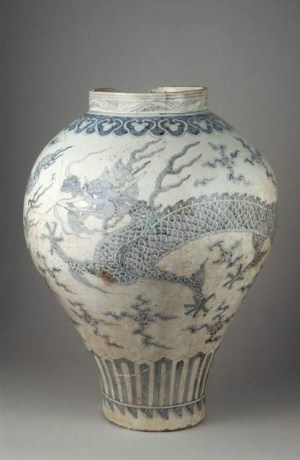
Dragon Jar, Korean, 18th century (MNC28154 Sèvres – Cité de la céramique / RMN)
Cité de la céramique célébre en 2015 les Années croisées France-Corée, en organisant deux expositions: l’une patrimoniale avec Roman d’un voyageur, l’autre contemporaine à travers la présentation des œuvres de Yik-Yung Kim et Yeun-Kyung Kim.
Du 21 janvier au 20 juillet, l’exposition Roman d’un voyageur s’articule autour de la figure emblématique du diplomate Victor Collin de Plancy (1853–1922), premier consul de France en Corée qui collecta de nombreux objets et œuvres d’art coréens. L’exposition invite à un double voyage : celui vers la péninsule coréenne, au cœur de l’Extrême-Orient, à la découverte d’une culture ancienne et raffinée, et l’autre sous la forme d’une plongée dans le temps, vers le « royaume ermite » de la fin de l’époque Choson, à la fin du XIXe siècle.
De nombreuses céramiques dont certaines exceptionnelles du 1er siècle de notre ère à nos jours, dont la grande jarre à décor de dragon du XVIIIe siècle, considérée comme un chef-d’oeuvre des collections nationales conservées par l’établissement, sont présentées ainsi que du mobilier, des instruments de musique, des objets quotidiens, des photographies, des peintures, des documents d’archives qui évoquent le pays et son art de vivre.
Une journée d’étude sur le céladon, à la fois sous l’angle historique mais aussi scientifique, prévue à l’automne, viendra ponctuer cette saison coréenne à la Cité de la céramique.
Le commissariat est assuré par Stéphanie Brouillet, conservatrice du patrimoine chargée des céramiques asiatiques à Sèvres. La scénographie est confiée au designer Vincent Dupont-Rougier.
A summary in English is available from the Asia Europe Museum Network (ASEMUS):
◊ ◊ ◊ ◊ ◊
The catalogue is published by Loubatières:
 Roman d’un Voyageur, Victor Collin de Plancy: L’histoire des Collections Coréennes en France (Carbonne: Loubatières, 2015), 263 pages, ISBN: 978-2862667195, 39€.
Victor Collin de Plancy fut le premier représentant de la France en Corée entre 1888 et 1906. Interprète puis diplomate, il se passionna pour l’histoire et l’art de ce pays resté longtemps fermé pour les Occidentaux. Désireux de le faire connaître en France, il rassembla un grand nombre d’objets—céramiques, manuscrits, livres, meubles ou costumes—dont il fit don à des institutions françaises au rang desquelles figure le Musée national de la céramique. Il fut également au cœur d’un petit groupe de voyageurs passionnés par la Corée qui, à leur tour, enrichirent les collections françaises.
A preview of the catalogue is available here»
The Burlington Magazine, May 2015
The eighteenth century in The Burlington:
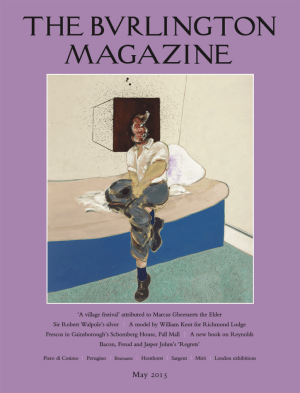
The Burlington Magazine 157 (April 2015)
 A R T I C L E S
• Tessa Murdoch, “Power and Plate: Sir Robert Walpole’s Silver,” pp. 318–24.
• Julius Bryant, “Queen Caroline’s Richmond Lodge by William Kent: An Architectural Model Unlocked,” pp. 325–30.
R E V I E W S
• Duncan Robinson, Review of Mark Hallet, Reynolds: Portraiture in Action (The Paul Mellon Centre for Studies in British Art, 2014), pp. 341–47. Available at The Burlington website for free.
• Stephen Lloyd, Review of Cory Korkow with Jon Seydl, British Portrait Miniatures: The Cleveland Museum of Art (D. Giles, Ltd., 2013), pp. 349–50.
• Richard Wolfe, Review of the exhibition Shifting Patterns: Pacific Barkcloth Clothing (British Museum, 2015), pp. 361–62.
• Jamie Mulherron, Review of two exhibitions: Charles de La Fosse: Le Triomphe de la Couleur (Versailles and Nantes, 2015) and Bon Boullogne (1649–1717): Un chef d’école au Grand Siècle (Dijon, 2014–15), pp. 365–67.
New Book | Ireland: Crossroads of Art and Design, 1690–1840
In connection with the exhibition now on view the Art Institute of Chicago, Yale University Press is distributing the catalogue (congratulations, Ireland, on an inspiring weekend). –CH
William Laffan and Christopher Monkhouse, eds., with Leslie Fitzpatrick, Ireland: Crossroads of Art and Design, 1690–1840 (New Haven: Yale University Press, 2015), 288 pages, ISBN: 978-0300210606, $50.
 This groundbreaking book captures a period in Ireland’s history when countless foreign architects, artisans, and artists worked side by side with their native counterparts. Nearly all of the works within this remarkable volume—many of them never published before—have been drawn from North American collections. This catalogue accompanies the first exhibition to celebrate the Irish as artists, collectors, and patrons over 150 years of Ireland’s sometimes turbulent history.
Featuring the work of a wide range of artists—known and unknown—and a diverse array of media, the catalogue also includes an impressive assembly of essays by a pre-eminent group of international experts working on the art and cultural history of Ireland. Major essays discuss the subjects of the Irish landscape and tourism, Irish country houses, and Dublin’s role as a center of culture and commerce. Also included are numerous shorter essays covering a full spectrum of topics and artworks, including bookbinding, ceramics, furniture, glass, mezzotints, miniatures, musical instruments, pastels, silver, and textiles.
William Laffan is an art historian and author, and former editor of Irish Architectural and Decorative Studies: The Journal of the Irish Georgian Society. Christopher Monkhouse is the chair and Eloise W. Martin Curator, Department of European Decorative Arts, at the Art Institute of Chicago.
New Book | Voltaire, Siècle de Louis XIV, volumes 1–6
From the Voltaire Foundation:
Voltaire, Siècle de Louis XIV, volumes 1–6, edited by Diego Venturino, et al. (Oxford: Voltaire Foundation, 2015–17).

Attributed to Antoine Benoist (1632–1717), Portrait of Louis XIV, lead pencil, sanguine and white chalk (Château de Versailles)
2015 marks the 300th anniversary of the death of Louis XIV (1638–1715), the Sun King, whose reign defined the era of the ‘Grand Siècle’ and saw France rise to become the dominant player on the European stage. To mark this anniversary, the Voltaire Foundation, in collaboration with the Château de Versailles, is publishing Voltaire’s seminal account of his reign, the Siècle de Louis XIV (1751), the first major overall account of the reign of Louis XIV. This text is the starting-point for any reflection on the political and cultural history of the era of the Sun King, and is a monument of eighteenth-century historiography, paving the way for both modern historiography and literary history. The lasting success of this flagship work is due to the depth of Voltaire’s insight into the people and events that he is describing and to his historical method, which was remarkable for its day. The emphasis on first-hand accounts from those who witnessed events and on the perspective of the age as a whole rather than a parade of facts bears the stamp of Voltaire. This edition is the first-ever full critical edition, and will be published in volumes 11–13 of the Complete Works of Voltaire. It takes as its base text the last version of the work that Voltaire authorised (1775), and gives variant readings from all preceding versions of the text. It will include the Catalogue des écrivains français qui ont paru dans le siècle de Louis XIV, an important and fascinating work in its own right. The edition will be supplied with an index with full names and dates of all persons mentioned in the text. These volumes are published with the support of the Centre de recherche du château de Versailles.
See “The Sun King and Voltaire: 300 Years On” for an overview of good reading relating to Louis XIV and his era, along with our Siècle de Louis XIV blog pieces: “Picturing the Reign of Louis XIV” and “Shadows at the Court of the Sun King.”
◊ ◊ ◊ ◊ ◊
• Œuvres complètes de Voltaire, tome 11 | Siècle de Louis XIV (I): Introduction, Textes annexes, Index (Oxford: Voltaire Foundation, 2017), ISBN: 978-0729411462.
• Œuvres complètes de Voltaire, tome 12 | Siècle de Louis XIV (II): Listes et Catalogue des écrivains (Oxford: Voltaire Foundation, 2016), ISBN: 978-0729411479.
• Œuvres complètes de Voltaire, tome 13A | Siècle de Louis XIV (III): Chapitres 1–12 (Oxford: Voltaire Foundation, 2015), ISBN 978-0729409650.
• Œuvres complètes de Voltaire, tome 13B | Siècle de Louis XIV (IV): Chapitres 13–24 (Oxford: Voltaire Foundation, 2015), ISBN: 978-0729411561.
• Œuvres complètes de Voltaire, tome 13C | Siècle de Louis XIV (V): Chapitres 25–30 (Oxford: Voltaire Foundation, 2015), ISBN: 978-0729411578.
• Œuvres complètes de Voltaire, tome 13D | Siècle de Louis XIV (VI): Chapitres 31–39 (Oxford: Voltaire Foundation, 2016), ISBN: 978-0729411554.
Exhibition | Unbuttoning Fashion

◊ ◊ ◊ ◊ ◊
Now on view at Les Arts Décoratifs:
Déboutonner la mode
Les Arts Décoratifs, Paris, 10 February — 19 July 2015
For the first time, the Déboutonner la mode exhibition at Les Arts Décoratifs is unveiling a collection of over 3,000 buttons unique in the world, and also featuring a selection of more than 100 female and male garments and accessories by emblematic couturiers such as Paul Poiret, Elsa Schiaparelli, Christian Dior, Jean Paul Gaultier and Patrick Kelly. Acquired in 2012, this collection was classified as a Work of Major Heritage Interest by the Consultative Commission on National Treasures.

Button, late eighteenth century, wax on painted metal
(Paris: Les Arts Décoratifs)
Although small in size, the priceless materials and skills involved in making these pieces dating from the 18th to the 20th century can make them fully-fledged objets d’art. Produced by artisans ranging from embroiderers, soft furnishers, glassmakers and ceramicists to jewellers and silversmiths, they crystallise the history and evolution of these skills. The button has also fascinated famous painters, sculptors and creators of jewellery, inspiring them to produce unique miniature creations for the great couture houses.
This collection, gathered by Loïc Allio, is exemplary in its variety, richness and eclecticism. Its exceptional pieces include a portrait of a woman in the Fragonard manner, a trio of buttons inspired by La Fontaine’s fables by the silversmith Lucien Falize, a set of eight birds painted on porcelain by Camille Naudot, and a series of 792 pieces by the sculptor Henri Hamm. The jewellers Jean Clément and François Hugo and the artists Jean Arp and Alberto Giacometti all produced pieces for the famous fashion designer Elsa Schiaparelli, as did Maurice de Vlaminck for the couturier Paul Poiret. Couture houses such as Dior, Balenciaga, Mme Grès, Givenchy, Balmain and Yves Saint Laurent enlisted the talents of the jewellers Francis Winter and Roger Jean-Pierre, and the exhibition also features creations by Sonia Delaunay and Line Vautrin.
Structured chronologically, the exhibition reveals the incredible history of the button, showing via this extraordinary collection how it perfectly reflects the creativity and humour of a period. Pictures, engravings, drawings and fashion photographs emphasize its importance on the garment and how crucial it is in creating the balance of a silhouette.

Button, attributed to Fragonard, late eighteenth century, miniature on ivory (Paris: Les Arts Décoratifs)
Since its appearance in the 13th century, the button has maintained its key role on the garment. Its production and use gradually developed but the golden age of the button in France did not come until the late 18th century, when it became a luxury item often more expensive than the garment itself. More than a mere ornament, it was also a means of conveying penchants and opinions, via humorous, intimate and even political messages (portraits of the royal family, scenes showing storming of the Bastille, etc.). However, not until around 1780 and the French craze for all things English, did the button appear in female fashion, on dresses and bodices with cuts inspired by male garments.
In the 19th-century male wardrobe the art of the button gave way to the art of buttoning. Now smaller and more discreet, the button came to denote the degree of refinement of a garment or level of distinction of its wearer. The attention paid to its positioning is particularly apparent on that most essential component of the male wardrobe, the waistcoat. With the industrial revolution in the second half of the 19th century button manufacturing developed into a full-scale industry mass-producing all sizes and colours of buttons for every type of garment and accessory.
Women’s buttons remained much more modest in size but their number increased. They now also appeared on ankle boots, gloves and eventually lingerie as the number of undergarments increased around 1850. Their number was precisely noted in fashion magazines and their description in contemporary literature established them as objects of coquetry and even seduction. In parallel, silversmiths and jewellers created valuable buttons, sometimes presented in caskets like jewellery and reflecting the artistic movements of the period, especially Art Nouveau.
The first floor of the exhibition ends with the 1910s and the return of the so-called ‘Empire’ line under the influence of the avant-garde-inspired couturier Paul Poiret, for whom the importance of a detail, for instance a button and its precise positioning, is dictated by a “secret geometry that is the key to aestheticism.”
The exhibition continues with the fashion of the 20s, featuring Art Deco buttons and the emergence of the paruriers, creators of accessories, jewellery and buttons, each with their own style and preference for different materials. Their close collaborations with the great couturiers are highlighted in a display featuring creations for Elsa Schiaparelli, Jean Clément and Jean Schlumberger. François Hugo’s designs for Schiaparelli include uncut stones set in bent and compressed metal. He also enlisted the talents of artists such as Pablo Picasso and Jean Arp for original creations. The decline of the button began in the 80s as couturiers returned to more minimal creations in which the button regained its original use.
In counterpoint to creations by artists, the exhibition emphasizes the manner in which certain couturiers creatively used and interpreted the button in their own way, ranging from Gabrielle Chanel and Christian Dior to Cristobal Balenciaga and the ‘jewellery buttons’ of Yves Saint Laurent. And of course there are also exquisite 21st-century examples, notably Jean Paul Gaultier’s trouser suit entirely covered with small mother-of-pearl buttons, and the coats by Céline subtly revisiting double-breasted buttoning.
Despite the emergence and increasing use of new types of fastenings such as the zip, the pressure button and velcro, the button is ever-present and still has many years to come.
◊ ◊ ◊ ◊ ◊
From Les Arts Décoratifs:
Véronique Belloir, ed., Déboutonner la mode (Paris: Les Arts Décoratifs, 2015), 164 pages, ISBN: 978-2916914541, 45€.
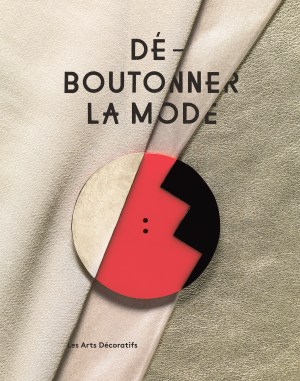 Il est des objets avec lesquels nous entretenons des rapports tout en délicatesse, entre conscience et émotion. À plus d’un titre, le bouton est de ceux-là, de ceux que l’on conserve parfois, sans bien savoir pourquoi, au fond d’une poche ou dans une boîte. Sur un vêtement, qu’il soit masculin ou féminin, son rôle est loin d’être anodin : élément structurant l’équilibre des formes, il entre en résonance avec une ligne, celle d’une boutonnière, d’une couture ou celle du vêtement lui-même. L’histoire du bouton révèle bien d’autres aspects méconnus. Qu’il soit modeste et utile ou précieux et décoratif, sa place évolue au fil du temps en fonction des convenances, des règles de savoir-vivre ou des variations de mode.
Sous la direction de Véronique Belloir, chargée de collections au musée Galliera. Auparavant conservatrice au musée des Arts décoratifs, en charge des collections mode 1800-1940, elle a fait classer la collection de boutons de Loïc Allio en 2012. Textes de Loïc Allio, Véronique Belloir, Raphaèle Billé, Farid Chenoune, Michèle Heuzé, Geoffrey Martinache, Sophie Motsch, Hélène Renaudin. Photographies de Patrick Gries. Référence dans le milieu de l’édition d’art, il excelle dans la photographie d’objets complexes, monumentaux ou minuscules, en répondant à de nombreuses commandes pour le monde du luxe, du design et de l’art contemporain.
New Book | James Thomson’s The Seasons
From Rowman & Littlefield:
Sandro Jung, James Thomson’s The Seasons, Print Culture, and Visual Interpretation, 1730–1842 (Bethlehem, PA: Lehigh University Press, 2015), 318 pages, ISBN: 978-1611461916 (hardback), ISBN: 978-1611461923 (ebook), $80 / £53.
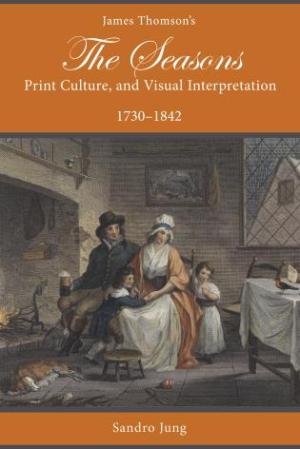 Drawing on the methods of textual and reception studies, book history, print culture research, and visual culture, this interdisciplinary study of James Thomson’s The Seasons (1730) understands the text as marketable commodity and symbolic capital which throughout its extended affective presence in the marketplace for printed literary editions shaped reading habits. At the same time, through the addition of paratexts such as memoirs of Thomson, notes, and illustrations, it was recast by changing readerships, consumer fashions, and ideologies of culture. The book investigates the poem’s cultural afterlife by charting the prominent place it occupied in the visual cultures of eighteenth- and early nineteenth-century Britain. While the emphasis of the chapters is on printed visual culture in the form of book illustrations, the book also features discussions of paintings and other visual media such as furniture prints. Reading illustrations of iconographic moments from The Seasons as paratextual, interpretive commentaries that reflect multifarious reading practices as well as mentalities, the chapters contextualise the editions in light of their production and interpretive inscription. They introduce these editions’ publishers and designers who conceived visual translations of the text, as well as the engravers who rendered these designs in the form of the engraving plate from which the illustration could then be printed. Where relevant, the chapters introduce non-British illustrated editions to demonstrate in which ways foreign booksellers were conscious of British editions of The Seasons and negotiated their illustrative models in the sets of engraved plates they commissioned for their volumes.
Sandro Jung is research professor of early modern British literature and founding director of the Centre for the Study of Text and Print Culture at Ghent University.
Exhibition | Costumes by Bellange and Berain
From Chantilly:
Fastes de cour au XVIIe siècle: Les costumes de Bellange et Berain
Château de Chantilly, 13 May — 13 August 2015
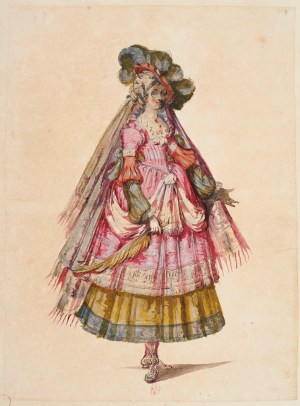 This exhibition is the first public showcasing of a portfolio acquired by the Duke of Aumale in 1854, which is now kept in the Condé museum in Chantilly. The portfolio features 23 exceptional drawings by Jacques Bellange (c. 1575–1616), depicting the Lorraine region festivities for the wedding of Henri de Bar and Marguerite de Gonzague (1606), as well as a series of 34 prints by Jean Berain (1640–1711) featuring watercolour, gold and silver highlights and magnificently depicting the splendours of the courts of Lorraine and France from the beginning to the end of the 17th century.
Paulette Choné and Jérôme de La Gorce, Fastes de cour au XVIIe siècle: Les costumes de Bellange et Berain (Saint-Remy-en-l’Eau: Éditions Monelle Hayot, 2015), 264 pages, ISBN: 978-2903824945, 49€.
Paulette Choné, professeur émérite des Universités, a enseigné l’histoire de l’art moderne à l’Université de Bourgogne. Philosophe, spécialiste de la civilisation des XVIe et XVIIe siècles, elle a consacré une large partie de ses travaux à l’art lorrain, aux fêtes de cour, aux études emblématiques qu’elle a contribué à mettre à l’honneur en France.
Jérôme de La Gorce est directeur de recherche au CNRS, historien d’art et musicologue. Auteur de plusieurs livres, il s’est spécialisé dans les arts de l’éphémère en étudiant notamment les dessins relatifs aux fêtes, aux spectacles et aux cérémonies aux XVIIe et XVIIIe siècles.
Exhibition | A Golden Age of China: Qianlong Emperor, 1736–1795

Jin Tingbiao, Chinese active (c. 1750–68), and Giuseppe Castiglione (attributed to), Italian 1688–1766, worked in China 1714–66, The Qianlong Emperor Enjoying the Pleasures of Life, poem inscribed by Qianlong Emperor in the spring of 1763, coloured inks on silk, 168 x 320 cm (The Palace Museum, Beijing, Gu5278)
◊ ◊ ◊ ◊ ◊
From the press release (26 March 2015) for the exhibition:
A Golden Age of China: Qianlong Emperor, 1736–1795
National Gallery of Victoria, Melbourne, 27 March — 21 June 2015
Hidden treasures from Beijing’s Palace Museum in the Forbidden City have come to Melbourne for the first time, in an Australian exclusive exhibition. A Golden Age of China: Qianlong Emperor, 1736–1795 tells the story of China’s foremost art collector Qianlong Emperor, one of China’s most successful rulers, fourth emperor of the Qing dynasty (1644–1911) and longest living emperor in Chinese history.
This exhibition provides an unprecedented opportunity to explore a rich concentration of more than 120 works from the Palace Museum’s art collection, which is built on the imperial collection of the Ming and Qing dynasties and holds some of China’s most rare and valuable works of art in its collection. . . .

Giuseppe Castiglione, Portrait of Qianlong Emperor in Ceremonial Court Robe, 1736, coloured inks on silk, 239 x 179 cm (The Palace Museum, Beijing, Gu6464)
The Qianlong Emperor’s long 60-year reign (1736–1795) was a particularly fascinating time in China’s history. Under his rule, China was the wealthiest and most populous nation in the world. Qianlong’s ability to preserve and foster his Manchu warrior-huntsman traditions whilst adopting the Confucian principles of political and cultural leadership, resulted in the successful governing of 150 million Chinese people.
It was his ability to adopt Chinese ways, yet honour his Manchu traditions that made him one of the most successful emperors of the Qing dynasty. He studied Chinese painting, loved to paint, and particularly loved to practice calligraphy. He was a passionate poet and essayist, and over 40,000 poems and 1300 pieces of prose are recorded in his collected writings. Qianlong wrote more poetry in his lifetime than all the poets in the Tang dynasty (618–906) combined, a dynasty known for its golden age of poetry. Aside from his own art practice, Qianlong combined his passion for collecting art with his role as preserver and restorer of Chinese cultural heritage. He also embraced the arts of other cultures: European, Japanese and Indian. Giuseppe Castiglione, an Italian Jesuit brother, exerted a great deal of influence over the arts in the court
academy of the Qianlong Emperor.
The exhibition puts the spotlight on Qianlong’s reign and art in five separate sections: Manchu Emperor, Son of Heaven, Imperial art under the Emperor’s patronage, Imperial art of religion and Chinese scholar, art connoisseur and collector. Visitors can enjoy a lavish display of paintings on silk and paper, silk court robes, precious-stone inlayed objet d’art and portraits of the Qianlong Emperor, Empress and imperial concubines; paintings of hunting scenes, court ceremonies and the private life of the Qianlong Emperor; and paintings of the Emperor as scholar and art collector. The exhibition also presents paintings and calligraphy by the Emperor himself as well as classical paintings in his collection. The exhibition includes a sumptuous display of ceremonial weapons of swords, bows and arrows, a chair made of antlers’ horns, silk court robes and ceremonial hats, amongst other ceremonial and palace treasures.
New Book | The Vitruvian Tradition in Enlightenment Poland
Forthcoming from Penn State UP:
Ignacy Potocki, Remarks on Architecture: The Vitruvian Tradition in Enlightenment Poland, edited and translated by Carolyn C. Guile (University Park: The Pennsylvania State University Press, 2015), 176 pages, ISBN: 978-0271066288, $75.
 At the end of the eighteenth century, the authors of Poland’s 3 May 1791 Constitution became the heirs to a defunct state whose territory had been partitioned by Russia, Prussia, and Austria. At this moment of intensive national postmortem, Ignacy Potocki, an eminent statesman and co-author of the Constitution, composed an architectural treatise. One of the best-preserved examples of early modern Polish architectural thought, published and translated here for the first time, the Remarks on Architecture announces itself as a project of national introspection, with architecture playing a direct role in the betterment of the nation. In it, Potocki addresses his remarks to the contemporary Polish nobility and conveys the lessons of a Vitruvian canon that shaped Continental classical architectural theory and practice throughout the early modern period. He argues that architecture is a vessel for cultural values and that it plays an important part in the formation and critique of broader national traditions. In her introduction, Carolyn Guile further explores Polish Enlightenment architectural writing as an example of cultural exchange, inheritance, and transformation.
Carolyn C. Guile is Assistant Professor of Art History at Colgate University.
Exhibition | Thé, Café ou Chocolat?
From the Musée Cognacq-Jay:
Thé, Café ou Chocolat? l’essor des boissons exotiques au XVIIIe siècle
Tea, Coffee, or Chocolate? The Boom of Exotic Drinks in the Eighteenth Century
Musée Cognacq-Jay, Paris, 26 May — 27 September 2015
Curated by Rose-Marie Herda-Mousseaux
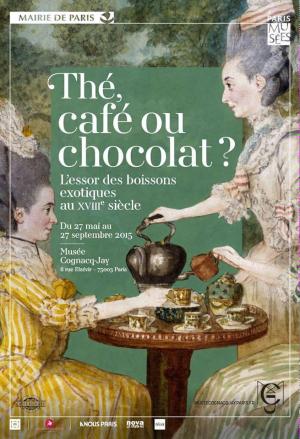 Praised for their medical and therapeutic virtues, the ‘exotic’ beverages, introduced to Europe in the 17th century became a real cornerstone of pleasure and social life during the 18th century. Drinks made with cocoa, coffee and tea—plants not grown in Europe—became an integral part of aristocratic and the upper middle class society following their official introductions to the courts of Europe. As an imported material, their high purchase price in the 17th and 18th centuries classed tea, coffee and chocolate as luxury goods and enhanced their prestigious. This was reflected in items of furniture and tableware designed for the consumption of these new drinks. Porcelain tea sets and other beautiful and luxurious pieces were produced in specialised manufactories. The rise of these products also created a new need for places designed for the public consumption of these drinks, such as cafes, and new mealtime additions such as at breakfast and afternoon tea, that spread throughout society. This exhibition offers a new overview of these beverages and their entry into the rituals of everyday life, presenting works by many iconic 18th-century artists such as Boucher and Chardin.
Louées pour leurs vertus médicales et thérapeutiques, les boissons dites « exotiques », introduites au XVIIe siècle en Europe, ont été associées aux plaisirs et aux sociabilités du XVIIIe siècle. Les boissons issues du cacaoyer, du caféier et du théier—plantes exogènes à l’Europe—ont fait partie intégrante des sociabilités de l’aristocratie et de la haute bourgeoisie dès leurs introductions officielles auprès des cours d’Europe. En tant que matière importée, leur coût d’achat classe au XVIIe et au XVIIIe siècles le thé, le café et le chocolat parmi les produits de luxe et ajoute à leur consommation celle de l’image affichée du prestige. Leur consommation s’est matérialisée dans l’apparition de mobiliers et de nécessaires ou services produits dans les manufactures. Elle a aussi permis l’existence de lieux de consommation publique, les cafés, et de nouvelles pratiques de table, telles le petit déjeuner et le goûter, qui se diffusent progressivement dans la société. Organisée autour de trois axes—« Vertus et dangers des boissons exotiques », « Cercles de consommation » et « Nouveaux services »—cette exposition propose une nouvelle lecture de ces boissons entrées dans les rituels du quotidien, en présentant des oeuvres de nombreux artistes emblématiques du XVIIIe siècle comme Boucher ou Chardin.
Commissaire: Rose-Marie Herda-Mousseaux, conservateur du patrimoine et directrice du musée Cognacq-Jay, avec la collaboration scientifique de Patrick Rambourg, chercheur et historien spécialiste de la cuisine et de la gastronomie, et de Guillaume Séret, docteur en histoire de l’art, spécialiste de la porcelaine de Sèvres.
Rose-Marie Herda-Mousseaux, Patrick Rambourg, Guillaume Séret, Thé, Café ou Chocolat? l’essor des boissons exotiques au XVIIIe siècle (Paris Musées, 2015), 176 pages, ISBN: 978-2759602834, 35€.
The press release (a 14-page PDF file) is available here»










 Enfilade
leave a comment