New Book | 1715: La France et la Monde
From Perrin:
Thierry Sarmant, 1715: La France et la Monde (Paris: Éditions Perrin, 2014), 400 pages, ISBN: 978-2262033316, 24€.
 Versailles, 1 er septembre 1715. Après une longue agonie, Louis XIV s’éteint “comme une chandelle que l’on souffle”. Ainsi finit le “Grand Siècle” (XVIIe) et commence le “siècle des Lumières” (XVIIIe). À ces expressions est d’ordinaire attachée l’idée d’une prépondérance française, politique et militaire d’abord, culturelle et intellectuelle ensuite. Qu’en est-il réellement ?
En observant les relations que tisse la France avec le monde, en questionnant sa place et son rôle autour de l’année charnière 1715, Thierry Sarmant éclaire l’un des phénomènes les plus saisissants de l’histoire humaine : l’essor de l’Occident vers une hégémonie mondiale. Alors que la question du déclin de la France et de l’Europe est omniprésente, quoi de plus pertinent que de s’interroger sur les ressorts cachés de l’expansion et du déclin ? C’est le pari de ce livre, qui entraine le lecteur de Versailles à Moscou, d’Istanbul à Stockholm et de Pékin à Delhi.
Archiviste-paléographe, Docteur habilité de l’université de Paris-I, Thierry Sarmant est conservateur en chef au musée Carnavalet. Historien de l’Ancien Régime, il a publié en dernier lieu Régner et gouverner : Louis XIV et ses ministres (en collaboration, 2010) et Louis XIV. Homme et roi (2012).
New Book | Le Luxe, les Lumières et la Révolution
From Les Éditions Champ Vallon:
Audrey Provost, Le Luxe, les Lumières et la Révolution (Seyssel: Éditions Champ Vallon, 2014), 272 pages, ISBN: 978-2876739796, 25€.
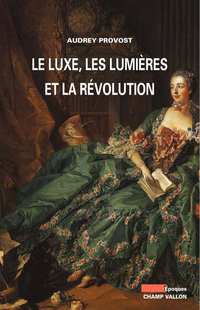 De sa réhabilitation par Voltaire dans son scandaleux poème du Mondain à son utilisation dans les pamphlets prérévolutionaires, le luxe est l’un des sujets les plus brûlants, les plus débattus du siècle des Lumières. D’innombrables auteurs, petits ou grands, se sont interrogés sur cet objet futile et sulfureux qui leur permet de parler de tout : des arts et des sciences, des femmes et de la confusion sociale, du bonheur et des inégalités, du progrès ou du déclin de l’esprit humain.
Alors que la monarchie a cessé d’édicter des lois somptuaires, alors que le discours de l’Église est marginalisé, des écrivains s’érigent en juges, en avocats et en législateurs de la « culture des apparences ». Ce faisant, ils s’adressent à l’opinion publique et proclament haut et fort les nouveaux pouvoirs de l’écriture : l’affrontement autour du luxe met en jeu les compétences et la légitimité des hommes de lettres à fixer des valeurs communes, en concurrence directe avec le pouvoir royal.
Au cœur de cette effervescence polémique, nous croisons les figures attachantes de ces petits polygraphes, ces « Rousseau des ruisseaux » qui tentent de prendre place dans la République des lettres ; nous faisons connaissance du « serial publicateur » que fut le chevalier du Coudray ; nous apprenons comment écrire un livre sur le luxe, à la manière d’un Rabelleau ; nous suivons la lutte entre Butel-Dumont et ses contradicteurs pour changer le sens du mot, et inventer des adjectifs et des étymologies transformées en autant de munitions dans cette guerre de libelles et de pamphlets.
À la fin des années 1780, les fastes de la monarchie ont cessé d’éblouir et le luxe de Marie-Antoinette, « l’Autrichienne » est devenu, sous la plume acérée des pamphlétaires, une arme politique redoutable, car ce débat foisonnant a aussi contribué au changement de culture politique qui mène à la Révolution.
Née en 1970, ancienne élève de l’ENS (Ulm), Audrey Provost est agrégée d’histoire.
◊ ◊ ◊ ◊ ◊
From its vindication in Voltaire’s scandalous poem Le Mondain, to its strategic use in pre-revolutionary pamphlets, luxury figures as the subject of some of the most heated debates of the eighteenth century. Innumerable authors, canonical and non, raised questions about this frivolous and yet fiery topic that allowed them to speak about everything and anything: of the arts and sciences, of women and social confusion, of happiness and inequality, of the progress or decline of the human spirit.
As the monarchy stopped issuing sumptuary laws, as the Church’s discourse was marginalized, writers presented themselves as judges, defenders, and legislators of the “culture of appearances.” In the process they addressed themselves to public opinion, and loudly proclaimed the new powers of writing: indeed, the debates about luxury put into play the competence and legitimacy of men of letters as they established a common set of values in a direct challenge of royal authority.
At the heart of these polemics, we find the touching figures of small polygraphs, those “Rousseau des ruisseaux” who tried to establish a place for themselves in the Republic of Letters. We meet a “serial publisher” in the figure of the chevalier du Coudray; we learn how to write a book on luxury according to Rabelleau; we follow the competition between Butel-Dumont and his opponents as they sought to change the meaning of the word “luxury,” and to invent adjectives and etymologies that became ammunition in this war of libels and pamphlets.
At the end of the 1780s, the fasts of the monarchy ceased to dazzle, and the luxury of Marie-Antoinette the “Austrian” became a considerable political weapon under the pen of pamphleteers. The ensuing debate contributed to a change in political culture, which eventually would lead to the Revolution.
Exhibition | Wellington: Triumphs, Politics and Passions
Press release (29 October 2014) from the NPG:
Wellington: Triumphs, Politics and Passions
National Portrait Gallery, London, 12 March — 7 June 2015
Curated by Paul Cox with Lucy Peltz

Sir Thomas Lawrence, Portrait of Arthur Wellesley, 1st Duke of Wellington, 1815–16. (London: Wellington Collection, Apsley House, English Heritage).
The first gallery exhibition devoted to the Duke of Wellington will open at the National Portrait Gallery, to mark the 200th anniversary year of the Battle of Waterloo in 2015. Wellington: Triumphs, Politics and Passions will explore not only the political and military career of the victor of this great battle—but also his personal life through portraits of his family and friends.
Highlights include Goya’s portrait of Wellington started in 1812 after his entry into Madrid and later modified twice to recognise further battle honours and awards; and from Wellington’s London home, Apsley House, Thomas Lawrence’s famous 1815 portrait painted in the same year as the Battle of Waterloo. This iconic military image of Wellington was used as the basis of the design of the British five pound note from 1971 to 1991.
Drawn from museums and private collections including that of the present Duke of Wellington, the exhibition of 59 portraits and other art works has the support of the Marquess of Douro, and includes rarely-seen loans from the family including a portrait by John Hoppner of the Duke as a youthful soldier and a daguerreotype portrait by Antoine Claudet, in the new medium of photography, taken on Wellington’s 75th birthday in 1844. The family has also loaned Thomas Lawrence’s beautiful drawing of Wellington’s wife, Kitty (née Pakenham).
The real experience of soldiers fighting in Wellington’s armies will be explored through eyewitness accounts, including prints based on sketches by serving soldiers and the illustrated diary of a young officer, Edmund Wheatley written, in a lively style, with the intention of it being read by his sweetheart.

Francisco de Goya, Portrait of Arthur Wellesley, 1st Duke of Wellington, 1812–14 (London: The National Gallery).
Wellington: Triumphs, Politics and Passions considers the attempts of the art world to celebrate the Duke of Wellington’s military successes. Commemorative objects on display will range from royal commissions by Europe’s foremost artists and manufacturers to more modest souvenirs aimed at the domestic market. Wellington’s eventful and often difficult political career will be illustrated by examples of the many satirical prints published in the 1820s and 1830s and the exhibition will also examine the reappraisal of Wellington’s life that took place at his death and on the occasion of his lavish state funeral.
The Duke of Wellington’s long life (1769–1852) spanned the eighteenth and nineteenth centuries. Most famous for his victory over Napoleon at the battle of Waterloo, he later entered politics, serving twice as Prime Minister. Wellington: Triumphs, Politics and Passions will explore the role of visual culture in creating the hero, the legacy of heroism and the role of the portrait in Wellington’s own public and personal self-representation.
Curated by Paul Cox, Associate Curator, National Portrait Gallery, with close support from Dr Lucy Peltz, Curator of Eighteenth-Century Portraits, National Portrait Gallery, this biographical exhibition will use portraits and objects to explore Wellington’s military career and his sometimes controversial political and personal life.
Paul Cox, Associate Curator, National Portrait Gallery, London, says: “The Duke of Wellington’s victory over Napoleon at Waterloo is well known. This exhibition provides the opportunity to examine less familiar aspects of his life, including the long political career during which he saw through important forward-looking legislation, but suffered a dramatic loss of popularity. I hope that visitors to the exhibition will gain a fuller picture of Wellington as a man, rather than simply as a hero.”
The exhibition is part of the Battle of Waterloo 200th Anniversary Commemorations, the national partnership of commemorative events.
◊ ◊ ◊ ◊ ◊
Paul Cox, with a foreword by William Hague, Wellington: Triumphs, Politics and Passions (London: National Portrait Gallery, 2015), 128 pages, ISBN: 978-1855144996, £15.
This new book about the 1st Duke of Wellington provides a novel take on the traditional biography in that it explores the life of this complex man through portraits of Wellington himself, his friends, family and associates, as well as his political and military allies and opponents. There are examples of painted portraits by Goya and Thomas Lawrence, several caricatures that illustrate Wellingtons political career, and a watercolour by George Chinnery that shows the future duke as a young Major-General at the Chepauk Palace, Madras being received by Azim al-Daula, Nawab of the Carnatic, in February 1805. Also reproduced is a rare photograph, a Daguerreotype, made by Antoine Claudet on the occasion of Wellingtons seventy-fifth birthday in 1844, and sections of a sixty-six-foot roll from the Collection of the National Portrait Gallery depicting his entire funeral procession. Paul Cox explores Wellingtons military career and the battle of Waterloo, which remain central to his story, but also examines his personal relationships, his legacy and his enduring place in the popular imagination. Finally, a narrative chronology presents a useful overview of Wellingtons life and times.
New Book | Memoirs of the Court of George III
From Pickering & Chatto:
Michael Kassler, Lorna Clark, Alain Kerhervé, and Peter Sabor, eds., Memoirs of the Court of George III, 4 vols., (London: Pickering & Chatto, 2015), c.1600 pages, ISBN: 978-1848934696, £350 / $625.
 George III was one of the longest reigning British monarchs, ruling over most of the English-speaking world from 1760 to 1820. Despite his longevity, George’s reign was one of turmoil. Britain lost its colonies in the War of American Independence and the European political system changed dramatically in the wake of the French Revolution. Closer to home, problems with the King’s health led to a constitutional crisis. Charlotte Papendiek’s memoirs cover the first thirty years of George III’s reign, while Mary Delany’s letters provide a vivid portrait of her years at Windsor. Lucy Kennedy was another long-serving member of court whose previously unpublished diary provides a great deal of new detail about the King’s illness. Finally, the Queen herself provides further insights in the only two extant volumes of her diaries, published here for the first time.
The edition will be invaluable to scholars of Georgian England as well as those researching the French and American Revolutions and the history and politics of the Regency period more widely. It will complement the ongoing project, The Court Journals and Letters of Frances Burney (OUP).
• All texts are first-hand accounts from those close to George III and relate information on important events, including the American and French Revolutions and the King’s ‘madness’
• Two volumes are editions of previously unpublished manuscripts
• All the texts are rare and Queen Charlotte’s diaries are newly transcribed from the Royal Archives at Windsor Castle
• Editorial apparatus includes a general introduction, volume introductions, headnotes, footnotes and indexes to the texts
General Editor: Michael Kassler, Independent scholar
Volume Editor: Lorna J Clark, Carleton University
Volume Editor: Alain Kerhervé, University of Western Brittany
Consultant Editor: Peter Sabor, McGill University
Volume 1
The Memoirs of Charlotte Papendiek (1765–1840): Court, Musical and Artistic Life in the Time of King George III
Mrs Papendiek’s Memoirs record events at court from 1761—when the future Queen Charlotte came to England to marry King George—until 1792. The Papendieks knew many musicians, including John Christian Bach (son of Johann Sebastian), William Herschel (who became an astronomer) and Haydn. The memoirs also record meetings with artists of the day, such as Thomas Lawrence and Thomas Gainsborough. They are a unique resource, recording significant information about living conditions, dress, education and Anglo-German relations.
Volume 2
Mary Delany (1700–1788) and the Court of George III
Though she failed to become a handmaiden to Queen Anne, Mary Delany went on to become a figure at Court, eventually lodging at Windsor. This new edition of her correspondence during her years at Windsor presents previously unpublished letters as well as applying modern standards of editorial principles to her correspondence. The letters show the daily rituals of living at Court, document the first social steps of Fanny Burney and Mary Georgina Port, and supply new information on the family life of the royal family – including material on the assassination attempt against George III by Margaret Nicholson.
Volume 3
The Diary of Lucy Kennedy (1793–1816)
Lucy Kennedy (c.1731–1826), had an insider’s view of life in Windsor castle and of members of the Royal Family for fifty-three years. Her diary, preserved in the Royal Library, Windsor Castle, has never before been published. In it she writes a moving account of the death of Princess Amelia which precipitated the final illness of George III and the Regency. Her observations of his symptoms are relevant for modern-day diagnoses of his malady.
Volume 4
The Diary of Queen Charlotte, 1789 and 1794
Queen Charlotte kept a diary in which she recorded her daily activities as well as those of George III and other members of the royal family. Only her volumes for 1789 and 1794 survive, in the Royal Archives at Windsor Castle. Her 1789 diary shows how the king’s illness and recovery impacted upon their lives. Both diary volumes provide hitherto unpublished information about court life and the royal family.
New Book | The Visual Culture of Catholic Enlightenment
From Penn State UP:
Christopher M. S. Johns, The Visual Culture of Catholic Enlightenment (University Park: Penn State University Press, 2014), 440 pages, ISBN: 978-0271062082, $90.
 Until relatively recently, most scholars considered the notion of a Catholic enlightenment either oxymoronic or even illusory, since the received wisdom was that the Catholic Church was a tireless and indefatigable enemy of modernist progress. According to Christopher Johns, however, the eighteenth-century papacy recognized the advantages of engaging with certain aspects of enlightenment thinking, and many in the ecclesiastical hierarchy, both in Italy and abroad, were sincerely interested in making the Church more relevant in the modern world and, above all, in reforming the various institutions that governed society. Johns presents the visual culture of papal Rome as a major change agent in the cause of Catholic enlightenment while assessing its continuing links to tradition. The Visual Culture of Catholic Enlightenment sheds substantial light on the relationship between eighteenth-century Roman society and visual culture and the role of religion in both.
New Book | Ladies of the Grand Tour in Naples and Environs
Published by Grimaldi and available from ArtBooks.com: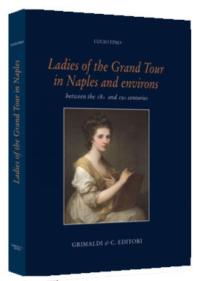
Lucio Fino, Ladies of the Grand Tour in Naples and Environs between the 18th and 19th Centuries (Naples: Grimaldi, 2014), 197 pages, ISBN: 978-8898199211, 95€ / $150.
Large volume with 145 color plates, many of which are full-paged reproductions—some previously unpublished—of prints, drawings, paintings, and watercolours from public and private collections. English text.
Exhibition | Eighteenth-Century Fans from the Lázaro Collection
◊ ◊ ◊ ◊ ◊
Thanks to Pierre-Henri Biger for noting this exhibition now on view at the Fundación Lázaro Galdiano:
Abanicos del Siglo XVIII en la Colección Lázaro
Museo Lázaro Galdiano, Madrid, 10 October 2014 — 26 January 2015
Curated by Carmen Espinosa
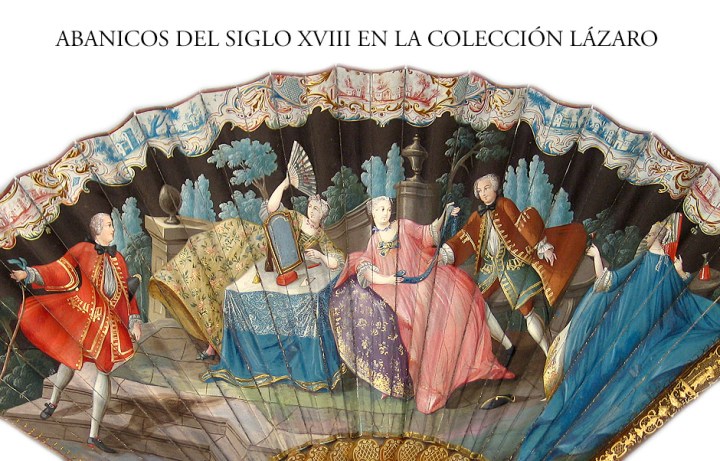
La exposición Abanicos del siglo XVIII en la Colección Lázaro, comisariada por Carmen Espinosa, conservadora jefe del Museo Lázaro Galdiano, se compone de una cuidada selección de 24 piezas correspondientes a la edad de oro del abanico, elemento fundamental del adorno personal femenino, signo de distinción y de lujo. La gran variedad de abanicos que atesoró José Lázaro es muestra de su incansable búsqueda como coleccionista, de meses e incluso años, para encontrar piezas con las que obsequiar a su esposa, Paula Florido, desde que la conoció en 1901.
Los ejemplares expuestos en Abanicos del siglo XVIII en la Colección Lázaro constituyen un excelente repertorio que permite al visitante apreciar la evolución de este complemento femenino. Se muestran obras tempranas, del primer tercio del siglo XVIII, donde las referencias al barroco clasicista son evidentes; piezas en las que vemos cómo se va fraguando el gusto rococó que dio lugar al abanico galante, fiel reflejo de la vida refinada y placentera de los nobles y burgueses europeos del segundo tercio de la centuria; y otras de estructura sencilla, pero de calidad, que nos adentran en el estilo neoclásico y la moda Imperio.
Las pinturas de los países están realizadas sobre papel o vitela -piel de vaca o ternera, adobada y pulida-, materiales que permiten el plegado, y están inspiradas en asuntos mitológicos, históricos, galantes y pastorales. Los poemas homéricos de la Iliada y la Odisea, unidos a la Eneida de Virgilio y Las Metamorfosis de Ovidio, fueron una fuente inagotable para los pintores de abanicos junto a las gestas de Alejandro Magno cuya figura encarnó los ideales de valor, poder y nobleza. La pintura de los abanicos de estilo Luis XV, identificados con el rococó, refleja la creciente hegemonía de la mujer en la vida social, protagonista indiscutible reflejada en la diosa Venus, personificación del amor, la belleza y la fertilidad; en Juno, diosa del matrimonio y protectora de la mujer; o en Onfalia que hizo que Hércules olvidará su valentía abandonándose a los placeres del amor. De la historia religiosa, habitual en abanicos del primer tercio del siglo, se escogieron relatos del Antiguo Testamento, aquellos donde la mujer desempeñó un papel fundamental como Sansón y Dalila, Salomé, Betsabé o la reina de Saba. A partir de 1750, a la literatura se unen, como fuente de inspiración para los pintores, el teatro, la ópera y el ballet.
Las pinturas de Antoine Coypel, Charles Le Brun y sobre todo las de Jean Antoine Watteau y François Boucher, creadores de la fiesta galante y de la pintura pastoral, son otro gran referente para la decoración de los abanicos dieciochescos. Esta riqueza iconográfica se muestra en los abanicos de la Colección Lázaro y queda patente en esta exposición.
Variedad y calidad están presentes en los abanicos de esta muestra, citemos como ejemplo uno francés con la representación de la Alegoría de las Artes o el italiano con una escena de toilette, que figuran entre las más ostentosas de la colección. También podemos deleitarnos con los elegantes varillajes realizados en marfil o carey con trabajo de piqué -técnica italiana adoptada en Francia e Inglaterra que consiste en la incrustación de pequeños fragmentos de oro y plata-, tallados y calados en forma de rejilla o puntos -grillé / pointillé-, a los que se añaden pequeñas láminas de madreperla, plata dorada o corlada, nácar y, en ocasiones, piedras preciosas en el adorno de las palas y en el clavillo -pasador que sujeta las varillas, las fuentes y palas, del abanico-.
La colección de abanicos, compuesta por noventa piezas, es un caso especial entre todas las que conforman la Colección Lázaro. Sus obras, nos explica Carmen Espinosa, son algo más que objetos de colección, fueron testigos mudos de una relación personal, la de los coleccionistas José Lázaro y Paula Florido: desde que se conocieron, en 1901, y hasta la muerte de Paula en 1932, Lázaro regaló a su esposa abanicos en dos fechas muy señaladas: el 15 de enero, día de su cumpleaños, y el 29 de junio, en que celebraba su onomástica. Estos abanicos responden al gusto de Lázaro que se esforzó por encontrar las piezas con las que agasajar a su esposa aunque, evidentemente, existió cierta complicidad pues conocía su preferencia por la época de Luis XV y Luis XVI. Los abanicos del XVIII estaban considerados, a comienzos del siglo XX y aún hoy, como verdaderas joyas, muy buscadas y de gran valor.
◊ ◊ ◊ ◊ ◊
From La Tienda de Los Museos Online:
Este catálogo recoge la colección completa de abanicos (casi un centenar) en la que están incluidas las 24 piezas de la exposición.
Arte, Lujo y Sociabilidad: La Colección de Abanicos de Paula Florido (Año Edición, 2009), 134 pages, ISBN: 978-8496411906, 12€.
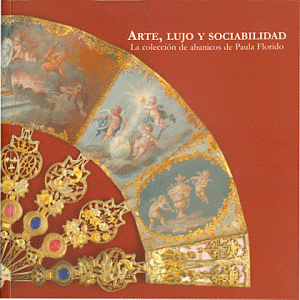 Se trata de una muestra de abanicos de elite, con materiales en su mayoría nobles de textiles, metales, brillantes, países y varillaje bien hecho y torneado, en madera de peral o de carey, con ejemplares muy selectos que abarcan los siglos XVIII y XIX.
Entre los abanicos expuestos también se encontraban cocardas (tipo paipai redondeado y recogido) o pericones, de mayor tamaño, así como abanicos de baraja. En su mayoría abanicos franceses, italianos e ingleses, con escenas bíblicas, mitológicas, heroicas, galantes, de la Comedia del arte y muy pocos con motivos políticos como el del matrimonio de doña Isabel II. En el abanico elegante se buscaban brillos y destellos de luz para impactar en sociedad.
Un bello cuadro de Luis Paret y Alcazar La Tienda (1772), perteneciente al mismo museo, ilustra sobre el modo en que un caballero y una dama adquieren ejemplares de abanico o miniaturas en aquel colmado ilustrado.
Se añaden algunos grabados de Goya que también dan cuenta del uso del abanico en Los Caprichos, objeto de indumentaria de lujo en principio, que paulatinamente se fue popularizando. El abanico era una pieza utilizada por el hombre o la mujer indistintamente, aunque era la mujer la que ofrecía con él todo un código de señales de sociabilidad.
New Book | Architectural Temperance: Spain and Rome, 1700–1759
From Taylor & Francis:
Victor Deupi, Architectural Temperance: Spain and Rome, 1700–1759 (New York: Routledge, 2014), 214 pages, ISBN: 978-0415724395, $155.
 Architectural Temperance examines relations between Bourbon Spain and papal Rome (1700–1759) through the lens of cultural politics. With a focus on key Spanish architects sent to study in Rome by the Bourbon Kings, the book also discusses the establishment of a program of architectural education at the newly founded Real Academia de Bellas Artes de San Fernando in Madrid.
Victor Deupi explores why a powerful nation like Spain would temper its own building traditions with the more cosmopolitan trends associated with Rome; often at the expense of its own national and regional traditions. Through the inclusion of previously unpublished documents and images that shed light on the theoretical debates which shaped eighteenth-century architecture in Rome and Madrid, Architectural Temperance provides readers with new insights into the cultural history of early modern Spain.
Victor Deupi teaches the history of art and architecture at the School of Architecture and Design at the New York Institute of Technology and in the Department of Visual and Performing Arts
at Fairfield University. His research focuses on cultural politics in
the early modern Ibero-American world.
◊ ◊ ◊ ◊ ◊
C O N T E N T S
Introduction: Architectural Temperance
1 Spain and Rome in the Early Eighteenth Century
2 Italian Grandeur
3 Metropoli Dell’ Universo
4 Iberian Architects in Rome
5 Santissima Trinità Degli Spagnoli in Via Condotti
6 Bourbon Patronage and Italian Influence
7 The Written Word and the Artifact
Exhibition | Goya: The Witches and Old Women Album
In the spirit of marking the 250th anniversary of Horace Walpole’s ’s The Castle of Otranto (published on Christmas Eve, 1764), I draw your attention to this upcoming exhibition, with best wishes for keeping the ghosts of Christmas at bay. –CH
Goya: The Witches and Old Women Album
The Courtauld Institute of Art, London, 26 February 2015 — 25 May 2014
Curated by Juliet Wilson-Bareau and Stephanie Buck
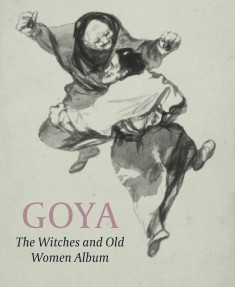 The Courtauld Gallery presents a groundbreaking exhibition which reunites for the first time all of the surviving drawings from one of Goya’s celebrated private albums. The albums were never intended to be seen beyond a small circle of friends, giving Goya the freedom to create images which range from the humorous, to the macabre and the bitingly satirical. With its themes of witchcraft, dreams and nightmares.
The ‘Witches and Old Women Album’ offers an important perspective on the development of Goya’s interest in old age, the fantastic and the diabolical. Above all, the drawings reveal his penetrating observation of human nature.
Additional information is available at The Guardian (10 December 2014).
◊ ◊ ◊ ◊ ◊
From Paul Holberton:
Juliet Wilson-Bareau with Stephanie Buck, Reva Wolf and Ed Payne, Goya: The Witches and Old Women Album (London: Paul Holberton Publishing, 2015), 200 pages, ISBN: 978-1907372766, £30.
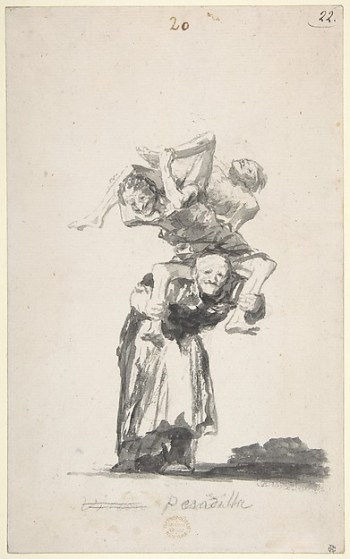
Goya, Nightmare, ‘Witches and Old Women’ Album (D), page 20, ca. 1819–23. Brush, black ink, and wash on Netherlandish laid paper (New York: Metropolitan Museum of Art, Rogers Fund, 1919)
One of the masterpieces of The Courtauld Gallery’s collection of Spanish drawings is a sheet known as Cantar y bailar (Singing and dancing), page 3 from Goya’s Album D, also known as the ‘Witches and Old Women’ album. Bringing together all the extant album pages, currently numbered up to 23, this catalogue proposes a reconstruction of the album that would include the sheets from which Goya’s page numbers have been erased or trimmed away.
Goya began to create ‘journal albums’ of drawings relatively late in life, after the shattering illness that left him stone deaf before the age of fifty. It was a practice he would sustain until his death, creating eight albums (named with letters A to H) that originally included a total of some 550 drawings. Visually, technically and intellectually coherent, these albums are unified in their discrete techniques and types of support, and paginated (after the first). In these album pages Goya committed to paper his views, with or without written comments, on human nature and the world around him. Each album has its own distinctive subject matter, style and technique.
The later history of the eight albums, already expertly chronicled, remains under investigation. The disbound album sheets were remounted in large volumes by Goya’s son, then sold en bloc by his grandson. Following their final dispersal by Federico de Madrazo and Valentín Carderera in the 1860s and 1870s, many gaps remain in all the albums.
This exhibition and the research underpinning it on Album D are the pilot for an international project for the reconstruction of Goya’s graphic oeuvre. The publication will test the extent of Album D and explore the possible sequence and thematic coherence of the sheets. The individual Album D drawings will be reproduced as a proposed reconstructed sequence, each with detailed catalogue entry and technical information. In addition, the publication will define the context of the album by including a number of closely related works by Goya.
New Book | L’imaginaire des grottes dans les jardins européens
Published by Hazan and available from Artbooks.com:
Hervé Brunon and Monique Mosser, L’imaginaire des grottes dans les jardins européens (Paris: Hazan, 2014), 399 pages, ISBN: 978-2754104890, 125€ / $190.
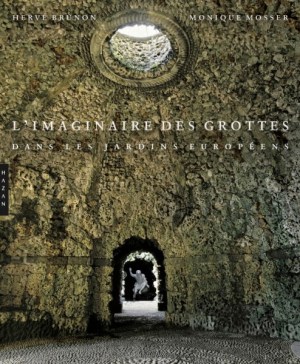 Dès l’Antiquité, puis de la Renaissance à nos jours, les grottes artificielles constituent un topos incontournable dans la création des jardins de toute l’Europe, soumis à d’infinies variations de formes, au gré des changements de goût, de l’excentricité des mécènes et de la fantaisie des concepteurs. Ce sont des milliers de grottes qui furent aménagées au cours des cinq derniers siècles selon des échelles extraordinairement variées allant de la simple niche abritant une petite fontaine à l’immense chaos naturel transformé en paysage sublime. Beaucoup ont disparu, en raison de l’extrême fragilité de ces décors précieux, mais d’admirables réalisations témoignent encore de cet engouement jamais démenti, notamment en Allemagne, en France, en Italie ou au Royaume-Uni, au Portugal et en Russie, en Finlande et Ukraine.
En rendant compte sans volonté d’exhaustivité—à travers plus d’une centaine d’exemples illustrés grâce à des prises de vue actuelles d’excellente qualité—de la richesse de ce patrimoine relativement méconnu, l’ouvrage vise à explorer les enjeux de cette fascination ininterrompue pour les grottes de jardin et à mettre en lumière l’inventivité formelle et technique à laquelle elles ont donné lieu. Il ne s’agit pas d’aborder les grottes en tant que motifs autonomes et isolés, mais bien de les inscrire tant dans leur contexte spatial et culturel, en considérant le rôle qu’elles tiennent dans la composition et la poésie du jardin, l’écriture du relief et des eaux miroitantes ou jaillissantes, la narration de la statuaire, et la manière dont elles révèlent les aspirations de chaque époque ou de chaque individu.
Une centaine de documents iconographiques—illustrations encyclopédiques, peintures allégoriques, portraits, décors de théâtre, etc.—permettent d’évoquer leur arrière-plan à la fois artistique, littéraire, scientifique, technique, religieux, philosophique ou encore anthropologique. Si le jardin opère comme microcosme, la grotte constitue à son tour un monde en réduction, une cristallisation de l’imaginaire s’incarnant dans des formes sensibles qui puisent à la réalité des lieux et poussent le vocabulaire ornemental à son paroxysme, qu’il relève du rustique, du grotesque ou encore de la rocaille. L’accumulation des matériaux et l’intensité des effets sonores et lumineux produisent des fantasmagories théâtrales ; la pénombre, les anfractuosités favorisent une intimité qui renvoie aux origines. Dépassant le simple catalogue par pays ou par périodes, les douze chapitres diachroniques de ce livre embrassent une série de catégories littéraires, esthétiques ou anthropologiques, qui, du primordial au profane en passant par le tellurique, le merveilleux et le diluvien, déclinent la poétique profonde des éléments et des émotions à l’œuvre dans la grotte. Un patrimoine exceptionnel à travers toute l’Europe redécouvert ici. Une iconographie non moins exceptionnelle. Un livre prestigieux présenté dans un coffret.
Hervé Brunon, historien des jardins et du paysage, est chargé de recherche au CNRS et directeur adjoint du Centre André Chastel (UMR8150, Paris), Laboratoire de recherche en histoire de l’art (du Moyen Âge à l’immédiat contemporain). Il est membre du comité de rédaction des revues Les Carnets du paysage et Projets de paysage : revue scientifique sur la conception et l’aménagement de l’espace, et fait partie du comité scientifique consultatif de la Fondazione Benetton Studi Ricerche (Trévise) et du conseil de l’enseignement et de la recherche de l’École nationale supérieure du paysage de Versailles. Il enseigne également à l’École nationale supérieure d’architecture de Versailles. Il est l’auteur de nombreuses publications, parmi lesquelles: Le Jardin, notre double: sagesse et déraison (direction, Autrement, 1999); Les Éléments et les métamorphoses de la nature: Imaginaire et symbolique des arts dans la culture européenne du XVIe au XVIIIe siècle (codirection; William Blake & Co, 2004); Rosario Assunto: Retour au jardin: Essais pour une philosophie de la nature, 1976–1987 (édition critique et traduction, Les Éditions de l’Imprimeur, 2003); Le Jardin contemporain: Renouveau, expériences et enjeux (avec Monique Mosser, Scala, 2006); Le Jardin comme labyrinthe du monde: Métamorphoses d’un imaginaire de la Renaissance à nos jours (direction, Presses de l’université Paris-Sorbonne/Musée du Louvre, 2008).
Monique Mosser est historienne de l’art, de l’architecture et des jardins, est ingénieur au CNRS (Centre André Chastel, UMR8150, Paris). Elle codirige, au sein de l’École nationale supérieure d’architecture de Versailles, le Master « Jardins historiques, patrimoine, paysage ». Elle a enseigné l’histoire des jardins à l’École nationale supérieure du paysage, à l’École de Chaillot, à l’École d’architecture de Genève. Engagée de longue date dans l’action culturelle et la défense du patrimoine, elle a organisé de très nombreuses expositions, tant en France qu’en Italie et d’autres pays d’Europe. Pionnière en matière d’histoire des jardins en France, elle a présenté, dès 1977, l’exposition Jardins, 1760–1820: Pays d’illusion, terre d’expérience à la Caisse nationale des monuments historiques et des sites (Hôtel de Sully) et joué, depuis, un rôle actif dans la politique menée par le ministère de la Culture sur le sujet. Auteur de nombreux articles et catalogues, elle a codirigé, avec Georges Teyssot, le livre de synthèse : Histoire des jardins de la Renaissance à nos jours (1990), publié en italien, anglais, français et allemand. Elle a été responsable d’une collection d’ouvrages sur le paysage et les jardins aux Éditions de l’Imprimeur (Besançon), où sont parus une vingtaine de titres.










 Enfilade
leave a comment