New Book | Inventing Falsehood, Making Truth
Published in December by Princeton UP:
Malcolm Bull, Inventing Falsehood, Making Truth: Vico and Neapolitan Painting (Princeton: Princeton University Press, 2013), 160 pages, ISBN: 978-0691138848, $25 / £17.
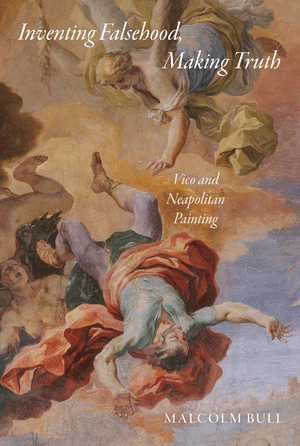 Can painting transform philosophy? In Inventing Falsehood, Making Truth, Malcolm Bull looks at Neapolitan art around 1700 through the eyes of the philosopher Giambattista Vico. Surrounded by extravagant examples of late Baroque painting by artists like Luca Giordano and Francesco Solimena, Vico concluded that human truth was a product of the imagination. Truth was not something that could be observed: instead, it was something made in the way that paintings were made–through the exercise of fantasy.
Juxtaposing paintings and texts, Bull presents the masterpieces of late Baroque painting in early eighteenth-century Naples from an entirely new perspective. Revealing the close connections between the arguments of the philosophers and the arguments of the painters, he shows how Vico drew on both in his influential philosophy of history, The New Science. Bull suggests that painting can serve not just as an illustration for philosophical arguments, but also as the model for them–that painting itself has sometimes been a form of epistemological experiment, and that, perhaps surprisingly, the Neapolitan Baroque may have
been one of the routes through which modern consciousness
was formed.
Malcolm Bull is university lecturer in fine art at the University of
Oxford. His previous books include Anti-Nietzsche, The Mirror
of the Gods, and Seeing Things Hidden.
C O N T E N T S
Acknowledgments
Prologue
1. Vico
2. Icastic Painting
3. Fantastic Painting
4. Theological Painting
Epilogue
Notes
Index
New Book | Johann Paul Egell, 1691–1752
From Imhof Verlag (and available at Artbooks.com). . .
Stefanie Michaela Leibetseder, Johann Paul Egell (1691–1752), Der kurpfälzische Hofbildhauer und die Hofkunst seiner Zeit: Skulptur – Ornament – Relief (Petersberg: Imhof, 2013), 176 pages, ISBN: 978-3865688514, 39€ / $75.
 Der kurpfälzische Hofbildhauer Paul Egell (1691–1752) zählt zu den bedeutendsten Bildhauern Deutschlands im 18. Jahrhunderts. Wie kein anderer Bildhauer der Zeit markiert sein Werk den Paradigmenwechsel zwischen den italienisch geprägten Traditionen des Barock und der französisch geprägten Formensprache des Rokoko. Das Buch spürt anhand exemplarischer Werke erstmals den Entstehungsbedingungen von Egells Werk nach. Im Mittelpunkt stehen sein Beitrag zum Nymphenbad des Dresdner Zwingers sowie die Skulpturen und Stuckaturen, die er für die kurpfälzische Residenz in Mannheim schuf. Es wird die ikonografische Tradition untersucht, in der sich Egell bewegte, und aufgezeigt, dass dessen Schaffen bereits sehr früh die Kunst der Régence in Frankreich rezipierte. Damit wird zum einen die Grundlage für eine differenziertere Einschätzung von Egells Œuvre gelegt, zum anderen werden Anregungen für die Auseinandersetzung mit anderen Bildhauern des deutschen Rokoko gegeben.
New Book | Queen Caroline
From Yale UP:
Joanna Marschner, Queen Caroline: Cultural Politics at the Early Eighteenth-Century Court (London: The Paul Mellon Centre for Studies in British Art, 2014), 232 pages, ISBN: 978-0300197778, $75.
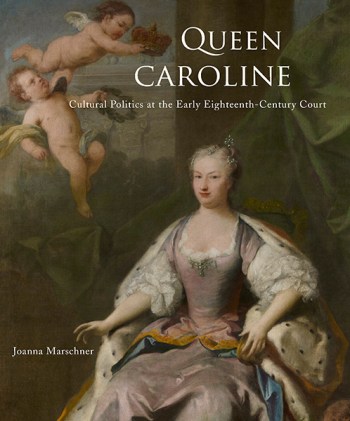 As the wife of King George II, Caroline of Ansbach became queen of England in 1727. Known for her intelligence and strong character, Queen Caroline wielded considerable political power until her death in 1737. She was enthusiastic and energetic in her cultural patronage, engaging in projects that touched on the arts, architecture, gardens, literature, science, and natural philosophy. This meticulously researched volume will survey Caroline’s significant contributions to the arts and culture and the ways in which she used her patronage to strengthen the royal family’s connections between the recently installed House of Hanover and English society. She established an extensive library at St. James’s Palace, and her renowned salons attracted many of the great thinkers of the day; Voltaire wrote of her, “I must say that despite all her titles and crowns, this princess was born to encourage the arts and the well-being of mankind.”
Joanna Marschner is senior curator at Historic Royal
Palaces.
Exhibition | The First Georgians: Art & Monarchy 1714–1760
Press release (29 January 2014) from The Royal Collection:
The First Georgians: Art & Monarchy 1714–1760
The Queen’s Gallery, Buckingham Palace, London, 11 April — 12 October 2014

◊ ◊ ◊ ◊ ◊
In 1714 Georg Ludwig, Elector of Hanover in Germany, acceded to the British throne as George I, the country’s first constitutional monarch. Despite many stronger genealogical claims to the crown than his, the 1701 Act of Settlement had declared that the choice of sovereign was the gift of Parliament alone and that only a Protestant could sit on the British throne. With this unprecedented decision, the Georgian era began, ushering in an unbroken line of succession to Her Majesty Queen Elizabeth II.
Marking the 300th anniversary of the Hanoverian succession, The First Georgians: Art & Monarchy 1714–1760 explores the reigns of George 1 (r.1714–27) and his son George II (r.1727–60), shedding light on the role of this new dynasty in the transformation of political, intellectual and cultural life. Through over 300 works from the Royal Collection, it tells the story of Britain’s emergence as the world’s most liberal, commercial and cosmopolitan society, embracing freedom of expression and the unfettered exchange of ideas.
The Hanoverians’ right to rule was fiercely disputed by the Jacobites, supporters of the Stuart claim to the throne. The ‘Old Pretender’, Prince James Francis Edward Stuart, set up a rival court in Paris and Rome, and his son, Prince Charles Edward—Bonnie Prince Charlie—led an uprising in 1745–46 on behalf of his father’s cause. The continuous threat to Hanoverian rule, both at home and overseas, is reflected in the exhibition’s military maps and battle plans. They include a draft order of battle at Culloden, thought to have been produced by George II’s son, the Duke of Cumberland, who led the King’s troops to victory in 1746.
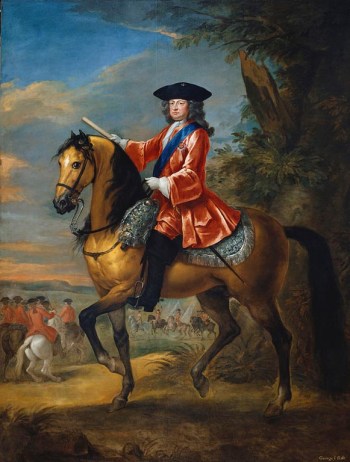
Vanderbank, Equestrian Portrait of George I, 1726
(Royal Collection 404412)
Although St James’s Palace remained the principal royal residence, the newly installed George I focused his artistic attention on Kensington Palace–its location outside London provided some shelter from the scrutiny of his more sceptical subjects. Here he appointed William Kent to decorate a new suite of State Rooms. The King filled Kensington with the best British furniture of the day, including pieces by James Moore and Old Master paintings, such as Don Roderigo Calderón on Horseback, 1612–15, and The Holy Family with St Francis, 1620–30, by Peter Paul Rubens.
The reigns of both Georges were fraught with familial strife. In 1717 George I expelled the Prince of Wales, the future George II, from St James’s Palace. Far from enduring a humiliating exile, the Prince established an alternative court, hosting ‘drawing rooms’, evening parties and balls, and regularly dining in public. Some 20 years later, George II’s son, Frederick, Prince of Wales (whose son George William Frederick became George III) was similarly banished and set up rival headquarters. Furnishing his private residences, the Prince could indulge his enthusiasm for the Old Masters. Among his acquisitions were Guido Reni’s Cleopatra with the Asp, c.1628, Anthony van Dyck’s Thomas Killigrew with an unidentified Man, c.1630, and ‘The Jealous Husband’, c.1660, by David Teniers.
Frederick presented himself as a fashionable man about town, entertaining freelyand informally—a typical supper party offered a menu of larks, pigeons, partridges, truffles, veal, turkey, lamb, turbot, salmon, teal, blackbird, asparagus, broccoli, sweetbreads, coffee cream and jelly. To dress his table, he commissioned dining plate in the new Rococo style, including the spectacular marine service by Paul Crespin and Nicholas Sprimont. Frederick’s mother, Queen Caroline, despised her son’s relaxed manner: “popularity always makes me sick,” she is reported to have said, “but Fretz’s popularity makes me vomit.”
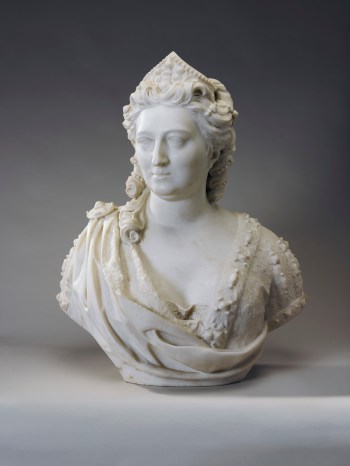
After John Michael Rysbrack and Joseph Highmore, Posthumous Portrait of Queen Caroline, Consort of George II, 1739
(Royal Collection, 31317)
Queen Caroline, consort of George II, was the most intellectual member of the Hanoverian dynasty. Her interests combined art, genealogy and a passion for gardening. She undertook major landscape projects at Kensington Palace and at her private retreat in Richmond, where she commissioned Charles Bridgeman to lay out the new gardens, complemented by follies created by William Kent. The most remarkable of these was the Hermitage, a picturesque temple devoted to British scientists and theologians, encapsulating Caroline’s belief in the interdependence of science and religion.
During the course of the 18th century, the focus of British cultural life began to shift away from court. Artists achieved success and fame through their own efforts, without the traditional support of a royal patron. William Hogarth’s portrait of David Garrick and his Viennese dancer wife, Eva-Marie Veigel, captures one of the most high-profile couples of the age. When the portrait was painted, in c.1757–64, Garrick had already combined great financial success as an actor-manager with international celebrity. Hogarth himself was not only a prominent artist, but
also a writer on art and a noted philanthropist.
The favourite genre of the early Georgian period was satire, both pictorial and literary. In 1724, its greatest practitioner, William Hogarth, published The Bad Taste of the Town, ridiculing British taste for foreign forms of art, such as Italian opera. London’s leading exponent of Italian opera was the German composer George Frideric Handel, who was employed in many royal roles. He was music teacher to George II’s daughter, Princess Anne, who is seen playing the cello with her two sisters and brother, Frederick, Prince of Wales, in Philippe Mercier’s The Music Party, 1733.

Meissen, Tea and coffee service with chinoiserie figures, 1720s
(Royal Collection, 5000106)
The desire for fashionable luxury goods drove Britain’s commercial enterprise and turned London into the most important trading city in the world. The Chelsea porcelain works, one of several new ventures set up to compete with the newly established Meissen factory in Germany, typified the entrepreneurialism of the time. With the emergence of a new leisure class came an explosion of coffee houses, gaming haunts, assembly rooms, theatrical entertainments and pleasure gardens. In the painting St James’s Park and the Mall, c.1745, all elements of cosmopolitan Georgian society mix together, with Frederick, Prince of Wales at the centre, rubbing shoulders with his future subjects.
◊ ◊ ◊ ◊ ◊
The catalogue is published by the Royal Collection and distributed by the University of Chicago Press:
Desmond Shawe-Taylor, ed., The First Georgians: Art & Monarchy 1714–1760 (London: Royal Collection Trust, 2014), 496 pages, ISBN 978-1905686797, £45 / $90.
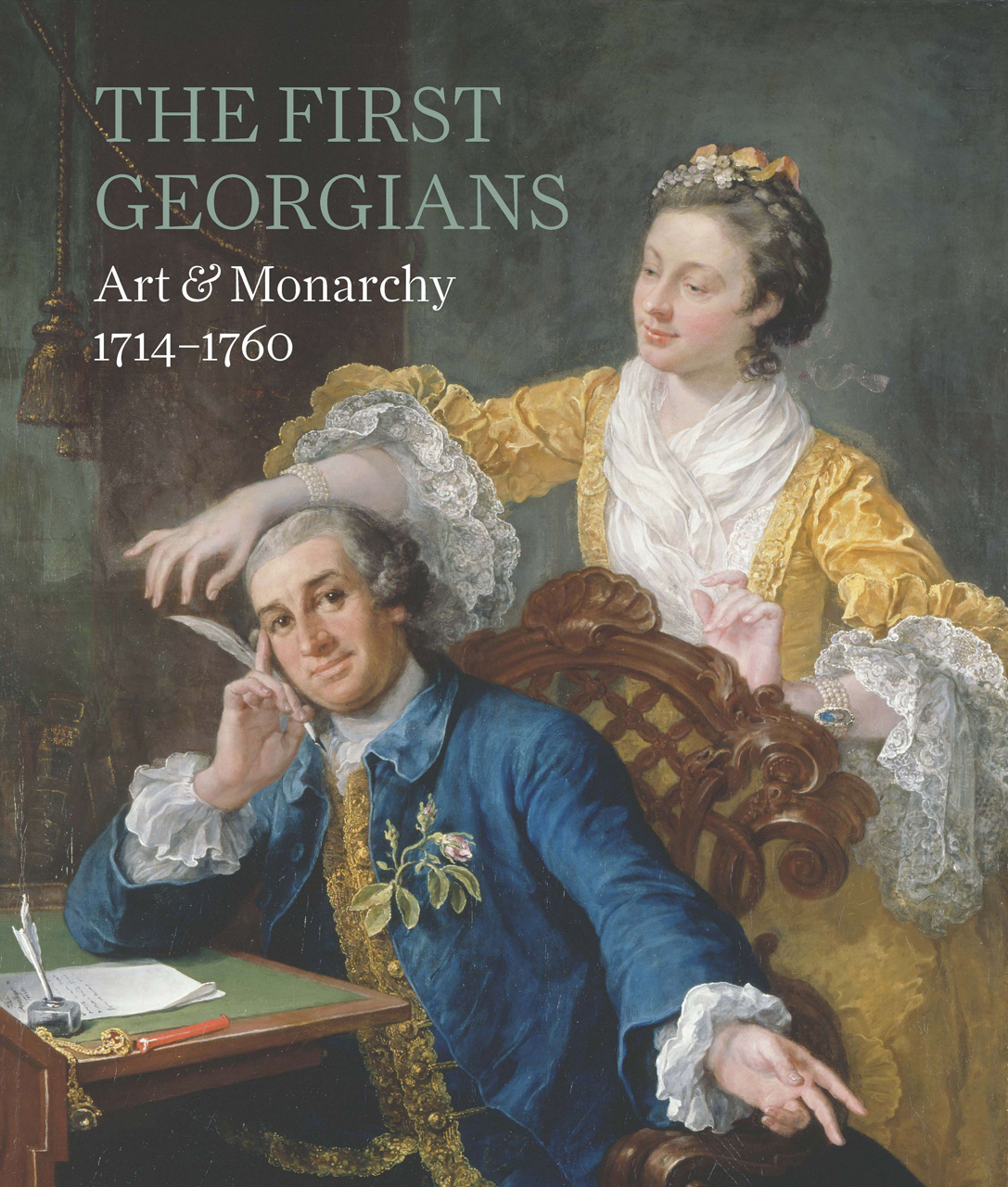 2014 marks the three-hundredth anniversary of the succession of the House of Hanover to the British throne. In celebration of this historic milestone, The First Georgians explores the rich artistic culture of the early Hanoverian period.
This publication showcases more than three hundred of the finest works of this period, many of which have never been on public display before. Created in Germany, France, and Britain during one of the most dramatic periods of change across all aspects of political, intellectual, and cultural life, they reflect changing views of science, politics, and art throughout the early to mid-eighteenth century—the period when modern Britain was coming into being.
New Book | The Great Mirror of Folly
Published in November 2013 by Yale University Press:
William N. Goetzmann, Catherine Labio, K. Geert Rouwenhorst, and Timothy G. Young, eds., The Great Mirror of Folly: Finance, Culture, and the Crash of 1720, with a foreword by Robert J. Shiller. Yale Series in Economic and Financial History (New Haven: Yale University Press, 2013). 360 pages, ISBN: 978-0300162462, $75.
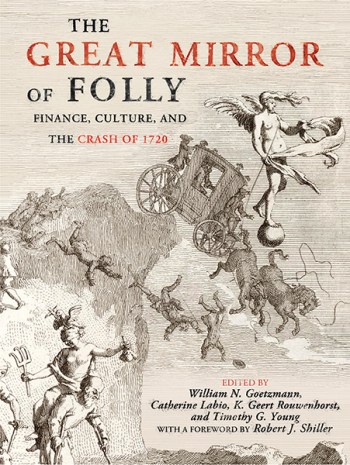 The world’s first global stock market bubble suddenly burst in 1720, destroying the dreams and fortunes of speculators in Paris, London, and Amsterdam. Their folly and misfortune inspired the quasi-simultaneous publication of an extraordinary Dutch collection of texts and images, including financial prospectuses, satirical prints, plays, poems, and suites of playing cards: Het groote Tafereel de Dwaasheid (The Great Mirror of Folly), the most aesthetically pleasing and historically valuable record of a financial crisis and its cultural dimensions.
No one discipline has been able to give a definitive account of the causes and effects of the bouts of “irrational exuberance” that have taken stock market participants and observers by surprise since 1720, when the collapses of the Mississippi, South Sea, and a host of smaller companies stunned Europe’s burgeoning financial markets. In this new and richly illustrated volume scholars from fields as diverse as economics, history, the history of art, literature, and cultural studies bring a wide variety of perspectives to bear on the Tafereel in order to provide a definitive account of the events of 1720 and of the mix of economic and cultural factors behind the financial crashes that have caused widespread economic and cultural shock for almost 300 years. The book also reproduces many of the engravings included in the Tafereel to give readers an approximation of the original volume and of the dramatic rise, progress, and fall of the first international stock market crash.
William N. Goetzmann is the Edwin J. Beinecke Professor of Finance and Management at the Yale School of Management. Catherine Labio is associate professor of English at the University of Colorado Boulder. K. Geert Rouwenhorst is Robert B. & Candice J. Haas Professor of Corporate Finance at the Yale School of Management. Timothy G. Young is curator of modern books and manuscripts at Beinecke Rare Book and Manuscript Library at Yale University.
New Book | The Duchess’s Shells
Due out in April from Yale UP:
Beth Fowkes Tobin, The Duchess’s Shells: Natural History Collecting in the Age of Cook’s Voyages (London: The Paul Mellon Centre for Studies in British Art, 2013), 328 pages, ISBN: 978-0300192230, $55.
 Margaret Cavendish Bentinck, the 2nd Duchess of Portland (1715–1785), was one of the wealthiest women in eighteenth-century Britain. She collected fine and decorative arts (the Portland Vase was her most famous acquisition), but her great love was natural history, and shells in particular. Over the course of twenty years, she amassed the largest shell collection of her time, which was sold after her death in a spectacular auction.
Beth Fowkes Tobin illuminates the interlocking issues surrounding the global circulation of natural resources, the commodification of nature, and the construction of scientific value through the lens of one woman’s marvelous collection. This unique study tells the story of the collection’s formation and dispersal—about the sailors and naturalists who ferried rare specimens across oceans and the dealers’ shops and connoisseurs’ cabinets on the other side of the world. Exquisitely illustrated, this book brings to life Enlightenment natural history and its cultures of collecting, scientific expeditions, and vibrant visual culture.
Beth Fowkes Tobin is a professor of English and
women’s studies at the University of Georgia.
Exhibition | Caravaggio to Canaletto
My apologies for (once again) being so late with this exhibition, which recently closed at the Museum of Fine Arts in Budapest. The catalogue, however, is still available from Artbooks.com. -CH
Caravaggio to Canaletto: The Glory of Italian Baroque and Rococo Painting
Museum of Fine Arts, Budapest, 26 October 2013 — 16 February 2014
Curated by Zsuzsanna Dobos

◊ ◊ ◊ ◊ ◊
The Museum of Fine Arts’ exhibition titled Caravaggio to Canaletto will present the leading styles, outstanding artist figures as well as the extraordinary wealth of genres, techniques, and themes of 17th- and 18th-century Italian painting through more than 140 works by 100 masters, including nine paintings—the highest number by a single artist included in the displayed material—by the period’s prominent painter genius, Caravaggio.
The backbone of the selection is formed by the 34 principal works from the internationally highly acclaimed Italian Baroque and Rococo collection of the museum’s Old Masters Gallery, which will be complemented by 106 masterpieces arriving in Budapest from sixty-two collections of eleven countries, such as the National Galleries in Washington and London, the Musée du Louvre in Paris, the Museo del Prado and the Museo Thyssen-Bornemisza in Madrid, the Galleria degli Uffizi in Florence, the Gemäldegalerie in Berlin, the Gemäldegalerie Alte Meister in Dresden, the Kunsthistorisches Museum in Vienna, and the Galleria Borghese in Rome. The material commands international attention since such a large-scale, comprehensive exhibition surveying the entirety of Italian painting as the one in Budapest has not been put on for decades anywhere in the world.
Some years ago the Museum of Fine Arts set itself the ambitious goal of presenting 15th- to 18th-century Italian painting in two consecutive exhibitions, unprecedented in its scope in Hungary. The first one, titled Botticelli to Titian, held in 2009–2010, attracted 230 thousand visitors, and thus became one of the most successful shows in the history of the museum.
The next, representative exhibition devoted to 17th- and 18th-century Italian painting will be the closing event of the Italian-Hungarian Cultural Season 2013 in Hungary. The two centuries of Italian art surveyed by the exhibition were determined by the Baroque style, which prevailed during the period all over Europe. The early Baroque, which had started at the end of the previous century saw the rise of the naturalism of Caravaggio and his followers, as well as the Bolognese School of Classicism linked to the Carracci. High Baroque, which lasted more than fifty years, was characterised equally by the dynamic style of the so-called master decorators, Baroque Classicism, and early Romanticism. We can talk about the Late Baroque period from the last decades of the seicento, when the tradition of the great masters was carried on in a somewhat empty, routine-like way. The Baroque Era ended in the 18th century with the luxurious Venetian Rococo, while in the middle of the century, also referred to as settecento, the beginnings of Neoclassicism started to appear. The artists of the various painting schools and styles of the 17th and 18th centuries were driven by the same desire: to imitate reality, strive for realistic depiction and create the illusion of tangibility, for which they had the whole range of artistic means at their disposal.
The exhibition will survey the period in eight chapters, starting with Caravaggio, whose activity in Rome brought radical change to painting, going on to the Baroque replacing Mannerism, and ending with the development of Rococo and Classicism, and the introduction of their masters. The opening section will display two early works by Caravaggio—one of them Boy with a Basket of Fruit—which will be followed by some religious compositions of Caravaggist painting, including two versions of Caravaggio’s Salome. The third section will showcase classicising Baroque linked to the names of Lodovico, Agostino and Annibale Carracci, while the fourth unit will present the spreading and flourishing of Baroque art. The fifth section will give an overview of the bourgeois genres of the still-life, the landscape, the portrait and the genre portrait, followed by the part devoted to the main stylistic trends of the 18th century. The last two sections will provide a glimpse into 18th-century painting in Venice and introduce the veduta (townscape), which became a popular genre at that time, through four Venetian townscapes by Canaletto.
The exhibition is implemented at the highest standard, thanks to the collaboration of nearly fifty Hungarian and foreign curators specialising in the period, and is accompanied by a Hungarianand English catalogue. The exhibition is curated by Zsuzsanna Dobos, art historian at the Old Masters Gallery, Museum of Fine Arts.
◊ ◊ ◊ ◊ ◊
From Artbooks.com:
Dobos, Zuzsanna, ed., Caravaggio to Canaletto: The Glory of Italian Baroque and Rococo Painting (Budapest: Museum of Fine Arts, 2013), 458 pages, ISBN: 978-6155304187, $130.
 Contents include
• J. Jernyei-Kiss, Italian Painting in the 17th and 18th Centuries
• J. Spike, Caravaggio and the Caravaggesque Movement
• D. Benati, The Carracci Academy: From Nature to History
• C. De Seta, The Grand Tour: The European Rediscovery of Italy in the 17th and 18th Centuries
• A. Vecsey, The Reception of 17th- and 18th-Century Italian Painting in Hungary: Taste and Collecting
New Book | Giovanni Baratta, 1670–1747
From L’Erma di Bretschneider (and available from artbooks.com) . . .
Francesco Freddolini, Giovanni Baratta 1670–1747: Scultura e industria del marmo tra la Toscana e le corti d’Europa (Rome: L’Erma di Bretschneider, 2013), 355 pages, ISBN: 978-8882659257, €215.
 Discendente di una tra le più importanti dinastie di scultori attive in Italia tra Sei e Settecento, Giovanni Baratta fu a capo del primo importante studio di scultura basato a Carrara, la città del marmo. Negli anni giovanili l’ ambiente artistico fiorentino ed il sofisticato mondo dei cortigiani medicei ispirarono lo scultore a sperimentare ardite soluzioni formali e soggetti raffinati e a creare alcuni tra i capolavori assoluti della decorazione a stucco italiana di primo Settecento. La natura delle commissioni, la composizione della bottega, l’organizzazione del lavoro ed i rapporti con i committenti subirono tuttavia un progressivo cambiamento nella stagione matura, quando l’ industria del marmo inizió a guidare le scelte dello scultore. Questo studio mostra come l’ evoluzione della carriera di Baratta—attraverso la grande decorazione scultorea e architettonica per le corti europee, la collaborazione con Filippo Juvarra ed il mercato del marmo—rifletta la risposta dello scultore alle sfide dell’ agone artistico italiano ed europeo e getti nuova luce sulla storia materiale e sociale della scultura.
Francesco Freddolini è Assistant Professor of Art History a Luther College, University of Regina, ed ha ricevuto borse di studio dalla National Gallery of Art, Washington, D.C., dallo Smithsonian American Art Museum, Washington, D.C., dalla Huntington Library, San Marino, CA, e dal Getty Research Institute, Los Angeles.
A preview of the book is available here»
New Book | Art, Theatre, and Opera in Paris, 1750–1850
Due out from Ashgate in April:
Sarah Hibberd and Richard Wrigley, eds., Art, Theatre, and Opera in Paris, 1750–1850: Exchanges and Tensions (Aldershot: Ashgate, 2014), 288 pages, ISBN: 978-1409439479, £65.
 Art, Theatre, and Opera in Paris, 1750–1850: Exchanges and Tensions maps some of the many complex and vivid connections between art, theatre, and opera in a period of dramatic and challenging historical change, thereby deepening an understanding of familiar (and less familiar) artworks, practices, and critical strategies in the eighteenth and nineteenth centuries. Throughout this period, new types of subject matter were shared, fostering both creative connections and reflection on matters of decorum, legibility, pictorial, and dramatic structure. Correspondances were at work on several levels: conception, design, and critical judgement. In a time of vigorous social, political, and cultural contestation, the status and role of the arts and their interrelation came to be a matter of passionate public scrutiny.
Scholars from art history, French theatre studies, and musicology trace some of those connections and clashes, making visible the intimately interwoven and entangled world of the arts. Protagonists include Diderot, Sedaine, Jacques-Louis David, Ignace-Eugène-Marie Degotti, Marie Malibran, Paul Delaroche, Casimir Delavigne, Marie Dorval, the ‘Bleeding Nun’ from Lewis’s The Monk, the Comédie-Française and Etienne-Jean Delécluze.
Sarah Hibberd is Associate Professor in the Department of Music at the University of Nottingham, UK. Richard Wrigley is Professor of Art History at the University of Nottingham, UK.
C O N T E N T S
Sarah Hibberd and Richard Wrigley, Introduction
David Charlton, Hearing through the eye in eighteenth-century French opera
Mark Darlow, Nihil per saltum: Chiaroscuro in eighteenth-century lyric theatre
Mark Ledbury, Musical mutualism: David, Degotti, and operatic painting
Thomas Grey, Music, theatre, and the Gothic imaginary: Visualising the ‘Bleeding Nun’
Sarah Hibberd, Belshazzar’s Feast and the operatic imagination
Olivia Voisin, Romantic painters as costumiers: The stage as pictorial battlefield
Stephen Bann, Delaroche off stage
Patricia Smyth, Performers and spectators: Viewing Delaroche
Beth S. Wright, Delaroche and the drama of history: Gesture and impassivity from The Children of Edward IV to Marie-Antoinette at the Tribunal
Céline Frigau Manning, Playing with excess: Maria Malibran as Clari at the Théâtre Italien
Richard Wrigley, All mixed up: Etienne-Jean Delécluze and the théâtral in art and criticism
Bibliography
Index
Catalogue | Art and Music in Venice
This catalogue accompanies the exhibition Venice: The Golden Age of Art and Music, which opened last weekend at the Portland Museum of Art. From Yale UP:
Hilliard T. Goldfarb, ed., Art and Music in Venice: From the Renaissance to Baroque (New Haven: Yale University Press, 2013), 240 pages, ISBN: 978-0300197921, $65.
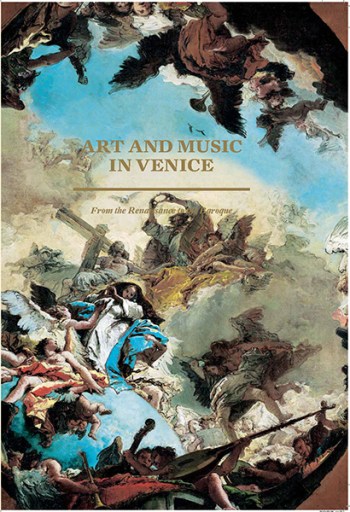 Artistic and musical creativity thrived in the Venetian Republic between the early 16th century and the close of the 18th century. The city-state was known for its superb operas and splendid balls, and the acoustics of the architecture led to complex polyphony in musical composition. Accordingly, notable composers, including Antonio Vivaldi and Adrian Willaert, developed styles that were distinct from those of other Italian cultures. The Venetian music scene, in turn, influenced visual artists, inspiring paintings by artists such as Jacopo Bassano, Canaletto, Francesco Guardi, Pietro Longhi, Bernardo Strozzi, Giambattista and Domenico Tiepolo, Tintoretto, and Titian. Together, art and music served larger aims, whether social, ceremonial, or even political. Lavishly illustrated, Art and Music in Venice brings Venice’s golden age to life through stunning images of paintings, drawings, prints, manuscripts, textbooks, illuminated choir books, musical scores and instruments, and period costumes. New scholarship into these objects by a team of distinguished experts gives a fresh perspective on the cultural life and creative output of the era.
Hilliard T. Goldfarb is associate chief curator and curator of Old Masters at the Montreal Museum of Fine Arts.










 Enfilade
leave a comment