Exhibition | Anton Graff: Faces of an Era
The exhibition opened last weekend on the two-hundredth anniversary of the artist’s death (22 June 1813). From the Museum Oskar Reinhart:
Anton Graff: Gesichter einer Epoche
Museum Oskar Reinhart, Winterthur, 22 June — 29 September 2013
National Gallery in Berlin, 25 October 2013 — 23 February 2014
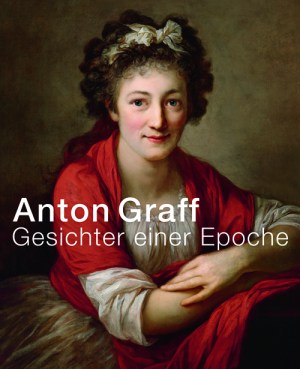 Anton Graff, who was born in Winterthur, was the most important portrait painter in the German-speaking world around 1800. He influenced the image of the bourgeoisie and nobility and the image of poets and thinkers on the brink of Modernism like no other. When he died in 1813, he left behind around 1800 portraits depicting a panorama of transitioning European society.
In celebration of the 200th anniversary of his death, the Museum Oskar Reinhart in Winterthur and the National Gallery in Berlin are honouring the work of Anton Graff in a comprehensive exhibition for the first time in 50 years. After a first stop at the Museum Oskar Reinhart from 22 June to 29 September 2013, the exhibition will be able to be seen in the National Gallery in Berlin between 25 October 2013 and 23 February 2014. The exhibition and the richly illustrated catalogue, which will be published by the Munich-based Hirmer Publishers, came about thanks to the cooperation of both institutions.
Marc Fehlmann and Birgit Verwiebe, eds., Anton Graff: Gesichter einer Epoche (Munich: Hirmer Publishers, 2013), 336 pages, ISBN: 978-3777420509, 40€.
◊ ◊ ◊ ◊ ◊
From Berlin’s Alte Nationalgalerie:
Bis in das Innere der Seele“ zu schauen, darin bestand, den Worten des Philosophen Johann Georg Sulzer zufolge, die Meisterschaft des großen Porträtisten Anton Graff. Der überaus produktive Künstler zählt zu den herausragenden Bildnismalern des späten 18. und frühen 19. Jahrhunderts. Sein größtes Verdienst war, die Berühmtheiten seiner Epoche zu porträtieren. Ihm ist das Panorama des deutschen Geistes zu danken, das die Bildnisse der bedeutendsten Dichter und Denker umfasst, wie etwa Lessing, Nicolai, Mendelssohn, Sulzer, Wieland, Gellert, Herder und Schiller.
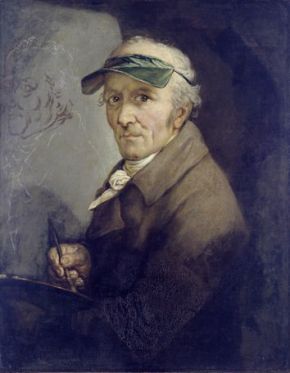
Anton Graff, Self-portrait with the Green Eye-shade, 1813 (Staatliche Museen zu Berlin, Nationalgalerie)
Graff wurde 1736 in Winterthur geboren und nahm dort seinen ersten Kunstunterricht. In Augsburg, Ansbach und Regensburg bildete er sich weiter. 1766 – 30jährig – wurde er in Dresden kurfürstlich-sächsischer Hofmaler und Mitglied der Akademie. Regelmäßig führten ihn Reisen nach Berlin, Leipzig und in die Schweiz. Gegen Ende seines Lebens wurde Graff gleichsam zu einer Symbolfigur für den Kreis junger Romantiker in Dresden. 1813, mit 76 Jahren, starb der Maler.
Graff hat seine Zeitgenossen nicht im Gestus der Repräsentation festgehalten. Vielmehr lag ihm daran, das Wesen des Einzelnen auszuloten, seine Individualität zu entdecken, seine seelischen und geistigen Qualitäten wiederzugeben. Auch heute noch spricht die innere Gestimmtheit der aufgeklärten geistigen Elite in Deutschland unmittelbar aus Graffs meisterhaften Werken. Mit Bildnissen von Königen und Fürsten, vom aufstrebenden Bürgertum, von Staatsmännern, Gelehrten, Künstlern, Kaufleuten, Geistlichen schuf er eine Galerie der deutschen Gesellschaft an der Schwelle zur Moderne.
Ein halbes Jahrhundert hat es keine Ausstellung zum Werk Graffs gegeben. Nun, anlässlich des 200. Todestages, wird sein Werk wieder umfassend präsentiert.
Die Retrospektive „Anton Graff. Gesichter einer Epoche“ entstand in Kooperation mit dem Museum Oskar Reinhart, Winterthur. Dort sind rund 80 Werke vom 22. Juni bis 29. September 2013 zu sehen. In der Alten Nationalgalerie Berlin wird die Ausstellung anschließend in erweiterter Form mit rund 140 Werken vom 25. Oktober 2013 bis 23. Februar 2014 gezeigt.
New Book | Funerary Sculpture in St Patrick’s Cathedral, Armagh
From the author’s website:
James Stevens Curl, Funerary Monuments and Memorials in St Patrick’s Cathedral, Armagh (Whitstable: Historical Publications, 2013), 164 pages, ISBN: 978-1905286492, £40 (hardcover) / ISBN: 978-1905286485, £20 (softcover) — ordering information is available here»
 The funerary monuments and memorials in the Church of Ireland (Anglican) Cathedral Church of St Patrick, Armagh, include fine works by celebrated sculptors including Bacon, Chantrey, Farrell, Marochetti, Nollekens, Roubiliac, Rysbrack, and others, yet are not widely known.
Professor Stevens Curl’s comprehensively illustrated book describes and shows all of them, as well as giving details of the artists and their subjects, thereby filling an unaccountable gap in the literature. It is published in two versions; a hardback, limited edition of only 250 numbered signed copies with dust-jacket at £40, and a softback edition at £20 per copy.
James Stevens Curl has held Chairs in Architectural History at two Universities. He is Professor of Architecture at the School of Architecture and Design, University of Ulster. He read for his Doctorate at University College London, and in 1991-2 and 2002 was Visiting Fellow at Peterhouse, University of Cambridge.
New Book | Les Biscuits de Porcelaine de Paris
Available from Artbooks.com:
Régine de Plinval de Guillebon, Les Biscuits de porcelaine de Paris : XVIIIe-XIXe siècles (Dijon: Faton, 2012), 331 pages, ISBN: 978-2878441628, 68€ / $125.
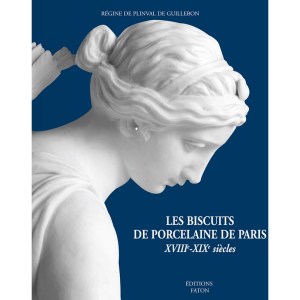 Aux biscuits de porcelaine de Paris sont souvent associés de grands noms de porcelainiers, tels Guérhard, Dihl, Gille jeune, Desprez et Nast. Pendules spectaculaires, statues gigantesques, ou bustes à taille humaine, ces figures ou groupes en porcelaine non émaillée sont pourtant assez méconnus ; on les imagine blancs, mais ils peuvent être bleus, noirs, polychromes ou dorés. Le biscuit parisien est de tout son temps très prisé par des amateurs aussi prestigieux que George Washington et le prince-régent d’Angleterre.
Après une présentation des origines de la porcelaine et des techniques de fabrication, Régine de Plinval de Guillebon nous entraîne au cœur de la vie mouvementée de 31 manufactures des XVIIIe et XIXe siècles, s’intéressant de près au travail des ouvriers, des artistes et des investisseurs, ainsi qu’au contexte économique général. Une analyse approfondie des formes, des couleurs, ainsi que de l’association du biscuit avec le bronze, l’orfèvrerie et le cristal, permet d’envisager l’évolution du style des biscuits, dont deux cents illustrent cet ouvrage. Un catalogue raisonné des manufactures parisiennes vient compléter cette remarquable étude.
Enfilade Turns Four! Buy an Art Book!
To celebrate Enfilade’s fourth birthday (22 June), I’m encouraging readers to participate in the second annual Buy-an-Art-Book Day! This year I’m happy to announce a special, one-day discount from Ashgate. Many thanks for the kind support. — Craig Hanson

 At Ashgate or Lund Humphries, use the promotion code 287Y for a 20% discount on Saturday, June 22. The offer should work internationally, though please bear in mind U.S. timezones.
New Book | Architecture and Statecraft: Charles of Bourbon’s Naples
From Penn State University Press:
Robin L. Thomas, Architecture and Statecraft: Charles of Bourbon’s Naples, 1734–1759 (University Park: Penn State University Press, 2013), 248 pages, ISBN: 978-0271056395, $90.
 The eighteenth century was a golden age of public building. Governments constructed theaters, museums, hospices, asylums, and marketplaces to forge a new type of city, one that is recognizably modern. Yet the dawn of this urban development remains obscure. In Architecture and Statecraft, Robin Thomas seeks to explain the origins of the modern capital by examining one of the earliest of these transformed cities. In 1737 King Charles Bourbon of Spain embarked upon the most extensive architectural and urban program of the entire century. A comprehensive study of these Neapolitan buildings does not exist, and thus Caroline contributions to this new type of city remain undervalued. This book fills an important gap in the scholarship and connects Charles’s urban improvements to his consolidation of the monarchy. By intertwining architecture and sovereignty, Thomas provides a framework for understanding
how politics created the eighteenth-century capital.
Robin L. Thomas is Assistant Professor of Art History at The
Pennsylvania State University. (more…)
Reviewed | Extravagant Inventions
Recently added to caa.reviews:
Wolfram Koeppe, Extravagant Inventions: The Princely Furniture of the Roentgens (New York: Metropolitan Museum of Art, 2012), 304 pages, ISBN: 978-0300185027, $75.
Reviewed by Michael Yonan; Department of Art History & Archaeology, University of Missouri; posted 6 June 2013.
Once in a while an exhibition comes along that achieves many things. It illuminates past and present, and does so by creating a viewing experience both beautiful and instructive. All the better when such an exhibition also brightens up a blind spot in the history of art. The exhibition at the Metropolitan Museum of Art entitled ‘Extravagant Inventions: The Princely Furniture of the Roentgens’ achieved this. Curated by Wolfram Koeppe, Maria Kellen French Curator of European Decorative Arts, the show was a monographic investigation of father-and-son furniture makers Abraham (1711–1793) and David Roentgen (1743–1807), whose workshop in the German town of Neuwied produced furniture for the European elite between 1743 and 1800. By my estimation this was the decorative arts show of the decade, an educationally illuminating and utterly enjoyable museum experience whose rewards far
exceeded, in the words of a colleague of mine, the
opportunity to look at ‘old desks’. . . .
The full review is available here» (CAA membership required)
Exhibition and Book | The Art of Living, Augsburg ca. 1780
The June 2013 issue of The World of Interiors features a remarkable album from the 1780s, believed to the the work of Balthasar Cornelius Koch. It was the subject of a 2010-11 exhibition in Augsburg; the catalogue is available in German.
◊ ◊ ◊ ◊ ◊
Michael Huey, “A Cabinet Curiosity,” The World of Interiors (June 2013): 150-57. The stuff of life, c1780, is laid bare in a handmade album documenting the décor and possessions of a prosperous goldsmith, and his family of servants, in 18th-century Augsburg. From watercolour to scraps of fabric, the enchanting tour, from pantry to salon, literally opens the doors on inner courtyards and armouries. The June issue of The World of Interiors uncovers shoes, nightcaps and lace — but no skeletons — in the closets.
. . . Part pen/ink and watercolour, part découpage (it incorporates copperplate engravings), part scrapbook (it also uses real historical fabrics and papers) and, in a sense, part diary, it records the everyday functions of the rooms of the house in full colour and significant detail. Included are a dining room; five salons (chose from green, white, ladies’, music and tea); five bedrooms (including those for the maids, the maternity room and one for a child); and five public or service spaces (halls, kitchen, pantry), with all their particular floorings, textiles, furnishings and other accoutrements. . . (156).

◊ ◊ ◊ ◊ ◊
From the museum’s website:
Die Kunst zu Wohnen: Ein Augsburger Klebealbum des 18. Jahrhunderts
Deutsche Barockgalerie im Schaezlerpalais, Augsburg, 24 November 2010 — 20 February 2011
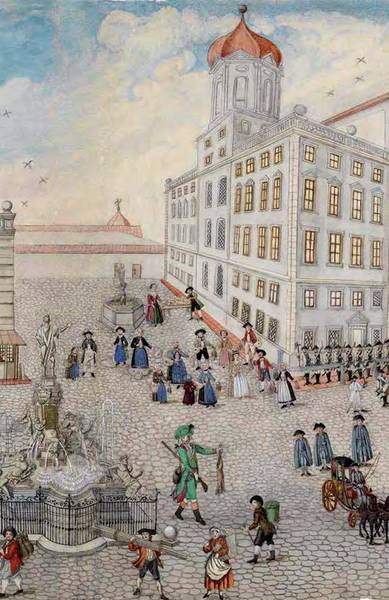 Augsburg war seit dem 16. Jahrhundert nicht nur eine Hochburg für den Buchdruck und die grafischeProduktion, hier entstanden ebenfalls sogenannte “Klebealben”. Diese wurden angelegt, um Kindern und Heranwachsenden aus bürgerlichen Familien die Welt zu erklären.
Die Jugendlichen schnitten aus eigens zu diesem Zweck herausgegebenen Bögen historische oder biblische Figuren, Tiere oderberühmte Bauwerke aus und klebten sie in gedruckte Vorlagen ein. Auch andere Druckgrafiken, Buntpapiere oder sogar Stoffe wurden zerschnitten und in die Klebealben eingefügt.
Das hier ausgestellte Klebealbum wurde nach 1780 für die Juwelierstochter Regina Barbara Waltherangelegt. Teile des Albums wie gezeichnete und kolorierte Figuren und Raumsituationen wurdenvermutlich bei dem Zimmerpolier Balthasar Cornelius Koch in Auftrag gegeben. Auf den Seiten blieb aber genügend Platz, so dass Regina Barbara selbst Figuren ausschneiden und einkleben konnte. Das Album stellt “die Kunst zu Wohnen” vor und verschafft den Betrachtern so bis heute einen Einblick in das Leben des Augsburger Bürgertums im
18. Jahrhundert. . .
More from the museum’s website»
◊ ◊ ◊ ◊ ◊
From the publisher:
Georg Haindl, Die Kunst zu Wohnen: Ein Augsburger Klebealbum des 18. Jahrhunderts (Berlin: Deutscher Kunstverlag, 2010), 240 pages, ISBN: 978-3422070400, 40€.
 Als beliebte Alternativen zu den Puppenhäusern wurden in Augsburg als wichtiger Verlagsstadt des 18. Jahrhunderts so genannte „Klebealben” von liebenden Eltern für ihre Kinder angelegt. Sie zeigen neben zentralen Plätzen Augsburgs auch die Räume idealtypischer Bürgerhäuser, in die ausgeschnittene Darstellungen von Figuren, Möbeln oder Geschirren eingeklebt werden konnten. Als Ressource hierfür dienten nicht nur die Augsburger „Ausschneidebögen”, wie sie von den Verlagen Johann Martin Wills oder Martin Engelbrechts extra für diesen Zweck herausgegeben wurden, sondern auch Modejournale, Buntpapiere, Textilien oder alte Bücher, die zerschnitten wurden.
In der Publikation widmen sich mehrere Autoren einem besonders qualitätsvollen und gut erhaltenen Album, bei dem nicht Kinder, sondern Heranwachsende die Adressaten waren, um ihnen einen perfekt funktionierenden Haushalt vor Augen zu führen. Das Album wurde in den 1780er Jahren vermutlich von dem Zimmerpolier Balthasar Kornelius Koch gefertigt und zeigt durch seine additive Darstellungsweise wichtige Aspekte des bürgerlichen Lebens dieser Zeit in Augsburg – eine unschätzbare kulturhistorische Quelle.
New Book | Gainsborough’s Cottage Doors
From Paul Holberton:
Hugh Belsey, Gainsborough’s Cottage Doors: An Insight into the Artist’s Last Decade (London: Paul Holberton, 2013), 120 pages, ISBN: 978-1907372506, £25 / $40.
 The work of Thomas Gainsborough is characterized by a series of subjects that preoccupied him, which with time he was able to hone and define more clearly. Inspired by the recent identification of a third autograph version of his masterpiece The Cottage Door, this book examines the significance of the multiple versions of designs that the artist produced during the 1780s. It demonstrates that without the pressure of exhibiting his work annually at the Academy and without a string of sitters waiting for their finished portraits, Gainsborough’s work became more personal, more thoughtful and searching.
A study of his unconventional background, training and early development as an artist provides some clues as to why Gainsborough came to use painting in this very personal way. It was not until the 1780s, however, that his creative energies really changed in this direction. He had never been happy with the constraints of the Royal Academy and he was at odds with the dictatorial opinions promoted by its president, Sir Joshua Reynolds. In removing himself from the Academy he cast off the shackles of producing paintings, competitive in their design and colouring, which inhibited the artist’s natural goals of likeness, subtlety and balanced tonality. He could now be choosey about the commissions he accepted, paint for his own pleasure and satisfy his own curiosity. He began to turn to portrait compositions that he had developed and refined over a number of years. With subtle alterations they could be made suitable for a variety of sitters. The margin between ‘fancy’ pictures and portraits became blurred and the categorization of some of these paintings changed while they were on the easel. Always finding composition difficult, rather than begin something new he often revisited earlier designs that had pleased him. He would paint them again and make slight changes of tone and emphasis that would radically change the concept and intention of the design.
Richly illustrated with beautiful new photography, this study of the last phase of the artist’s work is a totally fresh interpretation of not only the Cottage Door theme, which Gainsborough revisited over nearly 20 years, but other key late works such as Mrs Sheridan and Diana and Acteon. The subject matter in some of these late work veers towards the autobiographical and provides an invaluable insight into the artist’s personality and his very worrying concerns.
Hugh Belsey is currently Senior Research Fellow at the Paul Mellon Centre for Studies in British Art with the task of writing the definitive catalogue of portraits by Thomas Gainsborough.
Exhibition | Revisiting The Cottage Door: Gainsborough’s Masterpiece
From The Huntington:
Revisiting The Cottage Door: Gainsborough’s Masterpiece in Focus
The Huntington Library, San Marino, 1 June — 2 December 2013
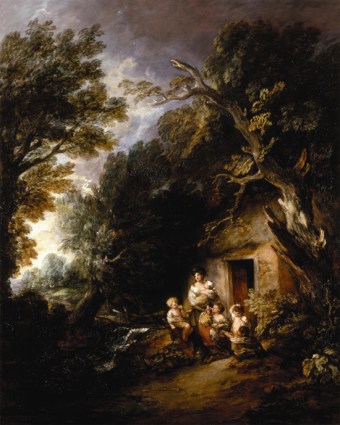
Thomas Gainsborough, The Cottage Door, ca. 1780
(San Marino: The Huntington)
The Cottage Door (ca. 1780), one of the treasures of The Huntington’s collections, is among Thomas Gainsborough’s most famous paintings. The idealized scene of rustic country life was exhibited at the Royal Academy in 1780, but both the subject and the composition continued to haunt the artist, and he repeated the design twice during the course of the decade. All three paintings are shown together for the first time in this special display, providing a unique opportunity to compare the subtle differences among them. Both of the later versions, on loan from private collections, are less finished than The Huntington’s canvas, and there are variations in tone and detail that give each a particular mood and a different emphasis.
A new book by Gainsborough specialist Hugh Belsey, Gainsborough’s Cottage Doors: An Insight into the Artist’s Last Decade, complements the installation. Inspired by the recent attribution of the third version, it examines how Gainsborough freed himself from the constraints of the Royal Academy and was able to make radical changes to his work during the last years of his
life.
New Book | Il Disegno nell’Europa del Settecento
Available from Artbooks.com:
Piera Giovanna Tordella, Il disegno nell’Europa del Settecento: Regioni teoriche ragioni critiche (Florence: Olschki, 2012), 284 pages, ISBN: 978-8822262332, $65.
 The book follows the theoretic and critical evolution of European drawing and of its complex configuration in the eighteenth century, with the aid of texts by German, French, English, Dutch and Italian authors. The theme is naturally variegated and connects the activity of intellectuals, philosophers, writers, poets, artists, connoisseurs and collectors. The scene is often animated by original interpreters that crossed conceptual and aesthetic horizons populated by acclaim and disapproval.










1 comment