New Book | Marlborough: Soldier and Diplomat
In the book’s final chapter, Richard Johns, curator of prints and drawings at the National Maritime Museum in Greenwich, addresses, “‘The British Caesar’: John Churchill, 1st Duke of Marlborough, and the Visual Arts.” From the publisher:
John Hattendorf, Augustus Veenendaal, and Rolof van Hövell tot Westerflier, eds., Marlborough: Soldier and Diplomat (Zutphen: Karwansaray Publishers, 2012), 408 pages, ISBN: 978-9490258047, € 75.
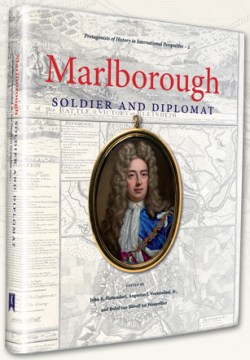
The subject of numerous books in English, Marlborough has typically been seen only in terms of British political and military history. In this book, twelve leading specialists of the period broaden the perspective by assessing Marlborough in the wider and more diverse contexts of the European situation, the common soldier in the British army, the complementary activities of navies, the differing perspectives of the Austrians, Dutch, French, and Germans as well as in the context of the British popular press and the visual arts.
John Churchill, the 1st Duke of Marlborough, is perhaps now best known for his role in the War of the Spanish Succesion. His victories at battles such as Blenheim, Ramillies, Oudenaarde, and Malplaquet have firmly established him as one of Britian’s greatest military heroes. His success also brought his family unprecedented wealth, power and influence. Physically handsome, he rose to power not only thanks to his military genius, but also his personal service as a very successful courtier. It was his interrelated personal, political, and family connections, combined with those his wife developed, that were the key elements in reaching and sustaining his positions of power. While the 1st Duke of Marlborough is firmly established in the British historical canon, far less has been said about him in a broader European context. Marlborough: Soldier and Diplomat attempts to address this disparity through a series of articles writen by noted international historians and experts. In this new book, the Duke is not only examined from the perspective of his enemies and allies, but also for his influence on social, military, and art history as a whole.
Edited by John B. Hattendorf, Augustus J. Veenendaal and Rolof van Hövell tot Westerflier, Marlborough: Soldier and Diplomat is lavishly illustrated with contemporary artwork and photographs of important places in Marlborough’s world. Each of its twelve chapters are dedicated to forming a complete but multi-faceted view of this important figure in European
Exhibition | Nicolas Colombel: L’Idéal et la grâce
Now on at the Musée des Beaux-Arts in Rouen:
Nicolas Colombel: L’Idéal et la grâce
Musée des Beaux-Arts, Rouen, 9 November 2012 — 24 February 2013
 This is the first monographic exhibition to be devoted to this figure long forgotten French painter of the Grand Siècle, Nicolas Colombel (ca. 1644-1717). The exhibition at the Museum of Fine Arts in Rouen brings us an important rediscovery. This artist born in Sotteville-lès-Rouen in approximately 1644 worked in Rome and Paris, developing a unique style which combines sensuality and idealism in the grand tradition of Poussin.
Bringing together over half of the artist’s known works today, dating from the 1680s until 1712, the exhibition offers a unique opportunity to discover Colombel’s unusual career. He was the only French painter of his generation to be successful in Rome before continuing a career in Paris at the Royal Academy of Painting and Sculpture during the reign of Louis XIV. The exhibition brings together exceptional loans from the most important collections in Europe and the United States.
◊ ◊ ◊ ◊ ◊
From the press materials:
Première exposition monographique consacrée à cette figure longtemps méconnue de la peinture française du Grand Siècle, l’exposition du musée des Beaux-Arts de Rouen consacre une redécouverte importante : celle d’un artiste né à Sotteville-lès-Rouen vers 1644, qui a fait carrière à Rome puis à Paris, concevant un style très singulier qui conjugue idéalisme et sensualité, dans la grande tradition de Poussin. Rassemblant plus de la moitié des oeuvres aujourd’hui connues, depuis les années 1680 jusqu’à 1712, l’exposition offre une occasion unique de découvrir le parcours atypique du seul peintre français de sa génération à rencontrer le succès à Rome, avant de faire carrière à Paris au sein de l’Académie royale de Peinture et de Sculpture, à la fin du règne de Louis XIV.
Nombre des tableaux de l’artiste n’ont été redécouverts que récemment : très recherchés des collectionneurs de peinture ancienne, ils sont aujourd’hui dispersés à travers le monde et la plupart sont conservés hors de France. L’exposition réunit des prêts exceptionnels venus des plus grandes collections d’Europe et des États-Unis. Elle marque également l’occasion de publier le catalogue raisonné de l’oeuvre de Nicolas Colombel.
Le parcours de l’exposition présente les principaux aspects de la carrière de Nicolas Colombel, articulés autour de deux axes : ses débuts à Rome, où il acquiert une notoriété auprès du public italien mais également français, puis sa carrière académique à Paris, lorsqu’il intègre l’Académie royale de Peinture et de Sculpture et développe, parallèlement à ses productions religieuses et à la peinture tirée de l’histoire ancienne, une peinture mythologique, aux tons éclaircis et accents de fable galante. Les débuts romains sont illustrés par la peinture religieuse marquée
par l’art de Nicolas Poussin ; Colombel est alors attaché à un classicisme rigoureux.
Les commandes réalisées à Rome pour les ordres religieux français démontrent qu’au-delà de l’exemple de Poussin, Colombel usa de références variées et retint les leçons de peintres tels que Philippe de Champaigne ou le Dominiquin. Les portraits de personnalités françaises peints à Rome révèlent que son activité de portraitiste
se développe suivant une ligne toute personnelle et qu’il développe en Italie un véritable réseau social français. L’italianisme dans la production de Colombel à Rome touche l’ensemble de sa production, les épisodes mythologiques, les scènes tirées de la littérature ou de l’histoire ancienne, comme celles issues de l’Ancien et du Nouveau Testament. Colombel tire ses modèles de Giacinto Gimignani, des Carrache, de Guido Reni.
Le retour à Paris est marqué par la réalisation de son morceau de réception à l’Académie royale qui dénote l’influence de Pierre Mignard, directeur de l’Académie royale, sur l’art de Colombel une fois qu’il intègre l’Académie. Les premières années de sa carrière parisienne doivent en effet beaucoup au modèle de Pierre Mignard, directeur de l’Académie royale, en particulier dans le genre du portrait mythologique dont Colombel fi t l’une de ses spécialités tout en continuant à offrir des compositions religieuses ou historiques. Sa compréhension de l’art bolonais, celui des élèves des Carrache, qu’il adapte aux attentes du public français dans des compositions mythologiques aux coloris clairs, à la ligne épurée et à la délicate sensualité font alors de lui l’un des artistes à la manière la plus séduisante au tournant du siècle.
◊ ◊ ◊ ◊ ◊
Catalogue: Karen Chastagnol, et al, Nicolas Colombel (vers 1644 – 1717): L’Idéal et la grâce (Paris: Éditions Nicolas Chaudun, 2012), 232 pages, ISBN: 978-2350391472, 39€ / $75. [available from ArtBooks.com]
 L’exposition réunit plus de la moitié des peintures de Colombel aujourd’hui conservées, ainsi que la plupart de ses dessins. Elle est l’occasion de publier un catalogue raisonné accompagné d’une biographie détaillée, rédigés par Karen Chastagnol, et complétés par plusieurs essais qui éclairent aussi bien les sources du peintre que le contexte romain des années 1680-1690.
Auteurs: Catalogue établi sous la direction de Karen Chastagnol avec des contributions de Pierre Rosenberg, Liliana Barroero et Diederik Bakhuÿs.
Exhibition | Johann Georg Pinsel: An 18th-Century Sculptor in Ukraine
From the Louvre:
Johann Georg Pinsel: Un Sculpteur Baroque en Ukraine au XVIIIe Siècle
Musée du Louvre, Paris, 22 November 2012 — 25 February 2013
Curated by Guilhem Scherf
 En étroite collaboration avec les institutions ukrainiennes, le musée du Louvre organise une exposition consacrée à Johann Georg Pinsel, un important sculpteur de l’époque baroque actif au milieu du XVIIIe siècle en Galicie, la partie occidentale du pays alors territoire polonais.
L’exposition s’appuie principalement sur les collections du musée Pinsel de Lviv, avec des emprunts venant d’autres musées de Galicie et aussi de Pologne (Wroclaw) et de Munich. Une trentaine de sculptures parmi les plus spectaculaires de l’artiste, majoritairement en bois (certaines avec polychromie ou dorure), seront présentées.
Le style de Pinsel, très brillant, proche de celui des grands sculpteurs de l’âge d’or du baroque germanique, témoigne d’une esthétique rarement montrée en France. L’artiste se distingue de ses contemporains par une personnalité propre : une gestuelle extravertie démonstrative, une expressivité prononcée, une caractérisation très personnelle des draperies.
◊ ◊ ◊ ◊ ◊
Jan K. Ostrowski and Guilhem Scherf, eds., Johann Georg Pinsel: Un sculpteur baroque en Ukraine au XVIIIe siècle (Paris: Coédition Louvre éditions/Snoeck éditions, 2012), 173 pages, ISBN: 978-9461610485, 32€.
Le catalogue, comprenant textes et notices d’oeuvres, est écrit par les spécialistes du sculpteur Jan Ostrowski, Boris Voznitsky, Oxana Kozyr-Fedotov avec également des essais de Claude Michaud et Guilhem Scherf. C’est le premier ouvrage sur Pinsel disponible en français.
◊ ◊ ◊ ◊ ◊
Didier Rykner reviewed the exhibition for La Tribune de l’Art (2 January 2013).
C’est à une vraie découverte que nous convie le département des sculptures du Musée du Louvre. Car qui, en France, pouvait se targuer d’avoir jamais entendu parler de Johann Georg Pinsel ? Ce sculpteur fut actif en Galicie, c’est-à-dire dans une région d’Europe de l’Est aux confins de la Pologne et de l’Ukraine, deux pays entre lesquels elle se partage aujourd’hui. Plus précisément, Pinsel exerça son art autour de Lviv (autrefois plutôt connue sous le nom de Lvov), un territoire faisant aujourd’hui partie de l’Ukraine, et aux populations mêlées, ainsi qu’aux religions diverses (catholiques romains, uniates – c’est-à-dire catholiques grecs, et orthodoxes). . . .
◊ ◊ ◊ ◊ ◊
New Book | The Fusion of Neo-Classical Principles
From Wordwell Books:
Lynda Mulvin, ed., The Fusion of Neo-Classical Principles (Dublin: Wordwell, 2012), 200 pages, ISBN: 978-1905569557, €35.
 Our understanding of Neo-Classicism is currently in an interesting phase of development, a progression to which this volume will make a significant contribution. As Kathleen James-Chakraborty’s keynote paper argues, scholarly attention is shifting from a focus on the production of works of art and buildings to a focus on consumption. The only chapter in the book that deals with painting, Brendan Cassidy’s on the reputation of Gavin Hamilton, neatly exemplifies the polarities of production and consumption. Hamilton painted his pictures in Rome where they were admired by travelling British patrons but, upon their arrival in England, they were consumed by the public with far less enthusiasm. Cassidy advances a very particular reason for this: that Grand Tourists tended to be very young men who took pleasure in identifying Hamilton’s historical subjects whilst on the sacred territory of Rome by reference to their schoolboy steeping in classical texts but, on their return to more distant northern Europe, were happy to conform with the predominant taste for landscape painting and portraiture.
Conor Lucey’s chapter, on the architectural pattern books that can be identified as having been in the hands of Dublin artisans, is a good contribution to the theme of diffusion of design ideas from one place to another, as is John Wilton-Ely’s on the design revolution of Robert Adam. As Wilton-Ely argues, the targeting and marketing of a ‘style’ is a sign of economic modernity. Another aspect of economic modernity in the eighteenth century is the quasi-professional organisation of the means of production, and Barbara Arciswewska’s essay on the reform of the English Office of Works instigated by the new Hanoverian dynasty is a very important contribution to scholarship in this respect.
In this volume the chapters of Michael McCarthy and Toby Barnard deal explicitly with the problem of when Neo-Classicism begins and ends. McCarthy argues that the fierceness of the nineteenth-century ‘battle of the styles’ has caused us to lose sight of the more gentlemanly basis on which the debate took place in the eighteenth century, but Barnard explores the religious disputes in Ireland that saw the Gothic commandeered by the Protestant community and the Catholics turning to classicism – and perhaps not unwillingly, given that their sense of civic duty was modelled on their classical educations like the young English aristocrats who, as we have seen, form the basis of Cassidy’s chapter.
The issue of the thoroughgoing Greek Revival, which would have hardly any place if this volume were circumscribed in chronological terms by the dates 1750-1800, is vigorously dealt with in this volume by three essays. Susan Pearce looks back to that first truly great phase of archaeological discovery in Greece that followed the Napoleonic Wars and in particular at the extraordinary understandings of Greek architecture and architectural sculpture of C.R. Cockerell. Lynda Mulvin’s own chapter on Cockerell’s work in Ireland pursues these ideas into built form are, while Patricia McCarthy deals with the much more extensive Irish projects of Richard and William Morrison. Also in this connection, Joe McDonnell through the works of the Irish sculptor Christopher Hewetson and Paul Caffrey with a collection of miniatures examine the emergence of Neo-Classicism in other media in Ireland.
A final strand to this rich volume can be found in the transference of design ideas between different artistic media. This is explored in the essays of Tracy Watts and Eddie McParland.
These essays will make a wide-ranging and stimulating contribution to current scholarly debates about the nature of Neo-Classicism, that critical cultural development that signals the arrival both of recognisable modernity and of internationalism in the western tradition. Moreover the essays have been written by some of the leading experts on the subject.
A Collaborative Reading of ‘Slavery and the Culture of Taste’
An invitation from Dave Mazella of The Long Eighteenth:
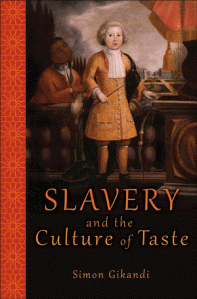 Simon Gikandi’s book Slavery and the Culture of Taste has just received a James Russell Lowell prize at MLA, and I thought that C18L, Long 18th, and other 18th-century scholars/readers might be interested in doing a collaborative reading of this book in the spring. Right now I’m trying to gauge the level of interest in the book, and seeing when might be a good time to do it.
We would probably do it over about a week or so, with one respondent per chapter posting a 500-800 word response every day or so, depending on the level of traffic. Then hopefully we can get Gikandi to respond to our posters at the end. For those interested in the process, we’ve done this with books by Joe Roach, Michael McKeon and Richard Sher in the past. Here’s the link to our announcement. If you’d like to participate, or better yet, help organize, please contact me at dmazella@uh.edu. It would also be helpful if you could give me an idea of the best week or weeks this spring for me to schedule.
Thanks,
Dave Mazella
The Long Eighteenth
◊ ◊ ◊ ◊ ◊
Recent postings at The Long Eighteenth offer numerous items of potential interest Enfilade readers including: 1) Soren Hammerschmidt‘s new course blog, Eighteenth-Century Media; 2) ‘Jeffersongate’ and the controversy surrounding Henry Wiencek’s treatment of Thomas Jefferson in Master of the Mountain; and 3) thoughts on synthesis. -CH
New Book | Hadrian’s Wall: A Life
From Oxford University Press:
Richard Hingley, Hadrian’s Wall: A Life (Oxford: Oxford University Press, 2012), 416 pages, ISBN: 978-0199641413, $150.
 In Hadrian’s Wall: A Life, Richard Hingley addresses the post-Roman history of this world-famous ancient monument. Constructed on the orders of the emperor Hadrian during the 120s AD, the Wall was maintained for almost three centuries before ceasing to operate as a Roman frontier during the fifth century. The scale and complexity of Hadrian’s Wall makes it one of the most important ancient monuments in the British Isles. It is the most well-preserved of the frontier works that once defined the Roman Empire.
While the Wall is famous as a Roman construct, its monumental physical structure did not suddenly cease to exist in the fifth century. This volume explores the after-life of Hadrian’s Wall and considers the ways it has been imagined, represented, and researched from the sixth century to the internet. The sixteen chapters, illustrated with over 100 images, show the changing manner in which the Wall has been conceived and the significant role it has played in imagining the identity of the English, including its appropriation as symbolic boundary between England and
Scotland. Hingley discusses the transforming political, cultural, and religious significance of the Wall during this entire period and addresses the ways in which scholars and artists have been inspired by the monument over the years.
◊ ◊ ◊ ◊ ◊
From Christopher Catling’s review, “Vandals and Hanoverians,” for TLS (14 December 2012): 27.
. . . in Gildas [writing around 540], the Wall is explicitly about “them and us” – civilization versus beastly paganism. The Wall is a genetic and cultural boundary, an idea that Hingley shows to be surprisingly long-lived: it recurs in nineteenth-century historical paintings of the Wall’s construction destined for the walls of the Houses of Parliament, in the illustrations to Kipling’s Puck of Pook’s Hill (1906), and even in a cartoon published in The Times in 1997 referring to the devolution debate. Civilization versus beastly paganism The idea that there is something different (for which read hostile and culturally inferior) about the people who live north of Hadrian’s Wall recurs every time political relations between the English and the Scottish come to the fore. . . .
Scotland really did turn hostile with the Jacobite uprisings of 1715. There was much talk about building a new Hadrian’s Wall, as roads, bridges and garrisons were constructed between 1725 and 1737 to militarize the Borders and the Highlands and Islands of Scotland. One result was the first accurate mapping of the Wall and its associated landscapes, undertaken by military surveyors; another was the use of the Wall as a quarry for road stone and the construction of a military road right on top of the eastern section of the Wall, from Newcastle to Sewingshields.
The antiquary William Stukeley was horrified by this act of desecration. Lobbying the Princess of Wales, he asked her to be his patron and champion in the work of protecting “this most noble, most magnificent work from further ruin, not from enemies, but from more than Gothic workmen, quite thoughtless and regardless of this greatest wonder, not of Brittain only, but of Europe.” Now, for the first time in the history of the Wall, it was the English who were cast in the role of the barbarians; Hanoverian military engineers were no better than the Goths and Vandals who had sacked Rome. . .
◊ ◊ ◊ ◊ ◊
For the Wall’s ongoing influence, we can also add The Game of Thrones, as George R. R. Martin acknowledged in 2000 (as quoted in The Guardian). Hadrian’s Wall as civilization’s boundary will presumably be with us for a long time.
Submissions for the Oscar Kenshur Book Prize
Oscar Kenshur Book Prize
Applications due by 31 January 2013
The Center for Eighteenth-Century Studies at Indiana University is pleased to announce its annual book prize, to be awarded for an outstanding monograph of interest to eighteenth-century scholars working in a range of disciplines. The prize honors the work of Oscar Kenshur, professor emeritus of comparative literature at Indiana University, a dix-huitièmiste par excellence, and one of the founding members of the Center.
Submissions in English from any discipline are welcome; authors can submit their work irrespective of citizenship. Multi-authored collections of essays and translations, as well as books by members of the Indiana-University-Bloomington faculty, are not eligible. The Kenshur prize of $1000 will be awarded together with an invitation to the Center for Eighteenth-Century Studies for a workshop dedicated to the winning book, in which several colleagues will discuss the book from different disciplinary perspectives. The Center will cover the author’s expenses to attend this event.
To be eligible for this year’s competition, a book must carry a 2012 copyright date. Submissions can be made by the publisher or the author: three copies must be received at the ASECS office by the 31st of January 2013. Please send the books (clearly marked for Kenshur Prize) to ASECS, 2598 Reynolda Rd., Suite C, Winston-Salem, NC 27106. For further inquiries please contact Professor Mary Favret, Director of the Center for Eighteenth-Century Studies at Indiana University (email favretm@indiana.edu).
Conference | European Portrait Miniatures
European Portrait Miniatures: Artists, Functions and Collections
Celle Castle, Celle, Germany, 25-27 January 2013
 The conference is being held on the occasion of the opening of the fifth exhibition of the Tansey Collection and the publication of the accompanying catalogue Miniatures from the Time of Marie-Antoinette in the Tansey Collection on 25 January 2013.
Admission is free. Celle Castle as well as the Bomann-Museum nearby are within walking distance (20 minutes) from Celle railway station. Trains from Hannover take approximately 25 to 45 minutes (Deutsche Bahn, Metronom or S-Bahn). For more information and for registration, please contact bernd.pappe@miniaturen-tansey.de.
◊ ◊ ◊ ◊ ◊
F R I D A Y , 2 5 J A N U A R Y 2 0 1 3
16:30 Opening of the exhibition Miniatures from the Time of Marie-Antoinette in the Tansey Collection
18:00 Visit of the exhibition and reception at the Bomann-Museum Celle
19:30 Dinner
S A T U R D A Y , 2 6 J A N U A R Y 2 0 1 3
Objects, Agencies, and Social Practices
9:00 Marcia POINTON (Manchester), Intimacy, Exclusion and Revelation: The Portrait Miniature as Image and Object, ca. 1640-1800
9:30 Bert WATTEEUW (Antwerp), Miniature Dramas: The Portrait Miniature as a Literary Motif in Early Modern European Drama
10:00 Discussion
10:15 Coffee
Politics and Representation
10:45 Vanessa REMINGTON (London), ‘Philistines or Connoisseurs?’: The Collecting of Miniatures by the Early Hanoverians at the English Court, 1714-1760
11:15 Karin SCHRADER (Bad Nauheim), Between Representation and Intimacy: The Portrait Miniatures of the Georgian Queens
11:45 Friederike DRINKUTH (Schwerin), Intimacy and Ancestry: A Dynastic Souvenir for Queen Charlotte
12:15 Discussion
12:30 Lunch
13:45 Laurent HUGUES (Nîmes), The Commissions of Miniatures of the Royal Family from France According to the Archival Sources, 1725-1792
14:15 Sarah GRANT (London), Miniatures of the Princesse de Lamballe (1749-1792): The Portraiture, Patronage and Politics of a Royal Favourite
14:45 Sigrid RUBY (Gießen/Saarbrücken), Love Affairs with the Founding Father: Portrait Miniatures of George Washington – Modes of Creation and Display
15:15 Discussion
15:30 Coffee
European Miniature Collections (part I)
16:00 Stephen LLOYD (Edinburgh), A Group of Miniatures by Jacob van Doordt (fl. 1606 – d. 1629) in the Buccleuch Collection
16:30 Thierry JAEGY (Paris), Masterpieces of Miniature Painting in French Private Collections
17:00 Markus MILLER (Eichenzell), The Collection of Portrait Miniatures of the Landgraves and Grand Dukes of Hesse-Darmstadt
Andreas DOBLER (Eichenzell), The Miniature Collection of Empress Friedrich in Castle Fasanerie
17:45 Discussion
19:30 Dinner
S U N D A Y , 2 7 J A N U A R Y 2 0 1 3
European Miniature Collections (part II)
9:00 Elizaveta ABRAMOVA (Saint Petersburg), The Collection of Miniatures from the State Hermitage, Saint Petersburg
9:30 Izabela WIERCZINSKA (Warsaw), The Enchantment of History: Selected Masterpieces from the Miniatures Collection of the Great Dukes of Hesse and by Rhine
10:00 Discussion
10:15 Coffee
10:45 Astrid SCHERP (Munich), The Collection of Portrait Miniatures of Elector Palatine Johann Wilhelm von der Pfalz (1658-1716)
11:15 Lucyna LENCZNAROWICZ and Danuta GODYN (Cracow), The Highlights of the Miniatures Collection at the National Museum in Cracow
11:45 Discussion
12:00 Lunch
Techniques and Materials
13:15 Emma RUTHERFORD (London), The Plumbago Portrait in Britain
13:45 Julia SEDDA (Berlin), Silhouettes: The Fashionable Paper Portrait Miniature around 1800
14:15 Discussion
Miniature Painters
14:30 Nathalie LEMOINE-BOUCHARD (Paris), Charles-Paul-Jérôme de Bréa (1739-1820) and his Work in Miniature
15:00 Coffee
15:30 Catherine DE LEUSSE (Paris), Mme. Herbelin, a Miniaturist of the July Monarchy and of the Second Empire
16:00 Roger and Carmela ARTURI PHILLIPS (Ferndown, Dorset), Miniature Painting in the 20th Century
16:30 Discussion
16:45 Closing Remarks
◊ ◊ ◊ ◊ ◊
From Artbooks.com:
Catalogue: Juliane Schmieglitz-Otten and Bernd Pappe, Miniaturen der Zeit Marie Antoinettes aus der Sammlung Tansey / Miniatures from the Time of Marie Antoinette in the Tansey Collection (Munich: Hirmer, 2013), 500 pages, ISBN: 978-3777490212, $105.
The Tansey miniatures, now housed in the Bomann Museum in Celle, form one of the most significant collections of European miniature paintings. Miniatures from the Time of Marie Antoinette in the Tansey Collection is the fifth book in a series exploring this collection by key periods; 168 works, mostly by French artists, are examined in actual size using the outstanding photographs of Birgitt Schmedding. The final 50 years of the 18th century constituted one of the most magnificent periods in the art of miniature painting, with regard to both style and technique. The artists, who produced these portraits for private gifts, not only excelled in applying watercolours to ivory, but also expressed great ingenuity in their representations of affection and love. The authors Bernd Pappe and Juliane Schmieglitz-Otten, both renowned connoisseurs in this field, detail and analyse each work. Introductory essays by leading specialists provide further insights into this fascinating time for miniature painting. The Tansey Collection, started about thirty years ago by the German-American couple Lieselotte and Ernest Tansey, was donated in part to the Bomann Museum in Celle 1997.
New Book | Common Land in English Painting, 1700-1850
From Boydell & Brewer:
Ian Waites, Common Land in English Painting, 1700-1850 (Woodbridge: Boydell Press, 2012), 216 pages, ISBN: 978-1843837619, $90.
 During the eighteenth and nineteenth centuries, much of England’s common land was eradicated by the processes of parliamentary enclosure. However, despite the fact that the landscape was frequently viewed as unproductive, outmoded and unsightly, many British landscape painters of the time – including Constable, Gainsborough and Turner – resolutely continued to depict it.
This book is the first full study of how they did so, using evidence drawn not only from art-historical picture analysis, but from contemporary poems and novels, and the contemporary pamphlets, essays and reports that advanced the rhetoric of both agricultural improvement and new theories on landscape aesthetics. It highlights a deep-rooted social and cultural attachment to the common field landscape, and demonstrates that common land played a significant but – until now – underestimated role in both the history of English art and of the formation of an English national identity, reflecting what are still highly sensitive issues of
progress, nostalgia and loss within the English countryside. Recasting common land as a recurrent facet of English culture in the modern period, the numerous paintings, drawings and prints featured in this book give the reader a comprehensive and evocative sense of what this now almost wholly lost landscape looked like in its hey-day.
Ian Waites is Senior Lecturer in History of Art and Design at the University of Lincoln.
Exhibition | The Patina of Time
From the Musée Cognacq-Jay:
La Patine du Temps: Conservation et restauration des oeuvres d’art
Musée Cognacq-Jay, Paris, 11 September — 30 December 2012
 Le musée Cognacq-Jay conserve essentiellement des œuvres du XVIIIe siècle et certaines sont plus anciennes encore : elles ont donc plusieurs siècles d’âge et toutes n’ont pas traversé le temps sans dommage. Sous le titre La Patine du temps, un parcours est proposé au visiteur, dans les salles-mêmes du musée, pour lui permettre de comprendre la fragilité des œuvres d’art, la manière dont elles vieillissent, ce que l’on peut faire pour freiner ce vieillissement ou ce que l’on doit attendre d’une restauration. Quatorze panneaux pédagogiques scandent la visite : À quoi ressemble un tableau en bon état ? Que faire d’une sculpture cassée ? figurent ainsi parmi les questions qui sont abordées.
Des restaurations récemment effectuées sur L’Ânesse de Balaam de Rembrandt et Le Retour de chasse de Diane de François Boucher, deux peintures majeures du musée Cognacq-Jay, font l’objet d’une étude plus minutieuse. Mais la conservation et la restauration des pastels, des sculptures ou du mobilier sont aussi évoquées en prenant des exemples éclairants parmi les œuvres du musée. De fait, ce sont aussi aux techniques de fabrication des
œuvres que le visiteur est initié.
Ce parcours fait suite à l’ouvrage publié sous le même titre en 2011, La Patine du temps, rédigé par Georges Brunel, directeur honoraire, et José de Los Llanos, actuel directeur du musée Cognacq-Jay.
◊ ◊ ◊ ◊ ◊
Catalogue: Georges Brunel and José de Los Llanos, La Patine du Temps (Paris: Paris-Musées, 2011), 71 pages, ISBN: 978-2759601547, 12€.
Techniques « Tous les êtres ont leur histoire : toi et moi en avons une, les oeuvres d’art aussi. L’histoire, c’est toute l’épaisseur du temps écoulé depuis que l’on est venu au monde. Il s’est pour ainsi dire condensé dans des craquelures, des accidents de surface, un changement des teintes… » Avec ce douzième titre de la collection « Petites Capitales », le lecteur est confronté aux questions délicates soulevées par la restauration des oeuvres d’art. Le temps ne se remonte pas… Comment présenter son passage sous le jour le plus favorable ? Beau sujet de débat entre Fiordiligi et Dorabella, deux jeunes Italiennes en visite au musée Cognacq-Jay. La vivacité de leur dialogue nous entraîne dans une méditation sur l’oeuvre et le temps, sur l’évolution du goût, à partir des restaurations exemplaires du Retour de chasse de Diane de Boucher et de L’Ânesse du prophète Balaam de Rembrandt, deux chefs d’oeuvre du musée Cognacq Jay. Rendre compte de la richesse du patrimoine parisien, de ses deux mille ans d’histoire et de la diversité des collections de la Ville de Paris, voilà l’ambition de la collection « Petites Capitales ». Le principe de chaque ouvrage est de rassembler une trentaine d’oeuvres emblématiques – peintures, dessins, sculptures, photographies, archives – autour d’un thème, en privilégiant le détail révélateur ; en regard de chaque illustration, des textes et de brefs commentaires créent un jeu de correspondances toujours éclairantes, sur le mode d’une érudition sensible et accessible à tous.
◊ ◊ ◊ ◊ ◊
Bénédicte Bonnet Saint-Georges reviewed the exhibition for The Art Tribune (available in English and French) . . .
The Musée Cognac-Jay is inviting visitors to rediscover their collections by taking a close look at the patina of time. Painting on canvas or wood, marquetry or upholstered furniture, terracotta sculpture…each object presents specific conservation, renovation and restoration problems. Though restorations must be reversible, legible and not alter the nature of the work since the signing of the Venice Charter in 1964, this has not always been the case.
Fourteen explanatory panels dealing with these various problems are scattered throughout the museum using examples of objects on view in the respective rooms. The didactic theme addresses the general public as does the publication behind this hang : written by Georges Brunel and José de Los Llanos, it is in the form of a dialogue between two women visiting the Musée Cognac-Jay. . . .
The full review is available here»










leave a comment