New Book | La légèreté et le grave
From Passés Composés:
Cécile Berly, La légèreté et le grave: Une histoire du XVIIIe siècle en tableaux (Paris: Passés Composés, 2021), 150 pages, ISBN: 978-2379334009, €24.
 Le XVIIIe siècle s’ouvre avec Le Pèlerinage à l’île de Cythère d’Antoine Watteau et s’achève avec La Mort de Marat de Jacques-Louis David : la naissance de la fête galante versus l’agonie d’un tribun révolutionnaire. Deux chefs-d’œuvre qui illustrent la légèreté et la gravité d’un siècle, deux facettes antagonistes mais complémentaires d’une même époque.
Les dix œuvres ici racontées sont ainsi autant de jalons pour saisir ce siècle passionnant dans ses innombrables contradictions : elles correspondent toutes à un moment du XVIIIe et disent son histoire artistique, culturelle, philosophique, sociale, économique et, bien évidemment, politique. Autant de chefs-d’œuvre qui ont forgé une société nouvelle, éprise de liberté, d’indépendance et de transgressions, au fil d’un siècle qui, sous la plume sensible de Cecile Berly, oscille sans cesse entre une légèreté savamment entretenue et une gravité qui confine au drame.
Historienne, spécialiste du XVIIIe siècle, Cécile Berly a publié plusieurs ouvrages sur Marie-Antoinette. Elle a également présenté et annoté la correspondance de Madame de Pompadour, et est l’auteure des Femmes de Louis XV et de Trois femmes: Madame du Deffand, Madame Roland, Madame Vigée Le Brun.
New Book | L’autre famille royale: Bâtards et maitresses
From Passés Composés:
Flavie Leroux, L’autre famille royale: Bâtards et maitresses d’henri IV à Louis XVI (Paris: Passés Composés, 2022), 272 pages, ISBN: 978-2379334801, €22.
 La faillite de l’absolutisme
Maîtresses et bâtards sont au cœur de l’histoire monarchique et tiennent, à l’avènement de ce qu’on appelle « l’absolutisme », un rôle de premier plan. Mais quel est-il ? Et surtout comment la famille royale peut-elle s’en accommoder alors que sur elle reposent la légitimité et la continuité du pouvoir ? C’est à cette question que Flavie Leroux répond en relisant les règnes des Bourbon, d’Henri IV à Louis XVI. Elle redonne leur place aux maîtresses successives et à leurs enfants, aussi bien dans l’idéologie monarchique que dans la réalité du pouvoir et de la vie de cour. D’abord famille de substitution sous Henri IV, avec Gabrielle d’Estrées et les Vendôme, ils s’imposent ensuite, avec Henriette d’Entragues, Louise de La Vallière ou Mme de Montespan, comme une famille parallèle que le roi garde auprès de lui et impose aux côtés de sa lignée légitime. Cette « contre famille » va concurrencer la « véritable » famille à un point tel que, sous Louis XV puis Louis XVI, c’est la crédibilité du pouvoir des Bourbon qui est mise en péril par cette nouvelle organisation. Entre famille, pouvoir et société, un livre inédit, brillant et décisif sur l’inexorable déclin de la monarchie française avant la Révolution française.
Docteur de l’École des Hautes Études en Sciences Sociales, chargée de recherche au Centre de recherche du château de Versailles, membre associée au Centre de recherches historiques, Flavie Leroux est spécialiste d’histoire de la cour et des femmes en France à l’époque moderne, en particulier des maîtresses royales, auxquelles elle a consacré sa thèse et un ouvrage, Les maîtresses du roi, de Henri IV à Louis XIV (2020).
New Book | Indigenous Continent: The Epic Contest for North America
From Norton:
Pekka Hämäläinen, Indigenous Continent: The Epic Contest for North America (New York: Liveright, 2022), 592 pages, ISBN: 978-163149698, $40.
 A prize-winning scholar rewrites 400 years of American history from Indigenous perspectives, overturning the dominant origin story of the United States.
There is an old, deeply rooted story about America that goes like this: Columbus ‘discovers’ a strange continent and brings back tales of untold riches. The European empires rush over, eager to stake out as much of this astonishing ‘New World’ as possible. Though Indigenous peoples fight back, they cannot stop the onslaught. White imperialists are destined to rule the continent, and history is an irreversible march toward Indigenous destruction.
Yet as with other long-accepted origin stories, this one, too, turns out to be based in myth and distortion. In Indigenous Continent, acclaimed historian Pekka Hämäläinen presents a sweeping counternarrative that shatters the most basic assumptions about American history. Shifting our perspective away from Jamestown, Plymouth Rock, the Revolution, and other well-trodden episodes on the conventional timeline, he depicts a sovereign world of Native nations whose members, far from helpless victims of colonial violence, dominated the continent for centuries after the first European arrivals. From the Iroquois in the Northeast to the Comanches on the Plains, and from the Pueblos in the Southwest to the Cherokees in the Southeast, Native nations frequently decimated white newcomers in battle. Even as the white population exploded and colonists’ land greed grew more extravagant, Indigenous peoples flourished due to sophisticated diplomacy and leadership structures.
By 1776, various colonial powers claimed nearly all of the continent, but Indigenous peoples still controlled it—as Hamalainen points out, the maps in modern textbooks that paint much of North America in neat, color-coded blocks confuse outlandish imperial boasts for actual holdings. In fact, Native power peaked in the late nineteenth century, with the Lakota victory in 1876 at Little Big Horn, which was not an American blunder, but an all-too-expected outcome.
Hämäläinen ultimately contends that the very notion of ‘colonial America’ is misleading, and that we should speak instead of an ‘Indigenous America’ that was only slowly and unevenly becoming colonial. The evidence of Indigenous defiance is apparent today in the hundreds of Native nations that still dot the United States and Canada. Necessary reading for anyone who cares about America’s past, present, and future, Indigenous Continent restores Native peoples to their rightful place at the very fulcrum of American history.
Pekka Hämäläinen is Rhodes Professor of American History at Oxford University and the author of The Comanche Empire, winner of the Bancroft Prize, and Lakota America: A New History of Indigenous Power. He lives in Oxford, England.
New Book | Women, Collecting, and Cultures beyond Europe
From Routledge:
Arlene Leis, ed., Women, Collecting, and Cultures beyond Europe (New York: Routledge, 2022), 282 pages, ISBN: 978-1032135465, £130 / $150
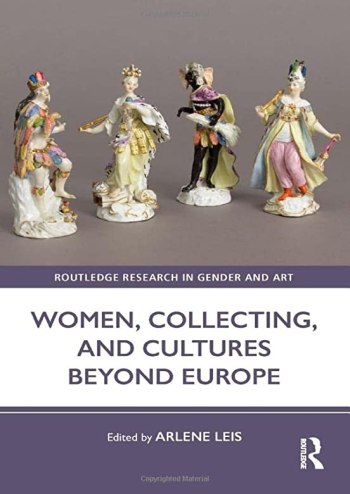 This edited volume builds on recent research and offers a wider lens through which to examine and challenge women’s collecting histories. Spanning from the seventeenth century to the twenty-first (although not organized chronologically) the research herein extends beyond European geographies and across time periods; it brings to light new research on how artificiallia and naturallia were collected, transported, exchanged, and/or displayed beyond Europe. Women, Collecting and Cultures beyond Europe considers collections as points of contact that forged transcultural connections and knowledge exchange. Some authors focus on collectors and what was collected, while others consider taxonomies, travel, patterns of consumption, migration, markets, and the after life of things. In its broad and interdisciplinary approach, this book amplifies women’s voices, and aims to position their collecting practices toward new transcultural directions, including women’s relation to distinct cultures, customs, and beliefs as well as exposing the challenges women faced when carving a place for themselves within global networks.
Arlene Leis is an independent art historian who received her PhD from University of York.
C O N T E N T S
Collecting to Collectingism: New Directions in Women’s Transcultural Practices — Arlene Leis
Part I: Points of Transcultural Exchange
1 Européenerie in Feminine Space: Qing Imperial Women and Collecting in China’s Long Eighteenth Century — Chih-En Chen
2 Coerced Contact: The Dzungar Court Costume of a Swedish Knitting Instructor — Lisa Hellman
3 Trading Places: The Japanese Art Collection of O’Tama Kiyohara Ragusa — Maria Antonietta Spadaro
4 Created to Gleam: Decorum, Taste, and Luxury of Four Dresses from Viceregal Mexico — Martha Sandoval-Villegas and Laura Garcia-Vedrenne
Part II: Natural History, Colonial Encounters, and Indigenous Histories
5 The Botanist Was a Woman: Classifying and Collecting on the First French Circumnavigation of the Globe — Glynis Ridley
6 Pineapple Lady: Expertise and Exoticism in Agnes Block’s Self-Representation as Flora Batava — Catherine Powell-Warren
7 A Memsahib’s ‘Natural World’: Lady Mary Impey’s Collection of Indian Natural History Paintings — Apurba Chatterjee
8 Women and Huipils: The Treasuring of an Indigenous Garment in New Spain — Martha Sandoval-Villegas
9 Colonial Pantomime: Queen Marie I of Portugal’s Human Cabinet of Curiosities — Agnieszka Anna Ficek
Part III: Settlers, Immigrants, and New Frontiers
10 Settler Botanists, Nature’s Gentlemen, and the Canadian Book of Nature: Catharine Parr Traill’s Canadian Wild Flowers — Cynthia Sugars
11 Collecting Indian Art in Santa Fe: The Bryn Mawrters and the Politics of Preservation — Nancy Owen Lewis
12 The Spectacle of Sponsoring an Ottoman Trousseau — Gwendolyn Collaço
13 Las Bexareñas and their Wills: Women’s Material Culture and Cataloguing Practices in Spanish San Fernando de Béxar — Amy M. Porter
Part IV: Recovery, Collaboration, and Repatriation
14 ‘He Surely Existed’: Women of the Early Folk Art Collecting Movement and Thomas W. Commeraw, Forgotten African-American Potter — Brandt Zipp
15 Adjacency in the Collection — Toby Upson
16 Collecting Fibre Arts in Arnhem Land — Louise Hamby
17 From Women’s Hands: Learning from Métis Women’s Collections — Angela Fey and Maureen Matthews
Exhibition | Clara the Rhinoceros

Jean-Baptiste Oudry, Clara, the Rhinoceros, 1749, oil on canvas, 306 × 453 cm
(Staatliches Museum Schwerin)
◊ ◊ ◊ ◊ ◊
From the press release (11 July 2022) for the exhibition:
Clara the Rhinoceros: Superstar of the 18th Century / Clara de Neushoorn: Superster van de 18e eeuw
Rijksmuseum, Amsterdam, 30 September 2022 — 15 January 2023
Curated by Gijs van der Ham
Clara was strange and new, huge and awe-inspiring—she was utterly unlike any other known animal. This fall, the Rijksmuseum presents Clara the Rhinoceros, an exhibition about an animal who travelled far from her native land of India and became the most famous rhinoceros in the world.

Saint-Germain, J.J., and F. Viger, Clock with Rhinoceros as Carrier, 1755 (Parnassia Collection).
The exhibition shows how new knowledge changed perceptions of the rhinoceros, and how art played its part in this process. The 60 objects on display include paintings, drawings, medals, statues, books, clocks, and a goblet. Very few of these artworks have been displayed before in the Netherlands, and never before have so many exceptional objects devoted to Clara the rhinoceros being presented together. They range from the first-ever European print depicting a rhinoceros—made in 1515 by Albrecht Dürer—to a life-size, full-length portrait of Clara by Jean-Baptiste Oudry dating from 1749. Clara the Rhinoceros runs from 30 September 2022 to 15 January 2023 in the Phillips Wing of the Rijksmuseum.
Clara may not have been the first rhinoceros to come to Europe, but she did become the most famous one. After her long voyage from India, in 1741 she arrived in Amsterdam. Her owner, Douwe Mout van der Meer, was soon showing her to anyone who would pay for the pleasure, whether at fairs, markets, carnivals, or royal courts. For the next 17 years she travelled around Europe in a custom-made cart, accompanied by her entourage. She travelled far and wide: to Vienna and Paris, and to Naples and Copenhagen. Upon her return to the Netherlands, she lived in a field in the North district of Amsterdam. Eventually, Clara died in London in 1758.
People touched, teased, admired, and studied Clara. She prompted this sensational level of interest because no one in Europe had ever been able to see a real live rhinoceros. She was a hyped up, must-see cultural phenomenon, and Mout used print advertising and medals to pump that hype to the max. Until Clara’s arrival, all that Europeans knew of her species was from a print made by Dürer in 1515. He based his drawing on a sketch of a rhinoceros that was briefly in Lisbon, though the sketch wasn’t entirely accurate: it depicted the rhinoceros with an extra horn on its back, for example, and skin that resembled a suit of armour.
 Clara’s appearance on the scene changed all this, leaing to a better understanding of the rhinoceros and to more accurate portrayals. Scholars studied her in minute detail, from head to tail, and artists became fascinated by every fold of her skin. A remarkable number of likenesses were made of Clara, in many forms and using many different materials. This exhibition presents an outstanding selection of these objects, including an impressive life-size portrait painted in Paris in 1749 by Oudry (on loan from Staatliches Museum Schwerin), a painting by Pietro Longhi showing Clara standing in front of her audience in Venice (from Ca’ Rezzonico, Venice), a large marble statue by the Flemish artist Pieter Anton Verschaffelt (from the Rothschild collection at Waddesdon Manor), and an exceptionally rare clock mounted on a Clara figure (from a private Dutch collection) made by the Parisian bronzier and clockmaker Jean-Joseph de Saint-Germain.
Clara was almost never free to walk or run. She depended on humans for her survival, and was rarely able to display natural behaviours—except for example the occasions when she needed to cross a river by swimming, and clearly enjoyed the water. In 1750 the Neurenberg biographer Christoph Gottlieb Richter published a conversation between a rhinoceros and a grasshopper, in which the rhinoceros bemoans the way people treat her and stare at her. This book presents a role-reversal, with the rhinoceros appraising and studying people rather than the other way around. And in her 2016 installation Clara, the contemporary artist Rossella Biscotti uses the rhinoceros’s story to interrogate the relationship between humans and animals. The installation, which is also part of the exhibition, shows that Clara’s story is also about colonialism, exoticism, and globalisation, as well as exploitation and power.
The exhibition design for Clara the Rhinoceros and Crawly Creatures is by stage designer Theun Mosk | Ruimtetijd. Graphic design for the exhibition is by Irma Boom.
Gijs van der Ham, Clara the Rhinoceros (Rotterdam: nai101, 2023), 208 pages, ISBN: 978-9462087477, $40.
Exhibition | Process: Design Drawings, 1500–1900

Design drawing for a patinated bronze vase, anonymous, ca. 1780
(Amsterdam: Rijksmuseum)
◊ ◊ ◊ ◊ ◊
From the museum:
Process: Design Drawings from the Rijksmuseum, 1500–1900
Créer: Dessiner pour les arts décoratifs, 1500–1900
Design Museum Den Bosch, Rijksmuseum, Amsterdam, 5 November 2022 — 12 February 2023
Fondation Custodia / Collection Frits Lugt, Paris, 25 February — 14 May 2023
Curated by Reinier Baarsen
This pioneering exhibition is an opportunity to discover a collection of extraordinary design drawings from the Rijksmuseum. The drawings, which date from the period 1500–1900, have been brought together for the first time and are arranged according to the successive stages of the design process.
 The focus here is not on big artistic names, but on the crucial role that drawings have played in design. We watch from close-by as the ideas for all sorts of items are formed and we also get to meet their inventors, makers, and patrons. Drawings of vases, chairs and clocks, stoves, sledges, and carriages are shown, from the first rough pencil sketches to beautifully worked-up and colourful presentations. The drawings in this exhibition were recently acquired by the Rijksmuseum in Amsterdam, where they belong to a special collection established by Senior Curator Reinier Baarsen. He offers us a unique insight here into the role that drawing has played in the design process, as well as the superb drawings it has produced.
Reinier Baarsen, Process: Design Drawings from the Rijksmuseum, 1500–1900 (Rotterdam: nai101, 2022), 464 pages, SBN 978-9462087354, €60 / $70.
◊ ◊ ◊ ◊ ◊
Note (added 28 February 2023) — The posting was updated to include the Fondation Custodia as a second venue.
Exhibition | Silver City: 500 Years of Portsmouth’s History
Now on view at the Portsmouth Museum and Art Gallery:
Silver City: 500 Years of Portsmouth’s History
Portsmouth Museum and Art Gallery, 28 May 2022 — 26 February 2023
Curated by James Daly and Susan Ward
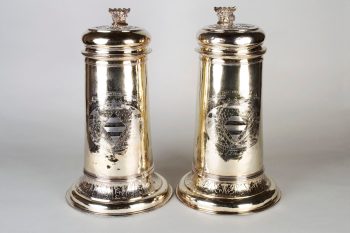
Portsmouth Flagons, made in 1683 by Wolfgang Howzer and presented to Portsmouth by Louise de Kéroualle, the Duchess of Portsmouth. She was one of Charles II’s mistresses and presented the Flagons to Portsmouth when she was made duchess, although there is no record of her having visited the town.
Silver City: 500 Years of Portsmouth’s History is a major exhibition at Portsmouth Museum and Art Gallery, telling the story of the city through amazing silver treasures. It showcases many precious objects that have never been on public display before. Most come from the city’s civic collection, but others have been loaned from the Royal Navy, the city’s Anglican cathedral, and the Goldsmiths’ Company Charity. Objects include a model of HMS Victory presented to the city when the Portsmouth Command of the Royal Navy was awarded the Freedom of the City in 1965. It is made from copper taken from the ship and plated in silver.
James Daly and Susan Ward, Silver City: 500 Years of Portsmouth’s History (Portsmouth: Tricorn Books, 2022), 161 pages, ISBN: 978-914615276, £27.
◊ ◊ ◊ ◊ ◊
Frances Parton’s review of the exhibition appeared in October issue of The Burlington Magazine, pp. 1015–17.
New Book | Connected Mobilities
From Amsterdam UP:
Paul Nelles and Rosa Salzberg, eds., Connected Mobilities in the Early Modern World: The Practice and Experience of Movement (Amsterdam: Amsterdam University Press, 2022), 282 pages, ISBN: 978-9463729239, €122.
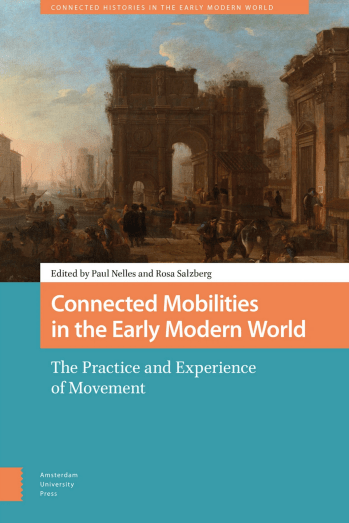 Connected Mobilities in the Early Modern World offers a panorama of movement, mobility, and exchange in the early modern world. While the pre-modern centuries have long been portrayed as static and self-contained, it is now acknowledged that Europe from the Middle Ages onwards saw increasing flows of people and goods. Movement also connected the continent more closely to other parts of the world. This book challenges dominant notions of the ‘fixed,’ immobile nature of pre-modern cultures through study of the inter-connected material, social, and cultural dimensions of mobility. The case studies presented here chart the technologies and practices that both facilitated and impeded movement in diverse spheres of social activity such as communication, transport, politics, religion, medicine, and architecture. The chapters underscore the importance of the movement of people and objects through space and across distance to the dynamic economic, political, and cultural life of the early modern period.
Paul Nelles is Associate Professor of early modern history at Carleton University. His research focuses on the history of books, writing, and religion in early modern Europe. His study of Jesuit communication, The Information Order: Writing, Mobility and Distance in the Making of the Society of Jesus (1540–1573), is forthcoming.
Rosa Salzberg is Associate Professor of Early Modern History, University of Trento. Her research focuses on communication, urban history and the history of migration and mobility in early modern Europe, with a focus on Venice. She is the author of Ephemeral City: Cheap Print and Urban Culture in Renaissance Venice (2014).
C O N T E N T S
Paul Nelles and Rosa Salzberg, Movement and Mobility in the Early Modern World: An Introduction
Moving Bodies
1 John Gallagher, Linguistic Encounter: Fynes Moryson and the Uses of Language
2 Gerrit Verhoeven, Wading through the Mire: Mobility on the Grand Tour, 1585–1750
3 Carolin Schmitz, Travelling for Health: Medicine and Rural Mobility in Early Modern Spain
Crossing Borders
4 Irene Fosi, Mobility and Danger on the Borders of the Papal States, 16th–17th Centuries
5 Paola Molino, News on the Road: The Mobility of Handwritten Newsletters in Early Modern Europe
6 Darka Bili., Quarantine, Mobility, and Trade: Commercial Lazzarettos in the Early Modern Adriatic
Global Networks
7 Paul Nelles, Devotion in Transit: Agnus Dei, Jesuit Missionaries, and Global Salvation in the Sixteenth Century
8 Felicita Tramontana, Getting to the Holy Land: Franciscan Journeys and Mediterranean Mobility
9 Sebouh Aslanian, From Mount Lebanon to the Little Mount in Madras: Mobility and Catholic-Armenian Alms-Collecting Networks during the 18th Century
Index
New Book | Architectural Type and Character
From Routledge:
Samir Younés and Carroll William Westfall, Architectural Type and Character: A Practical Guide to a History of Architecture (New York: Routledge, 2022), 272 pages, ISBN: 978-1138584037 (hardback), $128 / ISBN: 978-1138584051 (paperback), $36.
 Architectural Type and Character provides an alternative perspective to the current role given to history in architecture, reunifying architectural history and architectural design to reform architectural discourse and practice. Historians provide important material for appreciating buildings and guiding those who produce them. In current histories, a building is the product of a time, its form follows its function, irresistible influences produce it, and style, preferably novel, is its most important attribute. This book argues for an alternative. Through a two-part structure, the book first develops the theoretical foundations for this alternative history of architecture. The second part then provides drawings and interpretations of over one hundred sites from different times and places.
Samir Younes is Professor of Architecture at the University of Notre Dame where he was Director of Rome Studies and Director of Graduate Studies. He teaches architectural design and theory. His books include: The Imperfect City: On Architectural Judgement; Architects and Mimetic Rivalry; The Intellectual Life of the Architect; and Quatremère de Quincy’s Historical Dictionary of Architecture: The True, The Fictive, and The Real.
Carroll William Westfall’s PhD in the history of architecture from Columbia University was followed by five decades of teaching before retiring from the University of Notre Dame. His scholarly and general articles run from studies of Pompeii to critiques of current practice. His books are In This Most Perfect Paradise, a study of Rome in the 15th century; Architectural Principles in the Age of Historicism, a dialectic exchange with Robert Jan van Pelt; and Architecture, Liberty, and Civic Order: Architectural Theories from Vitruvius to Jefferson and Beyond, a review of architectural theory.
C O N T E N T S
List of Illustrations
Preamble
Introduction
Part I
1 The History of Architecture We Have
2 The Alternative: Type, Character, and Style
3 Urbanism
4 The Components and Types of Good Urban Form
Part II
5 The Tholos
6 The Temple
7 The Theatre
8 The Regia
9 The Dwelling
10 The Shop
11 The Hypostyle
New Book | Small Things in the Eighteenth Century
From Cambridge UP:
Chloe Wigston Smith and Beth Fowkes Tobin, eds., Small Things in the Eighteenth Century: The Political and Personal Value of the Miniature (Cambridge: Cambridge University Press, 2022), 280 pages, ISBN: 978-1108834452, $99.
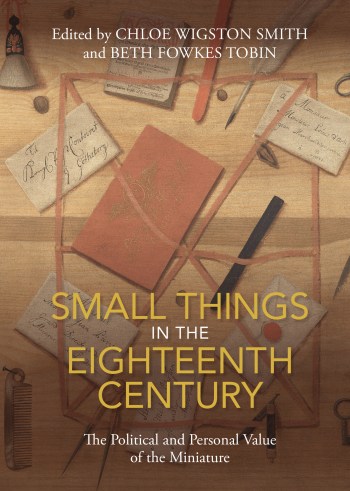 Offering an intimate history of how small things were used, handled, and worn, this collection shows how objects such as mugs and handkerchiefs were entangled with quotidian practices and rituals of bodily care. Small things, from tiny books to ceramic trinkets and toothpick cases, could delight and entertain, generating tactile pleasures for users while at the same time signalling the limits of the body’s adeptness or the hand’s dexterity. Simultaneously, the volume explores the striking mobility of small things: how fans, coins, rings, and pottery could, for instance, carry political, philosophical, and cultural concepts into circumscribed spaces. From the decorative and playful to the useful and performative, such small things as tea caddies, wampum beads, and drawings of ants negotiated larger political, cultural, and scientific shifts as they transported aesthetic and cultural practices across borders, via nationalist imagery, gift exchange, and the movement of global goods.
Chloe Wigston Smith is the author of Women, Work, and Clothes in the Eighteenth-Century Novel (2013) and co-editor, with Serena Dyer, of Material Literacy in Eighteenth-Century Britain: A Nation of Makers (2020). Her current research, supported by a British Academy fellowship, centers on material culture and the Atlantic world.
Beth Fowkes Tobin, a recipient of NEH and NSF fellowships, is the author of The Duchess’s Shells: Natural History Collecting in the Age of Cook’s Voyages (2014), Colonizing Nature: The Tropics in British Arts and Letters, 1760–1830 (2005), and Picturing Imperial Power: Colonial Subjects in Eighteenth-Century British Painting (1999).
C O N T E N T S
Figures
Notes on Contributors
Acknowledgments
Introduction: The Scale and Sense of Small Things — Chloe Wigston Smith and Beth Fowkes Tobin
Part I: Reading Small Things
1 ‘The Sum of All in All’: The Miniature Book and the Nature of Legibility — Abigail Williams
2 Nuts, Flies, Thimbles, and Thumbs: Eighteenth-Century Children’s Literature and Scale — Katherine Wakely-Mulroney
3 Gothic Syntax — Cynthia Wall
4 Small, Familiar Things on Trial and on Stage — Chloe Wigston Smith
Part II: Small Things in Time and Space
5 On the Smallness of Numismatic Objects — Crystal B. Lake
6 Crinoidal Limestone and Staffordshire Teapots: Material and Temporal Scales in Eighteenth-Century Britain — Kate Smith
7 ‘Joineriana’: The Small Fragments and Parts of Eighteenth-Century Assemblages — Freya Gowrley
8 ‘Pray What a Pox Are Those Damned Strings of Wampum?’ — Robbie Richardson
Part III: Small Things at Hand
9 ‘We Bought a Guillotine Neatly Done in Bone’: Illicit Industries on Board British Prison Hulks, 1775–1815 — Anna McKay
10 ‘What Number?’: Reform, Authority, and Identity in Late Eighteenth-Century Military Buttons — Matthew Keagle
11 Two Men’s Leather Letter Cases: Mercantile Pride and Hierarchies of Display — Pauline Rushton
12 The Aesthetic of Smallness: Chelsea Porcelain Seal Trinkets and Britain’s Global Gaze, 1750–1775 — Patricia F. Ferguson
13 ‘Small Gifts Foster Friendship’: Hortense de Beauharnais, Amateur Art, and the Politics of Exchange in Post-Revolutionary France — Marina Kliger
Part IV: Small Things on the Move
14 Hooke’s Ant — Tita Chico
15 Portable Patriotism: Britannia and Material Nationhood in Miniature — Serena Dyer
16 Revolutionary Histories in Small Things: Louis XVI and Marie Antoinette on Printed Ceramics, c. 1793–1796 — Caroline McCaffrey-Howarth
17 A Box of Tea and the British Empire — Romita Ray
Afterword: A Thing’s Perspective — Hanneke Grootenboer
Select Bibliography
Index










 Enfilade
leave a comment