Exhibition | ‘Without Hands’: The Art of Sarah Biffin
Now on view at Philip Mould in London:
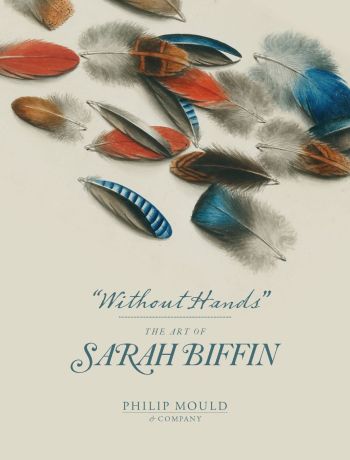
‘Without Hands’: The Art of Sarah Biffin
Philip Mould & Company, London, 1 November — 21 December 2022

Sarah Biffin, A miniature watercolour of subaltern or captain of a British ‘royal’ regiment of line infantry by, ca. 1815–20.
The remarkable story of Sarah Biffin (1784–1850), has been largely overlooked by historians. Those who have attempted to illustrate her life have often perpetuated misconceptions, and Biffin’s artistic reputation has suffered as a result. This exhibition, established upon ground-breaking primary research, is the first of its kind to present Biffin’s artistic achievements and represent her history.
Sarah Biffin (or Beffin) was born into a farming family in Somerset in 1784, where her baptism records state that she was “born without arms and legs.” Teaching herself to write and draw from a young age, Biffin rose to fame as an artist and established a professional career as a portrait painter. Throughout her long and successful career, she travelled extensively, took commissions from royalty, and recorded her own likeness through exquisitely detailed self-portraits. Her artworks—many proudly signed “Without Hands”—are a testament to her talent and accomplishment.
Around the age of twenty, Biffin left home. She contracted herself to a ‘Mr Dukes’ who toured the country with Biffin, visiting county fairs where she was described as the “Eighth Wonder.” Using her mouth and shoulder, Biffin would sew, write, and paint watercolours and portrait miniatures in front of crowds who turned up and left with a sample of her writing included in the cost of their ticket. One such spectator was the wealthy and well-connected Earl of Morton, who supported her in her quest to finesse her artistic skills. In her mid-twenties she began formal tuition with a miniature painter, William Marshall Craig. From 1816 she set herself up as an independent artist and later took commissions from nobility and royalty.
 Biffin travelled extensively, exhibiting her artwork and taking commissions all over the country and abroad. She took studios in cities including London, Brighton, Birmingham, Cheltenham, and Liverpool. In each of these cities, she taught the art of miniature painting and was a champion of women students in particular. Continuously recording her own image throughout her lifetime, Biffin’s self-portraits evidence the artistic aptitude, self-respect, and skill of this tenacious artist.
Following the story of her life, the exhibition includes original handbills and broadsides from Biffin’s time in travelling fairs, along with the samples of her writing included in the cost of the entry tickets. Visitors to the exhibition will also be able to see examples of the art from her professional career, including portraits, landscapes, and highly-skilled still lifes. More personal exhibits include private letters (including one to her mother) and almost every self-portrait she ever painted. With advisor, artist Alison Lapper MBE (born 180 years later with the same condition); consultant and contributor, Professor Essaka Joshua (specialist in Disability Studies at the University of Notre Dame, Indiana); and loans from national institutions, the exhibition will celebrate Biffin as a disabled artist who challenged attitudes to disability.
The catalogue is published by PHP and distributed by The University of Chicago Press:
Emma Rutherford and Ellie Smith, eds., with contributions by Essaka Joshua, Alison Lapper, and Elle Sushan, ‘Without Hands’: The Art of Sarah Biffin (London: Paul Holberton, 2022), 80 pages, ISBN: 978-1913645366, £18 / $25.
Emma Rutherford is a portrait miniatures consultant at Philip Mould & Company in London. Ellie Smith is a researcher at Philip Mould & Company. Professor Essaka Joshua is a specialist in disability studies at the University of Notre Dame, Indiana. Based in Brighton, Alison Lapper is an artist, television presenter, speaker, and Gig-Arts Charity patron. Elle Shushan is a specialist, author, lecturer, and museum consultant in Philadelphia.
New Book | Sculpture at the Ends of Slavery
From the University of California Press:
Caitlin Meehye Beach, Sculpture at the Ends of Slavery (Berkeley: University of California Press, 2022), 240 pages, ISBN: 978-0520343269, £47 / $60.
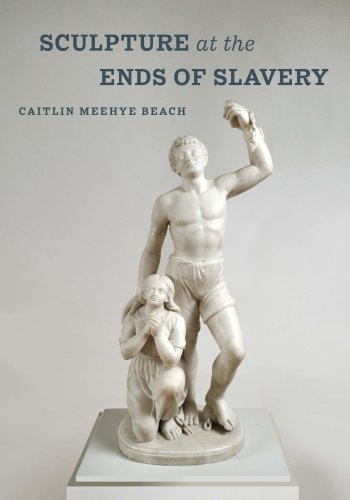 From abolitionist medallions to statues of bondspeople bearing broken chains, sculpture gave visual and material form to narratives about the end of slavery in the eighteenth and nineteenth centuries. Sculpture at the Ends of Slavery sheds light on the complex—and at times contradictory—place of such works as they moved through a world contoured both by the devastating economy of enslavement and by international abolitionist campaigns. By examining matters of making, circulation, display, and reception, Caitlin Meehye Beach argues that sculpture stood as a highly visible but deeply unstable site from which to interrogate the politics of slavery. With focus on works by Josiah Wedgwood, Hiram Powers, Edmonia Lewis, John Bell, and Francesco Pezzicar, Beach uncovers both the radical possibilities and the conflicting limitations of art in the pursuit of justice in racial capitalism’s wake.
Part of the Phillips Collection Book Prize Series and supported by the Simpson Imprint in Humanities.
Caitlin Meehye Beach is Assistant Professor in Art History and Affiliated Faculty in African and African American Studies at Fordham University.
C O N T E N T S
Acknowledgments
Introduction — ‘Within a Few Steps of the Spot’: Art in an Age of Racial Capitalism
1 Grasping Images: Antislavery and the Sculptural
2 ‘The Mute Language of the Marble’: Slavery and Hiram Powers’s The Greek Slave
3 Sentiment, Manufactured: John Bell and the Abolitionist Image under Empire
4 Relief Work: Edmonia Lewis and the Poetics of Plaster
5 Between Liberty and Emancipation: Francesco Pezzicar’s The Abolition of Slavery
Coda — ‘Sculptured Dream of Liberty’
Notes
List of Illustrations
Index
New Book | Repertoires of Slavery: Dutch Theater, 1770–1810
From Amsterdam UP:
Sarah Adams, Repertoires of Slavery: Dutch Theater between Abolitionism and Colonial Subjection, 1770–1810 (Amsterdam: Amsterdam University Press, 2022), 252 pages, ISBN: 978-9463726863, €117.
 Through the lens of a hitherto unstudied repertoire of Dutch abolitionist theatre productions, Repertoires of Slavery prises open the conflicting ideological functions of antislavery discourse within and outside the walls of the theatre and examines the ways in which abolitionist protesters wielded the strife-ridden question of slavery to negotiate the meanings of human rights, subjecthood, and subjection. The book explores how dramatic visions of antislavery provided a site for (re)mediating a white metropolitan—and at times a specifically Dutch—identity. It offers insight into the late-eighteenth- and early-nineteenth-century theatrical modes, tropes, and scenarios of racialised subjection and considers them as materials of the ‘Dutch cultural archive’, or the Dutch ‘reservoir’ of sentiments, knowledge, fantasies, and beliefs about race and slavery that have shaped the dominant sense of the Dutch self up to the present day.
Sarah J. Adams holds a Ph.D. in Dutch Literature (Ghent University, 2020). Her postdoctoral project Blackface Burlesques, funded by the Research Foundation — Flanders, investigates the scenarios, tropes, and techniques used to design and represent ‘Blackness’ on the comic stage of the Low Countries before the heyday of minstrel culture.
C O N T E N T S
Acknowledgements
List of Figures
Introduction
1 Dutch Politics, the Slavery-Based Economy, and Theatrical Culture in 1800
2 Suffering Victims: Slavery, Sympathy, and White Self-Glorification
3 Contented Fools: Ridiculing and Re-Commercializing Slavery
4 Black Rebels: Slavery, Human Rights, and the Legitimacy of Resistance
5 Conclusions
Bibliography
Consulted Archives, Collections, and Databases
Literature
Appendix
New Book | House and Home in Georgian Ireland
From Four Courts Press:
Conor Lucey, ed., House and Home in Georgian Ireland: Spaces and Cultures of Domestic Life (Dublin: Four Courts Press, 2022), 216 pages, ISBN: 978-1801510264, €50.
 This book explores the everyday character and functions of domestic spaces in Georgian Ireland. Reflecting real as opposed to ideal patterns of living, the topics and themes addressed here range widely from maternity and hospitality to social identity and consumption. Broadening the species of spaces typically considered for this period—embracing country piles and urban mansions, but also merchant houses, lodgings, and rural cabins—this collection of essays expands and deepens our understanding of the meanings of house and home in Ireland in the long eighteenth century.
Conor Lucey is associate professor in architectural history in the School of Art History & Cultural Policy, University College Dublin
C O N T E N T S
• Conor Lucey, Introduction: Species of Domestic Spaces
• Emma O’Toole, Brought to Bed: The Spaces and Material Culture of the Lying-in
• Patricia McCarthy, A Male Domain? The Dining Room Reconsidered
• Melanie Hayes, Fashioning, Fitting-out, and Functionality in the Aristocratic Town House: Private Convenience and Public Concerns
• Aisling Durkan, The Merchant House in Eighteenth-Century Drogheda
• Toby Barnard, ‘Baubles for Boudoirs’ or ‘an Article of Such Universal Consumption’: Ceramics in the Irish Home, 1730–1840
• Claudia Kinmonth, Communality and Privacy in One- or Two-Roomed Homes before 1830
• Judith Hill, Entertaining Royalty after the Union: Space, Decoration, and Performance in Charleville Castle, 1809
• Priscilla Sonnier, ‘A Taste for Building’: Domestic Space in Elite Female Correspondence
• Conor Lucey, Single Lives, Single Houses
New Book | Marie-Antoinette’s Legacy
From Amsterdam UP:
Susan Taylor-Leduc, Marie-Antoinette’s Legacy: The Politics of French Garden Patronage and Picturesque Design, 1775–1867 (Amsterdam: Amsterdam University Press, 2022), 316 pages, ISBN: 978-9463724241, €124.
 Challenging the established historiography that frames the French picturesque garden movement as an international style, this book contends that the French picturesque gardens from 1775 until 1867 functioned as liminal zones at the epicenter of court patronage systems. Four French consorts—queen Marie-Antoinette and empresses Joséphine Bonaparte, Marie-Louise, and Eugénie—constructed their gardens betwixt and between court ritual and personal agency, where they transgressed sociopolitical boundaries in order to perform gender and identity politics. Each patron endorsed embodied strolling, promoting an awareness of the sentient body in artfully contrived sensoria at the Petit Trianon and Malmaison, transforming these places into spaces of shared affectivity. The gardens became living legacies, where female agency, excluded from the garden history canon, created a forum for spatial politics. Beyond the garden gates, the spatial experience of the picturesque influenced the development of cultural fields dedicated to performances of subjectivity, including landscape design, cultural geography, and the origination of landscape aesthetics in France.
Susan Taylor-Leduc earned both her masters and doctoral degrees from the University of Pennsylvania. Since 1992, she has worked as a teacher, curator, and university administrator in Paris. She is currently affiliated with the Centre des Recherche du Château de Versailles.
C O N T E N T S
Acknowledgements
List of Illustrations
Introduction: Spatial Legacies
Prologue: Consorts & Fashionistas
1 A Gambling Queen: Marie-Antoinette’s Gamescapes, 1775–1789
2 Revolutionary Surprises, 1789–1804
3 A Créole Empress: Joséphine at Malmaison, 1799–1809
4 The Imperial Picturesque: Napoléon, Joséphine and Marie-Louise, 1810–14
5 Empress Eugénie and the Universal Exhibition of 1867
Epilogue
Index
Call for Articles | Women as Builders, Designers, and Critics
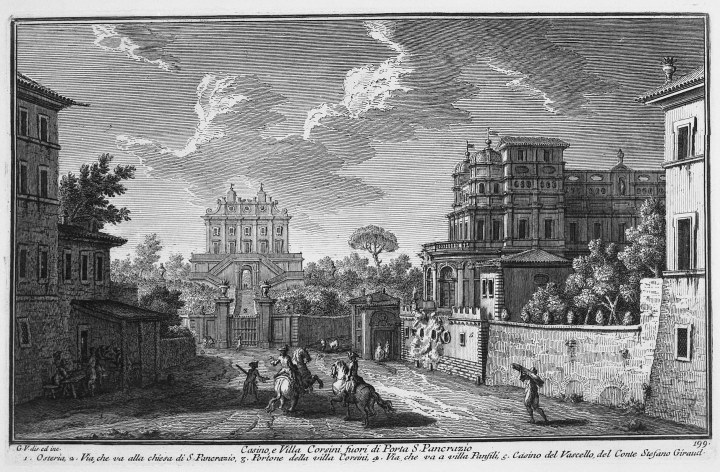
Villa Benedetta, designed by Plautilla Bricci (and completed in 1665) is the large residence to the right of the street in this engraving by Giuseppe Vasi, Casino e Villa Corsini fuori di Porta S. Pancrazio, Plate 199, 1761.
◊ ◊ ◊ ◊ ◊
From the Call for Proposals:
Women as Builders, Designers, and Critics of the Built Environment, 1200–1800
Volume edited by Shelley E. Roff
Proposals due by 1 December 2022; final chapter submissions due by 15 January 2024
Routledge Publishing invites book chapter proposals for a peer-reviewed edited volume that will re-write the history of architecture, urban space, and landscape before the modern age from an alternative, feminist point of view. Women as Builders, Designers and Critics will recover women’s agency within the built environment in the urban and rural setting from the perspective of distinct and often overlapping roles women have played as:
• Builders — manual labourers on constructions sites and in the building trades, building material suppliers, and managers of construction projects
• Designers — amateur designers of architecture, interiors and gardens, artists influencing design through their architectural imagery, patrons directly engaged with design
• Critics — writers, mentors, tutors, and patrons influencing the form of the built environment
Chapter authors should situate the women studied within the context of their social class, time period, and region. Within this context, authors may, if appropriate, choose to theorize about where these women fit within or challenge the canon of architectural history. The geographic scope is open and projects from earlier periods and addressing alternative roles are welcome.
Please send a 500-word abstract and a one-page CV to Shelley E. Roff at shelley.roff@utsa.edu by 1 December 2022. Notification of acceptance of abstracts will be sent by 10 December 2022. If your proposal is accepted, the deadline for a full chapter submission will be 15 January 2024. Chapters should be 5,000–8,000 words in length and must be published in English.
New Book | Country Church Monuments
From Penguin Books:
C. B. Newham, Country Church Monuments (London: Particular Books, 2022), 728 pages, ISBN: 978-0241488331, £40.
 A landmark illustrated history of rural church monuments, the forgotten national treasures of England and Wales
Deep in the countryside, away from metropolitan abbeys and cathedrals, thousands of funerary monuments are hidden in parish churches. These artworks—medieval brasses and elegant marble effigies, stone tomb chests, and grand mausoleums—are of great historical and cultural significance, but have, due to their relative inaccessibility, faded from accounts of our art history.
Over twenty-five years, C. B. Newham has visited and photographed more than eight thousand rural churches, cataloguing the monumental sculptures encountered on his quest. In Country Church Monuments, he presents 365 of the very best, each accompanied by detailed photographs, biographies of both the deceased and their sculptors, and a wealth of contextual material. Many of these works commemorate famous historical figures, from scheming Tudor courtier Richard Rich to Victorian prime minister William Ewart Gladstone. But more moving are the countless others—minor aristocrats, small-time industrialists, much-loved mothers, fathers, and children—who, if not for their memorials, would wholly be lost to time. As Newham blows the dust off these artworks and breathes life into the stories they tell, a new aesthetic history of rural England and Wales emerges. Country Church Monuments is a poignant record of the art we make at the borders of life and death, of our ceaseless human striving for eternity.
C. B. Newham lives in Yorkshire, England. A fellow of the Society of Antiquaries, he is Director of The Digital Atlas of England, a complete photographic record of English’s parish churches.
Exhibition | Archive of the World: Spanish America, 1500–1800
The exhibition closes at LACMA this weekend, but the catalogue remains available, and a version of the show will open at Nashville’s Frist Art Museum this time next year and then in Saint Louis in 2024.
Archive of the World: Art and Imagination in Spanish America, 1500–1800
Los Angeles County Museum of Art, 12 June — 30 October 2022
Frist Art Museum, Nashville, 20 October 2023 — 28 January 2024
Saint Louis Art Museum, 22 June — 1 September 2024
Curated by Ilona Katzew
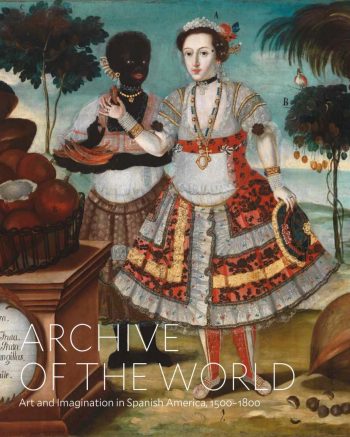 Archive of the World: Art and Imagination in Spanish America, 1500–1800 is the first exhibition of LACMA’s notable holdings of Spanish American art. Following the arrival of the Spaniards in the Americas in the 15th century, the region developed complex artistic traditions that drew on Indigenous, European, Asian, and African art. The Spanish conquest of the Philippines in 1565 inaugurated a commercial route that connected Asia, Europe, and the Americas. Private homes and civic and ecclesiastic institutions in Spanish America were filled with imported and locally made objects. Many local objects also traveled across the globe, attesting to their wide appeal. This confluence of riches signaled the status of the Americas as a major emporium—what one author described as “the archive of the world.” Featuring approximately 90 works, including several recent acquisitions, the exhibition emphasizes the creative power of Spanish America.
Following its presentation at LACMA, Archive of the World: Art and Imagination in Spanish America, 1500–1800 will be on view at the Frist Art Museum, Nashville, from 20 October 2023 through 28 January 2024.
The press release is available as a PDF file here»
Ilona Katzew, ed., Archive of the World: Art and Imagination in Spanish America, 1500–1800, Highlights from LACMA’s Collection (New York: DelMonico Books, 2022), 391 pages, ISBN: 978-1636810201, $85. With contributions by Ilona Katzew, Pablo F. Amador Marrero, Rafael Barrientos Martínez, Patricia Díaz Cayeros, Carlos F. Duarte, Clarissa M. Esguerra, Cristina Esteras Martín, Alejandra Mayela Flores Enríquez, Aaron M. Hyman, Rachel Kaplan, Paula Mues Orts, Jeanette Favrot Peterson, Elena Phipps, JoAnna M. Reyes, Maya Stanfield-Mazzi, Edward J. Sullivan, and Luis Eduardo Wuffarden. Designed by Lorraine Wild and Xiaoqing Wang, Green Dragon Office.
◊ ◊ ◊ ◊ ◊
Note (added 13 June 2024)— The posting was updated to include the Saint Louis Art Museum as a venue; there, the exhibition is entitled simply Art and Imagination in Spanish America, 1500–1800, Highlights from LACMA’s Collection.
The Burlington Magazine, September 2022
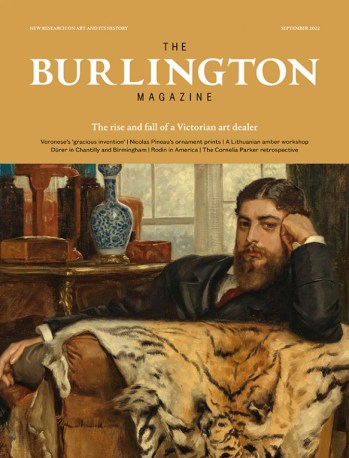
The eighteenth century in the September issue of The Burlington . . .
The Burlington Magazine 164 (September 2022)
 E D I T O R I A L
• “A Practical Guide to Restitution,” p. 835.
A R T I C L E S
• Rahul Kulka, “Counter-Reformation Ambers: Friedrich Schmidt’s Workshop in Kretinga, Lithuania,” pp. 839–53.
On the basis of a unique signed and dated domestic altarpiece it has been possible to attribute a significant body of work to the amber workshop of Friedrich Schmiddt, who worked in Kretinga in the seventeenth century. They include a reliquary of St Casimir given in 1678 with other works in amber to Grand Duke Cosimo III of Tuscany by the Bishop-Elect of Vilnius, Mikolajus Steponas Pacas.
• Aurora Laurenti, “Nicolas Pineau as a Designer of Ornament Prints,” pp. 864–73.
Although designs by the woodcarver Nicolas Pineau in publication by Jean Mariette and Jacques-François Blondel played a significant role in the creation and dissemination of the Rococo style in the first half of the eighteenth century, they have never been studied in detail and their sequence and chronology have remained uncertain.
R E V I E W S
• Alison Wright, Review of the exhibition Gold (British Library, 2022), pp. 910–12.
• Philippe Bordes, Review of the exhibition Le Voyage en Italie de Louis Gauffier (Montpellier, 2022) and the catalogue raisonné by Anna Ottani Cavina and Emilia Calbi, Louis Gauffier: Un pittore francese in Italia (Silvana Editoriale, 2022), pp. 915–18.
• Ariane Varela Braga, Review of Dario Gamboni, Jessica Richardson, and Gerhard Wolf, The Aesthetics of Marble: From Late Antiquity to the Present (Hirmer, 2021), p. 934.
• Celia Curnow, Review of J.V.G. Mallet and Elisa Sani, eds., Maiolica in Italy and Beyond: Papers of a Symposium held at Oxford in Celebration of Timothy Wilson’s Catalogue of Maiolica in the Ashmolean Museum (Ashmolean Museum, 2021), pp. 937–38.
• François Marandet, Review of Delphine Bastet, Les Mays de Notre-Dame de Paris, 1630–1707 (Arthena, 2021), pp. 938–40.
• John Bold, Review of Christina Strunck, Britain and the Continent 1660–1727: Political Crisis and Conflict Resolution in Mural Paintings at Windsor, Chelsea, Chatsworth, Hampton Court and Greenwich (De Gruyter, 2021), pp. 940–41.
• Mark Stocker, Review of Matthew Potter, Representing the Past in the Art of the Long Nineteenth Century: Historicism, Postmodernism, and Internationalism (Routledge, 2021), pp. 941–42.
• Yuriko Jackall, Review of Alan Hollinghurst and Xavier F. Salomon, Fragonard’s Progress of Love (Frick Collection, 2022), pp. 945–46.
O B I T U A R I E S
• Tim Knox, Obituary for John Harris (1931–2022), pp. 950–52.
New Book | Ars Critica Numaria: Joseph Eckhel (1737–1789)
From the Austrian Acadmey of Sciences Press:
Bernhard Woytek and Daniela Williams, eds., Ars Critica Numaria: Joseph Eckhel (1737–1789) and the Transformation of Ancient Numismatics (Vienna: Austrian Academy of Sciences Press, 2022), 683 pages, ISBN: 978-3700187745 (print edition), 240€ / ISBN: 978-3700191841 (free digital edition).
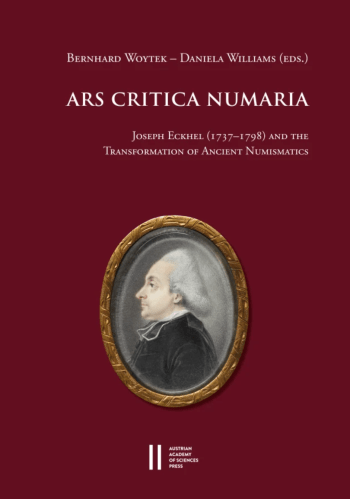 This richly illustrated volume explores the life and work of the Austrian classical scholar Joseph Eckhel, a crucial figure in the transformation of numismatic studies into a modern discipline. Eckhel has been celebrated widely as the ‘father of numismatics’ since the 19th century; still, this is the first book in the history of scholarship entirely dedicated to him. It contains twenty-one essays by an interdisciplinary group of international authors examining various aspects of Eckhel’s biography and scholarly activities: his Jesuit background, his formative study trip to Italy in 1773, his work as director of the imperial collection of ancient coins and professor of numismatics at the university of Vienna (from 1774), and his most important publications on ancient coins as well as on gems and cameos, notably his eight-volume opus magnum Doctrina numorum veterum (Vienna, 1792–98). Finally, Ars Critica Numaria considers Eckhel’s impact on contemporaries and later generations, with special regard to his role in the development of numismatic methodology in the Enlightenment and beyond.
The book is available as a free, open access pdf file here»
C O N T E N T S
Acknowledgements
Abbreviations and Bibliographical Conventions
Setting the Scene
Joseph Eckhel: Biographical Data
Eckhel’s Publications Printed during his Lifetime
• Bernhard Woytek, Ars critica numaria and the Study of Ancient Coins in the 18th Century: A Short Introduction
Eckhel in Context
• Karl Vocelka, Enlightened Scientific Research and Collecting: Vienna in the Second Half of the 18th Century
• Volker Heenes, Eckhel’s Approach to Ancient Coinage in the Context of 18th-Century Research on Ancient Art (Montfaucon, Caylus, Winckelmann)
• Jean Guillemain, Eckhel et la tradition jésuite. Les activités numismatiques dans la Compagnie de Jésus, du laboratoire lyonnais à la Doctrina numorum veterum. Avec un catalogue des collections, enseignements et ouvrages numismatiques des jésuites (1579–1816)
• Martin Gierl, Umgemünzte Aufklärung. Die Numismatik im 18. Jahrhundert bis Eckhel
• Martin Mulsow, Wie ordnet man die Antike? Das Programm einer Gesamtverzeichnung antiker Münzen von Lazius bis Eckhel
• Fritz Mitthof, Die Analyse eines siebenbürgischen Schatzfundes durch Abbé Eder im Jahr 1803: Goldstatere der bosporanischen Herrscher Pharnakes II. und Asandros in Vergesellschaftung mit solchen des Lysimachos-Typs
Eckhel’s Works
• Daniela Williams, From Collection to System: Eckhel in Italy (1772–1773) and the Numi veteres anecdoti (1775)
• Peter Franz Mittag, Eckhels numismatisches Lehrbuch. Die Kurzgefaßten Anfangsgründe zur alten Numismatik und ihre Ü bersetzungen
• Gabriella Tassinari, Joseph Eckhel e le gemme, antiche e ‘moderne’
• Bernhard Woytek, The Genesis of Eckhel’s Doctrina numorum veterum and Georg Zoëga’s Numismatic Papers
• Andrew Burnett, Scientia rei numariae – Ars critica numaria – Doctrina numorum veterum: What Are the Models?
• John Cunnally, Eckhel vs. Goltzius. The Reception of Renaissance Numismatics in the Doctrina
• Maria Cristina Molinari, De numis urbium Italicarum ex aere gravi. Joseph Eckhel’s Treatise in the Context of the Studies of Giovan Battista Passeri, Cardinal de Zelada, and Cardinal Borgia
• Kay Ehling, „Eckhels fürtreffliches Werk“ – Goethe liest die Doctrina numorum veterum
Eckhel’s Position in the ‘République des Médailles’
• François de Callataÿ, ‘The Father of the Father’: The Decisive Role of Erasmus Frölich (1700–1758) in Viennese Numismatics and Beyond
• Daniela Haarmann, Eckhel und seine Kollegen im k. k. Münzkabinett. Ein wissenssoziologischer Versuch
• Federica Missere Fontana, Viaggiatori instancabili: Sestini critico di Eckhel
• Christian E. Dekesel – Yvette M. M. Dekesel-de Ruyck (with contributions by Bernhard Woytek), The Unholy Relationship between a Numismatic Scholar and a Wheeler Dealer: Joseph Eckhel, Pieter van Damme and the Peculiar Recueil des médailles des Rois
• Jonathan Kagan, Eckhel and Britain: A Slow Courtship
By Way of Conclusion
• Bernhard Woytek, Systems, Coin Hoards, Dies and Provenances: Eckhel and the Evolution of Numismatic Method
Index of Persons
Contributors to this Volume










 Enfilade
leave a comment