Call for Papers and Panels: BSECS in Oxford
Brtish Society for Eighteenth-Century Studies Conference
St Hugh’s College, Oxford, January 5-7, 2010
Proposals due by September 26
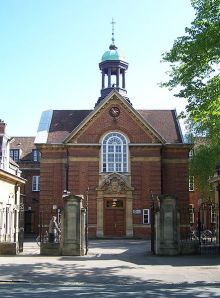
Main entrance of St Hugh's College, Oxford on St Margaret's Road (Photo by Stannered, Wikimedia Commons)
The annual meeting of the British Society for Eighteenth-Century Studies is Europe’s largest and most prestigious annual conference dealing with all aspects of the history, literature, and culture of the long eighteenth century.
We invite proposals for papers and sessions dealing with any aspect of the long eighteenth century, not only in Britain, but also throughout Europe, North America, and the wider world. Proposals are invited for individual papers, for fully comprised panels of three papers, for roundtable sessions of five speakers, and for ‘alternative format’ sessions of your devising. While proposals on all and any eighteenth-century topics are very welcome, this year the conference theme will be Time and Space. We would thus particularly welcome proposals for papers that address eighteenth-century understandings and uses of concepts of time, space, and periodisation, throughout the long eighteenth century and in any part of the world. These might include, but will not be confined to: the meanings and significance given to time in all fields from science to music; different ways of measuring time, calendars and almanacs; perceptions/representations of the past and the future, including in art and literature; models and applications of social, literary, architectural, and cosmic space; and travel and geography.
Send in That Proposal!
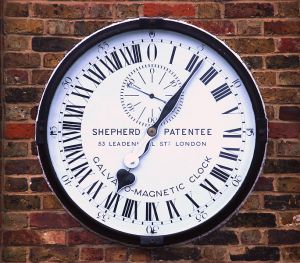
Clock in the Royal Observatory, Greenwich (Photo by Alves Gaspar, Wikimedia Commons)
To recap some previous posts as due dates approach:
- August 28 – Proposals for an edited collection of essays, Women of Fashion: Popular Culture in the Eighteenth Century and the Eighteenth Century in Popular Culture, edited by Tiffany Potter (University of British Columbia).
- September 1 – Submissions for the Catharine Macaulay Prize, awarded annually for the best graduate student paper on a feminist or Women’s Studies subject presented at the ASECS Annual Meeting or at any of the regional meetings during the academic year.
- September 1 – Paper proposals for a conference to be held in London at the National Gallery, in March 2010 on Correspondences: Exchanges and Tensions between Art, Theatre and Opera in France, c.1750-1850.
- September 1 – Session proposals for the annual CAA meeting in New York in February 2011.
- September 1 – Paper proposals for the annual CAA meeting in Chicago in February 2010, specifically for the panel hosted by the Historians of British Art, “Young Scholars’ Works in Progress.”
- September 10 – Paper proposals for a conference to be held in Salem, Massachusetts in March 2010 on Visual Arts and Global Trade in the Early American Republic.
- September 15 – Paper proposals for the 2010 ASECS conference in Albuquerque, March 18-21.
- September 18 – Proposals for an edited collection of essays on Sociability and Cosmopolitanism: Social Bonds on the Fringes of the Enlightenment.
- September 30 – Proposals for the 2010 ISECS interdisciplinary seminar for junior scholars, to be held in Belfast in August 2010 on the theme of Cultural Intermediaries.
Call for Papers: CAA in Chicago
Although most CAA panels for 2010 in Chicago closed long ago, the session allotted for the Historians of British Art business meeting will address the work of young scholars. Consequently, anyone falling into that category still has until the end of the month to submit proposals:
◊ ◊ ◊ ◊ ◊
HISTORIANS OF BRITISH ART: Young Scholars’ Works in Progress
Deadline: September 1, 2009
The Historians of British Art, a CAA-affiliated society, seeks papers for the upcoming mini-session to be held during CAA. Current or recent graduate students (if a Ph.D. recipient, the degree must have been earned within the past three years) are invited to submit proposals for consideration. The papers may address any topic related to British art, architecture, and visual culture. Presentations or “works in progress” should be limited to fifteen minutes to allow for ample discussion. Because the session will occur during the HBA business meeting, attendance is open to the public. To submit a paper for consideration, send the following items to the President of the Historians of British Art, Margaretta Frederick mfrederick@delart.org : (1) a 1-2 page abstract; (2) a 2-page C.V.; and (3) a brief cover letter explaining interest in the field. Decisions will be made by November 1. Upon selection, presenters are requested to join HBA if not currently a member.
Call for Papers: Sociability & Cosmopolitanism
CFP for a an edited collection of essays:
Sociability and Cosmopolitanism: Social Bonds on the Fringes of the Enlightenment
Deadline: 18 September 2009
The editors of this collection seek essays that explore how notions of sociability and cosmopolitanism were articulated in a variety of national contexts during the long eighteenth century. We are particularly interested in soliciting studies that focus upon traditions typically overlooked by scholars of the Enlightenment.
Historians are now familiar with the explosion of intellectual fervor during the long eighteenth century in such diverse locations as Naples, Königsberg, Edinburgh, and London. While the scholarly task of recovering the contours of debates along the “periphery” of the Enlightenment has made great progress, there are still a number of glaring lacunas to be filled. The study of notions of sociability is one such field. (more…)
Call for Papers: Conference on American Art & Trade

Custom House, Salem, Massachusetts, 1819 (Photo by Torsten Henning, Wikimedia Commons)
Visual Arts and Global Trade in the Early American Republic
Salem, Massachusetts, March 6, 2010 (tentative date)
Proposals Due September 10
American participation in global trade increased dramatically during the Early Republic. American ships ventured beyond the Cape of Good Hope and Cape Horn to expand direct contact with China, India, Indonesia, Southeast Asia, the Philippines, and other parts of the Pacific world. This trade brought widespread access to Asian arts and other visual materials and profoundly influenced American visual arts. While much of the literature on the arts of the Early Republic has focused on building nationalism in the wake of the Revolution, this conference investigates the state of early American internationalism. How did global trade contribute to knowledge and culture in the Early Republic, particularly in the arts? We invite papers and proposals that examine the impact of global trade from the 1780s to the 1840s on all aspects of visual art production: painting, sculpture, architecture, garden design, ceramics, furniture, silver, wallpaper, textiles, fashion, and other media. We also invite papers on the transmission of artistic ideas—through eyewitness accounts, illustrated books and prints, imported images and objects, museum collections, patronage, art markets, and other topics.
Honoraria and travel support for speakers are available through a generous grant from the Terra Foundation for American Art. Organizing institutions include Salem State College, the Salem Maritime Historical Site (National Park Service), and the Salem Athenaeum. The conference will provide opportunities to tour Salem’s magnificent Federalist architecture and museum collections. (more…)
ISECS Junior Scholar Seminar to Convene in Belfast, August 2010
The International Society for Eighteenth-Century Studies (ISECS) holds a seminar every year for junior scholars, which they define as those within six years of receiving their PhD. Below is the CFP for the next seminar, on the topic of Cultural Intermediaries, which will take place at Queen’s University, Belfast, Northern Ireland, from 16–20 August 2010.
I would strongly encourage HECAA’s younger members to submit proposals, and if not this year, then in the future. I took part in the 2008 seminar, held at the University of Pardubice in the Czech Republic, and had one of the very best scholarly experiences of my entire career. I made great friends, heard terrific papers, and spent a week in a gorgeous part of the world.
-Michael Yonan
◊ ◊ ◊ ◊ ◊

Charles Lanyon, Lanyon Building, ca. 1850 (Belfast: Queen's University)
Proposals are due 30 September 2009
The International Society for Eighteenth-Century Studies (ISECS) invites applications from scholars in all fields of eighteenth-century studies to an interdisciplinary seminar in 2010. It will be hosted by Queen’s University’s Centre for Eighteenth-Century Studies (CECS) with the support of the University’s Research and Regional Services Office. CECS is an interdisciplinary Centre dedicated to fostering research and academic exchange across the Arts and Social Sciences. The event will be organised by Professor Simon Davies and other members of CECS.
The theme proposed is Cultural Intermediaries. The theme will be interpreted as widely as possible but could include scholarly investigations of travellers, adventurers, diplomats, slave narratives, reports of colonial administrators as well as books, translations/adaptations, newspapers, periodicals, scientific reports, correspondences. Needless to say, other topics which can be shown to be relevant will be very welcome.
Accommodation, Subsistence, Travel – Accommodation and meals will be provided by CECS. Participants will be requested to pay for their own travel arrangements although some limited funds will be available from ISECS for those unable to obtain any financial support.
Submission of Proposals – The seminar will be limited to 12-15 participants. The proposals (approx. 2 pages, single-spaced) should be based on an original research project (eg. a doctoral thesis or equivalent) that deals with one of the aspects mentioned above. Because this is a seminar rather than a conference, each participant will be given one hour to present a paper which will then form the basis of a group discussion. Preference will be given to scholars at the beginning of their academic careers (doctorate or equivalent for less than six years). The official languages of the seminar are English and French. (more…)
CAA Session Proposals for 2011 Due September 1
As noted on CAA News blog:

Photo by Danielle Lupkin (Wikimedia Commons)
Individual CAA members may submit a session proposal for the centennial Annual Conference, taking place February 9–12, 2011, in New York. Proposals should cover the breadth of current thought and research in art, art and architectural history, theory and criticism, pedagogical issues, museum and curatorial practice, conservation, and developments in technology.
The Annual Conference Committee welcomes session proposals that include the work of established artists and scholars, along with that of younger scholars, emerging and midcareer artists, and graduate students. Particularly welcome are those sessions that highlight interdisciplinary work. Artists are especially encouraged to propose sessions appropriate to dialogue and information exchange relevant to artists.
Session proposals are only accepted online; paper forms and postal mailings are not required. To set up an account, please email Lauren Stark, CAA manager of programs, who will register your email address and provide you with a password. For full details on the submission process, please visit Chair a Conference Session.
Proposals are due September 1, 2009
Wanted: Essays on Women & Fashion
The following Call for Essay Proposals went out to C-18L on 6 August:
Women of Fashion: Popular Culture in the Eighteenth Century and the Eighteenth Century in Popular Culture, Edited by Tiffany Potter (University of British Columbia)
Proposals are invited for an edited collection of original essays that examine women’s popular culture in eighteenth-century England and representations of eighteenth-century England in modern popular culture. The volume will be published by the University of Toronto Press in 2011.
Women of Fashion will have three sections:
1) women and eighteenth-century arts (theatre, literature, music, painting)
2) women and eighteenth-century life (fashion, games, courtship, weddings, politics)
3) modern engagements of eighteenth-century women’s culture (in films, historical fiction, art exhibits, web communities, fan groups).
Please send a 500-word abstract or completed essay (4,000-6,000 words), plus a brief biographical statement (or c.v.), as e-mail attachments (in Word or RTF) to Tiffany Potter (tpotter@interchange.ubc.ca). The deadline for abstract submission is 28 August 2009. (more…)
Size Matters in Omaha
Midwest Art History Society Call for Session Proposals (due 23 August)
8-10 April 2010 – Omaha, Nebraska
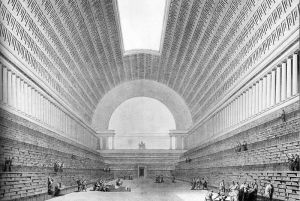
Étienne-Louis Boullée, "Projet de Bibliothèque Royale," 1785
The Midwest Art History Society is currently accepting session proposals for its annual conference, to be held next spring in Omaha. The meeting’s timely theme – Exploring Monumentality: Re-Thinking Scale Relationships in Art – comes on the heels of the remarkable 2008-09 exhibition, Grand Scale: Monumental Prints in the Age of Dürer and Titian (organized by Larry Silver with Elizabeth Wyckoff), and precedes an exhibition at the Getty that will pursue the subject into the seventeenth century; Grand Manner: Charles Le Brun and the Monumental Prints of the Ancien Régime (organized by Louis Marchesano) opens May 18 and runs through October 17.
The MAHS conference might provide an ideal venue for asking how oversize scale functioned in the eighteenth century (one thinks perhaps of Vanbrugh, Boullée, or Piranesi). Conference organizers will include some topics not related to the theme of monumentality, so other session ideas are welcome, too. Here’s the official call for proposals:
◊ ◊ ◊ ◊ ◊
For its 37th annual conference in Omaha, Nebraska (April 8-10, 2010), the Midwest Art History Society will devote the majority of sessions to a central topic–Monumentality. All cultures and periods have generated works of large relative scale. Well-known examples include the Colossus of Rhodes, the monumental heads of Easter Island, Mount Rushmore, the enormous statuary at Buddhist temple complexes throughout Asia, Michelangelo’s David, and the oversized creations of contemporary artist Jeff Koons. We invite session proposals devoted to the impact and meaning of size; logistical considerations for large and small-scale works; famous and/or important monumental works; and other issues related to scale. Because we will still offer open sessions for conference papers that do not address the central issue, we also invite proposals for sessions on other topics apart from that of our central theme. (more…)
European Architectural History Network

The Museu de Alberto Sampaio, Guimarães, founded as a museum of ecclesiastical art in 1928 and located in portions of the former convent of the Collegiate Church of Nossa Senhora da Oliveira in the heart of the city. Photograph: EAHN
A new CAA affiliate society, the European Architectural History Network (EAHN) has launched a smart-looking website with various sorts of useful content and a striking newsletter available for download (it includes the image and caption shown to the right). As outlined in its mission statement, EAHN “supports research and education by providing a public forum for the dissemination of knowledge about the histories of architecture. Based in Europe, it serves architectural historians and scholars in allied fields without restriction on their areas of study.” You do not, in other words, need to work on a European topic to be an active member.
The group’s first international meeting takes place in Guimarães, Portugal, 17-20 June 2010. Paper proposals are due by 30 October 2009 (see below for two session that might be relevant for eighteenth-century scholars).
The organization has also compiled a list of ranked architectural journals. Last updated in 2007, the version currently available on the Network’s website includes just over 100 periodicals, which are assigned a ranking of A, B, or C. The group explains the project as follows:
EAHN is working on this list as a support for architectural historians and their institutes to be able to validate their research output. In the absence of ranked list of periodicals in the field of architectural history by institutions such as ISI (Web of Science), it is important that we provide a list that can act as an international reference point for research in architectural history. This list is far from complete or adequate. As it stands now, it is based upon an agreement between architectural department in Flemish universities, who worked on a provisional list. We invite individuals and schools to react to this list, with proposals for extending it or for reconsidering the ranking of specific journals. Please mail to hilde.heynen@asro.kuleuven.be
CALL FOR PAPERS
Territorial Defensive Systems of European Colonies: 15th to 18th Centuries
Museum of Architecture / Architecture in the Museum (more…)










leave a comment