Call for Papers | Collecting and Knowledge Production through Travel
A reminder that a few sessions at RSA push the ‘Renaissance’ well into the early modern period. The full Call for Papers is available here.
Collecting and Knowledge Production through Travel (The Society for the History of Collecting)
Renaissance Society of America Conference, Palmer House Hilton, Chicago, 21–23 March 2024
Proposals due by 8 August 2023
The importance of travel in the circulation of ideas and goods in the early modern period cannot be overemphasized. Travel—whether for commercial, private, or public purposes—was a source of information and experience, and travellers collected at every level, bringing back new and rare objects as well as commercially important goods. Travellers might return with works of art, which they then organised and arranged into their collections, while traders negotiated and acquired rarities to be sold on the European markets. However, collectors created imaginary worlds in their collections as they gathered information, ideas, descriptions, and literary texts from cultures other than their own, or employed ekphrasis to relate new narratives and new art works.
The proposed sessions at RSA 2024 aim to investigate the intellectual contexts in which objects were collected, the relationships between travel accounts, whether published or unpublished, and the creation of new understandings of worlds beyond the immediate world of the collector. We intend to explore the dynamic relationships between trade and collectibles, the perceptions created by travelogues and travel manuscripts, and travels of the imagination, which could transcend the voyages made and recounted. We invite new research into any aspect of these topics as we aim to recover the intellectual environment created by travel in early modern Europe that influenced collectors. Equally important were the networks created by travellers who voyaged to different centres in Europe and beyond, possibly through previous contacts but equally creating new contacts and new networks in which collections were discussed and exchanged. We are also interested in papers that delve into the question of travel from a non-European perspective.
As an associate organization of RSA, the Society for the History of Collecting can sponsor up to four sessions. Proposals are invited for 20-minute papers. They must include a title, an abstract of no more than 150 words, keywords, and a one-page CV (including PhD completion year or expected completion). Speakers will need to be members of RSA at the time of the conference, and we strongly encourage them to be members of the Society for the History of Collecting. Proposals should be sent to session convenors Sophia McCabe, Adriana Turpin, and Lisa de Zoete at info@societyhistorycollecting.org with the heading “RSA 2024 Proposal” by 8 August 2023.
Call for Papers | Women Making Space in South America, 1400–1900
Women Making Space in South America, 1400–1900 (#S11)
Session at EAHN, Athens, 19–23 June 2024
Chairs: Anne Hultzsch and Dr Sol Pérez Martínez, ETH Zurich
Proposals due by 8 September 2023
The period between 1400 and 1900 in South America is characterised by a set of transitions and processes of transculturation as indigeneity emerged from the clash with colonisation. Empires competed, indigenous cultures grappled with European colonisation, and both later fed into American nation building. This session focuses on the period between the creation of the Tawantinsuyu, the Incan Realm of the Four Parts, in 1438, thus the definition of Andean territory as a continuous region, to the 1880s when the Mapuche people in Southern Chile and Argentina were the last indigenous group to lose control over their territories. The session aims to address gaps in the architectural historiography of the Andean region especially regarding moments of transition where “cultures meet, clash and grapple with each other,” creating “contact zones” (Pratt, 1991). We seek to start these new histories through the perspective of women—from any class or ethnicity—as one of the groups often excluded from scholarship on the period. We ask how those identifying as women influenced, shaped, critiqued, and made spaces within and alongside the force field of the contact zone, with its asymmetrical power relations, its struggles, pains, and opportunities?
Challenging linear Euro-American architectural narratives of styles imported to the supposed new world, we invite contributions exploring the role of women in shaping public and private spaces in the Andean territories—from home and convent to street and plaza. Practices to be examined for female space-making opportunities could include, for example, building, homemaking, designing, writing, patronage, financing, teaching, lobbying, gardening, or farming, even mothering. Contributions should explore questions emerging from the triangle between gender, architectures, and South America as a contact zone. What are the spatial categories most useful when exploring women ‘making space’ in the period and region (Matrix, 1984)? Does the public-private dichotomy of separate spheres serve here? What sources provide evidence how women made space? Which writing techniques yield the best results, from archival tracing to historical fiction? How can we fill gaps when there are few traces (Hartman, 2021)?
Besides a methodological appeal for new approaches, the session also queries key terminologies of architectural history: Who is the space-maker during this period? What is the relationship between space-making and the architect? Did the professionalisation of architecture during the 19th century further the exclusion of women from space-making practices? Was there a period of increased access colonial or institutional transitions closed doors to women? Are there comparable developments in other regions?
This session hopes to facilitate a pivotal change to how we look at the formation of architectural cultures in the past through the eyes of women and their lived experiences, considering questions of race, class, or religion, besides those of gender. As scholarship in the field of Latin American architectural history has so far often been dominated by isolated time periods defined by the male coloniser—such as pre-colonial, colonial, post-colonial, modernism—the proposed period between c. 1400 and 1900 invites cross-readings based on dynamic approaches to historical moments, places, and protagonists.
Information about the session can be found here.
Abstracts are invited by September 8, 2023, and should consist of no more than 300 words. Please submit your proposal following the instructions on the conference website. Submit at eahn2024@gmail.com along with the applicant’s name, email address, professional affiliation, address, telephone number, and a short curriculum vitae, all included in one single PDF file. The file must be named as follows: session or round table number, hyphen, surname e.g. S11-Tsiambaos.pdf.
Call for Papers | Anna Dorothea Therbusch in Context
From the Call for Papers:
Anna Dorothea Therbusch in Context: 18th Century (Women) Artists in Berlin and Europe
Kulturforum, Staatliche Museen zu Berlin, 26–27 September 2024
Organized by Nuria Jetter and Sarah Salomon
Proposals due by 17 September 2023
Born into the Prussian painter family Lisiewsky, Anna Dorothea Therbusch (1721–1782) achieved a remarkable international career in the 18th century, at a time when women’s access to artistic training and academies was structurally impeded. After training with her father Georg Lisiewsky and being influenced by the artistic taste of the Frederician Rococo (Watteau, Pesne, and others), Therbusch devoted herself to the education of her children for twenty years. It was not until 1761, at the age of almost forty, that she began to vigorously pursue her artistic ambitions in a professional manner.
After artistically productive stations at the courts of Stuttgart and Mannheim and admission to the academies of Stuttgart and Bologna, Anna Dorothea Therbusch spent about two years in Paris from summer 1766 to fall 1768. There, not without resistance, she was accepted into the Académie royale with a candlelight painting inspired by Dutch art. She exhibited at the Salon and socialized, among others, with the encyclopedist and art critic Denis Diderot, the engraver Johann Georg Wille, and Prince Golitsyn, who worked as an art agent for Catherine II. In 1768 Therbusch was admitted to the Vienna Academy of Fine Arts. She returned to Berlin via Brussels and the Netherlands.
Back in Berlin since 1769, the painter occupied a studio on Unter den Linden in 1772/73, where she worked temporarily with her brother Christoph Friedrich Reinhold Lisiewsky. She became a sought-after portraitist of Berlin high society, also working for the Russian court, and her mythological history paintings had success with Frederick II.
The Berlin Gemäldegalerie is currently conducting an art-historical and art-technological research project on Anna Dorothea Therbusch’s paintings held in the collections of the Staatliche Museen in Berlin. The resulting publication will provide new insights into the materials and working methods used by the artist and, with the participation of other public collections in Berlin and Brandenburg, will also present their holdings of Therbusch’s works. This is the occasion to further broaden the view of the artist and her work within the framework of a specialist symposium. It is to bring together researchers in order to illuminate Therbusch’s work in larger art historical contexts, to share insights, and to point out further research perspectives.
Of particular interest are proposals for presentations on the following topics:
1 Therbusch’s artistic models and her working environment
Which artists did she orientate herself on, which paintings and collections was she able to study in Prussia and on her travels? What was Therbusch’s working environment like and how did she relate to other artists?
2 Therbusch’s working methods and the thematic range of her oeuvre
What can be said about the processes of creation and execution of Therbusch’s paintings on the basis of art-technological findings and comparisons of works? Where can she be located concerning her painting technique? What were the significance and function of her genre and historical paintings? What modes of representation did she choose for her portraits?
3 Therbusch’s networks and career strategies
How did Therbusch obtain her commissions in Prussia, Stuttgart, Mannheim, Paris (and possibly beyond)? Which acquaintances and family or aristocratic connections could she have used for this purpose? Who were her clients and patrons? How did she promote herself?
4 The early reception of the painter and her work by contemporaries and up to the early 19th century
Please submit your proposal for a 20-minute presentation (preliminary title, abstract of 300 words max., short biography) in English or German by 17 September 2023 to Nuria Jetter (n.jetter@smb.spk-berlin.de) and Dr. Sarah Salomon (s.salomon@smb.spk-berlin.de). The symposium will take place on 26 and 27 September 2024 at the Kulturforum near Potsdamer Platz (Staatliche Museen zu Berlin, Matthäikirchplatz). If funds are available, a travel allowance will be granted.
s e l e c t e d b i b l i o g r a p h y
Reidemeister 1924
Leopold Reidemeister, “Anna Dorothea Therbusch – ihr Leben und Werk,” Dissertation Friedrich-Wilhelms-Universität zu Berlin, unveröffentlicht (Typoskript), Berlin 1924.
Ausst.-Kat. Potsdam-Sanssouci 1971
Anna Dorothea Therbusch 1721–1782. Ausstellung zum 250. Geburtstag im Kulturhaus „Hans Marchwitza“, Ausst.-Kat. Staatliche Schlösser und Gärten Potsdam-Sanssouci 1971, bearb. v. Gerd Bartoschek, Potsdam 1971.
Berckenhagen 1987
Eckhart Berckenhagen, “Anna Dorothea Therbusch,” in: Zeitschrift des deutschen Vereins für Kunstwissenschaft XLI, Heft 1, 1987, 118–160.
Dalinghaus 1987
Ruth Irmgard Dalinghaus, “Anna Dorothea Therbusch,” in: Das verborgene Museum I. Dokumentation der Kunst von Frauen in Berliner öffentlichen Sammlungen, Ausst.-Kat. Neue Gesellschaft für Bildende Kunst, Berlin, 1987–88, Berlin 1987, 112–116.
Küster-Heise 1999
Katharina Küster-Heise, “Sie war in allem Betracht eine seltene und verdienstvolle Frau. Anna Dorothea Therbusch, die Berliner Porträtistin Carl Theodors,” in: Lebenslust und Frömmigkeit. Kurfürst Carl Theodor (1724–1799) zwischen Barock und Aufklärung, Bd. 1: Handbuch, Ausst.-Kat. Städtisches Reiss-Museum Mannheim 1999, hrsg. v. Alfried Wieczorek u. Hansjörg Probst, Regensburg 1999, 255–260.
Bajou 2000
Thierry Bajou, “Eine deutsche Künstlerin im Paris des 18. Jahrhunderts. Anna Dorothea Therbusch,” in: Jenseits der Grenzen. Französische und deutsche Kunst vom Ancien Régime bis zur Gegenwart. Thomas W. Gaehtgens zum 60. Geburtstag, Bd. 1: Inszenierung der Dynastien, hrsg. v. Uwe Fleckner, Martin Schieder, Michael F. Zimmermann u. Thomas W. Gaehtgens, eine Veröffentlichung des Deutschen Forums für Kunstgeschichte (Paris), Köln 2000, 149–268.
Ausst.-Kat. Ludwigsburg 2002
Der freie Blick. Anna Dorothea Therbusch und Ludovike Simanowiz. Zwei Porträtmalerinnen des 18. Jahrhunderts, Ausst.-Kat. Städtisches Museum Ludwigsburg 2002/3, bearbeitet von Katharina Küster und Beatrice Scherzer, Heidelberg 2002.
Michaelis 2002
Die Deutschen Gemälde des 18. Jahrhunderts. Kritischer Bestandskatalog, Staatliche Museen zu Berlin – Gemäldegalerie, Berlin 2002 [darin Eintrag zu Therbusch und ihren Gemälden der Gemäldegalerie, 224–234].
Küster-Heise 2008
Katharina Küster-Heise, “Anna Dorothea Therbusch, geb. Lisiewska 1721–1782. Eine Malerin der Aufklärung. Leben und Werk,” Dissertation Ruprecht-Karls-Universität Heidelberg, 2008. [Als Mikrofilm in Bibliotheken verfügbar].
Bartoschek 2010
“Gemeinsam stark? Anna Dorothea Therbusch und ihre Zusammenarbeit mit Christoph Friedrich Reinhold Lisiewsky,” in: Christoph Friedrich Reinhold Lisiewsky (1725–1794), Ausst.-Kat. Kulturstiftung DessauWörlitz/Staatliches Museum Schwerin 2010-11, Berlin/München 2010, 77–84.
Kovalevski 2010
Bärbel Kovalevski, “‘Es ist eine Ehre, sich auf dem Niveau der großen Künstler zu sehen […].’ (Barbara Rosina de Gasc, 1768). Malerinnen der Familie Lisiewsky,” in: Ausst.-Kat. Kulturstiftung DessauWörlitz/Staatliches Museum Schwerin 2010–11, Berlin/München 2010, 77–84.
Lange 2017
Justus Lange, “Ehefrau – Schwester – Lehrerin. Anna Dorothea Therbuschs Doppelbildnis in Kassel im Kontext unterschiedlicher Deutungen,” in: Künstlerinnen. Neue Perspektiven auf ein Forschungsfeld der Vormoderne, hrsg. v. Birgit Ulrike Münch, Andreas Tacke, Markwart Herzog, Sylvia Heudecker, Petersberg 2017.
Kovalevski 2022
Bärbel Kovalevski, Barbara Rosina Lisiewska (1713–1783). Hofmalerin in Berlin und Braunschweig. Bildnisse mit Geschichten, Berlin 2022.
Vogtherr 2022
Christoph Martin Vogtherr, “Anna Dorothea Therbusch’s ‘Morceau de reception’ for the Académie royale de peinture et de sculpture,” in: Mélanges autour du dessin en l’honneur d’Emmanuelle Brugerolles, Mailand 2022, 213–216.
Call for Essays | Art and Memory in Early Modern Central Europe
From ArtHist.net:
Art and Memory in Early Modern Central Europe
Edited Volume
Proposals due by 1 September 2023; completed essays due by 1 December 2023
This edited volume will explore the culture of commemoration in early modern Central Europe as a testimony to the tectonic changes in the period’s social, religious, and political life. Memorials, tomb sculptures, and portraits reflected not only the desire of early modern elites to maintain family memory and highlight their confessional identity but also the emergence of ‘collective memory’ and national identity crystallised and secured in artefacts.
During the early modern period, which was marked by political conflicts and upheavals and profound changes in religious culture exemplified by the Reformation, the culture of commemoration including its visual expression changed substantially. While Western European commemorative practices were the focus of several recent edited volumes, the Central and Eastern European culture of commemoration remains rather understudied and leaves us asking about the possible dialogue if not entanglement in the domain of commemoration between Western and East-Central Europe in early modern times.
Therefore, we encourage submissions on the following topics:
• Art and Commemoration Practices
• Memory in Religious Controversies
• Memory and Social Identity
• Cultural Practices in Politics of Memory
• Art and the ‘Places of Memory’
We are looking for papers of 5,000–8,000 words including a bibliography. Interdisciplinary and transcultural contributions are particularly welcome. Please submit a 500-word abstract and a brief biography to Stefaniia Demchuk (demchuk@phil.muni.cz) by 1 September 2023. The selected authors will be expected to deliver a full paper by 1 December 2023. All submissions will be peer-reviewed.
Call for Papers | Publics of the First Public Museums: Sources
From the Call for Papers:
Publics of the First Public Museums: I. Institutional Sources, 18th–19th Centuries
Pubblici dei primi musei pubblici: I. Le fonti istituzionali, XVIII–XIX secolo
Rome, 19–20 October 2023
Proposals due by 30 July 2023
This international work-in-progress workshop on Publics of the First Public Museums: Institutional Sources, 18th–19th Centuries is part of the research project Visibility Reclaimed: Experiencing Rome’s First Public Museums, 1733–1870, directed by Carla Mazzarelli. It is the first of a series of three workshops that will explore research methods and sources relevant to the study of publics and their experiences in visiting the first public museums during the 18th and 19th centuries. Emphasizing an interdisciplinary and transnational perspective, the workshop aims to promote scholarly exploration beyond the mere visual dimensions commonly associated with exhibition spaces—urging researchers instead to delve into the material encounters within museum spaces, the practices of collecting, and the regulatory mechanisms implemented by institutions to govern public conduct during the 18th and 19th centuries. The first workshop revolves around research questions that arise from the analysis of sources produced directly by the institutions. These sources offer valuable insights into the institutions’ perspectives and attitudes towards the public, placing particular emphasis on:
1 Access procedures
2 Regulations governing public behaviour
3 Measures for the conservation/protection of artefacts
4 Quantitative and qualitative analysis of audiences
The workshop will explore primary sources such as regulations, access registers, visitor books, museum reports, institutional correspondences, formal requests for copying and/or studying artworks, and printed catalogues. A comparative analysis of equivalent sources from other institutions or places—libraries, academies, galleries, collections, villas and gardens as well as archaeological sites and places of worship—is encouraged.
Key questions to be addressed during the workshop include:
• How do these sources contribute to the reconstruction of the dynamic relationship between publics and museum institutions?
• Which analysis methods should be prioritised?
• How did the management of museum institutions evolve in response to the historical and political changes of the 18th and 19th centuries?
We invite submissions that align with the aforementioned areas and inquiries. Please note that:
• To facilitate dialogue among the most recent ongoing research in the field, the workshop is particularly geared towards doctoral students, young researchers, and scholars who are working on original topics and sources relevant to those proposed in the seminar.
• Preference will be given to applications that involve interdisciplinary research (e.g., the intersection of arts and history or arts and sciences) and proposals from disciplinary fields other than art history and architecture will be warmly welcomed, such as the history of institutions, the history of sciences, social sciences, and economic history.
• Case studies falling within the realm of Digital Humanities will be highly appreciated, including projects related to cataloguing, databases of sources pertaining to the publics of the first public museums or other institutions and sites that the project intends to study comparatively with museums (e.g., libraries, academies, galleries, villas, ancient and modern monuments).
• Case studies that prioritize transnational and/or transregional perspectives or address geographies that have received relatively less attention within the field of Museum Studies will also be particularly valued.
Interested participants should submit an abstract (of no more than 2000 characters, including spaces), a brief biography (maximum of 1500 characters, including spaces), and a minimum of three keywords to visibilityreclaimed@gmail.com by 30 July 2023. Notification of acceptance: 28 August 2023. Languages accepted: Italian, English, French, and Spanish.
For further information, please contact
Organising secretaries: Luca Piccoli and Ludovica Scalzo, visibilityreclaimed@gmail.com
Direction and scientific coordination: Prof. Dr. Carla Mazza, carla.mazzarelli@usi.ch
Organization Committee
Giovanna Capitelli (Università di Roma Tre)
Carla Mazzarelli (Università della Svizzera italiana)
Chiara Piva (Sapienza Università di Roma)
Organizing Secretaries
Luca Piccoli (Università della Svizzera italiana)
Ludovica Scalzo (Università di Roma Tre)
The workshop is part of the research project Visibility Reclaimed: Experiencing Rome’s First Public Museums, 1733–1870, An Analysis of Public Audiences in a Transnational Perspective (SNSF 100016_212922), directed by Carla Mazzarelli (Università della Svizzera italiana, Accademia di architettura di Mendrisio, Istituto di storia e teoria dell’arte e dell’architettura).
Project Partners
Giovanna Capitelli (Università di Roma Tre), Stefano Cracolici (Durham University), David Garcia Cueto (Museo del Prado), Christoph Frank (Università della Svizzera italiana), Daniela Mondini (Università della Svizzera italiana), Chiara Piva (Sapienza Università di Roma)
Call for Papers | The English Georgian North, 1714–1830
From the Call for Papers:
The English Georgian North, 1714–1830: Rethinking Cultures and Connections
Institute of Medieval and Early Modern Studies, Durham University, 15 September 2023
Proposals due by 14 July 2023
This symposium builds on conversations that have been taking place at Durham University over the last fifteen months as part of the IMEMS research strand The Georgian North, designed and led by Professor Fiona Robertson. It sets out to develop new approaches to the intellectual and creative cultures of the northern counties of England in the Georgian period, 1714–1830. Important contributions to knowledge, interpretation, creative practice, and scientific advance were made in the north country during this still largely rural and early industrial period in its history. They took shape in social, professional, and discursive networks of considerable complexity and reach, bringing together artists, abolitionists, antiquaries, architects, writers, theologians, musicians, astronomers, philosophers, mathematicians, botanists, landscape designers, linguists, clergy, social and political reformers, actors, and archaeologists. Yet there has been little connected cross-disciplinary exploration of these cultures, their significance, and their legacies.
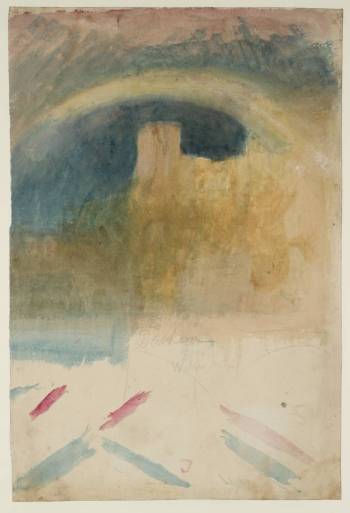
J.M.W. Turner, Durham Cathedral with a Rainbow, ca.1817, graphite and watercolour on paper, 55 × 37 cm (London: Tate, D25247).
We invite proposals for 15-minute papers or presentations to contribute to a day of informal and investigative discussion. Topics of interest include, but are not restricted to
• Environment and conservation
• Abolition, reform, and intervention
• Originality and innovation
• Scientific enquiry, speculation, and new worlds
• Practices of collecting, curation, and display
• Performance: players, theatres, audiences
• Composition: music, painting, poetry, prose fiction, architecture, design
• Ancient pasts: theories and artefacts
• Cultures of belief
• Depletion and rediscovery (buildings, communities, habitats, traditions)
• International and intercultural connections; connections across languages and traditions
• Conversation and exchange (social, professional, and discursive networks, philosophical and historical societies, bookshops, print cultures)
The region under discussion comprises the historic counties of northern England: County Durham, the North Riding of Yorkshire, Northumberland, Cumberland, and Westmorland. Of particular interest, because especially under-researched, is present-day County Durham and the areas immediately bordering it, but we welcome work on all relevant locales and communities. Of the many individuals active in the intellectual and creative cultures of the period, some were permanently settled in the northern counties, while others were here for shorter periods, often under-researched relative to the wider body of scholarship on their work. They are all of significance to our discussion, as are, also equally, the natural and constructed environments of the northern English counties—private and public buildings, landscapes and treescapes, theatres and observatories. All these environments helped shape the formation and development of ideas and many are now lost or under-regarded.
This is a free, in-person symposium, open to researchers across disciplines, with papers and roundtables and an emphasis on discussion and exchange. Teas, coffees, and a light lunch will be provided. There will be at least one online-only follow-up session later in 2023. We invite 300-word proposals for 15-minute papers or presentations. Please submit your proposal via this form by 14 July 2023.
If you cannot attend but are interested in receiving information about the Research Strand and follow-up sessions, you can use the above link to register your interest. We shall respond to all proposal submissions no later than 28 July, after which time further details and the registration link will be made available.
Call for Essays | Interpretations of Longinus in the Early Modern Period
From ArtHist.net:
Interpretations of Longinus in the Literature, Painted and Printed Imagery of the Early Modern Period
Edited Volume of Essays To Be Published in 2025
Proposals due by 15 July 2023; final chapters due by 1 July 2024
This volume of the series Trends in Classics (to be published by De Gruyter) seeks to explore aspects of Longinian ideas, addressing in particular the concept of the sublime. It will bring together scholars of art history, history of ideas, literature, and philosophy to reflect upon the reception of these ideas in the literature and the art of Italy, Spain, and the Low Countries from the 15th through the 18th century. Considering that there is probably no direct evidence concerning the Longinian sublime as a productive theory in the early modern times, the primary interest lies in possible interpretations of works in certain artistic media (paintings and prints) as well as re-readings of the Peri hypsus in the literature of the period.
The starting point is the relationship among artists, literati, and patrons; the connections of artworks to various textual sources; the existence of sublime/Longinian literature in libraries of the period; and the tracing of relevant text dissemination. The network of acquaintance with the notion of the sublime may be opened up towards other directions, such as politics, the treatment of the human body, the aesthetics of antiquity, and the Renaissance. The tackling of a complex problem such as the reception of Longinian ideas, makes cross-disciplinary research imperative.
The completed volume will be published in 2025. Drafts from participants will be discussed during an online workshop in February 2024. The presentations will be 20 minutes long. Contributors are invited to submit their proposals in English. There is a two-stage submission procedure.
15 July 2023
Please send a 250-word proposal (in English) and a short cv (500 words) to all the members of the editorial board:
• Ianthi Assimakopoulou, National Kapodistrian University of Athens, ianthiassim@icloud.com
• Nafsika (Nancy) Litsardopoulou, Athens School of Fine Arts, nancylitsardo@hotmail.com
• Evina Sistakou, Aristotle University of Thessaloniki, sistakou@gmail.com
15 September 2023
Selected abstracts will be invited to participate in the online international workshop in February 2024, under the aegis of the National and Kapodistrian University of Athens – Department of History and Archaeology.
February 2024
Online workshop.
1 July 2024
Submission of final versions of the papers (up to 7000 words, excluding bibliography). Following a peer review process, the editorial board will make final decisions on the acceptance of papers.
Call for Papers | Materialising Loss: Absence and Remaking

From CIHA, whose 2024 conference is organized around the theme ‘Matter Materiality’:
Materialising Loss: Absence and Remaking in Art History
36th Congrès du Comité International d’Histoire de l’Art (CIHA), Lyon, 23–28 June 2024
Chaired by Francesca Borgo and Felicity Bodenstein
Proposals due by 15 September 2023
Paper proposals are currently invited for the session “Materialising Loss: Absence and Remaking in Art History” at the 36th Congrès du Comité International d’Histoire de l’Art (CIHA) in Lyon, 23–28 June 2024, co-chaired by Francesca Borgo (University of St Andrews/ Bibliotheca Hertziana) and Felicity Bodenstein (Université Sorbonne).
The material turn in art history has reinstated a sensibility for the ‘thingness’ of things (Brown, 2001), the properties of their constitutive materials (Ingold, 2007), and the activity of their matter (Miller & Poh, 2022; Latour 1991; Gell 1998; Bennett, 2010). More recently still, interest has extended beyond making and materials: processes of unmaking, deterioration, care, and preservation have become subjects of investigation, accompanied by growing critical engagement with conservation (Fowler, 2019; Fowler & Nagel, 2023) and increasing attention to the behaviour of matter across the deep time of geological history (Borgo & Venturi, CIHA 2019).
But what happens when—despite all our best efforts to conserve, protect, and make last—things disappear? Taking this question as its starting point, we invite papers that reconsider matter and materiality from an unusual point of view: the object’s loss or inaccessibility and the practices undertaken to compensate for its absence, via physical replicas or virtual reconstructions. In centring itself on what has long been considered an epistemological endpoint in art historical studies—the disappearance of the original object—the session proposes a critical assessment of material and virtual remaking as site of art-historical knowledge. It asks how we might integrate that knowledge into the analytical methods of art history.
Looking at materiality from the seemingly paradoxical standpoint of absence reveals how much material studies takes for granted in terms of the object’s presence, permanence, and accessibility. Loss forcefully confronts us with the enabling operations and grounding conditions that go into writing material art history. It permeates everything we do, and yet it is distinctively undertheorized (Fricke & Kumler, 2022). What are the stakes of absence and reclamation? How does loss help us rethink the relationship between matter and form beyond the hylomorphic model? How do art historians deal with missing evidence, and how does its resurfacing or remaking change the canon and the narrative? Whose loss is worth talking about and why?
The threats of war, climate change and mass tourism give these questions a pressing relevance today, amplified by debates over sustainability, inclusion, and property rights. But art history seems sceptical of efforts to work against these risks: despite recent calls for ‘militant reproductions’ (Bredekamp, 2016), campaigns to widen the notion of originality (Lowe & Latour, 2010) and emphasize the seriality of the Classic (Settis & Anguissola, 2015), and appeals to the greater inclusivity of digital heritage (Terras, 2022; Michel, 2016), much of the discipline remains ambivalent about the remade, regarding it as ludic and nostalgic.
We live in a world in which heritage is constantly de- and re-materialised, formed and reformed in an unprecedented interplay between the material, immaterial, and neomaterial. And although the implications for objects and their histories are manifold, they remain largely unexplored. This session aims at remedying that imbalance, reflecting on the impact of physical loss on material art history and examining the value of remaking as historical method. In the interests of crafting a more inclusive narrative of loss and remaking and of fostering exchange between scholars from different geographical and professional backgrounds, we especially welcome papers offering global perspectives.
Proposals are due 15 September 2023 and must be submitted via the CIHA platform. Instructions on how to submit your proposal can be found here.
Call for Articles | Queerness in 18th- and 19th-C. European Art
From Arts:
Queerness in 18th- and 19th-Century European Art
Special Issue of Arts, edited by Andrew Shelton
Proposals due by 15 August 2023; final manuscripts due by 30 November 2023
A special issue of the international, peer-reviewed, open-access journal Arts dedicated to Queerness in 18th- and 19th-Century European Art and edited by Andrew Carrington Shelton (Department of History of Art, The Ohio State University) seeks essays on a wide variety of topics that subvert or disrupt heteronormative interpretations of the art and visual culture of this period. Topics to be addressed include, but are not limited to:
• Works of art produced by or under the auspices of personages who can plausibly be identified as attracted to members of the same sex
• Works or creative situations that can be construed as expressing or eliciting same-sex sexual desire or attraction
• Works or creative situations in which the heteronormative polarity of the processes of identification and desire can be perceived as having been collapsed or scrambled
• Works or creative situations that involve gender-bending or gender fluidity
• Works or creative situations that either deepen or complicate our understanding of sexuality and/or sexual identity
• Works that eroticize individuals or situations that are normally regarded as lying outside the realm of the erotic
Interested scholars should send an abstract (maximum 250 words) and CV to shelton.85@osu.edu, copying sylvia.hao@mdpi.com, by 15 August 2023. Final manuscripts must be submitted for blind peer-review no later than 30 November 2023. Due to journal restrictions, all articles must be submitted in English. Questions or concerns can be addressed to shelton.85@osu.edu or sylvia.hao@mdpi.com. More information is available here.
Call for Papers | Material and Visual Culture Seminar Series, Edinburgh
From ArtHist.net:
Material and Visual Culture Seminar Series
Online, University of Edinburgh, Autumn 2023
Proposals due by 31 July 2023
The Material and Visual Culture of the Seventeenth and Eighteenth Centuries Research Cluster is pleased to announce that the Material and Visual Culture Seminar Series (MVCS) will be continuing for a fifth year. We therefore invite proposals for twenty-minute papers from PhD candidates, early-career researchers, and cultural heritage professionals addressing any aspect of material and visual culture studies.
The seminars aim to explore a wide variety of themes, and localities within the long seventeenth and eighteenth centuries (broadly defined) to foster methodological and interdisciplinary dialogue. Topics might include but are not limited to: object or subject case studies, material/visual culture and identity especially with respect to marginalized peoples or communities, material/visual culture and literature, craft, consumer cultures, global ‘things’, etc. Please submit a title and abstract of no more than 250 words, with a short biography (about 100 words) to materialcultureresearcheca@ed.ac.uk by 31 July.
The seminars are scheduled for Wednesday evenings online, at 5pm BST/GMT fortnightly throughout semester one of the 2023/24 academic year.
Twitter: @mvcseminar
Instagram: mvccluster










leave a comment