Call for Papers | Women, Art, and Early Modern Global Courts
From ArtHist.net:
Challenging Empire: Women, Art, and the Global Early Modern World, ca. 1400–1750
The University of Alabama, Tuscaloosa, and the Birmingham Museum of Art, 1–2 March 2024
Organized by Tanja Jones, Doris Sung, and Rebecca Teague
Proposals due by 1 September 2023
The symposium Challenging Empire: Women, Art, and the Global Early Modern World, part of the project Global Makers: Women Artists in the Early Modern Courts of Europe and Asia, aims to extend and expand knowledge of cultural production by and for early modern women—particularly those associated with courts—on a global scale. While numerous conferences, symposia, and resulting publications in the past several decades have addressed women as producers, consumers, and subjects of European art during the early modern period (ca. 1400–1750), less consideration has been given to women’s roles in the courts—particularly as informed by the steadily increasing cross-cultural interactions (i.e. between Europe and Asia, the Americas, Africa, etc.) that characterized the period. This symposium aims to address this lacuna whilst simultaneously de-centering the traditional Euro-centric model of study in the analysis of women’s cultural production, presentation, and consumption surrounding courts and empires (institutions associated with ruling power). The goal is to encourage a more equitable view of early modern women’s experiences of and with art globally, across traditionally held national and continental boundaries.
We invite paper submissions from scholars (including advanced graduate students) whose work addresses topics including, but not limited to:
Early modern (court) women’s roles in
• transcultural artistic production, movement, and collecting across geographic or temporal spaces (across or between Asia, Europe, Africa, and the Americas)
• moments of cultural exchange, intersection, or reciprocity
Those that, in relation to early modern women’s roles in artistic production
• problematize or challenge long-held notions surrounding early modern gender, ‘court’, and ’empire’ as hegemonic and culturally conditioned concepts; encourage consideration of cultural differences in the definition, production, or reception of visual and material culture
• address issues of colonialism, imperialism, or patriarchy
• approach concepts of the body, exoticism, or gender performance across cultures
• address the movement of people, ideas, or objects
Those that incorporate emerging methods in the study of early modern (esp. court) women and art on a global scale (including digital humanities tools such as mapping and social network analysis)
While identifying the ‘early modern’ as the period from around 1400 to 1750, we recognize this datation as a Euro-centric, historiographic concept; therefore, we encourage papers addressing the central themes of the symposium, but with dates that may deviate slightly, especially those problematizing epochal differences in varied geographical and cultural contexts in Asia, Europe, Africa, the Americas, and beyond. Following the conference, a selection of papers will be chosen by the organizers for inclusion in a proposed edited volume. A limited number of travel subsidies will also be available for advanced graduate student presenters. This symposium is made possible by the generous support of the Samuel H. Kress Foundation, the Birmingham Museum of Art, the College of Arts and Sciences at The University of Alabama, and the Alabama Digital Humanities Center.
To submit a proposal, please send the following in one PDF file to the symposium organizers by Friday, 1 September 2023:
• Paper title
• Paper abstract (250-word maximum)
• CV with your full name, institutional affiliation (if applicable), title, and email address
Organizers
Dr. Tanja L. Jones, The University of Alabama, tljones10@ua.edu
Dr. Doris Sung, The University of Alabama, dhsung@ua.edu
Rebecca Teague, PhD student, University of California, Riverside, rteag001@ucr.edu
Call for Papers | Early Dance Symposium
From the Call for Papers:
New Work on Old Dance: A Pre-1800 Dance Studies Symposium
Online, 22–24 February 2024
Proposals due by 15 September 2023
What does it look like for historical expressions of dancing and movement arts to break out of traditional academic and performative boxes? How do scholars and practitioners escape the boundaries of discipline, chronology, geography, and methodology subsumed under the conventional appellation of ‘early dance’? Conversely, how can we demonstrate the ways in which our work complements and completes the work of other disciplines in light of these distinctions? This symposium explores early dance as an idea, a time, a place, a locus of cultural meaning and aims to draw together scholars working across disciplines and geographies who are nevertheless invested in ‘early’ dance and movement.
We invite papers for this virtual symposium from scholars across disciplines, exploring aspects of dance and movement from all methodological perspectives, nding commonality in the antecedental nature of their work. Whether looking at the musical, literary, cultural, political, religious, or social contexts of dance, or expanding knowledge of its somatic and kinesthetic dimensions, we nd unity in the chronological earliness of our work. We encourage papers that explore dance outside of Western European frameworks of knowledge and movement production, including comparative or transhistorical perspectives on pre-1800 or ‘early’ dance.
Possible Themes for Papers
• Dance, music, and choreomusicology
• Notation and choreographies
• Transmission, translation, and circulation
• Expanding geographies (pre-1800 dance across Asia, SWANA, the Americas and beyond)
• Race and racialization in pre-1800 dance practices
• Literature, textuality, and dance
• Representations of dance in art and literature
• Dance as metaphor/metaphors of dance
• Intersections of dance and/in theology, philosophy, theory, theater, art, philosophy, economics, etc.
• Theories and philosophies of dance
• Dance practices from page to stage: recreation, reconstruction, reenactment
• Costuming, clothing, and vestments
• Body politics/political bodies in historical dance
• Sociability and social life
• Translation problems: languages, historical periods, cultures
• Dance or movement as aide-memoire/embodied cognition
• Dance ontologies and dance as a way of knowing
Possible Themes for Roundtables and Forums
• What is ‘early dance’? Definitions and boundaries
• Early dance in global perspectives: expanding geographies
• Scholar/Practitioner: How does dance training aid or hinder research on early dance?
• Methodologies in research
• Graduate studies in early dance studies
• Interdisciplinary scholarship and dance studies: barriers and openings?
• Dance as knowledge production within academia
The program committee welcomes proposals for presentations in a variety of formats. Alternative formats may also be proposed. Graduate students, junior scholars, and unaffiliated scholars and performers are especially encouraged to submit proposals.
• Paper presentations (20 minutes)
• Work-in-progress presentations (5–10 minutes)
• Lecture-performances
• Workshops
• Roundtables (for themes listed above or entirely new roundtables)
• A collaborative performance, paper, manifesto, video, etc.
Please submit a proposal via the submission portal by 15 September 2023. Proposals should include your name, affiliation (if any), and email address; an abstract of 250–350 words; a short bibliography (optional); and a brief bio (100 words). All submissions materials must be in English, though presentations in other languages may be possible (please contact organizers).
This symposium is organized by members of the Early Dance Working Group of the Dance Studies Association. Please contact chair of the Organization Committee, Mary Channen Caldwell (maryca@sas.upenn.edu), with any questions.
Call for Papers | Sound, Image, Text

François Denis Née, after Joseph Barthélemy Le Bouteux, Le Concert (detail) in Jean Benjamin de Laborde, Choix de Chansons, 4 vols. (Paris: De Lormel, 1773). Binding with the arms of Marie-Antoinette (Paris: Bibliothèque nationale de France, Cotes RES-YE-778, Cotes RES-YE-779, Cotes RES-YE-780, Cotes RES-YE-781). The Bibliothèque Condé at the Château de Chantilly possesses a unique example printed on vellum bound with the original designs for the engravings; more information is available here.
◊ ◊ ◊ ◊ ◊
From the Call for Papers:
Sound, Image, Text
Australian National University, Canberra, 24–25 August 2023
Proposals due by 23 June 2023
This symposium hosted by the Centre for Art History and Theory in the ANU School of Art and Design will be of interest to scholars, curators, or creative practitioners interested in the relationship between sound, image, and text in the history of music, art, and literature. The event is inspired by the digital critical edition of Jean-Benjamin de Laborde’s Choix de Chansons (1773), developed by an interdisciplinary team of art historians, musicologists, and literary scholars from the Australian National University, University of Sydney, University of Oxford, and the Sorbonne. The project explores the interrelation and interactivity of images, music, and text in the Choix de Chansons and similar cultural objects in the eighteenth century.

François Denis Née, after Joseph Barthélemy Le Bouteux, Le Concert in Jean Benjamin de Laborde, Choix de Chansons, 1773 (Paris: Bibliothèque nationale de France, Cotes RES-YE-778, Cotes RES-YE-779, Cotes RES-YE-780, Cotes RES-YE-781). The inscription below the image reads “Vos yeux commencent nos tourmens, / Et vos doigts charmans / Achévent leur ouvrage” (Your eyes commence our torments / And your charming fingers / Accomplish their work). More information is available here.
We seek papers and interventions from artists, curators, publishers, and academics that include, but are not limited to, the following themes:
• Digital publication
• Multimedia research
• Interrelations of sound, image, and text.
• Digital methods for art history/musicology/literary studies
• Digital methods for researching the eighteenth century
• Book history (especially relating to music)
• History of image and text in performance
• Print culture and music
We strongly encourage participation from scholars, visual artists, and musicians who seek to develop, remake, rework, or remix the sound, image, and text of the digital critical edition of Choix de Chansons.
The symposium runs in conjunction with the Choix de Chansons exhibition at the School of Art and Design Gallery, which opens on Thursday, 24 August, and a concert of selected music from the Choix de Chansons held at the School of Music on Friday, 25 August. Modest bursaries to contribute towards travel and accommodation will be provided to international and interstate delegates. Please direct enquiries and paper submissions to Robert Wellington, Director, Centre for Art History and Art Theory, ANU at robert.wellington@anu.edu.au.
Call for Essays | Material Metamorphosis
From the Call for Essays for a project with Brepols:
Material Metamorphosis: Natural Resources, Artmaking, and Sustainability in the Early Modern World
Volume edited by Louise Arizzoli and Susanna Caviglia
Proposals due by 15 July 2023, with final papers due 15 May 2024
Between the sixteenth and the early nineteenth century, raw materials circulated globally to be traded, studied, and transformed into luxury goods for the consumption of Europeans, whose mishandling of the colonies’ natural resources turned some of the potentially wealthiest countries into the poorest ones. This volume proposes to investigate craftsmanship and artmaking against the backdrop of colonial trade and in relation to current issues such as environmental, social, cultural, and economic sustainability. The focus will be on natural resources, in particular their materiality, extraction, migration, and transformation through labor and manufacturing processes as well as on the effects of their cultivation and the exploitation of territories.
Global trade routes interconnecting distant parts of the world existed since Antiquity. The famous Silk Road allowed to bring silk and spices from China to Rome in exchange of wool, gold, or silver; the Incense Route facilitated the transport of frankincense and myrrh from Southern Arabia to the Mediterranean; and the Amber Road permitted to carry the precious homonymous stone from the Baltic Sea to the Mediterranean. These well-established complex networks of commercial trade boosted economies but were also vital means of intercultural exchanges. Global trade soared in the fifteenth and sixteenth centuries, with the lead of the Portuguese and the Spanish who opened new maritime routes, followed in the seventeenth century by the Dutch, the English, and the French. Renewed commercial relationships with India, China, Japan, and the Americas were the occasion for the Europeans to establish a stronghold on local economies and make profit on the trade of local products; the infamous triangular trade between Europe, Africa, and the Americas from the sixteenth to the nineteenth century represents one of the apexes of these exploitative systems.
These systems and their long-lasting impact on people, labor, production, and the landscape have gathered renewed scholarly interest. Here, we aim to investigate the effects of global trade routes on the exploitation of natural resources as related to artistic production, since raw materials were imported to Europe from abroad to produce goods of all kinds. The aim is to approach these objects not as finished products but as the final results of a long production process anchored in the exploitation of natural resources that contributed to the increasing environment’s degradation and led to question the relationship between the human being and nature.
We seek papers dealing with materials that travelled from Asia, the Americas, and Africa to Europe (such as sugar, coffee, tobacco, wood, cotton, indigo as well as gold, iron, and ivory). Papers could interrogate the fate of such natural resources and ask, in particular, how they were received, transformed, represented, collected, displayed, or consumed. In general, we welcome research that deconstructs the artwork and looks at the material itself, its origin, exploitation, metamorphosis, reuse, preservation, and consumption through the lenses of global exchange and development related to the modern concept of sustainability, the prodromes of which appear in the seventeenth century. This period coincides indeed with the occurrence of the first ecological damages (deforestation, soil erosion, silted rivers, drought, etc.) which can be directly related to the new commercial strategies.
The volume will be articulated around three areas of the world where Europe founded colonies and exploited natural resources. For example:
• Asia: silk, cotton, spices, precious stones, tea, cotton
• Africa: ivory, wood, iron, horn, gold, cloth
• The Americas: silver, gold, pigments, sugar, tobacco, coffee, cotton
This inquiry welcomes a variety of media, including but not limited to: the decorative arts, ephemeral arts (theatre, exhibitions, masquerades), visual arts, textiles, cabinets of curiosities, and jewelry. Please send proposals to Louise Arizzoli (larizzol@olemiss.edu) and Susanna Caviglia (susanna.caviglia@duke.edu). Include in your proposal: name and affiliation, paper title (maximum of 15 words), abstract (maximum of 200 words), and a brief CV (maximum of 300 words, in ordinary CV format) by 15 July 2023.
Submission Timeline
• 15 July 2023 — submit your abstract
• 1 September 2013 — notification of acceptance
• 15 May 2024 — submission of your contribution (information on publication format and guidelines available upon acceptance)
Call for Papers | Women, Opera, and the Public Stage in 18th-C. Venice
From the Call for Papers:
Women, Opera, and the Public Stage in Eighteenth-Century Venice
Norwegian University of Science and Technology (NTNU), Trondheim, 11–13 April 2024
Proposals due by 15 August 2023
This conference is organised within the framework of the 5-year research project Women, Opera, and the Public Stage in Eighteenth-Century Venice (WoVen), funded by the Norwegian Research Council and based at the Music Institute, NTNU. The project explores the role of women in European operatic culture during the Enlightenment. More specifically, WoVen focuses on Venice, a hub for critical debate and a prominent operatic centre of international significance in the eighteenth century. WoVen seeks to uncover how opera and operatic women contributed to the ‘women question’ through their multiple activities within and around the opera world in Venice at a time of profound change for women throughout Europe. We invite contributions for 20-minute papers (or 30-minute papers with performance/demonstration) within these four thematic areas:
1 Women’s Roles and Images of Femininity on the Venetian Stage
2 Performing Celebrity on the Venetian Stage
3 Audiences, Patrons and Women’s Participation in the Opera Business in Venice
4 Performing Eighteenth-Century Operatic Women and Gender: A Practice-Based Approach
Proposals for unpublished individual papers must be submitted as Word files with the following information: presenter’s name, paper title, session for which the paper is being proposed, abstract (maximum of 300 words), short biography (maximum of 150 words), institutional affiliation, and email address. The official language of the conference is English. Proposals must be sent to woven@musikk.ntnu.no by 15 August 2023 to be evaluated by 15 September 2023. Please indicate the subject of your email as: ‘WoVen—Call for Papers’. The scientific committee will select the best papers presented at the conference for peer-reviewed publication.
Accommodation for three nights is covered by WoVen. WoVen will also cover or contribute towards travel expenses for participants without or with only limited institutional support. For more information about the potential for travel support, please see the full Call for Papers.
Scientific Committee
Melania Bucciarelli (NTNU)
Tatiana Korneeva (NTNU)
Francesca Menchelli-Buttini (Conservatorio di Musica ‘G. Rossini’, Pesaro)
Call for Articles | Thresholds 52: Disappearance
From the Call for Papers via e-flux:
Thresholds 52: Disappearance, Spring 2024
Edited by Samuel Dubois and Susan Williams
Submissions of about 3000 words due by 15 June 2023 (extended from 1 June 2023)
Thresholds, the annual peer-reviewed journal produced by the MIT Department of Architecture and published by MIT Press, is now accepting submissions to be published Spring 2024.
 Some disappearances are pointedly more conspicuous than others. In 1983, magician David Copperfield ominously dropped a curtain revealing an empty black sky, having just made the Statue of Liberty vanish from sight. As Lady Liberty’s disappearance was watched with amazement by television viewers, Copperfield cautioned his audience: “Sometimes we don’t realize how important something is until it is gone.” Constructing illusions, playing tricks, and deceiving audiences, magicians challenge what is real, imagined, or just an illusion of the eye. But even a playful disappearance in a magic trick can reveal deeper implications.
Thresholds 52: Disappearance will explore the ways art and architecture negotiate the elusive topic of disappearance. We seek contributions that aim to discover how disappearances are spatially manifested (material/symbolic, living/non-living, human/non-human) and how the appearances of certain things have led to the disappearances of others. Submissions can address any time period or geographic setting. We are interested in scholarly articles and other artistic and intellectual contributions that engage the notion of disappearance by clarify, complicate, and challenge our collective understandings of architecture, art history, and other related disciplines and practices.
Disappearance is an ambiguous term—an occurrence, a process, or an outcome. While a disappearance can stay within the binary state of visibility to invisibility, it can also make something become less common through a slow process towards non-existence. If disappearance itself is a fascinating subject, what enables something to survive after its raison d’être disappears may be just as intriguing. Scientific determinism tells us that, materially speaking, nothing actually disappears. The law of mass conservation establishes that while matter can neither be created nor destroyed, it can be rearranged in space. But this scientific truth becomes convoluted when the lived spatial and visual experiences of humans are accounted for. How can these two opposing views exist—or not exist—within the same world?
Disappearances can be manifested in various ways, scales, and contexts:
• stolen art and historical artifacts
• start and end of various artistic movements or media
• visualization and spatial design as strategies of tracking disappearance
untraceable actions of internet culture
• phantasmagoric vanishing experiences in haunted spaces
• dematerialization of analog skills in architectural design and practice
• concealed or implied structural systems over real structures
• construction sites intrinsically being replaced with actual buildings
• disappearance of materials and techniques when better ones emerge
• sinking of coastal cities
• evaporating biodiversity
• or just anything or anyone hidden in plain sight
Please send your submission to thresh@mit.edu. Written submissions should be in English, approximately 3000 words in length, and formatted in accordance with the current Chicago Manual of Style. All submissions should include a cover letter (maximum of 200 words) as well as a biography (maximum of 50 words) and contact information for each author. Text submissions should be sent as .doc files. Where applicable, images should be submitted at 72 dpi as uncompressed .tif files. All scholarly submissions are subject to a double-blind peer review. Other creative proposals are not limited in size, medium, or format.
Call for Papers | HECAA Open Session at UAAC 2023, Banff
Apologies for the short notice, but this open session at October’s UAAC/AAUC Conference is still accepting proposals (until Wednesday). –CH
Open Session Sponsored by the Historians of Eighteenth-Century Art and Architecture
Universities Art Association of Canada / l’association d’art des universités du Canada
Banff, 19–21 October 2023
Chaired by Kathryn Desplanque (UNC Chapel Hill)
Proposals due by 31 May 2023
HECAA works to stimulate, foster, and disseminate knowledge of all aspects of eighteenth-century visual culture. This open session welcomes papers that examine any aspect of art and visual culture from the 1680s to the 1830s. Special consideration will be given to proposals that employ innovative methodological approaches, study marginalized communities, and challenge Eurocentrism. Applicants should send a 250-word abstract with “HECAA Open Session” as the subject heading to Kathryn Desplanque at desplanq@ad.unc.edu.
Kathryn adds: “University Arts Association of Canada is Canada’s College Art Association, but more intimate and friendly! This year, we are so fortunate to be hosted at the Banff Centre for Arts & Creativity. Banff and Lake Louise are nestled in the Rocky Mountains and is one of the most gorgeous destinations in Canada. Please join me in visiting it for the first time. The conference takes place 19–21 October 2023 (the leaves should be spectacular). Of particular note is UAAC’s Annual Graduate Student Essay award. Graduate students who’ve presented papers at the UAAC conference can submit complete versions of their essays for consideration. The winning essay is awarded $250CAD and will be published in the spring 2024 issue of the Canadian Art Review (RACAR). As a past recipient of the award, I’m eager to coach a graduate student through this process.”
Call for Papers | J.M.W. Turner: State of the Field
From ArtHist.net:
J.M.W. Turner: State of the Field
Online, hosted by the Yale Center for British Art, 22 September 2023
Proposals due by 7 July 2023
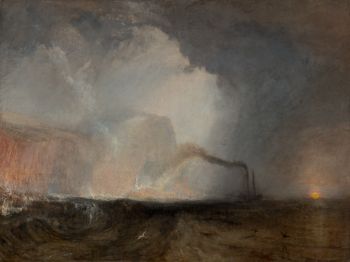
J.M.W. Turner, Staffa, Fingal’s Cave, 1831–32, oil on canvas, 91 × 121 cm (New Haven: Yale Center for British Art, Paul Mellon Collection).
On 22 September 2023, the Yale Center for British Art will host a one-day, online symposium titled J.M.W. Turner: State of the Field. This symposium will critically consider the state and meaning of Turner scholarship in advance of the 250th anniversary of Turner’s birth in 2025. Thinking through the extensive Turner historiography, the symposium seeks to explore the key ideas, underlying assumptions, and future direction of Turner research, and to consider its place within the broader field of British studies. We are particularly interested in critical analyses of the literature and studies that identify or exemplify potential new perspectives and approaches. We welcome proposals from established and emerging scholars on any topic within Turner studies and encourage participants to be imaginative in their approach.
Themes for consideration include but are not limited to
• The role of art historians, critics, curators, and institutions in building and maintaining Turner’s artistic prominence
• Turner’s place within past and contemporary approaches to British studies
• Turner’s place within discourses of modernity
• Turner’s own contribution to the construction of his artistic reputation
• ‘Realism’ and ‘idealism’ in Turner’s works
• Narrative and intentional meanings in Turner’s works, and what these might tell us about the artist’s broader social, cultural, and political positioning
• Issues of nationalism, race, and empire in Turner’s work
• Gaps that remain in studies of Turner’s artistic practice, including but not limited to his professional persona, relationships, and networks, and his engagement with the contemporary art market and/or print culture
• Innovative approaches to understanding Turner and his works, including new methodologies, critical perspectives, and future directions
Please submit an abstract of no more than 250 words and a short biography by 7 July 2023. Final presentations should not exceed twenty minutes in length.
Call for Essays | Studi Neoclassici
From ArtHist.net:
Studi Neoclassici: Rivista internazionale 11 (2023)
Submissions due by 30 June 2023
The journal Studi Neoclassici—created to publish the results of the activity promoted by the ‘Istituto di ricerca per gli studi su Canova e il Neoclassicismo’ (‘Research Institute for Studies on Canova and Neoclassicism’) of Bassano del Grappa—has been a tool for disseminating research of the Edizione Nazionale delle Opere di Antonio Canova (‘’National edition of the works of Antonio Canova’), that converges in the critical editions of the enormous Canova’s epistolary, with the historical, biographical, stylistic insights that matter requires. The major scholars of Neoclassicism constitute the scientific and editorial council of the journal. The magazine proposes itself to the attention of scholars in various fields of research, from history to literature, from archeology to art history, from the history of culture to art criticism to the history of collecting, from the history of music to that of dance and costume. Journal articles follow the same methodological approach that characterized the “Canovian Weeks”, that is connecting different artistic and cultural experiences, from literature to art history, to history and to other arts included in the historical period between second half of the eighteenth and the first decades of the twentieth century, with the intention of proposing a complete and not only specialized picture of the theme.
Studi Neoclassici publishes monographic numbers and free topic numbers relating to the historical period of the journal, the texts of which, selected through a Call for Papers procedure, are all—except for rare and justified exceptions—subject to peer review by a ‘double blind’ procedure. In the case of the aforementioned exceptions it is the management, in its collegiality, that after careful examination assumes the responsibility of accepting the texts. Issue number 11 (2023) will host free articles and one / two reviews of volumes relating to the period covered by the magazine, edited in 2021 and 2023.
The editorial rules are available here. Texts can be presented in Italian, German, French, English, or Spanish; must not exceed 35,000 characters (spaces and notes included); and must be sent by 30 June 2023 to the journal’s scientific directors: giuliana.ericani@gmail.com and gianpavese@gmail.com.
Call for Papers | Questioning the ‘Grand Siècle’
From ArtHist.net:
Grand Siècle? Pour l’histoire critique d’une notion
Université de Genève, Geneva, 16–18 May 2024
Organized by Jan Blanc
Proposals due by 20 May 2023
Que reste-t-il, aujourd’hui, du «Grand Siècle» ? Sans doute une notion, pour commencer, dont la fabrique ne remonte pourtant pas au XVIIe siècle, mais aux premières décennies de la IIIe République. Au sortir de la guerre de 1870, il s’agit de glorifier la France de Louis XIV et de Colbert pour célébrer la grandeur d’un État parfaitement administré, ainsi que l’importance du «génie français» dans l’histoire culturelle européenne. Face aux conceptions transhistoriques et transnationales développées par les historiens de l’art du monde germanique, qui font prévaloir l’Italie sur la France, il convient de montrer que c’est le même «classicisme» qui innerve les œuvres de Corneille, Molière et Racine, de Poussin, Claude et Le Sueur. C’est ainsi, désormais, au «Grand Siècle» qu’un nombre croissant d’expositions et d’ouvrages se consacrent, en se focalisant sur le règne de Louis XIV, décrit comme l’«âge d’or» de l’art français. Dès le premier tiers du XXe siècle, et jusqu’au tricentenaire de la mort de Louis XIV, des voix s’élèvent toutefois pour remettre en cause les «simplifications un peu scolaires» (Baldensperger 1937, cité par Stenzel 2006: 49) qui ont entouré le «Grand Siècle».
Les notions de «classicisme» et d’«absolutisme» sont remises en question, tandis qu’une autre société française est décrite, éprise de sainteté et de liberté autant que de gloire, et où l’ascension des meilleurs peintres et « la richesse de la vie artistique » ne peut plus se «réduire à de simples rapports de domination». Par ailleurs, et même si la notion elle-même est une fabrication tardive, il convient de s’interroger sur ce que le «Grand Siècle» doit à la France du XVIIe siècle. L’historiographie, on le sait, a été comme orientée par les écrits de Jean Desmarets de Saint-Sorlin, Dominique Bouhours, François Blondel, Charles Perrault et Voltaire, qui ont célébré «le siècle de Louis le Grand», puis le «siècle de Louis XIV»: «le “Grand Siècle” est le règne de Louis-le-Grand (sic)», écrit ainsi Bernard Teyssèdre (1964: 9). Cette focalisation est-elle pourtant pertinente ? Tandis que certains se sont intéressés de façon critique au tournant du XVIIIe siècle, trop souvent et facilement assimilé à une «période de transition», d’autres ont souligné l’importance de ce qui a pu être appelé la «naissance» (Pagès & Tapié 1948) et la «formation du Grand Siècle» (Bernhardt 1988: 409), ou encore le «premier Grand Siècle» (Descimon & Jouhaud 1996) — autant de questions qui, chez les historiens et les historiens de l’art, ne reçoivent pas de réponses nécessairement identiques. Le début du règne d’Henri IV (1589) correspond en effet à l’instauration d’un «nouveau style de gouvernement» et à la «reconstruction du royaume», saluée par les contemporains eux-mêmes. On a également souligné le rôle crucial de la régence de Marie de Médicis dans le développement des arts dans la France du XVIIe siècle, jusqu’à inspirer de flatteuses comparaisons avec le «Siècle de Louis le Grand». Ce sont toutefois les ministériats des cardinaux de Richelieu et Jules Mazarin, sous le règne de Louis XIII et du jeune Louis XIV, qui ont suscité l’attention la plus ancienne et la plus soutenue. Dès 1893, Henry Lemonnier affirme que cette période correspond au moment d’émergence du «classicisme» français, partant du «faux classicisme» de Simon Vouet pour aller jusqu’à l’«académisme» de Charles Le Brun. Louis Dimier reprend l’idée de Lemonnier en la nuançant.
Théorisant la notion de «seconde École de Fontainebleau», il lui accorde une place paradoxale : «Fontainebleau allait être le centre du renouveau de l’école effacée». Il situe lui aussi la naissance véritable de «l’école française» entre son «établissement» par Vouet et son «apogée» par Le Brun, mais accorde une importance plus grande au premier, dont le retour de Rome (1627), peu de temps avant celui de François Perrier et de Jacques Blanchard (1629), marque un tournant. Quatre-vingts ans après la mort de François Ier (la «première École de Fontainebleau»), la France d’Henri IV est enfin capable d’attirer à elle ou de conserver chez elle les meilleurs peintres qu’elle a vus naître sur son sol — ou presque, puisque Perrier est franc-comtois —, après avoir continué un temps de capitaliser sur l’héritage artistique de la fin du XVIe siècle (la «seconde École de Fontainebleau»). Un autre tournant est identifié par Dimier autour de l’émergence du « grand style » de Poussin et Lorrain, qui se conjuguera à l’«abondance unie» de Vouet dans l’art d’Eustache Le Sueur. Pour insister sur l’existence de ce «classicisme gallican», Bernard Dorival suggère plus tard d’appliquer la notion rhétorique d’«atticisme» à la peinture produite durant la dernière décennie du ministère de Mazarin, avant que d’autres ne la fassent remonter à la régence d’Anne d’Autriche, voire à la surintendance de François Sublet de Noyers.
Consacré à l’histoire critique de la notion de «Grand Siècle», ce colloque constituera le prologue d’un projet de recherche financé par le Fonds national suisse, Peindre et penser la peinture en France durant le premier XVIIe siècle : discours, artistes, concepts (2023–2027), dirigé par Jan Blanc (Université de Genève), et auquel collaborent Pauline Randonneix (doctorante), Antoine Gallay et Léonie Marquaille (postdoctorants) et Maxime Humeau (ingénieur informatique).
De nature interdisciplinaire, ce colloque propose de réunir des historiens de l’art, mais aussi des historiens, des philosophes, des spécialistes des questions littéraires et théâtrales, religieuses et théoriques, musicales et scientifiques, pour interroger les conditions historiques de genèse de la notion de «Grand Siècle», mais aussi son degré de pertinence dans l’analyse des différentes formes de pratiques intellectuelles et culturelles dans la France du long XVIIe siècle.
Les propositions de présentation devront nous parvenir avant le 20 mai 2023, sous la forme
• d’un titre provisoire
• d’une problématique résumée (500 mots maximum)
• d’une bio-bibliographie
adressées par courriel à jan.blanc@unige.ch
Les participantes et participants au colloque verront leurs frais de séjour et de déplacement remboursés.
B I B L I O G R A P H I E I N D I C A T I V E
BRUNETIERE, Ferdinand (1883). «La critique d’art au XVIIe siècle», Revue des Deux Mondes, LIII/3: 207–20.
LEMONNIER, Henry (1893). L’Art français au temps de Richelieu et de Mazarin (Paris: Hachette).
BREMOND, Henri (1916–1933). Histoire littéraire du sentiment religieux en France depuis la fin des guerres de religion jusqu’à nos jours (Paris: Bloud & Gay), 11 vol.
GAIFFE, Félix (1924). L’Envers du Grand Siècle: étude historique et anecdotique (Paris: Albin Michel).
DIMIER, Louis (1926). Histoire de la peinture française, du retour de Vouet à la mort de Lebrun (1627 à 1690) (Paris: G. van Oest), 2 vol.
BRAY, René (1927). La Formation de la doctrine classique en France (Paris: Hachette).
WEISBACH, Werner (1932). Französische Malerei des XVII. Jahrhunderts im Rahmen von Kultur und Gesellschaft (Berlin: Verlag Heinrich Keller).
BUSSON, Henri (1933). La Pensée religieuse française de Charron à Pascal (Paris: Imprimerie du Montparnasse).
LEROY, Alfred (1935). Histoire de la peinture française au XVIIe siècle (1600–1700): son évolution et ses maîtres (Paris : Albin Michel).
BALDENSPERGER, Fernand (1937). «Pour une “évaluation” littéraire du XVIIe siècle classique», Revue d’histoire littéraire de la France, XLIV/1: 1–15.
MORNET, Daniel (1940). Histoire de la littérature française classique, 1660–1700: ses caractères véritables, ses aspects inconnus (Paris: Armand Colin).
PINTARD, René (1943). Le Libertinage érudit dans la première moitié du XVIIe siècle (Paris: Boivin), 2 vol.
AMOUDRU, Bernard (1946). Le Sens religieux du Grand siècle (Paris: Éditions de la Revue des Jeunes).
PAGES, Georges & TAPIE, Victor-Lucien (1948). Naissance du Grand Siècle: la France de Henri IV à Louis XIV, 1598–1661 (Paris: Hachette).
BLUNT, Anthony (1953) 1983. Art et architecture en France, 1500–1700 (Paris: Macula).
LACLOTTE, Michel, éd. (1958). The Age of Louis XIV (Londres: Royal Academy of Arts).
ISARLO, George (1960). La Peinture en France au XVIIe siècle (Paris: Bibliothèque des Arts).
CHATELET, Albert & THUILLIER, Jacques (1963–1964). La Peinture française (Genève: Skira), 2 vol.
TEYSSEDRE, Bernard (1964). L’Histoire de l’art vue du Grand Siècle: recherches sur l’«Abrégé de la vie des peintres», par Roger de Piles (1699), et ses sources (Paris: Julliard).
PARISET, François-Georges (1965). L’Art classique (Paris: Presses universitaires de France).
GOUBERT, Pierre (1966). Louis XIV et vingt millions de Français (Paris: Fayard).
NIDERST, Alain (1971). «Le sens du mot siècle dans la langue classique», Le Français moderne, XXXIX : 207–19.
JOHNSON, Neil R. (1978). Louis XIV and the Age of the Enlightenment: The Myth of the Sun King from 1715 to 1789 (Oxford: Voltaire Foundation/University of Oxford).
BREJON DE LAVERGNEE, Arnauld & DORIVAL, Bernard (1979). Baroque et classicisme au XVIIe siècle en Italie et en France (Paris: Famot).
WRIGHT, Christopher (1985). The French Painters of the Seventeenth Century (Londres: Orbis).
BOTTINEAU, Yves (1986). L’Art baroque (Paris: Mazenod).
BERNHARDT, Jean (1988). «Compte rendu de la Correspondance du P. Marin Mersenne (Paris: Éd. du CNRS, 1986)», Revue d’histoire des sciences, XLI/3–4 : 409–10.
ARMOGATHE, Jean-Robert, éd. (1989). Le Grand Siècle et la Bible (Paris : Beauchesne).
GOUBERT, Pierre (1966) 1989. Louis XIV et vingt millions de Français (Paris: Fayard).
HENSCHALL, Nicholas (1992). The Myth of Absolutism: Change and Continuity in Early Modern European Monarchy (Londres: Routledge).
THUILLIER, Jacques (1992) 2014. La Peinture française au XVIIe siècle (Dijon: Faton).
HILAIRE, Michel & RAMADE, Patrick, éd. (1993). Grand Siècle : peintures françaises du XVIIe siècle dans les collections publiques françaises (Paris: Réunion des musées nationaux).
MEROT, Alain (1994). La Peinture française au XVIIe siècle (Paris: Gallimard).
DESCIMON, Robert & JOUHAUD, Christian (1996). La France du premier XVIIe siècle, 1594–1661 (Paris: Belin).
BURY, Emmanuel (1998). «Frontières du classicisme», Littératures classiques, XXXIV : 217–36.
CORNETTE, Joël (2000). «L’histoire au travail : le nouveau “Siècle de Louis XIV” : un bilan historiographique depuis vingt ans (1980–2000)», Histoire, économie & société, XIX/4 : 561–605.
COSANDEY, Fanny & DESCIMON, Robert, éd. (2002). L’Absolutisme en France : histoire et historiographie (Paris: Éditions du Seuil).
BELL, David A. (2003). The Cult of the Nation in France: Inventing Nationalism, 1680–1800 (Cambridge: Cambridge University Press).
CHALINE, Olivier (2005). Le Règne de Louis XIV (Paris: Le Grand Livre du Mois).
CHERVEL, André (2006). Histoire de l’enseignement du français du XVIIe au XXe siècle (Paris: Retz).
STENZEL, Hartmut (2006). «Le “classicisme” français et les autres pays européens», in Histoire de la France littéraire: classicismes (XVIIe–XVIIIe siècle), éd. Jean-Charles Darmon & Michel Delon (Paris: Presses universitaires de France): 39–78.
VENTURINO, Diego (2006). «Généalogies du Grand Siècle», in Voltaire et le Grand Siècle, éd. Anne-Sophie Barrovecchio & Jean Dagen (Oxford: Voltaire Foundation) : 3–13.
JOUHAUD, Christian (2007). Sauver le Grand-Siècle ? Présence et transmission du passé (Paris: Éditions du Seuil).
GADY, Bénédicte (2010). L’Ascension de Charles Le Brun : liens sociaux et production artistique (Paris: Éditions de la Maison des sciences de l’homme).
MAZEL, Claire (2013). «Les beaux-arts du siècle de Louis XIV : déconstructions et constructions historiographiques de la seconde moitié du XVIIIe siècle», in Penser l’art dans la seconde moitié du XVIIIe siècle : théorie, critique, philosophie, histoire, éd. Christian Michel & Carl Magnusson (Paris: Somogy): 531–46.
MARAL, Alexandre (2014). Les Derniers jours de Louis XIV (Paris: Perrin).
BONFAIT, Olivier (2015). Poussin et Louis XIV: peinture et monarchie dans la France du Grand siècle (Paris: Hazan).
COJANNOT-LE BLANC, Marianne (2015). «Apprécier les arts du règne de Louis XIV: une gageure pour notre temps ?», Revue de l’Art, XC/4 : 5–8.
CORNETTE, Joël (2015). 1er septembre 1715: la mort de Louis XIV — Apogée et crépuscule de la royauté (Paris: Gallimard).
PETITFILS, Jean-Christian (2015). Le Siècle de Louis XIV (Paris: Perrin).
FUHRING, Peter, MARCHESANO, Louis, MATHIS, Rémi & SELBACH, Vanessa, éd. (2015). Images du Grand Siècle: l’estampe française au temps de Louis XIV, 1660–1715 (Paris : BNF).
SUIRE, Éric (2016). «Le tricentenaire de la mort de Louis XIV: un bilan historiographique fécond ?», XVIIe siècle, CCLXXII/3 : 501–08.
GADY, Bénédicte & TREY, Juliette, éd. (2018). La France vue du Grand Siècle: dessins d’Israël Silvestre, 1621–1691 (Paris: Musée du Louvre).










leave a comment