Call for Papers | Rococo across Borders: Designers and Makers
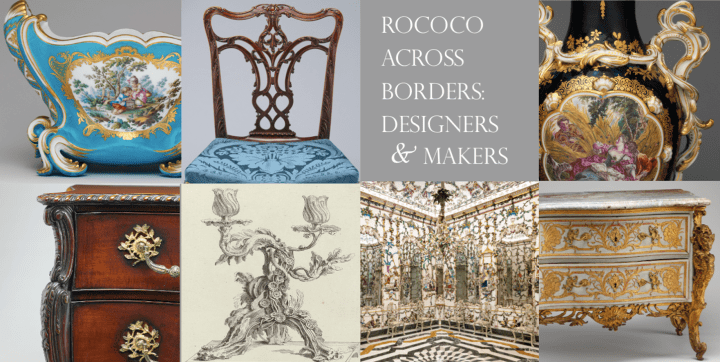
From the Call for Papers:
Rococo across Borders: Designers and Makers
London, venue TBC, 24–25 March 2023
Organized by the Furniture History Society and the French Porcelain Society
Proposals due by 4 November 2022
We are delighted to announce that the Furniture History Society and the French Porcelain Society will be joining forces in Spring 2023 to hold a two-day symposium on the theme of Rococo across Borders: Designers and Makers. Using the Versailles exhibition Louis XV, Passion d’un roi / Passions of a King as our starting point, the symposium will broaden out to discuss the geographical spread of the style, the interaction between designers and makers, and the significant roles played by print culture and the evolving art market in disseminating the Rococo across Europe.
This symposium calls for papers that go beyond the traditional geographical, chronological, and conceptual fields of Rococo design to explore how it evolved throughout the eighteenth and nineteenth centuries. In particular, it aims to open up wider discussions about the historical contexts for Rococo ceramics and furniture, the place of the ‘Rococo’ in museums and art historical scholarship today, and its impact on contemporary makers. We invite submissions for 30-minute conference papers. Topics for consideration may include, but are not limited to the following:
• ‘Beyond Rococo’: ceramics, furniture, and decorative schemes outside France
• Networks: makers, designers, and consumers across borders
• Case studies of individual interiors or objects
• Changing reception: scholastic and the art market
Please submit an abstract of 250–300 words and a short biography to diana_davis@hotmail.co.uk and events@furniturehistorysociety.org by Friday, 4 November 2022. Please email events@furniturehistorysociety.org with any queries.
Organizing Committee
Diana Davis, Patricia Ferguson, Beatrice Goddard, Caroline McCaffrey-Howarth, David Oakey, and Adriana Turpin
◊ ◊ ◊ ◊ ◊
Picture Credits: Top left to bottom right, Flower vase (cuvette Mahon), probably designed by Jean-Claude Duplessis, Sèvres Manufactory, soft-paste porcelain, ca. 1757–60 (Metropolitan Museum of Art, 1974.356.592); Side chair, attributed to Benjamin Randolph, Philadelphia, mahogany, ca. 1769 (Metropolitan Museum of Art, 1974.325); Vase, Chelsea factory, soft-paste porcelain, ca. 1762 (Metropolitan Museum of Art, 1970.313.2a); Commode attributed to William Vile and John Cobb, mahogany, pine, gilt-bronze, ca. 1760 (Metropolitan Museum of Art, 64.101.1142); Girandolle à branche de porcelaine garnie d’Or, from Oeuvres de Juste-Aurèle Meissonnier, engraved by Gabriel Huquier, French, 1738–49 (Cooper-Hewitt, Smithsonian Design Museum, 1921-6-212-29-b); Porcelain Room designed by Giuseppe Gricci, Real Fábrica de Porcelana del Buen Retiro, installed in the Palace of Aranjuez, 1763–65; Commode designed by Jean-François Cuvilliés, the Elder, pine partially painted and gilded, ca. 1735–40 (Metropolitan Museum of Art, 28.154).
Call for Papers | HECAA Emerging Scholar Showcase
HECAA Emerging Scholar Showcase
Online, Monday, 28 November 2022
Proposals due by 9 October 2022
The Historians of Eighteenth-Century Art and Architecture is pleased to invite Emerging Scholars studying the art, architecture, and visual culture of the long eighteenth century around the globe to participate in a virtual showcase once again. Our hope is to provide a platform for early career scholars to promote their own research, as well as a forum for networking and ongoing community building.
Each scholar will be given 3–5 minutes to present their work, followed by an open question and answer session. This year’s Emerging Scholars Showcase will be held on Monday, November 28 in the late afternoon/early evening. This shift is in response to the widespread preference for non-weekend events expressed by members who responded to the survey. As last year, an additional Spring showcase may be added if there is sufficient interest, so we encourage you to apply even if you are unable to present on November 28.
To apply, please fill out this form. Applications are due by Sunday, 9 October 2022 at midnight (EST). Please direct any questions to Daniella Berman: daniella.berman@nyu.edu.
Emerging Scholars do not need to be current HECAA members and may be current graduate students, and those who have received their degrees in the past five years; so please circulate this call to your networks as appropriate. If you are interested in volunteering (to help with tech-issues and help moderate the Q&A) for the Emerging Scholars Showcase, please reach out to Daniella.
Daniella Berman
HECAA Board Member At-Large; Graduate Student & Emerging Scholar Representative
Call for Papers | ASECS 2023, St. Louis
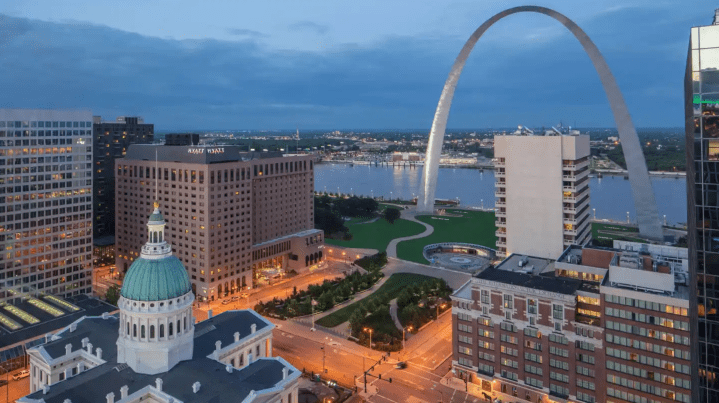
Proposals are due on Monday! In addition to the following selected panels, the full Call for Papers is available here. And please pay special attention to HECAA’s New Scholar Session, chaired in 2023 by Emily Casey and Amy Torbert.
2023 American Society for Eighteenth-Century Studies Conference
Hyatt Regency at the Arch, St. Louis, 9–11 March 2023
Proposals due by 24 October 2022 (extended from 3 October)
The American Society for Eighteenth-Century Studies (ASECS) is pleased to announce our Call for Papers for our 53rd Annual Meeting, to be held 9–11 March 2023 at the St. Louis Hyatt Regency at the Arch. The Society, established in 1969, is the foremost learned society in the United States for the study of all aspects of the period from the later seventeenth through the early nineteenth century.
We are committed to fostering an inclusive and welcoming conference environment in which all members participate fully in the exchange of knowledge and ideas. We welcome scholars pursuing all aspects of eighteenth-century studies and in all careers and career stages: in graduate studies; in tenured, tenure track, or non-tenure track academic positions; in part-time or temporary positions in the academy; and colleagues in contexts beyond the academy including libraries, museums, publishing, and teaching, as well as independent scholars. Please join us whether you are a long-time member, or new to ASECS!
New this year! We are collecting submissions centrally. Chairs of sessions will review applications to their sessions as in past years and forward their decisions to the Executive Director, Benita Blessing (director@asecs.org). You can find further instructions on the form itself.
◊ ◊ ◊ ◊ ◊
Aesthetics and Politics in Ireland [Irish Caucus]
Scott Breuninger, Virginia Commonwealth University, breuningersc@vcu.edu
During the eighteenth century, questions of aesthetics in Ireland were often linked to notions of political or social authority. Working in a society divided by religion, gender, and race, Irish artists and writers were faced with the uncomfortably stark nature of political power and the (mis-)attribution of meaning(s) to their work. In this context, many of the themes that were explored by Irish poets, playwrights, and musicians (among others) were necessarily grounded in discourses that tried to walk a fine line between personal expression and social expectations. Some of these creative works explicitly drew from Ireland’s past to inform their meaning, while others looked toward the future with varying degrees of optimism and pessimism. In this nexus of aesthetic creativity, artists were forced to negotiate with a wide range of pressures that were unique to Hibernia. This panel welcomes proposals that address how issues of artistic representation related to questions of political and social power within eighteenth-century Ireland, as well as modern scholars’ interpretations (or reinterpretations) of the significance of these works. Of particular interest are proposals that investigate how politically disenfranchised groups in Ireland addressed the connection between artistic representation, political power, and/or historical memory along lines associated with religion, gender, and race.
◊ ◊ ◊ ◊ ◊
All Things Great and Small: Miniatures and Monstrosities
Daniella Berman, Institute of Fine Arts, New York University, daniella.berman@nyu.edu; and Blythe C. Sobol, Nelson-Atkins Museum of Art and Institute of Fine Arts, NYU, blythe.sobol@gmail.com
From netsuke to Antonio Canova’s colossal nude statue of Napoleon as Mars, the visual culture of the long eighteenth century offers a multitude of examples through which to interrogate questions of scale and size. The period saw a rise in the prevalence of portrait miniatures, the expansion in size of pastel portraits facilitated by technical innovations, the advent of large-scale religious paintings in viceregal Mexico, the proliferation of reverse-painted Chinese snuff bottles, the growth in the number and variety of pieces in European porcelain services, and important shifts from large-scale history subjects to more intimate, so-called decorative ones in canvas painting and back again. This era provides a particularly fruitful opportunity to consider the impact of the miniature and the monumental on works of art, artists, and viewers alike. We seek papers that consider questions of size and scale, either by focusing on examples of extremes, by exploring the limitations or changing possibilities of certain media through technical innovations, or by considering the ways in which concerns of size and scale were discussed and theorized between artists, patrons and critics. What representational conundrums did artists encounter in these extremes of scale—in terms of production, display, and reception—and how were these negotiated? How did size and scale play a role in the rapidly changing hierarchies of the period, both art historical and political? And how were these tiny and grandiose wonders understood and consumed by an increasingly attuned public? Global approaches to this wide-ranging subject are especially welcome.
◊ ◊ ◊ ◊ ◊
Amateur Art
Katherine A. P. Iselin, University of Missouri, iselink@missouri.edu
The established hierarchy of the art historical canon excludes a significant number of art forms and media, centering instead almost entirely on painting and sculpture. Yet other types of art proliferate outside the Academy in the long eighteenth century. Often due to the inaccessibility of formal art training, ‘amateur’ artists worked in a variety of media that were strong departures from the professional art of the day, ranging from scrapbooks and dressed prints to shellwork and embroidery, along with everything in between. At the same time, many of these works of art incorporated subject matter that aligned with contemporary professional art, such as neoclassical themes. Though many of these works of art continue to be identified as “craft” today, they remain expressions of significant technical and creative achievement. This panel aims to highlight art frequently left outside the art historical canon, particularly encouraging an examination of how gender, race, and class intersect with the production of such works.
◊ ◊ ◊ ◊ ◊
Asia in the Eighteenth Century
Susan Spencer, University of Central Oklahoma (Emerita), sspencer@uco.edu
Asia in the long eighteenth century was a dynamic place. Widespread social and political upheaval, along with efficient, affordable new avenues for the dissemination of written material and household goods, created a ready market for novel commodities and fresh genres in art and literature. An increasingly affluent merchant class demanded luxury goods and commodities that reflected their own needs and interests rather than catering exclusively to the courtly tastes of the entrenched aristocracy. The age also produced written works that diverged from convention and are now valued as cultural treasures: the rising popularity of operatic musical theater, subversive collections of ghost tales, and domestic novels in China; Japan’s reinvention of haiku as performance art, sophisticated puppet theater and richly illustrated ukiyozōshi narratives of the rising merchant class; Vietnam’s national epic, The Tale of Kiều, with its graphic account of sexual trafficking from the victim’s perspective; and, in Korea, innovative new portraiture and a firsthand description of the corruption of courtly values in the Memoirs of Lady Hyegyong. How did the creations of Asian artisans, artists, and authors question—or fail to question—traditional expectations for class and gender? How did they challenge aristocratic values charged with assumptions that privilege rank, property, and patriarchy? This panel welcomes reflections on these and other developments in eighteenth-century Asia.
◊ ◊ ◊ ◊ ◊
Anne Schroder New Scholars Session [HECAA]
Emily Casey, University of Kansas; and Amy Torbert, Saint Louis Art Museum, emilycaseyphd@gmail.com
The Anne Schroder New Scholars Panel, sponsored by the Historians of Eighteenth-Century Art and Architecture, seeks to promote scholarship that represents the future of eighteenth-century studies. We invite proposals from dissertating graduate students and early-career scholars working in the academy or museum. We welcome submissions that explore topics across the cultures, spaces, and materials that are related to art and architectural history over the long eighteenth century and around the globe. We especially encourage projects that reflect new approaches to both long-standing and under-studied issues and methods in eighteenth-century studies broadly, including but not limited to: critical race art history; Disability studies; ecocriticism and environmental studies; empire, colonization, and decolonial theory; gender and queer theory; global diasporic histories; Indigeneity; and material culture studies. Papers can be based on dissertations, book or article manuscripts in progress, Digital Humanities collaborations, or curatorial projects. We particularly encourage BIPOC scholars, contingent or independent scholars, and those working outside of North America to apply.
◊ ◊ ◊ ◊ ◊
Building the Eighteenth Century: Histories of Physical Form
Janet R. White, UNLV School of Architecture, janet.white@unlv.edu
Historians of architecture, landscape architecture, and interior architecture are invited to submit proposals for papers dealing with the physical form, built or unbuilt, of the long eighteenth century. Subjects may range from neoclassical churches to exotic garden follies, Rococo salons to utopian images. The goal of the session is to cast a wide net and increase the coverage of physical form on the ASECS program.
◊ ◊ ◊ ◊ ◊
Changing Course: Riverways
Kathleen Fueger, Independent Scholar, kmfueger@gmail.com
St Louis lies just south of the confluence of the Mississippi and Missouri Rivers, a geography that attracted and sustained the Mound Builders of the Mississippian culture at Cahokia. The same watershed later inspired the city’s settlement by Europeans in the 1760s, first by French fur traders, later ceded to Spanish rule, retroceded to France and finally to the United States through the Louisiana Purchase. These rivers formed the political, economic, and communicative crossroads of the nascent country. In 1804 Lewis and Clark began their journey on the Missouri to explore the western territory; the east remained accessible via the Ohio River; and by 1818 steamboats travelled south on the Mississippi, connecting the city with New Orleans. All great global waterways, from the Amazon to the Chang Jiang to the Thames to the Tagus, are simultaneously a site of possibility—commerce, transportation, natural resources, protection, energy, exploration—and of peril: flooding, disease, invasion, isolation, exploitation, and colonization. This panel seeks contributions from a broad range of fields that explore the representations of rivers in the long eighteenth century. How are rivers a site of expansion and exploitation? What kinds of cultural, commercial, and environmental contributions or conflicts take place on their banks? Are rivers commodities or protagonists? How do rivers change the course of human communities, and how are the rivers changed in turn? Does the eighteenth century allow for an ecological view of rivers?
◊ ◊ ◊ ◊ ◊
Civility and Incivility in Early-Modern Salon Culture
Downing A Thomas, University of Iowa, downing-thomas@uiowa.edu
From the seventeenth through the eighteenth century, the salon provided a space for the acquisition of knowledge, civil exchange of ideas, and refinement of manners. Frequently feminocentric—although the gender profile changes over the years—salons provided men and women with the opportunity to engage in intellectual debates that influenced the cultural life of the French capital and the usage of language itself. Roturiers (non-nobles) could rely on their wit, wealth, and education to acquire the kinds of social skills previously reserved for the nobility, while the aristocracy frequented the salons to maintain and develop cultural capital garnered during the feudal era. Civil exchange was at the basis of the social processes advanced by the salon, and notions of ideal civility, love, and friendship were frequent topics of discussion, particularly in the seventeenth century. In the eighteenth, those debates became more aligned with the intellectual agendas of the philosophes and with the development of public-sphere sociability. This panel seeks to explore how civility as well as its opposite, incivility, defined the life of the salon in early modern France. How did refinement of manners exist in tension with the competition for cultural capital? What happened in the wake of instances of incivility, whether blatant or subtle? To what degree did the salons continue to be engaged in literary production throughout the ancien régime? What vestiges of salon society endured beyond the Revolution of 1789 to serve as points of reference in modern polite society?
◊ ◊ ◊ ◊ ◊
Botanical Gardens
Katie Sagal, Cornell College, asagal@cornellcollege.edu
Our annual meeting in 2023 will take place in St. Louis, home of the renowned Missouri Botanical Garden and the equally illustrious Peter H. Raven Library. Taking inspiration from this impressive duo, this panel seeks papers that investigate European botanical gardens of the eighteenth century. Collectors of both indigenous and exotic plants donated or contributed specimens throughout the century to a variety of professional gardens, adding to an explosion of known botanical specimens in Western scientific circles. Notable aristocrats cultivated expansive personal botanical gardens, burgeoning centers of naturalist study emerged alongside institutional gardens, and renowned artists travelled England and Europe for inspiration from a wide spectrum of professional garden spaces. This was an area where women’s contributions to botanical science shone, too, from Princess Augusta’s involvement in the founding of the Royal Botanic Gardens at Kew to Mary Delany’s creative sourcing of plant models from her mosaics to from a selection of botanical gardens great and small. Crucially, however, much of the plant sourcing for these domestic gardens relied upon imperial bioprospecting, as plants with deep significance for local populations—cultural, religious, and economic—were literally uprooted by European adventurers for financial gain. Papers that examine botanical gardens as centers of scientific research and development, as spaces for socio-cultural negotiation, as sites of imperialist violence, and as loci for fluctuating gender dynamics are all welcome, as well as other approaches to the topic.
◊ ◊ ◊ ◊ ◊
The Eighteenth-Century Fragment
Andrew Selcer, University of Louisiana, Lafayette, amselcer92@gmail.com
Material fragments such as a scrap of ancient poetry, a fractured sculpture, a torn diary page, or a partially written novel warranted increasing attention during the eighteenth century. The unfinished aesthetic of fragments offered an experience that was contrary to the sense of completion provided by whole and polished texts, and provided access to voices that would be otherwise inaccessible and lost. How do we understand this fascination with fragments in their various aesthetic, material, and political conditions? This panel invites contributions of papers on any aspect of the fragment. Papers may consider a single work, author, or artist; a theoretical approach; individual fragments or their role in larger works. We welcome papers from any discipline and national literature.
◊ ◊ ◊ ◊ ◊
Embodiment of Ideas in the French Enlightenment
Mladen Kozul, University of Montana, mladen.kozul@gmail.com
One could criticize the French Enlightenment for its superficiality, its lack of intellectual rigor or even its failure to elaborate coherent systems of thought. Conversely, one could appreciate the works of Kant or Hegel as signs of the emergence of a comprehensive continental philosophy. But the interest in the French Enlightenment lies not only in the resistance that it opposes to the system but equally in its recourse to both literary fiction and the theater to turn thoughts into action. In its opposition of embodiment to abstraction, confrontational ethics to systematic ethics, and in its proclivity for accepting allegory only if it makes ideas emerge in the flesh, the literature and theater of the eighteenth century in France paved the way to different ways of thinking. This panel aims to explore various modes of embodying ideas in narrative fiction and in theater, as well as in paintings, during the eighteenth century in France. It seeks to deepen our comprehension of the radical turn fiction gives to ideas, to examine textual traces of author’s voice, to identify tensions, contradictions and mutations inherent to the processes of embodiment. In short, to examine how thinking is carried out in the novel, comedy, tragedy and, indeed, in painting.
◊ ◊ ◊ ◊ ◊
Fashioning Eighteenth-Century Masculinities
Denise Amy Baxter, University of North Texas, denise.baxter@unt.edu
This panel invites papers that explore how masculinity was presented in the long eighteenth-century through clothes, accessories, and other forms of bodily adornment. Taking inspiration from exhibitions such as Reigning Men or the V&A’s recent Fashioning Masculinities this panel asks: how did suits or snuff boxes or sword bows (or the like) make the man? Papers that engage with material culture or its visual or verbal representations are equally welcome, as are those that discuss later re-fashionings of eighteenth-century masculinities.
◊ ◊ ◊ ◊ ◊
Indigenous, Black, Asian, and Mixed-Race Architects and Builders in the Americas
Luis Gordo Peláez, California State University, Fresno, luisgordopelaez@mail.fresnostate.edu; and Juan Luis Burke, University of Maryland, jlburke1@umd.edu
In colonial Mexico City, the guild of master builders barred the membership of people of Indigenous origin to its ranks. Some 120 km to the southeast, in Puebla de los Ángeles, the city’s guild of master builders, contrary to Mexico City’s, granted membership to indigenous builders, given the high demand for qualified builders in the region. Despite Mexico City’s official ban on Native builders’ membership to its ranks, recent scholarship is demonstrating that people of color took on roles of design and construction that were integral to the building of the colonial world in diverse regions of the Americas, besides constituting the bulk of the labor in many colonial settings. This panel welcomes proposals that investigate the role played by people of color across the long eighteenth century in the built environment of colonial settings, indistinct of geography. We are particularly interested in narratives that reveal the role that Black, Indigenous, Asian, and other non-White builders played in architecture and the construction world in general, such as in building guilds, the practice of architecture understood widely, the writing of treatises or other technical or philosophical texts regarding architecture, their participation in constructing the infrastructure of the eighteenth-century Americas, or other building endeavors. We look for works that reveal the forgotten role that builders of color played in colonial environments that traditional historiographical narratives have neglected to tell.
◊ ◊ ◊ ◊ ◊
Inventing the Global and Discovering the World in the Eighteenth Century
Idolina Hernandez, Lindenwood University, ihernandez@lindenwood.edu; and Heesoo Cho, Washington University in Saint Louis, heesoocho@wustl.edu
An expansion of travel and communications across continents led to new understandings of empires and belonging in the eighteenth century. Real and perceived discoveries of peoples and places in far away locations contributed to a process of imagination and invention that sought to make them legible as what scholars have identified as a ‘global’ perspective. As concepts of the ‘global’ center in eighteenth-century studies, what are the limits and opportunities that this term affords scholars? What are some of the ways in which an analytical conceptualization of the world as ‘global’ contributes to our understanding of an emerging global imagination? This panel seeks papers that explore how an eighteenth century understanding of the global contributes to current scholarship. We invite papers that explore how the global was established and discussed through narratives, art, empire building, commerce, and identities.
◊ ◊ ◊ ◊ ◊
Johnson, Art, and Aesthetics [Samuel Johnson Society of the West]
Timothy Erwin, University of Nevada, Las Vegas, timothy.erwin@unlv.edu
The Samuel Johnson Society of the West invites papers for a panel on Johnson and art at the 2023 St Louis meeting. Our period saw a divide open between notions of creating the artwork and experiencing a sensory response to it. Across the century the discourse of painting and connoisseurship found in Dryden and Pope became opposed to the novel aesthetic discourse of Addison, Burke, and their successors. The concept of the beautiful shifted away from classical outline and proportion to bright coloring, and the rough beauty of the landscape picturesque may be read as a synthesis of the two. Until the appearance of Morris Brownell’s Samuel Johnson’s Attitude to the Arts, Johnson was generally thought to be uninterested in the arts, and this despite his friendship with Charles Burney and Sir Joshua Reynolds. Brownell establishes another Johnson, one wholly familiar with developments in the fine arts.
Building on the revisionist view, this panel will host a reconsideration of Johnson’s views of music, painting, gardening, and architecture, and also those of the Johnson circle. Among many others, possible topics might take up the relation of Johnson’s generalized aesthetics to empiricism and academic painting more generally, along with his role in fashioning Reynolds’s Discourses; the portraits that Hester Thrale commissioned from Reynolds to hang in the Streatham library, each of which she annotated in ekphrastic verse; and the lyrics by Johnson that Haydn set to music, “The Winter’s Walk . . .” and “Even now . . . ,” or the melody of songs that Goldsmith included in ‘She Stoops to Conquer,’ both recently recovered by Ross Duffin.
◊ ◊ ◊ ◊ ◊
Knowing from Making, Ideas from Things
Sean Silver, Rutgers, sean.silver@rutgers.edu
What is to be learned by attending to the materials and practices of the Restoration and eighteenth-century arts and sciences? What is to be gained from historical recreation or exploratory archaeology? This panel aims to find out. Papers might recover a process or material from eighteenth-century texts; they might introduce and discuss an instrument, tool, or innovative device; they might discuss a historical recreation or reenactment which adds to our knowledge about the design arts, practical chemistry, the book trade, and so on. This panel invites reflections (theoretical, descriptive, or historical) on eighteenth-century craft knowledge, materials, instruments, and processes. It is especially interested, however, in projects that find their way from hands-on labor to ideas and argument. Not the archive, but the repertoire is especially wanted; not talk about craft, but craft itself; not historical recovery, but critical historical recreation.
◊ ◊ ◊ ◊ ◊
Le goût de la reine: Marie-Antoinette as Patron, Collector, and Connoisseur of the Arts
Todd Larkin, Montana State University, tlarkin@montana.edu
Charles-Nicolas Cochin completed a drawing and Benoît-Louis Prévost carried out the engraving for an elaborate allegorical conceit, Hommage des Arts (1776) sold as a single sheet and selected as the frontispiece for Boilly’s IVeme recueil d’airs choisis. The operatic image boasts no fewer than five cloud-supported genies—Music, Painting, Architecture, Sculpture, and Theater—gathered around a smoldering altar and raising flaming hearts to a portrait of Marie-Antoinette borne by angels and cherubs. The conceit is double edged: a mere two years into the queen’s reign she has commissioned cultural projects sufficient to be heralded a great patroness and the artistic community have placed their hopes in her that this beneficence may extend far into the future. What was the range of Marie-Antoinette’s patronage of the arts between 1774 and 1792, and of what was “le gout de la reine” said to consist during the same period? Objects, letters, texts, inventories, and documents permit a series of case studies on the fine arts, decorative arts, and material culture. Papers that employ archival, epistolary, and material resources to identify a particular creative approach, to relate a broader artistic trend, to underscore an aristocratic, bourgeois, or popular phenomenon, or to employ theoretical models for assessing power promotion, group affiliation, consumption practices, and audience reception will be particularly welcome. This session commences a reassessment of Marie-Antoinette’s contribution to the arts to mark the semi-quincentennial of her accession to the throne in 1774.
◊ ◊ ◊ ◊ ◊
Making it Work: Women, Labor, and Agency
Heidi Strobel, University of North Texas, Heidi.Strobel@unt.edu; and Jennifer Germann, Independent Scholar, jennifer.germann04@gmail.com
While working several jobs at the same time seems to exemplify work in the twenty-first century, it was a fairly common practice in the eighteenth century. Examples include portrait painter/surveyor Robert Feke, tailor/author James Carter, and teacher/gallery entrepreneur Mary Linwood, to name a few. Authors who have focused on this phenomenon include (but are not limited to) Zara Anishanslin (Portrait of a Woman in Silk), Carolyn Steedman (Labour’s Lost: Domestic Service and the Making of Modern England), and David Waldstreicher (Runaway America: Benjamin Franklin, Slavery, and the American Revolution). This panel invites interdisciplinary papers that consider non-elite women who worked multiple jobs and/or multitasked in multiple ways. For some women, ‘multi-jobbing’ was an autonomous choice, a means of expressing agency, and an avenue to economic success. For others (such as enslaved workers/laborers, indentured servants, and others in forced labor contexts), such work was a necessity. This panel welcomes papers that focus on individual case studies from around the globe in light of broader themes including agency, autonomy, and necessity.
◊ ◊ ◊ ◊ ◊
Making Knowledge in the Atlantic World
Alexandra Macdonald, William & Mary, ammacdonald@wm.edu; and Diego Pirillo, dpirillo@berkeley.edu
Where was knowledge produced in the eighteenth century? By whom? Whose hands and labour shaped knowledge in workshops, kitchens, universities, libraries, museums, and societies? And how did this knowledge circulate across the Atlantic World? This panel welcomes papers on topics relating to the production, circulation, and performance of knowledge in the eighteenth-century Atlantic World. We are particularly interested in papers that expand our definition of what knowledge is and complicate our understanding of whose knowledge drove the eighteenth-century Atlantic world. We seek papers from a broad range of disciplines and approaches including, but not limited to, art history, material culture studies, literary studies, and social, cultural, and gender history. Additionally, we welcome submissions from scholars at any stage in their program or career, both in and outside of academia.
◊ ◊ ◊ ◊ ◊
‘Nature display’d’: Visualizing the Natural World
Anne Nellis Richter, Independent Scholar, anne.nellis@gmail.com; and Melinda McCurdy, Huntington Library, Art Museum, and Botanical Gardens, mmccurdy@huntington.org
This panel seeks to explore the developing awareness of the impact that human activity had on the natural world during the long eighteenth century (1688–1815) and its expression through a wide range of visual media and material culture. Over the course of the eighteenth century, the taste for natural forms was expressed by a variety of theoreticians including figures like J.-J. Rousseau and William Hogarth; Theories about nature, and particularly their influence on the development of landscape painting and on trends in interior design, have long been the focus of art historians. However, the emergence of global networks of exchange alongside forms of industry and technology that left increasingly noticeable and unavoidable traces of human presence on the natural world in ways permeated the literary and visual arts. Certainly, painters, printmakers, and sculptors explored these themes in their work, and we welcome papers seeking to shed new light on how artists navigated the depiction of nature in the context of an increasingly globalized and industrialized world and in relation to issues like race, gender, and class. In addition, we hope this panel will be able to expand the discussion to explore how the makers of everyday and luxury objects, interior designers, architects, and garden designers thought about and visualized relationships between humans and their environment across the full range of media that constituted the visual field of the global eighteenth century.
◊ ◊ ◊ ◊ ◊
Off the Beaten Path: New Perspectives on the Grand Tour
Sarah Carter, University of Chicago, sarah.carter@mail.mcgill.ca; and Lauren DiSalvo, Utah Tech University, lauren.disalvo@utahtech.edu
The Grand Tour calls to mind British and other European elite males who visited continental Europe and Italy in pursuit of the antique and other cultural experiences afforded by travel. In light of new approaches toward the Grand Tour, such as Sarah Goldsmith’s Masculinity and Danger on the Eighteenth-Century Grand Tour or Emma Gleadhill’s Taking Travel Home: The Souvenir Culture of British Women Tourists, this interdisciplinary panel seeks papers that examine the Grand Tour and European travel in the eighteenth century from new perspectives. Panelists may explore unusual visual or literary representations of travel, unfamiliar routes and destinations, or the experience of travel across different classes, genders and nationalities. We also encourage papers that address how the Grand Tour influenced visual and material culture in surprising ways or that were produced at a remove from the Grand Tour.
◊ ◊ ◊ ◊ ◊
On the Wings of Enlightenment: Birds and Other Airborne Organisms [South-Central Society for Eighteenth-Century Studies]
Kevin L. Cope, encope@lsu.edu
Birds, not to mention airborne creatures such as insects, flying squirrels, and the occasional unexplained airborne entity, not only outnumber people during the Enlightenment but engage universally with all sorts of cultural activity. Most obviously, birds and their colleagues fill the pages of natural history, cultural geography, and travel books, but they also spread across paintings, ornament sculpture, provide themes and sound effects for music, decorate porcelain, punctuate poetry, festoon furniture, and fill landscape gardens. Birds could happily and tunefully accomplish what was impossible during the period, high-speed heavier-than-air flight, thus encouraging while also perplexing the first modern scientists. Sometimes domestic and sometimes migratory, sometimes in a zoo but more often en route and above ground, sometimes restricted to the barnyard and sometimes globally nomadic, birds both epitomized and challenged the border-defined nations and empires that emerged during the long eighteenth century. This panel welcomes papers addressing any aspect of the Enlightenment avian experience, including presentations addressing bird-like or bird-imitating creatures.
◊ ◊ ◊ ◊ ◊
Print Albums: From Artistic Collaboration to Geo-political Ramifications
Susanne Anderson-Riedel, University of New Mexico, ariedel@unm.edu
Print albums and printed and bound gallery collections are among the most prestigious and valuable graphic productions from the seventeenth to the early nineteenth century, before they were replaced by reproductive photo albums. Publishing print albums raised the reputation of art collections, collectors, artists, and publishers alike, whether the publications focused on individual artists (such as the “Recueil Julienne,” publishing Watteau’s paintings and drawings in prints) or on entire collections (such as the print folios “Le Cabinet du Roy,” “La Galerie de Florence,” “Shakespeare Gallery,” “Le Pitture Antiche d’Ercolano,” et.al). Print albums posed new and innovative questions for their time. They competed with older publications in terms of content and technique. They played a significant role in cultural politics. Not only did print albums contribute to making the reproduced artworks known beyond the region, but the prints contributed to the arts’ global visibility due to their multiplicity and wide dissemination. Thus, they shaped the teaching at art academies and applied arts schools worldwide, forming the first canon of European vs non-European art. From the perspective of their audiences, print albums influenced tastes, shaped artistic perceptions and expectations, and constructed cultural cognition. From the viewpoint of the producing artists (draughtsmen and engravers), authors, publishers, and editors, the collaborative print publications allowed for intense professional networking. We invite scholarship on the production, collaboration, dissemination, and the market of print albums and/or art books during the long eighteenth century, along with inquiries on theoretical frameworks that scholarship applies to understand the cultural, trans-regional, and geo-political ramifications of print publications.
◊ ◊ ◊ ◊ ◊
Rethinking Women and the Material World
Margaret Yoon, Kenyon College, yoonm@kenyon.edu
This panel seeks contributions from scholars working on women’s engagement with the material world in the long eighteenth century. Proposals are welcome from all disciplines and from a global perspective. For example, how might we reconsider the role and/or position of women in the global marketplace? Can we reassess women’s connection to the marketplace and investigate women as artisans, producers, and entrepreneurs? How have they shaped fashions and influenced culture? Other proposals might consider reassessing the power of women within their domestic spaces. For example, the growing research on children’s literature in the long eighteenth century focuses on women as the primary educators of children in the home. How might we re-examine the power of that role and the contributions of women to the nascent market for children’s books? Other papers may address how we can rethink domestic spaces as creative, open, or safe spaces rather than as private spaces that limit women’s creative potential. Women also historically have been associated with nature as a way to undermine their intellectual potential and in ways that diminish the power of that connection. Can we reconsider this connection with nature? And, of course, how might we reconsider the role of women in the literary world? Can we expand our knowledge of women and their involvement in writing, printing, and publishing? This panel welcomes papers from all disciplines that reconsider women’s roles and that reassess the question of their marginality.
◊ ◊ ◊ ◊ ◊
The Supernatural Enlightenment: Demons, Devils, Ghosts, and Spectres
Mira Zaman, Borough of Manhattan Community College / CUNY, mizaman@bmcc.cuny.edu
As serious investigations of the natural world rose up against an enduring legacy of the supernatural, the Enlightenment era witnessed, according to Ricardo Capoferro, the emergence of two new genres, both interested in the mode of empirical representation: first, the scientific writing advanced by Isaac Newton, Robert Hooke, Robert Boyle, and Francis Bacon, which privileged empirical reasoning and description; and second, a genre that “deployed empiricist modes of presentation to flesh out entities that transcended the materialist view promoted by the new science,” including “empirical apparition narratives” (70). The late seventeenth- and early eighteenth-century works of Joseph Glanville, Henry More, Richard Baxter, and Richard Boulton presented supposedly eye-witness accounts of invisible spirits, specters, ghosts and other supernatural entities. For instance, Boulton’s 1722 account of witchcraft trials (the last of its kind) presents firsthand testimony of those who claim to have conversed personally with demonic spirits. Such works engage the epistemological crisis of the late-seventeenth and early eighteenth centuries. Often adopting the language of empiricism, many writers attempted to verify the existence of an unseen spirit world to those who clamored for physical proof. This panel invites papers discussing any elements of the supernatural as it is represented in Enlightenment works of literature, art, science, history, or culture. Special consideration will be given to papers focusing on the problems and contingencies of empirical representation of supernatural entities—ghosts, spirits, specters, witches, demons, etc.—across various forms of media in the Enlightenment.
◊ ◊ ◊ ◊ ◊
Tangling with Natural History
Anita Guerrini, Anita Guerrini, Oregon State University/UC Santa Barbara, anita.guerrini@oregonstate.edu
The eighteenth century was the heyday of a particular style of natural history collecting. Poised between the cabinet of curiosities and the new taxonomy of Linnaeus, European natural history collections were the result of a vigorous global trade in natural objects. ‘Natural history’ was itself a broad and amorphous category, spilling over on the one hand into antiquarianism and on the other into natural philosophy. It encompassed plants, minerals, fossils, taxidermy and other forms of animal preservation, and all manner of animal and human bones, skeletons, and skulls. Anthropologist Nicholas Thomas coined the term “entangled objects” over thirty years ago, and eighteenth-century natural history objects are quintessentially entangled across continents, species, and bodies, in voyages of discovery and colonization, as well as in metropolitan worlds of capital, value, and exchange. This panel particularly invites papers that take postcolonial or decolonial perspectives, but all approaches are welcomed.
◊ ◊ ◊ ◊ ◊
‘Translating’ Shakespeare: Language, Image, Body in the Global Eighteenth Century
Monica Anke Hahn, Community College of Philadelphia, mhahn@ccp.edu
In 1767 the Cherokee leader Attakullakulla watched a performance of Richard III in New York City. London engraver and publisher John Boydell famously embarked on his ambitious project to illustrate the plays of William Shakespeare in a grand edition in 1786. Goethe’s discovery of the plays in the 1770s and his reverence of the Bard ushered in the German notion of “unser Shakespeare.” In 1784 Romeo and Juliet and Hamlet appeared on stage at The New Playhouse in Kolkata. Eighteenth-century acting manuals in many languages coached performers on pose and gesture to express the plays’ tragic and comedic plots. In transnational and colonial contexts, Shakespeare’s plays were restaged, reimagined, and refashioned. This panel will examine the ways in which actors, writers, artists, producers, and audiences mediated the words of William Shakespeare in the global eighteenth century. It seeks contributors who think capaciously about the notion of translation, as words that originated in The Folio became images, gestures, utterance. Especially encouraged are projects with interdisciplinary approaches, and those that consider wide geographical, social, and racial contexts. Proposals from scholars in and outside of academia, and at any stage in their program or career are welcome.
◊ ◊ ◊ ◊ ◊
Westminster Abbey Revisited
Bradford Mudge University of Colorado Denver, bradford.mudge@ucdenver.edu
This panel will reconsider the cultural importance of Westminster Abbey over the course of the long eighteenth century. Specifically, it invites papers to examine any facet of the Abbey’s complex role in the memorializing and the commemoration of national identity. Such examinations may focus on individual monuments or sculptures or on larger theoretical concerns, but they should acknowledge the ongoing controversies about funereal sculpture and its role in the Abbey (Addison, Goldsmith, etc.), the evolution of Poet’s Corner and its importance to the Abbey’s larger role and mission (Kent’s monument to Shakespeare, for example), and the increasing importance of the Abbey as a site where Britain’s national identity was made visible, rendered into a collection, a gallery, of material objects that could and should be visited, appreciated, and understood as vital to and synonymous with Britain itself.
◊ ◊ ◊ ◊ ◊
Roundtable: The Effect of Illustration
Emily Hodgson Anderson, USC, ehanders@usc.edu; and Jessica L. Leiman, jleiman@carleton.edu
From Pope’s copperplate sylphs, to Gravelot’s Pamela engravings and Sterne’s marbled page, many of the most famous works of eighteenth-century literature benefit from the art of illustration—and its effects. But the choice of eighteenth-century authors, editors, and booksellers to add illustrations to textual works raises a range of questions pertinent to how we study the art and literature of the time: how is the experience of reading affected by the addition of images? What moves an author, or an editor, to add illustrations to a previously unillustrated textual work? How are illustrations integrated into text? How does text inspire new directions in visual art? This roundtable asks participants to consider the image alongside the word and the word alongside the image: in the context of eighteenth-century literature, how did visual and verbal representation co-exist? Ways into the topic could include, but are not limited to:
• a focus on frontispieces
• analysis of illustrated versus non-illustrated editions of the same work
• ekphrastic language, or the interplay between word and image
• focus on material culture / book history: how textual illustrations are produced / inserted / excerpted from the literary work
• extra-textual author-artist relationships
• the commerce of illustrations: when are illustrations commissioned for a work? when are they not?
• the evolution of illustrations across successive editions
◊ ◊ ◊ ◊ ◊
Roundtable: Rethinking ‘Eighteenth-Century Women’
Susan S. Lanser, Brandeis University, lanser@brandeis.edu
A half-century of feminist scholarship has expanded our knowledge of the lives, works, and representations of eighteenth-century women. Yet in both the popular and scholarly imaginary, ‘women of the eighteenth century’, like the word ‘woman’ itself, still conjures images of whiteness and class privilege at odds with the realities of most eighteenth-century lives. This panel invites an expansion, critique, and reconception of ‘eighteenth-century women’. Which primary materials and iconic figures shape our current teaching and scholarship about women in the eighteenth century? What messages are conveyed through reinscriptions of the period in film and popular culture? Who were (not) included under the sign ‘woman’ during the eighteenth-century itself, and who resisted the period’s definitional practices? Who benefits from limited understandings of women, and how can these be dismantled and replaced? How might we build on the work of scholars who have pioneered in challenging these narrow definitions? This roundtable aims, in short, to ask how we can continue to change cultural and scholarly consciousness by re-presenting eighteenth-century women through antiracist, anti-elitist, queer, and intersectional lenses. Both ‘thought experiments’ and contributions grounded in research are welcome. Scholars working in all disciplinary and geographical arenas are encouraged to submit (one-page) proposals.
◊ ◊ ◊ ◊ ◊
Special Session, Lightning Round: ‘Sex Objects’ and Unstable Luxury
Joelle Del Rose, College for Creative Studies, Detroit, MI, Joelledelrose@gmail.com
The material elements of the ‘polite’ western world multiplied rapidly over the course of the long eighteenth century. As a new world of goods flooded middling homes and social spaces in the British and Atlantic world, they became closely integrated with personality, gender, and respectability. New luxury objects were often unstable, facing pejorative connotations before their eventual acceptance in later decades or centuries. This panel seeks to explore the connections to objects associated with luxury and sexuality over the course of the long eighteenth century. We are interested in discussing both middling and elite goods that signified wantonness, sexual availability, or decadence to onlookers, particularly in social settings. The social elements and of material use is significant to our discussion, and the goods themselves can be extant or represented in print culture or texts. We hope for creative, diverse approaches to understanding the context of women’s power and positive and pejorative associations with sexuality and luxury within particular social and spatial arenas. We invite short ‘lightening round’ presentations of seven to eight minutes so that we may devote the remaining time to a robust roundtable discussion for greater context.
◊ ◊ ◊ ◊ ◊
Special Session: Workshop, Style: A Seminar with a Common Text
Courtney Weiss Smith, Wesleyan University, csmith03@wesleyan.edu; and James Mulholland, North Carolina State University, mulholland@ncsu.edu
Note: This session is open to all without application, but you may note your interest in attending on this survey form for planning purposes.
What is style? This seminar with a common reading will revisit a fundamental question of eighteenth-century aesthetics to ask how we read and pursue literary criticism now. This session will be organized as a seminar with a common text, with each participant taking an active role in the discussion of a single pre-circulated reading. Everyone is welcome, without registration or application. This year’s common text will be selections from Hugh Blair’s Lectures on Rhetoric and Belles Lettres (1783). The Scottish critic offers an early, influential set of lectures on English literature–giving us a glimpse of how an eighteenth-century scholar taught some of the same material we teach today. Dwelling on styles alternatively “feeble,” “nervous,” “neat,” or “flowery,” Blair brings a set of moral and social associations to his judgments about the work of thinking displayed in writing. We seek to gather people to recover a provocative aesthetic concept and readerly posture. What does style mean–aesthetically or formally–when we talk about poetry or prose, music or art, raced or gendered bodies? How is it taken up in criticism now, and how is this related to an eighteenth-century understanding?
Call for Papers | Gender and Otherness in the Humanities
From the Call for Papers
Gender and Otherness in the Humanities: Drama, Literature, and Visual Culture
3rd Annual GOTH Symposium
The Open University, Milton Keynes, 18–20 May 2023
Proposals due by 30 November 2022
The annual GOTH Symposium welcomes scholars from within and outside The Open University for three days of productive interdisciplinary discussion and debate. The program committee invites proposals for 20-minute papers focusing on the following aspects of gender and otherness in drama, literature, and visual culture:
1. Gender and/or otherness in pre-1800 images of drama and literature, with topics including but not limited to:
• images by or relating to William Hogarth, and especially to his early career and book illustrations
• the anti-hero: Don Quixote and Hudibras illustrations at Littlecote House and elsewhere
• any aspect of the Littlecote House murals
2. Gender and/or otherness in modern performance receptions of ancient Greek drama, possibly addressing topics including but not limited to:
• new versions of rarely staged or fragmentary texts
• innovative or non-traditional modes of performance
• productions engaging with intersecting identities
3. Race, disability, and/or otherness in early modern theatre, with topics including but not limited to:
• depictions of otherness in dramatic writing and staging practices
• historical receptions of race and disability
• the significance of gender in representations of race and disability
4. ‘Collectible Otherness’, 1500–1800, with topics including but not limited to:
• dwarfs, conjoined twins, the abnormally hirsute
• genre: visual culture, drama, and literature
• contextualizing agency and Intersectionality of otherness: court, theatre, fairground, curiosity cabinet (Wunderkammer)
Please submit your proposal (300 words max) and academic bio (150 words max) on or before 30 November 2022, to m.a.katritzky@open.ac.uk and FASS-GOTH-Admin@open.ac.uk. Presenters will be provided with one night of accommodation. A limited number of travel bursaries will be awarded; if you wish to be considered please include a brief statement explaining what sum is required and why. Inquiries on any aspect of the symposium can be emailed to FASS-GOTH-Admin@open.ac.uk. Further information will be posted on the GOTH website as it becomes available.
GOTH Committee
• M. A. Katritzky – GOTH director / Barbara Wilkes Research Fellow in Theatre Studies
• Christine Plastow – GOTH web and media manager / Lecturer in Classical Studies
• Molly Ziegler – Lecturer in Drama and Performance Studies
Guest Co-Organizer
• Birgit Ulrike Münch, Rheinische Friedrich-Wilhelms-Universität Bonn
Call for Papers | CAA 2023, New York
I’ve highlighted here a selection of panels related to the eighteenth century; but please consult CAA’s full listing for additional possibilities. –CH
111th Annual Conference of the College Art Association
New York Midtown Hilton, 15–18 February 2023
Proposal due by 31 August 2022
CAA’s 111th Annual Conference will be held 15–18 February 2023 at the New York Midtown Hilton. Most sessions will be held in person, and some will be convened virtually (Zoom). The full conference schedule will be posted on 1 October 2022.
◊ ◊ ◊ ◊ ◊
Accessorizing the Medieval and Early Modern World
Chairs: Kristin M. O’Rourke and Jane Carroll (Dartmouth College), kristin.o’rourke@dartmouth.edu and jane.l.carroll@dartmouth.edu
Queen Elizabeth I would not hold an audience without her ropes of pearls, nor would a nineteenth-century dandy stroll the boulevards without his top hat and cane. This session hopes to go beyond the fabric of fashion to explore how carefully chosen accessories of dress allow subjects to add successive layers of signification to their costume. How accessories were worn or handled also carried meaning, as we see reflected in art. We seek papers that explore through case studies, theoretical, or historical discussions how items such as lace, buttons, ribbons, jewelry, umbrellas, gloves, fans, shoes, wigs, and so forth, transformed basic costumes into successive, diverse self-presentations.
Did accessories retain stable meanings over time and place? What forces influenced change and rupture? Beyond the elite consumer, can we trace a history of accessories, like aprons or caps? What is the gendered history of particular objects and were those lines ever transgressed? Additionally, we encourage work that explores how global trade or colonialism impacted material and fashion history over time. This panel sits at the intersection of art history, material culture, fashion history, cultural anthropology, among other disciplines. We hope to tease out the visual and iconic meanings of accessories over the centuries.
◊ ◊ ◊ ◊ ◊
Atlantic/Pacific: American Art Between Ocean Worlds (AHAA)
Chairs: Caitlin Meehye Beach and Katherine Fein (Columbia University), cbeach1@fordham.edu and katherine.fein@columbia.edu
The Americas have long been traversed by circuits of cultural and commercial exchange linking both ocean worlds, including long-distance Indigenous trade routes in the pre- and extra-colonial world, the Manilla Galleon Trade (1565–1815), the transcontinental railroad (completed 1869), and the Panama Canal (opened 1914). While studies frequently highlight the interconnectedness of the Americas in relation to land, this panel asks what happens when we orient the study of ‘American art’—broadly conceived—around not continental landmasses but bodies of water: namely, the Atlantic and Pacific Oceans. As Paul Gilroy, Tiffany Lethabo King, Robbie Shilliam, and others suggest, watery spaces— oceans, littorals, shoals, archipelagos—can open onto innovative and essential ways of thinking about cultural production and critique.
This panel invites contributions that foreground the role of visual and material culture in forging, revealing, and/or problematizing the interconnectedness of the Atlantic and Pacific worlds. How were these spaces linked through the movement of people, materials, objects, and ideas in the wake and apart from slavery, colonialism, forced migration, and exclusion? How might recent scholarship about the fraught connections across these spaces reframe narratives of American art history? What might the methods and objects of American art offer to broader investigations of oceanic networks? And finally, how can we find ways to think about trans- and inter-oceanic exchanges that acknowledge their interrelation while also holding space for local specificity? We welcome research-in-progress, curatorial projects, and artistic interventions that engage these and other questions as they position American art at the confluence of ocean worlds.
◊ ◊ ◊ ◊ ◊
Drawing as an Art: Invention and Innovation in Britain (HBA)
Chair: Laurel Peterson (Yale Center for British Art), laurel.peterson@yale.edu
In 1715, the artist and art theorist Jonathan Richardson described the practice of drawing as “the very spirit, and quintessence of art.” Drawing’s accessibility and speed primes it for innovation. Artists such as Thomas Gainsborough, J.M.W. Turner, Elizabeth Siddal, and Sonia Boyce have turned to drawing as a site of experimentation. Indeed, the utility, accessibility, and ease of drawing mean that it is practiced by painters, printmakers, sculptors, architects, scientists, administrators, and craftspeople alike. Despite its importance to the history of British art and architecture, rarely is drawing satisfactorily integrated into canonical histories, whether on its own terms or as a key link between mediums. This panel invites papers that identify drawings as sites of innovation and invention, produced across time, throughout Britain and its former empire. Panelists might consider the role played by drawings in the development of artistic composition, as a means of knowledge production, as studied and practiced within academic contexts, or as an end in itself. Papers might also consider the role played by collections of drawings and their impact on art making in Britain.
◊ ◊ ◊ ◊ ◊
Eighteenth-Century Atmospheres: Science, Politics, Aesthetics (ASECS)
Chairs: Cigdem Talu (McGill University) and Dimitra Vogiatzaki (Harvard University), merve.talu@mail.mcgill.ca and vogiatzaki@g.harvard.edu
First used in English in Rev. John Wilkins’s Discovery of New World (1638) as a climatic term, the word atmosphere came to gradually yield its literal meaning to a figurative one over the course of the eighteenth century; by 1817 we find it in Coleridge’s Biographia Literaria denoting a ‘moral environment.’ Drawing from twentieth-century phenomenology, new aesthetics, and affect studies, contemporary theories of the atmospheric seem to oscillate between the two approaches in an attempt to map it in conceptual, aesthetic and philosophical terms, whether defining it as the intangible space that opens up ‘in-between’ the individual and the collective, or as a space that is increasingly conceived in its comprehensive ecological, racial, and gendered dimensions.
This session seeks to retrace the origins of an ideologically tense atmosphere by exploring how scientists, philosophers, artists, and architects—among others—began to envision and visualize the world ‘in-between’ in the Age of Reason. From the materialist contig/nuities of Diderot’s rêve to Mesmeric utopianism; from Bernulli’s Hydrodynamica to the urban response to the threat of miasma; and from Montesquieu’s political theory of climates to the climactic articulation of sensational interiors: what were the figurative, conceptual, and even material means mobilized to grasp the shifting notion of atmospheres in the eighteenth century? What was the role of non-Western perspectives and the agency of marginalized individuals or groups in its shaping? We particularly invite proposals that foreground the ideological repercussions of this atmospheric awareness in the arts and sciences of the time.
◊ ◊ ◊ ◊ ◊
Environmental Crises and Their Impact on the Arts and Architecture of the Eighteenth-Century Atlantic World (HECAA)
Chairs: Luis J. Gordo Peláez and C. C. Barteet (The University of Western Ontario), luisgordopelaez@csufresno.edu and cbarteet@uwo.ca
Over the past decades, our global society has begun to document the undeniable impact of global warming. Extreme weather patterns are bringing about more severe flooding, fires, droughts, epidemics, and so on that at times coincide with volcanic eruptions and earthquakes that exacerbate already dire situations. As we are also recognizing the roots of our increasingly desperate global condition has its roots in the rise of Christian European colonialism that spread across the earth; an enterprise based on conquest and an extraction economy and the exploitation of resources and peoples. By the eighteenth century, signs of environmental crises were appearing across the Atlantic world, as peoples responded to severe droughts, deforestation, floods, hurricanes, epidemics, and other natural disasters and the challenges they posed for colonial and early independent societies. Not unexpectedly art and architecture responded to these events. Through art and architecture peoples explored new forms of engineering, building, religiosity, environmental studies, and etc. In this panel we seek to explore the impact of environmental crises on the art and architecture of the eighteenth-century Atlantic world. Papers that explore new technologies, architectural and engineering projects, artistic representations, and the like are welcomed.
◊ ◊ ◊ ◊ ◊
Ethics and Social Justice in Early Modern Iberian Global Art, 1492–1811 (virtual session)
Chair: Lisandra Estevez, estevezl@wssu.edu
The dual paradigms of ethics and social justice in early modern global Iberian art (1492 to 1811) are the foci of this session. The bracketed date is significant as it opens it up with the hallmark year of transatlantic Spanish colonization and concludes with the year that Spain officially banned slavery on the peninsula and in its colonies (although the practice remained in territories such as Cuba). The geographic scope of this panel includes Iberia (both Spain and Portugal), Mexico, the Caribbean, Central America, South America, the Philippines, and Goa.
Many of the artists whom we esteem and study as the ‘greats’ of the Spanish Golden Age enslaved Africans or had praxes that necessitated exploitative labor and social hierarchies, with Velázquez as the best-known example. Papers that focus on the writing of art histories that reevaluate the ethics entailed in canon formation as well on the art and agency of Afro-Iberian and Indigenous/First Nations artists in view of social justice methods are especially welcome. The role played by specific subjects, art genres, art practices, and institutions such as portraiture, still-life paintings, collecting, and the Holy Office of the Inquisition as arbiters of cultural control add layers of complexity to the reappraisal of ethics and social justice in the arts of the early modern Iberian world. Ethics and social justice are jointly considered to reevaluate both visual and art historical praxes as manifested in diverse art media that include architecture, books, drawing, manuscripts, painting, printmaking, and sculpture.
◊ ◊ ◊ ◊ ◊
Iberian Art in a Global Context: A Tribute to Jonathan Brown (Society for Iberian Global Art)
Chair: Edward J. Sullivan, edward.sullivan@nyu.edu
This panel honors the legacy of Jonathan Brown (1939–2022), one of the founding members of the American Society for Hispanic Art Historical Studies, the predecessor of the Society for Iberian Global Art (SIGA). Though perhaps best known for his scholarship on Diego Velázquez and Spain’s Golden Age, Brown’s extensive bibliography also encompasses the history of collecting; the critical fortunes of seventeenth-century Spanish art in the modern world; and viceregal painting, which he explored during the latter part of his career. Papers that touch on any aspect of Jonathan Brown’s wide-ranging interests, including those that reflect on his impact on the study of global Iberian art in the United States, are welcome. Topics could include:
• Patronage studies across imperial Spain
• Art and architecture at the early modern European court
• European sources of the painting of New Spain
• Transnational collecting in the early modern world
• The meaning of Las Meninas
• Interactions between conservation studies and art history
• Intersections of memoir and scholarship
◊ ◊ ◊ ◊ ◊
Illustrated Albums as Sites for Knowledge Production, Commercial Mediation, and Technological Investigation
Chair: Paulina Banas (University of Alabama at Birmingham), pbanas@uab.edu
Illustrated albums, from small travel publications to larger encyclopedias, while often consulted by scholars and the larger public for their appealing illustrations, textual information, or the scientific or artistic value of images, have a largely forgotten and complex history of production that requires further investigation. Since many of these books included illustrations executed on various media and reproduced through diverse traditional and modern printmaking techniques, these books often relied on greater financial investments and a higher number of contributors than many other non-illustrated publications. Additionally, the production of multi-volume books with hundreds of expensive plates, such as the Dutch collector Albertus Seba’s Thesaurus (1734–65), or La Description de l’Égypte (1809–22), written by the French scholars who accompanied Napoleon to Egypt, could take decades and involve temporary suspensions of the publication process, sometimes affected by the death of the author(s) or the change of direction in the publishing process. Finally, the production of illustrated albums could also call for well-measured marketing strategies (for instance, commercial prospectuses), and the preparation of various editions with differentiated formats and quality of prints thus responding to the changing public demand.
This panel seeks papers that bring light to the structural aspects of the book market and the production of illustrated albums across time and location. It particularly welcomes researchers who examine the process of production of illustrated books as dependent on technical and commercial aspects associated with publication and printmaking, that could affect the conceptualization of these books and the knowledge emerging from these products.
◊ ◊ ◊ ◊ ◊
Implicit Lessons: The Sociality of Instructional Texts from 1793 to 1993
Chairs: Colleen M. Stockmann (Gustavus Adolphus College) and Aleisha Elizabeth Barton (University of Minnesota), cstockmann@gustavus.edu and barto392@umn.edu
Artists and amateurs have long absorbed the lessons of art-making through the distribution of printed instruction, from the first American type foundry to the invention of the portable document format (PDF). This session examines technical manuals as objects of study in their own right, specifically in the context of the United States. With a focus on praxis and pedagogy as sites of social transformation, we seek to center the under-examined arena of creative instruction. As recent studies within American art and material culture suggest, process manuals and design guides can be interrogated as an archive of the social, political, and aesthetic philosophies of making. Scholarship such as Elizabeth Bacon Eager’s work on nineteenth-century technical drawing and Kristina Wilson’s study of racialized midcentury design directives suggest the implicit politics present within instructive texts that often remain undetected in discussions of completed works and compositions. Panelists may consider a wide range of materials, including: pattern book templates, photography manuals, advice columns for interior design, papermaking guides, and drawing manuals. This session seeks papers that, for example: theorize notions of directional versus didactic, dissect the interplay of handwork and vocational training, and/or provide a critical interpretation of instructional messaging. We invite elaborations on the theme that center the imaginative potential of instructive texts via experimentation and improvisation. Papers that tell the stories of unexpected interpretations of manuals and technical lessons are encouraged, especially as they pertain to marginalized makers and mediums underrepresented in the archives.
◊ ◊ ◊ ◊ ◊
Liquidities: Seascapes as Subject and Method
Chair: Kelly Presutti, kelly.presutti@gmail.com
When Joseph Vernet painted France’s ports in an array of grand canvases in the eighteenth century, the result was so effective that it countered the nation’s actual naval shortcomings—Louis XV declared, “there can be no navy other than that of Vernet.” When the sea is vast, unknown, and elsewhere, representation takes on an expanded capacity to stand in for, and alter, the real. As such, seascapes offer unique insight into commerce, conflict, and ways of controlling distant lands; oriented outward, they exemplify a tension between here and elsewhere; their subject demands a fluid response at odds with any fixed interpretation. Further, from early modern trade to contemporary flows of capital, water permeates the history of art. In an age when we look increasingly to both transcend national and disciplinary limitations and to contend with the global impact of rising tides, the time is ripe to revisit the seascape.
This panel calls for new approaches to studying the sea in art. Beyond the potential for metaphor, how have artists historically addressed liquidity? In what ways has the sea been rendered, claimed, and marked by visual representation? How have seascapes contended with the sweeping expanse of the world’s oceans, and what lessons might they impart for making distant waters more palpably present today? Open to a wide geographical and chronological scope, we seek novel ideas for situating seascapes in a global perspective, illuminating environmental issues related to waterways, and tracing fluidity as a potential methodological model.
◊ ◊ ◊ ◊ ◊
The Art of Sleeping in Early Modern and Modern Western World
Chairs: Guy Tal and Gal Ventura, guy1tal1@hotmail.com and galventura1@gmail.com
Both the historical and art-historical dimensions of human sleep were largely disregarded until the end of the twentieth century. Indeed, as a foremost physiological necessity, sleep was initially regarded as a ‘non-social’ experience: a natural rather than a culturally dictated event. Nonetheless, sociologist Marcel Mauss argues in a well-known essay that our movements, gestures, and the other ways in which we use our bodies are in themselves a product of socio-cultural learning processes. The meanings, methods, motives, and management of sleep thus vary culturally, socially, and historically. One should therefore distinguish between the biological notion of ‘being asleep’ and the cultural and historical implications of sleeping, or what sociologist Brian Taylor calls ‘doing sleeping’, referring to the techniques, rituals, and regulations forming our social conception of sleep.
In addressing this understudied topic, this session seeks to explore perspectives on sleep and sleeplessness through visual representations and artifacts ranging from the cultural, societal, medical, and psychological in the early modern and modern Western world (from 1500 to the present). This session includes studies on sleeping environments, sleeping postures, clothing, beds, and daily objects designated to produce or facilitate sleep, the psychology of sleep manifested in toys and transitional objects, and occurrences when sleep is obstructed by dreams and nightmares. How, for example, do images echo theories and common beliefs concerning sleep, dreams, and nightmares? And what can be learned from artifacts—whether real or representational—regarding sleep?
◊ ◊ ◊ ◊ ◊
The Art of the Periodical
Chair: Max Koss (Leuphana University Lüneburg), maxkoss@uchicago.edu
The recent effervescence of periodical studies has led to a renewed interest in the role of periodicals in the history of art, not only as platforms for the dissemination of text and image but as objects with artistic qualities in and of themselves. This panel seeks to address this ontological duality of periodicals by soliciting papers dealing with the material nature of periodicals, their design, their production, and the circumstances of their reception, as they relate to the periodicals’ dimension as artworks.
As a quintessentially modern medium, periodicals occupy a liminal position in many humanities disciplines but are at the same time only graspable in their totality with the application of a multi-perspectival methodology that takes into account their multimodal nature as a medium combining text with image in potentially endless variations.
This panel, however, wants to approach periodicals with an art historical eye, a hitherto neglected angle from which to describe and analyze this form of printed matter. A particular focus is the ‘facture’ of periodicals, specifically the sources and origins of their materials, not least paper, and their relative expense or cheapness, as well as the economy of reproductive technologies used to print and illustrate periodicals.
The panel welcomes contributions that address any kind of periodical or group of periodicals from the late eighteenth century onwards. The panel particularly welcomes proposals on periodicals produced and distributed in the global South, as well as those produced by marginalized groups, including, but not limited to women, BPoC, and LGBTQIA.
◊ ◊ ◊ ◊ ◊
The Dutch Americas (HNA)
Chairs: Stephanie C. Porras (Tulane University) and Aaron M. Hyman (Johns Hopkins University), sporras@tulane.edu and ahyman6@jhu.edu
Porcelain, lacquerware, carved ivory, sea shells, aromatic spices: even just a list of goods portered from the East to the Dutch Republic evokes a multi-faceted and multi-sensorial history. The last thirty years have seen a staggering amount of work on the material culture and artistic production enabled by the long-distance trade of the Dutch East India Company (VOC). With a few notable exceptions, far less art historical attention has been paid to the activities of the Dutch West Indian Company, the WIC. With footholds in North America, the Caribbean, South America, and the west coast of Africa, the company played a vital role in the shaping of the Americas and the transatlantic traffic of raw materials (tobacco, pearls, sugar, gold), refined artistic products, and people (both willing settlers and enslaved laborers).
This session aims to begin the process of assembling and reassessing the visual and material corpus related to Dutch trading companies in the Americas and is part of a larger, multi-year project that aims to redress this historiographic imbalance between east and west. Papers are welcome that treat any facet of Dutch artistic culture as it was inspired by the Americas or took shape in these geographies. Potential topics include: botanical expeditions and illustrations, plantation architecture, the material culture of slavery, mapping and navigation (particularly of complex waterways), engineering projects, inter-imperial artistic influence (critical to zones of contact and piracy like the Caribbean), the collection of Americana in the Netherlands, the mobilization of artistic resources (pearls, shells, pigment, etc.).
◊ ◊ ◊ ◊ ◊
Note (added 4 August 2022) — The original posting did not include information for Accessorizing the Medieval and Early Modern World. But certainly should have!
Call for Essays | The Académie Royale Art Collection
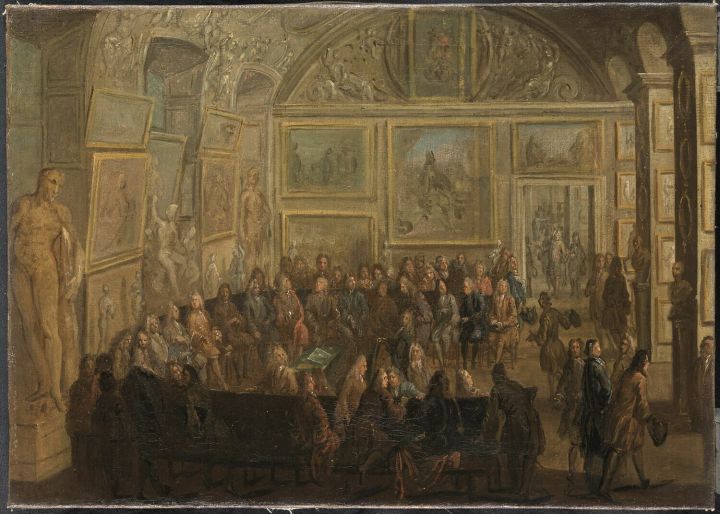
Jean-Baptiste Martin, View of the Salon of Diana at the Louvre, a Gathering of the Académie Royale de Peinture et de Sculpture (Séance de l’Académie royale de peinture et de sculpture au Louvre), ca. 1712–21, oil on canvas, 30 × 42 cm (Paris: Musée du Louvre, RF 1998-36).
◊ ◊ ◊ ◊ ◊
From ArtHist.net:
The Académie Royale Art Collection
Edited by Markus Castor, Sofya Dmitrieva, and Anne Klammt
Proposals due by 30 September 2022; selected contributions will be due 31 March 2023
Our book aspires to highlight the importance of the art collection that the Académie royale de peinture et de sculpture assembled in the century and a half of its existence (1648–1793) and show that this unique, yet almost entirely unstudied, body of works is essential to our understanding of eighteenth-century art and institutional practices.
The Académie royale art collection consisted mainly of reception pieces—the works that young artists submitted for examination by the academic jury to become full members of the institution. It also included miscellaneous donated artworks as well as portraits of the Académie’s patrons that the institution frequently commissioned from current members. Around 300 paintings and some 30 sculptures were on display in the Académie’s rooms at the Louvre and daily surrounded the artists who lived and worked there. The latter could also consult a rich collection of engravings at the Académie’s print room.
The collection was a unique corpus for multiple reasons. Firstly, as almost all the prominent old regime artists were members of the Académie royale, it united such iconic reception pieces as Watteau’s Pilgrimage to the Isle of Cythera (1717), Chardin’s Ray (1728), and Greuze’s Septimius Severus and Caracalla (1769). Secondly, these and other examinational works now offer invaluable insights into academic reception practices and aesthetic values as much as the commissioned portraits of the Académie’s patrons—into its behind-the-scenes personal networks. Finally, the hang of the works in the Louvre is an outstanding example of eighteenth-century curatorial work: since the collection’s arrangement was decided upon by academicians themselves, it stands an important ‘internal’ counterpart to the Académie’s public display, the Salons.
After the French Revolution, this one-of-a-kind body of works got dispersed and is shared today by the Louvre, the Versailles, the ENSBA, and several French regional museums. Thankfully, however, two detailed descriptions are still extant: in 1715, when the collection was housed on the Louvre’s ground floor, it was documented by Nicolas Guérin (Paris: J. Collombat), and in 1781, when it moved to the first floor, it was recorded by Antoine-Nicolas Dezallier d’Argenville (Paris: De Bure). In 1893, the two descriptions were republished as one volume by Anatole de Montaiglon. Two key critical works on the collection are the exhibition catalogue Les peintres du roi, 1648–1793 (Paris: Réunion des musées nationaux, 2000) and Hannah Williams’s monograph Académie Royale: A History in Portraits (Farnham: Ashgate, 2015).
The present book is part of the project run by the DFK Paris in collaboration with the Centre Dominique-Vivant Denon (Louvre) and the INHA that aspires to reconstruct the collection digitally and build a database of the works that constituted it.
We invite contributions that define the role of the Académie royale art collection and discuss its history and arrangement. Issues of our interest include but are not limited to:
• Collection arrangement: How did the hangs of the collection on the first and the ground floor of the Louvre differ? What were the guiding principles of the collection’s arrangement? What role did genre play in it? What was the function of different rooms and how did the works adorning the room reflect it? Did the arrangement reflect the Académie’s institutional hierarchy? How did prints, sculptures, and paintings that formed the collection work together?
• Instructive function of the collection: How did these sculptures, paintings, and prints, seen by the Académie’s students on day-to-day basis, influence their work? What message (if any) did they convey?
• Reception pieces: What role did the reception play in the artist’s career? What was the canon of academic reception pieces? How did it help crystallise the academic genre classification?
• Commissioned portraits: Who were the Académie’s patrons whose portraits the institution commissioned from its members? What role did these patrons play in the history of the Académie royale? How were they related to each other and what was their specific interest in sponsoring the institution?
• Conférences de l’Académie royale: How do the lectures that the members regularly delivered at the Académie royale relate to the collection? How do both reflect the Académie’s institutional and aesthetic values? What is the significance of the Salle d’Assemblée as the centre of the institutional life of the Académie royale?
• Dispersal of the collection: How were the works constituting the collection distributed after the French Revolution? What were the unique stories of these paintings, prints, and sculptures post-1793?
Contributions are welcome in English or French and are expected to be between 5,000 and 15,000 words in length. If you are interested, please send a short 300-word abstract and a brief 50-word biography to Sofya Dmitrieva sofya.k.dmitrieva@gmail.com by 30 September 2022. The deadline for selected contributions will be 31 March 2023.
◊ ◊ ◊ ◊ ◊
Note (added 12 August 2022) — The posting has been updated to include the editors and the painting by Jean-Baptiste Martin (from the PDF file of the Call for Essays)
Call for Papers | Boiseries: Decoration and Migration

From the Call for Papers:
Boiseries: Decoration and Migration from the Eighteenth Century to the Present
Camden Place, Chislehurst (Kent), 12–13 January 2023
Organized by Lindsay Macnaughton and Laura Jenkins
Proposals due by 9 September 2022
This conference investigates the cultural and commercial migrations of French eighteenth-century boiseries from their places of production in Paris and the Bâtiments du Roi to the drawing rooms of Britain and the United States.
From an historical perspective boiseries have always, in a sense, been mobile. In the eighteenth century, Paris joiners and carvers travelled to locations outside the city to install panelling, and entire decorative schemes were sent abroad to Germany, Spain, and Latin America. Accompanied by mirrors and tapestries from royal manufactories, these panels disseminated French style in accordance with the diplomacy of the monarch and the desires of foreign courts. Boiseries executed for particular sites but not installed were also sometimes reused elsewhere: failed deliveries and changes in taste during the period from commission to installation occasioned opportunities for buyers, and sets of panelling conceived as complete ensembles were broken up and dispersed for use in multiple locations, or disused altogether. Shifting fashions and continual reallocations of appartements at Versailles set into motion near-ceaseless rotations of décors, including boiseries. And, notwithstanding the legal categorisations of panels, once fixed, as immeubles, removals were negotiated by tenants during their lease of, and on their departure from, urban hôtels.
In the nineteenth century, the pace and directionality of movement changed, as elements of interior decoration began to be acquired for their own merit and eighteenth-century boiseries became the relics of a physically and culturally disappearing French national history as well as the trophies of an international collecting elite. Elements of woodwork, disassembled from demolished châteaux or reproduced in survey drawings and plaster casts, made their way into rooms in Britain and the United States, their proportions and ornament amplified and metamorphosed—to borrow terms used by John Harris and Bruno Pons—to match the pitch of the French Second Empire and later living.
Professional interior decorators and commercial dealers in decorative arts were largely to credit, providing channels by which goods could easily be transported from place to place. However, boiseries also emigrated, as it were, with exiles of the Republic, extending the presence of French style to less-cosmopolitan regions and adding geopolitical to social and architectural concerns.
Camden Place, where the conference will be held, is an English country house whose history and interiors have been shaped by the migration of people and decoration for over 300 years. Home to Chislehurst Golf Club, the Grade II* listed building features architectural elements by the British architects George Dance the Younger (1741–1825) and James ‘Athenian’ Stuart (1713–1788), and played host to the French Imperial court after the fall of the Empire in 1870. French chimney pieces, boiseries from the eighteenth-century Château de Bercy (demolished in 1862), and heavily carved oak panelling are among the elements that make up the house’s many layers, testifying both to the eclectic tastes of its nineteenth-century occupants and to the multifaceted, and multinational, histories of many English country houses.
This conference provides a unique opportunity for cultural historians of France, art and architectural historians, historians of collecting, curators, and heritage professionals to meet in a room reassembled following the landmark Château de Bercy sale (1860) and to meditate on the finer points of its significance in the dispersal of French cultural patrimony.
The organisers invite abstracts for 20-minute papers on topics engaging with, but not limited to:
• The relative mobility (meubles/immeubles) of boiseries in the 18th century
• Collecting, architectural salvage, and markets for boiseries in the 19th and 20th centuries
• Exchanges of taste and culture as a result of political displacement, in particular the influence of French émigrés
• Memory and the material traces of Empire
• Documentary and curatorial challenges posed by collections of boiseries
• The management of architectural heritage in private and commercial spaces today
Confirmed speakers include Dr Lee Prosser (Historic Royal Palaces), Frédéric Dassas (Musée du Louvre), Dr Ulrich Leben (German Ambassador’s residence, Paris), Dr Mathieu Deldicque (Musée Condé, Château de Chantilly), and Dr Tom Stammers (University of Durham).
Some funds will be available to support travel and accommodation for speakers. The conference is generously supported by the University of Buckingham, The Chislehurst Society, and Chislehurst Golf Club as part of a programme of events marking the 150th anniversary of the death of Napoleon III at Camden Place.
Submissions for 20-minute papers (300 words) should be sent to lindsay.macnaughton@buckingham.ac.uk and laura.jenkins@courtauld.ac.uk by Friday, 2 September 2022. We look forward to receiving your abstracts.
For more information, please visit: boiseriescamdenplace.wordpress.com (coming soon).
With thanks from the organisers: Dr Lindsay Macnaughton (University of Buckingham) and Laura C. Jenkins (The Courtauld Institute of Art).
◊ ◊ ◊ ◊ ◊
Note (added 31 August 2022) — The posting was updated with the new due date, extended from the original deadline of 2 September 2022.
Call for Papers | Design, Description, and Discovery in Cataloging
From ArtHist.net:
Terms of Art: Design, Description, and Discovery in Cataloging
Online, The Hood Museum of Art and Dartmouth Research Computing, Hanover, NH, 22–24 February 2023
Proposals due by 31 August 2022
An unusually tagged bronze statue, found in museum storage, “Brought in By Campus Police Oct. 1966” (Photo courtesy Beth Mattison).
Institutions such as museums, libraries, and archives have a mission to preserve, interpret, and disseminate cultural heritage. In addition to new acquisitions for their collections, these institutions must also update the tools with which researchers access and study these holdings, objects, and works of art. Increasingly, stakeholders like academics, educators, and the public treat a collection’s digital representation—its metadata records—as an entry point for discovery. Paradoxically, these web-based experiences meant to expose collections to broad audiences often assume users have specialized knowledge of the terms and processes GLAM (Galleries, Libraries, and Art Museums) institutions use to describe their own work, making them inaccessible to the majority of visitors. Additionally, variation and evolution of language often outpaces or does not align with public understanding. For example, someone interested in 17th-century Dutch art might not know that the phrase “Dutch Golden Age” has colonialist implications and has been removed from many museums’ internal databases. The search language isn’t wrong, it’s just outmoded.
The Hood Museum of Art and Dartmouth Research Computing are organizing a virtual symposium to bring together museums, libraries, and archives to discuss issues of access and ethical vocabularies in cultural heritage. The aim of the virtual conference is to develop the debate about how the language we use to describe collections impacts the communities that create and seek out art. The organizers hope to prompt dialogue on the issues curators and researchers face in trying to maintain equitable and anti-racist progress and research. Additionally, this symposium will emphasize the role of technologists who specialize in user-centered design as critical to promoting equity in information systems. In combining subject-matter specialists and user-centered design technologists, we aim to bridge the communication gap between institutions and the publics they serve, allowing each to educate the other about how they describe collections.
This virtual conference will feature panels, workshops, and roundtables from different institutions around the world. Speakers will be compensated at the rate of $250 per person.
Types of Panels
• Papers, posters, or case studies: 20-minute presentation with 10-minute Q&A
• Roundtables or panel discussions: 45- or 50-minute presentation with 10-minute Q&A
• Extended discussions and workshops: 90-minute participatory session with a 5- or 10-minute break for ideation, brainstorming, cross-pollination
• Other: a session you would like to submit that doesn’t fit the above criteria (prototyping, hackathon/datathon)
Organizers
• Meredith Steinfels, Assistant Director, Digital Platforms, Media, and Archives
• John Bell, Program Director, Data Experiences and Visualizations Studio
• Ashley Offill, Associate Curator of Collections
• Elizabeth Rice Mattison, Andrew W. Mellon Associate Curator of Academic Programming
Application requirements and submission details are available here»
Deadlines
Session submission: 31 August 2022
Approval and feedback: 3–7 October 2022
This conference is made possible by the generous support of the Leslie Center for the Humanities.
Call for Papers | 2023 Wallace Seminars in the History of Collecting
From the Call for Papers:
Seminars in the History of Collecting, 2023
The Wallace Collection, London, last Monday of the Month
Proposals due by 30 September 2022
The seminar series was established as part of the Wallace Collection’s commitment to the research and study of the history of collections and collecting, especially in the eighteenth and nineteenth centuries in Paris and London. We are keen to encourage contributions covering all aspects of the history of collecting, including:
• Formation and dispersal of collections
• Dealers, auctioneers, and the art market
• Collectors
• Museums
• Inventory work
• Research resources
The seminars, which are normally held on the last Monday of every month during the calendar year, excluding August and December, act as a forum for the presentation and discussion of new research into the history of collecting. Seminars are open to curators, academics, historians, archivists, and all those with an interest in the subject. Papers should generally be about 45–60 minutes long. Seminars take place between 5.30 and 7pm. The seminars will take place at the Wallace Collection in 2023.
If interested, please send a short text (500–750 words), a brief CV, and indicate any months when you would not be available to speak, by Friday 30 September 2022. For more information and to submit a proposal, please contact:
collection@wallacecollection.org.
Please note that we are able to contribute up to the following sums towards speakers’ travelling expenses to present their papers at the Wallace Collection on submission of receipts:
• Speakers within the UK – £100
• Speakers from Continental Europe – £180
• Speakers from outside Europe – £300
Call for Papers | Wastework
From ArtHist.net:
Wastework
Bibliotheca Hertziana – Max Planck Institute for Art History, Rome, 15–17 March 2023
Proposals due by 15 September 2022
Art students today know the rules: no solvents in the trash, no clay down the drain, and don’t forget to cure that resin before you toss it! Early modern craftsmen had their own rituals of disposal, too—albeit ones driven more by economies of thrift than by environmental regulation or fire safety. This international, interdisciplinary conference invites papers on the materiality, spatiality, and processing of waste in the early modern workshop, broadly conceived. It proposes to examine acts of disposal, displacement, removal, and abeyance—in short, the getting rid of unwanted things—and the consequences these carry for the study of early modern material culture.
Marble dust, scrap metal, broken glass, dried oil… How did the apparent formlessness of this discarded matter—the residues, the shavings, the piles—generate new ideas for forms or find new life through changes in state engendered by slaking, burning, distilling or casting? Who were the actors trading in workshop waste, and how can we map their networks, both local and global? How were materials stored and recycled between artistic acts? What disposal flows led household waste—egg shells, stale bread, stove ash—to enter the space of the studio as artistic material or cleaning product? How did the presence, accumulation and containment of waste—its conduits and repositories—condition the environment and location of the workshop? In research today, how can waste pits be used as sources for both the footprints and layouts of workshops and for the information they provide on technological and stylistic change? More broadly, how is waste archived, and are all archives just waste heaps of history?
We welcome papers that respond to these questions with historical case studies, wider-reaching theorisations, or methodological reflections. While our focus is on practices and spaces of art-making, we also seek contributions from beyond the history of art. Building on the home-economics framework of Simon Werrett’s Thrifty Science (2019); the emerging field of Discard Studies; and histories of pre-industrial recycling by Reinhold Reith and of medieval waste by Susan S. Morrison, this conference will serve as a forum for generating new narratives of waste, thrift, and re-use in the early modern arts that go beyond the well-researched category of spoliation. We foreground waste as the material expression of practices of ordering and classification by which people adjudicated between collection and disposal, wanted and unwanted, salvation and loss. In reimagining the discarded past we intend to test the usefulness of contemporary formulations—secondary product cycles, material fatigue, metabolic flows, sustainability, recycling—while also proposing new typologies and categories. A series of pre-conference visits to local workshops and heritage collections will launch the event. Travel and accommodation costs will be covered for speakers.
This conference is organized by Dr. Ruth Ezra and Dr. Francesca Borgo within the framework of the Lise Meitner Research Group Decay, Loss, and Conservation in Art History at the Bibliotheca Hertziana – Max Planck Institute for Art History. For more information see our webpage. Please send your CV (including current position and affiliation), a 250-word abstract, and paper title to john.rattray@biblhertz.it by 15 September 2022. Proposals will be considered for inclusion in a planned special journal issue on waste in the early modern workshop.










leave a comment