Call for Papers | Bodily Autonomies, Autonomous Bodies
From the Call for Papers, from IU Bloomington’s Center for Eighteenth-Century Studies:
Bodily Autonomies, Autonomous Bodies
Indiana Center for Eighteenth-Century Studies, Bloomington, 18–20 May 2023
Proposals due by 20 January 2023; accepted papers due mid-April 2023
The Indiana Center for Eighteenth-Century Studies announces its twenty-first annual Bloomington Workshop: Bodily Autonomies, Autonomous Bodies. The idea of ‘autonomy’ arises in the early modern period in relation to political entities, rather than individuals. A borrowing from the Greek (αὐτο + νόμος) meaning self law, autonomy referred to ability of an institution or a state to govern itself. In the eighteenth century, that scope began to apply increasingly to the capacities of individuals. Indeed, one strong tradition in eighteenth-century studies identifies our period with the invention of the author and the origins of the modern, autonomous individual. Looking back to the early modern, eighteenth-century conceptions of autonomy draw from the foundations that would lead to the birth of the nation state, and from contrasting models of internal and external virtue. From out of the eighteenth-century, the application of the term will spread from Montesquieu’s political philosophy, to Kant’s moral philosophy, and extend across the natural and social sciences. And yet the questions of autonomy—of self governance of a human or a political body—do not move in straight lines or toward easy answers.
Self-governance is often a sweet lie that hides the abuse of power, from the personal level to the geopolitical. Foucault has taught us that the individual operates within a network of power systems—religious, gendered, political, racial, geographic, and colonial, among others—that can influence, abridge, inhibit, or reinforce their ability to exercise agency or will over their life and body. More recently, methodological approaches such as New Materialisms, object-oriented ontologies, and alternative ontological frameworks such as those drawn from Black and indigenous studies often serve to unsettle the concept of autonomy, probing the spaces between the ephemeral capacity to self-govern, the material acts of self-determination, and the very notion of a ‘self’ who can be governed and determined at all. Therefore, with this Workshop theme, we hope to explore the limits of self-governance within the network of power structures that make up the world, to recognize the ways that autonomies exist against the grain of social discourse, and to acknowledge long-running ramifications—both positive and negative—of the aspirational quality of this ideal. At the same time, we look to question whether this idealization has contributed to dogmas of personal responsibility and economic self-interest at the expense of collective forms of action and care.
Within the sphere of the eighteenth century, we invite papers about autonomy as it applies to individuals across the spectrums of power and privilege; of groups whose identity or enforced social status inhibits or countermands their capacity to exercise agency; of national or political entities whose formation, liberation, and sovereignty are impacted by colonial pressures, and work that questions and probes autonomy’s drawbacks and boundaries as they figure in eighteenth-century histories, archives, and texts.
We look forward to reading your abstracts and ideas. A non-exhaustive list of topics they might address would include:
• negotiating questions of self and autonomy for enslaved persons
• the autonomy of gendered bodies
• autonomy within or of a colonized state
• freedom of movement: border-crossings, gatherings, quarantines, departures
• approaches that complicate or question ideas of personal or political sovereignty
• scientism and visions of the body as machine
• the individual figured against a backdrop of control or systems of power
• disenfranchisement: debt, citizenship, exile, etc.
In last year’s Workshop, which focused on Collaborations, questions arose about the limits of what can be considered labor performed together (col + labōrāre) in the context of radically inequal power relationships or within systems of sanctioned oppression. This year we hope to continue these conversations, which hold the echoes of the Center’s first workshop, Signs of the Self, and resound into a present where the concept of the autonomous individual is being questioned for political gain.
During the Workshop, we will discuss pre-circulated texts (due in mid-April) and perhaps have an occasional lecture or library, museum, or archive visit. Given the theme, we are especially open to co- and multi-authored contributions, including those that work across hitherto conventional boundaries of genre, discipline, and media. We intend and hope that the workshop will largely take place in person (and that participants will be present for the entire event), but anticipate making provision for some online participation as well.
The application deadline is Friday, 20 January 2023. Please send a paper proposal (1–2 pages) and current brief CV (3 pages, max) to Dr. Barbara Truesdell, Administrator, Center for Eighteenth-Century Studies. Please email to voltaire@indiana.edu. We will acknowledge all submissions within a fortnight: if you do not receive an acknowledgment by 31 January 2022, please email voltaire@indiana.edu or the Center’s Director, Jesse Molesworth (jmoleswo@indiana.edu).
Papers will be selected by an interdisciplinary committee. We cover most expenses for visiting scholars chosen to present their work: accommodations, travel (up to a certain limit), and most meals. Expanded abstracts and/or entire papers may be published in the Center’s The Workshop, along with discussion transcripts or summaries.
Call for Papers | Unpacking the V&A Wedgwood Collection

The V&A Wedgwood Collection in Barlaston, Stoke-on-Trent, Staffordshire.
◊ ◊ ◊ ◊ ◊
From the Call for Papers from the V&A:
Unpacking the V&A Wedgwood Collection
Barlaston (Stoke-on-Trent) and London, 7–8 July 2023
Proposals due by 15 February 2023
The V&A Wedgwood Collection is one of the most important industrial collections in the world and a unique record of over 260 years of British ceramic production. Owned by the V&A following a successful fundraising campaign spearheaded by Art Fund in 2014, it is on display at Barlaston, Stoke-on-Trent, where an imaginative public programme celebrates the diversity, creativity and depth of the collection. The conference is organised in honour of Gaye Blake-Roberts MBE, former curator of the then Wedgwood Museum. After forty years of research and achievements, she retired from her position in early 2020, continuing her research as Honorary Senior Research Fellow at the V&A Research Institute.
Wedgwood was founded in 1759 by British potter and entrepreneur Josiah Wedgwood, who helped transform English pottery from a cottage craft into an art form and international industry. A museum has existed since 1906, first at the Etruria site and then from 1952 at Barlaston and a newly designed museum opened in 2008, winning the prestigious Art Fund Museum of the Year prize in 2009. It houses the finest collection of Wedgwood material, showcasing innovations in taste and fashion over three centuries and the UNESCO recognised Wedgwood Archives.
We are pleased to invite submissions from established scholars as well as emerging voices, and look forward to exploring new dialogues and disciplines which broaden our understanding of Wedgwood. Contributions are invited for four research themes:

Isaac Cook, curator of the first Wedgwood Museum at the Etruria factory, sorting trays of Josiah Wedgwood’s trials © Fiskars.
1 Beyond Josiah Wedgwood: Re-examining the Narrative
2 Global Wedgwood
3 Creativity, Technology, Economics, and Labour
4 Impressions of the Past: Contemporary Ceramic Making
Topics may include, but are not limited to:
• Transatlantic and continental trade
• Creativity, design, and artists
• Race
• Economics and labour
• Disability
• Workshop traditions
• Female contributions to the development and history of Wedgwood and ceramics
• Production and consumption of ceramics
• Empire and colonialism
• Technology
• Class
• Displaying and collecting of ceramics
• Social histories of ceramics
• Factory architecture and employee welfare
Please submit a 400-word abstract outlining a 20- to 30-minute presentation along with a short biography or curriculum vitae by 15 February 2023 to r.klarner@vam.ac.uk. These will be reviewed by the organising committee. Selected participants will be notified by 15 March 2023.
◊ ◊ ◊ ◊ ◊
Note (added 20 January 2023) — As initially announced here at Enfilade in November, the conference date was scheduled for 30 June — 1 July 2023; the posting has been updated with the new dates of 7–8 July.
Call for Papers | The Mutability of Collections
From ArtHist.net and the Seminar on Collecting and Display:
The Mutability of Collections: Transformation, Contextualisation, and Re-Interpretation
Seminar on Collecting and Display
Institute of Historical Research, University of London, 7–8 July 2023
Proposals due by 30 November 2022
We invite proposals for papers reflecting on the ways in which the contents of collections are not permanent but may be subject to numerous mutations. Objects in collections are added, exchanged or disposed of, translated and transformed. Items can be moved to new surroundings and different decorative settings, resulting in altered contexts of display, meaning, and significance. The history of collections is more than a history of objects brought together by acquisitive owners; it is also a history whereby collectors and owners may re-interpret an inherited or purchased collection and re-arrange and complete it in accordance to their taste.
As is well known, the Medici amassed a collection that grew, was looted, regained, distributed over palaces and villas, and finally bequeathed to Tuscany as part of Anna Maria Louisa’s family pact in 1737. Obviously, the Medici’s treasures were not the only collection with a fragmented biography and that of Rudolf II would provide another famous example.In the nineteenth century, William Beckford added new layers of interpretation as he amassed his collections from a variety of different sources. Further translations and reinterpretations ensued when the first collection was dispersed and Beckford created a new collecting environment in Bath.
This session aims to explore the various issues underlying the mutability of collections, including
• the ways in which intentionality, taste, and the periodically fluctuating finances of collectors influenced the composition and display of a collection, sometimes more than once within a collection’s biography
• the ways in which fashion may have directed a collector towards particular groups of objects, as well as their alteration according to the taste of the time
• the ways in which collections may be reinterpreted and take on new meanings according to the spaces in which they were displayed
• the different associations and meanings given to individual objects through their changing representations, displays, or associations
We invite paper proposals of no more than 250 words, investigating the mutability of early-modern collections during their creation, transfer to new locations, transformation, or re-interpretation. Please send your proposals, along with a short bio (no more than 200 words) to collecting_display@hotmail.com by 30 November 2022.
Call for Articles | Race and Architecture in the Iberian World
From ArtHist.net:
Race and Architecture in the Iberian World, ca. 1500–1800s
Special Issue of Arts (2023), guest edited by Cody Barteet and Luis Gordo Peláez
Proposals due by 15 December 2022; finished articles due by 1 June 2023
In the field of art history, previous scholarship has addressed (and continues to address) the contribution of Indigenous, Black, Asian, and mixed-raced artists to the early modern visual culture in the Atlantic world. Frequently scholars are interested in documenting race and its enduring legacy through a variety of cultural artifacts such as paintings, sculptures, manuscripts, featherworks, metalwork, etc. However, much less attention has been given to architectural history, and particularly that of the early modern Iberian world.
Recently, Irene Cheng, Charles L. Davis II, and Mabel O. Wilson edited a ground-breaking volume titled Race and Modern Architecture (2020). Their publication provides an important collection of essays that discuss how the discipline of architectural history has been shaped by racial thought. Likewise, the Journal of the Society of Architectural Historians dedicated a short roundtable-style conversation on the subject of race and architecture in the 1400s through the 1800s (Carey, Dudley, Escobar, et. al. 2021). Each short paper considers the role of race in architecture and implores other scholars to investigate this understudied topic. This special issue of Arts is a response to this scholarly call to engagement. Specifically, we will explore the intersection of race, labor, and architectural history and their interconnectivity with the architecture and its accompanying artistic forms in the early modern Iberian world. We do so through considering how race and architecture are activated through construction projects, the building trades, the history of labor, and in plans, pictorial, and print representations, etc., in the vast territories (European, American, African, Asian) that comprised the Spanish and Portuguese empires.
We invite contributors to submit their research in English for consideration. Please note that there is a two-stage submission procedure. We will first collect a title and short abstract (maximum 250 words), five keywords, and a short bio (150 words), by 15 December 2022, via email to Dr. Cody Barteet (cbarteet@uwo.ca) and Dr. Luis Gordo Peláez (luisgordopelaez@csufresno.edu) or Dora Wang from Arts Editorial Office (dora.wang@mdpi.com). Selected abstracts will be invited to submit papers of 7000–9000 words for peer review by 1 June 2023. Journal publication is expected to occur from late spring through fall 2023, depending on the revision time needed after peer review. Each article will be published open access, on a rolling basis after successfully passing peer review.
Guest Editors
Cody Barteet, cbarteet@uwo.ca
Luis Gordo Peláez, luisgordopelaez@csufresno.edu
Special Issue Editor
Dora Wang, dora.wang@mdpi.com
Call for Papers | Unlocking the Fagel Collection
From Trinity College Dublin:
Unlocking the Fagel Collection: The Library and its Context
Trinity College Dublin, 22–23 June 2023
Proposals due by 15 December 2022
The Fagel Collection is one of the most important and largest Dutch private libraries of the eighteenth century still surviving today. It was assembled as a working library by several generations of the Fagel family, of whom successive members held high offices in the Dutch Republic throughout the seventeenth and eighteenth centuries. The collection of books, pamphlets, and maps was purchased as a whole for Trinity College Dublin in 1802.
This symposium represents the culmination of the Unlocking the Fagel Collection project (2020–2023), a collaboration between the Library of Trinity College Dublin and the KB National Library of the Netherlands, funded by the Dutch Ministry of Foreign Affairs. We will mark the achievements of the project which has facilitated access to and raised awareness of this unique heritage library through cataloguing of the Dutch imprints in the Short-Title Catalogue Netherlands (STCN). This moment also signals the beginning of a second phase of work, dedicated to enhanced cataloguing of all non-Dutch materials and supporting new research into the collection, notably through extensive digitisation as part of the Virtual Trinity Library.
As such, the symposium represents an opportunity to take a fresh look at the historical context and significance of the collection, and to look forward to future exploration thereof, particularly, it is hoped, through new collaborations and digital integration with collections and projects internationally.
Topics may include
• The history and socio-cultural context of the Fagel library and the Fagel family, e.g. Den Haag book culture, print, and the Dutch States General
• Comparative perspectives with contemporary libraries, cultures of collecting, in the Dutch Republic and elsewhere, e.g. patrician libraries, political libraries, expatriated libraries
• Fagel holdings in relation to overall STCN data and other recorded collections
• Exploration of the collection’s holdings: books, pamphlets, maps, engravings, manuscripts, items no longer in the collection
• Links with complementary collections: the Fagel archives, the (dispersed) art, coin, and plant collections, etc.
• The role and use of the Fagel Collection, then and now, e.g. information politics
• The collection’s organisation and history, in the Netherlands and at Trinity College Dublin
• Materiality of the collection, of individual items, and questions of preservation
• Perspectives on future development and use of the collection, e.g. in digital form
The organisers welcome proposals for papers (c. 250 words) on these and related topics. Proposals should be sent, together with a short bio-bibliographical statement including indication of institutional affiliation, by 15 December 2022. Email to Library.Events@tcd.ie with the subject heading ‘Fagel Symposium’.
Participation and attendance, including meals and refreshments, is free of charge. Travel costs and accommodation are not covered. For further information, please contact Ann-Marie Hansen, project manager of Unlocking the Fagel Collection, at the Library of Trinity College Dublin, anhansen@tcd.ie.
Call for Articles | Women as Builders, Designers, and Critics
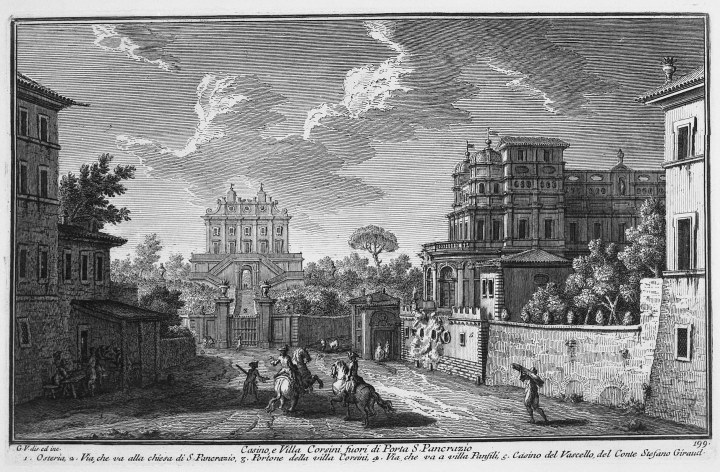
Villa Benedetta, designed by Plautilla Bricci (and completed in 1665) is the large residence to the right of the street in this engraving by Giuseppe Vasi, Casino e Villa Corsini fuori di Porta S. Pancrazio, Plate 199, 1761.
◊ ◊ ◊ ◊ ◊
From the Call for Proposals:
Women as Builders, Designers, and Critics of the Built Environment, 1200–1800
Volume edited by Shelley E. Roff
Proposals due by 1 December 2022; final chapter submissions due by 15 January 2024
Routledge Publishing invites book chapter proposals for a peer-reviewed edited volume that will re-write the history of architecture, urban space, and landscape before the modern age from an alternative, feminist point of view. Women as Builders, Designers and Critics will recover women’s agency within the built environment in the urban and rural setting from the perspective of distinct and often overlapping roles women have played as:
• Builders — manual labourers on constructions sites and in the building trades, building material suppliers, and managers of construction projects
• Designers — amateur designers of architecture, interiors and gardens, artists influencing design through their architectural imagery, patrons directly engaged with design
• Critics — writers, mentors, tutors, and patrons influencing the form of the built environment
Chapter authors should situate the women studied within the context of their social class, time period, and region. Within this context, authors may, if appropriate, choose to theorize about where these women fit within or challenge the canon of architectural history. The geographic scope is open and projects from earlier periods and addressing alternative roles are welcome.
Please send a 500-word abstract and a one-page CV to Shelley E. Roff at shelley.roff@utsa.edu by 1 December 2022. Notification of acceptance of abstracts will be sent by 10 December 2022. If your proposal is accepted, the deadline for a full chapter submission will be 15 January 2024. Chapters should be 5,000–8,000 words in length and must be published in English.
Call for Papers | Women in Art and Music, ca. 1500–1800
From ArtHist.net:
Women in Art and Music, ca. 1500–1800
The Juilliard School, New York, and the National Gallery of Art, Washington DC, 18 and 20 October 2023
Proposals due by 9 December 2022
The Juilliard School in New York, and the Center for Advanced Study in the Visual Arts at the National Gallery of Art in Washington, DC are excited to announce a co-hosted global interdisciplinary symposium on women in art and music in the early modern period (ca. 1500–1800). Our goal is to think broadly about women as creators, as part of the cultural and global economy, and as experts in their chosen field of art. We suggest that visual art and musical performance were so tightly enmeshed at this time as to form their own language, particularly in women-centered spaces. We, therefore, seek a new way of addressing this shared space—not necessarily as an interdisciplinary zone where art and music always converge—but one in which modes of creation are shared in codependent and overlapping ways in the early modern period.

Lavinia Fontana, Portrait of Lucia Bonasoni Garzoni, ca. 1590, oil on canvas, 45 × 34 inches (Washington, DC: National Gallery of Art).
The National Gallery of Art’s recent acquisition of the Bolognese painter Lavinia Fontana’s portrait of 16th-century Bolognese singer and lute player Lucia Bonasoni Garzoni (b. 1561)—the first painting by an early modern Italian woman artist to enter the museum’s collection—is the impetus for this interdisciplinary conference. A prolific artist, Fontana depicts Garzoni in an exquisite and highly detailed portrait alongside her lute, displayed on the table next to a score which accurately represents music for a lute with soprano voice. We might imagine these notes emanating from her instrument in concert with her dulcet voice, garnering her the praise she received from her literary contemporaries and poets, as one asserted, “And the host of the Graces, and the whole array of Virtues, testify to this in singing her glories and honors.”
On 23 April 1595, Lavinia Fontana’s eleventh and last-born child was baptized in Bologna, and documents show that none other than Lucia Bonasoni Garzoni served as the child’s godmother, linking the two women together personally, in addition to professionally. This picture tells the story of two women, one a painter and the other a musician, who were able to overcome obstacles in a patriarchal society to succeed in the artistic spheres of painting and music. This early modern synergy between a painter and a singer will be the springboard for exploring how women succeeded as artists and musicians in the early modern period on a global stage, whether independently or collaboratively.
Early modern scholarship has recently suggested that identity is a process, a fluid phenomenon rather than fixed formation, in which the interaction between groups (be they national, religious, social, gendered, or racial) is the crucial point of study. What happens when we apply this idea to the realm of artistic identity? Some questions to consider: How does reading art and music as coexistent entities enhance our understanding of women in the early modern era? When women depicted or included other women in their art what were the societal ramifications? How did art and music-making offer women pathways for social advancement or even independence in the early modern period? How did issues of social class and race, in addition to gender, play into possible advances for women on the global stage in art and music?
The symposium will take place at The Juilliard School, New York, NY on Wednesday, 18 October 2023 and at the Center for Advanced Study in the Visual Arts, National Gallery of Art, Washington, DC on Friday, 20 October 2023.
We hope that the comingling of a museum and a conservatory will help to answer some of these questions in a lively and engaging symposium. Live music will be provided alongside papers at both institutions by the ensemble Sonnambula and musicians from Juilliard’s Historical Performance program, to reveal how crucial musical performance is to the study of music and the sister arts in the early modern period. Musicians will be on-hand to play any music discussed in papers as needed; public performances will also occur on both days of the symposium.
We invite paper submissions from scholars across the humanities that engage with early modern women as artists and/or musicians from the disciplines of history, music history, historical performance, and art history, in addition to other relevant disciplines. Papers are encouraged that consider cross-cultural connections in how they address issues of artmaking and performance, in both secular and religious contexts in Africa, the Americas, Asia, Europe, and beyond. Proposals that include music or performance as part of the talk are welcome. A selection of papers will be published following the conference in an edited volume published by the Center and distributed by Yale University Press.
To submit a proposal, please send the following by email to the co-organizers of the conference by Friday, 9 December 2022:
• Paper title (15-word maximum)
• Paper abstract (250-word maximum)
• CV/resume with your full name, affiliation, title (or ‘Independent Scholar’), and email address
Dr. Eve Straussman-Pflanzer, Curator and Head of Italian and Spanish Paintings, National Gallery of Art
e-straussman-pflanzer@nga.gov
Dr. Elizabeth Weinfield, Professor of Music History, The Juilliard School, Director, Sonnambula
eweinfield@juilliard.edu
Call for Papers | Seeing Anatomy between Literature and the Arts
From ArtHist.net:
Seeing Anatomy between Literature and the Arts:
Words, Images, and Spaces from the Early Modern Age to the Present
Vedere l’anatomia tra letteratura e arti: parole, immagini e spazi dalla prima età moderna
Mendrisio/Lugano, Switzerland, 15–16 May 2023
Proposals due by 21 November 2022
The workshop intends to put into practice the interdisciplinary dialogue at the basis of the project ‘The Civilisation of Anatomy’: The Genre of Literary Anatomies in Seventeenth-century Italy (FNS 100012_204399), directed by Linda Bisello, in partnership with Carla Mazzarelli with regard to the visual arts and architecture. The research focuses on the epistemological effects of Andrea Vesalius’s De humani corporis fabrica (1543) on the early modern culture, from the literary imagination to other forms of knowledge (art and architecture, but also philosophy, grammar, rhetoric, geography, astronomy, etc.). Anatomy, in fact, “revolutionizes the way of feeling forms . . . by making scientific truth a means of enhancing visual reality” (Parronchi 1975).
While the core of the reflection lies in the early modern age (15th–17th centuries), a space for interventions with a broader chronology is nevertheless envisaged, starting from the early modern age to the contemporary age. Within the framework of the methodological reflections and the interdisciplinary perspective, the Workshop aims in particular to discuss topics such as the persistence of the anatomical paradigm in architectural theory or, in other respects, whether even today anatomy can still define a peculiar critical approach to literary criticism, image, and project.
We invite contributions which might relate, but not be limited, to the following fields:
• Institutions and spaces of anatomy: its performance, exposition, and spectacularisation (universities, academies, healthcare sites, theatres, museums, physical and digital libraries)
• The forms of visual and textual narration of anatomy (artistic anatomy, moral anatomy, encyclopaedic anatomy, anatomy as organisation, and visualisation of knowledge)
• Anatomy between allegory, symbol, and emblems
• Anatomy through interdisciplinary dialogue: frequentations and epistolary correspondence between physicians, humanists, and artists
• The ‘fabric of the body’: dialogues and intersections between medicine, architecture, design culture, and anatomy
• Anatomy in perspective: its metamorphoses, migrations and transpositions in the contemporary age (with particular reference to the intersection of literary criticism and visual arts)
Preference will be given to applications from young scholars (PhD and post-Doc students) with an interdisciplinary background or with research projects that fall within the scope of the digital humanities (e.g. digitisation of corpora concerning anatomy). Abstracts (max 2000 characters including spaces), together with a brief biography (max 1500 characters including spaces), and at least three keyword should be submitted to: vederelanatomia2023@gmail.com. Abstracts are welcome in Italian, English, French, and Spanish. The deadline for abstracts submission is 21 November 2022; the scientific board will confirm the acceptance of abstracts by 20 December 2022. Further information is available here.
Call for Papers | Evoking the Incommensurable: Painting the Sublime
From ArtHist.net:
Evoking the Incommensurable — Painting the Sublime
Friedrich Schiller University, Jena, 26–28 July 2023
Organized by Johannes Grave, Sonja Scherbaum, and Arno Schubbach
Proposals due by 15 December 2022
In the 18th century, the concept of the sublime constitutes a genuine novelty and a driving force for advancements in philosophy, theoretical reflection on the arts, and painterly practice. From its beginnings, this novelty was not limited to one country alone, but covered the whole of Europe. A first step was Nicolas Boileau’s French translation of Pseudo-Longinus’ Traité sur le sublime in 1674. Further decisive steps were Edmund Burke’s A Philosophical Inquiry into the Origin of Our Ideas of the Sublime and Beautiful from 1757 and Immanuel Kant’s Critique of the Power of Judgment from 1790. Thus, a discourse concerning the sublime could develop that extended across European languages and traditions, a discourse which, at least at first glance, is characterized much more strongly by its diversity than by a common conceptual basis or homogeneous philosophical framework.
Moreover, the sublime was not merely the subject of philosophical discourse; it was also embraced by the theoretical reflection on the arts, such as literature and painting. In this context, the sublime constitutes a challenge not only due to the fact that Burke and Kant distinguished it sharply from the beautiful, i.e., the traditional organizing subject of treatises on painting and literature. The sublime also raises questions because, according to Burke and Kant, the sublime breaks with classical standards of pictorial or literary representation; its excessive strain on the senses, its incommensurability with any measure, and its irreducibility to any bounded shape serve as a harsh contrast to the beautiful and the aesthetic values associated therewith. The attempt to incorporate this concept into aesthetic reflection not only gave rise to tensions but also offered an opportunity to establish new approaches. It is therefore no coincidence that the concept of the sublime was readily taken up by treatises on landscape painting in order to foster this newly reappraised pictorial genre.
Finally, the sublime was also a challenge to artistic practice. Theoretical discourse concerning the sublime often referred much more directly to our experience of nature than to our experience of artistic works. Particularly in the case of Kant, it was not evident that the arts are at all able to evoke anything sublime. Furthermore, the specific characteristics of the sublime do not make it seem to be a suitable subject for painting. It was by no means evident that it would be possible to represent the boundless greatness of sublime nature within the limited frame of a picture. Nevertheless, various attempts to paint the sublime can be seen in the genre of landscape painting and its many European varieties. And there are good reasons to assume that such attempts can also be found in other genres, whether in figurative representations, in ruin paintings and architectural representations, or even in book illustrations. The sublime challenged artists to push the limits of painting and to explore its capabilities anew. To evoke the incommensurable and paint the sublime requires, we would suggest, purposefully exploring and exploiting these capabilities in relation to the reception of the painting and, above all, the limits of the viewer’s perceptual capacities.
The international conference Evoking the Incommensurable — Painting the Sublime thus discusses the conception of the sublime as an innovative force on a Europe-wide scale, both in respect to the formation of the aesthetic discourses pertaining to it and in reference to the practice of painting and its exploration of the capability of pictures to evoke the incommensurable in their reception. The conference will be held in English. Conference presentations should be 30 minutes long. We will reimburse travel and accommodation costs.
We warmly welcome papers from doctoral, postdoctoral, and senior scholars. Please submit your abstract (250 words) along with a short biography, in English, to paintingthesublime@uni-jena.de by 15 December 2022. Speakers will be notified by 31 January 2023.
Call for Papers | Art beyond Placeness

Attributed to François Bunel the Younger, The Confiscation of the Contents of an Art Dealer’s Gallery, 1590, oil on panel, 28 × 47 cm
(The Hague: Mauritshuis, 875)
◊ ◊ ◊ ◊ ◊
From ArtHist.net:
Art beyond Placeness: Narratives of Movement in the Early Modern Period
Norwegian Institute in Rome, 31 May — 1 June 2023
Proposals due by 1 November 2022
In recent years, the new importance attributed to the biographies of objects and their global circulation has drawn new attention to the phenomenon of their physical transportation—in other words, to the complex set and modes of actions required to move an object from the point of creation to its final destination. Inspired by the growing body of scholarship, this workshop aims to develop new instruments to perceive, measure, and interpret the movement of things, by looking specifically at the way physical transportation has been described, inspected, and dissected in early modern sources. The materials under scrutiny here may take different forms, from diaries, letters, and other prosopographical accounts recording movement in its making; to archival materials that track unusual patterns of transportation and physical delivery; to letters, treatises, and even guides or handbooks reporting ex post facto descriptions of mobility. This workshop intends to probe this vast collection of sources in order to tease out how mobility was described and conceptualized, surveyed, and explored in the long early modern period (approximately from 1350 to 1800), before the rise of modern logistics. In short, it addresses from all angles the narrative potential of mobility: how describing movement ‘makes a good story’.
Potential topics include, but are not limited to
• Episodes of transportation recorded in archival materials, with special regard to the logistical demands and expenses encountered by artists in moving objects from the artistic workshop to the final destination
• Diaries and letters of artists and patrons describing physical transportation of objects
• Written sources that emphasize the miraculous, divine components of transportation
• 18th-century popularization of movement in the so-called ‘circulation narrative’ or ‘IT narratives’, which tell the story of inanimate objects exchanged and moved from place to place
• Treatises and technical accounts describing the logistical operations of transportation
The workshop will take place on May 31st and June 1st 2023 at the Norwegian Institute in Rome. ECRs are especially invited to present their research for discussion. Please submit an abstract of no more than 300 words, along with your CV to mattia.biffis@roma.uio.no by 1 November 2022. Travel expenses and participation will be covered.










leave a comment