ASECS 2022, Baltimore

Baltimore’s Inner Harbor
(Photo by Patrick Gillespie, September 2016; Wikimedia Commons)
◊ ◊ ◊ ◊ ◊
From ASECS:
2022 American Society for Eighteenth-Century Studies Conference
Hilton Baltimore Inner Harbor, 31 March — 2 April 2022
The 52nd annual meeting of the American Society for Eighteenth-Century Studies takes place in Baltimore. HECAA will be represented by the Anne Schroder New Scholars’ Session, chaired by Aaron Wile and Dipti Khera and scheduled for Thursday afternoon. HECAA’s annual business meeting will take place online in advance of the conference on March 25. A selection of 30 additional panels is included below (of the 172 sessions scheduled, many others will, of course, interest HECAA members). For the full slate of offerings, see the program.
◊ ◊ ◊ ◊ ◊
T H U R S D A Y , 3 1 M A R C H 2 0 2 2
Time and Temporality
Thursday, 8:00–9:30am, Key 1
Chair: Craig HANSON, Calvin University
1. Helena YOO ROTH, CUNY, “The Many Deaths of George II and Colonial Time Consciousness”
2. Stuart SHERMAN, Fordham University, “‘Unknown to All the Rest’: the Play of Time in Restoration Prologues and Epilogues”
3. Alexander CREIGHTON, Harvard University, “Tristram Shandy’s Variations on Habit”
◊ ◊ ◊ ◊ ◊
How ‘Byzantine’ was the Eighteenth Century? New Insights on the Christian Orthodox Art and Architecture of the Late Ottoman Empire, Part I
Thursday, 8:00–9:30am, Paca
Chair: Demetra VOGIATZAKI, Harvard University and Nikolaos MAGOULIOTIS, ETH Zurich/gta
1. Alper METIN, Università Sapienza di Roma, “Reflections of the So-called Ottoman Baroque on the 18th-Century Orthodox Buildings: Towards the Emergence of a New Imperial Architectural Synthesis?”
2. Theocharis TSAMPOURAS, University of Western Macedonia / Greek Ministry of Culture (Ephorate of Antiquities of Kozani), “Artists and Patrons Changing the Norms of Post-Byzantine Painting in the Eighteenth-Century-Ottoman Balkans”
◊ ◊ ◊ ◊ ◊
Skin & Bone: Animal Substrates
Thursday, 8:00–9:30am, Pickersgill
Chair: Sarah GRANDIN, The Clark Art Institute
1. Katherine FEIN, Columbia University, “Cracks in the Ivory: The Violence of Portrait Miniatures”
2. Catherine GIRARD, St. Francis Xavier University, “Forms of Erasure: Theorizing Reuses of Indigenous Beaver-Pelt Coats in European Hats”
3. Marianne VOLLE, York University/Glendon College & Université Paris 1 Panthéon- Sorbonne, “Flora Meets Fauna: A Reflection on the Use of Vellum for Botanical Illustrations at the Jardin du Roi”
◊ ◊ ◊ ◊ ◊
How ‘Byzantine’ was the Eighteenth Century? New Insights on the Christian Orthodox Art and Architecture of the Late Ottoman Empire, Part II
Thursday, 9:45–11:15, Paca
Chair: Demetra VOGIATZAKI, Harvard University and and Nikolaos MAGOULIOTIS, ETH Zurich/gta
1. Alexandra COURCOULA, MIT, “Ottoman Ecclesiastical Objects in the Benaki Museum: Shaping Greek National Historiography and Perceptions of Ottoman Art”
2. Maria GEORGOPOULOU, Gennadius Library, American School of Classical Studies at Athens, “Center and Periphery in the Ottoman Balkans: The Cultural Heritage of Ottoman, Turkish, Post-Byzantine and Greek Monuments”
3. Cosmin MINEA, ETH Zurich, “Writings about Romanian Art in the Late 19th Century and the Rise of the Brâncovenesc Heritage as National Style”
◊ ◊ ◊ ◊ ◊
Materials of Global Trade: Networks, Mobility, and Transformation
Thursday, 9:45–11:15, Key 5
Chair: Jennifer GERMANN, Independent Scholar
1. Tara ZANARDI, Hunter College, CUNY, “Bittersweet Empire: Alcora, Natural History, and the Chocolate Service”
2. Emily Rose BEEBER, University of Delaware, “Rubens Peale with a Geranium: Botanical Science and Slavery in the Early Republic”
3. Christina LINDEMAN, University of South Alabama, “Vermilion and Cinnabar: Seeing Red in Eighteenth-Century Europe”
◊ ◊ ◊ ◊ ◊
Spreading the Image: Print Cultures
Thursday, 11:30–1:00, Key 10
Chair: Susanne ANDERSON-RIEDEL, University of New Mexico
1. Michael FEINBERG, University of Wisconsin, Madison, “Flaming Landscapes in Stedman’s Narrative of a five year expedition”
2. Arthur LEE, Johns Hopkins University, “Illustrating the Haitian Revolution: Marcus Rainsford and Atlantic Visual Politics”
3. Ruth DAWSON, University of Hawaiʻi at Mānoa, “Picturing an Upstart Tsarina for a Downmarket Audience: Early Prints of Catherine the Great”
◊ ◊ ◊ ◊ ◊
Objects and the Making of Enlightenment Selves
Thursday, 11:30–1:00, Paca
Chair: Mary PEACE, Sheffield Hallam University, and Joelle DEL ROSE, College for Creative Studies
1. Sara WHISNANT, East Tennessee University, “‘The Sense of Taste’: Agency and Identity in Eighteenth-Century Group Portraiture”
2. Katherine ISELIN, University of Missouri, “Women and Eighteenth-Century Antiquarianism”
3. Lauren KELLOGG DISALVO, Dixie State University, “Women and Eighteenth-Century Antiquarianism”
4. Mary CRONE-ROMANOVSKI, Florida Gulf Coast University, “The Circulation of Material Objects In and Across Novels by Women”
◊ ◊ ◊ ◊ ◊
Gale Digital Scholar Lab, Lunch and Learn
Thursday, 1:00–2:15, Tubman B
Gale invites ASECS members to a lunch conversation about Gale Digital Scholar Lab, a text and data mining and visualization tool built specifically for primary sources. Using the analysis tools in the Lab, researchers can explore topics and patterns across collections including ECCO. During the session, Gale will provide an overview of the tool and case studies of how it’s been used in teaching and research at institutions around the world. Register at: https://forms.gle/hTMhLKirWMXm4usTA
◊ ◊ ◊ ◊ ◊
Anne Schroder New Scholars Session (HECAA)
Thursday, 2:30–4:00, Key 12
Chair: Aaron WILE, National Gallery of Art, and Dipti KHERA, New York University
1. Zoë DOSTAL, Columbia University, “From Idle to Industrious: Picturing Women Beating Hemp in the Bridewell”
2. Anna FICEK, CUNY Graduate Center, “From Print to Parlor: Les Incas’ Long Shadow in Visual and Decorative Arts”
3. Jinyi LIU, New York University, “Seaborne Craftsmen and Their Elastic Workshop Knowledge: An Eighteenth-Century Fujianese-made Sculpture of Mourning Mary”
4. Ankita SRIVASTAVA, Jawaharlal Nehru University, “The Architect and the Marchese: Two Italians at the Court of Begum Samru of Sardhana, India”
◊ ◊ ◊ ◊ ◊
Seen Here Making a Masterpiece: Rendering Artists, Musicians, and Authors in Painting, Poetry, Sculpture, and Prose [South-Central Society for Eighteenth-Century Studies]
Thursday, 2:30–4:00, Douglass
Chair: TBD
1. Bradford MUDGE, University of Colorado, Denver, “Transmediation and Portraiture”
2. Kristin O’ROURKE, Dartmouth College, “Picturing Artists and Writers: Media Specificity, Genre and Cultural Mythmaking”
3. Kevin L. COPE, Louisiana State University, “My Easel Just Fell into an Abysm and I’m under a Tidal Wave: Picturing Earthquake Experiencers”
◊ ◊ ◊ ◊ ◊
Performing the Eighteenth Century Today
Thursday, 4:15–5:45, Key 2
Chair: Ellen WELCH, University of North Carolina at Chapel Hill
1. Olivia SABEE, Swarthmore College, “Eighteenth-Century Performance Theory and Twenty-First Century Performance: Diderot, Noverre, The Noble, and the Grotesque”
2. Amanda MOEHLENPAH, University of North Carolina at Chapel Hill, “Foreign and Familiar: Cultural Codes and Affective Performance in Eighteenth-Century Ballet”
3. Meredith MARTIN, New York University, “Reimagining the Ballet des Porcelaines: Commerce, Colonialism, and Chinoiserie”
◊ ◊ ◊ ◊ ◊
Reproduction and Futurity, Part I
Thursday, 4:15–5:45, Key 9
Chair: Jane WESSEL, U.S. Naval Academy
1. Kirsten MARTIN, Rutgers University, “‘A Kind of Magick’: Imitation and Futurity in Sir Joshua Reynolds’s Pedagogy”
2. Laura EARLS,University of Delaware, “‘They could hardly persuade themselves they were not human creatures’: Women Waxwork Sculptors and Reproduction in the British Atlantic World”
3. Chelsea PHILLIPS, Villanova University, “Conceiving Genius: Sarah Siddons and the Future of Tragedy”
◊ ◊ ◊ ◊ ◊
Members’ Reception
Thursday, 6:00–7:30, Eutaw Street (Weather Permitting)
◊ ◊ ◊ ◊ ◊
Eighteenth-Century Game Night
Thursday, 7:30–midnight, Key 12
An open house to explore games inspired by the eighteenth century. For more information or to sign up for games, see http://aub.ie/asecs22games. Game Night also will be held on Friday, April 1.
◊ ◊ ◊ ◊ ◊
F R I D A Y , 1 A P R I L 2 0 2 2
The Eighteenth-Century Last Will and Testament, Part I
Friday, 9:45–11:15, Douglass
Chair: Pamela PHILLIPS, University of Puerto Rico, Río Piedras
1. Yvonne FUENTES, University of West Georgia, “Spanish Testaments, Wills, and Inventories: Bridging Heaven and Earth”
2. Melanie HAYES, Trinity College Dublin, “Crafted Legacies: Artisans’ Wills in Early Georgian Britain”
3. Stephanie KOSCAK, Wake Forest University, “‘Tokens of My Love’: Money, Memory, and Mourning in Eighteenth-Century England”
4. Emily ENGEL, Independent Scholar, “Portraits and Luxury in Eighteenth-Century South America”
◊ ◊ ◊ ◊ ◊
Let’s Get Small: Micro-Art Histories, Part I
Friday, 9:45–11:15, Key 6
Chair: Melissa HYDE, University of Florida
1. Rori BLOOM, University of Florida, “Miniature Portraits as Erotic Currency in Casanova’s Histoire de ma vie”
2. Jeff RAVEL, MIT, “An Eye on Theatrical Disorder: France and England, ca. 1800”
3. Yasemin ALTUN, Duke University, “Original-itty in Translation: Sophie Chéron’s Creative Reproduction of Miniature Gems”
◊ ◊ ◊ ◊ ◊
Presidential Session | Venice: Real and Imagined
Friday, 11:30–1:00, Key 12
Chair: Irene ZANINI-CORDI, Florida State University
1. Rebecca SQUIRES, Katholieke Universiteit Leuven, “Vedute of Venice: The Visual Construction of the Picturesque”
2. John HUNT, Utah Valley University, “Imaginary Hells: Witches and Magic Wells in Early Modern Venice”
3. Susan DALTON, Université de Montréal, “Venice’s Amazon? Giustina Renier Michiel’s Strategic Accommodations of Occupying Forces”
The panel will begin with a performed reading: “Giustina Renier Michiel’s and Chateaubriand’s Views on Venice,” presented by Aleksondra HULTQUIST, Stockton University, and Sayre GREENFIELD, University of Pittsburgh at Greensburg. *This reading is supported by the Arts, Theater, and Music Fund*
◊ ◊ ◊ ◊ ◊
Curious Taste: The Transatlantic Appeal of Satire
Friday, 11:30–1:00, Paca
Chair: Nancy SIEGEL, Towson University
1. Cynthia ROMAN, The Lewis Walpole Library, Yale University, “Museums ‘Look down on Them’ Librarians ‘Don’t Know How to Handle Them.’ The Layered Histories of Scholarship and Collecting of Eighteenth-Century British Satiric Prints at the Lewis Walpole Library”
2. Rebecca SZANTYR, Sterling and Francine Clark Art Institute, “Compiling Singularities: Alexander Anderson’s The Wheel of Fortune”
3. Allison STAGG, Technische Universitat Darmstadt, Germany, “Charles Pierce’s Album of Caricatures”
◊ ◊ ◊ ◊ ◊
Let’s Get Small: Micro-Art Histories, Part II
Friday, 11:30–1:00, Key 6
Chair: Melissa HYDE, University of Florida
1. Aoife COSGROVE, Trinity College Dublin, “Isabel Farnesio, Amateur: A Small-Scale Artist in a Big World”
2. Philippe HALBERT, Yale University, “Rouge, Redress, and the Sauvage: Reading Madame Bégon as Microhistory 1748–1753”
3. Ashley HANNEBRINK, Harvard University, “Small Sculptures, Big Ideas: Terracotta Statuettes and Theories of the Earth in Eighteenth-Century Paris”
◊ ◊ ◊ ◊ ◊
Conversations across the Arts: Adaptations
Friday, 11:30–1:00, Key 12
Chair: Daniella BERMAN, Institute of Fine Arts, NYU and Ashley BENDER, Texas Women’s University
1. Bethany E. QUALLS, University of California, Davis, “Sally Salisbury’s Eighteenth- Century Transmedia Adaptations and the Creation of B-List Celebrity”
2. Hamish WOOD, University of Sydney, “Adaptation, Epistolarity, and Staging the Letter: Jane Austen’s ‘Sir Charles Grandison or the happy man. A comedy’ (c.1800)”
3. Kathryn DESPLANQUE, University of North Carolina – Chapel Hill, “Why Have There Been No Great Women Starving Artists? The Presence and Absence of Women in Parisian Art-World Satire in the Long Eighteenth Century”
◊ ◊ ◊ ◊ ◊
Clothing and Empire: Dress and Power
Friday, 11:30–1:00, Douglass
Chair: Kristin, O’ROURKE, Dartmouth College
1. Marina KLIGER, Metropolitan Museum of Art, “A Turk at the Paris Salon: The Ambiguities of Dress and Cosmopolitanism in Jean-Baptiste Isabey’s Le Grand escalier du musée (1817)”
2. Jacqueline DELISLE, independent researcher, “The Straight-Edge Razor as a Tool of Masculine Self-Fashioning”
3. Nancy KARRELS, University of Illinois Urbana-Champaign, “Fashionable Loot: Female Influencers in Revolutionary France’s Cultural Heritage Debates”
4. Christine ADAMS, St. Mary’s College of Maryland, “Fashion and Politics: Élégantes and Merveilleuses under the Directory and Beyond”
◊ ◊ ◊ ◊ ◊
Lunches, Excursions, and Late-Breaking Special Sessions
Friday, 1:00–3:15
Use this time to explore Baltimore’s eighteenth-century history, connect with colleagues, or just take a breather amid our busy agenda!
Excursions: Except when noted, these are suggestions for members to organize on their own.
• Guide to Indigenous Baltimore (self-guided walking tour created by American University faculty member, Elizabeth Rule)
• Baltimore African American Heritage Walking Tour (self-guided walking tour)
• Baltimore Black History Tour (guided walking tour run by Black-owned business, I Love Baltimore Personal Tours)
• Reginald F. Lewis Museum of Maryland African American History & Culture
• Not exactly an excursion: but this an interesting digital resource: Visualizing Early Baltimore (batch of digital resources at UMBC, including BEARINGS of Baltimore, ca. 1815, an interactive 3D map that allows overlay of contemporary onto 1815 Baltimore)
• Walters Art Museum Guided Tour (capacity limited to 30; already full). On this two-stop private tour for ASECS members at the Walters Art Museum, Joaneath Spicer, the James A. Murnaghan Curator of European Renaissance and Baroque Art, will talk about two subjects for which she is well known: first, the presence and representation of Africans in Europe, specifically the museum’s newly acquired portrait of an African prince at the court of Louis XIV; and second, the Chamber of Wonders and its shifting character from the early 1600s to the 1700s.
◊ ◊ ◊ ◊ ◊
Flames of Freedom Showcase
Friday, 2:00–3:15, Key 12
Emily Friedman, Emily Kugler, and Sören Hammerschmidt will offer a brief introduction to Flames of Freedom, a table-top role-playing game that blends historical setting and folk horror genres with a deep commitment to diversity and equity in gaming, game design, and the broader community—followed by a hands-on showcase of the game’s approach to race, ethnicity, class, gender, disability, and other consideration in the character generation process. Those interested in playing the game can sign up for sessions on Thursday and Friday night, at http://aub.ie/asecs22games.
◊ ◊ ◊ ◊ ◊
Baltimore Museum of Art, HECAA Visit
Friday, 3:30–6:00
HECAA member Brittany Luberda, Assistant Curator of Decorative Arts at the Baltimore Museum of Art, has been kind enough to organize a HECAA-only tour of the museum’s eighteenth-century collections on Friday afternoon. Virginia Anderson, Curator of American Art, will be leading a tour of the early American galleries, and Brittany herself will offer a walk-through of the eighteenth-century European galleries. The tours are followed by an informal social hour at the museum bar starting at 5:00. Space is limited, so advanced registration for this event is required (see the HECAA email for details).
◊ ◊ ◊ ◊ ◊
ASECS Business Meeting / Presentation of ASECS Awards
Friday, 3:15–5:00, Key 7 & 8
Rebecca MESSBARGER, ASECS President, Mark BOONSHOFT, ASECS Executive Director, Joseph BARTOLOMEO, ASECS Treasurer
ASECS Presidential Address
Friday, 3:15–5:00, Key 7 & 8
Rebecca MESSBARGER Washington University in St. Louis, “Demystifying the Corpse in Italy’s Age of Reform”
◊ ◊ ◊ ◊ ◊
Eighteenth-Century Game Night
Friday, 7:00–midnight, Key 12
An open house to explore games inspired by the eighteenth century. For more information or to sign up for games, see http://aub.ie/asecs22games. Game Night also will be held on Thursday.
◊ ◊ ◊ ◊ ◊
S A T U R D A Y , 2 A P R I L 2 0 2 2
Transplanted Lives and Foreign Presence: Seeing Migration
Saturday, 9:45–11:15, Key 5
Chair: Marina KLIGER, Metropolitan Museum of Art, and Thea GOLDRING, Harvard University
1. Harvey Guy SHEPHERD, The Courtauld Institute of Art, “Alpine Identity in Transit: The Visual Culture of Savoyard Migrants in Eighteenth-Century Paris”
2. Oliver WUNSCH, Boston College, “The Limits of Visual Sensitivity: Sympathy, Sensibility, and Jean-Baptiste Perronneau’s Portrait of Mapondé”
3. Daniel O’QUINN, University of Guelph, “Between Superlunary and Sublunary Worlds: Muslims in the Metropolis of London”
◊ ◊ ◊ ◊ ◊
Trying to Earn Some Dosh: Chasing Economic and Professional Success in the in the Atlantic World
Saturday, 9:45–11:15, Key 10
Chair: Heather ZUBER, Queens College, CUNY and Amanda SPRINGS, Maritime College, SUNY
1. Christine WALKER, Yale-NUS College “‘I will not leave my affairs in any other hand:’ Women’s Trans-Atlantic Crossings and Caribbean Interests”
2. Heidi STROBEL, University of North Texas, “Mary Linwood’s Balancing Act”
3. Sonja LAWRENSON, Manchester Metropolitan University, “‘A World of New Wonders Shall Open on You’: Maria Edgeworth and Transatlantic Exchange”
4. Sarah CARTER, McGill University, “Artists, Antiquaries, and the Cosmopolitan Career of John Brown”
◊ ◊ ◊ ◊ ◊
The 38th James L. Clifford Memorial Lecture
Jennifer L. MORGAN, New York University, “On Race and Reinscription: Writing Enslaved Women into the Early Modern Archive”
Saturday, 11:30–12:30, Key 7 & 8
In this talk, Jennifer Morgan uses the history of three Black women from the sixteenth and seventeenth century to explore questions of methodology and evidence in the early history of the Black Atlantic. Through evidence from visual art, law, and commerce Morgan considers the challenges and possibilities of crafting a social historical study of women whose voices are so often absent from the archival record but whose lives and perspectives have proven to be essential for comprehending the origins of racial capitalism.
◊ ◊ ◊ ◊ ◊
Arts of the Table in Global Perspective
Saturday, 2:00–3:30, Key 9
Chair: Sarah R. COHEN, SUNY University at Albany
1. Ralph HOYLE, Independent Scholar, “The English Tea as Global Consumption”
2. Alicia CATICHA, Northwestern University, “Material Masquerade: Sugar and Marble on the Eighteenth-Century Dining Table”
3. Jacob MYERS, University of Pennsylvania, “The Cane-Rat, Delicacy, and Archival Stickiness on British Jamaica”
4. Susan B. EGENOLF, Texas A&M University, “Soup Tureens and Global Politics: Josiah Wedgwood’s Green Frog Service”
◊ ◊ ◊ ◊ ◊
Materializing Time and Temporality
Saturday, 2:00–3:30, Brent
Chair: Helena YOO ROTH, CUNY
1. Alexandra MACDONALD, William & Mary, “No Time to Dye: Gendered Labour in Eighteenth-Century Craft”
2. Craig HANSON, Calvin University, “The History and Present State of Before and After, The Origins of a Visual Convention”
3. Daniella BERMAN, NYU, “Uncertainty and Time: The Problem of Representing the French Revolution”
◊ ◊ ◊ ◊ ◊
Geographical Frontiers
Saturday, 2:00–3:30, Paca
Chair: Matthew GIN, Northeastern University
1. Zoe BEENSTOCK, University of Haifa, “Shifting Sands: Thomas Pownall’s Colonial Antiquarianism”
2. Laura GOLOBISH, University of New Mexico, “Piss, Poison, Potions, and other Paths from Scotland to England in London Caricature after 1745”
3. Emily CASEY, Independent Scholar, “Hydrographic Frontiers: Imagining Land and Sea in the Early Nation”
4. Nika ELDER, American University, “John Singleton Copley’s Watson and the Shark and the Whitewashing of History”
◊ ◊ ◊ ◊ ◊
Who Run(s) the World? Girl Culture in the Long Eighteenth Century
Saturday, 3:45–5:15, Key 9
Chair: Maura GLEESON, Valencia College, and Lauren WALTER, University of Florida
1. Nicole M. STAHL, West Virginia University, “The Girl in the Book: Anna Seward and Her Literary Forefathers”
2. Fiona BRIDEOAKE, American University, “Girls Narrating Girlhood in The Governess: or, The Little Female Academy”
3. Amanda STRASIK, Eastern Kentucky University, “Painting Paradoxes: Jeanne-Elisabeth Chaudet’s Little Girl Teaching her Dog to Read”
◊ ◊ ◊ ◊ ◊
Portraiture in the Americas
Saturday, 3:45–5:15, Armistead
Chair: Emily THAMES, Florida State University
1. Emily ENGEL, Independent Scholar, “Manifesting Visual Battlefields in Late Viceregal South America”
2. Kristi PETERSON, Skidmore College, “Material Ecologies: Silver, Women, and the Body Politic in Spanish American Portraiture”
3. Emily GERHOLD, High Point University, “A Portrait of the Artist as a Pair of Breasts: (Re)Considering Sarah Goodridge’s Self Portrait (1828)”
◊ ◊ ◊ ◊ ◊
HECAA Reception
Saturday, 5:00–7:00, Paca
A cash bar with conviviality; bring your friends!
◊ ◊ ◊ ◊ ◊
Note (added 25 March) — The original posting did not include the HECAA-organized tours at the Baltimore museum or the HECAA reception.
Conference | Fragile Splendour
From Haughton International:
Fragile Splendour: Prestige, Power, and Politics from the Medici to the Present Day
The British Academy, Carlton House Terrace, London, 29–30 June 2022
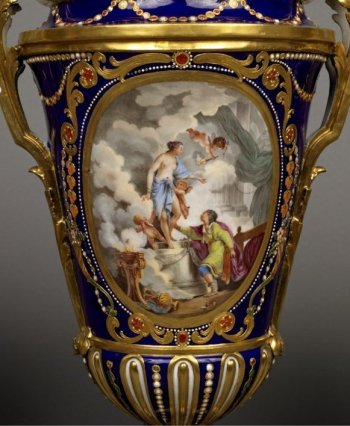
Vase ‘E de 1780’ Sèvres Porcelain Manufactory, 1781 (London: Wallace Collection C334 004).
We have great pleasure in announcing that this year’s Haughton International Seminar, entitled Fragile Splendour: Prestige, Power & Politics from the Medici’s to the Present Day, will again take place at The British Academy, 11 Carlton House Terrace, on Wednesday 29th and Thursday 30th June. Each year we draw together eminent international speakers to share their knowledge and passion with an appreciative audience. Information regarding this exciting seminar can be viewed on our website here. Tickets can be purchased online via this link. We look forward to welcoming you in June.
Cost of the two-day seminar: £110 (inc VAT). Cost of the two-day seminar including champagne reception and dinner at The Athenaeum on Wednesday, 29th June: £190 (inc VAT). Student tickets for the two-day seminar (on production of ID): £60 (inc VAT). Booking in advance through the website is essential due to limited numbers. The box office opens on Tuesday, 1st March. Below is a preliminary programme (subject to change).
W E D N E S D A Y , 2 9 J U N E 2 0 2 2
8.45 Registration
9.15 Welcome Address
9.30 Morning Session
• Gregory Irvine — The Art of War, the Arts of Peace: Patronage and Production of Luxury Crafts for the Samurai
• Timothy Schroder — Diplomatic Gifts in Gold
• Mathieu Deldicque — Prestige Despite Disfavour: The Prince de Condé and Chantilly Porcelain
• Helen Jacobson — The Art of Giving: Diplomacy at the Bourbon Court
1.00 Lunch Break
2.15 Afternoon Session
• Timothy Wilson — The Medici and Maiolica in the Time of the Florentine Republic
• Amin Jaffer — Attributes of Splendor: Jewels and the Projection of Power in Royal India
3.55 Face-to-Face: Rosalind Savill in Conversation with Brian Haughton
4.45 Q&A Session
6.30 Drinks Reception at The Athenaeum Club (for dinner guests only)
7.15 Dinner (dress code is smart with ties for gentlemen; no denim or training shoes)
T H U R S D A Y , 3 0 J U N E 2 0 2 2
9.00 Arrival
9.15 Morning Session
• Samuel Wittwer — Polishing the Crown: The Influence of Artists and Scholars on Royal Berlin Porcelain Orders
• Leslie Greene Bowman — Thomas Jefferson at Monticello: Prestige, Power, and the ‘Peculiar Institution’ of Slavery
• Eva Stroeber — For Sultans, Grand Dukes, and German Princes: Chinese Porcelain as Diplomatic Gift
• Rose Kerr — How Chinese Emperors Used Ceramics to Support their Power and Prestige
1.00 Lunch Break
2.15 Afternoon Session
• Johann Kräftner — Rebuilding a Collection: 20 Years of Working with Palaces, Paintings, Sculpture, Furniture, and Porcelain
• Julia Weber — Augustus the Strong and the ‘Red Porcelain’ from Saxony
• Judy Rudoe — Jewellery, Politics, and National Identity: Princess Alexandra and Her Wedding Gifts
4.30 Q&A Session
Online Symposium | Sea Machines

From the symposium website:
Sea Machines
Online, Daniels Faculty of Architecture, Landscape, and Design, University of Toronto, 4 February 2022
Organized by Christy Anderson and Jason Nguyen
Sea Machines is a one-day symposium (held on Zoom) that interrogates marine technology for the history and theory of architecture. From canoes and cargo ships to submarines and offshore drilling rigs, maritime vessels show how design has been employed to imagine, manoeuvre, conquer, and exploit the environments and ecosystems of the sea.
The sea has long been cast as the inverse of the habitable terracentric world. Depictions of storms, shipwrecks, and underwater monsters haunt the art and literature of coastal societies, serving as warnings to those who might venture into the blue expanse. Yet, across cultures and throughout history, humans have constructed elaborate structures to facilitate the crossing and even occupation of the ocean.
Recent scholarship in the blue humanities has shed light on the profound ways that oceans influence politics, economics, science, and culture. Aquatic environments have conditioned everything from human diets, artistic traditions, trade networks, and settlement patterns. Whereas architects and historians have studied harbours and ports, far fewer have looked at the vessels that traversed and inhabited the open water. These ‘sea machines’ signal the outer limits of a period and place’s techno-environmental imagination. What architectonic skills did designers, shipwrights, and navigators employ in the construction and operation of ocean structures? How did the forms and materials of water-based vessels speak to larger ideological and environmental forces, including those tied to colonization and slavery, capitalism, and the climate? And how might infrastructure linked to offshore extraction (e.g., fishing, pearl farming, coral and deep-sea mining, oil drilling, etc.) provide a specifically architectural way to evaluate the relationship between human and non-human entities across the land and sea divide?
Sea Machines brings together members of the Daniels Faculty and a diverse roster of internationally recognized scholars and practitioners with an interest in environmental history, technology, and design. The study of maritime spaces is timely and of wide interest for scholars and practitioners across the design disciplines, especially given the sea’s increasing precarity in the face of climate change. Ultimately, the symposium highlights the central role played by architecture in charting a future environmental and technological reality.
The event is free and open to the public. More information on the symposium and its speakers, including registration and Zoom information, is available here.
S C H E D U L E
10.00 Opening Remarks by Christy Anderson and Jason Nguyen
10.30 Session 1: Infrastructure
• Keller Easterling, ISO 1161
• Carola Hein, Oil on Water: The Global Petroleumscape and the Urbanization of the Sea
• Prita Meier, Below the Waterline: Dhows and the Politics of Heritage in the African Indian Ocean
11.30 Discussion
11.50 Lunch Break
1.00 Session 2: Culture
• Niklas Maak, Phalansteries at Sea: Fourier, Le Corbusier, and the Architecture of the Cruiseship
• Meredith Martin and Gillian Weiss, Sun King at Sea
• Elliott Sturtevant, Traveling the Heat Line: The ‘Great White Fleet’ as Climatic Media
2:00 Discussion
2.20 Break
2.30 Session 3: Energy
• Sara Rich, Naufragic Architecture in the Anthropocene
• Margaret Schotte, Water vs. Wood: Desalination Machines and the Shipboard Space, c. 1695
• Larrie Ferreiro, The Evolution of the Naval Architect, 1600–2000
3.30 Discussion
4.00 Closing Remarks by Christy Anderson and Jason Nguyen
Colloquium | The Myth of Versailles and European Courts
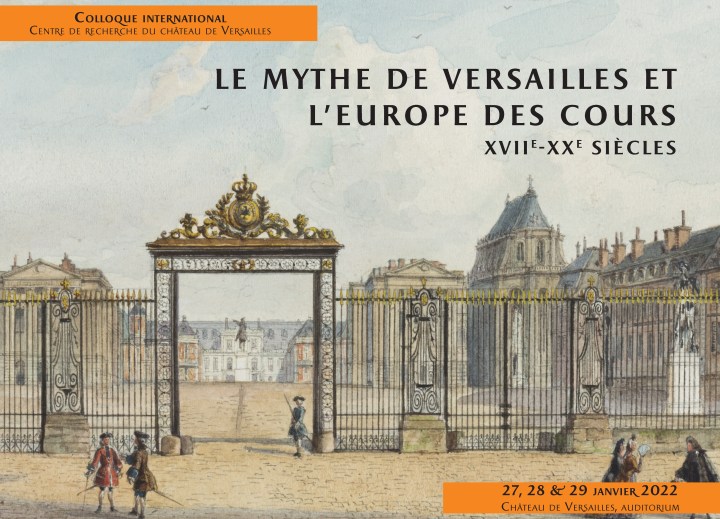
Schloss Versailles. Eingang zum Schloßhof. Album des vingt-deux vues de Versailles commandé par Louis II de Bavière à Jobst Riegel, aquarelle, 1876, V.2017.11. Château de Versailles.
◊ ◊ ◊ ◊ ◊
From Versailles and the conference programme:
The Myth of Versailles and European Courts, 17th–20th Centuries
Le mythe de Versailles et l’Europe des cours, XVIIe–XXe siècles
Auditorium du château de Versailles, 27–29 January 2022
Colloque international organisé par le Centre de recherche du château de Versailles dans le cadre de son programme de recherche « Identités curiales et le mythe de Versailles en Europe : perceptions, adhésions et rejets (XVIIIe–XIXe siècles) ». Il se tiendra les 27, 28 et 29 janvier 2022 à l’auditorium du château de Versailles. Les communications seront données en français et en anglais. Le colloque sera également diffusé en direct sur la chaîne Youtube du Centre de recherche du château de Versailles. L’accès à la retransmission ne nécessite pas d’inscription préalable.
J E U D I , 2 7 J A N V I E R 2 0 2 2
9.30 Accueil
9.35 Ouverture au nom du Centre de recherche du château de Versailles par Mathieu da Vinha, directeur scientifique
9.45 Introduction, Gérard Sabatier (professeur émérite, université de Grenoble II / directeur du programme CRCV « Identités curiales et le mythe de Versailles en Europe : perceptions, adhésions et rejets (XVIIIe–XIXe siècles) »)
10.00 Session I: La diffusion du mythe
Présidence de séance : Philip Mansel, président du Comité scientifique du Centre de recherche du château de Versailles / The Society for Court Studies
• Flavie Leroux (Centre de recherche du château de Versailles), Témoignages de visiteurs étrangers, XVIIe–XIXe siècles
• Johanna Daniel (Institut national d’Histoire de l’Art / Université Lyon 2), La vue d’optique, vecteur de diffusion du mythe versaillais dans la culture visuelle du XVIIIe siècle
• Sylvie Requemora-Gros (Aix Marseille Université), Le voyage encomiastique ou la fabrique du Songe de Versailles
12.30 Déjeuner
14.30 Session I: La diffusion du mythe, cont.
• Stefanie Leibetseder (chercheur indépendante, Berlin), Advertising or Demonizing the Myth? 18th-Century Travellers from Germany in Versailles
• Charles-Éloi Vial (Bibliothèque nationale de France / Sorbonne Université), Visiter Versailles sous l’Empire et la Restauration : musée, palais ou lieu de mémoire ?
16.00 Pause
16.15 Session II: Visiter Versailles, impressions personnelles
Présidence de séance : Marie-Christine Skuncke, professeur émérite de littérature, Uppsala Universitet
• Philip Mansel (Centre de recherche du château de Versailles / The Society for Court Studies), Versailles in England, from Charles II to George IV: Influences, Appropriations, and the Entente Cordiale
• Katarzyna Kuras (Université Jagellonne de Cracovie, Institut d’histoire), La famille Jabłonowski à Versailles au XVIIIe siècle. Impressions et inspiration
V E N D R E D I , 2 8 J A N V I E R 2 0 2 2
9.30 Session II: Visiter Versailles, impressions personnelles, cont.
• Ferenc Tóth (Centre de recherches en sciences humaines, Institut d’histoire, Budapest), Entre fascination et désillusion. Attitudes des nobles hongrois devant la cour de Versailles à l’époque des Lumières
• Éric Hassler (Université de Strasbourg), Versailles en Empire : les symptômes d’un mythe versaillais dans l’espace germanique dans la littérature de voyage germanique au XVIIIe siècle
• Sabrina Norlander Eliasson (Stockholm University, Department of Culture and Aesthetics), ‘A Landmark of the Transience of All Earthly Greatness, Glory, and Power!’ Versailles and the Myth of the Ancien Régime in the Writings and Collections of the Swedish Marquis Claes Lagergren (1853–1930)
12.00 Session III: La fabrique du faste
Présidence de séance : Maciej Forycki, maître de conférences en histoire moderne, Uniwersytet Adam Mickiewicz, Poznań
• Arianna Giorgi (Université de Murcie), en visioconférence, Habits, couleurs et boutons : mythe, rang et étiquette de la cour de Versailles chez les ducs d’Osuna
12.45 Déjeuner
14.30 Session III: La fabrique du faste, cont.
• Friedrich Polleroß (Université de Vienne, Institut für Kunstgeschichte), L’influence de Versailles à la cour de Vienne
• Thierry Franz (château de Lunéville / université de Lorraine), Lunéville au miroir de Versailles. La matérialisation du cérémonial à la cour de Lorraine, reflet d’un regard distancié sur le modèle français (1698–1737)
• Maureen Cassidy-Geiger (Independent Curator and Scholar, New York), en visioconférence, Versailles and Dresden: Myths and Models
• Raphaël Masson (Château de Versailles), L’univers versaillais de Louis II de Bavière : le cas de Linderhof
S A M E D I , 2 9 J A N V I E R 2 0 2 2
9.30 Session IV: Versailles en Europe : transferts culturels
Présidence de séance : Gérard Sabatier, professeur émérite, université de Grenoble II
• Dmitri Gouzévitch (EHESS / Centre d’Études des Mondes russe, caucasien et est-européen) et Irina Gouzévitch (EHESS / Centre Maurice Halbwachs), Le mythe de Versailles comme élément fondateur des « habits pour l’empire » de Pierre Ier : influence et parallélisme
• Andrea Merlotti (Reggia di Venaria, Centro studi delle Residenze Reali Sabaude), en visioconférence, Un mythe ambigu. Les « Versailles d’Italia » (XIX–XXe siècles)
• Jonathan Spangler (Manchester Metropolitan University), Between Habsburg and Bourbon: The Court of Lorraine as a Blended Model of Court Culture and a Symbol of Political Neutrality
• Pablo Vázquez Gestal (Boston University / CNRS / Sorbonne Université, Centre Roland Mousnier), Un mythe à deux sens. Versailles et les monarchies bourboniennes de l’axe méditerranéen (1715–1788)
Online Study Day | Joshua Johnson: Conversations and New Discoveries
This online study day is held in conjunction with the the exhibition, which closes January 23:
Joshua Johnson: Conversations and New Discoveries
Online, Washington County Museum of Fine Arts, Hagerstown, Maryland, 14 January 2022.

Joshua Johnson, Portrait of Benjamin Franklin Yoe and Son Benjamin Franklin You Jr., 1809, oil on canvas mounted onto hardboard, 37 × 26 inches (Hagerstown: WCMFA, Gift of F. Sydney Cushwa).
The exhibition Joshua Johnson: Portraitist of Early American Baltimore presents a rare opportunity for Johnson scholars and art historians to study a significant group of Johnson’s works in one place.
Join WCMFA staff and colleagues Friday, January 14, for a day of intriguing, in-depth conversations about portraitist Joshua Johnson (ca. 1763–1824/25), one of the first professional African American artists. Joshua Johnson: Conversations and New Discoveries will be held from 9am to 4pm (EST) via Zoom. Organized in conjunction with the final days of the exhibition, this study day will address a variety of topics, including Johnson’s life and historical context in antebellum Maryland, his patrons, artistic style and technique, and connoisseurship. A broad range of speakers and special guests will offer unique perspectives and expertise about this fascinating artist in an informal, conversational format.
The first monographic presentation of the artist’s work since 1988, Joshua Johnson: Portraitist of Early American Baltimore contextualizes Johnson both historically and culturally and explores the key forms of natural symbolism represented in his paintings. Johnson was a freed slave who achieved a remarkable degree of success as a portraitist in his lifetime by painting affluent patrons in his native Baltimore such as politicians, doctors, clergymen, merchants, and sea captains. The exhibition is accompanied by a scholarly catalogue available for purchase from the museum.
To register for the study day, please email Donna Rastelli at drastelli@wcmfa.org or call 301.739.5727.
S C H E D U L E
9.00 Introduction by Sarah Hall (Director Washington County Museum of Fine Arts) with Opening Remarks by Kellie Mele (Director of Education for WCMFA)
9.30 Who Was Joshua Johnson? — David Terry (Associate Professor of History and Geography at Morgan State University) and Daniel Fulco (Agnita M. Stine Schreiber Curator at Washington County Museum of Fine Arts)
10.30 The Artist’s Patrons — Mark Letzer (President & CEO, Maryland Center for History and Culture), Stiles Colwill (Stiles T. Colwill Interiors), and Linda Crocker Simmons (Curator Emerita, Corcoran Gallery of Art)
11.15 Roundtable Discussion — This hour-long conversation features our panelists discussing Johnson’s influence and style, addressing his predecessors and contemporaries, some of whom are on view in a companion exhibition at the WCMFA.
12.15 Lunch Break
1.15 Johnson’s Cultural and Historical Context and Relationship to Baltimore Society — David Terry, Daniel Fulco, and Philippe Halbert (PhD candidate, Department of the History of Art, Yale University)
2.15 Connoisseurship: Technique, Materials, and Conservation. See the Yoe family portraits up close with Heather Smith (Conservator, Maryland Art Conservation), Sian Jones (Art Conservator), and Stiles Colwill.
3.15 Future Directions — In this concluding segment, panelists will discuss Johnson in public and private collections. Other topics include the art market as well as new research and directions in the field.
P A N E L I S T S
David Terry is Associate Professor of History and Geography at Morgan State University in Baltimore. He previously was the executive director of the Reginald F. Lewis Museum and was a research specialist in African American history for the Maryland State Archives. He holds a doctorate in history from Howard University, a Master of Arts in African American history from Morgan State University and a Bachelor of Arts in American studies from the University of Maryland-College Park.
Mark Letzer is the President and CEO of Maryland Center for History and Culture in Baltimore. Letzer is an expert in Maryland silver and decorative and fine arts. He became connected with MCHC when he was researching for his book, The Diary of William Faris: The Daily Life of an Annapolis Silversmith, which was published in 2003. In addition, he has written numerous articles on Maryland silver and decorative arts and lectured on the topic. Previously, he served as the Chief Development Officer for the Maryland Historical Society.
Anne Verplanck is Associated Professor of American Studies for Penn State-Harrisburg. She teaches courses in American art and visual culture, social and cultural history, American decorative arts and material culture, museum studies and heritage studies. Prior to becoming part of the Penn State-Harrisburg faculty she worked in the museum field for 30 years. She is the former Curator of Prints and Paintings at Winterthur Museum where she also served as Interim Director of Museum Collections and Interim Director of the Research Fellowship Program.
Linda Crocker Simmons has spent over 40 years in the museum field. Since 1998 she has held the title of Curator Emerita for the Corcoran Gallery of the Art. She has also worked with private and institutional clients including the Alice Ferguson Foundation at Hard Bargain Farm in Accokeek, Maryland. She holds a Bachelor of Arts in studio art and art history from American University; a Master of Arts in art history from the University of Delaware; a certificate in arts administration from Harvard University and remains a.b.d. for her PhD from the University of Virginia. She is an expert in the field of American painting from the end of the 18th century into the early 20th century.
Stiles Colwill has been the President and Chief Designer of Stiles Tuttle Colwill Interiors in Lutherville, Maryland, for nearly 30 years. Colwill also operates Halcyon House Antiques with New York City antiques firm John Rosselli & Associates. He previously served as a Board of Trustees for Baltimore Museum of Art where he served as chairman for five years. He also spent 16 years with the Maryland Historical Society.
Heather Smith is the Owner and Chief Conservator of Maryland Art Conservation LLC (formerly Art Conservation Services) in Baltimore. In 2005, she began her career with ACS after receiving her Master of Art Conservation at Queen’s University in Ontario, Canada, the previous year. She is a professional associate of the American Institute for Conservation.
Sian Jones is the previous owner of Art Conservation Services before retiring in 2018 after more than 30 years. She studied art conservation at the State University of New York at Oneonta, and studied art at Goucher College in Baltimore.
Phillipe Halbert is a doctoral candidate with the Department of History of Art at Yale University. He studies the intersection of art and identity in Colonial America and early modern Europe. For more than a decade he has been an independent museum consultant and has served as a guest curator at a variety of historic sites and museums. He has a Master of Philosophy in art history, criticism and conservation from Yale University and a Master of Arts in American material culture from the University of Delaware. He was a dual major in French and Francophone studies and history at The College of William and Mary where he received his undergraduate degree.
This exhibition is generously supported by grants from the following: National Endowment for the Arts (NEA), the Art Dealers Association of America (ADAA) Foundation, an anonymous donor, Mr. & Mrs. James N. Holzapfel, Dr. & Mrs. George E. Manger, the Heart of the Civil War Heritage Area (part of the Maryland Heritage Areas Authority), Maryland Marketing Partnership, Community Foundation of Washington County MD, Inc., Dr. & Mrs. Robert S. Strauch, and Mr. & Mrs. Thomas B. Riford.
Journées d’étude | The Rediscovered Colors of Aubusson Tapestries
From ArtHist.net:
Les Couleurs retrouvées des Tapisseries d’Aubusson
Online, Aubusson, 17–18 January 2022
Ces journées d’étude seront l’occasion de partager les premiers résultats d’une recherche pluridisciplinaire originale menée dans le cadre du programme Aubusson: Les couleurs retrouvées des tapisseries fines d’Aubusson (XVIIIe siècle) — Culture matérielle: conception, production, caractérisation, altération et conservation soutenu par la Région Nouvelle Aquitaine. Centrées sur l’étude d’un exemple, une tapisserie récemment acquise par la Cité internationale de la Tapisserie à Aubusson, elles convoquent l’histoire naturelle, l’histoire sociale, l’histoire de l’art, les sciences physiques et chimiques, les sciences du patrimoine et les nouvelles technologies afin de renouveler la connaissance des objets analysés. Le propos touche donc à l’identification des choses représentées, à l’examen des processus d’élaboration et des stratégies de production des tapisseries, à reconsidérer les techniques de tissage et les matériaux utilisés par la constitution d’une base de données des différents supports et par l’analyse non invasive des colorants. Il s’agit aussi de poser des diagnostics de conservation et de présentation des collections et de tenter une restitution numérique des couleurs d’origine.
These study days will be an opportunity to share the first results of an original multidisciplinary research conducted within the framework of the Aubusson program: Les couleurs retrouvées des tapisseries fines d’Aubusson (XVIIIe siècle) — Culture matérielle: conception, production, caractérisation, altération et conservation, supported by the Région Nouvelle Aquitaine. Focusing on the study of an single example, a tapestry recently acquired by the Cité internationale de la Tapisserie in Aubusson, they bring together natural history, social history, art history, physical and chemical sciences, heritage sciences, and new technologies in order to renew the knowledge of the analyzed objects. The aim is to identify the things represented in the tapestry, to examine the tapestry elaboration process and production strategies, and to reconsider the weaving techniques and the materials used through the constitution of a database of the different supports and by the non-invasive analysis of the dyes. It is also a question of diagnosing the conservation and presentation of the collections and attempting a digital restitution of the original colors of the tapestry.
Comité Scientifique
Alice Bernadac, Pascal-François Bertrand, Floréal Daniel, Aurélie Mounier, Audrey Nassieu Maupas, Bruno Ythier
Pour le 17/01 : https://us06web.zoom.us/j/87245772303
872 4577 2303 / pas de code secret
Pour le 18/01 : https://us06web.zoom.us/j/86846013778
868 4601 3778 / pas de code secret
1 7 J A N V I E R 2 0 2 2
9.00 Ouverture par Emmanuel Gérard, Directeur de la Cité internationale de la Tapisserie, et Introduction par Pascal-François Bertrand
10.00 Session 1 | Sciences Naturelles: ReprÉsenter la Nature
• Cécile Aupic — Identification de la flore dans la Verdure aux armes de Brühl
• Jacques Cuisin — Les animaux dans la Verdure aux armes de Brühl
11.00 Session 2 | Histoire Sociale: Approche Socio-Écomonique
• Koenraad Brosens — Le marché de la verdure en Europe
• Ute Koch — Heinrich von Brühl et les tapisseries de son château de Brody
12.00 Pause déjeuner
14.00 Visite des ateliers, Jean-Marie Dor
15.30 Session 3 | Histoire de l’Art: Peindre et Tisser des Paysages
• Ingrid de Meuter — Les verdures flamandes, 1640–1750
• Charissa Bremer David — Les verdures de la Manufacture de tapisserie de Beauvais, 1690–1740
• Camilla Pietrabissa — La peinture de paysage en France dans la première moitié du XVIIIe siècle
• Benjamin Perronet — Dessins de paysage autour d’Oudry et de Boucher
• Élodie Pradier — Jean-Baptiste Oudry et la question de la couleur
1 8 J A N V I E R 2 0 2 2
9.00 Session 4 | Sciences Physiques et Chimie
• Aurélie Mounier, Hortense de La Codre, et Floréal Daniel — Mise au point d’une méthodologie spécifique, sans contact, pour l’identification des colorants et textiles
• Hortense de La Codre, Rémy Chapoulie, Laurent Servant, et Aurélie Mounier — Manufactures Royales de Tapisseries françaises (Gobelins, Beauvais, Aubusson) : entre sources écrites et réalité matérielle. Application de méthodes spectroscopiques non-invasives à l’étude de trois tapisseries du XVIIIe siècle
10.00 Session 5 | Sciences du Patrimoine: Restauration et Muséologie
• Alice Bernadac, Carole Redais (Langlois Tapisseries), et Jean-Marie Dor — La restauration de la Verdure aux armes de Brühl
• Alice Bernadac — Présenter la Verdure aux armes de Brühl dans les salles de la Cité de la Tapisserie (dans les salles)
11.30 Session 6 | Technologies Numériques
• Loïc Espinasse, Pascal Mora, Michael Rouca, et François Daniel — Restituer virtuellement les couleurs de la Tapisserie aux armes de Brühl
12.00 Conclusion
• Bruno Ythier
Conference | La Chiesa di San Rocco

Scuola Grande di San Rocco and Chiesa di San Rocco, Venice
(Wikimedia Commons; September 2017)
◊ ◊ ◊ ◊ ◊
From ArtHist.net:
La Chiesa di San Rocco: Spazio Sacro Confraternale e Centro di Culto
Auditorium Santa Margherita, Chiesa di San Rocco, Venice, 2–4 December 2021
Organized by Maria Agnese Chiari Moretto Wiel and David D’Andrea
The church of San Rocco is the only Venetian church that is both a confraternal devotional space and a ‘sanctuary’ that houses the body of the titular saint, who was translated to Venice in 1485 and located in the main altar since 1520. Belief in the miraculous power of San Rocco to heal and protect those afflicted with the plague made the church a popular pilgrimage destination and site of international devotion. The church was adorned with rich artwork and musical space (an organ and choir gallery) designed to focus religious devotion on the altar-reliquary. The original church, built in 1489, was heavily renovated by Giovanni Scalfarotto between 1726 and 1733. The rebuilt façade, completed by Bernardino Maccaruzzi in 1769, unifies the confraternity’s ritual space, which encompasses the square and the adjacent streets.
The conference proposes to examine, in a broad chronological span and with an interdisciplinary approach, the significant aspects of this devotional space, where processions, festivals, and pilgrimages reaffirmed the status of the confraternity and the healing power of San Rocco both in Venetian life and in universal Catholic devotion. Papers will discuss the origins of the cult of San Rocco in Venice, the foundation of the Scuola, the construction of the church and the relationship between the church and confraternity. The altars and devotional images of the fifteenth- and sixteenth-century church and the later seventeenth- and eighteenth-century renovations will be analyzed in relationship with the other confraternal churches in Venice. Particular attention will be dedicated to ritual spaces, music, objects of devotion (the relic of San Rocco, the miraculous Crucifix, the miraculous image of Christ Carrying the Cross; devotion to the Holy Eucharist), and festivals, including changes introduced by new religious devotions and spaces (the Redentore and Madonna della Salute) associated with the plague.
The conference—part of the Churches of Venice: New Research Perspectives project—will consist of two days in the classroom (Auditorium Santa Margherita) and a final session on site in the church. Places are limited, and the required registration can be completed here. In addition, the sessions will be recorded and made available on the ‘Chiese di Venezia’ YouTube channel. For more information, please email chiesedivenezia@gmail.com.
2 D E C E M B E R 2 0 2 1
9.30 Welcome
9.45 Introduction by Maria Agnese Chiari Moretto Wiel, David D’Andrea
10.15 Session 1: Gli inizi del culto di San Rocco nel Veneto, la Scuola e la chiesa veneziana
Chair: David D’Andrea
• Claudia Salmini (Scuola Grande di San Rocco, già Archivista di Stato a Venezia), Alla ricerca delle fonti sulla chiesa di San Rocco
• Rachele Scuro (Università degli Studi di Milano Bicocca), Il culto di san Rocco e la presenza ebraica a Venezia e nello Stato veneto nel Rinascimento
• Francesco Bianchi (Università degli Studi di Padova), San Rocco in ospedale (secc. XV–XVI)
• Adelaide Ricci (Università di Pavia), Le opere e i segni: san Rocco nel progetto narrativo della Scuola di Venezia
13.00 Break
15.00 Session 2: La chiesa quattro-cinquecentesca: gli apparati decorativi e il messaggio dei teleri
Chair: Paola Marini
• Gianmario Guidarelli (Università degli Studi di Padova), L’architettura della chiesa di San Rocco
• Maria Agnese Chiari Moretto Wiel (Wake Forest University), L’arredo della chiesa quattro-cinquecentesca e le sue trasformazioni nel corso del Seicento: proposta
• Diana Gisolfi (Pratt Institute), L’organo rinascimentale della chiesa di San Rocco
• Lorenzo Lazzarini (Laboratorio di Analisi dei Materiali Antichi, Università Iuav di Venezia), Le pietre e i marmi della chiesa di San Rocco
• Louise Marshall (University of Sydney), St Roch Between North and South: Understanding Artistic and Confraternal Choices in Tintoretto’s Narratives at the Chiesa di San Rocco
• Ewa Rybalt (Indipendent Scholar; Lublino), ‘San Rocco cura gli appestati’ di Tintoretto e la disputa tra Valerio Superchio e Vettor Trincavello
3 D E C E M B E R 2 0 2 1
10.00 Session 3: I rapporti della Scuola e della chiesa con il popolo
Chair: Martina Frank
• David D’Andrea (Oklahoma State University), From the Renaissance to the Grand Tour: The Church of San Rocco in the Eyes of Spiritual and Cultural Pilgrims
• Giulia Zanon (University of Leeds), Relazioni sociali e devozionali nella chiesa di San Rocco tra Cinque e Seicento
• Matteo Casini (University of Massachusetts, Boston), Liturgia urbana, di Stato, di gruppi
• Fabio Tonizzi (Facoltà Teologica dell’Italia Centrale), La chiesa di San Rocco: un santuario? Aspetti giuridici e devozionali
13.00 Break
15.00 Session 4: Il culto di San Rocco e la vita religiosa tra XVI e XVIII secolo
Chair: Fabio Tonizzi
• Christopher Nygren (Center for Advanced Study in the Visual Art, National Gallery / University of Pittsburgh), Il Cristo portacroce della Scuola di San Rocco, tra antropologia dell’immagine e storia dell’arte
• Alexandra Bamji (University of Leeds), The Church of San Rocco between Venetian Piety and Post-Tridentine Devotion
• Andrea Savio (Università degli Studi di Padova), La festa di San Rocco a Venezia dopo la pestilenza del 1630
• William Barcham (Fashion Institute of Technology, State University of New York, emeritus), La trasformazione della facciata di San Rocco, ca. 1756–1769
• Federica Restiani (Istituto Veneto per i Beni Culturali), Giuseppe Angeli e il rinnovato ciclo pittorico della cupola del presbiterio. Contributi dal cantiere di restauro
• Jonathan Glixon (University of Kentucky), The Choir of San Rocco and Its Music
4 D E C E M B E R 2 0 2 1
10.00 Session 5: Trasformazioni, restauri, nuove prospettive
Chair: Demetrio Sonaglioni
• Maria Agnese Chiari Moretto Wiel (Wake Forest University) and Melissa Conn (Save VeniceInc.), Ultime trasformazioni interne della chiesa: dal XVIII secolo ad oggi
• Amalia Donatella Basso (Scuola Grande di San Rocco, già Soprintendenza per i Beni Architettonici e Paesaggistici di Venezia e Laguna), Rileggendo i dipinti di Tintoretto nella chiesa confraternale di San Rocco. Considerazioni e riflessioni
• Mario Piana (Università Iuav di Venezia), La cantoria
• David D’Andrea (Oklahoma State University), Sintesi dei temi del convegno
Online Colloquium | Celebrating the Illustrious in Europe, 1580–1750
From the programme for the conference:
La célébration des Illustres en Europe (1580-1750) : vers un nouveau paradigme?
Celebrating the Illustrious in Europe, (1580–1750): Towards a New Paradigm?
Online, 25–26 November 2021
Organized by Antoine Gallay, Carla Julie, and Matthieu Lett
Colloque organisé conjointement par l’UNIL (Section d’Histoire de l’art) et par l’Université de Bourgogne (LIR3S CNRS UMR 7366) avec le concours de la Conférence universitaire de Suisse occidentale (CUSO)
Le colloque se propose d’explorer une partie des productions biographiques d’une période usqu’alors peu étudiée sous cet angle. Les deux journées ont pour objectif de mieux comprendre comment se transformèrent, entre 1580 et 1750, les modes de célébration de la gloire des illustres, tant par l’écrit que par l’image, en tenant compte de l’ensemble des médiums que constituent le livre, l’estampe, la peinture, la sculpture ou encore la médaille.
Organisation
• Antoine Gallay (Université de Tel Aviv – The Cohn Institute), antgallay@hotmail.com
• Carla Julie (Université de Lausanne – Université de Bourgogne), carla.julie@unil.ch
• Matthieu Lett (Université de Bourgogne – LIR3S), matthieu.lett@u-bourgogne.fr
Comité scientifique
• Jan Blanc, professeur d’histoire de l’art de la période moderne (Université de Genève)
• Estelle Doudet, professeure de littérature française (Université de Lausanne)
• Laurence Giavarini, maîtresse de conférences HDR en littérature des XVIe et XVIIe siècles (Université de Bourgogne – LIR3S)
• Christian Michel, professeur d’histoire de l’art de la période moderne (Université de Lausanne)
• Frédéric Tinguely, professeur de littérature française (Université de Genève)
Lien du colloque:
https://unil.zoom.us/j/92708025500
ID de réunion : 927 0802 5500
J E U D I , 2 5 N O V E M B R E 2 0 2 1
9.15 Accueil
9.30 Introduction
• Antoine Gallay, Carla Julie, Matthieu Lett
10.00 Session 1: Nouveaux Illustres
Président de séance : Matthieu Lett
• Rémi Jimenes (Université de Tours) et Estelle Leutrat (Université Rennes 2) — Gabriel-Michel de La Rochemaillet, Jean Le Clerc et Les pourtraicts de plusieurs hommes illustres qui ont flory en France depuis l’an 1500
• Paula Almeida Mendes (CITCEM – Université de Porto) — Les ‘femmes illustres’: représentations littéraires et culturelles au Portugal, XVIe–XVIIIe siècles
• Malcolm Baker (University of California, Riverside) — How did images make modern authors illustrious?
12.30 Pause déjeuner
14.00 Session 2: Nouveaux Régimes de Célébration
Président de séance : Frédéric Tinguely
• Marion Deschamp (Université de Lorraine) — En être, ou pas. Conversions, redéfinitions et exclusions de l’économie des grandeurs dans les recueils protestants d’hommes illustres, XVIe– XVIIe siècles
• Pascale Cugy (Université Rennes 2) — Le monde du spectacle dans les portraits en mode parisiens (1690–1710) : à propos de la célébration gravée de quelques noms de la Comédie-Française et de l’Opéra
• Sophie-Luise Mävers (Universität zu Köln) — A faceless gallery of illustrious scientists and artists? Sébastien Leclerc’s orchestration of an institutional utopia
• François Lavie (Université Paris 8) — Recueillir les bons mots des « personnes illustres » dans la France moderne : pratiques de compilation et célébration de l’esprit des grands hommes, 1680–1750
V E N D R E D I , 2 6 N O V E M B R E 2 0 2 1
9.30 Session 3: Desseins Politiques
Président de séance : Laurence Giavarini
• Stanis Perez (Maison des sciences de l’homme Paris-Nord) — La Gallerie des femmes fortes : de la collection historiographique au miroir politique
• Margaux Prugnier (Université Paris Nanterre) — De la célébration des Grands à celle des Lorrains : les œuvres de Dom Calmet (1672–1757) au gré des évolutions de la France de la première moitié du XVIIIe siècle
• Craig Hanson (Calvin University, Grand Rapids) — Thomas Birch’s Heads of Illustrious Persons (1743–1751). Collecting Art, Collecting National Histories
12.00 Pause déjeuner
13.30 Session 4: De la Collection à la Célébration
Président de séance : Antoine Gallay
• Clarisse Evrard (Université de Lille) — Regard d’un illustre sur ses pairs : l’Armamentarium Heroicum, de la collection d’armures au théâtre de papier
• Carla Julie (Université de Lausanne – Université de Bourgogne) — Curieux d’estampes et Illustres dans la France du XVIIe siècle : autour de Michel de Marolles
• Maxime Martignon (Université Paris Nanterre) — Choisir les Illustres : Michel Bégon et le projet biographique
16.00 Conclusion
• Christian Michel (Université de Lausanne)
Online Workshop | Cotsen Textile Collection: From India to the World
From The George Washington University Museum:
The Cotsen Textile Traces Global Roundtable: From India to the World
Online, 17–18 November 2021

Panel fragment, painted and resist dyed, India, ca. 1770, 96 × 46 cm (Cotsen Textile Traces Study Collection T-2021, The George Washington University Museum and The Textile Museum).
More than 200 textiles from India form a cornerstone of the Cotsen Textile Traces Study Collection at The George Washington University Museum and the Textile Museum in Washington, D.C. They testify to cross-cultural exchanges, offer a rich resource for artistic inspiration and cross-disciplinary research, and serve as the inspiration for the Center’s second annual Cotsen Textile Traces Global Roundtable. On November 17, the theme is ‘Embroidered Textiles’; on November 18, ‘Painted and Printed Textiles’.
The Cotsen Textile Traces Study Collection represents a lifetime of collecting by business leader and philanthropist Lloyd Cotsen (1929–2017). Comprised of nearly 4,000 fragments from all over the world, the collection offers insights into human creativity from antiquity to the present. Cornerstones of the collection include fragments from Japan, China, pre-Hispanic Peru, and 16th- to 18th-century Europe. The entire collection is available online.
To join us for the roundtable, please register early to reserve your space. Once you have registered, we will email you links and details for joining each day of the roundtable on Zoom. We will also email registered participants a full program with a detailed schedule.
This program is made possible through funding from the Cotsen Textile Traces Study Collection Endowment, as well as support from Barbara Tober in honor of Dr. Young Yang Chung.
W E D N E S D A Y , 1 7 N O V E M B E R 2 0 2 1
Embroidered Textiles
9.00 Welcome and Introduction to Indian Embroidered Textiles from the Cotsen Textile Traces Study Collection
• Lori Kartchner, curator of education
• John Wetenhall, director
• Marie-Eve Celio-Scheurer, academic coordinator for the Cotsen Textile Traces Study Center
9.20 Keynote Conversation: Indian Textiles: Conversing with the Transcendent
• Ghiora Aharoni, Cotsen Studio artist-in-residence
• Mayank Mansingh Kaul, independent curator and writer, New Delhi
10.00 Panel 1: Chikankari and Inspiration for Today’s Fashion
• Shalini Sethi, creative head, Good Earth, New Delhi
• Paola Mandfredi, independent researcher and consultant, Milano, Italy
• Jaspal Kalra, social entrepreneur, design educator, executive director of Kalhath Institute, Lucknow, India
11.00 Panel 2: Kantha, Then and Now
• Ruchira Ghose, former director, National Crafts Museum, New Delhi
• Niaz Zaman, advisor, Department of English and Modern Languages, Independent University, Dhaka, Bangladesh
• Pika Ghosh, visiting associate professor, Haverford College, Haverford, Pa.
Noon Panel 3: Embroidered Traditions From Kashmir and Beyond
• Monisha Ahmed, independent anthropologist, Mumbai, India
• Asaf Ali, co-founder of the Kashmir Loom Company, New Delhi and Srinagar, Jammu and Kashmir
1.00 Reflections on Day 1
• Maximiliano Modesti, craft and fashion entrepreneur, Paris and Mumbai, India
• Attiya Ahmad, associate professor of anthropology and international affairs, George Washington University, Washington, D.C.
T H U R S D A Y , 1 8 N O V E M B E R 2 0 2 1
Painted and Printed Textiles
9.00 Introduction to Indian Painted and Printed Textiles from the Cotsen Textile Traces Study Collection
• Lori Kartchner, curator of education
• Marie-Eve Celio-Scheurer, academic coordinator for the Cotsen Textile Traces Study Center
9.15 Keynote Lecture: Indian Printed and Painted Textiles, a Global Phenomenon
• Lee Talbot, curator, The Textile Museum Collection
• Ben Evans, editor, Hali Publications, London
• Rosemary Crill, former senior curator, Victoria and Albert Museum, London
10.00 Panel 1: Hand Painted and Printed in India Today
• Brigitte Singh, artist, artisan and designer, Jaipur, India
• Renukha Reddy, artist, Red Tree Studio, Bangalore, India
• Sufiyan Ismail Khatri, Ajrakh craftsman, Kutch, India
11.00 Panel 2: From India to the World (Asia and Africa)
• Sae Ogasawara, professor emeritus, Japan Women’s University, Tokyo
• Ruth Barnes, curator, Yale University Art Gallery, New Haven, Conn.
• Sarah Fee, senior curator of global fashion and textiles, Royal Ontario Museum, Toronto
Noon Panel 3: From India to the World (Europe and America)
• Helen Bieri Thomson, director, Musée national suisse, Zürich, Switzerland
• Sylvia W. Houghteling, assistant professor, Department of History of Art, Bryn Mawr College, Bryn Mawr, Pa.
• Amelia Peck, Marica F. Vilcek Curator of American Decorative Arts and supervising curator of the Antonio Ratti Textile Center, The Metropolitan Museum, New York
Online Workshop | Insects and Colours between Art and Natural History
From ArtHist.net:
Insects and Colours between Art and Natural History
Online, 29–30 November 2021
Organized by V. E. Mandrij and Giulia Simonini
This two-day online workshop addresses the issue of recording colours in entomology during the 17th and 18th centuries. Because of the bewildering variety of insect colours, artists and naturalists had difficulty describing and reproducing them with pigments. Some early modern scholars disapproved of using colours to depict insects in entomological illustrations. Other naturalists instead collaborated with artists to document the colours and shapes of insects.
Centuries later, this cooperation continues. Although irrelevant for the study of their anatomy, colour was significant for the identification of different species. However, artists and naturalists had different ways of tackling the problem of recording the appearances and names of the chromatic variety that exists in the insect world. Despite the variety of approaches and techniques used or proposed to record the colors of insects, this issue has not received the scholarly attention it deserves.
This workshop investigates the relationship between colours and insect images and aims to answer questions such as: Why in entomology, more than in any other discipline, were so many different approaches developed to address the problem of recording colours? Why did painters and scholars not agree on one unique method? To what extent did their subjectivity play a role in their choice of approach?
Speakers from several fields will discuss the topic of recording the colours of insects in art and natural history. They will touch on topics such as the significance of entomology in the development of color standardization practices, new artistic techniques (such as lepidochromy) and optical theories.
To attend the online workshop and receive the zoom-link, please register by emailing the organisers Giulia Simonini (giulia.simonini[at]tu-berlin.de) and V.E. Mandrij (v.e.mandrij[at]uni-konstanz.de). The maximum number of participants is 40. Listed times correspond with Central European Time (CET).
M O N D A Y , 2 9 N O V E M B E R 2 0 2 1
14.00 Zoom room opens
14.15 Introduction
Giulia Simonini (she) and V. E. Mandrij (they), Translating Natural Colours of Insects
15.00 Break
15.10 Depicting Insects and Colouring Practices
Panellist: Florike Egmond
• Erma Hermens, Painting Insects in 17th-Century Netherlands: Written Instruction and Practice
• Giulia Simonini, Painting by Numbers and Entomology
• Beth Tobin, Colouring Drawings of Insects at Home and Abroad
17.10 Break
17.20 Colours of Insects
Panellist: Hanneke Grootenboer
• Kay Etheridge, The Biology of Colour
18.00 Break
18.10 Aperitivo
T U E S D A Y , 3 0 N O V E M B E R 2 0 2 1
14.00 Zoom room opens
14.05 Entomologists and Colours
Panellist: Friedrich Steinle
• Katharina Schmidt-Loske, Observation and Depiction: Maria Sibylla Merian’s Individual Style of Drawing Insects and Plants
• Stefanie Jovanovic-Kruspel, The Somber and Opaque Colors of Butterflies: Schiffermüller and His Attempt of a Colour System
15.25 Break
15.35 Lepidochromy
Panellist: Karin Leonhard
• V.E. Mandrij, ‘Butterflies Truer-to-nature than Paintings’: Colours in Lepidochromy Technique
• Grace Touzel, Lepidochromy at the Natural History Museum (London): Butterfly Wings as a Printing Medium
16.55 Break
17.05 Colours of Insects
Panellist: Hossein Rajaei
• Brian Ogilvie, Catching the Rainbow: Iridescent Insects Before Iridescence
17.45 Break
18.00 Final Discussion with Dominik Hünniger










leave a comment