U of Michigan Graduate Symposium: All That Glitters
The day’s presentations include these eighteenth-century papers:
All That Glitters: Magnificence in Art, Architecture, and Visual Culture
2016 Graduate Symposium
University of Michigan Museum of Art, Ann Arbor, 12 November 2016
• Philippe L. B. Halbert (Yale University), ‘Our Colony Has Today Become Opulent’: Material Magnificence in the French Atlantic World, 1660–1789
• Emily Anderson (University of Southern California), Magnificent Macabre: The Engravings of the Anatomical Preparations of Frederik Ruysch
Conference | The Inexplicable and the Unfathomable: China and Britain
This weekend at The Courtauld:
The Inexplicable and the Unfathomable: China and Britain, 1600–1900
The Courtauld Institute of Art, London, 11–12 November 2016
Organized by David Park, Lars Tharp, and Frances Wood
 The “Chinese character seems at present inexplicable,” observed Lord Macartney during his celebrated embassy to China in the 1790s, while the Chinese themselves at this time often described “western ocean barbarians” as “unfathomable.” The failure of Macartney’s embassy is well known, not least the Emperor Qianlong’s dismissive comment that “we possess all things. I set no value on objects strange or ingenious, and have no use for your country’s manufactures.”
A sense of bafflement might therefore overwhelm the present-day visitor to the Forbidden City, on encountering its glorious array of English clocks, many imported during Qianlong’s reign. The present conference will consider some of the endless misunderstandings and deliberate deceptions that characterised relations between Britain and China in the four centuries under review, in fields as varied as religion and art, and commerce and literature. It will also explore, however, the burgeoning range of contacts between the two countries, and the increased mutual understanding achieved by two cultures separated by “the confines of many seas.”
Advance booking required: £16 general admission / £11 students and concessions.
Organisers
David Park, The Courtauld Institute of Art
Lars Tharp, Ceramics Historian, Curator and Broadcaster
Frances Wood, Former Curator of Chinese Collections, The British Library
◊ ◊ ◊ ◊ ◊
F R I D A Y , 1 1 N O V E M B E R 2 0 1 6
17.30 Registration
18.00 Keynote Address
• Donald S. Lopez (University of Michigan), Britain and Buddhism: George Bogle in Tibet, 1774–75
19.15 Reception
S A T U R D A Y , 1 2 N O V E M B E R 2 0 1 6
9.45 Registration
10.15 Session 1 – Chair: Roderick Whitfield
• Greg Clingham (Bucknell University, PA), Cosmology and Commerce on Lord Macartney’s Embassy to China, 1792–94
• Catherine Pagani (University of Alabama), Elaborate Clocks and Sino-British Encounters in the Eighteenth Century
11.25 Tea and coffee
11.55 Session 2 – Chair: David Park
• Tang Hui (University of Warwick), ‘The Finest of Earth’: Selling Porcelain in Eighteenth-Century Canton
• Lars Tharp, China on a Plate: Images from Hogarth to Whistler
13.00 Lunch break
14.30 Session 3 – Chair: Frances Wood
• Jessica Harrison-Hall (The British Museum), Collecting Chinese Art at the British Museum, 1760–1860
• Edward Weech and Nancy Charley (Royal Asiatic Society), The Thomas Manning Archive and Prospects for a New Perspective on British Intellectual Engagement with China in the Early 1800s
15.45 Tea and coffee
16.45 Session 4 – Chair: Lars Tharp
• Elizabeth Chang (University of Missouri), Writing Personhood from the Frontier of Western China
• Frances Wood, The View from the Other Side: China’s Reactions to the West
17.45 Concluding remarks
Symposium | Objects of Study: Paper, Ink, and the Material Turn
From the symposium website:
Objects of Study: Paper, Ink, and the Material Turn
University of Pennsylvania and the Philadelphia Museum of Art, 30 March — 1 April 2017
This symposium is co-organized by Aaron M. Hyman (University of California, Berkeley) and Juliet Sperling (University of Pennsylvania). It is funded by the Andrew W. Mellon Foundation, through a partnership of the Andrew W. Mellon Fellowship of Scholars in Critical Bibliography at Rare Book School and the Andrew W. Mellon Object-Based Learning Initiative between the History of Art Department at the University of Pennsylvania and the Philadelphia Museum of Art.
The goal of this symposium is to dissect the interpretive aims of ‘materiality studies’ through a focused lens of works on paper. In recent years, ‘materiality’ has become a buzzword across the humanities, and an impressive range of methods, investigative starting points, and analytic goals have come to rest under the term’s mantle. But in grouping this diverse array of approaches under a single heading, does each method’s unique potential risk becoming flattened and obscured? An illustrated book might just as easily inspire a reconsideration of workshop practices as it could a chemical investigation of ink formulae; are social history and chemistry, to name just these two examples, justifiably held together within the rubric of materiality?
The institutional landscape of object-based study has had a role to play in miscommunications about the goals of focusing on materiality. As art historians, we have noticed that materiality, as a concept, has often complicated communication between scholars of art objects in academic and museum settings. Conversations about process and the substance of things in the academy often veer quite far from the ways of engaging objects with which curators and conservators have long been deeply invested. In light of this muddled translation across institutions, we have chosen to focus this symposium on a single genre of objects that rely upon the materials of paper and ink. Books, prints, drawings, and documents, to name but a few examples, attract intense interest across not only museums and the academy but also libraries, archives, and antiquarian collections. By looking at the spectrum of approaches generated by these materials, this symposium works towards answering a pressing question: do the academy, museum, archive, and library define ‘materiality’ differently? And, if so, what are future avenues towards intersection and collaboration?
The questions and objectives of this symposium have been shaped by the emerging field of ‘critical bibliography’, which unites scholars from a range of disciplinary and methodological backgrounds around the central axis of the book. We aim to map these connections onto art history by gathering academics, archivists, artists, conservators, and curators to think together about shared and divergent premises and, most importantly, goals for object-based study. The symposium will interweave hands-on workshops led by curators, conservators and artists with public talks by materially-focused scholars. In turn, discussions will not solely center on formal presentations, but will extend to alternative venues: the conservation lab, the studio, and the study room.
To begin addressing the symposium’s driving questions, we will ask participants to present ‘materialist’ case studies of 20 minutes in length, and then to devote at least 5 additional minutes to explicitly addressing how ‘materiality’ operates in their work. What are the analytic goals of a materially focused account? Where and how does such an inquiry begin? And, finally, how do those aims and methods relate to the field’s broader material turn? Talks may engage these questions in relationship to works on paper across time, and from any geographic origin.
Conference | Decor and Architecture in the 17th and 18th Centuries
From H-ArtHist (25 October 2016). . .
Decor and Architecture in the 17th and 18th Centuries
University of Lausanne, 24–25 November 2016
During the early modern period, décor was considered to be one of the most fundamental elements of architecture. Thanks to décor, architecture could elevate itself beyond simple masonry and claim a superior status. Décor was thus defined as a necessary prerequisite for architecture, rather than a marginal component. However, despite its privileged status, many authors mistrusted it, fearing the harmful effect which an uncontrollable proliferation of ornament would surely have on architecture. This conference aims to question how the relations between décor and architecture were defined and implemented in Europe in the 17th and 18th centuries.
Our perception of these relations has often been informed by teleological approaches: indeed, the radical ideas conveyed by certain 20th-century texts, which define décor as an unnecessary bi-product of architecture, have acted as a distorting prism. The history of art, for its part, has often separated décor-related studies from architecture-related ones, suggesting a de facto rupture between these fields and potentially biasing our understanding of the artistic production of the Early Modern Period by reducing its scope. As various case studies have shown, the conditions to which the invention of a décor was subjected varied greatly from one building to another. The architects’ prerogatives differed according to the circumstances and constraints imposed on them: while some were largely involved in the invention of the décor, others delegated its conception to artists or workmen.
Scientific Organisers
Matthieu LETT (université de Lausanne, université Paris Ouest Nanterre La Défense)
Carl MAGNUSSON (The Courtauld Institute of Art, université de Lausanne)
Léonie MARQUAILLE (Université de Lausanne)
Scientific Committee
Marianne COJANNOT-LE BLANC (université Paris Ouest Nanterre La Défense)
Alexandre GADY (université Paris-Sorbonne)
Dave LÜTHI (université de Lausanne)
Christian MICHEL (université de Lausanne)
Werner OECHSLIN (Eidgenössische Technische Hochschule Zürich)
Antoine PICON (Harvard University)
Katie SCOTT (The Courtauld Institute of Art)
◊ ◊ ◊ ◊ ◊
T H U R S D A Y , 2 4 N O V E M B E R 2 0 1 6
9.30 Accueil des participants
9.45 Introduction by Matthieu LETT, Carl MAGNUSSON, Léonie MARQUAILLE
10.15 1. Les artistes au service de l’architecte? (Président: Christian Michel, Université de Lausanne)
• Sébastien BONTEMPS (Bibliothèque nationale de France), Invention, fonction(s) et exécution du décor architectural: Paul-Ambroise Slodtz et l’embellissement du chœur de l’église Saint-Merry à Paris
• Hermann DEN OTTER (University of Amsterdam), Changes in the Role of the Joiner in 18th-Century Paris
• Sandra BAZIN-HENRY (Université Paris IV Sorbonne), Le langage architectural des glaces: La part de l’architecte et du miroitier dans l’invention des décors
13.00 Lunch
14.30 2. Le rôle de l’architecte (Président: Alexandre Gady, Université Paris IV Sorbonne)
• Léonie MARQUAILLE (Université de Lausanne), Jacob van Campen, architecte et peintre de la Salle d’Orange à la Huis ten Bosch
• Alexia LEBEURRE (Université Bordeaux Montaigne), « Tout est de son ressort » : l’architecte et la décoration intérieure dans la seconde moitié du XVIIIe siècle
• Matthieu LETT (Université de Lausanne), La question de la répartition de l’invention sur le chantier du nouveau palais royal de Madrid, 1735–1790
• Adrian Fernandez ALMOGUERA (Université Paris IV Sorbonne), De Versailles à Pompéi: Continuités, transformations et hybridations dans le décor architectural espagnol à la fin du XVIIIe siècle
F R I D A Y , 2 5 N O V E M B E R 2 0 1 6
9.30 3. La question de la décoration intérieure (Président: Carl Magnusson, The Courtauld Institute, Université de Lausanne)
• Hendrik ZIEGLER (Université de Reims Champagne-Ardenne), La place de la décoration intérieure française dans les récits de voyage d’architectes allemands, 1685–1723
• Jason NGUYEN (Harvard University), Smoke and Mirrors: Architectural Decoration and the Physics of Fire, ca. 1700
• Thomas WILKE, Jacques-François Blondel and the Rules of Interior Decoration
• Paolo CORNAGLIA (Politecnico di Torino), Leonardo Marini, Giuseppe Battista Piacenza and Carlo Randoni: Neoclassical Interior Decoration at the Turin Court, 1775–1793
Lunch
14.30 4. Les programmes d’embellissement: une nécessaire adaptation du décor à l’architecture? (Présidente: Marie Theres Stauffer, Université de Genève)
• Emmanuelle BORDURE (Université Paris IV Sorbonne), Architecture religieuse et décor sculpté dans le dernier quart du XVIIIe siècle: étude comparative de quatre cas d’églises paroissiales en Ile-de-France
• Léonore LOSSERAND et Alexandra MICHAUD (Université Paris IV Sorbonne), Les embellissements du chœur de Saint-Germain-l’Auxerrois: entre architecture et sculpture, 1755–1762
• Tomas MACSOTAY (Universitat Pompeu Fabra), The Rise and Fall of the Décor Economy in Ecclesiastical Interiors in Murcia, Valencia, and the Balearic Islands
17.15 Concluding remarks from Christian MICHEL (Université de Lausanne)
Exhibition | Charles Percier: Architecture and Design
Press brochure for the exhibition at Bard Graduate Center:
Charles Percier: Architecture and Design in an Age of Revolutions
Bard Graduate Center Gallery, New York, 18 November 2016 — 5 February 2017
Château de Fontainebleau, 18 March — 19 June 2017
Curated by Jean-Philippe Garric
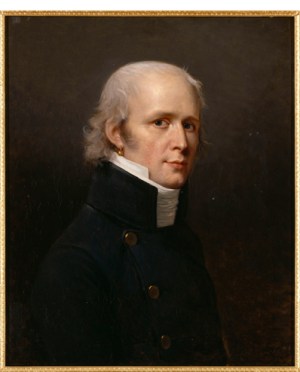
Robert Lefèvre, Portrait of Charles Percier, 1807, oil on canvas (Chateaux de Versailles et de Trianon, Versailles; photo by Gerard Blot).
Charles Percier: Architecture and Design in an Age of Revolutions will be the first large-scale exhibition to survey the magnificent range of projects undertaken by the French architect and designer from the end of the eighteenth to the beginning of the nineteenth century. Jean-Philippe Garric, professor of the history of architecture at the University of Paris I, Panthéon- Sorbonne, is the curator.
Although largely remembered for his close collaboration with Pierre François Léonard Fontaine (1762–1853)—together they defined the Empire style and created the decorative program of Napoleon’s reign—Charles Percier’s (1764–1838) artistic style was unique, complex, and ever-evolving. From the last years of the ancien régime, when Percier was a promising student—first at the Académie royale d’architecture in Paris and then at the French Academy in Rome, where he concentrated on graphic work—his commissions for public and private clients significantly influenced decorative arts and architecture during an extremely turbulent and rapidly changing period in French history.
Charles Percier: Architecture and Design in an Age of Revolutions breaks with the tradition of considering Percier and Fontaine together. This choice, shaped by the discovery of new documents relating to the production of the two partners, allows a better understanding of Percier’s multifaceted artistic practice. The exhibition will feature more than 130 art works from principal museums and cultural institutions in France and the United States, as well as key objects from private collections, including his designs for furniture, porcelain, metalwork, and the renovation of the rue de Rivoli—the construction of which transformed the center of Paris. Rare drawings and spectacular examples of early nineteenth-century cabinets, candelabras, and tureens will also be displayed. By focusing on his most famous and seminal works, such as sketches for the arc du Carrousel, the interior designs for Josephine Bonaparte’s rooms in the Tuileries Palace, and the magnificent books dedicated to Roman palaces and interior decoration, the exhibition will demonstrate the diverse and extraordinary creations of an artist whose work brilliantly bridged ancien régime court culture and the industrial production of the nineteenth and early twentieth centuries.
Organized by Bard Graduate Center Gallery, New York, in association with the château de Fontainebleau and the Réunion des musées nationaux-Grand Palais, Paris. Following its presentation at Bard Graduate Center Gallery, Charles Percier: Architecture and Design in an Age of Revolutions will be on view at château de Fontainebleau from March 18, 2017 to June 19, 2017.
Background
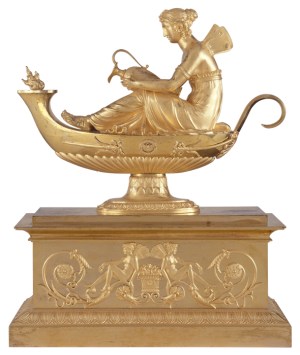
Pierre Phillippe Thomire after design by Charles Percier, Andiron with Psyche, 1809, chased and gilt bronze (Château de Fontainebleau, inv. F 943 C)
With thousands of drawings in public and private collections, several architectural and urban interventions of prime importance in the heart of Paris, numerous furniture and interior designs commissioned by prestigious patrons, publications that left their mark on several generations of architects and decorators, and, among his students, sixteen Prix de Rome winners and seven members of the Institut de France, the genius of Charles Percier was evident to his contemporaries. While his importance has been acknowledged by most historians of art, architecture, and decorative arts, no exhibition or book has yet attempted an overview of his production as a whole. This is not merely an injustice to him given his central role in the arts at a time of transition between the ancien régime and the modern period and his proximity to those in power under Napoleon, it has compromised our understanding of the architecture and decorative arts produced during this time, not just in France but throughout Europe.
While there are many surviving graphic documents and other works by Percier, there is no Percier archive. The principal sources—Fontaine’s journal and memoirs, the former written for posterity and the latter for his grandchildren—purport to be accurate, but often overlook entire aspects of his career. Fontaine failed to mention all of the projects undertaken by Percier alone. As a result, this exhibition, by concentrating on Percier, offers a biographical synthesis of his career that focuses on specific projects, whether realized, published, or drawn.
Percier and His Circles
Charles Percier owed a great deal to the academic world, and he gave a great deal back to it. After studying drawing at an exemplary philanthropic institution of the last years of the ancien régime, the École gratuite de dessin (Free Drawing School), he was a model student at the Académie royale d’architecture (Royal Academy of Architecture) and then, after winning the prestigious Prix de Rome in 1786, an enthusiastic pensioner (fellow) at the Académie royale d’architecture. He began teaching students of his own in 1791—almost immediately after returning to Paris from Italy—and gradually became one of the most important French architecture professors of the first third of the nineteenth century, entering the Institut de France in 1811. Percier lived alone but often worked with others—Pierre Fontaine, the most important of these, was by no means the only one—and befriended many of his fellow Rome pensioners as he would later do with several of his students, many of whom collaborated with him. His circle included fellow École gratuite de dessin pupils such as Anne Louis Girodet-Trioson (1767–1824); his teacher Antoine François Peyre (1739–1823); fellow Rome pensioners, most notably Jean German Drouais (1763–1788); architects and painters including François Gérard (1770–1837); and several generations of students who engaged in com- mon projects and socialized, both casually and within more structured frameworks such as the dinners of the society of artists known as the Duodi.
This theme presents Percier’s various academic projects, including his Grand Prix winning architectural design, sketches he made in Rome, his graphic reconstruction of Trajan’s Column, as well as portraits of and work by his students.
Between Italy and France
Percier’s Italian sojourn (1786–91) had a profound effect on him. Like many fellowship students at the French Academy in Rome, his stay there was characterized by enthusiasm and wonder, but, more than any other, he made this experience a key moment in his emotional, artistic, and intellectual life. A relentless campaign of measuring and drawing made it possible for him to gather material for two volumes of engravings that were to have considerable influence on his con- temporaries and later designers. For the rest of his life, he remained a fervent admirer of Italian antiquity and Renaissance art and architecture, and planned a second trip to Italy that never happened.
Despite his ardent Italophilia, Charles Percier was not indifferent to French architecture, especially that of the French Renaissance, and he admired the decorative and sculptural production of Jean Goujon (active 1540–65) and Pierre Lescot (ca. 1515–1578). Consistent with his admiration of Italian architecture, he carefully studied the château de Fontainebleau through hundreds of drawings. He also collaborated with art historian Alexandre Lenoir (1761–1839) on the installation and graphic reproduction of works in the Musée des monuments français, a museum dedicated to French architectural heritage, which Lenoir opened in 1795.
This theme evokes the artistic context of Percier’s Italian sojourn through drawings from his stay at the French Academy in Rome, a volume on Roman palaces and villas, and sketches. It also examines his involvement with the Musée des monuments français.
A Graphic Artist
Apart from a few letters, Percier left behind almost no writings. From the several thousand carefully organized drawings he bequeathed, it is apparent, even during his early training at the École gratuite de dessin, that his skill as a draftsman enabled him to stand out, consolidate his position, and prevail over his contemporaries. His line is fine and precise, and he was less interested in the art of perspective than in delineation and linear agility. His mastery of outline and contour coupled with his passion for abundant ornament were the very heart of his creative work. This ability, cemented by his prolonged study of the bas-reliefs of Trajan’s Column, enabled him to stand out as the illustrator, graphic designer, and decorator of his own publications and other prestigious editions, as well as of luxury objects.
Percier’s most remarkable achievements, given that he’s an architect, are his drawings for the editions of Horace and the Fables of La Fontaine published by Didot. –Alexandre Lenoir, 1805
This theme emphasizes Percier’s graphic work, considered both as an independent artistic domain and as the unifying thread between Percier’s other creative projects. Exquisite drawings from the Louvre, luxury books, including a commemorative book for Napoleon’s coronation, prints, and even a fan for Josephine will be on view.
The Recueil de décorations intérieures

Charles Percier, Clock, by Sèvres Porcelain Manufactory, 1813, bisque porcelain, gold highlights (Sèvres, Cité de la céramique, MNC 13022).
Percier’s production in the realm of interior decoration and furniture design was considerable. Not only was he called upon to design a great many interiors, furnishings, and objects—from his first commissions for the National Convention in 1793 to the carriage for the coronation of Charles X—his major works were much publicized by the Recueil de décorations intérieures (1801–12). This collection of 72 plates of furniture and interior designs was one of the most important and influential ornament books in France and indeed in Europe of the time. It established an international neoclassical taste and became a model for commercial catalogues of ornaments, unwittingly inaugurating an era of industrial arts production. The Recueil was a major source of inspiration for generations of decorators and designers. It ensured Percier’s legacy while simultaneously linking it inextricably to that of Fontaine.
Percier, whose temperament and taste, indeed his gifts, were ill-suited to the trouble and demands of business, left all practical matters to me. I handled the correspondence as well as the accounts, and he focused almost exclusively on study drawings and graphic compositions. –Pierre Fontaine, 1804
As Fontaine acknowledged himself, the Recueil was Percier’s masterwork. Percier drew and engraved the plates largely on his own, despite including both of their signatures. ‘Percier and Fontaine’ is thus perhaps more akin to a luxury brand than an indication of shared artistic paternity. Separating Percier from Fontaine, this exhibition restores Percier’s role and singular contribution to the decorative arts as an expert draftsman and designer.
But the contributions Charles Percier made to the realms of furniture and interior decoration do not all fall within the chronological parameters of the Recueil de decorations intérieures, nor are they limited to the ensembles and objects represented there. His work for artisanal firms like Jacob frères and that of Martin Guillaume Biennais and his designs for manufactories like Sèvres were the point of departure for national and international diffusion of the style Percier. This diffusion ran parallel to the gradual industrialization of the arts, as well as a certain democratization of access to luxury objects.
This theme first focuses on the Recueil de décorations intérieures, juxtaposing rare hand-colored prints from the publication with corresponding drawings, furniture, and objects. It will include extraordinary pieces made for Napoleon, Josephine, and members of the imperial circle from the collections of Versailles, Fontainebleau, and the Elysée Palace. It also demonstrates the dissemination of Percier’s style and its vulgarization, as well as Percier’s continued artistic development after 1815.
The Louvre, the Tuileries and the rue de Rivoli
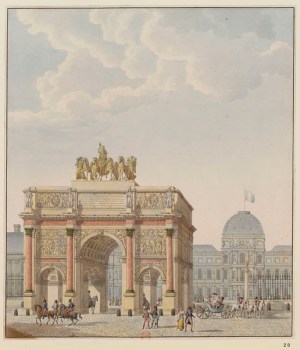
Charles Percier and Pierre Fontaine, Arc du Carrousel, south side view, 1806–15, watercolor and pen (Paris: Bibliothèque nationale de France, département Estampes et photographie, RESERVE FOL-VE-53 C).
At the beginning of the nineteenth century Napoleon engaged Percier and Fontaine to execute one of the most ambitious projects of his reign and of their careers—linking the Louvre and Tuileries palaces. This large-scale enterprise had three principal ambitions. The first and oldest one was to connect the Louvre with the Tuileries, thereby creating a palace of unmatched magnitude. As heir to the Revolution, Napoleon could not reside at Versailles, and he wanted to complete a project that a century of royal rule had been unable to bring to fruition. The Tuileries became the principal imperial residence, with all its practical and symbolic consequences. The second ambition was to transform the surrounding city. Given their dimensions and location, connecting the Louvre with the Tuileries meant recasting the center of Paris. From this perspective, the operation constitutes a link between the great urban embellishment projects of the eighteenth century and the transformations of the Second Empire. Finally, the third ambition, doubtless the most contemporary, was cultural in nature: to complete and restore buildings considered jewels of French architectural patrimony as well as to create, within the Louvre, the world’s largest museum.
This theme presents Percier and Fontaine’s designs for the Louvre and the Tuileries, from an urban scale to the arrangement of interiors and decoration. It will also include their designs for the renovation of the arcades on the nearby rue de Rivoli.
Paper Architecture
Much of the architecture Charles Percier designed with Pierre Fontaine was never built. Paper architecture, or plans for unrealized structures, was the reality for architects during this era of political turmoil. In fact, paper architecture became a practice in itself at the Académie royale d’architecture when Percier was a student there during the late eighteenth century. Economic crises in the 1780s resulted in a lack of architectural commissions and architects like Percier began defining themselves as artists who produced beautiful drawings of hypothetical structures, rather than builders.
When Percier left Paris for Rome, he was still training to be a court architect. By the time he returned in the midst of the French Revolution, the world he knew was shattered. Percier’s talent for drawing enabled him to be flexible and versatile in seeking other forms of work. Besides book illustration, in the 1790s, Percier and Fontaine served as co-directors of set design at the Paris Opera, where they created spectacular yet ephemeral scenery for the stage.
Despite being swept into Napoleon’s extravagant ambitions, including his plans for a Palace of the King of Rome, Percier and Fontaine managed to build only a small number of important structures. Their contributions to the staging of Napoleonic power, notably the emperor’s coronation and his marriage to Marie-Louise, represent a significant portion of their realized work. The fact that they produced more ephemeral projects and—especially—designs for buildings that were never constructed resulted in a corpus of works on paper that reveal the richness and diversity of their imaginations. This final theme presents architectural drawings, water- colors, commemorative volumes, and objects, related to Napoleonic ceremonies and commissions, as well as opera sets designed by both Percier and Fontaine.
◊ ◊ ◊ ◊ ◊
Symposium | Percier: Antiquity and Empire
Bard Graduate Center, New York, 18 November 2016
Taking place on Friday afternoon, 18 November 2016, the symposium will feature speakers including Jean-Philippe Garric, Ulrich Leben, Iris Moon, Darius Spieth, and more. RSVP is required. Please click on the registration link here or email public.programs@bgc.bard.edu.
◊ ◊ ◊ ◊ ◊
From Yale UP:
Jean-Philippe Garric, ed., Charles Percier: Architecture and Design in an Age of Revolutions (New Haven: Yale University Press, with Bard Graduate Center, 2017), 304 pages, ISBN: 978-0300221589, $75.
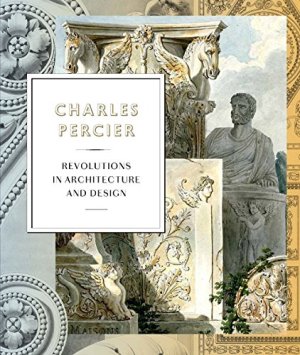 Handsomely designed and richly illustrated, this publication surveys the magnificent spectrum of projects undertaken by French architect and interior designer Charles Percier (1764–1838). After gaining an illustrious reputation for supervising the scenery at the Paris Opéra during the French Revolution, Percier was later appointed by Napoleon Bonaparte. With the Emperor’s support, he developed the opulent versions of neoclassicism closely associated with the Napoleonic era, and now known as Directoire style and Empire style. Percier worked on the renovation or redecoration of many of France’s royal palaces, including the Louvre, the Tuileries, and the chateaux of Malmaison, Saint-Cloud, and Fontainebleau. The full scope and variety of Percier’s design projects are revealed in this book, which also includes archival material detailing Percier’s relationships with patrons and peers.
Jean-Philippe Garric is professor of architecture at the University of Paris I, Panthéon Sorbonne.
◊ ◊ ◊ ◊ ◊
Note (added 28 November 2016) — The symposium included the following presentations:
• Jean-Philippe Garric (Professor, History of Architecture, University of Paris I, Panthéon-Sorbonne and curator of the exhibition Charles Percier: Architecture and Design in an Age of Revolutions), Charles Percier: Beyond the Antique Model
• Iris Moon (Visiting Assistant Professor, School of Architecture, Pratt Institute), New Heads for Old Bodies: Percier’s Designs for the French Revolution
• Ulrich Leben (Research Scholar and Visiting Professor, Bard Graduate Center), Charles Percier’s Vision of Antiquity
• Darius Spieth (Professor, Art History, Louisiana State University), Percier and Piranesi
• Jean-François Bédard (Associate Professor, School of Architecture, Syracuse University), Franks, Not Romans: Medieval Imagery and the Making of Imperial France
Conference | Synagogue and Museum
From the Society of Architectural Historians:
Synagogue and Museum: 3rd International Congress on Jewish Architecture
Technische Universität Braunschweig, 21–23 November 2016
Organized by the Bet Tfila – Research Unit for Jewish Architecture (Technische Universität Braunschweig/ Center for Jewish Art at the Hebrew University of Jerusalem) and Hochschule für jüdische Studien Heidelberg, in cooperation with the Braunschweigisches Landesmuseum, Braunschweig, and the Israel Jacobson Netzwerk für jüdische Kultur und Geschichte e.V.
Since antiquity and especially since the destruction of the Jerusalem Temple in the year 70 CE, synagogues have become the central places of gathering of Jewish communities. They are complex, highly significant and polyvalent objects of for religious, social, economic, architectural, and artistic developments in Jewish culture. At the same time, they reflect the interdependencies with the surrounding cultures. Since the holocaust, historic synagogues also gained high importance as focal points of remembrance and education.
However, scholars were interested in the material culture(s) of Jews all over the world well before the holocaust and turned synagogues and their furnishings into a focus of their research. The documentation of synagogues as objects of cultural and historical significance started alongside with the establishment of Jewish ethnography (jüdische Volkskunde) as an academic discipline at the end of the 19th century. They became items of collecting, which were set up in exhibitions and museums. Objects from the religious and cultural practice got ‘musealised’, as well as entire synagogue furnishings and sometimes even architectural elements. After 1945, the interest in synagogues as objects of cultural history continued. Besides ritual objects and furnishings, the ’empty’ buildings of the annihilated communities became objects of interest. Historic synagogue buildings were regarded as museums, their material substance was and is restored and interpreted in different ways. The virtual and haptic reconstruction of destroyed synagogues generated another group of ‘immaterial’ exhibits.
The congress will examine the subject in a wide range of perspectives of theoretical and historical reflections. Historic and actual examples of documenting, collecting, and researching synagogues and their furnishing will shed light on the history, the presence, and the future of synagogues in and as museums.
For registration and any questions, please, contact us by email, synagogen@tu-bs.de; registration should be done by 7 November 2016. A congress fee of 50€ is payable directly at the registration desk; it includes coffee breaks and refreshments, the visit of the Braunschweigisches Landesmuseum Hinter Aegidien, and the evening events on Tuesday, 22 November.
◊ ◊ ◊ ◊ ◊
M O N D A Y , 2 1 N O V E M B E R 2 0 1 6
13:00 Opening Session
• Welcome from Alexander von Kienlin (Braunschweig)
• Greetings, Jürgen Hesselbach (President of the TU Braunschweig), Johannes Heil (Rektor of the Hochschule für Jüdische Studien Heidelberg), Heike Pöppelmann (Braunschweigisches Landesmuseum), Aliza Cohen-Mushlin (Center for Jewish Art, Jerusalem), and Jochen Litterst (Braunschweig)
• Keynote address by Annette Weber (Heidelberg)
• Introduction, Ulrich Knufinke (Braunschweig)
14:30 Coffee break
15:00 Panel 1 | Displaying Synagogues: A History of Transfers and Transformations
Chair: Barbara Kirshenblatt-Gimblett (New York)
• Sabine Offe (Bremen), Synagogues as Traces
• Ilia Rodov (Bar Ilan), Synagogue as Museum: Ritual and Exposition
• Naomi Simhony (Jerusalem), Synagogue Exhibitions in National Museums in the State of Israel
16:45 Panel 2 | Synagogues as Sources for Research and Education
Chair: Jutta Dick (Halberstadt)
• Mirko Przystawik (Braunschweig), The Hornburg Synagogue and Its Furnishing
• Renato Athias (Pernambuco/Brazil), Memory and Architectural Preservation of the First Synagogue in the Americas
• Marc Grellert (Darmstadt), Synagogues Destroyed in Germany: 20 Years of Virtual Reconstructions in Museums
T U E S D A Y , 2 2 N O V E M B E R 2 0 1 6
9:00 Panel 3 | Collecting Contexts: Objects From Synagogues in Jewish and Non-Jewish Collections
Chair: Chana C. Schütz (Berlin)
• Felicitas Heimann-Jelinek (Wien), The Judaica-Collection at the Braunschweigisches Landesmuseum and its Presentation(s)
• Sergey Kravtsov (Jerusalem), The Jewish Museum in Lviv: Genius Loci and Realpolitik
• Miranda Crowdus (Hannover), Synagogue Music-Objects as Metonyms: Ethics and Dissonances in the Material Representation/Display of Jewish Practice
10:30 Coffee break
11:00 Panel 4 | Objects and Sites of Jewish Material Culture
Chair: Alexander von Kienlin (Braunschweig)
• Svetlana Tarkhanova (Moscow), The Chorazin Synagogue (4th–6th centuries) at the Archaeological Site and in the Museum Space
• Askold Ivantchik (Bordeaux), Archeological and Epigraphical Traces of an Early Diaspora Community in Tanais, Russia
• Hans-Christof Haas (Bamberg), The Sukkah of Mendel Rosenbaum in Zell /Lower Franconia: Tradition – Research – Presentation
12:30 Lunch break
13:30 Poster presentation
14:15 Panel 5 | Synagoguges as Museums: New Concepts of Display and Education
Chair: Samuel Gruber (Syracuse NY)
• Ron Epstein (Zurich), Re-Used Synagogues in Switzerland
• Martha Keil (St. Pölten/Wien), ‘Who is in need of a Judentempel?’ The Former Synagogue of St. Pölten (Lower Austria) and Its Cultural Location
• Barbara Kirshenblatt-Gimblett (New York), The Example of the Wooden Synagogue in the Polin-Museum, Warsaw
16:30 Visit of the Jüdisches Museum des Braunschweigischen Landesmuseums
18:00 Reception by the Lord Mayor of the City of Braunschweig, Altstadtrathaus
19:00 Public Lecture
Ismar Schorsch (New York), Leopold Zunz und die Wissenschaft des Judentums
W E D N E S D A Y , 2 3 N O V E M B E R 2 0 1 6
9:00 Panel 6 | Reconstruction, Re-contextualization: Synagogue-Museums and Their
Environments
Chair: Rudolf Klein (Budapest)
• Anselm Hartinger (Erfurt), The Museum Old Synagogue
• Gabi Rudolf M.A. (Würzburg), Synagogue Arnstein: Visual Fragment of an Invisible History
• Givi Gambashidze, Tbilisi), Museum as a Space of Peace
10:30 Coffee break
11:00 Panel 7 | The Future of Synagogues in/ as Museums
Chair: Vladimir Levin (Jerusalem)
• Eszter Gantner (Marburg), Synagogue as Space of Conflicts: The Formal Synagogue of Esztergom, Hungary
• Heike Pöppelmann and Hans Jürgen Derda (Braunschweig), The Museum of Religions in the Braunschweigisches Landesmuseum
• Benigna Schönhagen (Augsburg), The Example of Augsburg
• Christiane Twiehaus and Sebastian Ristow (Cologne), The Findings, Reconstruction, and Museum Presentation of the Cologne Medieval Synagogue and the Jewish Quarter
12:30 Final discussion
Conference | Celebrating Scott’s ‘The Antiquary’
From Eventbrite:
Romantic Antiquarianism: A Conference Celebrating Scott’s The Antiquary
The Georgian Group, 6 Fitzroy Square, London, 26 November 2016
Co-organised by Fiona Robertson and Peter Lindfield
This one-day conference in the heart of London celebrates the bicentenary of the publication of Sir Walter Scott’s novel The Antiquary by looking at the multi-faceted nature of antiquarianism in Georgian Britain. Leading scholars from across the UK gather to present new and engaging material on the topic. Registration (£30) includes teas/coffees and lunch in one of Robert Adam’s town houses. Register online here.
◊ ◊ ◊ ◊ ◊
P R O G R A M M E
9.30 Registration and Introductions: Peter N. Lindfield (University of Stirling) and Fiona Robertson (University of Durham)
10.00 Plenary 1 (Chair: Fiona Robertson)
• Nicola J. Watson (Open University): ‘The Antiquary, the Discomforts of Antiquarianism, and the Ambitions of Abbotsford’
11.00 Morning Panel (Chair: Peter N. Lindfield)
• Rosemary Sweet (University of Leicester): ‘Antiquaries and the Antiquities of Everyday Life’
• Kelsey Williams (University of Stirling): ‘Antiquarianism and The Antiquary’
• Frances Sands (Sir John Soane Museum): ‘Robert Adam as Antiquarian Architect’
12.15 Lunch
1.15 Plenary 2 (Chair: Peter N. Lindfield)
• Christopher Woodward: ‘Ruins, Rescue and Antiquarianism in the Eighteenth-Century Imagination’
2.15 Afternoon Panel (Chair: Fiona Robertson)
• Catherine Jones (University of Aberdeen): ‘Mapping Antiquarianism’
• Peter N. Lindfield (University of Stirling): ‘Antiquarian Identities and Thomas Barritt’s Assumed Persona’
• Andrew Teverson (Kingston University): ‘Nicht Nought Nothing & Rashin Coatie: Andrew Lang’s Border Tales and the Influence of Walter Scott’
Conference | Architect-Designed Objects, 1650–1950
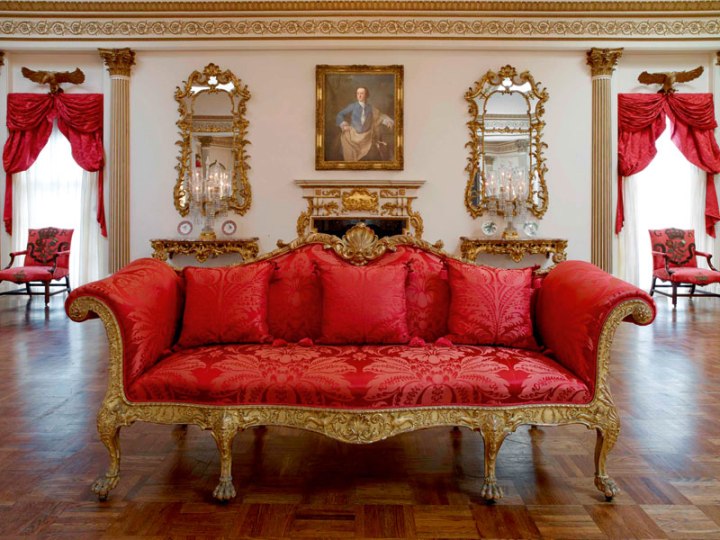
Designed by Robert Adam, made by Thomas Chippendale, The Dundas Sofa, commissioned 1764, made 1765, gilt pine and beech, with later silk upholstery (Museum of Fine Arts, Houston)
◊ ◊ ◊ ◊ ◊
From the MFAH:
A Sense of Proportion: Architect-Designed Objects, 1650–1950
Museum of Fine Arts, Houston, 24 September 2016
Rienzi, the MFAH house museum for European decorative arts, presents its biennial symposium. This edition focuses on objects that are the embodiments or extensions of an architect’s ideas or aesthetic. Scholars discuss objects made for particular spaces, objects used to explore new design sources, and objects intended to be part of an integrated space.
The keynote address will presented by Adriano Aymonino, coordinator of undergraduate programs, department of art history, University of Buckingham. Dr. Aymonino’s main academic interest is the reception of the classical tradition in the Early Modern period, with a particular focus on Britain. He is working on a revised edition of Francis Haskell and Nicholas Penny’s Taste and the Antique and on a project tracing the impact of antiquarian publications on 17th- and 18th-century European art and architecture. Aymonino obtained his PhD at the University of Venice and has held postdoctoral fellowships at the Paul Mellon Centre for Studies in British Art and at the Getty Research Institute.
Ticket information is available here»
◊ ◊ ◊ ◊ ◊
10:00 Welcome by Christine Gervais (director, Rienzi; curator, decorative art)
10:15 Keynote Address
• Robert Adam (1728–1792) and the Sources of the ‘True Style of Antique Decoration’, Adriano Aymonino (University of Buckingham)
11:30 Coffee Break
12:00 Session A
• Baroque Furnishings: Aesthetics and Design in Giacomo Amato’s Graphic Oeuvre (1643–1732), Sabina de Cavi, professor (University of Córdoba)
• Marvelous Volumes: Artistry of the 18th-Century British Designer’s Manuscript, Elizabeth Deans (assistant director, Smithsonian-George Mason University)
12:45 Lunch Break
1:50 Session B
• Jean-Démosthène Dugourc’s 1787 Model for a Jewel Cabinet and the Stakes of Royal Furniture Design in Pre-Revolutionary France, Iris Moon (visiting assistant professor, Pratt Institute)
• The Furniture Design Legacy of Karl Friedrich Schinkel, Serena Newmark (doctoral student and English-language children’s programs assistant, Museum August Kestner)
2:35 Coffee Break
3:05 Session C
• The Quality of Calmness and Clarity: Heinrich Tessenow’s Search for Objectivity in the Design of Furniture and Household Goods, Jurjen Zeinstra (doctoral student and associate professor, University of Technology)
• Transitional Moments: Architectural Hardware, Marcel Breuer, and the Bauhaus in America, Robert Wiesenberger (doctoral student and curatorial fellow, Harvard Art Museums)
Conference | European Portrait Miniatures
From the conference flyer:
European Portrait Miniatures: Artists, Functions, and Collections
The Tansey Miniatures Foundation, Bomann-Museum, Celle, 11–13 November 2016
 The conference is being held on the occasion of the opening of the sixth exhibition of the Tansey Miniatures Foundation and the publication of the accompanying catalogue Miniatures from the Baroque Period in the Tansey Collection.
Both conference venues are within walking distance (20 minutes) from the railway station. Trains from Hannover take approximately 25 to 45 minutes (Deutsche Bahn, Metronom, and S-Bahn).
For registration, please contact Juliane Schmieglitz-Otten, Head of the Residence Museum at Celle Castle, juliane.schmieglitz-otten@tansey-miniatures.com. For more information, please contact Bernd Pappe, Art Historian and Restorer, bernd.pappe@tansey-miniatures.com. Conception IT Coordination by Birgitt Schmedding, Photo Designer, birgitt.schmedding@tansey-miniatures.com.
◊ ◊ ◊ ◊ ◊
F R I D A Y , 1 1 N O V E M B E R 2 0 1 6
15:00 Registration
16:30 Welcome and opening of the exhibition Miniatures from the Baroque Period in the Tansey Collection
S A T U R D A Y , 1 2 N O V E M B E R 2 0 1 6
9:00 Objects, Agencies, and Social Practices
• Ulrike Kern (Frankfurt), The Limner’s Language: Words and Concepts Related to Miniature Painting in England
• Miranda L. Elston (Chapel Hill, North Carolina), Hilliard’s Miniatures: Enacted Desire within the Elizabethan Court
• Eloise Owens (New York), The Hand behind the Likeness: Women’s Practice as Portrait Miniaturists in Eighteenth-Century England
• Christoph Großpietsch (Salzburg), Portrait Miniatures of Mozart: Problems of Authenticity
• Violaine Joëssel (Geneva), A Quest for Legitimacy: The Practice of Miniature Painting in Colonial America
• Dimitri Gorchko (Moscow), ‘… et que tout ait un nom nouveau’: Portrait Miniatures of Napoleon’s Marshals, Generals, and Colonels: Analysis and Identification
13:00 Lunch
14:15 Politics and Representation
• Delia Schffer (Kassel), Power through Relations: Duke Louis of Württemberg‘s Family Ties in a Series of Miniature Portraits
• Sarah Grandin (Paris), Density in the ‘Boîte à Portrait’ under Louis XIV
• Stefanie Linsboth (Vienna), From Large-Scale Paintings to Precious Miniatures: Maria Theresa’s Portrait Miniatures
• Karin Schrader (Bad Nauheim), ‘Taking the Veil’: Miniatures of Royal Widows from the Sixteenth to the Nineteenth Centuries
16:30 Coffee
17:00 Special Techniques and Materials
• Tatjana Wischniowski (Dresden), Oil-Based Paint under a Layer of Water: Arnaud Vincent de Montpetit’s ‘Eludoric Painting’, a Rare Miniature Painting Technique
• Emma Rutherford, Alan Derbyshire, and Victoria Button (London), The Drawings of John Smart (1742–1811): Function, Purpose, and Line
S U N D A Y , 1 3 N O V E M B E R 2 0 1 6
9:00 Miniature Collections
• Lucy Davis (London), Famous Women in the Miniatures at The Wallace Collection
• Catherine Hess (San Marino, California), Up Close and Personal: Portrait Miniatures at The Huntington Art Collections
• Isabel M. Rodríguez-Marco (Madrid), The Collection of Portrait Miniatures and Small Portraits in the Museo Nacional de Artes Decorativas, Madrid
• Paul Caffrey (Dublin), European Enamels from the National Gallery of Ireland Collection
• Wladyslaw Maximowicz (Bergamo), The Portrait Miniature in Russian Provincial Collections
• Reetta Kuojärvi-Närhi (Helsinki), Small Treasures in Finland: Paul Sinebrycho as a Miniature Collector
13:00 Lunch
14:15 Miniature Painters
• Halgard Kuhn (Hannover), Peter Boy (c. 1650–1727): Medallions and Miniatures by the Frankfurt Baroque Goldsmith and Enamel Painter as Integrating Parts in Golden Jewellery
• Karen Hearn (London), The ‘Small Oil Colour Pictures’ of Cornelius Johnson (1593–1661)
• Marco Pupillo (Rome), Francesco Antonio Teriggi, a Miniaturist in the Service of Joseph Bonaparte
• Roger and Carmela Arturi Phillips (Ringwood), The True and Flawed Genius of John Engleheart
• Stephen Lloyd (Liverpool), Copying Portraits in Miniature in Regency England: The Work of William Derby (1786–1847) for the 13th Earl of Derby at Knowsley Hall
◊ ◊ ◊ ◊ ◊
The exhibition catalogue is distributed in North America and Japan by The University of Chicago Press (with information on the other five volumes published thus far from The Tansey Foundation). . .
Bernd Pappe and Juliane Schmieglitz-Otten, eds., Miniatures from the Baroque Period in the Tansey Collection / Miniaturen des Barock aus der Sammlung Tansey (Munich: Hirmer Publishers, 2016), 400 pages, ISBN: 978-3777426389, $64.
The Tansey miniatures, now held by the Bomann Museum in Celle, represent one of the most significant collections of European miniature paintings. This volume is the sixth in a series exploring the collection in key periods. Each volume presents new photographic reproductions of the miniatures at actual size and with close-up photographs that show important details. This volume covers portrait miniatures created throughout the Baroque period of the seventeenth-century, with more than one hundred representative works. Essays by specialists in the field offer insights into the artworks, their patrons, and the period. The resulting book is as informative as it is beautiful, a stunning testament to a bygone age and a once-popular form.
Conference | The Art Market, Collectors, and Agents
The first installment of the conference took place in July at the Warburg Institute in London. For the two days in Paris, I’ve included only the sessions most relevant to the eighteenth century. The full schedule is available from H-ArtHist:
The Art Market, Collectors, and Agents: Then and Now
Institut national d’histoire de l’art, Paris, 20–21 October 2016
The focus of the conference is to explore the changing and complex nature of the role of agent in the art market during the Early Modern Period. Papers will explore shifts in the dynamics of the market, the changing taste of collectors and the importance of writers, critics, museum curators and dealers in influencing these changes. The papers demonstrate how examining the role of agents through their correspondence with clients, day books or private records, bring new insights into the workings of the art world through the detailed evidence of how transactions were negotiated.
We would like to thank the speakers’ institutions and the Institut d’Etudes Supérieres des Arts for supporting the conference. The conference is free but to register for the lunches (20€ per day), please email a.turpin@iesa.edu.
Organised by the Collecting and Display Seminar Group London with the Centre André Chastel, INHA, Paris.
• Tamsin Foulkes (PhD Candidate, University of Nottingham), James Thornhill as an Agent-Collector in Early Eighteenth-Century Paris
• Corina Meyer (Institute of Art History, University of Stuttgart), ‘To See Once Again the Glorious Picture by Moretto before It Is Forever Lost for Rome’: Johann David Passavant’s (1787–1861) Recommendations and Selection of Paintings
• Tina Kosak (France Stele Institute of Art History, ZRC SAZU Ljubljana), Conquering New Art Markets: International Art Dealers and Local ‘Agents’ in Inner Austria in the Second Half of the Seventeenth Century
• Laura Popoviciu (PhD Candidate, Warburg Institute), Shaping the Taste of British Diplomats in Eighteenth-Century Venice
• Renata Schellenberg (Mount Allison University, Sackville, Canada), Commerce, Culture, and Connoisseurship: The Emergence of the Art Dealer in Eighteenth-Century Germany










leave a comment